Even if you’re not sure why you’re looking…
…thanks for looking

—

—

Even if you’re not sure why you’re looking…
…thanks for looking
—
—
‘ America is a young country with an old mentality.’
‘Detroit Nocturne‘ found here. Via Mick Hartley.
I’m partial to ‘Joey’s Meatcutter Inn, Bar & Grill 2017‘:
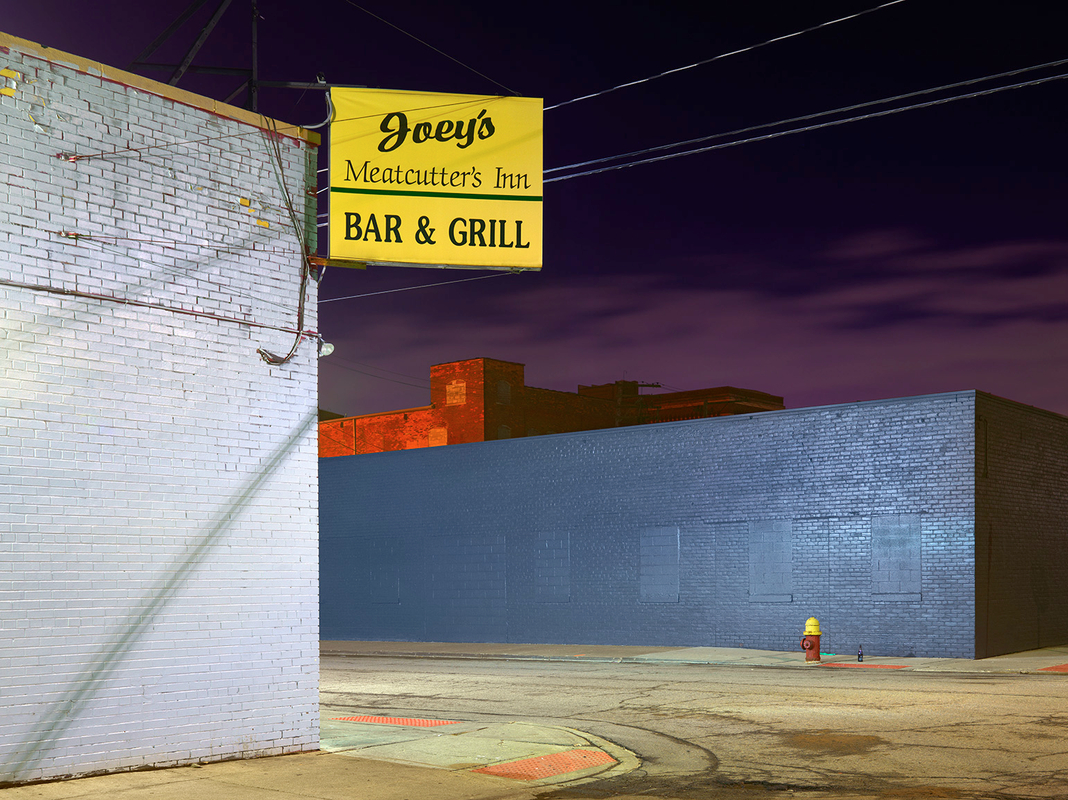
Immediately, I think of Edward Hopper: The lonely cityscape at night or the familiar glow of gas station lights cast into the American wilderness. The eye might want to linger among the colors, shapes and clouds even though the mind knows this is pretty much an empty street in a ‘post-industrial’ zone.
Perhaps it has do with another strand of expression: The break into free verse from past forms. The move from American Romanticism to Modernism which occurred this early past century. William Carlos Williams produced many good poems from a process of earnest, scrapbook-style intensity in trying to discover, redefine, and order a new poetic form within a modern ‘urban landscape.’
The individual artist is quite alone in the task he’s set before himself, and like much of modernism, it’s a rather big task.
Pastoral
When I was younger
it was plain to me
I must make something of myself.
Older now
I walk back streets
admiring the houses
of the very poor:
roof out of line with sides
the yards cluttered
with old chicken wire, ashes,
furniture gone wrong;
the fences and outhouses
built of barrel staves
and parts of boxes, all,
if I am fortunate,
smeared a bluish green
that properly weathered
pleases me best of all colors.
No one
will believe this
of vast import to the nation
Do you believe any of that to be of vast import to the nation? Are you no one?
Another one of Jordano’s photos which stuck out was: ‘Church Rectory With Lightning, Eastside, Detroit, 2016

Perhaps I’m not wrong in having called Halloween horror stills and movie images to mind (it’s my mind, after all, so maybe I’m just thinking of Devil’s Night). I really enjoy the light on the dumpster and the side-front rectory wall. There seems to be a little more mood here, more drama, so maybe Edgar Allan Poe’s ‘psychological intensity,’ his surrealism, and terror are more appropriate for comparison.
Poe was a bit mad, after all, despite his fascinatingly untamed and powerful imagination. He achieved a uniqueness and completeness of vision few artists do. Maybe there’s a bit of the sullen, self-aggrandizing earnestness in him of the teenager (J.D. Salinger); the desire to shock, delight and terrify.
The mind is as though a chamber, the horror rises to fever pitch, the lush rhyme matches an increasingly desperate search for truth and beauty in the world (Poe had very much his own Romantically inspired metaphysics).
Alone
From childhood’s hour I have not been
As others were—I have not seen
As others saw—I could not bring
My passions from a common spring—
From the same source I have not taken
My sorrow—I could not awaken
My heart to joy at the same tone—
And all I lov’d—I lov’d alone—
Then—in my childhood—in the dawn
Of a most stormy life—was drawn
From ev’ry depth of good and ill
The mystery which binds me still—
From the torrent, or the fountain—
From the red cliff of the mountain—
From the sun that ’round me roll’d
In its autumn tint of gold—
From the lightning in the sky
As it pass’d me flying by—
From the thunder, and the storm—
And the cloud that took the form
(When the rest of Heaven was blue)
Of a demon in my view—
Nice photos, Dave. Thank you.
As previously posted:
Via Curbed Detroit. (via David Thompson)
70 photos of the abandoned, foreboding Temple. Mysterious symbols and a certain sad grandeur that’s come to represent Detroit these days.
-Photographer Ben Marcin has a series called ‘Last House Standing.’ Solitary row-homes…the only ones left on the block.
From Buzzfeed: ‘Why I Bought A House in Detroit For $500:’
How did Detroit get here? Very comprehensive and easy to navigate.
More from Megan McArdle on the behavior that comes with pension bonuses.Charlie LeDuff, Detroit’s populist, citizen journalist’s youtube channel here. At least he’s sticking around.
Are you looking at beautiful photos and feeling sorry for Detroit, and yourself? See Time Magazine’s photo essay by Yves Marchand and Romain Meffre (less porn-like, more thoughtful).
Hipster hope, artists, collectivists and small business types can’t save it either: A Short Culture Wars Essay-Two Links On Detroit & ‘Ruin Porn’
GM is not a municipality, but good money got put in, probably after bad and it reeks of politics: From The Detroit News: ‘How The Treasury, GM Stock Deal Got Done’
You Can Have It
My brother comes home from work
and climbs the stairs to our room.
I can hear the bed groan and his shoes drop
one by one. You can have it, he says.
The moonlight streams in the window
and his unshaven face is whitened
like the face of the moon. He will sleep
long after noon and waken to find me gone.
Thirty years will pass before I remember
that moment when suddenly I knew each man
has one brother who dies when he sleeps
and sleeps when he rises to face this life,
and that together they are only one man
sharing a heart that always labours, hands
yellowed and cracked, a mouth that gasps
for breath and asks, Am I gonna make it?
All night at the ice plant he had fed
the chute its silvery blocks, and then I
stacked cases of orange soda for the children
of Kentucky, one gray boxcar at a time
with always two more waiting. We were twenty
for such a short time and always in
the wrong clothes, crusted with dirt
and sweat. I think now we were never twenty.
In 1948 the city of Detroit, founded
by de la Mothe Cadillac for the distant purposes
of Henry Ford, no one wakened or died,
no one walked the streets or stoked a furnace,
for there was no such year, and now
that year has fallen off all the old newspapers,
calendars, doctors’ appointments, bonds
wedding certificates, drivers licenses.
The city slept. The snow turned to ice.
The ice to standing pools or rivers
racing in the gutters. Then the bright grass rose
between the thousands of cracked squares,
and that grass died. I give you back 1948.
I give you all the years from then
to the coming one. Give me back the moon
with its frail light falling across a face.
Give me back my young brother, hard
and furious, with wide shoulders and a curse
for God and burning eyes that look upon
all creation and say, You can have it.
Repost-A Reaction To Jeff Koons-For Commerce Or Contemplation?
Denis Dutton suggests art could head towards Darwin (and may offer new direction from the troubles of the modern art aimlessness and shallow depth) Review of Denis Dutton’s ‘The Art Instinct’
Two ways around postmodernism, nihilism?: Through postmodernism? One is Allan Bloom Update And Repost: ‘A Few Thoughts On Allan Bloom–The Nietzsche / Strauss Connection’…A structure in the desert…not even a city Update On LACMA, Michael Heizer And The ‘Levitated Mass’-Modern Art And The Public;.
What He Thought
We were supposed to do a job in Italy
and, full of our feeling for
ourselves (our sense of being
Poets from America) we went
from Rome to Fano, met
the mayor, mulled
a couple matters over (what’s
a cheap date, they asked us; what’s
flat drink). Among Italian literati
we could recognize our counterparts:
the academic, the apologist,
the arrogant, the amorous,
the brazen and the glib — and there was one
administrator (the conservative), in suit
of regulation gray, who like a good tour guide
with measured pace and uninflected tone narrated
sights and histories the hired van hauled us past.
Of all, he was most politic and least poetic,
so it seemed. Our last few days in Rome
(when all but three of the New World Bards had flown)
I found a book of poems this
unprepossessing one had written: it was there
in the pensione room (a room he’d recommended)
where it must have been abandoned by
the German visitor (was there a bus of them?)
to whom he had inscribed and dated it a month before.
I couldn’t read Italian, either, so I put the book
back into the wardrobe’s dark. We last Americans
were due to leave tomorrow. For our parting evening then
our host chose something in a family restaurant, and there
we sat and chatted, sat and chewed,
till, sensible it was our last
big chance to be poetic, make
our mark, one of us asked
“What’s poetry?
Is it the fruits and vegetables and
marketplace of Campo dei Fiori, or
the statue there?” Because I was
the glib one, I identified the answer
instantly, I didn’t have to think — “The truth
is both, it’s both,” I blurted out. But that
was easy. That was easiest to say. What followed
taught me something about difficulty,
for our underestimated host spoke out,
all of a sudden, with a rising passion, and he said:
The statue represents Giordano Bruno,
brought to be burned in the public square
because of his offense against
authority, which is to say
the Church. His crime was his belief
the universe does not revolve around
the human being: God is no
fixed point or central government, but rather is
poured in waves through all things. All things
move. “If God is not the soul itself, He is
the soul of the soul of the world.” Such was
his heresy. The day they brought him
forth to die, they feared he might
incite the crowd (the man was famous
for his eloquence). And so his captors
placed upon his face
an iron mask, in which
he could not speak. That’s
how they burned him. That is how
he died: without a word, in front
of everyone.
And poetry —
(we’d all
put down our forks by now, to listen to
the man in gray; he went on
softly) —
poetry is what
he thought, but did not say.
All photos are in-camera. Nikon Z6 with a 24-200 mm lens.
No AI, as some people have asked. New AI tools to create and manipulate images are coming fast, however.
For me, photography is mostly about experience; noticing people and engaging with the world through the lens.
Thanks for looking.

—


—

I claim no special literary insight, other than these five short stories have stuck with me, as they have for many other readers besides. Links included.
Regular readers will recognize the same ol’ post.
——————–
Catch-up with Turkey, Nippers, and Ginger Nut; their daily routines at the office.
Our narrator:
‘I am one of those unambitious lawyers who never addresses a jury, or in any way draws down public applause; but in the cool tranquillity of a snug retreat, do a snug business among rich men’s bonds and mortgages and title-deeds. All who know me consider me an eminently safe man. The late John Jacob Astor, a personage little given to poetic enthusiasm, had no hesitation in pronouncing my first grand point to be prudence; my next, method.’
We all want to be alone, and to be with others, and Bartleby…Bartleby would just prefer not to:
‘Ah Bartleby! Ah humanity! ‘
——————–
As they were for many other high-school boys, the first lines were enough for me:
‘A man stood upon a railroad bridge in northern Alabama, looking down into the swift water twenty feet below. The man’s hands were behind his back, the wrists bound with a cord. A rope closely encircled his neck.’
‘Now I do not know whether I was then a man dreaming I was a butterfly, or whether I am now a butterfly, dreaming I am a man?
———————-
O’Connor’s Southern Gothic style often flirts with the grotesque, and can traffic in the macabre, but there’s reason behind it, and a brilliantly skeptical, humane eye. Few writers get so many things right, in my opinion.
The world is changing, and so is the South.
Julian’s mother is living in the past:
‘They had reached the bus stop. There was no bus in sight and Julian, his hands still jammed in his pockets and his head thrust forward, scowled down the empty street. The frustration of having to wait on the bus as well as ride on it began to creep up his neck like a hot hand. The presence of his mother was borne in upon him as she gave a pained sigh. He looked at her bleakly. She was holding herself very erect under the preposterous hat, wearing it like a banner of her imaginary dignity. There was in him an evil urge to break her spirit. He suddenly unloosened his tie and pulled it off and put it in his pocket’
——————–
A lot can be ‘swallowed’ up in the desert, lost in translation; across time, language and civilizations.
Things don’t always end well for the intellectually curious and naive…:
‘It occurred to him that he ought to ask himself why he was doing this irrational thing, but he was intelligent enough to know that since he Was doing it, it was not so important to probe for explanations at that moment.’
Let’s leave it at that.
——————–
To what does a man put his hopes?
But such wonderful writing:
‘When the short days of winter came, dusk fell before we had well eaten our dinners. When we met in the street the houses had grown sombre. The space of sky above us was the colour of ever-changing violet and towards it the lamps of the street lifted their feeble lanterns. The cold air stung us and we played till our bodies glowed.’
October
O hushed October morning mild,
Thy leaves have ripened to the fall;
Tomorrow’s wind, if it be wild,
Should waste them all.
The crows above the forest call;
Tomorrow they may form and go.
O hushed October morning mild,
Begin the hours of this day slow.
Make the day seem to us less brief.
Hearts not averse to being beguiled,
Beguile us in the way you know.
Release one leaf at break of day;
At noon release another leaf;
One from our trees, one far away.
Retard the sun with gentle mist;
Enchant the land with amethyst.
Slow, slow!
For the grapes’ sake, if they were all,
Whose leaves already are burnt with frost,
Whose clustered fruit must else be lost—
For the grapes’ sake along the wall.


—

I
Black brushstrokes
within yellow-gold grasses
become breeze-shaken
shadows; a wild
stillness in motion.
The moon curls
in aquamarine; above
pink, gray and blue-white swirls
of cloud. The eye catches
a few bright patches
within the dark-leafed cypress.
Two pillars; as one would bless
each breath with starlight.

—