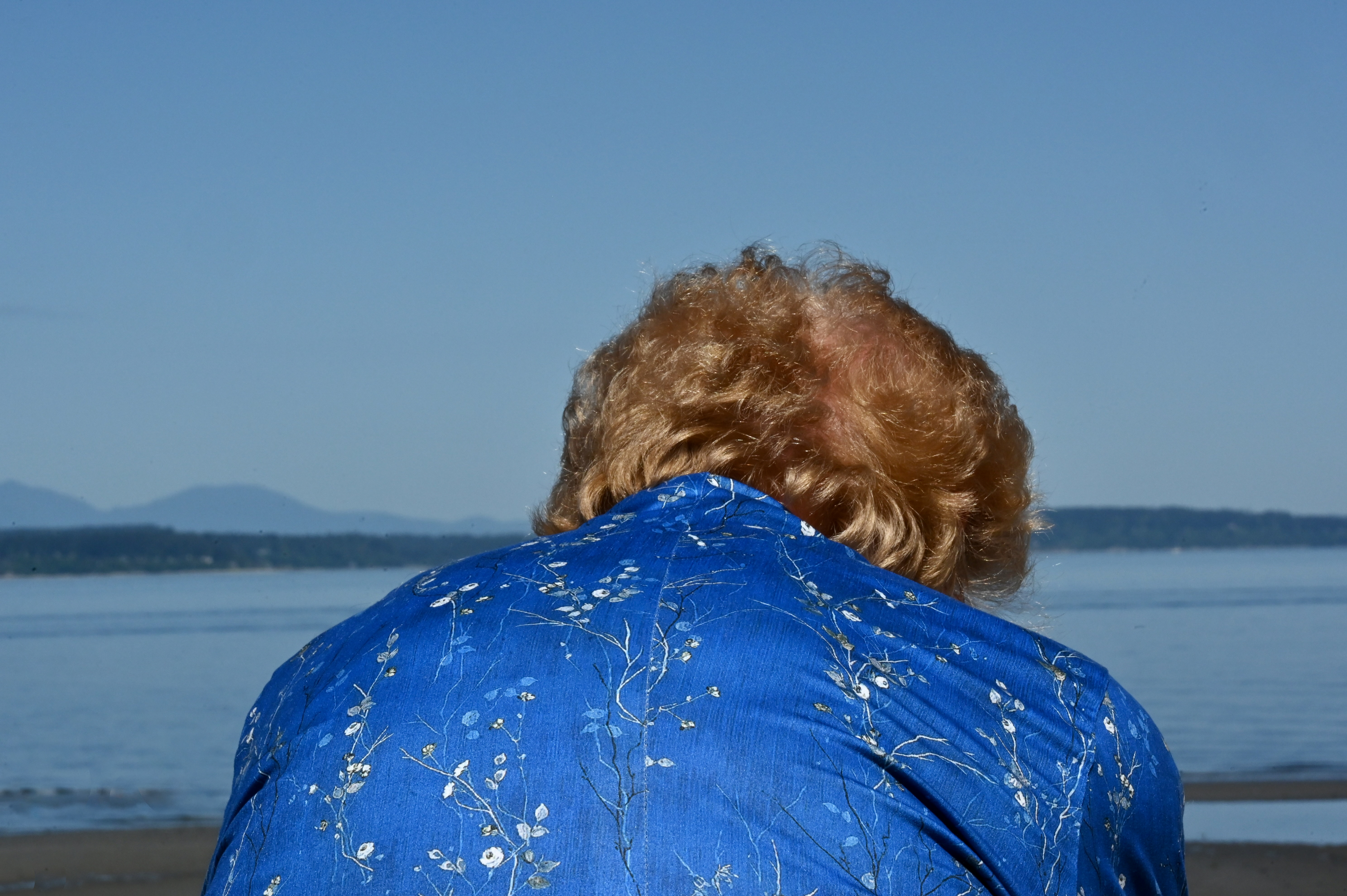
Men at forty Learn to close softly The doors to rooms they will not be Coming back to.
At rest on a stair landing, They feel it moving Beneath them now like the deck of a ship, Though the swell is gentle.
And deep in mirrors They rediscover The face of the boy as he practises tying His father’s tie there in secret
And the face of the father, Still warm with the mystery of lather. They are more fathers than sons themselves now. Something is filling them, something
That is like the twilight sound Of the crickets, immense, Filling the woods at the foot of the slope Behind their mortgaged houses.
I’m attracted to older paint jobs. Peeling back the layers of memory, I calculate the thousands of man hours I must have spent noticing things no longer here (like old paint jobs).
Moving through the world in my bubble, noticing things (funny, I don’t FEEL any older), I peel back layers like an onion.
‘…Should storms, as may well happen, Drive you to anchor a week In some old harbour-city Of Ionia, then speak With her witty scholars, men Who have proved there cannot be Such a place as Atlantis: Learn their logic, but notice How its subtlety betrays Their enormous simple grief; Thus they shall teach you the ways To doubt that you may believe.‘
‘Brutalist architecture flourished from the 1950s to the mid-1970s, having descended from the modernist architectural movement of the early 20th century. The term originates from the French word for “raw”, as Le Corbusier described his choice of material béton brut, meaning raw concrete in French.’
Our local host and local guest pick favorite (unfavorite) examples of ‘raw concrete’ buildings in NYC and alternately discuss some facts about each one.
Tell all the truth but tell it slant — Success in Circuit lies Too bright for our infirm Delight The Truth’s superb surprise As Lightning to the Children eased With explanation kind The Truth must dazzle gradually Or every man be blind —
When I was younger it was plain to me I must make something of myself. Older now I walk back streets admiring the houses of the very poor: roof out of line with sides the yards cluttered with old chicken wire, ashes, furniture gone wrong; the fences and outhouses built of barrel staves and parts of boxes, all, if I am fortunate, smeared a bluish green that properly weathered pleases me best of all colors
No one will believe this of vast import to the nation.
You were probably imagining barely standing walls, bric-a-brac; maybe some knee-high grass amidst patches of dirt (Imagism).
I’ve tried to distill the idea further down to color saturation, no ownership (nor pride of ownership), but rather an ever-present, creative vandalism.
Best to break reality up into tasks, manageable, soluble; pushing us to the edge of one of many circles. After a few days, the dream city appears, glittering again upon the horizon.
Images 1 and 3 below, especially, read as illustrations to me, while image 2 acts as more of a bridge. As readers know, I tend towards quiet, observational photographs. There is a progression present moving outdoors-in, to a more intimate space.
Edward Hopper practiced deep color complentarity in his paintings, balancing cool and warm. I first noticed his use of red here, and it got me thinking:
‘Red is powerful. Hopper’s using it with purpose.‘
This got me thinking a little further: ‘How much red is too much?‘
Henri Matisse went full red one time, but there’s much more: Expert lines, curves, and composition (no focal point) make me feel at home. In fact, I think this domestically-minded Frenchman’s put most of his life’s purpose into his painting.
—
What’s the most aggressive, yet soothing, use of red I’ve seen consistently throughout my life?
Probably a Coke can, billboard, or truck. Check out this Arthur Meyerson photo with a Coke truck in context.
Another color problem: Color draws the eye quickly. Color is powerful. It snatches your eye and mind. The original black-and-white photographers thought color photography would distract, vulgarize, and commercialize; away from subject and composition, especially given the camera technology at the time.
It turns out the old guys weren’t entirely wrong, as many advertisers and fashion photographers barf color all over the place. Some expertly upchuck. Others, alas, puke like Brits on holiday in Ibiza.
Kids with crayons and iPads, shock and awe pop-artist and portraitists, movie directors, and even ideologues making their propaganda, use color freely. We’re all being gradually exposed to the newer synthetic AI stuff coming down the pike. We are living, I believe, amidst an information revolution (storage, access, process and attention). I mean, unless you’re color blind, you see the world in color.
Remember that one sunset and her makeup and the city behind her all blended together?
On that note, Dear Reader, this has been one of the best approaches I’ve found so far along my later, more limited, photographic journey in life:
‘Beware of color theories. Theories in color photography are dangerous. The plain fact that there are so many of them proves my point. A color philosophy comes much closer to the truth. Beware of scientific color tests. They are as quickly outdated as a timetable. Their truth is short lived. Most theories are the result of an attempt to bring one’s practical experiences into a formula. There is no formula. There are only confirmations to formulas which one has already discovered oneself. I myself love to read theories without ever using them when working.‘
Hopefully, I’ve jarred something loose inside your head.
‘In a series comprised of over 20 paintings, Monet recreated haystacks during varying weather conditions and at different times of day. Here, a single stack of wheat sits in a sundrenched, late-summer field framed by poplars and rolling hills.’
Give me one minute and your mind. 1. Please read the poem aloud. 2. Take a closer look at the photo 3. Play the first 30 seconds of Chopin’s Nocturne in B-flat minor, Op 9, No. 1. (past the 00:26 mark).
The goal: Create a dreamy, contemplative experience before you move on.
Who knows how people come to haunt their own lives?
Warner had been in some kind of band, then out wandering the street for fifteen years. He’d emerge from time to time with ideas. Harry noticed three new crosses behind his left ear and a long, purple scar on his right hand.
—
‘It’s free if you guys want it. That’s what I’m saying.’
‘People meet every night. That’s free?’ Harry asked.
‘What I’m giving you. Something’s going on. Guys in Bremerton. The construction guys. Everybody knows.’
‘Knows what?’
‘I can’t tell you all of it. I don’t know. You sit there all night and they give you $75. That’s real fuckin’ money.’
‘What I’m tellin’ you is you get $20. For showing up. $50 for the night.’
‘That’s $70. I need a place, Warner. Names.’
‘You smell like shit, Warner. Don’t touch my desk.’ Wylie handed him a Red Bull.
‘I don’t have to be here.’ A long pause. Warner looked down at his feet. ‘Oliveira.’
What’s he look like? Harry asked.
Brown guy. Glasses. Like a banker. Short hair. He speaks German too. Good English.’
‘And you guys work?’ Harry asked.
‘You ask around. You show up but nothing happens. They take one group of guys, and disappear. Like a Penske truck. Illegals. Then it changes.’
‘What changes?’
‘The place. You gotta know someone, then it’s somewhere else. But you gotta know someone.‘ They pay out, man.’
‘German?’ Wylie asked, staring.
‘Yeah, it’s fuckin’ German.’
‘Get me in,’ Harry said.
‘Ronnie’s on 4th near the stadium.‘ $500 now and $500 when we’re done.‘
‘$100′ right now and we talk when it’s done’ Harry said, handing Warner a bill. I’m good for it.
‘Tonight,’ Warner shuffled out staring at Wylie.‘You can’t come, asshole,’
‘Text me, Harry.I got like five phones.‘ He shouted from the hall.
—
‘Oliveira’s Portugese’ Harry said. ‘Popular name.’
‘There are Germans in Brazil. Supermodels.’ Wylie said.
‘Lots of places to learn German’ Kathy was standing in the doorway. ‘I’ll check AI, incarceration, sex offenders, construction companies. Brazilians just replaced my neighbor’s roof’
‘II’ll talk to Skoda. He does data privacy. Maybe he knows something.’ Wylie said.
‘Lots of companies unloading on the Island.’ Harry said. ‘Fifteen million is serious money.’
‘There was a strike last year. Remember the Asian front food company near Georgetown?’ I can’t remember the name….lots of fraud’ Kathy said walking out. ‘My friend knows someone who works delivery. I’ll look that up, too.
‘Who makes money on each shipping container?’Who touches these containers?’
Detective Harry: ‘Good light, nice drama. Way too much negative space. Don’t be afraid to put more in.‘
‘Read this poem and come back in a month.’
—
—What’s this poem about? What’s this got to do with winter?
‘My tab’s due…time to go.’
—‘Okay, Harry, all right…’
—
Blizzard
Snow falls: years of anger following hours that float idly down — the blizzard drifts its weight deeper and deeper for three days or sixty years, eh? Then the sun! a clutter of yellow and blue flakes — Hairy looking trees stand out in long alleys over a wild solitude. The man turns and there — his solitary track stretched out upon the world.
Painters have to represent light on a 2D surface with geometry, materials and technique. It takes years of experimenting with colors and color-mixing. Most of all, artists have to have some kind of vision.
It can take months to make a single painting…
Photographers ‘find’ instead of ‘make,’ deciding where to stand, and when to click the shutter. If you can’t see it in your mind’s eye, you probably won’t ‘see’ a good photograph.