‘The most useful definition of modernist fiction I’ve encountered comes from Brian McHale’s Postmodernist Fiction. He says modernist fiction tends to “foreground epistemological questions” such as “How can I interpret the world I’m part of? What is there to be known? Who knows it? What are the limits of that knowledge?” In contrast, postmodernist fiction tends to “foreground ontological questions” such as “What is a world? What kinds of worlds are there and how are they constituted? What happens when…boundaries between worlds are violated?’
As to the epistemological questions surrounding Modernism, below are four poems. Hopefully, each is a representative example of a move away from the Romanticism that had been prevalent up until the late 1800’s.
In addition to the move away from traditional Romantic rhyme and meter towards modern blank verse, there’s also a certain conception of the Self rendered in them; a presentation of our natures that might be worth examining in some detail.
I believe we can see clearly a move away from tradition towards the Self, the Poet isolated, the poem itself as a means of communication, and an anxiety so common within the 20th century.
‘At the heart of Bloom’s project is the ancient quarrel between “poetry” and “philosophy.” In Bloom’s opinion, we ought not have to choose between Homer and Plato; we can have both, as long as we recognize that poetry is superior.’
Says the guy who writes about poetry…
What does one find within, as one looks without, waking from sleep and dream?
What kind of world is this, and can the poet actually help us know it?
You tossed a blanket from the bed
You lay upon your back, and waited;
You dozed, and watched the night revealing
The thousand sordid images
Of which your soul was constituted;
They flickered against the ceiling.
And when all the world came back
And the light crept up between the shutters
And you heard the sparrows in the gutters,
You had such a vision of the street
As the street hardly understands;
Sitting along the bed’s edge, where
You curled the papers from your hair,
Or clasped the yellow soles of feet
In the palms of both soiled hands.
—
The world will stain you, and it is a fallen, modern world, rendered profoundly and exquisitely.
As consciousness creeps in, building a bridge to the day, to the world, to the facts left as though they were the first facts, the light as though it were the first light, what one finds is distressing, both within and without.
That distress must be ‘made new,’ which is to say, the suffering (original?) in which we all sometimes find ourselves must match our experiences within the modern city and world, at least, the world created within Eliot’s lyrical verse.
Of the four poems, only the first and last have a 3rd-person subject.
—
Wallace Stevens‘ ‘I’ is in a more contemplative state, but it’s an ‘I’ exploring similar themes, and experiencing some distress in trying to know how the world actually is, and what might lie within.
The journey to The Self may not be a journey for the faint of heart.
The Poems Of Our Climate (stanzas II and III)
II Say even that this complete simplicity Stripped one of all one’s torments, concealed The evilly compounded, vital I And made it fresh in a world of white, A world of clear water, brilliant-edged, Still one would want more, one would need more, More than a world of white and snowy scents.
III There would still remain the never-resting mind, So that one would want to escape, come back To what had been so long composed. The imperfect is our paradise. Note that, in this bitterness, delight, Since the imperfect is so hot in us, Lies in flawed words and stubborn sounds.
—
Even if the verse can describe a perfected world, delivering us, perhaps, a little closer to perfection, our poet is still not free from the impulses and desires which simply never cease.
Interestingly, we end-up not with a discussion of the heart, the spirit, libido etc. as a source for those desires (for Plato, the irrational), but rather, for Stevens, just a mind.
We also find more Romantic elements of language and an almost baroque/rococo arrangement of words and ideas, dandyish even, yet combined with an intense effort to abstract, define, and clarify. From here, the poet may proceed on his task of flawed words and stubborn sounds.
***I find myself thinking of elements of modern architecture and abstract-expressionist painting. The meaning, or at least some delivery from our restless existences, can be found within the abstract itself. Or at least within a retreat to the abstract for its own sake, away from the world.
The modernist, glass-walled house on the hill will exist in its own space, offering and defying meaning. The structure’s own shapes will be stripped down to often mathematically precise forms interacting with Nature. These shall guide Man, or at least offer individual men a little refuge.
It is perhaps in Stevens’ poem we can see the questions of knowledge about the world suggesting questions about whether there is a world at all, or, at least, what kind of worlds each Self might be able to inhabit.
—
Here’s one of Robert Lowell’s poems, occurring a generation later, in the mid 20th-century, as part of the confessionals.
The Self is extremely isolated. In fact, Lowell went more than a little crazy. Unlike the known nervous breakdown of Eliot from which Eliot recovered, Lowell’s life was essentially one long breakdown from which he never recovered.
Here he is, looking back:
Epilogue
Those blessed structures plot and rhyme- why are they no help to me now i want to make something imagined not recalled? I hear the noise of my own voice: The painter’s vision is not a lens it trembles to caress the light. But sometimes everything i write With the threadbare art of my eye seems a snapshot lurid rapid garish grouped heightened from life yet paralyzed by fact. All’s misalliance. Yet why not say what happened? Pray for the grace of accuracy Vermeer gave to the sun’s illumination stealing like the tide across a map to his girl solid with yearning. We are poor passing facts. warned by that to give each figure in the photograph his living name.
—
The weight of having to make that meaning, for yourself, and by yourself, is a horrible weight indeed. One can glorify one’s Self and family, but that, alas, only goes so far. Rhyme and form still carry one’s living name, as far as they do.
Of course, there’s still wonderful rhythm and form here (this is excellent verse), but blanker now, with a relentless focus on the ‘I.’ The poet is perhaps talking a little more to himself, and the poem keeps self-consciously calling attention to itself.
—
In fact, it reminded me of the poem below, by Robert Creeley, which was published a few years afterwards.
From this page:
‘Creeley was a leader in the generational shift that veered away from history and tradition as primary poetic sources and gave new prominence to the ongoing experiences of an individual’s life. Because of this emphasis, the major events of his life loom large in his literary work.’
There’s Nothing but the Self and the Eye seeking and making meaning, by itself within a void of emotionally compact and precise language (of course there’s still form and other things besides).
Can the poet fit inside the little abstract chapel of words he’s building for himself (let alone the world, tradition etc.)?
For all the talk about ‘space,’ there seems very little.
The Window
Position is where you put it, where it is, did you, for example, that
large tank there, silvered, with the white church along- side, lift
all that, to what purpose? How heavy the slow
world is with everything put in place. Some
man walks by, a car beside him on the dropped
road, a leaf of yellow color is going to
fall. It all drops into place. My
face is heavy with the sight. I can feel my eye breaking.
—
The distress is still there…but I’d argue that we are now a good distance away from the grandness of Eliot’s vision, his religiosity and virtuosity with form and meter at the dawn of Modernism. Very few people can/could do what Eliot did (addition: even if he can help us gain knowledge of our Selves or the world).
That said, it’s unclear there’s enough tradition and confidence to even undertake such a project, now, even as such talents come along. The state of things is more scattered. We’re in a very different place of selves and artists isolated, of anxiety and post-anxiety.
Aside from the very accomplished poets above, in terms of both knowledge (epistemology) and being (ontology), we often have writers feeling pressure to weigh-in on such questions without even being about to write that well; artists who can’t draw or paint that well, and frankly, quite a bit of bullshit besides.
So, where are we headed? Who’s ‘we’ exactly?
Predictions are hard, especially about the future.
As previously posted:
Why not just put a few algorithms to work in writing those artist statements?
‘In “Sea Change,” Graham becomes Prospero, casting spells by spelling out her thoughts to merge with ours, and with the voices of the elements. The result is a mingling of perceptions rather than a broadcasting of opinions. Instead of analysis, the poems encourage emotional involvement with the drastic changes overwhelming us, overwhelm- ing the planet.’
and:
‘Strengths and weaknesses, flows and ebbs, yet every poem in “Sea Change” bears memorable lines, with almost haunting (if we truly have but 10 years to “fix” global warming) images of flora and fauna under siege. Jorie Graham has composed a swan song for Earth.’
Oh boy.
What are these poems being asked to do?
And moving away from poetry into the realm of ‘performance art,’
Via Mick Hartley, British photographer Mark Power’s Good Morning, America, vols. 1 (mostly Arkansas) & 2 (mostly across the South).
Power:
‘I keep a physical and metaphorical distance between myself and the subject. It’s a way of delineating my ‘foreignness’ and is a similar stance to the one I took while working in Poland making The Sound of Two Songs (2004-09). It’s comes very naturally to me; I’ve always felt I’m better at observing than participating, so to stand back and watch from afar suits me very well.’
I often find myself drawn to photos with some distance.
As posted:
Via Mick Hartley, Steve Fitch Photography has neon motel signs glowing into the Western night.
What’s more American than an exiled member of the Russian aristocracy intimately making his way into the English language and peering out from a thousand Motor Lodges?
“Nabokov in America” is rewarding on all counts, as biography, as photo album (there are many pictures of people, Western landscapes and motels) and as appreciative criticism. Not least, Roper even avoids the arch style so often adopted by critics faintly trying to emulate their inimitable subject.’
—
Well, there’s Donald Judd and Marfa, Texas, which looks interesting:
As previously posted, The Critic Laughs, by Hamilton:
Do you long for the days of unabashed American consumerism? Are you nostalgic for nights lit only by a soft, neon glow on the underbellies of clouds? Return to a time when America broadcast its brash, unironic call to the heavens.
But it can be empty, and lonely, and full of hard work and suffering:
Montana Pastoral
I am no shepherd of a child’s surmises.
I have seen fear where the coiled serpent rises,
Thirst where the grasses burn in early May
And thistle, mustard and the wild oat stay.
There is dust in this air. I saw in the heat
Grasshoppers busy in the threshing wheat.
So to this hour. Through the warm dusk I drove
To blizzards sifting on the hissing stove,
And found no images of pastoral will,
But fear, thirst, hunger, and this huddled chill.
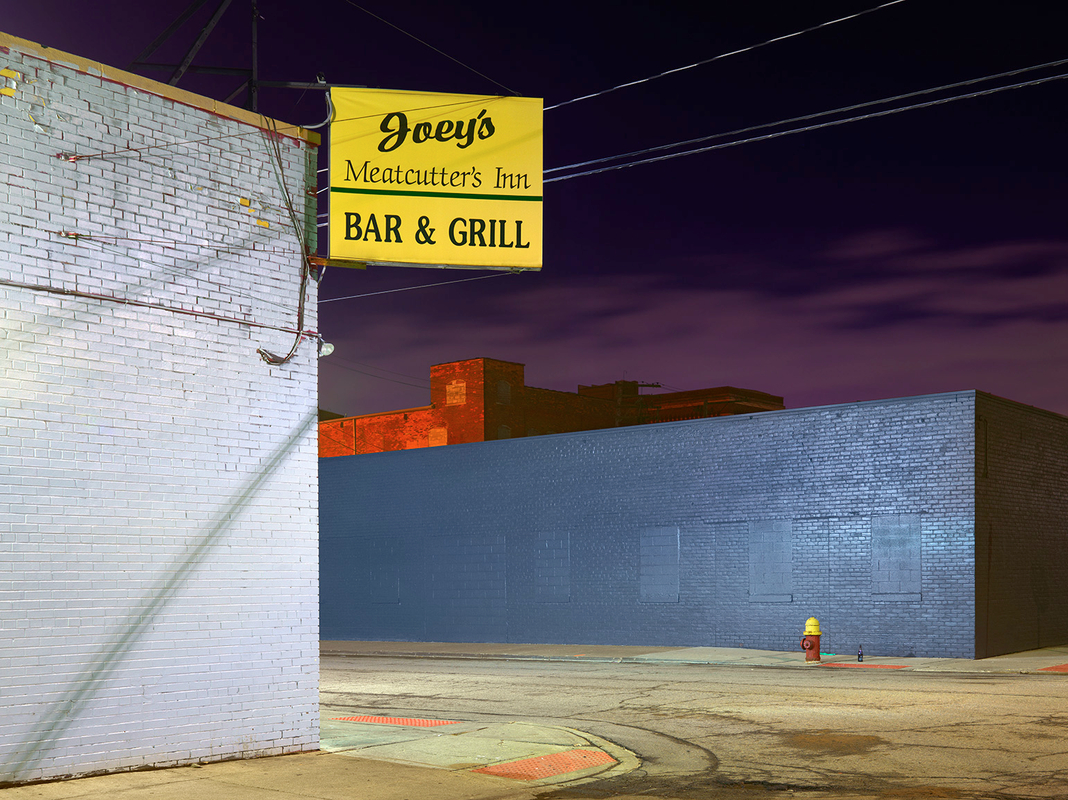
Immediately, I think of Edward Hopper: The lonely cityscape at night or the familiar glow of gas station lights cast into the American wilderness. The eye might want to linger among the colors, shapes and clouds even though the mind knows this is pretty much an empty street in a ‘post-industrial’ zone.
Perhaps it has do with another strand of expression: The break into free verse from past forms. The move from American Romanticism to Modernism which occurred this early past century. William Carlos Williams produced many good poems from a process of earnest, scrapbook-style intensity in trying to discover, redefine, and order a new poetic form within a modern ‘urban landscape.’
The individual artist is quite alone in the task he’s set before himself, and like much of modernism, it’s a rather big task.
Pastoral
When I was younger
it was plain to me
I must make something of myself.
Older now
I walk back streets
admiring the houses
of the very poor:
roof out of line with sides
the yards cluttered
with old chicken wire, ashes,
furniture gone wrong;
the fences and outhouses
built of barrel staves
and parts of boxes, all,
if I am fortunate,
smeared a bluish green
that properly weathered
pleases me best of all colors.
No one
will believe this
of vast import to the nation
‘Following the cut-and-paste technique of Dada-ist collages and the sourcing of commercial imagery in Pop Art, appropriation of visual material or pop culture images has long been utilized by street and graffiti artists. Le Rat continues this style of sampling in his more recent body of works, employing pop culture references and Old Master artworks in a series of graphic spray paint works on canvas.’
An interview here:
——————
Hopefully, dear reader, you will indulge a few ideas that have sprung to mind, as clearlyno one knows better what’s happening on the streets.
The first is the Youtube mashup, or in certain cases the sampling of music across different genres and styles, then cramming and crafting them back together into potentially new creations just by using the stuff of Youtube videos.
All this requires is access to a computer and the focus to really listen to music that draws one in. No particular musical training nor long years’ sacrifice is required. In fact, Youtube has some real practitioners out there, taking apart and putting music videos back together, sifting through an enormous compilation of free and/or cheap recorded music. The bar for being a D.J. just got lower.
The lower cost and easier availability of basic programs and equipment has spurred-on new genres of music, often driven by a few creative, talented and ambitious people and groups out to make something rather beautiful out of these component parts and their own experiences.
Hip-hop and 80’s synth-pop are just two examples.
————————-
The second idea that springs to mind is the shared history Youtube mashups, stencil artists like Le Rat, and graffiti artists might have with pop and modern art’s impulse to make meaning, often deeper meaning, out of what is at-hand in a large commercial society such as ours. All this takes might be a can of spray-paint, some basic technique, and a willingness to break the law where the law doesn’t often go.
On the higher-end, the art can be meant to spread and ‘democratize’ deeper artistic influences and ideas (a certain smugness there), while on the lower-end, a tag can be the nothing more a than a guy taking a piss on a wall with a spray-can. The high-low dynamic can be intoxicating.
Yet, there are beautiful things to be found, however, especially when and where one looks for beauty.
There seems a basic desire in us to make something that will last and that will endure, to copy what works, and to aim for beauty and try and transcend and give meaning to our own experiences and circumstances.
The need to discover and share meaning through aesthetic influence and preference likely isn’t going anywhere either. From gangs to high-school cliques to art houses, from individual taggers to the loftiest aesthete and critic, there’s a whole lot of judgment and self-identification constantly going on in human affairs through through the process of judging what we like and don’t like, which group we may be a part of and which we may not at any point in time.
Back to the piece:
‘Hugely influential on today’s generation of graffiti artists, Le Rat’s counter-iconography continues to cut across time periods, media, and styles while still paying tribute to the iconic works and masters he uses in his work.’
Images surround us in the form of thousands of prints, photos, comic book art, cartoons, advertisements etc that first drove a lot of modernism and its subsequent reactions in Pop Art.
Robert Hughes really didn’t like the lack of acquired skill and mastery of materials many moderns lack.
There have been a lot of virulent reactions to ‘modern’ life and technology ranging from utopian futurism to nihilism to consumerism and a kind of dejected anti-consumerism and spiritual malaise.
—————
Camille Paglia wants to tilt the culture more towards art education, but manages to resist the more virulent strains of secular ideology filling the modern hole, pushing back against the radicalism of feminist ideology when it encroaches upon aesthetics:
—————-
You don’t need Debussy when you’ve got Paul Mauriat.
What if eternity is listening to well-done orchestral elevator music?
Did you know Hawthorne had a son who wrote for Hearst and rubbed shoulders with Twain?:
‘Over the course of his long life, Julian Hawthorne seems to have met every major literary and public figure of his time. As a child, he sometimes listened in as his father conversed with Emerson, Thoreau and Melville. At birthday parties, he played games with little Louisa May Alcott.’
‘We stayed for the afternoon talk-in which Richard Schrader revealed how slanted and inaccurate Mencken’s account of the Scopes evolution trial had been…’
The business of monkeys…
I’m often returned to the simple pleasures of bookishness while reading Dirda.
“As a student of his native literature, Mencken favours writers with the authentic American yawp – Walt Whitman and Mark Twain, the humorists George Ade and Ring Lardner. Huckleberry Finn is the novel he loves most (followed, somewhat surprisingly, by Joseph Conrad’s Lord Jim). He judges Emerson to be overrated – “an importer of stale German elixirs, sometimes direct and sometimes through the Carlylean branch house”. He can’t bear the circumlocutions of Henry James and the gentility of William Dean Howells”
Menand wonders in his new book, why it often can take 9 years for a humanities PhD to get their doctorate. He suggests part of the answer lies in the numbers: fewer opportunities and fewer university programs since 1970. Overtrained and underpaid.
You may have already heard this mystery photographer’s story, if not, take a look.
Just a link for all the unknown photographers out there, documenting the grit and stuff of life.
Addition: I should clarify on behalf of a friend, that when the subject can be difficult to look at, the below quote about Walker Evans’ work might come in handy.
Art for art’s sake:
‘Many artists during the New Deal era wished to portray the poor to gain empathy and support for the experimental political program. Agee and Evans, however, saw this as a crude and manipulative practice, and defied it by “respecting the moral integrity of the poor while recognizing in these tenants something transcendentally human, making them more than just the tools of political propaganda,” said Jones. ‘
Well, good.
Continuing on that theme, Ken Burns discusses how he is primarily an artist, not an historian. Burns wants to be recognized as an artist striving for higher aesthetic and technical goals in his work (his influences range from Martin Scorsese to Henri Cartier-Bresson) in addition to the “social conscience.”
As for such an abstraction as a ‘social conscience’ he sees himself:
“…rooted in a humanist tradition of American History..that includes not just the old top down version, but the bottom up version that acknowledges women and labor and minorities….”
No wonder some folks at NPR love him. Here’s libertarian Nick Gillespie needling Burns about that issue.
———————————————-
Here’s a poem by beloved American modernist/physician whose work I had never associated with any sort of political philosophy, and which I still don’t while addressing his work:
Pastoral
When I was younger
it was plain to me
I must make something of myself.
Older now
I walk back streets
admiring the houses
of the very poor:
roof out of line with sides
the yards cluttered
with old chicken wire, ashes,
furniture gone wrong;
the fences and outhouses
built of barrel staves
and parts of boxes, all,
if I am fortunate,
smeared a bluish green
that properly weathered
pleases me best of all colors.
No one
will believe this
of vast import to the nation
As that same friend points out. Bill Moyers, “working-man” populist though he is, strives for journalistic excellence. But as for history, perhaps no one should aim for a Zinn-like state.