Tuesday Poem-T.S. Eliot

Cousin Nancy

Miss Nancy Ellicott
Strode across the hills and broke them,
Rode across the hills and broke them—
The barren New England hills—
Riding to hounds
Over the cow-pasture.

Miss Nancy Ellicott smoked
And danced all the modern dances;
And her aunts were not quite sure how they felt about it,
But they knew that it was modern.

Upon the glazen shelves kept watch
Matthew and Waldo, guardians of the faith,
The army of unalterable law.

T.S. Eliot  

Matthew=Matthew Arnold. Waldo=Ralph Waldo Emerson.

Thursday Poem-Robert Frost

Mending Wall

 Something there is that doesn’t love a wall,
That sends the frozen-ground-swell under it,
And spills the upper boulders in the sun;
And makes gaps even two can pass abreast.
The work of hunters is another thing:
I have come after them and made repair
Where they have left not one stone on a stone,
But they would have the rabbit out of hiding,
To please the yelping dogs. The gaps I mean,
No one has seen them made or heard them made,
But at spring mending-time we find them there.
I let my neighbour know beyond the hill;
And on a day we meet to walk the line
And set the wall between us once again.
We keep the wall between us as we go.
To each the boulders that have fallen to each.
And some are loaves and some so nearly balls
We have to use a spell to make them balance:
“Stay where you are until our backs are turned!”
We wear our fingers rough with handling them.
Oh, just another kind of out-door game,
One on a side. It comes to little more:
There where it is we do not need the wall:
He is all pine and I am apple orchard.
My apple trees will never get across
And eat the cones under his pines, I tell him.
He only says, “Good fences make good neighbours.”
Spring is the mischief in me, and I wonder
If I could put a notion in his head:
“Why do they make good neighbours? Isn’t it
Where there are cows? But here there are no cows.
Before I built a wall I’d ask to know
What I was walling in or walling out,
And to whom I was like to give offence.
Something there is that doesn’t love a wall,
That wants it down.” I could say “Elves” to him,
But it’s not elves exactly, and I’d rather
He said it for himself. I see him there
Bringing a stone grasped firmly by the top
In each hand, like an old-stone savage armed.
He moves in darkness as it seems to me,
Not of woods only and the shade of trees.
He will not go behind his father’s saying,
And he likes having thought of it so well
He says again, “Good fences make good neighbours.”

Robert Frost

I know it’s summer, but this one popped into my head this morning.

Looking For Place In America-Some Poetry & Photography Links

Via Mick Hartley, British photographer Mark Power’s Good Morning, America, vols. 1 (mostly Arkansas) & 2 (mostly across the South).

Power:

‘I keep a physical and metaphorical distance between myself and the subject. It’s a way of delineating my ‘foreignness’ and is a similar stance to the one I took while working in Poland making The Sound of Two Songs (2004-09). It’s comes very naturally to me; I’ve always felt I’m better at observing than participating, so to stand back and watch from afar suits me very well.’

I often find myself drawn to photos with some distance.

As posted:

Via Mick Hartley, Steve Fitch Photography has neon motel signs glowing into the Western night.

He also has a book simply titled ‘Motel Signs:’

What’s more American than an exiled member of the Russian aristocracy intimately making his way into the English language and peering out from a thousand Motor Lodges?

Nabokov in America:  On The Road To Lolita.

Michael Dirda review of the review here.

“Nabokov in America” is rewarding on all counts, as biography, as photo album (there are many pictures of people, Western landscapes and motels) and as appreciative criticism. Not least, Roper even avoids the arch style so often adopted by critics faintly trying to emulate their inimitable subject.’

Well, there’s Donald Judd and Marfa, Texas, which looks interesting:

As previously posted, The Critic Laughs, by Hamilton:

Do you long for the days of unabashed American consumerism? Are you nostalgic for nights lit only by a soft, neon glow on the underbellies of clouds? Return to a time when America broadcast its brash, unironic call to the heavens.

But it can be empty, and lonely, and full of hard work and suffering:

MT-3 Storm Breaking-3

Montana Pastoral
I am no shepherd of a child’s surmises.
I have seen fear where the coiled serpent rises,

Thirst where the grasses burn in early May
And thistle, mustard and the wild oat stay.

There is dust in this air. I saw in the heat
Grasshoppers busy in the threshing wheat.

So to this hour. Through the warm dusk I drove
To blizzards sifting on the hissing stove,

And found no images of pastoral will,
But fear, thirst, hunger, and this huddled chill.

Detroit Nocturne‘ found here. Via Mick Hartley.

I’m partial to ‘Joey’s Meatcutter Inn, Bar & Grill 2017‘:
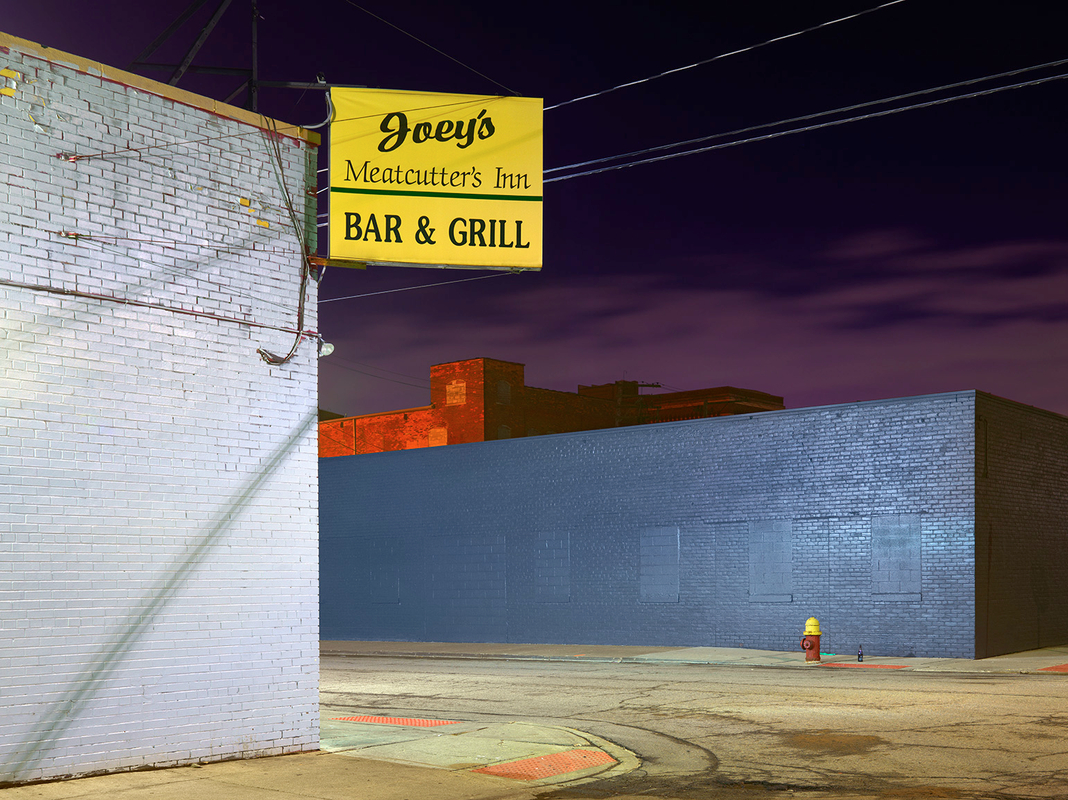
Joey's Meatcutter's Inn, Eastside, Detroit 2017

Immediately, I think of Edward Hopper: The lonely cityscape at night or the familiar glow of gas station lights cast into the American wilderness. The eye might want to linger among the colors, shapes and clouds even though the mind knows this is pretty much an empty street in a ‘post-industrial’ zone.

Perhaps it has do with another strand of expression: The break into free verse from past forms. The move from American Romanticism to Modernism which occurred this early past century. William Carlos Williams produced many good poems from a process of earnest, scrapbook-style intensity in trying to discover, redefine, and order a new poetic form within a modern ‘urban landscape.’

The individual artist is quite alone in the task he’s set before himself, and like much of modernism, it’s a rather big task.

Pastoral

When I was younger
it was plain to me
I must make something of myself.
Older now
I walk back streets
admiring the houses
of the very poor:
roof out of line with sides
the yards cluttered
with old chicken wire, ashes,
furniture gone wrong;
the fences and outhouses
built of barrel staves
and parts of boxes, all,
if I am fortunate,
smeared a bluish green
that properly weathered
pleases me best of all colors.

No one
will believe this
of vast import to the nation

William Carlos Williams

Do you believe any of that to be of vast import to the nation? Are you no one?

Tuesday Poem-Wallace Stevens & Some Quotes, Links & Thoughts

Six Significant Landscapes

I
An old man sits
In the shadow of a pine tree
In China.
He sees larkspur,
Blue and white,
At the edge of the shadow,
Move in the wind.
His beard moves in the wind.
The pine tree moves in the wind.
Thus water flows
Over weeds.

II
The night is of the colour
Of a woman’s arm:
Night, the female,
Obscure,
Fragrant and supple,
Conceals herself.
A pool shines,
Like a bracelet
Shaken in a dance.

III
I measure myself
Against a tall tree.
I find that I am much taller,
For I reach right up to the sun,
With my eye;
And I reach to the shore of the sea
With my ear.
Nevertheless, I dislike
The way ants crawl
In and out of my shadow.

IV
When my dream was near the moon,
The white folds of its gown
Filled with yellow light.
The soles of its feet
Grew red.
Its hair filled
With certain blue crystallizations
From stars,
Not far off.

V
Not all the knives of the lamp-posts,
Nor the chisels of the long streets,
Nor the mallets of the domes
And high towers,
Can carve
What one star can carve,
Shining through the grape-leaves.

VI
Rationalists, wearing square hats,
Think, in square rooms,
Looking at the floor,
Looking at the ceiling.
They confine themselves
To right-angled triangles.
If they tried rhomboids,
Cones, waving lines, ellipses
As, for example, the ellipse of the half-moon
Rationalists would wear sombreros.

Wallace Stevens

I quite like this one.  Perhaps it’s because of what I see as a Romantic sensibility fitted to imagistic purpose.

As to that final stanza: That’s a lot of very lush language to describe what are, to my mind, very visual-field, mathematical concepts.  Stevens was a poet of lush language, celebrating it like the old dandy he was, but also translating the Romantic arrangment of language to the spare, image-based aims of modernism.  Make it new and strip it down.

Perhaps, this is more the tension occurring here rather than that of a frustrated mathematician.

I’ll try and stir the pot a bit:

‘…modern rationalism is what commonplace minds made out of the inspiration of men of discrimination and genius.’

Oakeshott, Michael. Rationalism In Politics And Other Essays. Indianapolis: Liberty Fund, 1991. Print. Pg 6.

One might ask what kind of genius?  Artistic, linguistic and poetic? Or rather mathematical and physical?  Parts of this debate could be said to stretch back to the Greeks, at least.  They exist [such debates] all around us today, within our universities, politics and lives.

Personally, I’m reminded of many modern debates over reason, what it can do , what it can’t, and also many rationalist/anti-rationalist reactions to it.

The Romantic impulse generally involves a return to Nature and the countryside, away from civilization.  The poet and the artist also invite one back to one’s own sense experience anew; the ambitious attempting to celebrate the emotions and grand themes without a hint of irony (love, death, war).

At least, many try and show us as we are and can be to ourselves.

But, this is also having some downstream effects, at least in German theory: Tom Wolfe on Max Weber on one conspicuous use of art in the ‘modern’ world:

aesthetics is going to replace ethics, art is going to replace religion, as the means through which educated people express their spiritual worthiness…

The first modern?

Full slide show here.

“Fantasy abandoned by reason produces impossible monsters: united with her, she is the mother of the arts and the origin of their marvels.”

See Also On This Site: Goya’s Fight With Cudgels and Goya’s Colossus. A very good Goya page here.

Weekend Poem-Richard Eberhart

The Groundhog

In June, amid the golden fields,
I saw a groundhog lying dead.
Dead lay he; my senses shook,
And mind outshot our naked frailty.
There lowly in the vigorous summer
His form began its senseless change,
And made my senses waver dim
Seeing nature ferocious in him.
Inspecting close his maggots’ might
And seething cauldron of his being,
Half with loathing, half with a strange love,
I poked him with an angry stick.
The fever arose, became a flame
And Vigour circumscribed the skies,
Immense energy in the sun,
And through my frame a sunless trembling.
My stick had done nor good nor harm.
Then stood I silent in the day
Watching the object, as before;
And kept my reverence for knowledge
Trying for control, to be still,
To quell the passion of the blood;
Until I had bent down on my knees
Praying for joy in the sight of decay.
And so I left; and I returned
In Autumn strict of eye, to see
The sap gone out of the groundhog,
But the bony sodden hulk remained.
But the year had lost its meaning,
And in intellectual chains
I lost both love and loathing,
Mured up in the wall of wisdom.
Another summer took the fields again
Massive and burning, full of life,
But when I chanced upon the spot
There was only a little hair left,
And bones bleaching in the sunlight
Beautiful as architecture;
I watched them like a geometer,
And cut a walking stick from a birch.
It has been three years, now.
There is no sign of the groundhog.
I stood there in the whirling summer,
My hand capped a withered heart,
And thought of China and of Greece,
Of Alexander in his tent;
Of Montaigne in his tower,
Of Saint Theresa in her wild lament.

Richard Eberhart

Every summer…

Friday Poem-David Ignatow

The Bagel

I stopped to pick up the bagel
rolling away in the wind,
annoyed with myself
for having dropped it
as if it were a portent.
Faster and faster it rolled,
with me running after it
bent low, gritting my teeth,
and I found myself doubled over
and rolling down the street
head over heels, one complete somersault
after another like a bagel
and strangely happy with myself.

David Ignatow

Repost-Ah, Look At All The Lonely People-‘Jeff Koons Is Back’ Via Vanity Fair

Full piece here.

-Koons gets the Annie Leibovitz treatment (an unfortunate photo at the link).

-This is not a commentary on Koons’ art, some of which I like well enough, it’s a much worse beast; another attempt at cultural criticism.

In the talk around Koons, what often stands-out to me is how much talk there is about Koons himself, and the search for meaning in all that talk. The concept of artist-as-individual is nothing new; an isolated Self, quite apart from society, mining his interior life and experiences in order to represent beauty, meaning, and some attempt at expressing universal truths through his work and craft. This is unsurprisingly part of what all artists do, and the extreme individuality of this process is what Western artists somewhat consciously have been doing for a few centuries now, from musicians to writers to sculptors, from romanticism to modernism to post-modernism and beyond.

The fact that Koons is doing this with such relentless self-promotion and while also courting celebrity is arguably a much more ‘modern’ phenomenon. A certain amount of melliflous, abstract bullshit seems part of the Koons’ game, as if you’d walked onto a used-art lot as Koons tours you around, asking what’s-it-gonna-take-to-get-you-into-one-of-his-pieces. He offers you an invitation and a return to part of your Self. He can make you whole again within the work produced by his Self.

Jeff Koons is a brand.

Perhaps this is what it takes these days to make a living by schmoozing with wealthy art-buyers, but in some ways, it has a distinctly American feel. High and low culture mix in a highly commercial, utilitarian way. The urge to merge abstract art and the avant-garde with mass, pop-culture is expressed. Fame and meta-critiques on fame, celebrity, money, and the Self amplified for all the other Selfs to see has implications for much of our culture, I suspect.

As to establishing Koons’ bona fides enough to merit attention by Vanity Fair, here are a few quotes from the piece:

Everyone’s getting in on the bullshit!

“Jeff is the Warhol of his time,” proclaims Adam Weinberg, the Whitney’s director.’

You need an L.G.B.T. blessing to be truly avant-garde these days:

‘The reference to Curtis ties Koons to the last true avant-garde—a pedigree the artist likes. Curtis, who refused to be called a drag queen, was a pioneer of the L.G.B.T. movement and, like Candy Darling, was made famous by Warhol’

And:

‘What Warhol and Koons do have in common, though, is an uncanny ability to nail an image or an object so that it catches the Zeitgeist.’

Partially true, perhaps, but what if the Zeitgeist is nothing but a leafy suburb full of good schools, intact families, and moderate lives? Isn’t this why some youngish people (ahem…many hipsters) often leave their small towns and suburbs looking for meaning, group membership and purpose in what can end-up vaguely collectivist and vaguely individualist lives in cities?

Everyone’s an artist, these days.

Also, you must establish modernist credentials for the brand:

‘Koons’s job at MoMA gave him the opportunity to immerse himself in the history of modernism, in particular the ideas of Marcel Duchamp, who changed art history by showing how everyday objects, or “readymades,” could be elevated into the realm of art, depending on context. Duchamp’s theories were a revelation to Koons.’

Yes, dear reader, Piketty and Brecht in the same paragraph:

‘Barbara Kruger, the artist whose unsentimental pronouncements have been cutting to the chase about the art world for decades, says “Oh boy” when I call to discuss Koons, whom she has known since they both were starting out in New York. She needed to think about it and later wrote me: “Jeff is like the man who fell to earth, who, in this grotesque time of art flippage and speculative mania, is either the icing on the cake or some kind of Piketty-esque harbinger of the return of Brecht’s ‘making strange.’

And finally, while I have no quarrel with neurosicence, pop-neuroscience is often a repository for the modern search for legitimate experiences and theories of the Self:

‘Dr. Eric R. Kandel, a Nobel Prize-winning neuroscientist, was so impressed with the show that he e-mailed Koons afterward. I asked Kandel why. He explained, “I have been interested in the ‘beholder’s share,’ an idea that came from the Viennese art historian Alois Riegl. It involves the concept that when a painter paints a painting or a sculptor makes a sculpture it is not complete unless a beholder, a viewer, responds to it.”

Kandel adds, “When you looked at the sculptures you saw yourself embedded in the gazing balls. Artists sometimes put mirrors in works, but they don’t design the work so that you find yourself in the arms or chest of a statue, which is what Jeff did.’

Go and find your Self and be made whole, dear reader, within Jeff Koons’ work and the Jeff Koons brand, and try and tell the dancer from the dance.

————————

Koons’ Made In Heaven only amplifies that sound, blurring the line between art and porn, private experience and public show, innocence (so easily corrupted) and naive, narcissistic indulgence.

I suspect Made In Heaven explores previous themes of high and low that were already emerging in his kitsch work, fleshed out in pieces like Michael Jackson And Bubbles, Winter Bears and on this site: ‘St John The Baptist’.

Some quotes from Koons:

‘This type of dislocated imagery is what motivates people. They’re amused by it, but they have a lot of guilt and shame that they respond to it. I was trying to remove that guilt and shame.’

Another quote which highlights an idea of some import to the nation:

Coming from a suburban, middle-class background, as he did, he felt that there was something, if not dignified, at least, too easily discarded about this kind of imagery and this kind of sentiment.’

Roger Scruton says keep politics out of the arts, and political judgment apart from aesthetic judgment…this includes race studies/feminist departments/gay studies etc.: Roger Scruton In The American Spectator Via A & L Daily: Farewell To Judgment

Goya’s Fight With Cudgels and Goya’s Colossus. A very good Goya page here.

Joan Miro: WomanGoethe’s Color Theory: Artists And ThinkersSome Quotes From Kant And A Visual Exercise

A Reaction To Jeff Koons ‘St John The Baptist’

Denis Dutton suggests art could head towards Darwin (and may offer new direction from the troubles of the modern art aimlessness and shallow depth) Review of Denis Dutton’s ‘The Art Instinct’


Saturday Poem-George Santayana

Cape Cod

The low sandy beach and the thin scrub pine,
The wide reach of bay and the long sky line,—
O, I am sick for home!

The salt, salt smell of the thick sea air,
And the smooth round stones that the ebbtides wear,—
When will the good ship come?

The wretched stumps all charred and burned,
And the deep soft rut where the cartwheel turned,—
Why is the world so old?

The lapping wave, and the broad gray sky
Where the cawing crows and the slow gulls fly,
Where are the dead untold?

The thin, slant willows by the flooded bog,
The huge stranded hulk and the floating log,
Sorrow with life began!

And among the dark pines, and along the flat shore,
O the wind, and the wind, for evermore!
What will become of man?

George Santayana

Thursday Poem-Seamus Heaney

Night Drive

The smells of ordinariness
Were new on the night drive through France
Rain and hay and woods on the air
Made warm draughts in the open car

Signposts whitened relentlessly
Montreuil, Abbeville, Beauvais
Were promised, promised, came and went,
Each place granting its name’s fulfillment.

A combine groaning its way late
Bled seeds across its work-light.
A forest fire smouldered out.
One by one small cafes shut.

I thought of you continuously
A thousand miles south where Italy
Laid its loin to France on the darkened sphere.
Your ordinariness was renewed there.

Seamus Heaney

Sunday Poem-Robert Frost

A Prayer In Spring

Oh, give us pleasure in the flowers to-day;
And give us not to think so far away
As the uncertain harvest; keep us here
All simply in the springing of the year.

Oh, give us pleasure in the orchard white,
Like nothing else by day, like ghosts by night;
And make us happy in the happy bees,
The swarm dilating round the perfect trees.

And make us happy in the darting bird
That suddenly above the bees is heard,
The meteor that thrusts in with needle bill,
And off a blossom in mid air stands still.

For this is love and nothing else is love,
The which it is reserved for God above
To sanctify to what far ends He will,
But which it only needs that we fulfil.

Robert Frost

Air Still Thick With Dreams On Fire

A good work of art can free your from the shackles of habitual perception.  It can make you alive anew to the strangeness of life, drawing you onwards through beauty, symmetry, and a bit of wonder.  Ars celare artem.

I believe the rush to contemporize all one’s experience and emotions into narrow ideological and political channels; to forego talent and skill for concept and blurb is a shame.

Meanwhile, over at The Whitney:

‘Ms. Hockley explained that these choices weren’t due to a fascination with all things “hot, young, new,” but rather grew out of traveling around the country and seeing how many artists were facing “an incredible amount of pressure coming from all sides,” including the burden of debt from M.F.A. programs, the collapse of smaller galleries that might help launch their careers and the difficulty of finding and keeping affordable studio space.’

And on one artist in particular:

‘For the biennial, Mr. Fernandes, a former ballet dancer who is based in Chicago, will present a new version of a piece titled “The Master and Form,” which consists of archaic-looking wooden scaffolding and devices that allow performers to hold the five basic ballet positions for long periods of time. “For me it is a social-political space, a piece that questions the agency of the body, the agency of the dancer and our labor,” said Mr. Fernandes.’

As posted:

James Panero on the New Whitney museum:

‘As America went abstract, the museum also never lost its taste for the real, a fact reflected in the strengths and weaknesses of its permanent collection now on display. This explains its abundance of American Scene hokum and WPA art as well as the artists who have defined the museum’s self-image, in particular Edward Hopper.

But it also explains its appetite for art that is strident, narrow, and of the moment, demonstrating a taste that has only become more bitter with age.’

Panero:

‘For many years, the French writer Guy de Maupassant insisted on eating lunch every day at the restaurant in the Eiffel Tower. The reason, he explained, was simple: the restaurant offered the only spot in Paris where he could look out and not have to see the Eiffel Tower.’

=================

How about popular culture from 30 years ago? Now, this is important. This blog is still looking for 80’s awesome badness, for nothing can predict the cultural trends of today like the lyrics of ‘Angel Of The City,’ the theme from Sylvester Stallone’s 1986 ‘Cobra.’

Succumb to the power of 80’s rock ballad poetry.

The streets they scream….with desire…the air is thick with dreams on fire:’

=====================

Ah, Look At All The Lonely People-‘Jeff Koons Is Back’ Via Vanity Fair…Awesome 80’s Badness-From The Running Man: Restless Heart (Running Away With You)

Roger Scruton says keep politics out of the arts, and political judgment apart from aesthetic judgment…this includes race studies/feminist departments/gay studies etc.: Roger Scruton In The American Spectator Via A & L Daily: Farewell To Judgment

Goya’s Fight With Cudgels and Goya’s Colossus. A very good Goya page here.

Joan Miro: WomanGoethe’s Color Theory: Artists And ThinkersSome Quotes From Kant And A Visual Exercise

A Reaction To Jeff Koons ‘St John The Baptist’

Denis Dutton suggests art could head towards Darwin (and may offer new direction from the troubles of the modern art aimlessness and shallow depth) Review of Denis Dutton’s ‘The Art Instinct’

Sunday Poem-Robert Hayden

Those Winter Sundays

Sundays too my father got up early
and put his clothes on in the blueblack cold,
then with cracked hands that ached
from labor in the weekday weather made
banked fires blaze. No one ever thanked him.

I’d wake and hear the cold splintering, breaking.
When the rooms were warm, he’d call,
and slowly I would rise and dress,
fearing the chronic angers of that house,

speaking indifferently to him,
who had driven out the cold
and polished my good shoes as well.
What did I know, what did I know
of love’s austere and lonely offices?

Robert Hayden

Repost-Modern Land Artists Point You Back To Nature, Placing You In Time, But Whose ‘Now’ Is This, Man? What Is Nature, Exactly?

Paul Wood discusses the works of Robert Smithson (Broken Circle, Spiral Hill) and Richard Serra (Fulcrum, Spin Out):

Land-art pieces are site-specific. They require you to be there and experience them, designed as they are to be within the specific spaces they occupy.

In so doing, they break from previous modernist ‘Readymades‘ and reproduced images (I don’t know about you, but I’m tiring of so many commentaries on consumerism, the desire for craft over mass production, a certain collective vagueness against such disposability…the dream of unique Selfhood, celebrity even, amidst a thousand urinals).

As a viewer, you’re supposed to interact with these pieces and start feeling and thinking differently than perhaps you might have otherwise. Walk around, through, and over them. View one hillock from another. Walk back over to the first hillock and look from whence you came. The view is never quite what you were imagining.

Clap inside of Serra’s ‘Vortex:’

Time is clearly intended to be an element, here; the long sweep of geologic and/or historical time as the artist understands it, as well as the relative brevity of personal time during just a 10-minute visit.

These pieces can act as signposts towards Nature and what we can begin to observe of our specific natural environments (steel rusts in unique, but perhaps underlying, patterns…winds blow at different angles and around different obstacles in one grove as opposed to another, these lichens are growing here…other lichens over there, are they the same species?).

If you pull the piece out of its specific environment, it may just wither and die, looking out-of-place as many other products of civilization do amidst natural settings (a jar in Tennessee). Perhaps, though, they won’t look quite so out-of-place as mass-produced objects because of such careful design and attention to detail.

That said, these pieces will eventually look quite awkward undergoing the changes they will undergo if Nature’s Laws are any guide (Romantic/Modernist recreations of Nature can promise the comforts of Home).

Here’s Wikipedia, keeping it simple:

‘Land art, earthworks (coined by Robert Smithson), or Earth art is an art movement in which landscape and the work of art are inextricably linked.’

From the video description:

‘Robert Smithson and Richard Serra both believed that sculpture should have a dialog with its environment. This program explores the challenging dialectic of the site-specific sculpture of Smithson and Serra through examples of their work. In an interview, Serra discusses the aspects of time and context in relation to his art as well as the influence of Smithson.’

Maybe it’s worth pointing out that Serra seems interested in symmetry, visualizing and realizing abstract shapes with the help of some mathematics and the practice of drawing/drafting. Interesting problems can arise from tooling around with shapes on paper (a practice of Serra’s), the kind I’m guessing folks fascinated by puzzles and software and math love to solve.

But Serra’s not a mathematician nor an engineer nor an architect. He’s not writing a proof for its own sake nor building bridges nor houses for practical use.

Rather, the intuitive and creative impulses of the artist take over in his work, a kind of creative exploration, as well as the dialog between fellow artists, living and dead.

Much (A)rt, of course, is useless for most, if not all, purposes. It’s one of the things that can make it meaningful for people. There can be a significant gap between what the artist may have felt, thought and realized, and which emotions, thoughts and experiences any viewer/listener might have in interacting with a particular piece.

Serra, in his work, wants to alter the thinking of anyone moving through the space he creates by manipulating specific substances like steel (he has a facility with the material), and by getting viewers to a point of reorientation of spatial and temporal awareness.

Of course, this involves reorientation towards certain ideas as he understands them, and by promising people a return to themselves, or a state of experience and creative play perhaps similar to that of the artist.

Here’s a Charlie Rose interview:

More about Land Artists:

Any thoughts and comments are welcome. Feel free to highlight my ignorance…

Related On This Site:A structure in the desert…not even a city Update On LACMA, Michael Heizer And The ‘Levitated Mass’-Modern Art And The Public

Denis Dutton suggested art could head towards Darwin (and may offer new direction from the troubles of the modern art aimlessness and shallow depth…the money and the fame) Review of Denis Dutton’s ‘The Art Instinct’

No thanks to living in planned communities upon someone else’s overall vision.: Roger Scruton In The City Journal: Cities For Living–Is Modernism Dead?

Modern Art For Sale In The Middle-East-From The New Yorker: ‘Richard Serra In the Qatari Desert’

Wednesday Poem-Seamus Heaney

Scaffolding

Masons, when they start upon a building,
Are careful to test out the scaffolding;

Make sure that planks won’t slip at busy points,
Secure all ladders, tighten bolted joints.

And yet all this comes down when the job’s done
Showing off walls of sure and solid stone.

So if, my dear, there sometimes seem to be
Old bridges breaking between you and me

Never fear. We may let the scaffolds fall
Confident that we have built our wall.

Seamus Heaney

Tuesday Poem-Emily Dickinson

I measure every Grief I meet (561)

I measure every Grief I meet
With narrow, probing, eyes –
I wonder if It weighs like Mine –
Or has an Easier size.

I wonder if They bore it long –
Or did it just begin –
I could not tell the Date of Mine –
It feels so old a pain – 

I wonder if it hurts to live –
And if They have to try –
And whether – could They choose between –
It would not be – to die – 

I note that Some – gone patient long –
At length, renew their smile –
An imitation of a Light
That has so little Oil – 

I wonder if when Years have piled –
Some Thousands – on the Harm –
That hurt them early – such a lapse
Could give them any Balm – 

Or would they go on aching still
Through Centuries of Nerve –
Enlightened to a larger Pain –
In Contrast with the Love – 

The Grieved – are many – I am told –
There is the various Cause –
Death – is but one – and comes but once –
And only nails the eyes – 

There’s Grief of Want – and grief of Cold –
A sort they call “Despair” –
There’s Banishment from native Eyes –
In sight of Native Air – 

And though I may not guess the kind –
Correctly – yet to me
A piercing Comfort it affords
In passing Calvary – 

To note the fashions – of the Cross –
And how they’re mostly worn –
Still fascinated to presume
That Some – are like my own –

Emily Dickinson

Thursday Poem-A.E. Stallings

The Mistake

The mistake was light and easy in my hand,
A seed meant to be borne upon the wind.
I did not have to bury it or throw,
Just open up my hand and let it go.

The mistake was dry and small and without weight,
A breeze quickly snatched it from my sight,
And even had I wanted to prevent,
Nobody could tell me where it went.

I did not think on the mistake again,
Until the spring came, soft, and full of rain,
And in the yard such dandelions grew
That bloomed and closed, and opened up, and blew

A.E. Stallings

Tuesday Poem: T.S. Eliot, Preludes Part 3

3.

You tossed a blanket from the bed
You lay upon your back, and waited;
You dozed, and watched the night revealing
The thousand sordid images
Of which your soul was constituted;
They flickered against the ceiling.
And when all the world came back
And the light crept up between the shutters
And you heard the sparrows in the gutters,
You had such a vision of the street
As the street hardly understands;
Sitting along the bed’s edge, where
You curled the papers from your hair,
Or clasped the yellow soles of feet
In the palms of both soiled hands.

Has there been a better poet writing in English in the past 150 years?   Probably not.

The depth of commitment to his metaphysical vision and the breadth of that vision is remarkable.   Look at the rhyme and meter!  Sinful.

Weekend Poem-W.H. Auden

On The Circuit

Among pelagian travelers,
Lost on their lewd conceited way
To Massachusetts, Michigan,
Miami or L.A.,

An airborne instrument I sit,
Predestined nightly to fulfill
Columbia-Giesen-Management’s
Unfathomable will,

By whose election justified,
I bring my gospel of the Muse
To fundamentalists, to nuns,
to Gentiles and to Jews,

And daily, seven days a week,
Before a local sense has jelled,
From talking-site to talking-site
Am jet-or-prop-propelled.

Though warm my welcome everywhere,
I shift so frequently, so fast,
I cannot now say where I was
The evening before last,

Unless some singular event
Should intervene to save the place,
A truly asinine remark,
A soul-bewitching face,

Or blessed encounter, full of joy,
Unscheduled on the Giesen Plan,
With, here, an addict of Tolkien,
There, a Charles Williams fan.

Since Merit but a dunghill is,
I mount the rostrum unafraid:
Indeed, ‘twere damnable to ask
If I am overpaid.

Spirit is willing to repeat
Without a qualm the same old talk,
But Flesh is homesick for our snug
Apartment in New York.

A sulky fifty-six, he finds
A change of mealtime utter hell,
Grown far too crotchety to like
A luxury hotel.

The Bible is a goodly book
I always can peruse with zest,
But really cannot say the same
For Hilton’s Be My Guest.

Nor bear with equanimity
The radio in students’ cars,
Muzak at breakfast, or–dear God!–
Girl-organists in bars.

Then, worst of all, the anxious thought,
Each time my plane begins to sink
And the No Smoking sign comes on:
What will there be to drink?

Is this a milieu where I must
How grahamgreeneish! How infra dig!
Snatch from the bottle in my bag
An analeptic swig?

Another morning comes: I see,
Dwindling below me on the plane,
The roofs of one more audience
I shall not see again.

God bless the lot of them, although
I don’t remember which was which:
God bless the U.S.A., so large,
So friendly, and so rich.

W.H. Auden

Repost-From Slate: ‘MFA vs. NYC’

Full post here.

Of the MFA (Master Of Fine Arts):

‘Staffed by writer-professors preoccupied with their own work or their failure to produce any; freed from pedagogical urgency by the tenuousness of the link between fiction writing and employment; and populated by ever younger, often immediately postcollegiate students, MFA programs today serve less as hotbeds of fierce stylistic inculcation, or finishing schools for almost-ready writers (in the way of, say, Iowa in the ’70s), and more as an ingenious partial solution to an eminent American problem: how to extend our already protracted adolescence past 22 and toward 30, in order to cope with an oversupplied labor market.’

There are of course still storytellers, geniuses honing their craft that will hold up a mirror and lens for humanity within their creative imaginations.  Maybe they can be found at MFA programs, but I’m guessing they’re more likely doing other things:  getting crippled on a naval campaign, spending their days in an attic, learning to navigate the Mississippi by steamboat, or acting and writing for a theater troupe.

Addition:  And as a reader points out:  learning how to communicate during the current technological revolution.

How much good are all these museums, foundations, and institutions actually doing for the arts and humanities?

Related On This SiteFrom Poemshape Via Andrew Sullivan: ‘Let Poetry Die’…Here’s a suggestion to keep aesthetic and political judgements apart-Roger Scruton In The American Spectator Via A & L Daily: Farewell To Judgment…English departments can’t just copy “(S)cience”…From Bloggingheads: Shakespeare and The Second Law Of ThermodynamicsRepost-How To Study Literature: M.H. Abrams In The Chronicle Of Higher Ed

Wednesday Poem: Wallace Stevens-Anecdote of The JarWednesday Poem: A Postcard From The Volcano..-Review of Denis Dutton’s ‘The Art Instinct’

From The Arnoldian Project: ‘Architecture, Campus, And Learning To Become’

From NPR: Grants To The NEA To Stimulate The Economy?From 2 Blowhards-We Need The Arts: A Sob Story

Arts and Foundations and Institutions-MOMA is private, so perhaps it’s not as decadent if they display Tilda Swinton in a box:

Tilda Swinton At MOMA-From Arma Virumque: ‘Nightmare In A Box’

From The City Journal Via Arts And Letters Daily: Andre Glucksman On “The Postmodern Financial Crisis”

Roger Scruton says keep politics out of the arts, and political judgment apart from aesthetic judgment…this includes race studies/feminist departments/gay studies etc.:  Roger Scruton In The American Spectator Via A & L Daily: Farewell To Judgment

Tuesday Poem-Seamus Heaney

Thanks to a reader (there are a few out there :):

Mid-Term Break

I sat all morning in the college sick bay
Counting bells knelling classes to a close.
At two o’clock our neighbours drove me home.

In the porch I met my father crying—
He had always taken funerals in his stride—
And Big Jim Evans saying it was a hard blow.

The baby cooed and laughed and rocked the pram
When I came in, and I was embarrassed
By old men standing up to shake my hand

And tell me they were ‘sorry for my trouble’.
Whispers informed strangers I was the eldest,
Away at school, as my mother held my hand

In hers and coughed out angry tearless sighs.
At ten o’clock the ambulance arrived
With the corpse, stanched and bandaged by the nurses.

Next morning I went up into the room. Snowdrops
And candles soothed the bedside; I saw him
For the first time in six weeks. Paler now,

Wearing a poppy bruise on his left temple,
He lay in the four-foot box as in his cot.
No gaudy scars, the bumper knocked him clear.

A four-foot box, a foot for every year.

Seamus Heaney

Wednesday Poem-Wallace Stevens

The Snow Man

One must have a mind of winter
To regard the frost and the boughs
Of the pine-trees crusted with snow;

And have been cold a long time
To behold the junipers shagged with ice,
The spruces rough in the distant glitter

Of the January sun; and not to think
Of any misery in the sound of the wind,
In the sound of a few leaves,

Which is the sound of the land
Full of the same wind
That is blowing in the same bare place

 For the listener, who listens in the snow,
And, nothing himself, beholds
Nothing that is not there and the nothing that is.

 –Wallace Stevens

Christmas Trees-Robert Frost

Christmas Trees

The city had withdrawn into itself
And left at last the country to the country;
When between whirls of snow not come to lie
And whirls of foliage not yet laid, there drove
A stranger to our yard, who looked the city,
Yet did in country fashion in that there
He sat and waited till he drew us out
A-buttoning coats to ask him who he was.
He proved to be the city come again
To look for something it had left behind
And could not do without and keep its Christmas.
He asked if I would sell my Christmas trees;
My woods—the young fir balsams like a place
Where houses all are churches and have spires.
I hadn’t thought of them as Christmas Trees.
I doubt if I was tempted for a moment
To sell them off their feet to go in cars
And leave the slope behind the house all bare,
Where the sun shines now no warmer than the moon.
I’d hate to have them know it if I was.
Yet more I’d hate to hold my trees except
As others hold theirs or refuse for them,
Beyond the time of profitable growth,
The trial by market everything must come to.
I dallied so much with the thought of selling.
Then whether from mistaken courtesy
And fear of seeming short of speech, or whether
From hope of hearing good of what was mine, I said,
“There aren’t enough to be worth while.”
“I could soon tell how many they would cut,
You let me look them over.”

                                                     “You could look.

But don’t expect I’m going to let you have them.”
Pasture they spring in, some in clumps too close
That lop each other of boughs, but not a few
Quite solitary and having equal boughs
All round and round. The latter he nodded “Yes” to,
Or paused to say beneath some lovelier one,
With a buyer’s moderation, “That would do.”
I thought so too, but wasn’t there to say so.
We climbed the pasture on the south, crossed over,
And came down on the north. He said, “A thousand.”

“A thousand Christmas trees!—at what apiece?”

He felt some need of softening that to me:

“A thousand trees would come to thirty dollars.”
Then I was certain I had never meant
To let him have them. Never show surprise!
But thirty dollars seemed so small beside
The extent of pasture I should strip, three cents
(For that was all they figured out apiece),
Three cents so small beside the dollar friends
I should be writing to within the hour
Would pay in cities for good trees like those,
Regular vestry-trees whole Sunday Schools
Could hang enough on to pick off enough.
A thousand Christmas trees I didn’t know I had!
Worth three cents more to give away than sell,
As may be shown by a simple calculation.
Too bad I couldn’t lay one in a letter.
I can’t help wishing I could send you one,
In wishing you herewith a Merry Christmas.

Robert Frost

Weekend Poem-Robert Browning

My Last Duchess

That’s my last Duchess painted on the wall,
Looking as if she were alive. I call
That piece a wonder, now: Frà Pandolf’s hands
Worked busily a day, and there she stands.
Will ‘t please you sit and look at her? I said
‘Frà Pandolf’ by design, for never read
Strangers like you that pictured countenance,
The depth and passion of its earnest glance,
But to myself they turned (since none puts by
The curtain I have drawn for you, but I)
And seemed as they would ask me, if they durst,
How such a glance came there; so, not the first
Are you to turn and ask thus. Sir, ‘t was not
Her husband’s presence only, called that spot
Of joy into the Duchess’ cheek: perhaps
Frà Pandolf chanced to say, ‘Her mantle laps
Over my lady’s wrist too much,’ or ‘Paint
Must never hope to reproduce the faint
Half-flush that dies along her throat:’ such stuff
Was courtesy, she thought, and cause enough
For calling up that spot of joy. She had
A heart—how shall I say?—too soon made glad,
Too easily impressed; she liked whate’er
She looked on, and her looks went everywhere.
Sir, ‘t was all one! My favour at her breast,
The dropping of the daylight in the West,
The bough of cherries some officious fool
Broke in the orchard for her, the white mule
She rode with round the terrace—all and each
Would draw from her alike the approving speech,
Or blush, at least. She thanked men,—good! but thanked
Somehow—I know not how—as if she ranked
My gift of a nine-hundred-years-old name
With anybody’s gift. Who’d stoop to blame
This sort of trifling? Even had you skill
In speech—(which I have not)—to make your will
Quite clear to such an one, and say, ‘Just this
Or that in you disgusts me; here you miss,
Or there exceed the mark’—and if she let
Herself be lessoned so, nor plainly set
Her wits to yours, forsooth, and made excuse,
—E’en then would be some stooping; and I choose
Never to stoop. Oh, sir, she smiled, no doubt,
Whene’er I passed her; but who passed without
Much the same smile? This grew; I gave commands;
Then all smiles stopped together. There she stands
As if alive. Will ‘t please you rise? We’ll meet
The company below then. I repeat,
The Count your master’s known munificence
Is ample warrant that no just pretence
Of mine for dowry will be disallowed;
Though his fair daughter’s self, as I avowed
At starting, is my object. Nay, we’ll go
Together down, sir. Notice Neptune, though,
Taming a sea-horse, thought a rarity,
Which Claus of Innsbruck cast in bronze for me!

Robert Browning

Monday Poem-Yusuf Komunyakaa

Thanks

Thanks for the tree
between me & a sniper’s bullet.
I don’t know what made the grass
sway seconds before the Viet Cong
raised his soundless rifle.
Some voice always followed,
telling me which foot
to put down first.
Thanks for deflecting the ricochet
against that anarchy of dusk.
I was back in San Francisco
wrapped up in a woman’s wild colors,
causing some dark bird’s love call
to be shattered by daylight
when my hands reached up
& pulled a branch away
from my face. Thanks
for the vague white flower
that pointed to the gleaming metal
reflecting how it is to be broken
like mist over the grass,
as we played some deadly
game for blind gods.
What made me spot the monarch
writhing on a single thread
tied to a farmer’s gate,
holding the day together
like an unfingered guitar string,
is beyond me. Maybe the hills
grew weary & leaned a little in the heat.
Again, thanks for the dud
hand grenade tossed at my feet
outside Chu Lai. I’m still
falling through its silence.
I don’t know why the intrepid
sun touched the bayonet,
but I know that something
stood among those lost trees
& moved only when I moved.

Yusef Komunyakaa

Repost: From The NY Times Via A & L Daily: Helen Vendler On Wallace Stevens ‘The Plain Sense Of Things’

Full review here.

Vendler reviewed John Serio’s then new “Selected Poems”  of Wallace Stevens.

“Stevens’s conscience made him confront the chief issues of his era: the waning of religion, the indifferent nature of the physical universe, the theories of Marxism and socialist realism, the effects of the Depression, the uncertainties of philosophical knowledge, and the possibility of a profound American culture, present and future.”

and

“Stevens’s poetry oscillates, throughout his life, between verbal ebullience and New England spareness, between the high rhetoric of England (and of religion) and the “plain sense of things” that he sometimes felt to be more American…”

See Also On This Site:  Trying to stick something against his poems: Wednesday Poem: Wallace Stevens-Anecdote of The JarWednesday Poem: Wallace Stevens, The Snow ManFriday Poem: Wallace Stevens And A Quote By David Hume

Sunday Poem-William Butler Yeats: ‘When You Are Old’

When You Are Old

When you are old and gray and full of sleep,
And nodding by the fire, take down this book,
And slowly read, and dream of the soft look
Your eyes had once, and of their shadows deep;

How many loved your moments of glad grace,
And loved your beauty with love false or true,
But one man loved the pilgrim soul in you,
And loved the sorrows of your changing face;

And bending down beside the glowing bars,
Murmur, a little sadly, how Love fled
And paced upon the mountains overhead
And hid his face among a crowd of stars.

WIlliam Butler Yeats

Tuesday Poem-Walt Whitman

Facing West From California’s Shores

Facing west, from California’s shores,
Inquiring, tireless, seeking what is yet unfound,
I, a child, very old, over waves, towards the house of maternity, the land of migrations, look afar,
Look off the shores of my Western Sea—the circle almost circled;
For, starting westward from Hindustan, from the vales of Kashmere,
From Asia—from the north—from the God, the sage, and the hero,
From the south—from the flowery peninsulas, and the spice islands;
Long having wander’d since—round the earth having wander’d,
Now I face home again—very pleas’d and joyous;
(But where is what I started for, so long ago? And why it is yet unfound?)

Walt Whitman

Sunday Poem-W.B. Yeats

Long-Legged Fly

That civilisation may not sink,
Its great battle lost,
Quiet the dog, tether the pony
To a distant post;
Our master Caesar is in the tent
Where the maps are spread,
His eyes fixed upon nothing,
A hand under his head.

Like a long-legged fly upon the stream
His mind moves upon silence.

That the topless towers be burnt
And men recall that face,
Move most gently if move you must
In this lonely place.
She thinks, part woman, three parts a child,
That nobody looks; her feet
Practise a tinker shuffle
Picked up on a street.

Like a long-legged fly upon the stream
Her mind moves upon silence.

That girls at puberty may find
The first Adam in their thought,
Shut the door of the Pope’s chapel,
Keep those children out.
There on that scaffolding reclines
Michael Angelo.
With no more sound than the mice make
His hand moves to and fro.

Like a long-legged fly upon the stream
His mind moves upon silence.

William Butler Yeats

Thursday Poem-William Shakespeare

Sonnet LX

Like as the waves make towards the pebbled shore,
So do our minutes hasten to their end;
Each changing place with that which goes before,
In sequent toil all forwards do contend.
Nativity, once in the main of light,
Crawls to maturity, wherewith being crown’d,
Crooked elipses ‘gainst his glory fight,
And Time that gave doth now his gift confound.
Time doth transfix the flourish set on youth
And delves the parallels in beauty’s brow,
Feeds on the rarities of nature’s truth,
And nothing stands but for his scythe to mow:
And yet to times in hope my verse shall stand,
Praising thy worth, despite his cruel hand.

WIlliam Shakespeare

All forwards?

Friday Poem-Robert Frost

October

O hushed October morning mild,
Thy leaves have ripened to the fall;
Tomorrow’s wind, if it be wild,
Should waste them all.
The crows above the forest call;
Tomorrow they may form and go.
O hushed October morning mild,
Begin the hours of this day slow.
Make the day seem to us less brief.
Hearts not averse to being beguiled,
Beguile us in the way you know.
Release one leaf at break of day;
At noon release another leaf;
One from our trees, one far away.
Retard the sun with gentle mist;
Enchant the land with amethyst.
Slow, slow!
For the grapes’ sake, if they were all,
Whose leaves already are burnt with frost,
Whose clustered fruit must else be lost—
For the grapes’ sake along the wall.

Robert Frost

Wednesday Poem-Wallace Stevens

Postcard From The Volcano

Children picking up our bones
Will never know that these were once
As quick as foxes on the hill;

And that in autumn, when the grapes
Made sharp air sharper by their smell
These had a being, breathing frost;

And least will guess that with our bones
We left much more, left what still is
The look of things, left what we felt

At what we saw. The spring clouds blow
Above the shuttered mansion-house,
Beyond our gate and the windy sky

Cries out a literate despair.
We knew for long the mansion’s look
And what we said of it became

A part of what it is . . . Children,
Still weaving budded aureoles,
Will speak our speech and never know,

Will say of the mansion that it seems
As if he that lived there left behind
A spirit storming in blank walls,

A dirty house in a gutted world,
A tatter of shadows peaked to white,
Smeared with the gold of the opulent sun.

Wallace Stevens

A little authoritative and paternal, but a romantic poet. A modernist, brilliant with language but precise in meaning, abstract, somewhat philosophical.  They say he had a deathbed conversion. Here’s another line of his:

The poem must resist the intelligence / Almost successfully.“

And then just to frustrate matters more:

Beauty is no quality in things themselves, it exists merely in the mind which contemplates them; and each mind perceives a different beauty.

David Hume

See Also:  Wednesday Poem: Wallace Stevens-Anecdote of The Jar…and while I may not agree with his conclusions, Denis Dutton knows aesthetics pretty well and philosophy too:  Review of Denis Dutton’s ‘The Art Instinct’…

f-30-moving-carousel-1

Wednesday Poem-Conrad Aiken

Melody In A Restaurant

The cigarette smoke loops and slides above us,
Dipping and swirling as the waiter passes.
You strike a match and stare upon the flame.
The tiny firelight leaps in your eyes a moment
And dies away as silently as it came.

This melody, you say, has certain voices?
They rise like nereids from a river, singing,
Lift white faces, and dive to darkness again.
Wherever you go you bear this river with you:
A leaf falls, and it flows, and you have pain.

So says the tune to you? but what to me?
What to the waiter, as he pours your coffee?
The violinist who suavely draws his bow?
That man, who folds his paper, overhears it.
A thousand dreams revolve and fall and flow.

Someone there is who sees a virgin stepping
Down marble stairs to a deep tomb of roses:
At the last moment she lifts remembering eyes.
Green leaves blow down; the place is checked with shadows;
A long-drawn murmur of rain goes down the skies.
And oaks are stripped and bare, and smoke with lightning;
And clouds are blown and torn upon high forests;
And the great sea shakes its walls.
And then falls silence And through long silence falls
This melody once more:
Down endless stairs she goes, as once before.

So says the tune to him? but what to me?
What are the worlds I see?
What shapes fantastic, terrible dreams?
I go my secret way, down secret alleys.
My errand is not so simple as it seems.

Conrad Aiken

Sunday Poem-Emily Dickinson

Success is counted sweetest

Success is counted sweetest
By those who ne’er succeed.
To comprehend a nectar
Requires sorest need.

Not one of all the purple Host
Who took the Flag today
Can tell the definition
So clear of victory

As he defeated – dying –
On whose forbidden ear
The distant strains of triumph
Burst agonized and clear!

Emily Dickinson

Meekly You Keep The Mortal Rendevouz-Monday Poem

On The Manner Of Addressing Clouds

Gloomy grammarians in golden gowns,
Meekly you keep the mortal rendezvous,
Eliciting the still sustaining pomps
Of speech which are like music so profound
They seem an exaltation without sound.
Funest philosophers and ponderers,
Their evocations are the speech of clouds.
So speech of your processionals returns
In the casual evocations of your tread
Across the stale, mysterious seasons. These
Are the music of meet resignation; these
The responsive, still sustaining pomps for you
To magnify, if in that drifting waste
You are to be accompanied by more
Than mute bare splendors of the sun and moon.

Wallace Stevens

Sunday Poem-Seamus Heaney

Blackberry-Picking

Late August, given heavy rain and sun
For a full week, the blackberries would ripen.
At first, just one, a glossy purple clot
Among others, red, green, hard as a knot.
You ate that first one and its flesh was sweet
Like thickened wine: summer’s blood was in it
Leaving stains upon the tongue and lust for
Picking. Then red ones inked up and that hunger
Sent us out with milk cans, pea tins, jam-pots
Where briars scratched and wet grass bleached our boots.
Round hayfields, cornfields and potato-drills
We trekked and picked until the cans were full,
Until the tinkling bottom had been covered
With green ones, and on top big dark blobs burned
Like a plate of eyes. Our hands were peppered
With thorn pricks, our palms sticky as Bluebeard’s.

We hoarded the fresh berries in the byre.
But when the bath was filled we found a fur,
A rat-grey fungus, glutting on our cache.
The juice was stinking too. Once off the bush
The fruit fermented, the sweet flesh would turn sour.
I always felt like crying. It wasn’t fair
That all the lovely canfuls smelt of rot.
Each year I hoped they’d keep, knew they would not.

Seamus Heaney

Robert Frost’s “The Oven Bird”

The Oven Bird

There is a singer everyone has heard,
Loud, a mid-summer and a mid-wood bird,
Who makes the solid tree trunks sound again.
He says that leaves are old and that for flowers
Mid-summer is to spring as one to ten.
He says the early petal-fall is past
When pear and cherry bloom went down in showers
On sunny days a moment overcast;
And comes that other fall we name the fall.
He says the highway dust is over all.
The bird would sing and be as other birds,
But that he knows in singing not to sing.
The question that he frames in all but words
is what to make of a diminished thing.

Robert Frost

The Brown River & The Sea-Three Weekend Poems

Across The Brown River

The Brown River, finger of a broken fist,
Moved sluggish through the woods and dust.
We made a bridge of the crashed oak, dancing over
the limbs like monkeys or lovers,
eschewing the deeps with our eyes;
For on the other side they said lay paradise.

It was a modern replica, built by the offspring of some rich
Dog-like dowager-some son-of-a-bitch
Who like formal gardens of paths and shaven trees,
Hedges in a maze and many elegant statues.
I looked long at “The Girl With Silk,” a stone queen
With legs apart but draped in the nick of time between.

The most expressive statuary was “The Last
Centaur Expiring,” his face folded on his breast
All the segment that was a man pleading love
And fatal attraction for the brutal half.
A visitor beside grew incensed
At miscegenation, and spoke out against.

I walked away alone, over the fallen oak,
Into the woods. From the woods outside of Eden came
a snake.
I found no principle of evil here except
Two well-dressed women halted as they stepped,
Binoculars fixed on birds escaping in the trees
These eyes from outer space, evicted statues.

Galway Kinnell

The Dry Salvages
(No. 3 of ‘Four Quartets’)

I do not know much about gods; but I think that the river
Is a strong brown god—sullen, untamed and intractable,
Patient to some degree, at first recognised as a frontier;
Useful, untrustworthy, as a conveyor of commerce;
Then only a problem confronting the builder of bridges.
The problem once solved, the brown god is almost forgotten
By the dwellers in cities—ever, however, implacable.
Keeping his seasons and rages, destroyer, reminder
Of what men choose to forget. Unhonoured, unpropitiated
By worshippers of the machine, but waiting, watching and waiting.
His rhythm was present in the nursery bedroom,
In the rank ailanthus of the April dooryard,
In the smell of grapes on the autumn table,
And the evening circle in the winter gaslight.

The river is within us, the sea is all about us;
The sea is the land’s edge also, the granite
Into which it reaches, the beaches where it tosses
Its hints of earlier and other creation:
The starfish, the horseshoe crab, the whale’s backbone;
The pools where it offers to our curiosity
The more delicate algae and the sea anemone.
It tosses up our losses, the torn seine,
The shattered lobsterpot, the broken oar
And the gear of foreign dead men. The sea has many voices,
Many gods and many voices.
The salt is on the briar rose,
The fog is in the fir trees.
The sea howl
And the sea yelp, are different voices
Often together heard: the whine in the rigging,
The menace and caress of wave that breaks on water,
The distant rote in the granite teeth,
And the wailing warning from the approaching headland
Are all sea voices, and the heaving groaner
Rounded homewards, and the seagull:
And under the oppression of the silent fog
The tolling bell
Measures time not our time, rung by the unhurried
Ground swell, a time
Older than the time of chronometers, older
Than time counted by anxious worried women
Lying awake, calculating the future,
Trying to unweave, unwind, unravel
And piece together the past and the future,
Between midnight and dawn, when the past is all deception,
The future futureless, before the morning watch
When time stops and time is never ending;
And the ground swell, that is and was from the beginning,
Clangs
The bell.

T.S. Eliot

Flowers By The Sea

When over the flowery, sharp pasture’s
edge, unseen, the salt ocean

lifts its form—chicory and daisies
tied, released, seem hardly flowers alone

but color and the movement—or the shape
perhaps—of restlessness, whereas

the sea is circled and sways
peacefully upon its plantlike stem

William Carlos Williams

Sunday Poem-Donald Justice

Women In Love

It always comes, and when it comes they know.
To will it is enough to bring them there.
The knack is this, to fasten and not let go.

Their limbs are charmed; they cannot stay or go.
Desire is limbo: they’re unhappy there.
It always comes, and when it comes they know.

Their choice of hells would be the one they know.
Dante describes it, the wind circling there.
The knack is this, to fasten and not let go.

The wind carries them where they want to go.
Yet it seems cruel to strangers passing there.
It always comes, and when it comes they know
The knack is this, to fasten and not let go.

Donald Justice

Thursday Poem-Robert Frost

Acquainted with the Night

I have been one acquainted with the night.
I have walked out in rain—and back in rain.
I have outwalked the furthest city light.

I have looked down the saddest city lane.
I have passed by the watchman on his beat
And dropped my eyes, unwilling to explain.

I have stood still and stopped the sound of feet
When far away an interrupted cry
Came over houses from another street,

But not to call me back or say good-bye;
And further still at an unearthly height,
One luminary clock against the sky

Proclaimed the time was neither wrong nor right.
I have been one acquainted with the night.

Robert Frost

Sunday Poem-W.H. Auden

Three Short Poems

The underground roads
Are, as the dead prefer them,
Always tortuous.
– – –
When he looked the cave in the eye,
Hercules
Had a moment of doubt.
– – –
Leaning out over
The dreadful precipice,
One contemptuous tree.

W.H. Auden

Friday Poem-Wallace Stevens

Anecdote of the Jar

I placed a jar in Tennessee,
And round it was, upon a hill.
It made the slovenly wilderness
Surround that hill.

The wilderness rose up to it,
And sprawled around, no longer wild.
The jar was round upon the ground
And tall and of a port in air.

It took dominion every where.
The jar was gray and bare.
It did not give of bird or bush,
Like nothing else in Tennessee.

Wallace Stevens

Throw something at it and see if it sticks.  I like Helen Vendler’s interpretation….

What do you do with an uncivilized, wild land?  Import European learning and literature “atop” it?

The nature/culture divide?  Nature is wonderful but it is to culture where we must return.  If you are an artist, you turn towards direct experience in this land, but…you also turn to that which inspires you…European learning and thought….the products of other cultures.

Repost-‘Spring Beauties’-A Brief Post And A Link On Andrew Wyeth

Andrew Ferguson on Andrew Wyeth: ‘Terror In The Abstract:’

Andrew Wyeth homepage here with some images included.

There are definitely interesting things going on with light in Wyeth’s work. It fills his paintings. I also find my eye and mind hovering between realist depiction and abstract arrangement of objects on the canvas.

Ferguson:

‘Beneath the frequent prettiness, most of the pictures are just this side of harrowing, not just lonesome and melancholy but portraits of life as it seeps inevitably away. The wind that lifts the lace curtain in Wind from the Sea makes the hair on your arms stand up. Jamie Wyeth, Andrew’s son and a celebrated artist himself, confesses to being puzzled by the benign view of Wyeth’s work. “My father’s work is terrifying,” he said. It’s not sentimental. It’s luminous! But in a creepy way.’

Wyeth reached a level of popular appreciation few artists ever receive in their lifetimes.

Like many Americans, I find myself drawn to what I would call a New England plainness and Yankee work ethic and aesthetic, which is evident is some of Wyeth’s landscapes, at least. Long winters and deep woods. Shorter distances and stonier soil in the meadows. Perhaps a Puritan, high-minded spiritual reserve.

Robert Frost, Emily Dickinson and Nathaniel Hawthorne spring immediately to mind, but, I confess so did that gothic Mainer and fiction horror-writer Stephen King.

Or perhaps the Shaker work song ‘Simple Gifts’ adapted by Aaron Copland might be a good example of what I’m trying to get at.

Here’s Yo-Yo Ma and Alison Kraus performing:

————————————–

So, is this representative of Wyeth? Perhaps. He did much of his work in Chadds Ford, Pennsylvania and Maine, but according to Wikipedia there may be other influences as well:

‘N.C. also fostered an inner self-confidence to follow one’s own talents without thought of how the work is received. N.C. wrote in a letter to Wyeth in 1944:[8]

“The great men [ Thoreau, Goethe, Emerson, Tolstoy] forever radiate a sharp sense of that profound requirement of an artist, to fully understand that consequences of what he creates are unimportant. Let the motive for action be in the action itself and not in the event. I know from my own experience that when I create with any degree of strength and beauty I have no thought of consequences. Anyone who creates for effect — to score a hit — does not know what he is missing!”‘

So, I’m speculating. Addition: There’s also a strong modernist-influenced creative imagination at work here too, and like Hopper, the American question of what to do with all that space and wilderness.

Yet, a man able to walk familiar land, seeing it anew with keen eyes, hoping his senses pick up more than he knows, having a medium with which to express his thoughts seems a man who’s had some success in life, regardless of popular appreciation.

Of course, a concupiscent eye must come into tension with other parts of a man’s character.

Or at least when there was a tittering about his ‘Helga‘ paintings a while back.

Ferguson:

‘Stopping to rest near a group of European spring beauties, he saw on a trail above him a young woman on a walk. Assuming she was alone, she moved off the trail, lifted her skirt, and defecated in the grass. Wyeth was charmed. “The white curve of her bottom was amazing,” he told Meryman. The little lumps she left tumbled downhill and stopped in the patch of spring beauties.’

Well, there you go, America.

————————

Repost-A Reaction To Jeff Koons-For Commerce Or Contemplation?

Roger Scruton says keep politics out of the arts, and political judgment apart from aesthetic judgment…this includes race studies/feminist departments/gay studies etc.: Roger Scruton In The American Spectator Via A & L Daily: Farewell To Judgment

Goya’s Fight With Cudgels and Goya’s Colossus. A very good Goya page here.

Joan Miro: WomanGoethe’s Color Theory: Artists And ThinkersSome Quotes From Kant And A Visual Exercise

A Reaction To Jeff Koons ‘St John The Baptist’

Denis Dutton suggests art could head towards Darwin (and may offer new direction from the troubles of the modern art aimlessness and shallow depth) Review of Denis Dutton’s ‘The Art Instinct’


Some Sunday Swedish Pop-Country-Folk Links

These are great vocals and harmonies and very good songwriting.  It’s country-folk with a bit of distance and strangeness; as though its been washed-through some pop and the indie L.A. scene, but also, apparently, through Sweden.

The Swedes seem to bring a forlorn, northern folk-depth to the table.

Hey, this reciprocity works for me:

A quintessential pop-song.  There’s actually a lot of depth and arrangment here:

A Few Thoughts On Dave Jordano’s ‘Detroit Nocturne’

Detroit Nocturne‘ found here.  Via Mick Hartley.

I’m partial to ‘Joey’s Meatcutter Inn, Bar & Grill 2017‘:

Joey's Meatcutter's Inn, Eastside, Detroit 2017

Immediately, I think of Edward Hopper: The lonely cityscape at night or the familiar glow of gas station lights cast into the American wilderness.  The eye might want to linger among the colors, shapes and clouds even though the mind knows this is pretty much an empty street in a ‘post-industrial’ zone.

Perhaps it has do with another strand of expression:  The break into free verse from past forms.  The move from American Romanticism to Modernism which occurred this early past century.  William Carlos Williams produced many good poems from a process of earnest, scrapbook-style intensity in trying to discover, redefine, and order a new poetic form within a modern ‘urban landscape.’

The individual artist is quite alone in the task he’s set before himself, and like much of modernism, it’s a rather big task. 

Pastoral

When I was younger
it was plain to me
I must make something of myself.
Older now
I walk back streets
admiring the houses
of the very poor:
roof out of line with sides
the yards cluttered
with old chicken wire, ashes,
furniture gone wrong;
the fences and outhouses
built of barrel staves
and parts of boxes, all,
if I am fortunate,
smeared a bluish green
that properly weathered
pleases me best of all colors.

No one
will believe this
of vast import to the nation

William Carlos Williams

Do you believe any of that to be of vast import to the nation.  Are you no one?

Another one of Jordano’s photos which stuck out was: ‘Church Rectory With Lightning, Eastside, Detroit, 2016

https://chrisnavin.com/wp-content/uploads/2018/04/b784b-6a00d83451ebab69e201b8d2e873dc970c-pi.jpg

Perhaps I’m not wrong in having called Halloween horror still and movie images to mind (it’s my mind, after all, so maybe I’m just thinking of Devil’s Night).  I really enjoy the light on the dumpster and the side-front rectory wall. There seems to be a little more mood here, more drama, so maybe Edgar Allan Poe’s ‘psychological intensity,’ surrealism, and terror are more appropriate for comparison.

Poe was a bit mad, after all, despite his fascinatingly untamed and powerful imagination.  He achieved a uniqueness and completeness of vision few artists do.  Maybe there’s a bit of the sullen, self-aggrandizing earnestness in him of the teenager (J.D. Salinger); the desire to shock, delight and terrify.

The mind is as though a chamber, the horror rising to fever pitch, the lush rhyme matching an increasingly desperate search for truth and beauty in the world (Poe had very much his own Romantically inspired metaphysics).

Alone

From childhood’s hour I have not been
As others were—I have not seen
As others saw—I could not bring
My passions from a common spring—
From the same source I have not taken
My sorrow—I could not awaken
My heart to joy at the same tone—
And all I lov’d—I lov’d alone—
Then—in my childhood—in the dawn
Of a most stormy life—was drawn
From ev’ry depth of good and ill
The mystery which binds me still—
From the torrent, or the fountain—
From the red cliff of the mountain—
From the sun that ’round me roll’d
In its autumn tint of gold—
From the lightning in the sky
As it pass’d me flying by—
From the thunder, and the storm—
And the cloud that took the form
(When the rest of Heaven was blue)
Of a demon in my view—

Nice photos, Dave.  Thank you.

As previously posted:

Via Curbed Detroit. (via David Thompson)

70 photos of the abandoned, foreboding Temple.  Mysterious symbols and a certain sad grandeur that’s come to represent Detroit these days.

-Photographer Ben Marcin has a series called ‘Last House Standing.’ Solitary row-homes…the only ones left on the block.

From Buzzfeed: ‘Why I Bought A House in Detroit For $500:’

How did Detroit get here? Very comprehensive and easy to navigate.

More from Megan McArdle on the behavior that comes with pension bonuses.Charlie LeDuff, Detroit’s populist, citizen journalist’s youtube channel here.  At least he’s sticking around.

Are you looking at beautiful photos and feeling sorry for Detroit, and yourself?  See Time Magazine’s photo essay by Yves Marchand and Romain Meffre (less porn-like, more thoughtful).

Hipster hope, artists, collectivists and small business types can’t save it either:  A Short Culture Wars Essay-Two Links On Detroit & ‘Ruin Porn’

GM is not a municipality, but good money got put in, probably after bad and it reeks of politics: From The Detroit News: ‘How The Treasury, GM Stock Deal Got Done’

Modernism At The Movies

You Can Have It

My brother comes home from work
and climbs the stairs to our room.
I can hear the bed groan and his shoes drop
one by one. You can have it, he says.

The moonlight streams in the window
and his unshaven face is whitened
like the face of the moon. He will sleep
long after noon and waken to find me gone.

Thirty years will pass before I remember
that moment when suddenly I knew each man
has one brother who dies when he sleeps
and sleeps when he rises to face this life,

and that together they are only one man
sharing a heart that always labours, hands
yellowed and cracked, a mouth that gasps
for breath and asks, Am I gonna make it?

All night at the ice plant he had fed
the chute its silvery blocks, and then I
stacked cases of orange soda for the children
of Kentucky, one gray boxcar at a time

with always two more waiting. We were twenty
for such a short time and always in
the wrong clothes, crusted with dirt
and sweat. I think now we were never twenty.

In 1948 the city of Detroit, founded
by de la Mothe Cadillac for the distant purposes
of Henry Ford, no one wakened or died,
no one walked the streets or stoked a furnace,

for there was no such year, and now
that year has fallen off all the old newspapers,
calendars, doctors’ appointments, bonds
wedding certificates, drivers licenses.

The city slept. The snow turned to ice.
The ice to standing pools or rivers
racing in the gutters. Then the bright grass rose
between the thousands of cracked squares,

and that grass died. I give you back 1948.
I give you all the years from then
to the coming one. Give me back the moon
with its frail light falling across a face.

Give me back my young brother, hard
and furious, with wide shoulders and a curse
for God and burning eyes that look upon
all creation and say, You can have it.

Philip Levine

Repost-A Reaction To Jeff Koons-For Commerce Or Contemplation?

Denis Dutton suggests art could head towards Darwin (and may offer new direction from the troubles of the modern art aimlessness and shallow depth) Review of Denis Dutton’s ‘The Art Instinct’

Two ways around postmodernism, nihilism?: Through postmodernism? One is Allan Bloom Update And Repost: ‘A Few Thoughts On Allan Bloom–The Nietzsche / Strauss Connection’…A structure in the desert…not even a city Update On LACMA, Michael Heizer And The ‘Levitated Mass’-Modern Art And The Public;.

Sunday Poem-Elizabeth Barrett Browning

Sonnet 43

How do I love thee? Let me count the ways.
I love thee to the depth and breadth and height
My soul can reach, when feeling out of sight
For the ends of being and ideal grace.
I love thee to the level of every day’s
Most quiet need, by sun and candle-light.
I love thee freely, as men strive for right.
I love thee purely, as they turn from praise.
I love thee with the passion put to use
In my old griefs, and with my childhood’s faith.
I love thee with a love I seemed to lose
With my lost saints. I love thee with the breath,
Smiles, tears, of all my life; and, if God choose,
I shall but love thee better after death.

Elizabeth Barrett Browning

Monday Poem-Donald Justice

Bus Stop

Lights are burning
In quiet rooms
Where lives go on
Resembling ours.

The quiet lives
That follow us—
These lives we lead
But do not own—

Stand in the rain
So quietly
When we are gone,
So quietly . . .
And the last bus
Comes letting dark
Umbrellas out—
Black flowers, black flowers.

And lives go on.
And lives go on
Like sudden lights
At street corners

Or like the lights
In quiet rooms
Left on for hours,
Burning, burning.

Donald Justice

Tuesday Poem-Gwendolyn Brooks

kitchenette building

We are things of dry hours and the involuntary plan,
Grayed in, and gray. “Dream” makes a giddy sound, not strong
Like “rent,” “feeding a wife,” “satisfying a man.”

But could a dream send up through onion fumes
Its white and violet, fight with fried potatoes
And yesterday’s garbage ripening in the hall,
Flutter, or sing an aria down these rooms

Even if we were willing to let it in,
Had time to warm it, keep it very clean,
Anticipate a message, let it begin?

We wonder. But not well! not for a minute!
Since Number Five is out of the bathroom now,
We think of lukewarm water, hope to get in it.

Monday Poem-Wallace Stevens

The Snow Man

One must have a mind of winter
To regard the frost and the boughs
Of the pine-trees crusted with snow;

And have been cold a long time
To behold the junipers shagged with ice,
The spruces rough in the distant glitter

Of the January sun; and not to think
Of any misery in the sound of the wind,
In the sound of a few leaves,

Which is the sound of the land
Full of the same wind
That is blowing in the same bare place

 For the listener, who listens in the snow,
And, nothing himself, beholds
Nothing that is not there and the nothing that is.

 –Wallace Stevens

Wednesday Poem-The Blue Booby

The Blue Booby

The blue booby lives
on the bare rocks
of Galapagos
and fears nothing.
It is a simple life:
they live on fish,
and there are few predators.
Also, the males do not
make fools of themselves
chasing after the young
ladies. Rather,
they gather the blue
objects of the world
and construct from them
a nest—an occasional
Gaulois package,
a string of beads,
a piece of cloth from
a sailor’s suit. This
replaces the need for
dazzling plumage;
in fact, in the past
fifty million years
the male has grown
considerably duller,
nor can he sing well.
The female, though,

asks little of him—
the blue satisfies her
completely, has
a magical effect
on her. When she returns
from her day of
gossip and shopping,
she sees he has found her
a new shred of blue foil:
for this she rewards him
with her dark body,
the stars turn slowly
in the blue foil beside them
like the eyes of a mild savior
.

James Tate

Repost-From Gizmodo: ‘The Eerie Ruins Of 11 Abandoned Hotels’

Click through (just one photo apiece)

When I was about nineteen, or twenty, there was a farmhouse nearby that had been sitting vacant for a few years, ready to be demolished. It had been lived-in and seemed decently kept for most of my life, and was still sitting there in my mind, where I had left it, but that was a different farmhouse, one I’d been in only briefly.

The farmhouse I entered, one spring day, with the thrill of trespass, boarded-up and shuttered, was in shockingly bad shape: I remember sunken floors in most of the rooms and wallpaper peeling off most of the walls. A great bloom of mold traced a crack in one bulging wall, in particular, where the spring melt was still re-freezing and tearing things apart at night. There were broken windows in every room, where I remember a few birds, beating their wings in and out.

There was a lot of silence. After just a few years, things had fallen apart in an unsettling, pretty unforgiving way.

Maybe that’s why I’m linking to these things.

As posted previously:

-Photographer Ben Marcin has a series called ‘Last House Standing.’ Solitary row-homes…the only ones left on the block.

-From Popular Mechanics, ‘Creepy Abandoned Military Sites From Around the World.

-Hippies in an old nuclear missile silo!:

———————-

-Check out Buzludzha, the abandoned communist monument in Bulgaria’s Balkan mountains, which still draws up to 50,000 Bulgarian Socialists for a yearly pilgrimage. Human Planet’s Timothy Allen visited the structure in the snow and took some haunting photos. You will think you’ve stepped into a Bond film and one of Blofeld’s modernist lairs, but with somewhat Eastern Orthodox tile frescos of Lenin and Marx gazing out at you, abandoned to time, the elements and to nature.

-Click here to experience ‘The Gobbler.

‘If you’re ever wondering what the War Room of “Dr. Strangelove” would look like if the movie had been directed by Prince, here you go.’

————————-

Pastoral

When I was younger
it was plain to me
I must make something of myself.
Older now
I walk back streets
admiring the houses
of the very poor:
roof out of line with sides
the yards cluttered
with old chicken wire, ashes,
furniture gone wrong;
the fences and outhouses
built of barrel staves
and parts of boxes, all,
if I am fortunate,
smeared a bluish green
that properly weathered
pleases me best of all colors.

No one
will believe this
of vast import to the nation

William Carlos Williams

They designed a city in the heart of Brazil that really doesn’t work for people: Brasilia: A Planned City

No thanks to living in planned communities upon someone else’s overall vision.: Roger Scruton In The City Journal: Cities For Living–Is Modernism Dead?Repost-Via Reason: ‘Salvador Allende’s Cybersocialist Command Center’From Grist.Org Via The New Republic Via The A & L Daily: ‘Getting Past “Ruin Porn” In Detroit’

A structure in the desert…not even a city Update On LACMA, Michael Heizer And The ‘Levitated Mass’-Modern Art And The Public;..where is modernism headed? Via Youtube: Justin, The Horse That Could Paint

Wednesday Poem-Seamus Heaney

Bogland

We have no prairies
To slice a big sun at evening–
Everywhere the eye concedes to
Encrouching horizon,

Is wooed into the cyclops’ eye
Of a tarn. Our unfenced country
Is bog that keeps crusting
Between the sights of the sun.

They’ve taken the skeleton
Of the Great Irish Elk
Out of the peat, set it up
An astounding crate full of air.

Butter sunk under
More than a hundred years
Was recovered salty and white.
The ground itself is kind, black butter

Melting and opening underfoot,
Missing its last definition
By millions of years.
They’ll never dig coal here,

Only the waterlogged trunks
Of great firs, soft as pulp.
Our pioneers keep striking
Inwards and downwards,

Every layer they strip
Seems camped on before.
The bogholes might be Atlantic seepage.
The wet centre is bottomless.

Seamus Heaney

Meekly You Keep The Mortal Rendevouz-Monday Poem

On The Manner Of Addressing Clouds

Gloomy grammarians in golden gowns,
Meekly you keep the mortal rendezvous,
Eliciting the still sustaining pomps
Of speech which are like music so profound
They seem an exaltation without sound.
Funest philosophers and ponderers,
Their evocations are the speech of clouds.
So speech of your processionals returns
In the casual evocations of your tread
Across the stale, mysterious seasons. These
Are the music of meet resignation; these
The responsive, still sustaining pomps for you
To magnify, if in that drifting waste
You are to be accompanied by more
Than mute bare splendors of the sun and moon.

Wallace Stevens

The Darkest Evening Of The Year: Thursday Poem-Robert Frost

Stopping By Woods On A Snowy Evening

Whose woods these are I think I know.
His house is in the village though;
He will not see me stopping here
To watch his woods fill up with snow.

My little horse must think it queer
To stop without a farmhouse near
Between the woods and frozen lake
The darkest evening of the year.

He gives his harness bells a shake
To ask if there is some mistake.
The only other sound’s the sweep
Of easy wind and downy flake.

The woods are lovely, dark and deep.
But I have promises to keep,
And miles to go before I sleep,
And miles to go before I sleep.

Robert Frost

Thursday Poem-Robert Frost

Design

I found a dimpled spider, fat and white,
On a white heal-all, holding up a moth
Like a white piece of rigid satin cloth–
Assorted characters of death and blight
Mixed ready to begin the morning right,
Like the ingredients of a witches’ broth–
A snow-drop spider, a flower like a froth,
And dead wings carried like a paper kite.

What had that flower to do with being white,
The wayside blue and innocent heal-all?
What brought the kindred spider to that height,
Then steered the white moth thither in the night?
What but design of darkness to appall?–
If design govern in a thing so small.

Robert Frost (wikipedia)

Wednesday Poem-Richard Wilbur

First Snow In Alsace

The snow came down last night like moths
Burned on the moon; it fell till dawn,
Covered the town with simple cloths.

Absolute snow lies rumpled on
What shellbursts scattered and deranged,
Entangled railings, crevassed lawn.

As if it did not know they’d changed,
Snow smoothly clasps the roofs of homes
Fear-gutted, trustless and estranged.

The ration stacks are milky domes;
Across the ammunition pile
The snow has climbed in sparkling combs.

You think: beyond the town a mile
Or two, this snowfall fills the eyes
Of soldiers dead a little while.

Persons and persons in disguise,
Walking the new air white and fine,
Trade glances quick with shared surprise.

At children’s windows, heaped, benign,
As always, winter shines the most,
And frost makes marvelous designs.

The night guard coming from his post,
Ten first-snows back in thought, walks slow
And warms him with a boyish boast:

He was the first to see the snow.

Richard Wilbur

Sunday Poem-Robert Hayden

Those Winter Sundays

Sundays too my father got up early
and put his clothes on in the blueblack cold,
then with cracked hands that ached
from labor in the weekday weather made
banked fires blaze. No one ever thanked him.

I’d wake and hear the cold splintering, breaking.
When the rooms were warm, he’d call,
and slowly I would rise and dress,
fearing the chronic angers of that house,

speaking indifferently to him,
who had driven out the cold
and polished my good shoes as well.
What did I know, what did I know
of love’s austere and lonely offices?

Robert Hayden

Sunday Poem-Theodore Roethke

Autumn Poem

I have come to a still, but not a deep center,
A point outside the glittering current;
My eyes stare at the bottom of a river,
At the irregular stones, iridescent sandgrains,
My mind moves in more than one place,
In a country half-land, half-water.
I am renewed by death, thought of my death,
The dry scent of a dying garden in September,
The wind fanning the ash of a low fire.
What I love is near at hand,
Always, in earth and air.

Theodore Roethke

Not always one of my favorites, but thanks to a reader!


Friday Poem-Robert Frost

My November Guest

My Sorrow, when she’s here with me,
Thinks these dark days of autumn rain
Are beautiful as days can be;
She loves the bare, the withered tree;
She walks the sodden pasture lane.

Her pleasure will not let me stay.
She talks and I am fain to list:
She’s glad the birds are gone away,
She’s glad her simple worsted gray
Is silver now with clinging mist.

The desolate, deserted trees,
The faded earth, the heavy sky,
The beauties she so truly sees,
She thinks I have no eye for these,
And vexes me for reason why.

Not yesterday I learned to know
The love of bare November days
Before the coming of the snow,
But it were vain to tell her so,
And they are better for her praise.

Robert Frost

Friday Poem-Gary Snyder

Four Poems For Robin

An Autumn Morning In Shokoku-ji

Last night watching the Pleiades,
Breath smoking in the moonlight,
Bitter memory like vomit
Choked my throat.
I unrolled a sleeping bag
On mats on the porch
Under thick autumn stars.
In dream you appeared
(Three times in nine years)
Wild, cold, and accusing.
I woke shamed and angry:
The pointless wars of the heart.
Almost dawn. Venus and Jupiter.
The first time I have
Ever seen them close.

Gary Snyder

Monday Poem-Marianne Moore

No Swan So Fine

“No water so still as the
   dead fountains of Versailles.” No swan,
with swart blind look askance
and gondoliering legs, so fine
   as the chintz china one with fawn-
brown eyes and toothed gold
   collar on to show whose bird it was.

Lodged in the Louis Fifteenth
   candelabrum-tree of cockscomb-
tinted buttons, dahlias,
sea urchins, and everlastings,
   it perches on the branching foam
of polished sculptured
flowers – at ease and tall. The king is dead.

Marianne Moore

From Vinheteiro: ‘Sweet Dreams Are Made Of Memes’-If You Bring Back The 80’s, Please Don’t Do It In Public

I had always thought the deep bass note is the driving force behind the song. Much like the low rumbling and deep bass sounds indicate foreboding and fear in a cinema experience.  Relentless with a hint of dread.

But then again, the chord progession is rather haunting and Annie Lennox’s vocals (top-notch) are stark and beautiful.  Maybe it’s the syncopation?

From the description (arranged for order):

I’m going with the 8-bit or the dual piano (2 and/or 4).

‘Piano version, 8 bit version, ragtime version, dual piano version or the terror version…’

The original video is mildly surrealistic 80’s shock-pop; just cheesy enough to flirt with schlock, but the combination of lyrics, story, musicality and simplicity give this song serious staying-power:


Repost-Continuing On A Theme Found Elsewhere: Painting The American West

Below is Albert Bierstadt’s ‘Puget Sound, on the Pacific Coast, 1870″ which is on display the Seattle Art Museum (SAM). Bierstadt painted the picture without having seen Puget Sound! More on the Hudson River School here, with its strong roots in romanticism.

photo
From KentOfKent’s photostream on Flickr, part of his Olga Comes To Seattle series.
—————————————–
The Smart Set had a recent article (with a reproduction of one of the paintings) of Xie Zhiliu, a Chinese painter taken with Yosemite:
Then you get to the last room of the exhibit, where something special happens. In 1994, Xie traveled to Yosemite National Park with his painter wife Chen Peiqiu. There, he produced a series of paintings that are a testimonial to cognitive dissonance. He paints the mountains and trees of Yosemite, but they look vaguely Chinese.”
How do we come to know nature? What do we do with all this wilderness?

Also at SAM: A Reaction To Jeff Koons ‘St John The Baptist’

How might Nietzsche figure in the discussion (was he most after freeing art from a few thousand years of Christianity, monarchy and aristocracy…something deeper?), at least with regard to Camille Paglia. See the comments: Repost-Camille Paglia At Arion: Why Break, Blow, Burn Was Successful


Ye Olde Blue-Green English: Some Songs And Links For Merry Listeners

Too much shredding?  Maybe, but that’s some tone, timing and technique!

You need a guy with near virtuosic talent on his instrument, some feel for composition, and long, long hours to play so faithfully live.

I like the change to the Am chorus at 2:50 or so.

Towards a theme.  New-agey and way 80’s yes, but I really like the composition, and the raucous feel beginning at the :32 mark as the drums and bass kick-in:

Why, it’s a like a tapestry of vocal harmonies:

Everything old is new again.  It gets positively medieval at 3:20 seconds?:

Who’s writing these things?  Just enjoy.  You culture has much to teach you if you bother to listen.  Stuff gets passed down, you know.

You can’t see (hear) it all from one place.

Tuesday Poem-Robert Frost

October

O hushed October morning mild,
Thy leaves have ripened to the fall;
Tomorrow’s wind, if it be wild,
Should waste them all.
The crows above the forest call;
Tomorrow they may form and go.
O hushed October morning mild,
Begin the hours of this day slow.
Make the day seem to us less brief.
Hearts not averse to being beguiled,
Beguile us in the way you know.
Release one leaf at break of day;
At noon release another leaf;
One from our trees, one far away.
Retard the sun with gentle mist;
Enchant the land with amethyst.
Slow, slow!
For the grapes’ sake, if they were all,
Whose leaves already are burnt with frost,
Whose clustered fruit must else be lost—
For the grapes’ sake along the wall.

Robert Frost