Neoclassicism Making A Comeback?

From The City Journal: ‘American Architecture’s Classical Revival:’

Well, trying to suffuse an architectural movement with an entire political philosophy might be a little much, but more ‘local’ would be nice. Also, The Northeast has lost population, while many cities and the Southwest have gained.

‘Classical architecture is not just about history; it’s also about light, color, and human proportions, all of which help us understand it and relate to it so naturally. “People will not look forward to prosperity,” Edmund Burke once said, “who never look backwards to their ancestors.” In politics, as in architecture, tastes evolve. But lasting institutions can be built only on strong foundations.’

Some cool photos at the link.

As previously posted on this site.  When the Romantic became the Modern, and a great American poet tried to find place in the world, something that would carry from generation to generation.

Postcard From The Volcano

Children picking up our bones
Will never know that these were once
As quick as foxes on the hill;

And that in autumn, when the grapes
Made sharp air sharper by their smell
These had a being, breathing frost;

And least will guess that with our bones
We left much more, left what still is
The look of things, left what we felt

At what we saw. The spring clouds blow
Above the shuttered mansion-house,
Beyond our gate and the windy sky

Cries out a literate despair.
We knew for long the mansion’s look
And what we said of it became

A part of what it is . . . Children,
Still weaving budded aureoles,
Will speak our speech and never know,

Will say of the mansion that it seems
As if he that lived there left behind
A spirit storming in blank walls,

A dirty house in a gutted world,
A tatter of shadows peaked to white,
Smeared with the gold of the opulent sun.

Related On This Site:  They designed a city in the heart of Brazil that really doesn’t work for people: Brasilia: A Planned City

No thanks to living in planned communities upon someone else’s overall vision.: Roger Scruton In The City Journal: Cities For Living–Is Modernism Dead?Repost-Via Reason: ‘Salvador Allende’s Cybersocialist Command Center’From Grist.Org Via The New Republic Via The A & L Daily: ‘Getting Past “Ruin Porn” In Detroit’

A structure in the desert…not even a city Update On LACMA, Michael Heizer And The ‘Levitated Mass’-Modern Art And The Public;..where is modernism headed? Via Youtube: Justin, The Horse That Could Paint

Denis Dutton suggested art could head towards Darwin (and may offer new direction from the troubles of the modern art aimlessness and shallow depth…the money and the fame) Review of Denis Dutton’s ‘The Art Instinct’

Roger Scruton In The American Spectator: The New Humanism…From Nigel Warburton’s Site: A Definition of Humanism?…From The City Journal Via Arts And Letters Daily: Andre Glucksman On “The Postmodern Financial Crisis”

Repost-The Only Post That Yielded Much In The Way Of ‘Halloween’ On This Site-Happy Halloween

Detroit Nocturne‘ found here. Via Mick Hartley.

I’m partial to ‘Joey’s Meatcutter Inn, Bar & Grill 2017‘:
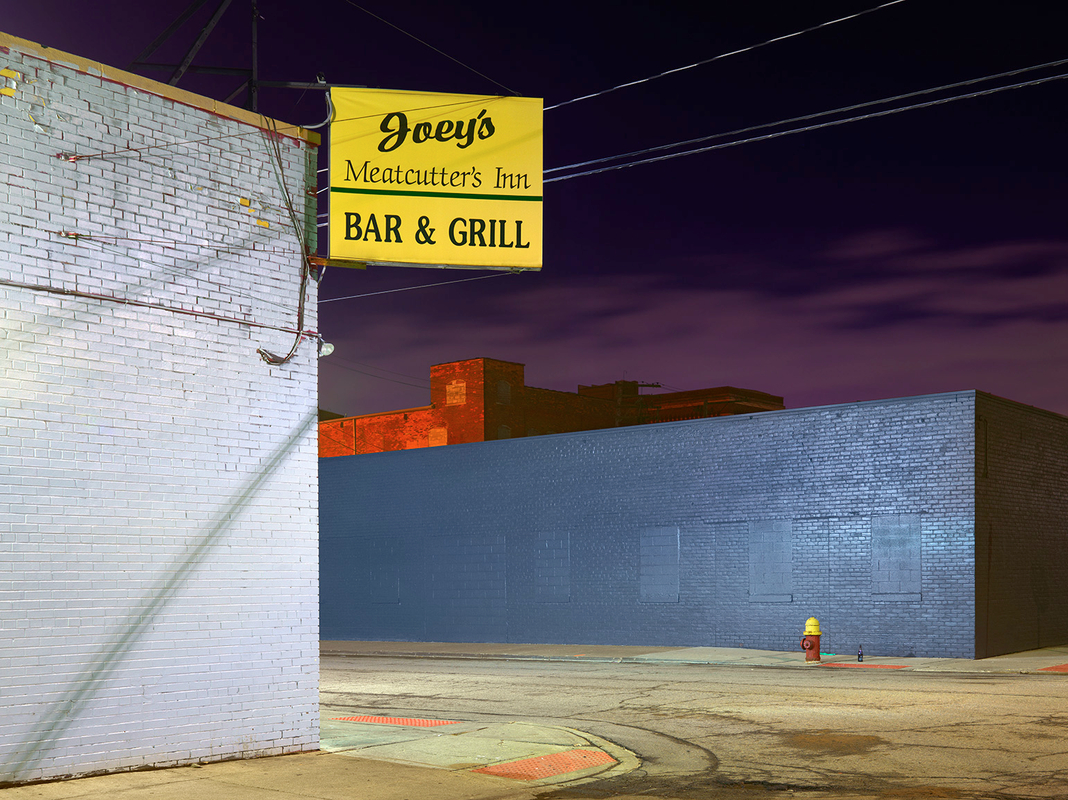
Joey's Meatcutter's Inn, Eastside, Detroit 2017

Immediately, I think of Edward Hopper: The lonely cityscape at night or the familiar glow of gas station lights cast into the American wilderness. The eye might want to linger among the colors, shapes and clouds even though the mind knows this is pretty much an empty street in a ‘post-industrial’ zone.

Perhaps it has do with another strand of expression: The break into free verse from past forms. The move from American Romanticism to Modernism which occurred this early past century. William Carlos Williams produced many good poems from a process of earnest, scrapbook-style intensity in trying to discover, redefine, and order a new poetic form within a modern ‘urban landscape.’

The individual artist is quite alone in the task he’s set before himself, and like much of modernism, it’s a rather big task.

Pastoral

When I was younger
it was plain to me
I must make something of myself.
Older now
I walk back streets
admiring the houses
of the very poor:
roof out of line with sides
the yards cluttered
with old chicken wire, ashes,
furniture gone wrong;
the fences and outhouses
built of barrel staves
and parts of boxes, all,
if I am fortunate,
smeared a bluish green
that properly weathered
pleases me best of all colors.

No one
will believe this
of vast import to the nation

William Carlos Williams

Do you believe any of that to be of vast import to the nation? Are you no one?

Another one of Jordano’s photos which stuck out was: ‘Church Rectory With Lightning, Eastside, Detroit, 2016

https://chrisnavin.com/wp-content/uploads/2018/04/b784b-6a00d83451ebab69e201b8d2e873dc970c-pi.jpg

Perhaps I’m not wrong in having called Halloween horror stills and movie images to mind (it’s my mind, after all, so maybe I’m just thinking of Devil’s Night). I really enjoy the light on the dumpster and the side-front rectory wall. There seems to be a little more mood here, more drama, so maybe Edgar Allan Poe’s ‘psychological intensity,’ his surrealism, and terror are more appropriate for comparison.

Poe was a bit mad, after all, despite his fascinatingly untamed and powerful imagination. He achieved a uniqueness and completeness of vision few artists do. Maybe there’s a bit of the sullen, self-aggrandizing earnestness in him of the teenager (J.D. Salinger); the desire to shock, delight and terrify.

The mind is as though a chamber, the horror rises to fever pitch, the lush rhyme matches an increasingly desperate search for truth and beauty in the world (Poe had very much his own Romantically inspired metaphysics).

Alone

From childhood’s hour I have not been
As others were—I have not seen
As others saw—I could not bring
My passions from a common spring—
From the same source I have not taken
My sorrow—I could not awaken
My heart to joy at the same tone—
And all I lov’d—I lov’d alone—
Then—in my childhood—in the dawn
Of a most stormy life—was drawn
From ev’ry depth of good and ill
The mystery which binds me still—
From the torrent, or the fountain—
From the red cliff of the mountain—
From the sun that ’round me roll’d
In its autumn tint of gold—
From the lightning in the sky
As it pass’d me flying by—
From the thunder, and the storm—
And the cloud that took the form
(When the rest of Heaven was blue)
Of a demon in my view—

Nice photos, Dave. Thank you.

As previously posted:

Via Curbed Detroit. (via David Thompson)

70 photos of the abandoned, foreboding Temple. Mysterious symbols and a certain sad grandeur that’s come to represent Detroit these days.

-Photographer Ben Marcin has a series called ‘Last House Standing.’ Solitary row-homes…the only ones left on the block.

From Buzzfeed: ‘Why I Bought A House in Detroit For $500:’

How did Detroit get here? Very comprehensive and easy to navigate.

More from Megan McArdle on the behavior that comes with pension bonuses.Charlie LeDuff, Detroit’s populist, citizen journalist’s youtube channel here. At least he’s sticking around.

Are you looking at beautiful photos and feeling sorry for Detroit, and yourself? See Time Magazine’s photo essay by Yves Marchand and Romain Meffre (less porn-like, more thoughtful).

Hipster hope, artists, collectivists and small business types can’t save it either: A Short Culture Wars Essay-Two Links On Detroit & ‘Ruin Porn’

GM is not a municipality, but good money got put in, probably after bad and it reeks of politics: From The Detroit News: ‘How The Treasury, GM Stock Deal Got Done’

Modernism At The Movies

You Can Have It

My brother comes home from work
and climbs the stairs to our room.
I can hear the bed groan and his shoes drop
one by one. You can have it, he says.

The moonlight streams in the window
and his unshaven face is whitened
like the face of the moon. He will sleep
long after noon and waken to find me gone.

Thirty years will pass before I remember
that moment when suddenly I knew each man
has one brother who dies when he sleeps
and sleeps when he rises to face this life,

and that together they are only one man
sharing a heart that always labours, hands
yellowed and cracked, a mouth that gasps
for breath and asks, Am I gonna make it?

All night at the ice plant he had fed
the chute its silvery blocks, and then I
stacked cases of orange soda for the children
of Kentucky, one gray boxcar at a time

with always two more waiting. We were twenty
for such a short time and always in
the wrong clothes, crusted with dirt
and sweat. I think now we were never twenty.

In 1948 the city of Detroit, founded
by de la Mothe Cadillac for the distant purposes
of Henry Ford, no one wakened or died,
no one walked the streets or stoked a furnace,

for there was no such year, and now
that year has fallen off all the old newspapers,
calendars, doctors’ appointments, bonds
wedding certificates, drivers licenses.

The city slept. The snow turned to ice.
The ice to standing pools or rivers
racing in the gutters. Then the bright grass rose
between the thousands of cracked squares,

and that grass died. I give you back 1948.
I give you all the years from then
to the coming one. Give me back the moon
with its frail light falling across a face.

Give me back my young brother, hard
and furious, with wide shoulders and a curse
for God and burning eyes that look upon
all creation and say, You can have it.

Philip Levine

Repost-A Reaction To Jeff Koons-For Commerce Or Contemplation?

Denis Dutton suggests art could head towards Darwin (and may offer new direction from the troubles of the modern art aimlessness and shallow depth) Review of Denis Dutton’s ‘The Art Instinct’

Two ways around postmodernism, nihilism?: Through postmodernism? One is Allan Bloom Update And Repost: ‘A Few Thoughts On Allan Bloom–The Nietzsche / Strauss Connection’…A structure in the desert…not even a city Update On LACMA, Michael Heizer And The ‘Levitated Mass’-Modern Art And The Public;.

A Link To Some Atlantic City Photos

Via Mick Hartley via Creative Boom-In Atlantic City: Photographs by Timothy Roberts that show its ‘last hurrah’ following years of struggle

Long ago in Atlantic City: I got my palm read by a girl under an aluminum scaffold covered with a cheap, white tarp.  It cost $15. She took my hand in hers and led me through the other booths to a canvas folding chair.  She traced my palm lines and told me I would be rich.  There was salt in the air, and a smell of tar rising from the boardwalk.  A fly kept landing on her cheek and she kept extending her lower lip, exhaling a breath to blow it away.  She was busy looking into my hand, my eyes, then off into the sea or seemingly within herself, as if divining some deeper meaning.  The fly would land again, crawl slowly over her cheek, and rub its two front legs together and over its eyes.

Her hand was soft.

As posted:

Glitzy:

From ‘Atlantic City Waiter’ by Countee Cullen

Just one stanza might do, to show there are many eyes you see, that may also see you:

‘For him to be humble who is proud
Needs colder artifice;
Though half his pride is disavowed,
In vain the sacrifice.’

It’s also the backdrop of a hard-luck guy with mob connections at the end of his rope. Desperate hopes.

As previously posted, and probably relevant enough to post here: Bowling Alone and Charles Murray:

The best poems I could find, but we’re not quite there to summer yet:

A Long Branch Song

Some days in May, little stars
Winked all over the ocean. The blue
Barely changed all morning and afternoon:

The chimes of the bank’s bronze clock;
The hoarse voice of Cookie, hawking
The Daily Record for thirty-five years

Robert Pinsky

What is the poet looking at?:

Neither Far Out Nor In Deep

The people along the sand
All turn and look one way.
They turn their back on the land.
They look at the sea all day. 

As long as it takes to pass
A ship keeps raising its hull;
The wetter ground like glass
Reflects a standing gull. 

The land may vary more;
But wherever the truth may be—
The water comes ashore,
And the people look at the sea. 

They cannot look out far.
They cannot look in deep.
But when was that ever a bar
To any watch they keep

Robert Frost

A Few Thoughts On Dave Jordano’s ‘Detroit Nocturne’

Detroit Nocturne‘ found here.  Via Mick Hartley.

I’m partial to ‘Joey’s Meatcutter Inn, Bar & Grill 2017‘:

Joey's Meatcutter's Inn, Eastside, Detroit 2017

Immediately, I think of Edward Hopper: The lonely cityscape at night or the familiar glow of gas station lights cast into the American wilderness.  The eye might want to linger among the colors, shapes and clouds even though the mind knows this is pretty much an empty street in a ‘post-industrial’ zone.

Perhaps it has do with another strand of expression:  The break into free verse from past forms.  The move from American Romanticism to Modernism which occurred this early past century.  William Carlos Williams produced many good poems from a process of earnest, scrapbook-style intensity in trying to discover, redefine, and order a new poetic form within a modern ‘urban landscape.’

The individual artist is quite alone in the task he’s set before himself, and like much of modernism, it’s a rather big task. 

Pastoral

When I was younger
it was plain to me
I must make something of myself.
Older now
I walk back streets
admiring the houses
of the very poor:
roof out of line with sides
the yards cluttered
with old chicken wire, ashes,
furniture gone wrong;
the fences and outhouses
built of barrel staves
and parts of boxes, all,
if I am fortunate,
smeared a bluish green
that properly weathered
pleases me best of all colors.

No one
will believe this
of vast import to the nation

William Carlos Williams

Do you believe any of that to be of vast import to the nation.  Are you no one?

Another one of Jordano’s photos which stuck out was: ‘Church Rectory With Lightning, Eastside, Detroit, 2016

https://chrisnavin.com/wp-content/uploads/2018/04/b784b-6a00d83451ebab69e201b8d2e873dc970c-pi.jpg

Perhaps I’m not wrong in having called Halloween horror still and movie images to mind (it’s my mind, after all, so maybe I’m just thinking of Devil’s Night).  I really enjoy the light on the dumpster and the side-front rectory wall. There seems to be a little more mood here, more drama, so maybe Edgar Allan Poe’s ‘psychological intensity,’ surrealism, and terror are more appropriate for comparison.

Poe was a bit mad, after all, despite his fascinatingly untamed and powerful imagination.  He achieved a uniqueness and completeness of vision few artists do.  Maybe there’s a bit of the sullen, self-aggrandizing earnestness in him of the teenager (J.D. Salinger); the desire to shock, delight and terrify.

The mind is as though a chamber, the horror rising to fever pitch, the lush rhyme matching an increasingly desperate search for truth and beauty in the world (Poe had very much his own Romantically inspired metaphysics).

Alone

From childhood’s hour I have not been
As others were—I have not seen
As others saw—I could not bring
My passions from a common spring—
From the same source I have not taken
My sorrow—I could not awaken
My heart to joy at the same tone—
And all I lov’d—I lov’d alone—
Then—in my childhood—in the dawn
Of a most stormy life—was drawn
From ev’ry depth of good and ill
The mystery which binds me still—
From the torrent, or the fountain—
From the red cliff of the mountain—
From the sun that ’round me roll’d
In its autumn tint of gold—
From the lightning in the sky
As it pass’d me flying by—
From the thunder, and the storm—
And the cloud that took the form
(When the rest of Heaven was blue)
Of a demon in my view—

Nice photos, Dave.  Thank you.

As previously posted:

Via Curbed Detroit. (via David Thompson)

70 photos of the abandoned, foreboding Temple.  Mysterious symbols and a certain sad grandeur that’s come to represent Detroit these days.

-Photographer Ben Marcin has a series called ‘Last House Standing.’ Solitary row-homes…the only ones left on the block.

From Buzzfeed: ‘Why I Bought A House in Detroit For $500:’

How did Detroit get here? Very comprehensive and easy to navigate.

More from Megan McArdle on the behavior that comes with pension bonuses.Charlie LeDuff, Detroit’s populist, citizen journalist’s youtube channel here.  At least he’s sticking around.

Are you looking at beautiful photos and feeling sorry for Detroit, and yourself?  See Time Magazine’s photo essay by Yves Marchand and Romain Meffre (less porn-like, more thoughtful).

Hipster hope, artists, collectivists and small business types can’t save it either:  A Short Culture Wars Essay-Two Links On Detroit & ‘Ruin Porn’

GM is not a municipality, but good money got put in, probably after bad and it reeks of politics: From The Detroit News: ‘How The Treasury, GM Stock Deal Got Done’

Modernism At The Movies

You Can Have It

My brother comes home from work
and climbs the stairs to our room.
I can hear the bed groan and his shoes drop
one by one. You can have it, he says.

The moonlight streams in the window
and his unshaven face is whitened
like the face of the moon. He will sleep
long after noon and waken to find me gone.

Thirty years will pass before I remember
that moment when suddenly I knew each man
has one brother who dies when he sleeps
and sleeps when he rises to face this life,

and that together they are only one man
sharing a heart that always labours, hands
yellowed and cracked, a mouth that gasps
for breath and asks, Am I gonna make it?

All night at the ice plant he had fed
the chute its silvery blocks, and then I
stacked cases of orange soda for the children
of Kentucky, one gray boxcar at a time

with always two more waiting. We were twenty
for such a short time and always in
the wrong clothes, crusted with dirt
and sweat. I think now we were never twenty.

In 1948 the city of Detroit, founded
by de la Mothe Cadillac for the distant purposes
of Henry Ford, no one wakened or died,
no one walked the streets or stoked a furnace,

for there was no such year, and now
that year has fallen off all the old newspapers,
calendars, doctors’ appointments, bonds
wedding certificates, drivers licenses.

The city slept. The snow turned to ice.
The ice to standing pools or rivers
racing in the gutters. Then the bright grass rose
between the thousands of cracked squares,

and that grass died. I give you back 1948.
I give you all the years from then
to the coming one. Give me back the moon
with its frail light falling across a face.

Give me back my young brother, hard
and furious, with wide shoulders and a curse
for God and burning eyes that look upon
all creation and say, You can have it.

Philip Levine

Repost-A Reaction To Jeff Koons-For Commerce Or Contemplation?

Denis Dutton suggests art could head towards Darwin (and may offer new direction from the troubles of the modern art aimlessness and shallow depth) Review of Denis Dutton’s ‘The Art Instinct’

Two ways around postmodernism, nihilism?: Through postmodernism? One is Allan Bloom Update And Repost: ‘A Few Thoughts On Allan Bloom–The Nietzsche / Strauss Connection’…A structure in the desert…not even a city Update On LACMA, Michael Heizer And The ‘Levitated Mass’-Modern Art And The Public;.

Ah, Look At All The Lonely People-‘Jeff Koons Is Back’ Via Vanity Fair

Full piece here.

-Koons gets the Annie Leibovitz treatment (an unfortunate photo at the link).

-This is not a commentary on Koons’ art, some of which I like well enough, it’s a much worse beast: Another attempt at cultural criticism.

In the talk around Koons, what often stands-out to me is how much talk there is about Koons himself, and the search for meaning in all that talk. The concept of artist-as-individual is nothing new: An isolated Self, quite apart from society, mining his interior life and experiences in order to represent beauty, meaning, and some attempt at expressing universal truths through his work and craft. This is unsurprisingly part of what all artists do, and the extreme individuality of this process is what Western artists somewhat consciously have been doing for a few centuries now, from musicians to writers to sculptors, from romanticism to modernism to post-modernism and beyond.

The fact that Koons is doing this with such relentless self-promotion and while also courting celebrity is arguably a much more ‘modern’ phenomenon. A certain amount of melliflous, abstract bullshit seems part of the Koons’ game, as if you’d walked onto a used-art lot as Koons tours you around, asking what’s-it-gonna-take-to-get-you-into-one-of-his-pieces, yet with soothing, professional demeanor, offering an invitation to return a part of of your Self to you and make you whole again within the work produced by his Self. Jeff Koons is a brand.

Perhaps this is what it takes these days to make a living by schmoozing with wealthy art-buyers, but in some ways, it has a distinctly American feel as well. High and low culture mix in a highly commercial, utilitarian way. The urge to merge abstract art and the avant-garde with mass, pop-culture is expressed. Fame and meta-critiques on fame, celebrity, money, the Self amplified for all the other Selfs to see has implications for much of our culture, I suspect.

As to establishing Koons’ bona fides enough to merit attention by Vanity Fair…here are a few quotes from the piece:

“Jeff is the Warhol of his time,” proclaims Adam Weinberg, the Whitney’s director.

Everyone’s getting in on the bullshit!

‘The reference to Curtis ties Koons to the last true avant-garde—a pedigree the artist likes. Curtis, who refused to be called a drag queen, was a pioneer of the L.G.B.T. movement and, like Candy Darling, was made famous by Warhol’

You need the cultural legitimacy of an L.G.B.T. blessing to be truly avant-garde these days.

‘What Warhol and Koons do have in common, though, is an uncanny ability to nail an image or an object so that it catches the Zeitgeist.’

Partially true, perhaps, but what if the Zeitgeist is nothing but a leafy suburb full of good schools, intact families, and moderate lives?  Isn’t this why some youngish people (ahem…many hipsters) often leave their small towns and suburbs looking for meaning, group membership and purpose in what can end-up vaguely collectivist and vaguely individualist lives in cities?

Everyone’s an artist, these days.

Establishing modernist credentials for the brand:

 ‘Koons’s job at MoMA gave him the opportunity to immerse himself in the history of modernism, in particular the ideas of Marcel Duchamp, who changed art history by showing how everyday objects, or “readymades,” could be elevated into the realm of art, depending on context. Duchamp’s theories were a revelation to Koons.’

Piketty and Brecht in the same paragraph:

‘Barbara Kruger, the artist whose unsentimental pronouncements have been cutting to the chase about the art world for decades, says “Oh boy” when I call to discuss Koons, whom she has known since they both were starting out in New York. She needed to think about it and later wrote me: “Jeff is like the man who fell to earth, who, in this grotesque time of art flippage and speculative mania, is either the icing on the cake or some kind of Piketty-esque harbinger of the return of Brecht’s ‘making strange.’

And finally, while I have no quarrel with neurosicence, pop-neuroscience is often a repository for the modern search for legitimate experiences and theories of the Self:

‘Dr. Eric R. Kandel, a Nobel Prize-winning neuroscientist, was so impressed with the show that he e-mailed Koons afterward. I asked Kandel why. He explained, “I have been interested in the ‘beholder’s share,’ an idea that came from the Viennese art historian Alois Riegl. It involves the concept that when a painter paints a painting or a sculptor makes a sculpture it is not complete unless a beholder, a viewer, responds to it.”

Kandel adds, “When you looked at the sculptures you saw yourself embedded in the gazing balls. Artists sometimes put mirrors in works, but they don’t design the work so that you find yourself in the arms or chest of a statue, which is what Jeff did.’

Go and find your Self and be made whole, dear reader, within Jeff Koons’ work and the Jeff Koons brand, and try and tell the dancer from the dance.

————————

Koons’ Made In Heaven only amplifies that sound, blurring the line between art and porn, private experience and public show, innocence (so easily corrupted) and naive, narcissistic indulgence.

I suspect Made In Heaven explores previous themes of high and low that were already emerging in his kitsch work, fleshed out in pieces like Michael Jackson And BubblesWinter Bears and on this site: ‘St John The Baptist’.

Some quotes from Koons:

‘This type of dislocated imagery is what motivates people. They’re amused by it, but they have a lot of guilt and shame that they respond to it.  I was trying to remove that guilt and shame.’

Another quote which highlights an idea of some import to the nation:

Coming from a suburban, middle-class background, as he did, he felt that there was something, if not dignified, at least, too easily discarded about this kind of imagery and this kind of sentiment.’

Roger Scruton says keep politics out of the arts, and political judgment apart from aesthetic judgment…this includes race studies/feminist departments/gay studies etc.:  Roger Scruton In The American Spectator Via A & L Daily: Farewell To Judgment

Goya’s Fight With Cudgels and Goya’s Colossus.  A very good Goya page here.

Joan Miro: Woman… Goethe’s Color Theory: Artists And ThinkersSome Quotes From Kant And A Visual Exercise

A Reaction To Jeff Koons ‘St John The Baptist’

Denis Dutton suggests art could head towards Darwin (and may offer new direction from the troubles of the modern art aimlessness and shallow depth) Review of Denis Dutton’s ‘The Art Instinct’