For the time being, the detective story ‘The Case Of The Five Ties’ will be discontinued. Writing crime fiction isn’t at my core, it seems.
As large organizations must ‘strategically realign and re-position‘ themselves due to ‘changing market conditions’, I, too, must ‘implement departmental changes‘ within Navincorp. Wiley, Harry and Oliveira are now free to find meaningful work in different stories, with different character arcs. Many plots are doing quite well right now. Handsomely, in fact.
To those saying my brisk and sudden beeline towards the tall grasses, where a man may find quiet repose, lacks certain qualities of leadership. Cowards, all of you.
Thanks for the email suggestions. A few of you should CLEARLY be writing your own stories. Keep at it.
Harry Gruyaert’s celebrated, but I’d argue he’s still underrated for his mastery of color.
From Kenn Sava, Gruyaert’s not a portraitist, per se:
‘It’s not the person that interests me most. It’s the person in its environment. To me, all the elements are important. I don’t have any particular intention. It’s just what I see.
I think humans have such a great idea about ourselves, but nature is so much more powerful.’
According to the interview, American pop-art influenced Gruyaert, potentially freeing him from elements of European formalism (pushing him into some great color work). If you’re interested in seeing fine color, atmospheric and ‘lived-in’ photography, I’d recommend Rivages.
—
As for pop-art, it can often be colorful, innovative, intuitive and non-serious…on the surface.
Frank O’Hara’s mid-century American poems are surprisingly visual. The idea of a wild freedom wrapped within casual conversation; a moment to moment associative intensity is achieved through O’Hara’s form. This is often where we long to be, on the edges of possibilities, living intensely with others (even through memory, sometimes especially through nostalgia and memory).
Also, the poem suggests this freedom as a return to our animal natures; which involves a certain view of Nature, functioning as a Romantically primitive return to Nature. Frankly, it’s a pretty good love poem.
Animals
Have you forgotten what we were like then when we were still first rate and the day came fat with an apple in its mouth
it’s no use worrying about Time but we did have a few tricks up our sleeves and turned some sharp corners
the whole pasture looked like our meal we didn’t need speedometers we could manage cocktails out of ice and water
I wouldn’t want to be faster or greener than now if you were with me O you were the best of all my days.’
As for color, perhaps this also doesn’t mean color must be completely abstracted into the ambitious meaning-making mission of Mark Rothko. I mean, the sky is blue, the trees green, and the balloons red and yellow.
‘Mark Rothko sought to make paintings that would bring people to tears. “I’m interested only in expressing basic human emotions—tragedy, ecstasy, doom, and so on,” he declared. “And the fact that a lot of people break down and cry when confronted with my pictures shows that I can communicate those basic human emotions….If you…are moved only by their color relationships, then you miss the point.”
Seal the compound…I mean chapel. (come to Houston, land of little zoning, fair pilegrim).
—
Readers will know this blog maintains skepticism for pop-art Neo-dadaism and the consecration of ordinary objects along the Duchamp line (‘American Standard’?). Making Duchampian exceptions rules, even clever rules, can desecrate what’s important.
Everyday people, living right, must keep the important things in view, namely wife/husband/children/parents/death/taxes/health/time; not merely their own impulses nor artistic visions (artists remain acutely aware of such indifference). Meaning is usually to be found within love for another, and this usually means everyday people (& the everyday within us) lives between the sacred and profane: The 9-5 grind and the unexpected conversation about grandma’s death, the enveloping silence afterwards.
Artists, at their best, point towards wisdom, truth and beauty regarding everyday things. All the artists I’m linking to are doing so in one way or another, although ‘how’ and ‘how well’ are endlessly disputed.
I’ve already seen a thousand urinals in my life, Marcel, even a few in my dreams.
The triumph of the conceptual over the actual, the mass-produced over the created; perhaps these aren’t entirely healthy trends. The retreat into (S)elf, and the retreat into irony alongside (A)rt as commodity, perhaps these are dead-ends as much as they are freshly-paved streets. The lamentations of art as (R)eligion could be a leading indicator of a deeper hunger for meaning; a hunger with as many bad as good outcomes for artists and everyday people…
Some food for thought, Dear Reader.
As a contrast, here’s some American art that’s more grounded; some realism with psychological depth, albeit with impressionist influence.
I think Raymond Chandler’s High Window is among the best of the American detective novel.
Here are some quotations of his, if you’re interested.
“Los Angeles was just a big dry sunny place with ugly homes and no style, but good-hearted and peaceful. It had the climate they yap about now. People used to sleep out on porches. Little groups who thought they were intellectual used to call it the Athens of America.”
Here is the link. It’s been a long time since they just reviewed the book and not the author.
Boy, oh boy, James Ellroy: America’s best current historical crime fiction writer, showing up to entertain, shock and vulgarize:
The poem that most came to mind after looking at Hopper:
Acquainted with the Night
I have been one acquainted with the night. I have walked out in rain—and back in rain. I have outwalked the furthest city light.
I have looked down the saddest city lane. I have passed by the watchman on his beat And dropped my eyes, unwilling to explain.
I have stood still and stopped the sound of feet When far away an interrupted cry Came over houses from another street,
But not to call me back or say good-bye; And further still at an unearthly height, One luminary clock against the sky
Proclaimed the time was neither wrong nor right. I have been one acquainted with the night.
Red scruffy chin-beard yanked open the roll-up door at the same time the black man flung himself into it, pushing his way out. Redbeard caught him by the neck, dragged him to the ground and pinned his chest.
Harry could make-out a streetlight thirty-feet away, some pavement, and gravel leading up a hillside.
‘Let me the fuck go’
Oliveira appeared, leaning over the man, headset tumbling forwards. He slapped the man’s face loudly.
‘What is this?’ Oliveira yelled.
‘Get me the fuck outta here I said’
Headlights approached, quickly flashing off. The man in the Prius jumped out and also pinned the man with both knees. The scene was now one of panic.
Oliveira slapped the man again, viciously. Redbeard arose, striding over to the roll-up door and slamming it shut.
In the darkness, seven Mexicans, two Filipinos, one black guy and Harry listened to the commotion outside for a minute; no one saying a word.
—
I’m listening.‘ Wiley said. ‘We’ll be okay here.’ He’d parked against a slice of curb in a five house cul-de-sac, about a mile from first contact with ‘John.’
‘There is not very much security on this network.’ John said. ‘Regular password. I can’t use my own hotspot. This is not even my device sir. I am like a criminal.’ John leaned over to Wiley, showing him the screen.
‘My company automates existing workflows. Big, global clients. We sync them with AI engines and AI agents. We migrate client data onto our platform for testing, and the client decides what to automate.’
‘Got it.’ Wiley said
Hart International Shipping has offices in China, Venezuela, Brazil, Seattle, Tacoma and Los Angeles. Big ports. They must have granted access to sensitive data during the migration. Financials, internal emails etc.This is normally a compliance issue. We don’t want to know.‘
‘We informed Hart and they quickly shut off testing. Same day. All data removed. Then, there was almost no contact. This account has been sitting open for six months. Our companies’ lawyers are in some limited communication. I have moved on to other clients.’
‘Clear as a bell.’
‘Last month, our accountant started receiving phone calls. A man was asking questions about companies in South Seattle. What kind of work does she do? This is not her job at all.‘
‘One evening she approached me saying a strange man is in the parking lot, and she does not want to leave the building alone...’
Derek—‘I know, but…these…shapes in my head. They’re everywhere. They’re in my dreams.’
Alan–‘You can program your mind to notice anything. You’re making good money. No drinking…no crazy drugs, right?
Derek–‘I know…I know…nothing like that. You’ve been a good friend to me. I’ve got to share this with the world..this is…what I’m supposed to be doing.’
Alan-‘I’ve got a mortgage. You’ve got a mortgage. What about your KIDS? What about Kathy?’
Derek-‘The music. It’s the same five notes again and again. I’ve already booked the tickets. We’re leaving Sunday.
Alan-‘Jesus. I can’t get behind this, Derek. This is crazy.’
Derek–‘Notes echo into the blackness, yet the lightboard shines back. We are not alone. The choir was there all along; every note resolving at ONCE.
Alan-Are you at home? Are the girls there with you now?
Derek–A TOWER OF ALIEN SCHMALTZ, Alan. You’ve never seen so much SCHMALTZ!
Where was the data coming from? Who was controlling the flow?
—
Wiley parked in an unused Microsoft lot, with visibility and cover behind a parked construction crane. He figured he’d have some minutes before he aroused suspicion. Stop #71335 sat halfway down a ramp, towards 520, heading West. About six people milled around, two getting on a bus, then a few more filtering in: Three Indians, two Chinese professional women and a white guy in sweat pants with his belly hanging out in the cold.
Shouldn’t there be more people? These buses are leaving campus, heading towards Seattle. Is this the wrong stop? Was it the stop heading East? As these thoughts flashed across Wiley’s mind, someone knocked on the window.
Startled, Wiley’s hand reached for his sidearm under his shirt. ‘No, no!’ the man said, backing away. ‘Please it is me’. He was wearing a red coat with a pea-green hat.
‘I’m sorry. I have to be careful’ his arms dropping to his sides. ‘So careful. This is very bad now. You are Wiley and I will present everything.Let’s turn off our phones off and drive.’
Wiley nodded and motioned the man around the car. He appeared to be in his late twenties, thin with glasses. Wiley scanned and saw no one else around. So much for ‘Emerald City Investigations offers top-notch surveillance skills.’
‘Call me John.’ the man said climbing in. A laptop was under his arm as he placed his backpack between his legs. ‘Thank you for coming. It is me. Please head away from here through the neighborhoods. Your phone must be off. We will find a network.’
Harry hadn’t noticed a teal Prius sitting thirty-feet away. The driver was staring at his phone. Harry saw two open laptops inside.
—
One of the two men, thin-shouldered with wingtips, began pacing while speaking into a headset. The left side of his face was scarred.
A tall man with sunken eyes lifted the roll-up door of the Penske truck, motioning the group inside. He wore a scruffy, red chin-beard.
Harry counted seven Mexicans (one under five feet), two filipinos (Tagalog), and two black guys as everyone piled in. Only a coiled length of rope lay coiled in the corner. No tools. No other equipment.
Mexican patter began to fill the stuffy box. The truck did a half-turn in the gravel lot, exiting on Marginal. Left.
—
8:37 pm.–The smell was horrendous. One of Harry’s group began to whistle. Clear, high, bird calls. A little unhinged. Now, the man was rocking back and forth, intense and agitated.
‘Stop the goddamn truck.’
Harry and another man grabbed his shoulders.
‘This is easy money, come on motherfucker‘
‘Get me out’ Stop the goddamn truck!’
A few Mexicans began whistling their disapproval. The man was standing in the middle of the truck, swinging his arms wildly.
Among the rain and lights I saw the figure 5 in gold on a red firetruck moving tense unheeded to gong clangs siren howls and wheels rumbling through the dark city.
‘Imagism was a sub-genre of Modernism concerned with creating clear imagery with sharp language. The essential idea was to re-create the physical experience of an object through words. As with all of Modernism, Imagism implicitly rejected Victorian poetry, which tended toward narrative.‘
And:
‘The most exemplified phase of Modernism, referred to as “High Modernism,” occurred during the inter-war years (1918-1939). This was the time when writers synonymous with Modernism, such as Virginia Woolf, James Joyce, T.S. Eliot, and D.H. Lawrence, thrived. While Victorians typically concerned themselves with rendering reality as they understood it into fiction, Modernists recognized that reality was subjective, and instead strove to represent human psychology in fiction.‘
In response: I don’t believe reality to be subjective, though I’ve met a lot of people who seem to.
Where’s the proof for such a claim?
For my part, I believe reality is there, and that my senses are giving me evidence and essential elements of reality. One of the strengths of the camera is the ability to move faster than the eye and brain (stuff I’m too slow to notice and process…lots of randomness).
While I’m inspired deeply by much modern art, and was raised in a postmodern milieu, I’ve not been persuaded by postmodern truth and knowledge claims. Postmodernism seems like a game with unclear rules, a few admirable people, and a lot of weirdos answering to Nehru-jacket-wearing authorities spewing gobbledy-gook.
During the post-war years, the confessional poets, with a fair amount of free and blank verse became dominant, with a kind of feelings-first, psychological exploration of the (S)elf. We’re now seeing many downstream effects in our culture (I’ll leave this to your imagination…for good and ill).
The Straussian truth and knowledge claims, as one example, pushes back to a kind of classicist revival, an embrace of tradition, and rejection of much modern and postmodern thinking.
And now for something…somewhat related…
What I’ve Seen Lately In The Lonely Parts Of Town. I like abstraction, and certain shapes I see. I like arranging photos in series/sequences to highlight certain shared variables (color, light, shape etc.). This attraction starts with my senses out in the world, but ultimately must answer to my physical limitations, limitations of my technique/skill and limitations of the camera. It must answer to limitations of time, weather and light conditions, and the wishes of other people.
I’m usually behind reality, or in the wrong position, or I just missed what was a lovely, serendipitous moment. There are the known knowns I missed, the known unknowns, and also the unknown unknowns (stuff I’ll never see, but for example, I can admire in the work of other photographers).
Anyways, what a long-winded ass I’ve become. I hope you find something of value in this short four-photo-sequence.
Through fog, remembering the day’s words, true and untrue, the ships must all go now
to sea, spreading their news. Gazing down the wells of the afternoon,
the sunlight turns silvery-blue.
—
Give me one minute and your mind. 1. Please read the poem aloud. 2. Take a closer look at the photo 3. Play the first 30 seconds of Chopin’s Nocturne in B-flat minor, Op 9, No. 1. (past the 00:26 mark).
The goal: Create a dreamy, contemplative experience before you move on.
8:24 pm Friday night: Agressive mist and wind pelted Harry’s face. The asphalt under 99 was slick; a series of rented scooters abandoned along the way.
He wore a dirty hoodie, the oldest jeans he could find, and Wylie’s boots (one size too small).
He’d approached the only person near the stadium; doubled-over, coming down from a fentanyl high. The man lifted his face, shuffled back into a pillar; slumping down into a sitting position.
—
‘What do you want?’
‘Warner told me to meet’
‘You got junk? You got money, man?’
‘You alright?’ Harry said, crouching down.
‘I’m alright.’ the man said staring vacantly ahead. A smile grew on his face. A healthy mistrust hung in the air: ‘Warner’s got a girl up on the hill. Probably where he is.’
Harry appreciated the effort.
‘I’m looking for work’ Harry said, holding out a $50. ‘for the night.’
Ronnie’s hand was bloated and cold.
‘Yeah they got that shit locked down. I’m sleepy. Warner ain’t here so I ain’t going nowhere.‘
Harry handed him another $50. Both man stared into the darkness.
‘The knife place. 8:30 pm.’
‘Off Spokane?
‘Yeah’
‘Tell Warner to call me. Harry said. ‘Look me up.’
‘Yeah, he told me about you. I didn’t send you and I don’t fuckin’ know you.
—
Harry walked down 3rd, texting Kathy. ‘Near Epicurean Knife Store. 8:30 pm. No Warner.
He remembered seeing a bank of bikes and turned West on Atlantic. He started slow-jogging. ‘Shit.’
The phone buzzed. ‘Be careful. No Oliveira info. Wylie not back. Wendell unclear.‘
Harry got to Alaskan in about five minutes. There were no bikes, only two scooters…
—
Soon, Harry was trundling along at twelve miles per hour. He reached the corner of an industrial building. He set the scooter down, tapping ‘end ride’ on his phone. It chimed way too loudly.
As he rounded the corner, ten or eleven men stood in a semi-circle, between a set of train-tracks and a graffiti-covered wall. Most had hoodies. There was a mid-size box truck parked fifty-feet away, under a curving overpass where two men stood.
The email: ‘My company’s missing fifteen-million dollars over eight quarters. MASSIVE data fraud. All points in Seattle’s port. Only three of us know (on the American side). Help.‘
That was one way to get a private eye’s attention.
The cold seemed to seep in from the front windows. Harry’s eyes traced the worn edges of the ‘D’ in ‘Emerald City Investigations.’
Wylie: Who else knows and what are the risks? Why not just escalate through the company?
Harry’s eyes lingered on a large indentation in the glass; raindrops gathering there until their sudden release.
The building’s radiator rattled to life.
Kathy: ‘The prosecutor’s office? The Commission? We’re not that important. Look at this office.’
Wylie: What if it’s a setup?I’ll trace the server.’ We should ask for like, $300 an hour.’
Harry read the last part of the email aloud: ‘I will be at the #71335 bus stop at 8:00 am tomorrow. Red coat, green woolen hat. Normal routine. No errors. I need to trust someone. Kindly. Please. Please.’
‘What about a pretty please?’ Wylie said. ‘I’ll go Harry.’
Swimming far-out, most men tell their wives when brushing-up against something sinister. A confidante. Someone.
Most people, most of the time, choose not to notice.
Who knows how people come to haunt their own lives?
Warner had been in some kind of band, then out wandering the street for fifteen years. He’d emerge from time to time with ideas. Harry noticed three new crosses behind his left ear and a long, purple scar on his right hand.
—
‘It’s free if you guys want it. That’s what I’m saying.’
‘People meet every night. That’s free?’ Harry asked.
‘What I’m giving you. Something’s going on. Guys in Bremerton. The construction guys. Everybody knows.’
‘Knows what?’
‘I can’t tell you all of it. I don’t know. You sit there all night and they give you $75. That’s real fuckin’ money.’
‘What I’m tellin’ you is you get $20. For showing up. $50 for the night.’
‘That’s $70. I need a place, Warner. Names.’
‘You smell like shit, Warner. Don’t touch my desk.’ Wylie handed him a Red Bull.
‘I don’t have to be here.’ A long pause. Warner looked down at his feet. ‘Oliveira.’
What’s he look like? Harry asked.
Brown guy. Glasses. Like a banker. Short hair. He speaks German too. Good English.’
‘And you guys work?’ Harry asked.
‘You ask around. You show up but nothing happens. They take one group of guys, and disappear. Like a Penske truck. Illegals. Then it changes.’
‘What changes?’
‘The place. You gotta know someone, then it’s somewhere else. But you gotta know someone.‘ They pay out, man.’
‘German?’ Wylie asked, staring.
‘Yeah, it’s fuckin’ German.’
‘Get me in,’ Harry said.
‘Ronnie’s on 4th near the stadium.‘ $500 now and $500 when we’re done.‘
‘$100′ right now and we talk when it’s done’ Harry said, handing Warner a bill. I’m good for it.
‘Tonight,’ Warner shuffled out staring at Wylie.‘You can’t come, asshole,’
‘Text me, Harry.I got like five phones.‘ He shouted from the hall.
—
‘Oliveira’s Portugese’ Harry said. ‘Popular name.’
‘There are Germans in Brazil. Supermodels.’ Wylie said.
‘Lots of places to learn German’ Kathy was standing in the doorway. ‘I’ll check AI, incarceration, sex offenders, construction companies. Brazilians just replaced my neighbor’s roof’
‘II’ll talk to Skoda. He does data privacy. Maybe he knows something.’ Wylie said.
‘Lots of companies unloading on the Island.’ Harry said. ‘Fifteen million is serious money.’
‘There was a strike last year. Remember the Asian front food company near Georgetown?’ I can’t remember the name….lots of fraud’ Kathy said walking out. ‘My friend knows someone who works delivery. I’ll look that up, too.
‘Who makes money on each shipping container?’Who touches these containers?’
From our rather reasonable AI overlords: ‘Common skepticism is a healthy critical attitude towards dubious claims, while philosophical skepticism challenges foundational knowledge and the justification for belief itself, demanding proof for everything, a stance few people adopt in daily life.’
I knew a philosophic skeptic, he was smarter than me & fun, but, man…what an asshole.
Commoners have good reasons to be skeptical when it comes to modern art:
‘Titled Comedian, the humoristic piece can be considered a challenge to the sometimes-absurdist nature of the art market and the art collecting world. “To me, Comedian was not a joke; it was a sincere commentary and a reflection on what we value,” said the artist in an interview at the time. “At art fairs, speed and business reign, so I saw it like this: if I had to be at a fair, I could sell a banana like others sell their paintings. I could play within the system, but with my rules.”’
Who can forget the transcendent darkness of this photo (the shock-concept and the celebrity overshadowing the skill/visual impact).
‘He immersed a crucifix he bought in an antique shop in his own urine.‘
Fellow commoners, we have as a counterpoint, rather beautiful, innovative classics like Falling Water, by Frank Lloyd Wright. A pain in the ass to maintain, but still a place for the genuine:
As I see the world: We have beliefs, and we’ve usually locked them away beyond critique. So has most everyone else. Some beliefs have more truth in them than others.
We use shared beliefs to form and maintain relationships. We use them to get stuff and give other people stuff. We rely on shared beliefs to organize events/clubs, workplaces, and hierarchies of judgment and knowledge, without killing each other. Shared beliefs regulate and help us navigate our emotions, as well as our personal, interpersonal and social behavior. We outsource much of our thinking to shared beliefs, while forgetting they’re even there. We’re often proudest of passing our beliefs on if we think they’re true, lasting and important.
The rub is the relationship these beliefs have with truth, and knowledge. A modern rationalist might say something like: ‘We have access to enough scientific and economic knowledge to run the government, and effectively plan your life. (M)an is something holy, and we’ve only just begun perfecting (M)an.Go ahead be creative and vote for the $1 billion arts package or else.‘
A typical Catholic might say something like: ‘Let’s check in with Canon Law. The Pope is closest to God, then the Cardinals, then the Archbishops etc.’ We’re only redeemed through Christ. So….that’s what art should be doing. Capiche?
What if a radical questioning of belief becomes the norm, around which people are…still believing?
What, then, do people actually believe?
What do artists, often radically questioning belief while making stuff, actually believe?
Those increasingly ridiculous artist statements? Some curious mix of irony, doom and nihilism all the way down? Modern mysticism?
A digression: Let’s say a kid in bad neighborhood, at a vulnerable age, joins a gang. He gets protection, savage discipline and access to stuff. The gang serves dark masters of the soul of course (in our case: How to rob specific makes/models of cars and sell them for parts, leaving a trail of harm, making the kid violent and dangerous).
Let’s also say the same kid in a bad neighborhood, on weekends, hangs with his uncle. His uncle fixes cars. Our kid learns to honor something within himself, other people, and the world. Like his time with the gang, life unfolds as a series of challenges, struggles and possibilities. Yet, his lifespan probability opens from twenty-two to sixty-four. Much better of parts of the kid’s nature come forwards. People drive their cars away, grumbling over the price and the delays…but, still.
Clearly, one path is better for the kid, the neighborhood and the rest of us?
Surely?
Now, what if, at school, that same kid is particularly talented, smart and sensitive? What if he is guided by someone towards personal self-expression, and even the eventual self-doubt, poverty and emotional rollercoaster of a typical artist’s life?
Shouldn’t the kid at least be taught how to notice things? how to describe how a good painting looks? how to draw? how to draft? how to mix paint?
Surely?
These days, it seems we find ourselves in a ‘post, postmodern landscape.’
What is this curious, Western belief to ‘blank-slate’ everything? How can it be true that the kid’s emotions are a reservoir and his reason a man-made, oppressive dam? That he just needs to make a dark, mixed-media video collage and he’s arrived?
It seems making simple moral judgments in real-world scenarios raises serious questions about the Romantic/Modern/Postmodern projects.
The case for the visual art over the primacy of concept/idea: Lets say you’re looking at John Singer Sargent’s ‘Lady Agnew Of Lochnaw‘ (somewhere between realism/impressionism). You’re not looking at merely the idea of painting (good paintings already have ideas in them).
—
Maybe you want to touch her skin? How did he paint like that? Look at the color and light. What is the artist saying? This painting took six sittings, but, arguably, a lifetime and maybe the better elements of a civilization to achieve.
A simple case: The Duchamp/Warhol line (concept/idea over visual communication/technical skill) warrants tremendous common-sense skepticism (I’ve gone a little deeper…but you get the point). Enough already.
Bananas duct-taped to walls and crucifixes dunked in piss are not just wasting our time, perhaps they’re harming our imaginations.
There are so many reasons to doubt so much bullshit within modern/postmodern thinking, while at the same time learning from the good.
—
Tom Wolfe went on the T.V. with William F Buckley (too political for my taste) to discuss his book: ‘The Painted Word.’
At min 5:39 Wolfe argues the following (one part of the art/money/celebrity feedback loop):
‘It’s really a religious thing. One thing I didn’t say in The Painted Word, that I should have said, is that art today, is the religion of the educated classes. I don’t mean that by analogy, it isn’t like being a Baptist in 1870, it is being a Baptist in 1870.’
—
From Art vs Machine: Here is a video making the case that Jackson Pollock achieved something, but it wasn’t really the innovative use of drip-paint.
Maybe it was kinda beautiful in its own way? Romantically Primitive?
—
Also, are Robert Hughes criticisms’ of Andy Warhol’s art really blocked by YouTube?
Making a hero of the androgynous anti-hero is orthodoxy these days, but also pretty tired (the Warhol to Bowie line seems over-rated):
—
What came before modernism/postmodernism? Why the below video might be worth listening to (min 34:22):
‘There was a great turn towards emotionalism. There was a sudden interest in the primitive and remote; the remote in time and the remote in place. There was a outbreak of craving for the infinite’
A movement emerged, about 1760–1840, which has deeply affected our conceptions of the Self, Art, heroes and villains, and most importantly, what makes life worth living.
Detective Harry: ‘Good light, nice drama. Way too much negative space. Don’t be afraid to put more in.‘
‘Read this poem and come back in a month.’
—
—What’s this poem about? What’s this got to do with winter?
‘My tab’s due…time to go.’
—‘Okay, Harry, all right…’
—
Blizzard
Snow falls: years of anger following hours that float idly down — the blizzard drifts its weight deeper and deeper for three days or sixty years, eh? Then the sun! a clutter of yellow and blue flakes — Hairy looking trees stand out in long alleys over a wild solitude. The man turns and there — his solitary track stretched out upon the world.
‘For yet another cause of unhappiness was the encroachment of machine industry and its attendant uglification of town and country. The Romanticists had sung in an agrarian civilization; towns were for handiwork and commerce. Industry brought in not factories only, and railroads, but also the city — slums, crowds, a new type of filth, and shoddy goods, commonly known as “cheap and nasty.” And when free public schools were forced on the nation by the needs of industry, a further curse was added: the daily paper, also cheap.’
The incentives of print/online clickbait aside, our author can’t just write about something so boring and conventionally dull as taking a walk through the city at night, partaking in the pleasures of the flaneur.
A self-date is about reclaiming that control. The choice is yours: What would you do with your time if no one else got to call the shots? For how long would you do it, and when?
I’m being an a**hole here, but, must everything be given a theory and an explanation?
I mean, you can’t handle that kind of freedom to take a walk, right? Nor be alone with your thoughts?
Therapeutic, conformist psycho-babble is pretty common out there, as well as articles about aloneness away from these incessant screens and inter-connectedness.
As I age-out into irrelevance (Gen X), spinning sadly into forgetting, weakness and oblivion, I’d like to remind younger folks: I didn’t ask to be born in something like a Great Unwinding, either. I’ve found some poems, photographs, music and paintings which I love. I hope you come to appreciate them, too. I’ve found work which challenges me, and some principles I find worth defending (speech, property, and the honor freedom requires).
This technology will end up being the main story of our times, quite likely.
Everybody wants to be a (S)elf, nobody wants to be a (S)elf.
I’m pretty sure: The nihilist fog has settled in and will be here for awhile. American politics will likely become even more contentious. Political parties will be increasingly full of (S)elves and (C)auses, as well as the odd principle. Cynicism and ironic detachment will wear much easier than patient duty. Many institutions are becoming captured by true-believers. Righteous people, of course, will often prevail (not necessarily right, nor truthful, nor reasonable…especially in groups and through the laws).
If you’ve read thus far, thank you, so here are some past thoughts and links for free:
We should be comforted when corporate/bureaucratic art is bland, bad, and uncommunicative. After all, do you think you’d trust a bank more or less if it had a shocking modern/pop art sculpture in the lobby?
What about when their marketing team tells you how you should think, behave and act?
The attempt to seek collective purpose and postmodern meaning in modern art, music and even cartoons etc. is fast upon us. The flirtations with nihilism can encourage more desperate collectivist/ideological impulses to fill the void. The excesses are many.
As for a critique of Albany Plaza, another modernist/bureaucratic concrete wonderland, here’s Robert Hughes:
‘At their best, the Schiffs can be models for renewing the unquenched aspiration of a century ago, to place art and its imaginative demands at the center of an effort to build a more humane future’
Humane. Human. Human rights. Make it new. Break with the past. Shape man’s destiny upon new foundations of knowledge, explore new possibilities, and perhaps shape men themselves.
Why, there’s a whole philosophy under there. Not a religion necessarily, and not always moral claims to knowledge, but a whole framework nonetheless.
Well, some of it, anyways.
Related On This Site: MOMA is private, so perhaps it’s not as decadent if they display Tilda Swinton in a box:
The black and white was made in 1924, and is probably most evocative of noir.
I think Raymond Chandler’s High Window is the best of the detective novel.
Here are some quotations of his, if you’re interested.
“Los Angeles was just a big dry sunny place with ugly homes and no style, but good-hearted and peaceful. It had the climate they yap about now. People used to sleep out on porches. Little groups who thought they were intellectual used to call it the Athens of America.”
Here is the link. It’s been a long time since they just reviewed the book and not the author.
The poem that most came to mind:
Acquainted with the Night
I have been one acquainted with the night. I have walked out in rain—and back in rain. I have outwalked the furthest city light.
I have looked down the saddest city lane. I have passed by the watchman on his beat And dropped my eyes, unwilling to explain.
I have stood still and stopped the sound of feet When far away an interrupted cry Came over houses from another street,
But not to call me back or say good-bye; And further still at an unearthly height, One luminary clock against the sky
Proclaimed the time was neither wrong nor right. I have been one acquainted with the night.
If you were a kid at the right time, you caught snatches of detective shows on T.V; maybe without having ever watched a full episode.
Columbo seemed rumpled but classy, deceptively ensnaring his prey. Magnum P.I. drove a Ferrari and had a friend with a helicopter. Matlock was clearly for the Olds.
One night, we caught an episode of Stacy Keach as Mike Hammer. The intro screen advertised ‘Mickey Spillane’s’ Mike Hammer.‘
Intrigued by a rumor filtered down from the adults, my brother grabbed a phone book. Mickey Spillane’s listed. He lives nearby.
‘It’s ringing.‘ He says.
‘Mr Spillane? I just wanted to say we’re here watching Mike Hammer and we’re nearby and we really like it.’
‘Yes.‘ my brother says. ‘Sure.’
‘Thank you Mr. Spillane.‘
—
The photo below reminds me of a poster for a knock-off T.V. detective.
I’m strolling by and see a single shaft of weak light falling though a Pioneer square bar. It’s falling right on this gentleman on the corner seat. He sees me seeing him.
Should I take the shot?
I raise my camera and start snapping away as I walk towards the entrance (me and God/the Gods are working this behavior out).
—
There’s absolutely nothing funny about Telly Savalas playing Kojak as reported by Norm MacDonald to Jerry Seinfeld, shattering naive fictions in solving a T.V. crime-drama:
I claim no special literary insight, other than these five short stories have stuck with me, as they have for many other readers besides. Links included.
Catch-up with Turkey, Nippers, and Ginger Nut; their daily routines at the office.
Our narrator:
‘I am one of those unambitious lawyers who never addresses a jury, or in any way draws down public applause; but in the cool tranquillity of a snug retreat, do a snug business among rich men’s bonds and mortgages and title-deeds. All who know me consider me an eminently safe man. The late John Jacob Astor, a personage little given to poetic enthusiasm, had no hesitation in pronouncing my first grand point to be prudence; my next, method.’
We all want to be alone, and to be with others, and Bartleby…Bartleby would just prefer not to:
As they were for many other high-school boys, the first lines were enough for me:
‘A man stood upon a railroad bridge in northern Alabama, looking down into the swift water twenty feet below. The man’s hands were behind his back, the wrists bound with a cord. A rope closely encircled his neck.’
‘Now I do not know whether I was then a man dreaming I was a butterfly, or whether I am now a butterfly, dreaming I am a man?
O’Connor’s Southern Gothic style often flirts with the grotesque, and can traffic in the macabre, but there’s reason behind it, and a brilliantly skeptical, humane eye. Few writers get so many things right, in my opinion.
The world is changing, and so is the South.
Julian’s mother is living in the past:
‘They had reached the bus stop. There was no bus in sight and Julian, his hands still jammed in his pockets and his head thrust forward, scowled down the empty street. The frustration of having to wait on the bus as well as ride on it began to creep up his neck like a hot hand. The presence of his mother was borne in upon him as she gave a pained sigh. He looked at her bleakly. She was holding herself very erect under the preposterous hat, wearing it like a banner of her imaginary dignity. There was in him an evil urge to break her spirit. He suddenly unloosened his tie and pulled it off and put it in his pocket’
A lot can be ‘swallowed’ up in the desert, lost in translation; across time, language and civilizations.
Things don’t always end well for the intellectually curious and naive…:
‘It occurred to him that he ought to ask himself why he was doing this irrational thing, but he was intelligent enough to know that since he Was doing it, it was not so important to probe for explanations at that moment.’
‘When the short days of winter came, dusk fell before we had well eaten our dinners. When we met in the street the houses had grown sombre. The space of sky above us was the colour of ever-changing violet and towards it the lamps of the street lifted their feeble lanterns. The cold air stung us and we played till our bodies glowed.’
‘The minor vogue and rapid extinction of Imagism, a movement whose influence we still feel, has been hashed over by literary critics for a century. Its rehearsal here is merely to bring the poem into focus within the slow progress toward the densities of language, the images like copperplate engraving, that made Pound Pound’
Thorough and well done.
The result would echo back to the States years later:
‘Imagism was a sub-genre of Modernism concerned with creating clear imagery with sharp language. The essential idea was to re-create the physical experience of an object through words. As with all of Modernism, Imagism implicitly rejected Victorian poetry, which tended toward narrative.‘
And:
‘The most exemplified phase of Modernism, referred to as “High Modernism,” occurred during the inter-war years (1918-1939). This was the time when writers synonymous with Modernism, such as Virginia Woolf, James Joyce, T.S. Eliot, and D.H. Lawrence, thrived. While Victorians typically concerned themselves with rendering reality as they understood it into fiction, Modernists recognized that reality was subjective, and instead strove to represent human psychology in fiction.‘
During the post-war years, the confessionals, with a fair amount of free and blank verse became dominant, with a kind of feelings-first, psychological exploration of the (S)elf.
This blog tends to look cautiously at many of the ideas of the Romantic poets, and the break to modernism, but not necessarily the poems themselves. The echo ripples outwards:
…
Mid-August at Sourdough Mountain Lookout
Down valley a smoke haze Three days heat, after five days rain Pitch glows on the fir-cones Across rocks and meadows Swarms of new flies.
I cannot remember things I once read A few friends, but they are in cities. Drinking cold snow-water from a tin cup Looking down for miles Through high still air.
Once we start arriving at ‘ecological’ appreciations of nature, and the postmodern, confessional altar of Self and the turn inwards to the Self a subject for the art, and the desperate search for meaning, I get more and more turned off, for my own reasons. Such good poems will carry on.
Any thoughts and comments are welcome.
—
Addition: Meanwhile, comics are so much the cultural bellwethers, there are now videos about podcasts (male gossip-mongering). People, generally, and guys specifically, seek discussions of truth from guys getting paid to deliver jokes (often vulgar, usually funny). Also, of course, the ‘how to live, what to do?’ questions.
In the postmodern void, politics (a thing) has become for many more people a defining, tribal thing, and we’re all along for the ride.
Also, podcasts make you feel connected in a world of increasing technological dislocation (as well as the same old dislocations). There’s a much more personal, easily available way to make you feel connected, and less lonely.
Certainly, more than dead poets, for most people most of the time, nowadays.
Did you know Hawthorne had a son who wrote for Hearst and rubbed shoulders with Twain?:
‘Over the course of his long life, Julian Hawthorne seems to have met every major literary and public figure of his time. As a child, he sometimes listened in as his father conversed with Emerson, Thoreau and Melville. At birthday parties, he played games with little Louisa May Alcott.’
‘We stayed for the afternoon talk-in which Richard Schrader revealed how slanted and inaccurate Mencken’s account of the Scopes evolution trial had been…’
The business of monkeys…
I’m often returned to the simple pleasures of bookishness while reading Dirda.
“As a student of his native literature, Mencken favours writers with the authentic American yawp – Walt Whitman and Mark Twain, the humorists George Ade and Ring Lardner. Huckleberry Finn is the novel he loves most (followed, somewhat surprisingly, by Joseph Conrad’s Lord Jim). He judges Emerson to be overrated – “an importer of stale German elixirs, sometimes direct and sometimes through the Carlylean branch house”. He can’t bear the circumlocutions of Henry James and the gentility of William Dean Howells”
Menand wonders in his new book, why it often can take 9 years for a humanities PhD to get their doctorate. He suggests part of the answer lies in the numbers: fewer opportunities and fewer university programs since 1970. Overtrained and underpaid.
‘The most useful definition of modernist fiction I’ve encountered comes from Brian McHale’s Postmodernist Fiction. He says modernist fiction tends to “foreground epistemological questions” such as “How can I interpret the world I’m part of? What is there to be known? Who knows it? What are the limits of that knowledge?” In contrast, postmodernist fiction tends to “foreground ontological questions” such as “What is a world? What kinds of worlds are there and how are they constituted? What happens when…boundaries between worlds are violated?’
As to the epistemological questions surrounding Modernism, below are four poems. Hopefully, each is a representative example of a move away from the Romanticism that had been prevalent up until the late 1800’s.
In addition to the move away from traditional Romantic rhyme and meter towards modern blank verse, there’s also a certain conception of the Self rendered in them; a presentation of our natures that might be worth examining in some detail.
I believe we can see clearly a move away from tradition towards the Self, the Poet isolated, the poem itself as a means of communication, and an anxiety so common within the 20th century.
‘At the heart of Bloom’s project is the ancient quarrel between “poetry” and “philosophy.” In Bloom’s opinion, we ought not have to choose between Homer and Plato; we can have both, as long as we recognize that poetry is superior.’
Says the guy who writes about poetry…
What does one find within, as one looks without, waking from sleep and dream?
What kind of world is this, and can the poet actually help us know it?
You tossed a blanket from the bed You lay upon your back, and waited; You dozed, and watched the night revealing The thousand sordid images Of which your soul was constituted; They flickered against the ceiling. And when all the world came back And the light crept up between the shutters And you heard the sparrows in the gutters, You had such a vision of the street As the street hardly understands; Sitting along the bed’s edge, where You curled the papers from your hair, Or clasped the yellow soles of feet In the palms of both soiled hands.
—
The world will stain you, and it is a fallen, modern world, rendered profoundly and exquisitely.
As consciousness creeps in, building a bridge to the day, to the world, to the facts left as though they were the first facts, the light as though it were the first light, what one finds is distressing, both within and without.
That distress must be ‘made new,’ which is to say, the suffering (original?) in which we all sometimes find ourselves must match our experiences within the modern city and world, at least, the world created within Eliot’s lyrical verse.
Of the four poems, only the first and last have a 3rd-person subject.
—
Wallace Stevens‘ ‘I’ is in a more contemplative state, but it’s an ‘I’ exploring similar themes, and experiencing some distress in trying to know how the world actually is, and what might lie within.
The journey to The Self may not be a journey for the faint of heart.
The Poems Of Our Climate (stanzas II and III)
II Say even that this complete simplicity Stripped one of all one’s torments, concealed The evilly compounded, vital I And made it fresh in a world of white, A world of clear water, brilliant-edged, Still one would want more, one would need more, More than a world of white and snowy scents.
III There would still remain the never-resting mind, So that one would want to escape, come back To what had been so long composed. The imperfect is our paradise. Note that, in this bitterness, delight, Since the imperfect is so hot in us, Lies in flawed words and stubborn sounds.
—
Even if the verse can describe a perfected world, delivering us, perhaps, a little closer to perfection, our poet is still not free from the impulses and desires which simply never cease.
Interestingly, we end-up not with a discussion of the heart, the spirit, libido etc. as a source for those desires (for Plato, the irrational), but rather, for Stevens, just a mind.
We also find more Romantic elements of language and an almost baroque/rococo arrangement of words and ideas, dandyish even, yet combined with an intense effort to abstract, define, and clarify. From here, the poet may proceed on his task of flawed words and stubborn sounds.
***I find myself thinking of elements of modern architecture and abstract-expressionist painting. The meaning, or at least some delivery from our restless existences, can be found within the abstract itself. Or at least within a retreat to the abstract for its own sake, away from the world.
The modernist, glass-walled house on the hill will exist in its own space, offering and defying meaning. The structure’s own shapes will be stripped down to often mathematically precise forms interacting with Nature. These shall guide Man, or at least offer individual men a little refuge.
It is perhaps in Stevens’ poem we can see the questions of knowledge about the world suggesting questions about whether there is a world at all, or, at least, what kind of worlds each Self might be able to inhabit.
—
Here’s one of Robert Lowell’s poems, occurring a generation later, in the mid 20th-century, as part of the confessionals.
The Self is extremely isolated. In fact, Lowell went more than a little crazy. Unlike the known nervous breakdown of Eliot from which Eliot recovered, Lowell’s life was essentially one long breakdown from which he never recovered.
Here he is, looking back:
Epilogue
Those blessed structures plot and rhyme- why are they no help to me now i want to make something imagined not recalled? I hear the noise of my own voice: The painter’s vision is not a lens it trembles to caress the light. But sometimes everything i write With the threadbare art of my eye seems a snapshot lurid rapid garish grouped heightened from life yet paralyzed by fact. All’s misalliance. Yet why not say what happened? Pray for the grace of accuracy Vermeer gave to the sun’s illumination stealing like the tide across a map to his girl solid with yearning. We are poor passing facts. warned by that to give each figure in the photograph his living name.
—
The weight of having to make that meaning, for yourself, and by yourself, is a horrible weight indeed. One can glorify one’s Self and family, but that, alas, only goes so far. Rhyme and form still carry one’s living name, as far as they do.
Of course, there’s still wonderful rhythm and form here (this is excellent verse), but blanker now, with a relentless focus on the ‘I.’ The poet is perhaps talking a little more to himself, and the poem keeps self-consciously calling attention to itself.
—
In fact, it reminded me of the poem below, by Robert Creeley, which was published a few years afterwards.
From this page:
‘Creeley was a leader in the generational shift that veered away from history and tradition as primary poetic sources and gave new prominence to the ongoing experiences of an individual’s life. Because of this emphasis, the major events of his life loom large in his literary work.’
There’s Nothing but the Self and the Eye seeking and making meaning, by itself within a void of emotionally compact and precise language (of course there’s still form and other things besides).
Can the poet fit inside the little abstract chapel of words he’s building for himself (let alone the world, tradition etc.)?
For all the talk about ‘space,’ there seems very little.
The Window
Position is where you put it, where it is, did you, for example, that
large tank there, silvered, with the white church along- side, lift
all that, to what purpose? How heavy the slow
world is with everything put in place. Some
man walks by, a car beside him on the dropped
road, a leaf of yellow color is going to
fall. It all drops into place. My
face is heavy with the sight. I can feel my eye breaking.
—
The distress is still there…but I’d argue that we are now a good distance away from the grandness of Eliot’s vision, his religiosity and virtuosity with form and meter at the dawn of Modernism. Very few people can/could do what Eliot did (addition: even if he can help us gain knowledge of our Selves or the world).
That said, it’s unclear there’s enough tradition and confidence to even undertake such a project, now, even as such talents come along. The state of things is more scattered. We’re in a very different place of selves and artists isolated, of anxiety and post-anxiety.
Aside from the very accomplished poets above, in terms of both knowledge (epistemology) and being (ontology), we often have writers feeling pressure to weigh-in on such questions without even being about to write that well; artists who can’t draw or paint that well, and frankly, quite a bit of bullshit besides.
So, where are we headed? Who’s ‘we’ exactly?
Predictions are hard, especially about the future.
As previously posted:
Why not just put a few algorithms to work in writing those artist statements?
‘In “Sea Change,” Graham becomes Prospero, casting spells by spelling out her thoughts to merge with ours, and with the voices of the elements. The result is a mingling of perceptions rather than a broadcasting of opinions. Instead of analysis, the poems encourage emotional involvement with the drastic changes overwhelming us, overwhelm- ing the planet.’
and:
‘Strengths and weaknesses, flows and ebbs, yet every poem in “Sea Change” bears memorable lines, with almost haunting (if we truly have but 10 years to “fix” global warming) images of flora and fauna under siege. Jorie Graham has composed a swan song for Earth.’
Oh boy.
What are these poems being asked to do?
And moving away from poetry into the realm of ‘performance art,’
‘The minor vogue and rapid extinction of Imagism, a movement whose influence we still feel, has been hashed over by literary critics for a century. Its rehearsal here is merely to bring the poem into focus within the slow progress toward the densities of language, the images like copperplate engraving, that made Pound Pound.’
Thorough and well done.
The result would echo back to the States years later:
This blog tends to look cautiously at many of the ideas of the Romantic poets, and the break to modernism, but not necessarily the poems themselves. The echo ripples outwards:
…
Mid-August at Sourdough Mountain Lookout
Down valley a smoke haze Three days heat, after five days rain Pitch glows on the fir-cones Across rocks and meadows Swarms of new flies.
I cannot remember things I once read A few friends, but they are in cities. Drinking cold snow-water from a tin cup Looking down for miles Through high still air.
Once we start arriving at ‘ecological’ appreciations of nature, and the postmodern, confessional altar of Self and the turn inwards to the Self a subject for the art, and the desperate search for meaning, I get more and more turned off, for my own reasons. Such good poems will carry on.
The black and white was made in 1924, and is probably most evocative of noir.
I think Raymond Chandler’s High Window is the best of the detective novel.
Here are some quotations of his, if you’re interested.
“Los Angeles was just a big dry sunny place with ugly homes and no style, but good-hearted and peaceful. It had the climate they yap about now. People used to sleep out on porches. Little groups who thought they were intellectual used to call it the Athens of America.”
Here is the link. It’s been a long time since they just reviewed the book and not the author.
The poem that most came to mind:
Acquainted with the Night
I have been one acquainted with the night. I have walked out in rain—and back in rain. I have outwalked the furthest city light.
I have looked down the saddest city lane. I have passed by the watchman on his beat And dropped my eyes, unwilling to explain.
I have stood still and stopped the sound of feet When far away an interrupted cry Came over houses from another street,
But not to call me back or say good-bye; And further still at an unearthly height, One luminary clock against the sky
Proclaimed the time was neither wrong nor right. I have been one acquainted with the night.
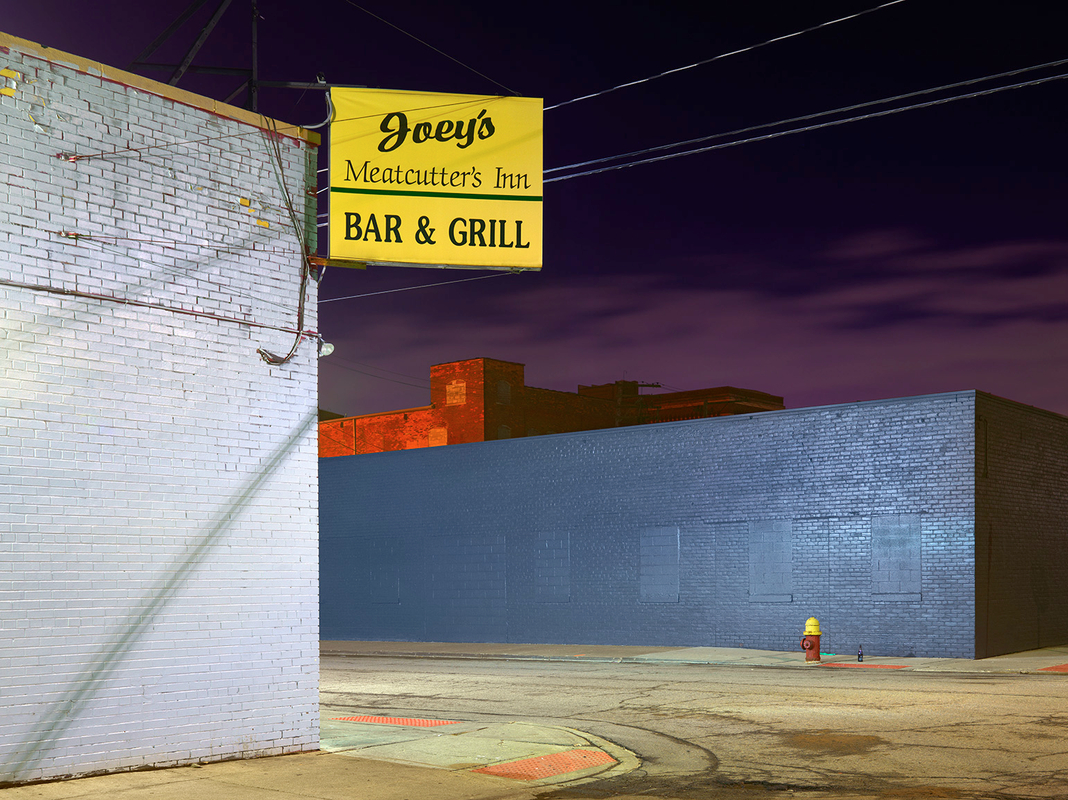
The lonely cityscape at night or the familiar glow of gas station lights cast into the American wilderness. The eye might want to linger among the colors, shapes and clouds even though the mind knows this is pretty much an empty street in a ‘post-industrial’ zone.
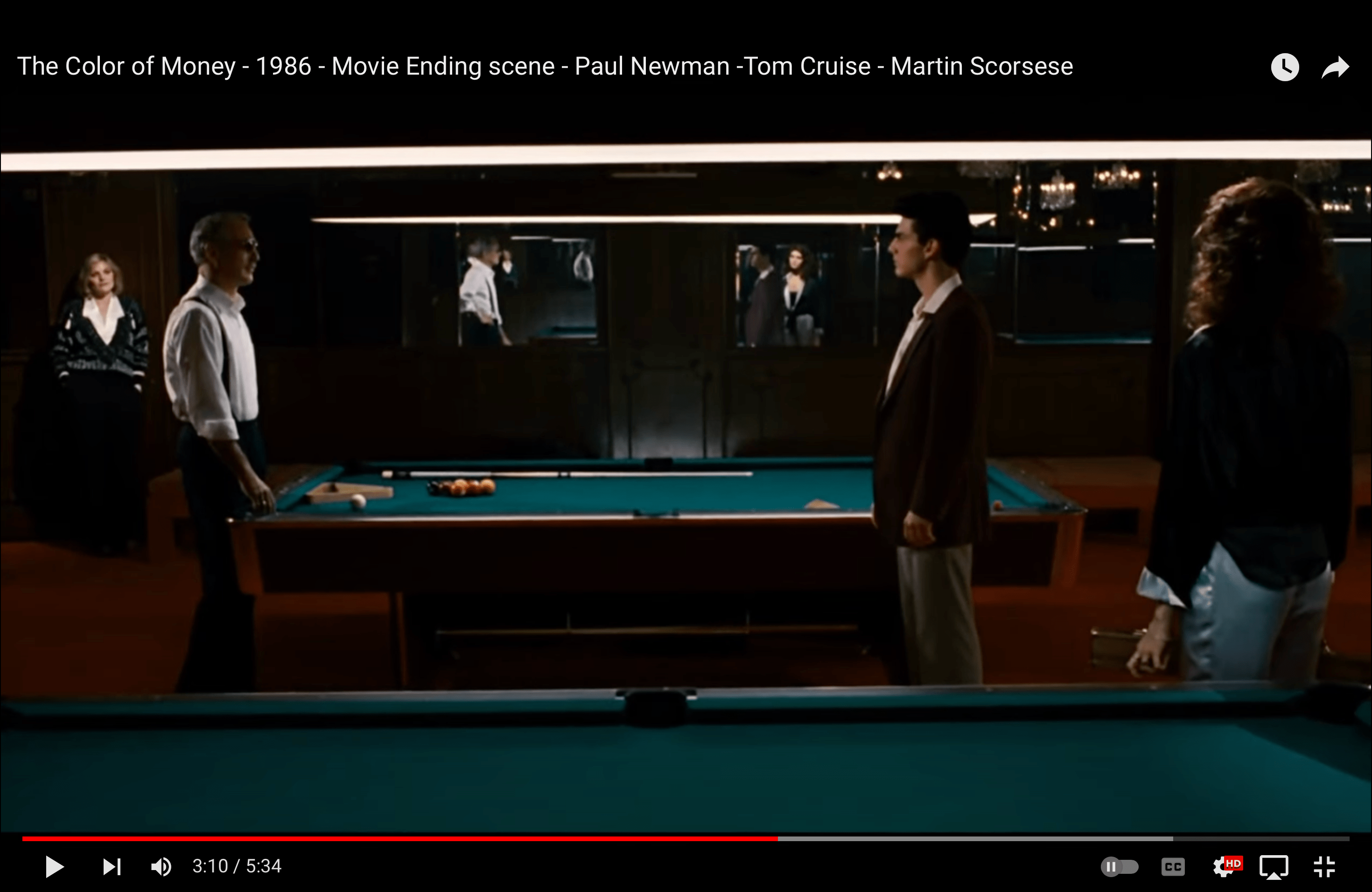
Movie Title: The Color Of Money (Director-Martin Scorsese). 1986.
What’s good and what’s genuine in characters who hustle for a living? Can the American pulp novella/novel be a source of both popular and high entertainment?
Visual Storytelling (end-scene pool showdown): The wiser and more experienced mentor, perhaps washed-up, is being pushed out of the business during his comeback, but he’s not going quietly (we need some dramatic tension). His lady waits for him near the edge of frame, while both of them only take about 1/5 of the frame (all four characters are on the diagonal).
Does he still have it?
—
Brash, untempered (arrogant), less experienced rising talent and his lady take about 1/3 of the frame, closer to the audience. They’ve been hustled; learning the art of the con pretty well.
Should he accept the challenge? Is this it?
Possible conclusions: Maybe that’s what we get in life, a view every now and again. At the height of our powers (or past our powers), we get a moment when the conception of the game and the game become one. In a tacky hall of mirrors, no less. I hope it’s not all a hall of mirrors.
Generations stuck in a stand-off…
My point: A good visual storyteller takes his craft seriously, associating the story and the images to push the story forward. He has an appreciation for beauty. I appreciate Scorsese for working hard because the harder he works, the more my intelligence is respected.
To be honest, the movie dragged on for me and is very much of its time (this is pool for Christ’s Sake, how much can you glamorize pool?). Mythos is tough to achieve.
That said, I appreciate a director practicing his craft and trying to provide some continuity in American life through the visual arts. I appreciate someone who understands that developed characters invite us to see something of ourselves in frame.
This was Harry at his most presentable: A shrewd cunning in stillness. Perhaps, he’d even brought me a question.
He was half-again as large as the other gulls near the Market. Not respected, maybe, but feared.
My mind would wander to thoughts of freedom, watching his wings dip and scissor, cutting the air. Sometimes I would watch his eyes, too, scouring the ground for food and the sky for other birds.
The constant shrieking and territorial displays were better than silence, Dear Reader, especially if thoughts of death crept in (how much I missed L).
—
Harry had other behaviors: Gobbling fish guts and slurping coffee directly from the street. One day, he’d snatched a french-fry mid-air from a child’s fingers. After the shock and a brief consolation, we smiled in mutual surprise.
Among the rain and lights I saw the figure 5 in gold on a red firetruck moving tense unheeded to gong clangs siren howls and wheels rumbling through the dark city.
‘Imagism was a sub-genre of Modernism concerned with creating clear imagery with sharp language. The essential idea was to re-create the physical experience of an object through words. As with all of Modernism, Imagism implicitly rejected Victorian poetry, which tended toward narrative.‘
And:
‘The most exemplified phase of Modernism, referred to as “High Modernism,” occurred during the inter-war years (1918-1939). This was the time when writers synonymous with Modernism, such as Virginia Woolf, James Joyce, T.S. Eliot, and D.H. Lawrence, thrived. While Victorians typically concerned themselves with rendering reality as they understood it into fiction, Modernists recognized that reality was subjective, and instead strove to represent human psychology in fiction.‘
During the post-war years, the confessionals, with a fair amount of free and blank verse became dominant, with a kind of feelings-first, psychological exploration of the (S)elf.
Dear Reader, this photograph represents the closest I’ve gotten to elements of the modernist imagination so far. I hope you enjoy. The Straussian movement pushes back to a kind of classicist revival, an embrace of tradition, and rejection of much modernity.
***On second-thought, the photo of these parts of very real thing is abstracted into a kind of modernesque design.
‘Francis Macomber had, half an hour before, been carried to his tent from the edge of the camp in triumph on the arms and shoulders of the cook, the personal boys, the skinner and the porters. The gun-bearers had taken no part in the demonstration. When the native boys put him down at the door of his tent, he had shaken all their hands, received their congratulations, and then gone into the tent and sat on the bed until his wife came in.‘
Catch-up with Turkey, Nippers, and Ginger Nut; their daily routines at the office.
Our narrator:
‘I am one of those unambitious lawyers who never addresses a jury, or in any way draws down public applause; but in the cool tranquillity of a snug retreat, do a snug business among rich men’s bonds and mortgages and title-deeds. All who know me consider me an eminently safe man. The late John Jacob Astor, a personage little given to poetic enthusiasm, had no hesitation in pronouncing my first grand point to be prudence; my next, method.’
We all want to be alone, and to be with others, and Bartleby…Bartleby would just prefer not to:
‘He had not walked five hundred yards down the road when he saw, within reach of him, the plaster figure of a Negro sitting bent over on a low yellow brick fence that curved around a wide lawn. The Negro was about Nelson’s size and he was pitched forward at an unsteady angle because the putty that held him to the wall had cracked. One of his eyes was entirely white and he held a piece of brown watermelon.’
Redemption, mercy, original sin, and a decent short-story leaving you not knowing what to think, exactly.
‘The most useful definition of modernist fiction I’ve encountered comes from Brian McHale’s Postmodernist Fiction. He says modernist fiction tends to “foreground epistemological questions” such as “How can I interpret the world I’m part of? What is there to be known? Who knows it? What are the limits of that knowledge?” In contrast, postmodernist fiction tends to “foreground ontological questions” such as “What is a world? What kinds of worlds are there and how are they constituted? What happens when…boundaries between worlds are violated?’
As to the epistemological questions surrounding Modernism, below are four poems. Hopefully, each is a representative example of a move away from the Romanticism that had been prevalent up until the late 1800’s.
In addition to the move away from traditional Romantic rhyme and meter towards modern blank verse, there’s also a certain conception of the Self rendered in them; a presentation of our natures that might be worth examining in some detail.
I believe we can see clearly a move away from tradition towards the Self, the Poet isolated, the poem itself as a means of communication, and an anxiety so common within the 20th century.
‘At the heart of Bloom’s project is the ancient quarrel between “poetry” and “philosophy.” In Bloom’s opinion, we ought not have to choose between Homer and Plato; we can have both, as long as we recognize that poetry is superior.’
Says the guy who writes about poetry…
What does one find within, as one looks without, waking from sleep and dream?
What kind of world is this, and can the poet actually help us know it?
You tossed a blanket from the bed You lay upon your back, and waited; You dozed, and watched the night revealing The thousand sordid images Of which your soul was constituted; They flickered against the ceiling. And when all the world came back And the light crept up between the shutters And you heard the sparrows in the gutters, You had such a vision of the street As the street hardly understands; Sitting along the bed’s edge, where You curled the papers from your hair, Or clasped the yellow soles of feet In the palms of both soiled hands.
—
The world will stain you, and it is a fallen, modern world, rendered profoundly and exquisitely.
As consciousness creeps in, building a bridge to the day, to the world, to the facts left as though they were the first facts, the light as though it were the first light, what one finds is distressing, both within and without.
That distress must be ‘made new,’ which is to say, the suffering (original?) in which we all sometimes find ourselves must match our experiences within the modern city and world, at least, the world created within Eliot’s lyrical verse.
Of the four poems, only the first and last have a 3rd-person subject.
—
Wallace Stevens‘ ‘I’ is in a more contemplative state, but it’s an ‘I’ exploring similar themes, and experiencing some distress in trying to know how the world actually is, and what might lie within.
The journey to The Self may not be a journey for the faint of heart.
The Poems Of Our Climate (stanzas II and III)
II Say even that this complete simplicity Stripped one of all one’s torments, concealed The evilly compounded, vital I And made it fresh in a world of white, A world of clear water, brilliant-edged, Still one would want more, one would need more, More than a world of white and snowy scents.
III There would still remain the never-resting mind, So that one would want to escape, come back To what had been so long composed. The imperfect is our paradise. Note that, in this bitterness, delight, Since the imperfect is so hot in us, Lies in flawed words and stubborn sounds.
—
Even if the verse can describe a perfected world, delivering us, perhaps, a little closer to perfection, our poet is still not free from the impulses and desires which simply never cease.
Interestingly, we end-up not with a discussion of the heart, the spirit, libido etc. as a source for those desires (for Plato, the irrational), but rather, for Stevens, just a mind.
We also find more Romantic elements of language and an almost baroque/rococo arrangement of words and ideas, dandyish even, yet combined with an intense effort to abstract, define, and clarify. From here, the poet may proceed on his task of flawed words and stubborn sounds.
***I find myself thinking of elements of modern architecture and abstract-expressionist painting. The meaning, or at least some delivery from our restless existences, can be found within the abstract itself. Or at least within a retreat to the abstract for its own sake, away from the world.
The modernist, glass-walled house on the hill will exist in its own space, offering and defying meaning. The structure’s own shapes will be stripped down to often mathematically precise forms interacting with Nature. These shall guide Man, or at least offer individual men a little refuge.
It is perhaps in Stevens’ poem we can see the questions of knowledge about the world suggesting questions about whether there is a world at all, or, at least, what kind of worlds each Self might be able to inhabit.
—
Here’s one of Robert Lowell’s poems, occurring a generation later, in the mid 20th-century, as part of the confessionals.
The Self is extremely isolated. In fact, Lowell went more than a little crazy. Unlike the known nervous breakdown of Eliot from which Eliot recovered, Lowell’s life was essentially one long breakdown from which he never recovered.
Here he is, looking back:
Epilogue
Those blessed structures plot and rhyme- why are they no help to me now i want to make something imagined not recalled? I hear the noise of my own voice: The painter’s vision is not a lens it trembles to caress the light. But sometimes everything i write With the threadbare art of my eye seems a snapshot lurid rapid garish grouped heightened from life yet paralyzed by fact. All’s misalliance. Yet why not say what happened? Pray for the grace of accuracy Vermeer gave to the sun’s illumination stealing like the tide across a map to his girl solid with yearning. We are poor passing facts. warned by that to give each figure in the photograph his living name.
—
The weight of having to make that meaning, for yourself, and by yourself, is a horrible weight indeed. One can glorify one’s Self and family, but that, alas, only goes so far. Rhyme and form still carry one’s living name, as far as they do.
Of course, there’s still wonderful rhythm and form here (this is excellent verse), but blanker now, with a relentless focus on the ‘I.’ The poet is perhaps talking a little more to himself, and the poem keeps self-consciously calling attention to itself.
—
In fact, it reminded me of the poem below, by Robert Creeley, which was published a few years afterwards.
From this page:
‘Creeley was a leader in the generational shift that veered away from history and tradition as primary poetic sources and gave new prominence to the ongoing experiences of an individual’s life. Because of this emphasis, the major events of his life loom large in his literary work.’
There’s Nothing but the Self and the Eye seeking and making meaning, by itself within a void of emotionally compact and precise language (of course there’s still form and other things besides).
Can the poet fit inside the little abstract chapel of words he’s building for himself (let alone the world, tradition etc.)?
For all the talk about ‘space,’ there seems very little.
The Window
Position is where you put it, where it is, did you, for example, that
large tank there, silvered, with the white church along- side, lift
all that, to what purpose? How heavy the slow
world is with everything put in place. Some
man walks by, a car beside him on the dropped
road, a leaf of yellow color is going to
fall. It all drops into place. My
face is heavy with the sight. I can feel my eye breaking.
—
The distress is still there…but I’d argue that we are now a good distance away from the grandness of Eliot’s vision, his religiosity and virtuosity with form and meter at the dawn of Modernism. Very few people can/could do what Eliot did (addition: even if he can help us gain knowledge of our Selves or the world).
That said, it’s unclear there’s enough tradition and confidence to even undertake such a project, now, even as such talents come along. The state of things is more scattered. We’re in a very different place of selves and artists isolated, of anxiety and post-anxiety.
Aside from the very accomplished poets above, in terms of both knowledge (epistemology) and being (ontology), we often have writers feeling pressure to weigh-in on such questions without even being about to write that well; artists who can’t draw or paint that well, and frankly, quite a bit of bullshit besides.
So, where are we headed? Who’s ‘we’ exactly?
Predictions are hard, especially about the future.
As previously posted:
Why not just put a few algorithms to work in writing those artist statements?
‘In “Sea Change,” Graham becomes Prospero, casting spells by spelling out her thoughts to merge with ours, and with the voices of the elements. The result is a mingling of perceptions rather than a broadcasting of opinions. Instead of analysis, the poems encourage emotional involvement with the drastic changes overwhelming us, overwhelm- ing the planet.’
and:
‘Strengths and weaknesses, flows and ebbs, yet every poem in “Sea Change” bears memorable lines, with almost haunting (if we truly have but 10 years to “fix” global warming) images of flora and fauna under siege. Jorie Graham has composed a swan song for Earth.’
Oh boy.
What are these poems being asked to do?
And moving away from poetry into the realm of ‘performance art,’
Something of how the homing bee at dusk Seems to inquire, perplexed, how there can be No flowers here, not even withered stalks of flowers, Conjures a garden where no garden is And trellises too frail almost to bear The memory of a rose, much less a rose. Great oaks more monumentally great oaks now Than ever when the living rose was new Cast shade that is the more completely shade Upon a house of broken windows merely And empty nests up under broken eaves No damask any more prevents the moon, But it unravels, peeling from a wall, Red roses within roses within roses.
Interesting written interview on Southern Stoicism, with mention of Walker Percy.
Flannery O’Connor’s Southern Gothic style often flirts with the grotesque, and can traffic in the macabre, but there’s reason behind it, and a brilliantly skeptical, humane eye.
‘They had reached the bus stop. There was no bus in sight and Julian, his hands still jammed in his pockets and his head thrust forward, scowled down the empty street. The frustration of having to wait on the bus as well as ride on it began to creep up his neck like a hot hand. The presence of his mother was borne in upon him as she gave a pained sigh. He looked at her bleakly. She was holding herself very erect under the preposterous hat, wearing it like a banner of her imaginary dignity. There was in him an evil urge to break her spirit. He suddenly unloosened his tie and pulled it off and put it in his pocket’
Nelson, composing his expression under the shadow of his hat brim, watched him with a mixture of fatigue and suspicion, but as the train glided past them and disappeared like a frightened serpent into the woods, even his face lightened and he muttered, “I’m glad I’ve went once, but I’ll never go back again!”
A little bit about politics and also the politics amidst fellow writers and critics:
‘…when in doubt, I always follow the simple method of choosing that line of conduct which may be the most displeasing to the Reds and the Russells.’
and:
‘Who’s in, who’s out, and where are the snows of yesteryear. All very amusing. I am a little sorry to be left out. Nobody can decide if I am a middle-aged American writer or an old Russian writer—or an ageless international freak.’
On his professional collection of butterflies:
‘The pleasures and rewards of literary inspiration are nothing beside the rapture of discovering a new organ under the microscope or an undescribed species on a mountainside in Iran or Peru. It is not improbable that had there been no revolution in Russia, I would have devoted myself entirely to lepidopterology and never written any novels at all.’
Via Youtube: An interviewer, Nabokov and Lionel Trilling discuss ‘Lolita:’
Immediately, I think of Edward Hopper: The lonely cityscape at night or the familiar glow of gas station lights cast into the American wilderness. The eye might want to linger among the colors, shapes and clouds even though the mind knows this is pretty much an empty street in a ‘post-industrial’ zone.
Perhaps it has do with another strand of expression: The break into free verse from past forms. The move from American Romanticism to Modernism which occurred this early past century. William Carlos Williams produced many good poems from a process of earnest, scrapbook-style intensity in trying to discover, redefine, and order a new poetic form within a modern ‘urban landscape.’
The individual artist is quite alone in the task he’s set before himself, and like much of modernism, it’s a rather big task.
Pastoral
When I was younger it was plain to me I must make something of myself. Older now I walk back streets admiring the houses of the very poor: roof out of line with sides the yards cluttered with old chicken wire, ashes, furniture gone wrong; the fences and outhouses built of barrel staves and parts of boxes, all, if I am fortunate, smeared a bluish green that properly weathered pleases me best of all colors.
No one will believe this of vast import to the nation
Perhaps I’m not wrong in having called Halloween horror still and movie images to mind (it’s my mind, after all, so maybe I’m just thinking of Devil’s Night). I really enjoy the light on the dumpster and the side-front rectory wall. There seems to be a little more mood here, more drama, so maybe Edgar Allan Poe’s ‘psychological intensity,’ surrealism, and terror are more appropriate for comparison.
Poe was a bit mad, after all, despite his fascinatingly untamed and powerful imagination. He achieved a uniqueness and completeness of vision few artists do. Maybe there’s a bit of the sullen, self-aggrandizing earnestness in him of the teenager (J.D. Salinger); the desire to shock, delight and terrify.
The mind is as though a chamber, the horror rising to fever pitch, the lush rhyme matching an increasingly desperate search for truth and beauty in the world (Poe had very much his own Romantically inspired metaphysics).
Alone
From childhood’s hour I have not been As others were—I have not seen As others saw—I could not bring My passions from a common spring— From the same source I have not taken My sorrow—I could not awaken My heart to joy at the same tone— And all I lov’d—I lov’d alone— Then—in my childhood—in the dawn Of a most stormy life—was drawn From ev’ry depth of good and ill The mystery which binds me still— From the torrent, or the fountain— From the red cliff of the mountain— From the sun that ’round me roll’d In its autumn tint of gold— From the lightning in the sky As it pass’d me flying by— From the thunder, and the storm— And the cloud that took the form (When the rest of Heaven was blue) Of a demon in my view—
Are you looking at beautiful photos and feeling sorry for Detroit, and yourself? See Time Magazine’s photo essay by Yves Marchand and Romain Meffre (less porn-like, more thoughtful).
It is the word pejorative that hurts. My old boat goes round on a crutch And doesn’t get under way. It’s the time of the year And the time of the day.
Perhaps it’s the lunch that we had Or the lunch that we should have had. But I am, in any case, A most inappropriate man In a most unpropitious place.
Mon Dieu, hear the poet’s prayer. The romantic should be here. The romantic should be there. It ought to be everywhere. But the romantic must never remain,
Mon Dieu, and must never again return. This heavy historical sail Through the mustiest blue of the lake In a really vertiginous boat Is wholly the vapidest fake. . . .
It is least what one ever sees. It is only the way one feels, to say Where my spirit is I am, To say the light wind worries the sail, To say the water is swift today,
To expunge all people and be a pupil Of the gorgeous wheel and so to give That slight transcendence to the dirty sail, By light, the way one feels, sharp white, And then rush brightly through the summer air.
‘Therein lies the central tension of Speak, Memory. Its prose is meticulous, suggesting memory as an exercise in exacting dictation from an omniscient oracle, yet its message points to memory as mutable, prone to the passage of time and the vagaries of imagination’
“Nabokov in America” is rewarding on all counts, as biography, as photo album (there are many pictures of people, Western landscapes and motels) and as appreciative criticism. Not least, Roper even avoids the arch style so often adopted by critics faintly trying to emulate their inimitable subject.’
What’s more American than an exiled member of the Russian aristocracy intimately making his way into the English language and peering out from a thousand Motor Lodges?
A little bit about politics and also the politics amidst fellow writers and critics:
‘…when in doubt, I always follow the simple method of choosing that line of conduct which may be the most displeasing to the Reds and the Russells.’
and:
‘Who’s in, who’s out, and where are the snows of yesteryear. All very amusing. I am a little sorry to be left out. Nobody can decide if I am a middle-aged American writer or an old Russian writer—or an ageless international freak.’
On his professional collection of butterflies:
‘The pleasures and rewards of literary inspiration are nothing beside the rapture of discovering a new organ under the microscope or an undescribed species on a mountainside in Iran or Peru. It is not improbable that had there been no revolution in Russia, I would have devoted myself entirely to lepidopterology and never written any novels at all.’
Via Youtube: An interviewer, Nabokov and Lionel Trilling discuss ‘Lolita:’
Men at forty Learn to close softly The doors to rooms they will not be Coming back to.
At rest on a stair landing, They feel it moving Beneath them now like the deck of a ship, Though the swell is gentle.
And deep in mirrors They rediscover The face of the boy as he practises tying His father’s tie there in secret
And the face of the father, Still warm with the mystery of lather. They are more fathers than sons themselves now. Something is filling them, something
That is like the twilight sound Of the crickets, immense, Filling the woods at the foot of the slope Behind their mortgaged houses.
My fiftieth year had come and gone, I sat, a solitary man, In a crowded London shop, An open book and empty cup On the marble table-top. While on the shop and street I gazed My body of a sudden blazed; And twenty minutes more or less It seemed, so great my happiness, That I was blessed and could bless.
What do they think has happened, the old fools, To make them like this? Do they somehow suppose It’s more grown-up when your mouth hangs open and drools, And you keep on pissing yourself, and can’t remember Who called this morning? Or that, if they only chose, They could alter things back to when they danced all night, Or went to their wedding, or sloped arms some September? Or do they fancy there’s really been no change, And they’ve always behaved as if they were crippled or tight, Or sat through days of thin continuous dreaming Watching the light move? If they don’t (and they can’t), it’s strange; Why aren’t they screaming?
At death you break up: the bits that were you Start speeding away from each other for ever With no one to see. It’s only oblivion, true: We had it before, but then it was going to end, And was all the time merging with a unique endeavour To bring to bloom the million-petalled flower Of being here. Next time you can’t pretend There’ll be anything else. And these are the first signs: Not knowing how, not hearing who, the power Of choosing gone. Their looks show that they’re for it: Ash hair, toad hands, prune face dried into lines – How can they ignore it?
Perhaps being old is having lighted rooms Inside your head, and people in them, acting People you know, yet can’t quite name; each looms Like a deep loss restored, from known doors turning, Setting down a lamp, smiling from a stair, extracting A known book from the shelves; or sometimes only The rooms themselves, chairs and a fire burning, The blown bush at the window, or the sun’s Faint friendliness on the wall some lonely Rain-ceased midsummer evening. That is where they live: Not here and now, but where all happened once. This is why they give
An air of baffled absence, trying to be there Yet being here. For the rooms grow farther, leaving Incompetent cold, the constant wear and tear Of taken breath, and them crouching below Extinction’s alp, the old fools, never perceiving How near it is. This must be what keeps them quiet: The peak that stays in view wherever we go For them is rising ground. Can they never tell What is dragging them back, and how it will end? Not at night? Not when the strangers come? Never, throughout The whole hideous inverted childhood? Well, We shall find out.
What are you doing with your time and imagination?
You’re fine, Mr. Corte. In fact, you’re looking a little better than yesterday…:
‘Giuseppe Corte didn’t need anything, but he began to chat freely with the young woman, asking for information about the clinic. In this way, he learned about the hospital’s unique practice of assigning its patients to different floors in accordance with the gravity of their illness. On the seventh floor, the top floor, only the very mildest cases were treated. Those whose forms of the illness weren’t grave, but who certainly couldn’t be neglected, were assigned to the sixth floor. More serious infections were treated on the fifth floor, and so on and so forth. Gravely ill patients were housed on the second floor; and on the first floor, those for whom all hope had been abandoned.’
You probably spent a lot of energy when younger, wishing to be older, and as you get older, find yourself spending time wishing you were younger.
Maybe it’s Pilgrim’s pride, or perhaps the Puritan pursuit of image-less purity, or the Colonialists ecumenical style, or maybe even some Shaker weirdness that finds itself up for analysis.
Perhaps somewhere there’s a spare, Yankee work ethic resting on a simple, wooden shelf in the ‘American mind.’
Could such a thing be discovered within mid 20th-century modernism?
Robert Hughes takes a look at Donald Judd’s ‘Temple Of Aesthetic Fanaticism,’ and Richard Serra’s nod to Jackson Pollack and abstract expressionism in the rawness of material sculpture. You know, making stuff (a potentially sensitive subject with so many technological changes going on right now).
(link may not last):
As for Land Art, Michael Heizer’s life’s-work land-art project is apparently complete, if such a thing can be complete:
Apparently, Heizer’s been working since 1972 on this sculpture in the Eastern Nevada desert, which was originally called ‘Complex One.’ It’s morphed into his life’s work, called City. It’s very large. It can’t be moved. You can’t reproduce it. It represents a break from traditional sculpture. It can’t be put in a museum and it’s not clear that it has a function.
In Brasil, they just started from the top-down and built a city that doesn’t work that well for people: Brasilia: A Planned City
——————
I have to confess that seeing that structure upon the wide open emptiness of Eastern Nevada is comforting for the familiarity it brings. It’s a little bit of order upon the unknown, and the design, or lack thereof (about which a man may wonder), within Nature herself. I think this is why a military installation out in the desert can captivate the imagination as it’s been known to in Hollywood and in the public mind (dreaming of aliens and conspiracies).
To expand on that theme, Wallace Stevens might shed some light. He was an American poet on the hinge between romanticism and modernism:
Anecdote of the Jar
I placed a jar in Tennessee, And round it was, upon a hill. It made the slovenly wilderness Surround that hill.
The wilderness rose up to it, And sprawled around, no longer wild. The jar was round upon the ground And tall and of a port in air.
It took dominion every where. The jar was gray and bare. It did not give of bird or bush, Like nothing else in Tennessee.
What do you do with an uncivilized, wild land? Import European learning and literature “atop” it? Christian tradition and the Natural Law? Import the triumph of the Western mathematical sciences and technology? Import its movements of the arts and the individual artist?
I chased Badeau to the bottom of the stairs, where he gave a grunt and a cry before disappearing to the upper rooms. It was the last anyone would see of him until summer. Our little waterfront pursuit would go on to make headlines.
That night, I awoke as a neighbor’s headlights launched through my eyes, illuminating some animal part of my soul.
I think you’ve got to look at Billy Joel’s raw talent; the prodigious musical gifts and compositional ability; the mimicry, the voices, the piano-playing which became a vehicle for so many of his hits. Add a quite nice voice and a road-warrior mentality trying to offer value at every show, and you’ve got quite a package.
An American Songbook kind of guy.
I can barely think of anyone more Lon-Giland, who put his abilities to the American grindstone, but whose talent often hovers above any chosen genre he finds himself in.
Thanks, Billy.
Nick Paumgartner on a Slate review of Joel:
‘He was terrible, he is terrible, he always will be terrible. Anodyne, sappy, superficial, derivative, fraudulently rebellious. . . . Billy Joel’s music elevates self-aggrandizing self-pity and contempt for others into its own new and awful genre: ‘Mock-Rock.’ ”
He [Rosenbaum] called Joel “the Andrew Wyeth of contemporary pop music.”
When I mentioned this to Joel, he said, “What’s wrong with Andrew Wyeth?”
‘In between pieces, he began to explain that these were variations on a motif and that they were telling the story of the history of Long Island, from its pastoral beginnings to the arrival of the Europeans—“I’m imagining the prow of a ship, and a Puritan hymn”—and then the bustle of the nineteenth century. Farming, fishing, the railroad. “Getting busy on Long Island,” he said. “This one’s almost Coplandesque, with big open fifths.” We were a long way from Brenda and Eddie. He played intently as the room went dark.’
That sounds like a pretty talented artist looking for roots and sifting through American history and Americana for inspiration to me…
Here’s a popular song in the seafaring style trying to do good for local people without the righteous self-flattery and regard stars so often bring to the table:
I claim no special literary insight, other than these five short stories have stuck with me, as they have for many other readers besides. Links included.
Catch-up with Turkey, Nippers, and Ginger Nut; their daily routines at the office.
Our narrator:
‘I am one of those unambitious lawyers who never addresses a jury, or in any way draws down public applause; but in the cool tranquillity of a snug retreat, do a snug business among rich men’s bonds and mortgages and title-deeds. All who know me consider me an eminently safe man. The late John Jacob Astor, a personage little given to poetic enthusiasm, had no hesitation in pronouncing my first grand point to be prudence; my next, method.’
We all want to be alone, and to be with others, and Bartleby…Bartleby would just prefer not to:
As they were for many other high-school boys, the first lines were enough for me:
‘A man stood upon a railroad bridge in northern Alabama, looking down into the swift water twenty feet below. The man’s hands were behind his back, the wrists bound with a cord. A rope closely encircled his neck.’
‘Now I do not know whether I was then a man dreaming I was a butterfly, or whether I am now a butterfly, dreaming I am a man?
O’Connor’s Southern Gothic style often flirts with the grotesque, and can traffic in the macabre, but there’s reason behind it, and a brilliantly skeptical, humane eye. Few writers get so many things right, in my opinion.
The world is changing, and so is the South.
Julian’s mother is living in the past:
‘They had reached the bus stop. There was no bus in sight and Julian, his hands still jammed in his pockets and his head thrust forward, scowled down the empty street. The frustration of having to wait on the bus as well as ride on it began to creep up his neck like a hot hand. The presence of his mother was borne in upon him as she gave a pained sigh. He looked at her bleakly. She was holding herself very erect under the preposterous hat, wearing it like a banner of her imaginary dignity. There was in him an evil urge to break her spirit. He suddenly unloosened his tie and pulled it off and put it in his pocket’
A lot can be ‘swallowed’ up in the desert, lost in translation; across time, language and civilizations.
Things don’t always end well for the intellectually curious and naive…:
‘It occurred to him that he ought to ask himself why he was doing this irrational thing, but he was intelligent enough to know that since he Was doing it, it was not so important to probe for explanations at that moment.’
‘When the short days of winter came, dusk fell before we had well eaten our dinners. When we met in the street the houses had grown sombre. The space of sky above us was the colour of ever-changing violet and towards it the lamps of the street lifted their feeble lanterns. The cold air stung us and we played till our bodies glowed.’
A return to Nature? To origins of faith? To a simple freedom in a wild land, and new understandings, with death in view? To visions of Romantic Primitivism becoming modern?:
VII
Supple and turbulent, a ring of men Shall chant in orgy on a summer morn Their boisterous devotion to the sun, Not as a god, but as a god might be, Naked among them, like a savage source. Their chant shall be a chant of paradise, Out of their blood, returning to the sky; And in their chant shall enter, voice by voice, The windy lake wherein their lord delights, The trees, like serafin, and echoing hills, That choir among themselves long afterward. They shall know well the heavenly fellowship Of men that perish and of summer morn. And whence they came and whither they shall go The dew upon their feet shall manifest.
Did you know Hawthorne had a son who wrote for Hearst and rubbed shoulders with Twain?:
‘Over the course of his long life, Julian Hawthorne seems to have met every major literary and public figure of his time. As a child, he sometimes listened in as his father conversed with Emerson, Thoreau and Melville. At birthday parties, he played games with little Louisa May Alcott.’
‘We stayed for the afternoon talk-in which Richard Schrader revealed how slanted and inaccurate Mencken’s account of the Scopes evolution trial had been…’
The business of monkeys…
I’m often returned to the simple pleasures of bookishness while reading Dirda.
“As a student of his native literature, Mencken favours writers with the authentic American yawp – Walt Whitman and Mark Twain, the humorists George Ade and Ring Lardner. Huckleberry Finn is the novel he loves most (followed, somewhat surprisingly, by Joseph Conrad’s Lord Jim). He judges Emerson to be overrated – “an importer of stale German elixirs, sometimes direct and sometimes through the Carlylean branch house”. He can’t bear the circumlocutions of Henry James and the gentility of William Dean Howells”
Menand wonders in his new book, why it often can take 9 years for a humanities PhD to get their doctorate. He suggests part of the answer lies in the numbers: fewer opportunities and fewer university programs since 1970. Overtrained and underpaid.
Ernst Haas-Western Skies Motel, Colorado, 1977. It’s a wonderful use of color, along with those clouds and that light. A mood is created, and not much extra visual information is provided.
Ernst Haas-There’s so much visual information, but is there? What is communicated through your eye and to your brain? Route 66 Albuquerque, New Mexico, 1969
—
As posted:
Via Mick Hartley, British photographer Mark Power’s Good Morning, America, vols. 1 (mostly Arkansas) & 2 (mostly across the South).
Power:
‘I keep a physical and metaphorical distance between myself and the subject. It’s a way of delineating my ‘foreignness’ and is a similar stance to the one I took while working in Poland making The Sound of Two Songs (2004-09). It’s comes very naturally to me; I’ve always felt I’m better at observing than participating, so to stand back and watch from afar suits me very well.’
I often find myself drawn to photos with some distance.
As posted:
Via Mick Hartley, Steve Fitch Photography has neon motel signs glowing into the Western night.
What’s more American than an exiled member of the Russian aristocracy intimately making his way into the English language and peering out from a thousand Motor Lodges?
“Nabokov in America” is rewarding on all counts, as biography, as photo album (there are many pictures of people, Western landscapes and motels) and as appreciative criticism. Not least, Roper even avoids the arch style so often adopted by critics faintly trying to emulate their inimitable subject.’
—
Well, there’s Donald Judd and Marfa, Texas, which looks interesting:
As previously posted, The Critic Laughs, by Hamilton:
Do you long for the days of unabashed American consumerism? Are you nostalgic for nights lit only by a soft, neon glow on the underbellies of clouds? Return to a time when America broadcast its brash, unironic call to the heavens.
But it can be empty, and lonely, and full of hard work and suffering:
Montana Pastoral
I am no shepherd of a child’s surmises. I have seen fear where the coiled serpent rises,
Thirst where the grasses burn in early May And thistle, mustard and the wild oat stay.
There is dust in this air. I saw in the heat Grasshoppers busy in the threshing wheat.
So to this hour. Through the warm dusk I drove To blizzards sifting on the hissing stove,
And found no images of pastoral will, But fear, thirst, hunger, and this huddled chill.
Immediately, I think of Edward Hopper: The lonely cityscape at night or the familiar glow of gas station lights cast into the American wilderness. The eye might want to linger among the colors, shapes and clouds even though the mind knows this is pretty much an empty street in a ‘post-industrial’ zone.
Perhaps it has do with another strand of expression: The break into free verse from past forms. The move from American Romanticism to Modernism which occurred this early past century. William Carlos Williams produced many good poems from a process of earnest, scrapbook-style intensity in trying to discover, redefine, and order a new poetic form within a modern ‘urban landscape.’
The individual artist is quite alone in the task he’s set before himself, and like much of modernism, it’s a rather big task.
Pastoral
When I was younger it was plain to me I must make something of myself. Older now I walk back streets admiring the houses of the very poor: roof out of line with sides the yards cluttered with old chicken wire, ashes, furniture gone wrong; the fences and outhouses built of barrel staves and parts of boxes, all, if I am fortunate, smeared a bluish green that properly weathered pleases me best of all colors.
No one will believe this of vast import to the nation
Nelson, composing his expression under the shadow of his hat brim, watched him with a mixture of fatigue and suspicion, but as the train glided past them and disappeared like a frightened serpent into the woods, even his face lightened and he muttered, “I’m glad I’ve went once, but I’ll never go back again!”
‘The most useful definition of modernist fiction I’ve encountered comes from Brian McHale’s Postmodernist Fiction. He says modernist fiction tends to “foreground epistemological questions” such as “How can I interpret the world I’m part of? What is there to be known? Who knows it? What are the limits of that knowledge?” In contrast, postmodernist fiction tends to “foreground ontological questions” such as “What is a world? What kinds of worlds are there and how are they constituted? What happens when…boundaries between worlds are violated?’
As to the epistemological questions surrounding Modernism, below are four poems. Hopefully, each is a representative example of a move away from the Romanticism that had been prevalent up until the late 1800’s.
In addition to the move away from traditional Romantic rhyme and meter towards modern blank verse, there’s also a certain conception of the Self rendered in them; a presentation of our natures that might be worth examining in some detail.
I believe we can see clearly a move away from tradition towards the Self, the Poet isolated, the poem itself as a means of communication, and an anxiety so common within the 20th century.
‘At the heart of Bloom’s project is the ancient quarrel between “poetry” and “philosophy.” In Bloom’s opinion, we ought not have to choose between Homer and Plato; we can have both, as long as we recognize that poetry is superior.’
Says the guy who writes about poetry…
What does one find within, as one looks without, waking from sleep and dream?
What kind of world is this, and can the poet actually help us know it?
You tossed a blanket from the bed You lay upon your back, and waited; You dozed, and watched the night revealing The thousand sordid images Of which your soul was constituted; They flickered against the ceiling. And when all the world came back And the light crept up between the shutters And you heard the sparrows in the gutters, You had such a vision of the street As the street hardly understands; Sitting along the bed’s edge, where You curled the papers from your hair, Or clasped the yellow soles of feet In the palms of both soiled hands.
—
The world will stain you, and it is a fallen, modern world, rendered profoundly and exquisitely.
As consciousness creeps in, building a bridge to the day, to the world, to the facts left as though they were the first facts, the light as though it were the first light, what one finds is distressing, both within and without.
That distress must be ‘made new,’ which is to say, the suffering (original?) in which we all sometimes find ourselves must match our experiences within the modern city and world, at least, the world created within Eliot’s lyrical verse.
Of the four poems, only the first and last have a 3rd-person subject.
—
Wallace Stevens‘ ‘I’ is in a more contemplative state, but it’s an ‘I’ exploring similar themes, and experiencing some distress in trying to know how the world actually is, and what might lie within.
The journey to The Self may not be a journey for the faint of heart.
The Poems Of Our Climate (stanzas II and III)
II Say even that this complete simplicity Stripped one of all one’s torments, concealed The evilly compounded, vital I And made it fresh in a world of white, A world of clear water, brilliant-edged, Still one would want more, one would need more, More than a world of white and snowy scents.
III There would still remain the never-resting mind, So that one would want to escape, come back To what had been so long composed. The imperfect is our paradise. Note that, in this bitterness, delight, Since the imperfect is so hot in us, Lies in flawed words and stubborn sounds.
—
Even if the verse can describe a perfected world, delivering us, perhaps, a little closer to perfection, our poet is still not free from the impulses and desires which simply never cease.
Interestingly, we end-up not with a discussion of the heart, the spirit, libido etc. as a source for those desires (for Plato, the irrational), but rather, for Stevens, just a mind.
We also find more Romantic elements of language and an almost baroque/rococo arrangement of words and ideas, dandyish even, yet combined with an intense effort to abstract, define, and clarify. From here, the poet may proceed on his task of flawed words and stubborn sounds.
***I find myself thinking of elements of modern architecture and abstract-expressionist painting. The meaning, or at least some delivery from our restless existences, can be found within the abstract itself. Or at least within a retreat to the abstract for its own sake, away from the world.
The modernist, glass-walled house on the hill will exist in its own space, offering and defying meaning. The structure’s own shapes will be stripped down to often mathematically precise forms interacting with Nature. These shall guide Man, or at least offer individual men a little refuge.
It is perhaps in Stevens’ poem we can see the questions of knowledge about the world suggesting questions about whether there is a world at all, or, at least, what kind of worlds each Self might be able to inhabit.
—
Here’s one of Robert Lowell’s poems, occurring a generation later, in the mid 20th-century, as part of the confessionals.
The Self is extremely isolated. In fact, Lowell went more than a little crazy. Unlike the known nervous breakdown of Eliot from which Eliot recovered, Lowell’s life was essentially one long breakdown from which he never recovered.
Here he is, looking back:
Epilogue
Those blessed structures plot and rhyme- why are they no help to me now i want to make something imagined not recalled? I hear the noise of my own voice: The painter’s vision is not a lens it trembles to caress the light. But sometimes everything i write With the threadbare art of my eye seems a snapshot lurid rapid garish grouped heightened from life yet paralyzed by fact. All’s misalliance. Yet why not say what happened? Pray for the grace of accuracy Vermeer gave to the sun’s illumination stealing like the tide across a map to his girl solid with yearning. We are poor passing facts. warned by that to give each figure in the photograph his living name.
—
The weight of having to make that meaning, for yourself, and by yourself, is a horrible weight indeed. One can glorify one’s Self and family, but that, alas, only goes so far. Rhyme and form still carry one’s living name, as far as they do.
Of course, there’s still wonderful rhythm and form here (this is excellent verse), but blanker now, with a relentless focus on the ‘I.’ The poet is perhaps talking a little more to himself, and the poem keeps self-consciously calling attention to itself.
—
In fact, it reminded me of the poem below, by Robert Creeley, which was published a few years afterwards.
From this page:
‘Creeley was a leader in the generational shift that veered away from history and tradition as primary poetic sources and gave new prominence to the ongoing experiences of an individual’s life. Because of this emphasis, the major events of his life loom large in his literary work.’
There’s Nothing but the Self and the Eye seeking and making meaning, by itself within a void of emotionally compact and precise language (of course there’s still form and other things besides).
Can the poet fit inside the little abstract chapel of words he’s building for himself (let alone the world, tradition etc.)?
For all the talk about ‘space,’ there seems very little.
The Window
Position is where you put it, where it is, did you, for example, that
large tank there, silvered, with the white church along- side, lift
all that, to what purpose? How heavy the slow
world is with everything put in place. Some
man walks by, a car beside him on the dropped
road, a leaf of yellow color is going to
fall. It all drops into place. My
face is heavy with the sight. I can feel my eye breaking.
—
The distress is still there…but I’d argue that we are now a good distance away from the grandness of Eliot’s vision, his religiosity and virtuosity with form and meter at the dawn of Modernism. Very few people can/could do what Eliot did (addition: even if he can help us gain knowledge of our Selves or the world).
That said, it’s unclear there’s enough tradition and confidence to even undertake such a project, now, even as such talents come along. The state of things is more scattered. We’re in a very different place of selves and artists isolated, of anxiety and post-anxiety.
Aside from the very accomplished poets above, in terms of both knowledge (epistemology) and being (ontology), we often have writers feeling pressure to weigh-in on such questions without even being about to write that well; artists who can’t draw or paint that well, and frankly, quite a bit of bullshit besides.
So, where are we headed? Who’s ‘we’ exactly?
Predictions are hard, especially about the future.
As previously posted:
Why not just put a few algorithms to work in writing those artist statements?
‘In “Sea Change,” Graham becomes Prospero, casting spells by spelling out her thoughts to merge with ours, and with the voices of the elements. The result is a mingling of perceptions rather than a broadcasting of opinions. Instead of analysis, the poems encourage emotional involvement with the drastic changes overwhelming us, overwhelm- ing the planet.’
and:
‘Strengths and weaknesses, flows and ebbs, yet every poem in “Sea Change” bears memorable lines, with almost haunting (if we truly have but 10 years to “fix” global warming) images of flora and fauna under siege. Jorie Graham has composed a swan song for Earth.’
Oh boy.
What are these poems being asked to do?
And moving away from poetry into the realm of ‘performance art,’
Did you know Hawthorne had a son who wrote for Hearst and rubbed shoulders with Twain?:
‘Over the course of his long life, Julian Hawthorne seems to have met every major literary and public figure of his time. As a child, he sometimes listened in as his father conversed with Emerson, Thoreau and Melville. At birthday parties, he played games with little Louisa May Alcott.’
‘We stayed for the afternoon talk-in which Richard Schrader revealed how slanted and inaccurate Mencken’s account of the Scopes evolution trial had been…’
The business of monkeys…
I’m often returned to the simple pleasures of bookishness while reading Dirda.
“As a student of his native literature, Mencken favours writers with the authentic American yawp – Walt Whitman and Mark Twain, the humorists George Ade and Ring Lardner. Huckleberry Finn is the novel he loves most (followed, somewhat surprisingly, by Joseph Conrad’s Lord Jim). He judges Emerson to be overrated – “an importer of stale German elixirs, sometimes direct and sometimes through the Carlylean branch house”. He can’t bear the circumlocutions of Henry James and the gentility of William Dean Howells”
Menand wonders in his new book, why it often can take 9 years for a humanities PhD to get their doctorate. He suggests part of the answer lies in the numbers: fewer opportunities and fewer university programs since 1970. Overtrained and underpaid.
‘The most useful definition of modernist fiction I’ve encountered comes from Brian McHale’s Postmodernist Fiction. He says modernist fiction tends to “foreground epistemological questions” such as “How can I interpret the world I’m part of? What is there to be known? Who knows it? What are the limits of that knowledge?” In contrast, postmodernist fiction tends to “foreground ontological questions” such as “What is a world? What kinds of worlds are there and how are they constituted? What happens when…boundaries between worlds are violated?’
As to the epistemological questions surrounding Modernism, below are four poems. Hopefully, each is a representative example of a move away from the Romanticism that had been prevalent up until the late 1800’s.
In addition to the move away from traditional Romantic rhyme and meter towards modern blank verse, there’s also a certain conception of the Self rendered in them; a presentation of our natures that might be worth examining in some detail.
I believe we can see clearly a move away from tradition towards the Self, the Poet isolated, the poem itself as a means of communication, and an anxiety so common within the 20th century.
‘At the heart of Bloom’s project is the ancient quarrel between “poetry” and “philosophy.” In Bloom’s opinion, we ought not have to choose between Homer and Plato; we can have both, as long as we recognize that poetry is superior.’
Says the guy who writes about poetry…
What does one find within, as one looks without, waking from sleep and dream?
What kind of world is this, and can the poet actually help us know it?
You tossed a blanket from the bed
You lay upon your back, and waited;
You dozed, and watched the night revealing
The thousand sordid images
Of which your soul was constituted;
They flickered against the ceiling.
And when all the world came back
And the light crept up between the shutters
And you heard the sparrows in the gutters,
You had such a vision of the street
As the street hardly understands;
Sitting along the bed’s edge, where
You curled the papers from your hair,
Or clasped the yellow soles of feet
In the palms of both soiled hands.
—
The world will stain you, and it is a fallen, modern world, rendered profoundly and exquisitely.
As consciousness creeps in, building a bridge to the day, to the world, to the facts left as though they were the first facts, the light as though it were the first light, what one finds is distressing, both within and without.
That distress must be ‘made new,’ which is to say, the suffering (original?) in which we all sometimes find ourselves must match our experiences within the modern city and world, at least, the world created within Eliot’s lyrical verse.
Of the four poems, only the first and last have a 3rd-person subject.
—
Wallace Stevens‘ ‘I’ is in a more contemplative state, but it’s an ‘I’ exploring similar themes, and experiencing some distress in trying to know how the world actually is, and what might lie within.
The journey to The Self may not be a journey for the faint of heart.
The Poems Of Our Climate (stanzas II and III)
II Say even that this complete simplicity Stripped one of all one’s torments, concealed The evilly compounded, vital I And made it fresh in a world of white, A world of clear water, brilliant-edged, Still one would want more, one would need more, More than a world of white and snowy scents.
III There would still remain the never-resting mind, So that one would want to escape, come back To what had been so long composed. The imperfect is our paradise. Note that, in this bitterness, delight, Since the imperfect is so hot in us, Lies in flawed words and stubborn sounds.
—
Even if the verse can describe a perfected world, delivering us, perhaps, a little closer to perfection, our poet is still not free from the impulses and desires which simply never cease.
Interestingly, we end-up not with a discussion of the heart, the spirit, libido etc. as a source for those desires (for Plato, the irrational), but rather, for Stevens, just a mind.
We also find more Romantic elements of language and an almost baroque/rococo arrangement of words and ideas, dandyish even, yet combined with an intense effort to abstract, define, and clarify. From here, the poet may proceed on his task of flawed words and stubborn sounds.
***I find myself thinking of elements of modern architecture and abstract-expressionist painting. The meaning, or at least some delivery from our restless existences, can be found within the abstract itself. Or at least within a retreat to the abstract for its own sake, away from the world.
The modernist, glass-walled house on the hill will exist in its own space, offering and defying meaning. The structure’s own shapes will be stripped down to often mathematically precise forms interacting with Nature. These shall guide Man, or at least offer individual men a little refuge.
It is perhaps in Stevens’ poem we can see the questions of knowledge about the world suggesting questions about whether there is a world at all, or, at least, what kind of worlds each Self might be able to inhabit.
—
Here’s one of Robert Lowell’s poems, occurring a generation later, in the mid 20th-century, as part of the confessionals.
The Self is extremely isolated. In fact, Lowell went more than a little crazy. Unlike the known nervous breakdown of Eliot from which Eliot recovered, Lowell’s life was essentially one long breakdown from which he never recovered.
Here he is, looking back:
Epilogue
Those blessed structures plot and rhyme- why are they no help to me now i want to make something imagined not recalled? I hear the noise of my own voice: The painter’s vision is not a lens it trembles to caress the light. But sometimes everything i write With the threadbare art of my eye seems a snapshot lurid rapid garish grouped heightened from life yet paralyzed by fact. All’s misalliance. Yet why not say what happened? Pray for the grace of accuracy Vermeer gave to the sun’s illumination stealing like the tide across a map to his girl solid with yearning. We are poor passing facts. warned by that to give each figure in the photograph his living name.
—
The weight of having to make that meaning, for yourself, and by yourself, is a horrible weight indeed. One can glorify one’s Self and family, but that, alas, only goes so far. Rhyme and form still carry one’s living name, as far as they do.
Of course, there’s still wonderful rhythm and form here (this is excellent verse), but blanker now, with a relentless focus on the ‘I.’ The poet is perhaps talking a little more to himself, and the poem keeps self-consciously calling attention to itself.
—
In fact, it reminded me of the poem below, by Robert Creeley, which was published a few years afterwards.
From this page:
‘Creeley was a leader in the generational shift that veered away from history and tradition as primary poetic sources and gave new prominence to the ongoing experiences of an individual’s life. Because of this emphasis, the major events of his life loom large in his literary work.’
There’s Nothing but the Self and the Eye seeking and making meaning, by itself within a void of emotionally compact and precise language (of course there’s still form and other things besides).
Can the poet fit inside the little abstract chapel of words he’s building for himself (let alone the world, tradition etc.)?
For all the talk about ‘space,’ there seems very little.
The Window
Position is where you put it, where it is, did you, for example, that
large tank there, silvered, with the white church along- side, lift
all that, to what purpose? How heavy the slow
world is with everything put in place. Some
man walks by, a car beside him on the dropped
road, a leaf of yellow color is going to
fall. It all drops into place. My
face is heavy with the sight. I can feel my eye breaking.
—
The distress is still there…but I’d argue that we are now a good distance away from the grandness of Eliot’s vision, his religiosity and virtuosity with form and meter at the dawn of Modernism. Very few people can/could do what Eliot did (addition: even if he can help us gain knowledge of our Selves or the world).
That said, it’s unclear there’s enough tradition and confidence to even undertake such a project, now, even as such talents come along. The state of things is more scattered. We’re in a very different place of selves and artists isolated, of anxiety and post-anxiety.
Aside from the very accomplished poets above, in terms of both knowledge (epistemology) and being (ontology), we often have writers feeling pressure to weigh-in on such questions without even being about to write that well; artists who can’t draw or paint that well, and frankly, quite a bit of bullshit besides.
So, where are we headed? Who’s ‘we’ exactly?
Predictions are hard, especially about the future.
As previously posted:
Why not just put a few algorithms to work in writing those artist statements?
‘In “Sea Change,” Graham becomes Prospero, casting spells by spelling out her thoughts to merge with ours, and with the voices of the elements. The result is a mingling of perceptions rather than a broadcasting of opinions. Instead of analysis, the poems encourage emotional involvement with the drastic changes overwhelming us, overwhelm- ing the planet.’
and:
‘Strengths and weaknesses, flows and ebbs, yet every poem in “Sea Change” bears memorable lines, with almost haunting (if we truly have but 10 years to “fix” global warming) images of flora and fauna under siege. Jorie Graham has composed a swan song for Earth.’
Oh boy.
What are these poems being asked to do?
And moving away from poetry into the realm of ‘performance art,’
‘Staffed by writer-professors preoccupied with their own work or their failure to produce any; freed from pedagogical urgency by the tenuousness of the link between fiction writing and employment; and populated by ever younger, often immediately postcollegiate students, MFA programs today serve less as hotbeds of fierce stylistic inculcation, or finishing schools for almost-ready writers (in the way of, say, Iowa in the ’70s), and more as an ingenious partial solution to an eminent American problem: how to extend our already protracted adolescence past 22 and toward 30, in order to cope with an oversupplied labor market.’
There are of course still storytellers, geniuses honing their craft that will hold up a mirror and lens for humanity within their creative imaginations. Maybe they can be found at MFA programs, but I’m guessing they’re more likely doing other things: getting crippled on a naval campaign, spending their days in an attic, learning to navigate the Mississippi by steamboat, or acting and writing for a theater troupe.
Addition: And as a reader points out: learning how to communicate during the current technological revolution.
How much good are all these museums, foundations, and institutions actually doing for the arts and humanities?
She sang beyond the genius of the sea. The water never formed to mind or voice, Like a body wholly body, fluttering Its empty sleeves; and yet its mimic motion Made constant cry, caused constantly a cry, That was not ours although we understood, Inhuman, of the veritable ocean.
The sea was not a mask. No more was she. The song and water were not medleyed sound Even if what she sang was what she heard. Since what she sang was uttered word by word. It may be that in all her phrases stirred The grinding water and the gasping wind; But it was she and not the sea we heard.
For she was the maker of the song she sang. The ever-hooded, tragic-gestured sea Was merely a place by which she walked to sing. Whose spirit is this? we said, because we knew It was the spirit that we sought and knew That we should ask this often as she sang.
If it was only the dark voice of the sea That rose, or even colored by many waves; If it was only the outer voice of sky And cloud, of the sunken coral water-walled, However clear, it would have been deep air, The heaving speech of air, a summer sound Repeated in a summer without end And sound alone. But it was more than that, More even than her voice, and ours, among The meaningless plungings of water and the wind, Theatrical distances, bronze shadows heaped On high horizons, mountainous atmospheres Of sky and sea. It was her voice that made The sky acutest at its vanishing. She measured to the hour its solitude. She was the single artificer of the world In which she sang. And when she sang, the sea, Whatever self it had, became the self That was her song, for she was the maker. Then we, As we beheld her striding there alone, Knew that there never was a world for her Except the one she sang and, singing, made.
Ramon Fernandez, tell me, if you know, Why, when the singing ended and we turned Toward the town, tell why the glassy lights, The lights in the fishing boats at anchor there, As night descended, tilting in the air, Mastered the night and portioned out the sea, Fixing emblazoned zones and fiery poles, Arranging, deepening, enchanting night.
Oh! Blessed rage for order, pale Ramon, The maker’s rage to order words of the sea, Words of the fragrant portals, dimly-starred, And of ourselves and of our origins, In ghostlier demarcations, keener sounds.
Some ideas of what it could mean here, though I suspect saying it aloud, feeling its pomp and humility, staring out at the sea, into the dark ahead of you; is enough the kind of satisfaction to be found in such a poem.
I recall musical and deeply rhythmic English (Bowles was a composer who lived in Morocco for most of his life), along with a recurrent theme of Western innocence, ignorance and arrogance meeting ancient North African realities and brutalities.
‘Moments passed with no movement but then the snake suddenly made a move towards Allal. It then began to slither across Allal’s body and then rested next to his head. He was very calm at this moment and looked right into the snake’s eyes and felt almost one with the snake. Soon his eyes closed and he fell asleep in this position.’
What have you done with your I/Eye, dear Reader?
Something tells me the kind of fantastical savagery and imaginative schlock of Conan the Barbarian doesn’t quite capture the deeply moral, frighteningly real and lushly imagined Bowlesian world…
But maybe it does highlight some themes Bowles’ drew into relief:
‘By 1958, Wilson was past his prime and so were his cherished subjects, Marxism and modernism. But throughout the 1920s and ’30s, he had written selflessly and gorgeously about his contemporaries, literary and otherwise, making a contribution to American literature as large as, and much broader than, Nabokov’s brilliant but narrow one. It’s not surprising that Nabokov’s reputation has endured while Wilson’s has faded. Personality sells. But it would be a shame if “The Feud,” so brisk and entertaining, provided a reader’s only glimpse of one of America’s best critics.’
But soft, what light through yonder window breaks?
It is the east, and Juliet is the sun.
Arise, fair sun, and kill the envious moon,
Who is already sick and pale with grief
That thou, her maid, art far more fair than she. . . .
…The brightness of her cheek would shame those stars
As daylight doth a lamp; her eyes in heaven
Would through the airy region stream so bright
That birds would sing and think it were not night.
See how she leans her cheek upon her hand!
O, that I were a glove upon that hand,
That I might touch that cheek!
This blog is still trying to work towards a definition:
‘Like many scholars of modernism, I’m often asked two questions: What is modernism? And why is modernist studies, it seems, all the rage right now? I don’t have a good, succinct answer to either question — and I’ve no doubt frustrated plenty of friends because of that — but the reasons why I don’t are pretty telling.’
From the comments:
‘The most useful definition of modernist fiction I’ve encountered comes from Brian McHale’s Postmodernist Fiction. He says modernist fiction tends to “foreground epistemological questions” such as “How can I interpret the world I’m part of? What is there to be known?Who knows it? What are the limits of that knowledge?” In contrast, postmodernist fiction tends to “foreground ontological questions” such as “What is a world? What kinds of worlds are there and how are they constituted? What happens when…boundaries between worlds are violated?’
‘There is no morality in art. There is morality in religion; there are philosophical objectives embedded in politics. The two are intertwined in a society and reflected in its art. When you sever art from its cultural moorings and make “newness” the overriding criterion by which the merits of a work are judged, then anything is possible. This results in crap. Not always’
James Joyce, Virginia Woolf, Ezra Pound, the Bauhaus, the imagists, the futurists etc. Some of those influences have morphed into post-modernism or where such currents have flowed and keep flowing.
Lileks’ take:
‘The primary urge of the revolutionary and the modernist and the adolescent: impatience.’
So, do we aim for maturity? Reverence? Good old Longfellow?
Food for thought. Science, technology, mathematics are doing quite fine, and moving ahead, but what about the humanities?
What are you doing with your time and imagination?
You’re fine, Mr. Corte. In fact, you’re looking a little better than yesterday…:
‘Giuseppe Corte didn’t need anything, but he began to chat freely with the young woman, asking for information about the clinic. In this way, he learned about the hospital’s unique practice of assigning its patients to different floors in accordance with the gravity of their illness. On the seventh floor, the top floor, only the very mildest cases were treated. Those whose forms of the illness weren’t grave, but who certainly couldn’t be neglected, were assigned to the sixth floor. More serious infections were treated on the fifth floor, and so on and so forth. Gravely ill patients were housed on the second floor; and on the first floor, those for whom all hope had been abandoned.’
You probably spent a lot of energy when younger, wishing to be older, and as you get older, find yourself spending time wishing you were younger.
These lines from ‘The Old Fools‘ by Philip Larkin spring to mind:
‘…Extinction’s alp, the old fools, never perceiving How near it is. This must be what keeps them quiet: The peak that stays in view wherever we go For them is rising ground. Can they never tell What is dragging them back, and how it will end? Not at night? Not when the strangers come? Never, throughout The whole hideous inverted childhood? Well, We shall find out.’
‘They are, in fact, idealists: and idealism is a cast of mind that Conrad questions even more than he questions radicalism. The logical end of radicalism, in his view, is terrorism; but idealism is the mental aberration that allows terrorism to be brought about. Conrad’s originality was to see that a new tyranny could be generated by people who thought that their rebellion against the old tyranny was rational. Thus his writings seem prescient about what was to happen in the Soviet Union. He didn’t predict the Nazi tyranny because he had underestimated the power of the irrational to organise itself into a state. But then, nobody predicted that except its perpetrators; and anyway, mere prediction was not his business. His business was the psychological analysis made possible by an acute historical awareness. Under Western Eyes is valuable not because it came true but because it rang true even at the time, only now we can better hear the deep, sad note.’
‘In 30 brief essays James goes on to tell us — in his most digressive, conversational manner — about the books he’s discovered or returned to quite probably for the last time.’
============
Not entirely unrelated:
John Gray begins a discussion of his book ‘The Silence Of Animals‘ with a quote from Conrad:
————————————-
Added bonus if you act now in the face of no possible objective knowledge.
Part of Bryan Magee’s series:
=========================
Nietzsche directed his thought against Christian morality, secular morality (Kantian and utilitarian), was quite anti-democratic, and anti-Socratic.
Vendler reviewed John Serio’s new “Selected Poems” of Wallace Stevens.
“Stevens’s conscience made him confront the chief issues of his era: the waning of religion, the indifferent nature of the physical universe, the theories of Marxism and socialist realism, the effects of the Depression, the uncertainties of philosophical knowledge, and the possibility of a profound American culture, present and future.”
and
“Stevens’s poetry oscillates, throughout his life, between verbal ebullience and New England spareness, between the high rhetoric of England (and of religion) and the “plain sense of things” that he sometimes felt to be more American…”
I think you’ve got to look at Billy Joel’s raw talent; the prodigious musical gifts and compositional ability; the mimicry, the voices, the piano-playing which became a vehicle for so many of his hits. Add a quite nice voice and a road-warrior mentality trying to offer value at every show, working alongside his band, and you’ve got quite a package.
An American Songbook kind of guy.
I can barely think of anyone more Lon-Giland, who put his abilities to the American grindstone, but whose talent often hovers above any chosen genre he finds himself in.
Thanks, Billy.
Nick Paumgartner on a Slate review of Joel:
‘He was terrible, he is terrible, he always will be terrible. Anodyne, sappy, superficial, derivative, fraudulently rebellious. . . . Billy Joel’s music elevates self-aggrandizing self-pity and contempt for others into its own new and awful genre: ‘Mock-Rock.’ ”
He [Rosenbaum] called Joel “the Andrew Wyeth of contemporary pop music.”
When I mentioned this to Joel, he said, “What’s wrong with Andrew Wyeth?”
‘In between pieces, he began to explain that these were variations on a motif and that they were telling the story of the history of Long Island, from its pastoral beginnings to the arrival of the Europeans—“I’m imagining the prow of a ship, and a Puritan hymn”—and then the bustle of the nineteenth century. Farming, fishing, the railroad. “Getting busy on Long Island,” he said. “This one’s almost Coplandesque, with big open fifths.” We were a long way from Brenda and Eddie. He played intently as the room went dark.’
That sounds like a pretty talented artist looking for roots and sifting through American history and Americana for inspiration to me…
Here’s a popular song in the seafaring style trying to do good for local people without the righteous self-flattery and regard stars so often bring to the table:
Did you know Hawthorne had a son who wrote for Hearst and rubbed shoulders with Twain?:
‘Over the course of his long life, Julian Hawthorne seems to have met every major literary and public figure of his time. As a child, he sometimes listened in as his father conversed with Emerson, Thoreau and Melville. At birthday parties, he played games with little Louisa May Alcott.’
‘We stayed for the afternoon talk-in which Richard Schrader revealed how slanted and inaccurate Mencken’s account of the Scopes evolution trial had been…’
The business of monkeys…
I’m often returned to the simple pleasures of bookishness while reading Dirda.
“As a student of his native literature, Mencken favours writers with the authentic American yawp – Walt Whitman and Mark Twain, the humorists George Ade and Ring Lardner. Huckleberry Finn is the novel he loves most (followed, somewhat surprisingly, by Joseph Conrad’s Lord Jim). He judges Emerson to be overrated – “an importer of stale German elixirs, sometimes direct and sometimes through the Carlylean branch house”. He can’t bear the circumlocutions of Henry James and the gentility of William Dean Howells”
Menand wonders in his new book, why it often can take 9 years for a humanities PhD to get their doctorate. He suggests part of the answer lies in the numbers: fewer opportunities and fewer university programs since 1970. Overtrained and underpaid.