I do not know much about gods; but I think that the river Is a strong brown god—sullen, untamed and intractable, Patient to some degree, at first recognised as a frontier; Useful, untrustworthy, as a conveyor of commerce; Then only a problem confronting the builder of bridges. The problem once solved, the brown god is almost forgotten By the dwellers in cities—ever, however, implacable. Keeping his seasons and rages, destroyer, reminder Of what men choose to forget. Unhonoured, unpropitiated By worshippers of the machine, but waiting, watching and waiting. His rhythm was present in the nursery bedroom, In the rank ailanthus of the April dooryard, In the smell of grapes on the autumn table, And the evening circle in the winter gaslight.
“Paterson lies in the valley under the Passaic Falls its spent waters forming the outline of his back. He lies on his right side, head near the thunder of the waters filling his dreams! Eternally asleep, his dreams walk about the city where he persists incognito. Butterflies settle on his stone ear. Immortal he neither moves nor rouses and is seldom seen, though he breathes and the subtleties of his machinations drawing their substance from the noise of the pouring river animate a thousand automations. Who because they neither know their sources nor the sills of their disappointments walk outside their bodies aimlessly for the most part, locked and forgot in their desires-unroused.‘
If you were a kid at the right time, you caught snatches of detective shows on T.V; maybe without having ever watched a full episode.
Columbo seemed rumpled but classy, deceptively ensnaring his prey. Magnum P.I. drove a Ferrari and had a friend with a helicopter. Matlock was clearly for the Olds.
One night, we caught an episode of Stacy Keach as Mike Hammer. The intro screen advertised ‘Mickey Spillane’s’ Mike Hammer.‘
Intrigued by a rumor filtered down from the adults, my brother grabbed a phone book. Mickey Spillane’s listed. He lives nearby.
‘It’s ringing.‘ He says.
‘Mr Spillane? I just wanted to say we’re here watching Mike Hammer and we’re nearby and we really like it.’
‘Yes.‘ my brother says. ‘Sure.’
‘Thank you Mr. Spillane.‘
—
The photo below reminds me of a poster for a knock-off T.V. detective.
I’m strolling by and see a single shaft of weak light falling though a Pioneer square bar. It’s falling right on this gentleman on the corner seat. He sees me seeing him.
Should I take the shot?
I raise my camera and start snapping away as I walk towards the entrance (me and God/the Gods are working this behavior out).
—
There’s absolutely nothing funny about Telly Savalas playing Kojak as reported by Norm MacDonald to Jerry Seinfeld, shattering naive fictions in solving a T.V. crime-drama:
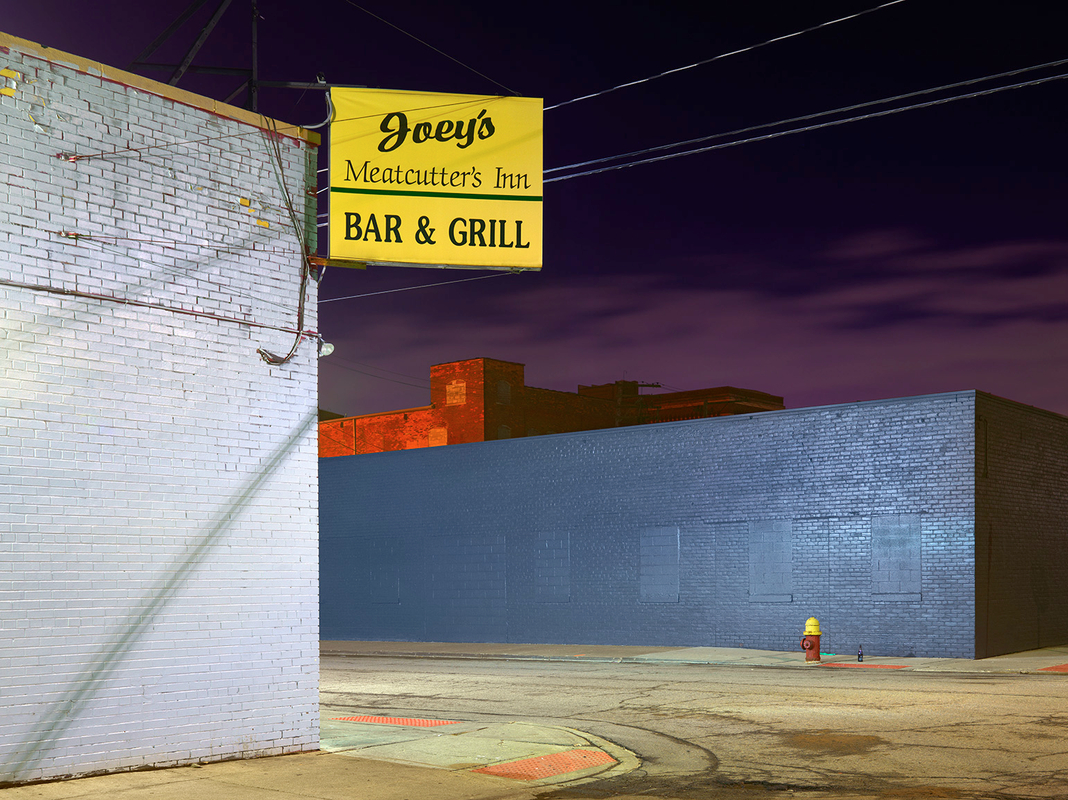
Immediately, I think of Edward Hopper: The lonely cityscape at night or the familiar glow of gas station lights cast into the American wilderness. The eye might want to linger among the colors, shapes and clouds even though the mind knows this is pretty much an empty street in a ‘post-industrial’ zone.
Perhaps it has do with another strand of expression: The break into free verse from past forms. The move from American Romanticism to Modernism which occurred this early past century. William Carlos Williams produced many good poems from a process of earnest, scrapbook-style intensity in trying to discover, redefine, and order a new poetic form within a modern ‘urban landscape.’
The individual artist is quite alone in the task he’s set before himself, and like much of modernism, it’s a rather big task.
Pastoral
When I was younger it was plain to me I must make something of myself. Older now I walk back streets admiring the houses of the very poor: roof out of line with sides the yards cluttered with old chicken wire, ashes, furniture gone wrong; the fences and outhouses built of barrel staves and parts of boxes, all, if I am fortunate, smeared a bluish green that properly weathered pleases me best of all colors.
No one will believe this of vast import to the nation
Perhaps I’m not wrong in having called Halloween horror stills and movie images to mind (it’s my mind, after all, so maybe I’m just thinking of Devil’s Night). I really enjoy the light on the dumpster and the side-front rectory wall. There seems to be a little more mood here, more drama, so maybe Edgar Allan Poe’s ‘psychological intensity,’ his surrealism, and terror are more appropriate for comparison.
Poe was a bit mad, after all, despite his fascinatingly untamed and powerful imagination. He achieved a uniqueness and completeness of vision few artists do. Maybe there’s a bit of the sullen, self-aggrandizing earnestness in him of the teenager (J.D. Salinger); the desire to shock, delight and terrify.
The mind is as though a chamber, the horror rises to fever pitch, the lush rhyme matches an increasingly desperate search for truth and beauty in the world (Poe had very much his own Romantically inspired metaphysics).
Alone
From childhood’s hour I have not been As others were—I have not seen As others saw—I could not bring My passions from a common spring— From the same source I have not taken My sorrow—I could not awaken My heart to joy at the same tone— And all I lov’d—I lov’d alone— Then—in my childhood—in the dawn Of a most stormy life—was drawn From ev’ry depth of good and ill The mystery which binds me still— From the torrent, or the fountain— From the red cliff of the mountain— From the sun that ’round me roll’d In its autumn tint of gold— From the lightning in the sky As it pass’d me flying by— From the thunder, and the storm— And the cloud that took the form (When the rest of Heaven was blue) Of a demon in my view—
Are you looking at beautiful photos and feeling sorry for Detroit, and yourself? See Time Magazine’s photo essay by Yves Marchand and Romain Meffre (less porn-like, more thoughtful).
My brother comes home from work and climbs the stairs to our room. I can hear the bed groan and his shoes drop one by one. You can have it, he says.
The moonlight streams in the window and his unshaven face is whitened like the face of the moon. He will sleep long after noon and waken to find me gone.
Thirty years will pass before I remember that moment when suddenly I knew each man has one brother who dies when he sleeps and sleeps when he rises to face this life,
and that together they are only one man sharing a heart that always labours, hands yellowed and cracked, a mouth that gasps for breath and asks, Am I gonna make it?
All night at the ice plant he had fed the chute its silvery blocks, and then I stacked cases of orange soda for the children of Kentucky, one gray boxcar at a time
with always two more waiting. We were twenty for such a short time and always in the wrong clothes, crusted with dirt and sweat. I think now we were never twenty.
In 1948 the city of Detroit, founded by de la Mothe Cadillac for the distant purposes of Henry Ford, no one wakened or died, no one walked the streets or stoked a furnace,
for there was no such year, and now that year has fallen off all the old newspapers, calendars, doctors’ appointments, bonds wedding certificates, drivers licenses.
The city slept. The snow turned to ice. The ice to standing pools or rivers racing in the gutters. Then the bright grass rose between the thousands of cracked squares,
and that grass died. I give you back 1948. I give you all the years from then to the coming one. Give me back the moon with its frail light falling across a face.
Give me back my young brother, hard and furious, with wide shoulders and a curse for God and burning eyes that look upon all creation and say, You can have it.
‘Oakeshott connected his perceptive account of tacit knowledge with a larger conception of modally distinct worlds of discourse, and, in this way, his account differed from Ryle’s. However, both thinkers contributed to the re-emergence of a kind of traditionalist and pluralist epistemology which rejects the reductionism of scientism and acknowledges the multitudinous ways in which human beings know things. For both writers, authentic knowledge always involves a capacity which cannot be reduced to articulable explicit propositions. Knowledge depends upon being capable of using it in some way.’
‘Modes, then, are provisionally coherent and distinguishable kinds or categories of understanding and inquiry. In Experience and Its Modes, Oakeshott aims to identify the presuppositions in terms of which a mode can be made coherent and distinguished from other modes. In philosophy, categorial distinctions are distinctions of kind rather than degree and what are called categories are often thought of as the most fundamental classes to which things can belong. But philosophers differ on whether the identified kinds are natural or real (ontological) or conceptual (epistemological). The former are categories of being (Aristotle), the latter categories of understanding (Kant). Philosophers also disagree about whether a categorial scheme must be exhaustive and fixed or, alternatively, can be open and mutable. The modes that Oakeshott identifies in Experience and Its Modes—history, science, and practice, to which he later added “poetry” (art)—are epistemological categories, not ontological ones. And although the modes are mutually exclusive, they do not form a closed set. They are constructions that have emerged over time in human experience. They could change or even disappear and other modes might yet appear.’
and:
‘The idea of a hierarchy of modes is not particular to Idealism. Where there are different understandings, it can occur to someone interested in reconciling them to imagine that they represent different levels of understanding. In contrast to unifying philosophies, including philosophical Idealism, Oakeshott’s position is pluralist and anti-hierarchical. In this respect he has more in common with Wilhelm Dilthey, who struggled with the issue of relativity in metaphysics and how to distinguish the human from the natural sciences, than with the British Idealists—Bradley, Bosanquet, and McTaggart among others—with whom he is often associated (Boucher 2012). For Oakeshott, all knowledge is tentative and conditional. Theorizing is “an engagement of arrivals and departures” in which “the notion of an unconditional or definitive understanding may hover in the background, but … has no part in the adventure” (OHC 2–3). In attempting to construct a coherent view of the world the philosopher “puts out to sea” (OHC 40) and is perpetually en voyage: there are no “final solutions” in philosophy any more than in practical affairs.’
I’m guessing Oakeshott would NOT have taken the case of monarchy up, nor the divine right of kings via Robert Filmer. Nor, likely, would he have taken up Thomas Hobbes’s case for the Leviathan based on a synthesis of the burgeoning practice of the natural sciences of the time. This isn’t an empiricist account of the world either (all knowledge arises in experience, sensation is separated from its object).
An Oakeshotian might see technical manuals everywhere, and few practitioners. He might see a lot of category errors, especially amongst those who mistake their own brilliance, method and scope as being enough to design political systems, laws and rules for the rest of us. Especially when such folks have little to no experience of those political systems, laws and rules.
‘The “hidden spring” of rationalism, as Oakeshott explains, is a belief in technical knowledge–which, by its very nature, is “susceptible of precise formulation”–as the sufficient or even the sole form of knowledge. This goes with a ‘preoccupation with certainty’ and an obsession with method, of the sort that can be expounded in a book; what it excludes is the kind of practical knowledge that is acquired only through prolonged contact with an experienced practitioner (RP, 11-17). Here one is reminded of Hobbes’s frequent insistence that true “science,” which yields certain knowledge, is different from “prudence,” which merely extracts probabilities from experience. Hobbes believed that geometry was the prototype of a true science, and that his own civil science was modeled on it;…’
And now for something mildly different:
During my humanities education, I developed an increasing suspicion of the postmodern rejection of tradition, rules, laws, rituals and beliefs, at least with regard to reading, writing and thinking. In engaging with some dull, and other absolutely mesmerizing, works of the creative imagination, I realized many of my own rituals and beliefs were being challenged. There are many experiences, and views, and ways to understand both myself and the world.
This is a good reason to get a good education!
It also slowly dawned on me that the lack of pedagogy, endless deconstructionist academic discussions, canon-less syllabi and increasing identitarian drift (is this person a professor because he/she’s the best poet/teacher or because he/she’s black/female or some mix of both?) were taking up valuable time.
I aimed to be open-minded, but not so much as to notice my brains falling out.
Honestly, I didn’t come across too many radicals and wasn’t particularly radical myself, though I went deep enough to see how people can become animated by some cause or injustice, often deep within their own lives (a bad childhood, homosexuality, social isolation, legal injustice, rejected prodigal talent etc).
It’s tough to say what conspires to make great artists and observers of life and their own experiences; but maybe it’s a little less tough to understand how some people forego the difficulty of creation in favor of political activism, religious certainty and belief, ideological certainty and second-rate moral scolding.
Oh, there are reasons.
Maybe I was just aging out or wasn’t so creative myself, anyways.
‘The most useful definition of modernist fiction I’ve encountered comes from Brian McHale’s Postmodernist Fiction. He says modernist fiction tends to “foreground epistemological questions” such as “How can I interpret the world I’m part of? What is there to be known? Who knows it? What are the limits of that knowledge?” In contrast, postmodernist fiction tends to “foreground ontological questions” such as “What is a world? What kinds of worlds are there and how are they constituted? What happens when…boundaries between worlds are violated?’
As to the epistemological questions surrounding Modernism, below are four poems. Hopefully, each is a representative example of a move away from the Romanticism that had been prevalent up until the late 1800’s.
In addition to the move away from traditional Romantic rhyme and meter towards modern blank verse, there’s also a certain conception of the Self rendered in them; a presentation of our natures that might be worth examining in some detail.
I believe we can see clearly a move away from tradition towards the Self, the Poet isolated, the poem itself as a means of communication, and an anxiety so common within the 20th century.
‘At the heart of Bloom’s project is the ancient quarrel between “poetry” and “philosophy.” In Bloom’s opinion, we ought not have to choose between Homer and Plato; we can have both, as long as we recognize that poetry is superior.’
Says the guy who writes about poetry…
What does one find within, as one looks without, waking from sleep and dream?
What kind of world is this, and can the poet actually help us know it?
You tossed a blanket from the bed You lay upon your back, and waited; You dozed, and watched the night revealing The thousand sordid images Of which your soul was constituted; They flickered against the ceiling. And when all the world came back And the light crept up between the shutters And you heard the sparrows in the gutters, You had such a vision of the street As the street hardly understands; Sitting along the bed’s edge, where You curled the papers from your hair, Or clasped the yellow soles of feet In the palms of both soiled hands.
—
The world will stain you, and it is a fallen, modern world, rendered profoundly and exquisitely.
As consciousness creeps in, building a bridge to the day, to the world, to the facts left as though they were the first facts, the light as though it were the first light, what one finds is distressing, both within and without.
That distress must be ‘made new,’ which is to say, the suffering (original?) in which we all sometimes find ourselves must match our experiences within the modern city and world, at least, the world created within Eliot’s lyrical verse.
Of the four poems, only the first and last have a 3rd-person subject.
—
Wallace Stevens‘ ‘I’ is in a more contemplative state, but it’s an ‘I’ exploring similar themes, and experiencing some distress in trying to know how the world actually is, and what might lie within.
The journey to The Self may not be a journey for the faint of heart.
The Poems Of Our Climate (stanzas II and III)
II Say even that this complete simplicity Stripped one of all one’s torments, concealed The evilly compounded, vital I And made it fresh in a world of white, A world of clear water, brilliant-edged, Still one would want more, one would need more, More than a world of white and snowy scents.
III There would still remain the never-resting mind, So that one would want to escape, come back To what had been so long composed. The imperfect is our paradise. Note that, in this bitterness, delight, Since the imperfect is so hot in us, Lies in flawed words and stubborn sounds.
—
Even if the verse can describe a perfected world, delivering us, perhaps, a little closer to perfection, our poet is still not free from the impulses and desires which simply never cease.
Interestingly, we end-up not with a discussion of the heart, the spirit, libido etc. as a source for those desires (for Plato, the irrational), but rather, for Stevens, just a mind.
We also find more Romantic elements of language and an almost baroque/rococo arrangement of words and ideas, dandyish even, yet combined with an intense effort to abstract, define, and clarify. From here, the poet may proceed on his task of flawed words and stubborn sounds.
***I find myself thinking of elements of modern architecture and abstract-expressionist painting. The meaning, or at least some delivery from our restless existences, can be found within the abstract itself. Or at least within a retreat to the abstract for its own sake, away from the world.
The modernist, glass-walled house on the hill will exist in its own space, offering and defying meaning. The structure’s own shapes will be stripped down to often mathematically precise forms interacting with Nature. These shall guide Man, or at least offer individual men a little refuge.
It is perhaps in Stevens’ poem we can see the questions of knowledge about the world suggesting questions about whether there is a world at all, or, at least, what kind of worlds each Self might be able to inhabit.
—
Here’s one of Robert Lowell’s poems, occurring a generation later, in the mid 20th-century, as part of the confessionals.
The Self is extremely isolated. In fact, Lowell went more than a little crazy. Unlike the known nervous breakdown of Eliot from which Eliot recovered, Lowell’s life was essentially one long breakdown from which he never recovered.
Here he is, looking back:
Epilogue
Those blessed structures plot and rhyme- why are they no help to me now i want to make something imagined not recalled? I hear the noise of my own voice: The painter’s vision is not a lens it trembles to caress the light. But sometimes everything i write With the threadbare art of my eye seems a snapshot lurid rapid garish grouped heightened from life yet paralyzed by fact. All’s misalliance. Yet why not say what happened? Pray for the grace of accuracy Vermeer gave to the sun’s illumination stealing like the tide across a map to his girl solid with yearning. We are poor passing facts. warned by that to give each figure in the photograph his living name.
—
The weight of having to make that meaning, for yourself, and by yourself, is a horrible weight indeed. One can glorify one’s Self and family, but that, alas, only goes so far. Rhyme and form still carry one’s living name, as far as they do.
Of course, there’s still wonderful rhythm and form here (this is excellent verse), but blanker now, with a relentless focus on the ‘I.’ The poet is perhaps talking a little more to himself, and the poem keeps self-consciously calling attention to itself.
—
In fact, it reminded me of the poem below, by Robert Creeley, which was published a few years afterwards.
From this page:
‘Creeley was a leader in the generational shift that veered away from history and tradition as primary poetic sources and gave new prominence to the ongoing experiences of an individual’s life. Because of this emphasis, the major events of his life loom large in his literary work.’
There’s Nothing but the Self and the Eye seeking and making meaning, by itself within a void of emotionally compact and precise language (of course there’s still form and other things besides).
Can the poet fit inside the little abstract chapel of words he’s building for himself (let alone the world, tradition etc.)?
For all the talk about ‘space,’ there seems very little.
The Window
Position is where you put it, where it is, did you, for example, that
large tank there, silvered, with the white church along- side, lift
all that, to what purpose? How heavy the slow
world is with everything put in place. Some
man walks by, a car beside him on the dropped
road, a leaf of yellow color is going to
fall. It all drops into place. My
face is heavy with the sight. I can feel my eye breaking.
—
The distress is still there…but I’d argue that we are now a good distance away from the grandness of Eliot’s vision, his religiosity and virtuosity with form and meter at the dawn of Modernism. Very few people can/could do what Eliot did (addition: even if he can help us gain knowledge of our Selves or the world).
That said, it’s unclear there’s enough tradition and confidence to even undertake such a project, now, even as such talents come along. The state of things is more scattered. We’re in a very different place of selves and artists isolated, of anxiety and post-anxiety.
Aside from the very accomplished poets above, in terms of both knowledge (epistemology) and being (ontology), we often have writers feeling pressure to weigh-in on such questions without even being about to write that well; artists who can’t draw or paint that well, and frankly, quite a bit of bullshit besides.
So, where are we headed? Who’s ‘we’ exactly?
Predictions are hard, especially about the future.
As previously posted:
Why not just put a few algorithms to work in writing those artist statements?
‘In “Sea Change,” Graham becomes Prospero, casting spells by spelling out her thoughts to merge with ours, and with the voices of the elements. The result is a mingling of perceptions rather than a broadcasting of opinions. Instead of analysis, the poems encourage emotional involvement with the drastic changes overwhelming us, overwhelm- ing the planet.’
and:
‘Strengths and weaknesses, flows and ebbs, yet every poem in “Sea Change” bears memorable lines, with almost haunting (if we truly have but 10 years to “fix” global warming) images of flora and fauna under siege. Jorie Graham has composed a swan song for Earth.’
Oh boy.
What are these poems being asked to do?
And moving away from poetry into the realm of ‘performance art,’
Let’s say you use mathematics and/or engineer systems, in pursuit of new knowledge and truth.
Come worship at the Human Pagoda!
Are you an artist, captivated by the beauty of this world?
We have an ecopodment for you.
At the cutting-edge Institute of Global Citizens (IGC), we draft rules for tomorrow’s leaders.
As a thought-leader, your contributions will feed into a Council of Purely Democratic Representation, uniting our fractured world and restoring Nature’s purity.
Swim in the warm bath of the (S)elf. Float in the bowl of Romantic Nature.
As posted, someone called me a Postmodern Conservative a while back, and I’d just like to say that there are many identities juxtaposed at the intersectionality of bodies in space. Dominant narratives, meta-narratives, and counter-narratives serve to liber…
‘The most useful definition of modernist fiction I’ve encountered comes from Brian McHale’s Postmodernist Fiction. He says modernist fiction tends to “foreground epistemological questions” such as “How can I interpret the world I’m part of? What is there to be known? Who knows it? What are the limits of that knowledge?” In contrast, postmodernist fiction tends to “foreground ontological questions” such as “What is a world? What kinds of worlds are there and how are they constituted? What happens when…boundaries between worlds are violated?’
As to the epistemological questions surrounding Modernism, below are four poems. Hopefully, each is a representative example of a move away from the Romanticism that had been prevalent up until the late 1800’s.
In addition to the move away from traditional Romantic rhyme and meter towards modern blank verse, there’s also a certain conception of the Self rendered in them; a presentation of our natures that might be worth examining in some detail.
I believe we can see clearly a move away from tradition towards the Self, the Poet isolated, the poem itself as a means of communication, and an anxiety so common within the 20th century.
‘At the heart of Bloom’s project is the ancient quarrel between “poetry” and “philosophy.” In Bloom’s opinion, we ought not have to choose between Homer and Plato; we can have both, as long as we recognize that poetry is superior.’
Says the guy who writes about poetry…
What does one find within, as one looks without, waking from sleep and dream?
What kind of world is this, and can the poet actually help us know it?
You tossed a blanket from the bed You lay upon your back, and waited; You dozed, and watched the night revealing The thousand sordid images Of which your soul was constituted; They flickered against the ceiling. And when all the world came back And the light crept up between the shutters And you heard the sparrows in the gutters, You had such a vision of the street As the street hardly understands; Sitting along the bed’s edge, where You curled the papers from your hair, Or clasped the yellow soles of feet In the palms of both soiled hands.
—
The world will stain you, and it is a fallen, modern world, rendered profoundly and exquisitely.
As consciousness creeps in, building a bridge to the day, to the world, to the facts left as though they were the first facts, the light as though it were the first light, what one finds is distressing, both within and without.
That distress must be ‘made new,’ which is to say, the suffering (original?) in which we all sometimes find ourselves must match our experiences within the modern city and world, at least, the world created within Eliot’s lyrical verse.
Of the four poems, only the first and last have a 3rd-person subject.
—
Wallace Stevens‘ ‘I’ is in a more contemplative state, but it’s an ‘I’ exploring similar themes, and experiencing some distress in trying to know how the world actually is, and what might lie within.
The journey to The Self may not be a journey for the faint of heart.
The Poems Of Our Climate (stanzas II and III)
II Say even that this complete simplicity Stripped one of all one’s torments, concealed The evilly compounded, vital I And made it fresh in a world of white, A world of clear water, brilliant-edged, Still one would want more, one would need more, More than a world of white and snowy scents.
III There would still remain the never-resting mind, So that one would want to escape, come back To what had been so long composed. The imperfect is our paradise. Note that, in this bitterness, delight, Since the imperfect is so hot in us, Lies in flawed words and stubborn sounds.
—
Even if the verse can describe a perfected world, delivering us, perhaps, a little closer to perfection, our poet is still not free from the impulses and desires which simply never cease.
Interestingly, we end-up not with a discussion of the heart, the spirit, libido etc. as a source for those desires (for Plato, the irrational), but rather, for Stevens, just a mind.
We also find more Romantic elements of language and an almost baroque/rococo arrangement of words and ideas, dandyish even, yet combined with an intense effort to abstract, define, and clarify. From here, the poet may proceed on his task of flawed words and stubborn sounds.
***I find myself thinking of elements of modern architecture and abstract-expressionist painting. The meaning, or at least some delivery from our restless existences, can be found within the abstract itself. Or at least within a retreat to the abstract for its own sake, away from the world.
The modernist, glass-walled house on the hill will exist in its own space, offering and defying meaning. The structure’s own shapes will be stripped down to often mathematically precise forms interacting with Nature. These shall guide Man, or at least offer individual men a little refuge.
It is perhaps in Stevens’ poem we can see the questions of knowledge about the world suggesting questions about whether there is a world at all, or, at least, what kind of worlds each Self might be able to inhabit.
—
Here’s one of Robert Lowell’s poems, occurring a generation later, in the mid 20th-century, as part of the confessionals.
The Self is extremely isolated. In fact, Lowell went more than a little crazy. Unlike the known nervous breakdown of Eliot from which Eliot recovered, Lowell’s life was essentially one long breakdown from which he never recovered.
Here he is, looking back:
Epilogue
Those blessed structures plot and rhyme- why are they no help to me now i want to make something imagined not recalled? I hear the noise of my own voice: The painter’s vision is not a lens it trembles to caress the light. But sometimes everything i write With the threadbare art of my eye seems a snapshot lurid rapid garish grouped heightened from life yet paralyzed by fact. All’s misalliance. Yet why not say what happened? Pray for the grace of accuracy Vermeer gave to the sun’s illumination stealing like the tide across a map to his girl solid with yearning. We are poor passing facts. warned by that to give each figure in the photograph his living name.
—
The weight of having to make that meaning, for yourself, and by yourself, is a horrible weight indeed. One can glorify one’s Self and family, but that, alas, only goes so far. Rhyme and form still carry one’s living name, as far as they do.
Of course, there’s still wonderful rhythm and form here (this is excellent verse), but blanker now, with a relentless focus on the ‘I.’ The poet is perhaps talking a little more to himself, and the poem keeps self-consciously calling attention to itself.
—
In fact, it reminded me of the poem below, by Robert Creeley, which was published a few years afterwards.
From this page:
‘Creeley was a leader in the generational shift that veered away from history and tradition as primary poetic sources and gave new prominence to the ongoing experiences of an individual’s life. Because of this emphasis, the major events of his life loom large in his literary work.’
There’s Nothing but the Self and the Eye seeking and making meaning, by itself within a void of emotionally compact and precise language (of course there’s still form and other things besides).
Can the poet fit inside the little abstract chapel of words he’s building for himself (let alone the world, tradition etc.)?
For all the talk about ‘space,’ there seems very little.
The Window
Position is where you put it, where it is, did you, for example, that
large tank there, silvered, with the white church along- side, lift
all that, to what purpose? How heavy the slow
world is with everything put in place. Some
man walks by, a car beside him on the dropped
road, a leaf of yellow color is going to
fall. It all drops into place. My
face is heavy with the sight. I can feel my eye breaking.
—
The distress is still there…but I’d argue that we are now a good distance away from the grandness of Eliot’s vision, his religiosity and virtuosity with form and meter at the dawn of Modernism. Very few people can/could do what Eliot did (addition: even if he can help us gain knowledge of our Selves or the world).
That said, it’s unclear there’s enough tradition and confidence to even undertake such a project, now, even as such talents come along. The state of things is more scattered. We’re in a very different place of selves and artists isolated, of anxiety and post-anxiety.
Aside from the very accomplished poets above, in terms of both knowledge (epistemology) and being (ontology), we often have writers feeling pressure to weigh-in on such questions without even being about to write that well; artists who can’t draw or paint that well, and frankly, quite a bit of bullshit besides.
So, where are we headed? Who’s ‘we’ exactly?
Predictions are hard, especially about the future.
As previously posted:
Why not just put a few algorithms to work in writing those artist statements?
‘In “Sea Change,” Graham becomes Prospero, casting spells by spelling out her thoughts to merge with ours, and with the voices of the elements. The result is a mingling of perceptions rather than a broadcasting of opinions. Instead of analysis, the poems encourage emotional involvement with the drastic changes overwhelming us, overwhelm- ing the planet.’
and:
‘Strengths and weaknesses, flows and ebbs, yet every poem in “Sea Change” bears memorable lines, with almost haunting (if we truly have but 10 years to “fix” global warming) images of flora and fauna under siege. Jorie Graham has composed a swan song for Earth.’
Oh boy.
What are these poems being asked to do?
And moving away from poetry into the realm of ‘performance art,’
‘By the time “Paralyzed: 50 Floors” earned wide release, Bellagamba’s unique blend of post-war Italian neorealism, sci-fi surrealism, and giallo was no longer finding an audience.
Bellagamba died penniless in his native Abruzzo in 1999, interred within a bowl of Diavolicchio (red chili) inside the stomach of a white dove. ‘
Still from the set of “Paralyzed: 50 floors:’. Antonio Stagglione (sp) plays the protagonist as child and future child within the then-longest-recorded Italian sci-fi action dream sequence.
‘We look inside the shards of the past to discover a future that lies stranded in the present.‘
-Giacomo Bellagamba. R.I.P.
***Addendum: Hey, I’d just like to help prepare us all for a world with the coming AI assistive technology. Easily manipulable images and standardized, formalized text are happening right now. Keep your bullshit detectors finely-tuned.