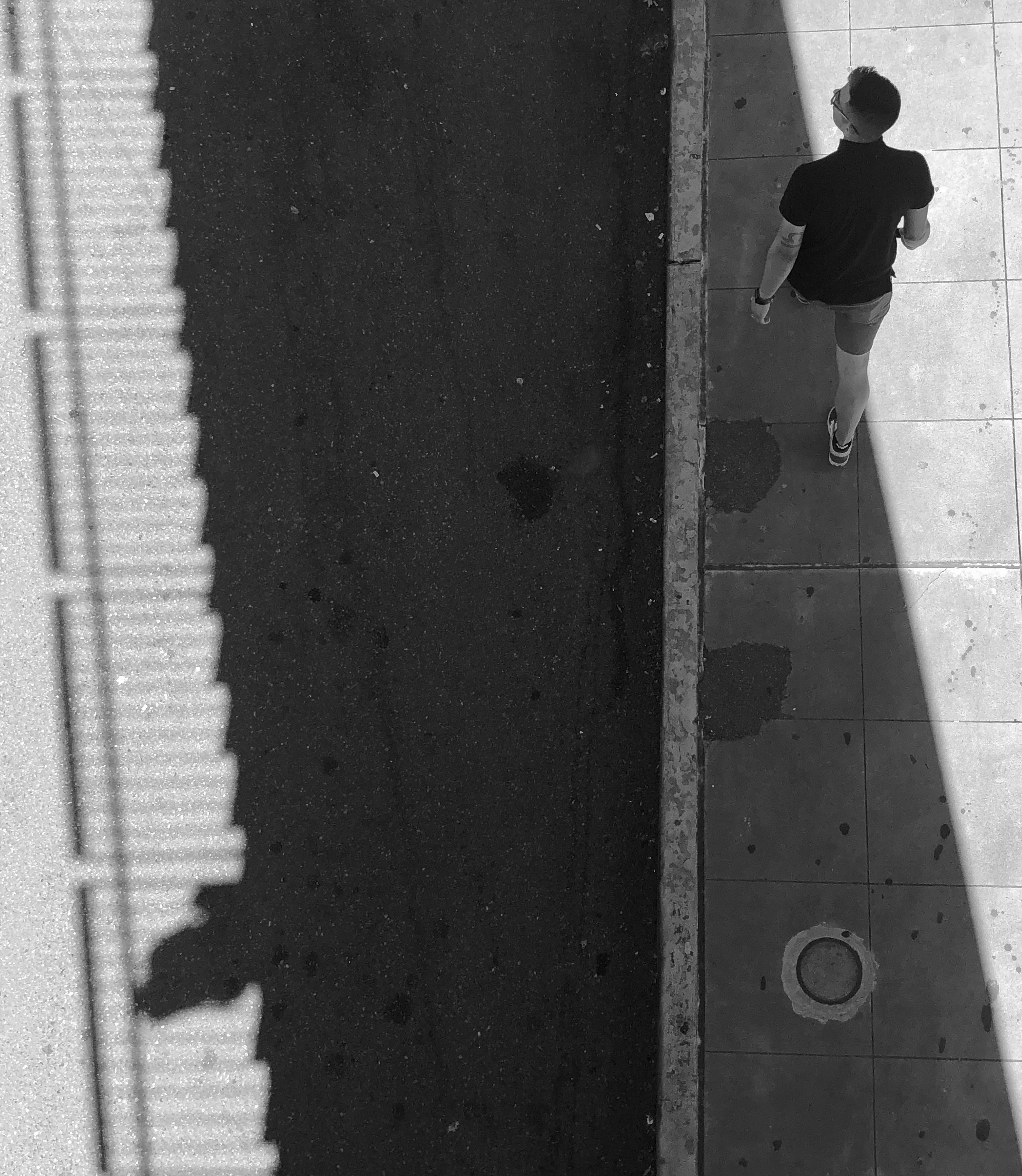
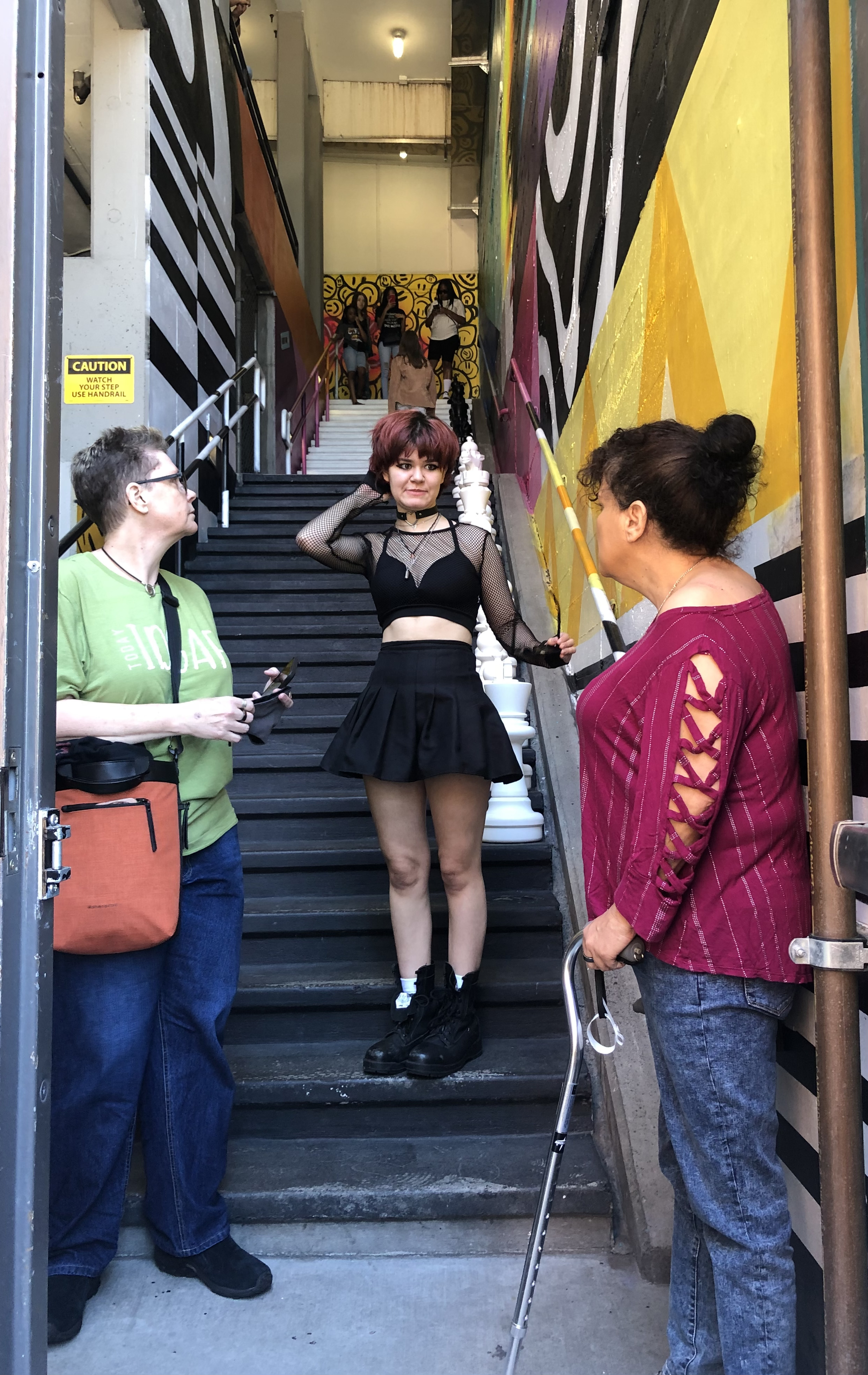
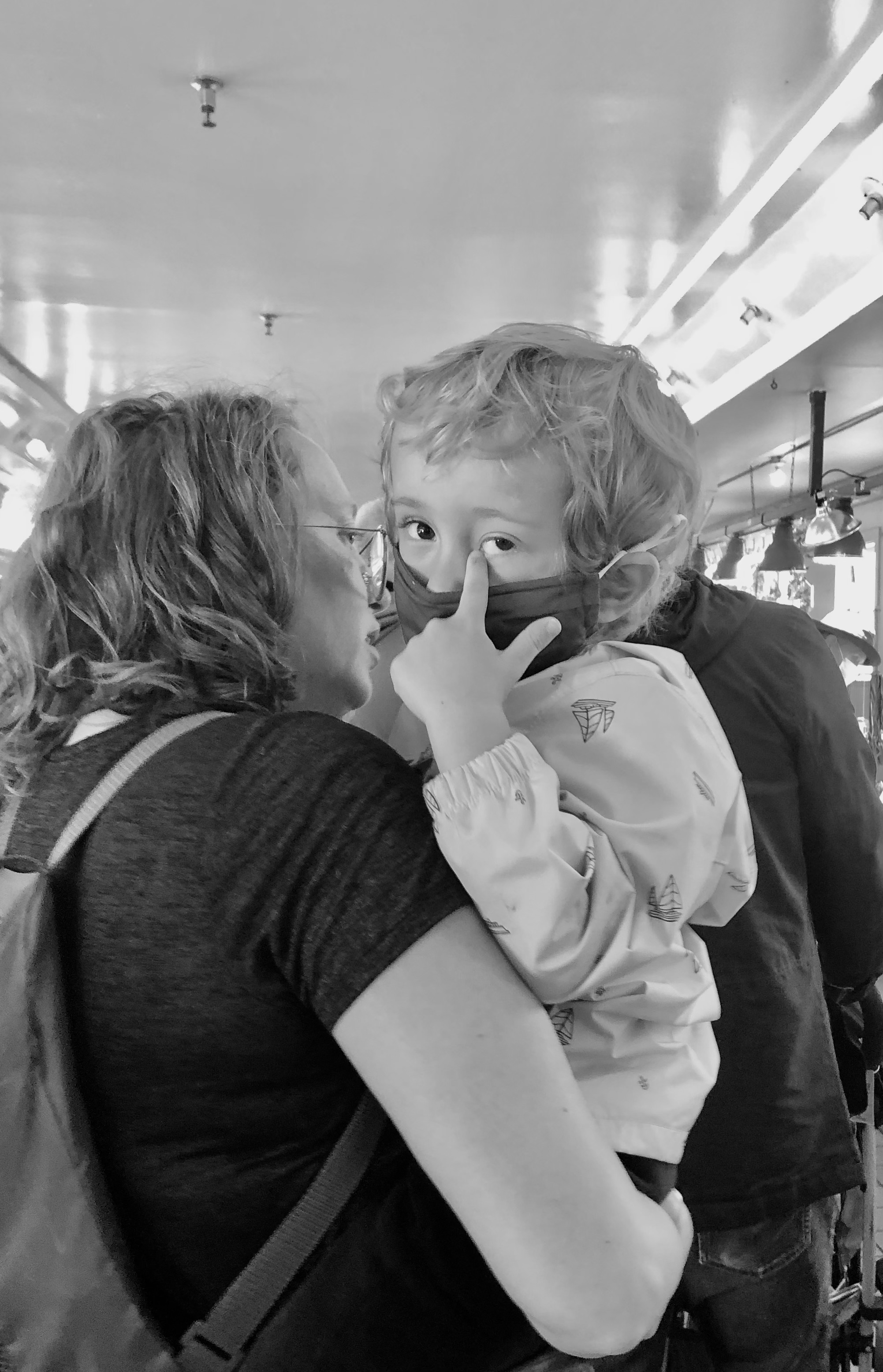
Images 1 and 3 below, especially, read as illustrations to me, while image 2 acts as more of a bridge. As readers know, I tend towards quiet, observational photographs. There is a progression present moving outdoors-in, to a more intimate space.
Edward Hopper practiced deep color complentarity in his paintings, balancing cool and warm. I first noticed his use of red here, and it got me thinking:
‘Red is powerful. Hopper’s using it with purpose.‘
This got me thinking a little further: ‘How much red is too much?‘
Henri Matisse went full red one time, but there’s much more: Expert lines, curves, and composition (no focal point) make me feel at home. In fact, I think this domestically-minded Frenchman’s put most of his life’s purpose into his painting.
—
What’s the most aggressive, yet soothing, use of red I’ve seen consistently throughout my life?
Probably a Coke can, billboard, or truck. Check out this Arthur Meyerson photo with a Coke truck in context.
Another color problem: Color draws the eye quickly. Color is powerful. It snatches your eye and mind. The original black-and-white photographers thought color photography would distract, vulgarize, and commercialize; away from subject and composition, especially given the camera technology at the time.
It turns out the old guys weren’t entirely wrong, as many advertisers and fashion photographers barf color all over the place. Some expertly upchuck. Others, alas, puke like Brits on holiday in Ibiza.
Kids with crayons and iPads, shock and awe pop-artist and portraitists, movie directors, and even ideologues making their propaganda, use color freely. We’re all being gradually exposed to the newer synthetic AI stuff coming down the pike. We are living, I believe, amidst an information revolution (storage, access, process and attention). I mean, unless you’re color blind, you see the world in color.
Remember that one sunset and her makeup and the city behind her all blended together?
On that note, Dear Reader, this has been one of the best approaches I’ve found so far along my later, more limited, photographic journey in life:
‘Beware of color theories. Theories in color photography are dangerous. The plain fact that there are so many of them proves my point. A color philosophy comes much closer to the truth. Beware of scientific color tests. They are as quickly outdated as a timetable. Their truth is short lived. Most theories are the result of an attempt to bring one’s practical experiences into a formula. There is no formula. There are only confirmations to formulas which one has already discovered oneself. I myself love to read theories without ever using them when working.‘
Hopefully, I’ve jarred something loose inside your head.
Give me one minute and your mind. 1. Please read the poem aloud. 2. Take a closer look at the photo 3. Play the first 30 seconds of Chopin’s Nocturne in B-flat minor, Op 9, No. 1. (past the 00:26 mark).
The goal: Create a dreamy, contemplative experience before you move on.
From our rather reasonable AI overlords: ‘Common skepticism is a healthy critical attitude towards dubious claims, while philosophical skepticism challenges foundational knowledge and the justification for belief itself, demanding proof for everything, a stance few people adopt in daily life.’
I knew a philosophic skeptic, he was smarter than me & fun, but, man…what an asshole.
Commoners have good reasons to be skeptical when it comes to modern art:
‘Titled Comedian, the humoristic piece can be considered a challenge to the sometimes-absurdist nature of the art market and the art collecting world. “To me, Comedian was not a joke; it was a sincere commentary and a reflection on what we value,” said the artist in an interview at the time. “At art fairs, speed and business reign, so I saw it like this: if I had to be at a fair, I could sell a banana like others sell their paintings. I could play within the system, but with my rules.”’
Who can forget the transcendent darkness of this photo (the shock-concept and the celebrity overshadowing the skill/visual impact).
‘He immersed a crucifix he bought in an antique shop in his own urine.‘
Fellow commoners, we have as a counterpoint, rather beautiful, innovative classics like Falling Water, by Frank Lloyd Wright. A pain in the ass to maintain, but still a place for the genuine:
As I see the world: We have beliefs, and we’ve usually locked them away beyond critique. So has most everyone else. Some beliefs have more truth in them than others.
We use shared beliefs to form and maintain relationships. We use them to get stuff and give other people stuff. We rely on shared beliefs to organize events/clubs, workplaces, and hierarchies of judgment and knowledge, without killing each other. Shared beliefs regulate and help us navigate our emotions, as well as our personal, interpersonal and social behavior. We outsource much of our thinking to shared beliefs, while forgetting they’re even there. We’re often proudest of passing our beliefs on if we think they’re true, lasting and important.
The rub is the relationship these beliefs have with truth, and knowledge. A modern rationalist might say something like: ‘We have access to enough scientific and economic knowledge to run the government, and effectively plan your life. (M)an is something holy, and we’ve only just begun perfecting (M)an.Go ahead be creative and vote for the $1 billion arts package or else.‘
A typical Catholic might say something like: ‘Let’s check in with Canon Law. The Pope is closest to God, then the Cardinals, then the Archbishops etc.’ We’re only redeemed through Christ. So….that’s what art should be doing. Capiche?
What if a radical questioning of belief becomes the norm, around which people are…still believing?
What, then, do people actually believe?
What do artists, often radically questioning belief while making stuff, actually believe?
Those increasingly ridiculous artist statements? Some curious mix of irony, doom and nihilism all the way down? Modern mysticism?
A digression: Let’s say a kid in bad neighborhood, at a vulnerable age, joins a gang. He gets protection, savage discipline and access to stuff. The gang serves dark masters of the soul of course (in our case: How to rob specific makes/models of cars and sell them for parts, leaving a trail of harm, making the kid violent and dangerous).
Let’s also say the same kid in a bad neighborhood, on weekends, hangs with his uncle. His uncle fixes cars. Our kid learns to honor something within himself, other people, and the world. Like his time with the gang, life unfolds as a series of challenges, struggles and possibilities. Yet, his lifespan probability opens from twenty-two to sixty-four. Much better of parts of the kid’s nature come forwards. People drive their cars away, grumbling over the price and the delays…but, still.
Clearly, one path is better for the kid, the neighborhood and the rest of us?
Surely?
Now, what if, at school, that same kid is particularly talented, smart and sensitive? What if he is guided by someone towards personal self-expression, and even the eventual self-doubt, poverty and emotional rollercoaster of a typical artist’s life?
Shouldn’t the kid at least be taught how to notice things? how to describe how a good painting looks? how to draw? how to draft? how to mix paint?
Surely?
These days, it seems we find ourselves in a ‘post, postmodern landscape.’
What is this curious, Western belief to ‘blank-slate’ everything? How can it be true that the kid’s emotions are a reservoir and his reason a man-made, oppressive dam? That he just needs to make a dark, mixed-media video collage and he’s arrived?
It seems making simple moral judgments in real-world scenarios raises serious questions about the Romantic/Modern/Postmodern projects.
The case for the visual art over the primacy of concept/idea: Lets say you’re looking at John Singer Sargent’s ‘Lady Agnew Of Lochnaw‘ (somewhere between realism/impressionism). You’re not looking at merely the idea of painting (good paintings already have ideas in them).
—
Maybe you want to touch her skin? How did he paint like that? Look at the color and light. What is the artist saying? This painting took six sittings, but, arguably, a lifetime and maybe the better elements of a civilization to achieve.
A simple case: The Duchamp/Warhol line (concept/idea over visual communication/technical skill) warrants tremendous common-sense skepticism (I’ve gone a little deeper…but you get the point). Enough already.
Bananas duct-taped to walls and crucifixes dunked in piss are not just wasting our time, perhaps they’re harming our imaginations.
There are so many reasons to doubt so much bullshit within modern/postmodern thinking, while at the same time learning from the good.
—
Tom Wolfe went on the T.V. with William F Buckley (too political for my taste) to discuss his book: ‘The Painted Word.’
At min 5:39 Wolfe argues the following (one part of the art/money/celebrity feedback loop):
‘It’s really a religious thing. One thing I didn’t say in The Painted Word, that I should have said, is that art today, is the religion of the educated classes. I don’t mean that by analogy, it isn’t like being a Baptist in 1870, it is being a Baptist in 1870.’
—
From Art vs Machine: Here is a video making the case that Jackson Pollock achieved something, but it wasn’t really the innovative use of drip-paint.
Maybe it was kinda beautiful in its own way? Romantically Primitive?
—
Also, are Robert Hughes criticisms’ of Andy Warhol’s art really blocked by YouTube?
Making a hero of the androgynous anti-hero is orthodoxy these days, but also pretty tired (the Warhol to Bowie line seems over-rated):
—
What came before modernism/postmodernism? Why the below video might be worth listening to (min 34:22):
‘There was a great turn towards emotionalism. There was a sudden interest in the primitive and remote; the remote in time and the remote in place. There was a outbreak of craving for the infinite’
A movement emerged, about 1760–1840, which has deeply affected our conceptions of the Self, Art, heroes and villains, and most importantly, what makes life worth living.
And let’s not forget one of the masters (as though putting such words here imbues this blog with the same stuff):
But, soft! what light through yonder window breaks? It is the east, and Juliet is the sun. Arise, fair sun, and kill the envious moon, Who is already sick and pale with grief, That thou her maid art far more fair than she: Be not her maid, since she is envious; Her vestal livery is but sick and green And none but fools do wear it; cast it off. It is my lady, O, it is my love! O, that she knew she were! She speaks yet she says nothing: what of that? Her eye discourses; I will answer it. I am too bold, ’tis not to me she speaks: Two of the fairest stars in all the heaven, Having some business, do entreat her eyes To twinkle in their spheres till they return. What if her eyes were there, they in her head? The brightness of her cheek would shame those stars, As daylight doth a lamp; her eyes in heaven Would through the airy region stream so bright That birds would sing and think it were not night. See, how she leans her cheek upon her hand! O, that I were a glove upon that hand, That I might touch that cheek!