Between my finger and my thumb The squat pen rests; snug as a gun.
Under my window, a clean rasping sound When the spade sinks into gravelly ground: My father, digging. I look down
Till his straining rump among the flowerbeds Bends low, comes up twenty years away Stooping in rhythm through potato drills Where he was digging.
The coarse boot nestled on the lug, the shaft Against the inside knee was levered firmly. He rooted out tall tops, buried the bright edge deep To scatter new potatoes that we picked, Loving their cool hardness in our hands.
By God, the old man could handle a spade. Just like his old man.
My grandfather cut more turf in a day Than any other man on Toner’s bog. Once I carried him milk in a bottle Corked sloppily with paper. He straightened up To drink it, then fell to right away Nicking and slicing neatly, heaving sods Over his shoulder, going down and down For the good turf. Digging.
The cold smell of potato mould, the squelch and slap Of soggy peat, the curt cuts of an edge Through living roots awaken in my head. But I’ve no spade to follow men like them.
Between my finger and my thumb The squat pen rests. I’ll dig with it.
When I was younger it was plain to me I must make something of myself. Older now I walk back streets admiring the houses of the very poor: roof out of line with sides the yards cluttered with old chicken wire, ashes, furniture gone wrong; the fences and outhouses built of barrel staves and parts of boxes, all, if I am fortunate, smeared a bluish green that properly weathered pleases me best of all colors.
No one will believe this of vast import to the nation
By the road to the contagious hospital under the surge of the blue mottled clouds driven from the northeast—a cold wind. Beyond, the waste of broad, muddy fields brown with dried weeds, standing and fallen
patches of standing water the scattering of tall trees
All along the road the reddish purplish, forked, upstanding, twiggy stuff of bushes and small trees with dead, brown leaves under them leafless vines—
Lifeless in appearance, sluggish dazed spring approaches—
They enter the new world naked, cold, uncertain of all save that they enter. All about them the cold, familiar wind—
Now the grass, tomorrow the stiff curl of wildcarrot leaf
One by one objects are defined— It quickens: clarity, outline of leaf
But now the stark dignity of entrance—Still, the profound change has come upon them: rooted they grip down and begin to awaken
The art of losing isn’t hard to master; so many things seem filled with the intent to be lost that their loss is no disaster,
Lose something every day. Accept the fluster of lost door keys, the hour badly spent. The art of losing isn’t hard to master.
Then practice losing farther, losing faster: places, and names, and where it was you meant to travel. None of these will bring disaster.
I lost my mother’s watch. And look! my last, or next-to-last, of three loved houses went. The art of losing isn’t hard to master.
I lost two cities, lovely ones. And, vaster, some realms I owned, two rivers, a continent. I miss them, but it wasn’t a disaster.
– Even losing you (the joking voice, a gesture I love) I shan’t have lied. It’s evident the art of losing’s not too hard to master though it may look like (Write it!) like disaster.
That civilisation may not sink, Its great battle lost, Quiet the dog, tether the pony To a distant post; Our master Caesar is in the tent Where the maps are spread, His eyes fixed upon nothing, A hand under his head.
Like a long-legged fly upon the stream His mind moves upon silence.
That the topless towers be burnt And men recall that face, Move most gently if move you must In this lonely place. She thinks, part woman, three parts a child, That nobody looks; her feet Practise a tinker shuffle Picked up on a street.
Like a long-legged fly upon the stream Her mind moves upon silence.
That girls at puberty may find The first Adam in their thought, Shut the door of the Pope’s chapel, Keep those children out. There on that scaffolding reclines Michael Angelo. With no more sound than the mice make His hand moves to and fro.
Like a long-legged fly upon the stream His mind moves upon silence.
I know that I shall meet my fate Somewhere among the clouds above; Those that I fight I do not hate, Those that I guard I do not love; My country is Kiltartan Cross, My countrymen Kiltartan’s poor, No likely end could bring them loss; Nor leave them happier than before. Nor law; nor duty bade me fight, Nor public men, nor cheering crowds, A lonely impulse of delight Drove to this tumult in the clouds; I balanced all, brought all to mind, The years to come seemed waste of breath, A waste of breath the years behind In balance with this life, this death.
Somewhere up in the clouds of Venus, there’s Phosphine [possibly]. So far, there’s no known naturally occurring reason for this, but that doesn’t mean there isn’t one. On Earth, when bacteria farts in our guts and in swamps, that’s when you get Phosphine. I’ll bet it smells nice.
Maybe in those clouds of sulfuric acid, racing above surface temperatures high-enough to melt lead, there’s some ammonia? Maybe this ammonia is neutralizing the cloud PH balance enough for some kind of bacteria to survive?
These are questions to which a little exploration can provide answers.
—
You know the moment you notice that the world has fallen away for awhile? You’re leisurely enjoying a photograph, or a painting, or a poem…
‘In the critical terminology of the time, Ghirri’s close-up photographs of the details of atlases and other maps question the link between signifier and signified, referring to a supposedly ‘natural’ environment that has long since become a simulacrum, and revealing the specific aesthetics harboured within ‘objective’ representation.’
The NIGHT of the BLURB! It’s postmodern, it’s (S)elf referential, it’s….alive. It’s dead. It’s…subjectivity and objectivity combined!
—
And now for a ‘modern’ poem.
The Snow Man
One must have a mind of winter To regard the frost and the boughs Of the pine-trees crusted with snow;
And have been cold a long time To behold the junipers shagged with ice, The spruces rough in the distant glitter
Of the January sun; and not to think Of any misery in the sound of the wind, In the sound of a few leaves,
Which is the sound of the land Full of the same wind That is blowing in the same bare place
For the listener, who listens in the snow, And, nothing himself, beholds Nothing that is not there and the nothing that is.
Let confusion be the design and all my thoughts go, swallowed by desire: recess from promises in the November of your arms. Release from the rose: broken reeds, strawpale, through which, from easy branches that mock the blood a few leaves fall. There the mind is cradled, stripped also and returned to the ground, a trivial and momentary clatter. Sleep and be brought down, and so condone the world, eased of the jagged sky and all its petty imageries, flying birds, its fogs and windy phalanxes . . .
Man, looking into the sea— taking the view from those who have as much right to it as you have it to yourself— it is human nature to stand in the middle of a thing but you cannot stand in the middle of this: the sea has nothing to give but a well excavated grave. The firs stand in a procession—each with an emerald turkey-foot at the top— reserved as their contours, saying nothing; repression, however, is not the most obvious characteristic of the sea; the sea is a collector, quick to return a rapacious look. There are others besides you who have worn that look— whose expression is no longer a protest; the fish no longer investigate them for their bones have not lasted; men lower nets, unconscious of the fact that they are desecrating a grave, and row quickly away—the blades of the oars moving together like the feet of water-spiders as if there were no such thing as death. The wrinkles progress upon themselves in a phalanx—beautiful under networks of foam, and fade breathlessly while the sea rustles in and out of the seaweed; the birds swim through the air at top speed, emitting cat-calls as heretofore— the tortoise-shell scourges about the feet of the cliffs, in motion beneath them and the ocean, under the pulsation of light-houses and noise of bell-buoys, advances as usual, looking as if it were not that ocean in which dropped things are bound to sink— in which if they turn and twist, it is neither with volition nor consciousness. –
The trees are in their autumn beauty, The woodland paths are dry, Under the October twilight the water Mirrors a still sky; Upon the brimming water among the stones Are nine-and-fifty swans.
The nineteenth autumn has come upon me Since I first made my count; I saw, before I had well finished, All suddenly mount And scatter wheeling in great broken rings Upon their clamorous wings.
I have looked upon those brilliant creatures, And now my heart is sore. All’s changed since I, hearing at twilight, The first time on this shore, The bell-beat of their wings above my head, Trod with a lighter tread.
Unwearied still, lover by lover, They paddle in the cold Companionable streams or climb the air; Their hearts have not grown old; Passion or conquest, wander where they will, Attend upon them still.
But now they drift on the still water, Mysterious, beautiful; Among what rushes will they build, By what lake’s edge or pool Delight men’s eyes when I awake some day To find they have flown away?
I have come to a still, but not a deep center, A point outside the glittering current; My eyes stare at the bottom of a river, At the irregular stones, iridescent sandgrains, My mind moves in more than one place, In a country half-land, half-water. I am renewed by death, thought of my death, The dry scent of a dying garden in September, The wind fanning the ash of a low fire. What I love is near at hand, Always, in earth and air.
Having used every subterfuge To shake you, lies, fatigue, or even that of passion, Now I see no way but a clean break. I add that I am willing to bear the guilt.
You nod assent. Autumn turns windy, huge, A clear vase of dry leaves vibrating on and on. We sit, watching. When I next speak Love buries itself in me, up to the hilt.
A return to Nature? To origins of faith? To a simple freedom in a wild land, and new understandings, with death in view? To visions of Romantic Primitivism becoming modern?:
VII
Supple and turbulent, a ring of men Shall chant in orgy on a summer morn Their boisterous devotion to the sun, Not as a god, but as a god might be, Naked among them, like a savage source. Their chant shall be a chant of paradise, Out of their blood, returning to the sky; And in their chant shall enter, voice by voice, The windy lake wherein their lord delights, The trees, like serafin, and echoing hills, That choir among themselves long afterward. They shall know well the heavenly fellowship Of men that perish and of summer morn. And whence they came and whither they shall go The dew upon their feet shall manifest.
Ernst Haas-Western Skies Motel, Colorado, 1977. It’s a wonderful use of color, along with those clouds and that light. A mood is created, and not much extra visual information is provided.
Ernst Haas-There’s so much visual information, but is there? What is communicated through your eye and to your brain? Route 66 Albuquerque, New Mexico, 1969
—
As posted:
Via Mick Hartley, British photographer Mark Power’s Good Morning, America, vols. 1 (mostly Arkansas) & 2 (mostly across the South).
Power:
‘I keep a physical and metaphorical distance between myself and the subject. It’s a way of delineating my ‘foreignness’ and is a similar stance to the one I took while working in Poland making The Sound of Two Songs (2004-09). It’s comes very naturally to me; I’ve always felt I’m better at observing than participating, so to stand back and watch from afar suits me very well.’
I often find myself drawn to photos with some distance.
As posted:
Via Mick Hartley, Steve Fitch Photography has neon motel signs glowing into the Western night.
What’s more American than an exiled member of the Russian aristocracy intimately making his way into the English language and peering out from a thousand Motor Lodges?
“Nabokov in America” is rewarding on all counts, as biography, as photo album (there are many pictures of people, Western landscapes and motels) and as appreciative criticism. Not least, Roper even avoids the arch style so often adopted by critics faintly trying to emulate their inimitable subject.’
—
Well, there’s Donald Judd and Marfa, Texas, which looks interesting:
As previously posted, The Critic Laughs, by Hamilton:
Do you long for the days of unabashed American consumerism? Are you nostalgic for nights lit only by a soft, neon glow on the underbellies of clouds? Return to a time when America broadcast its brash, unironic call to the heavens.
But it can be empty, and lonely, and full of hard work and suffering:
Montana Pastoral
I am no shepherd of a child’s surmises. I have seen fear where the coiled serpent rises,
Thirst where the grasses burn in early May And thistle, mustard and the wild oat stay.
There is dust in this air. I saw in the heat Grasshoppers busy in the threshing wheat.
So to this hour. Through the warm dusk I drove To blizzards sifting on the hissing stove,
And found no images of pastoral will, But fear, thirst, hunger, and this huddled chill.
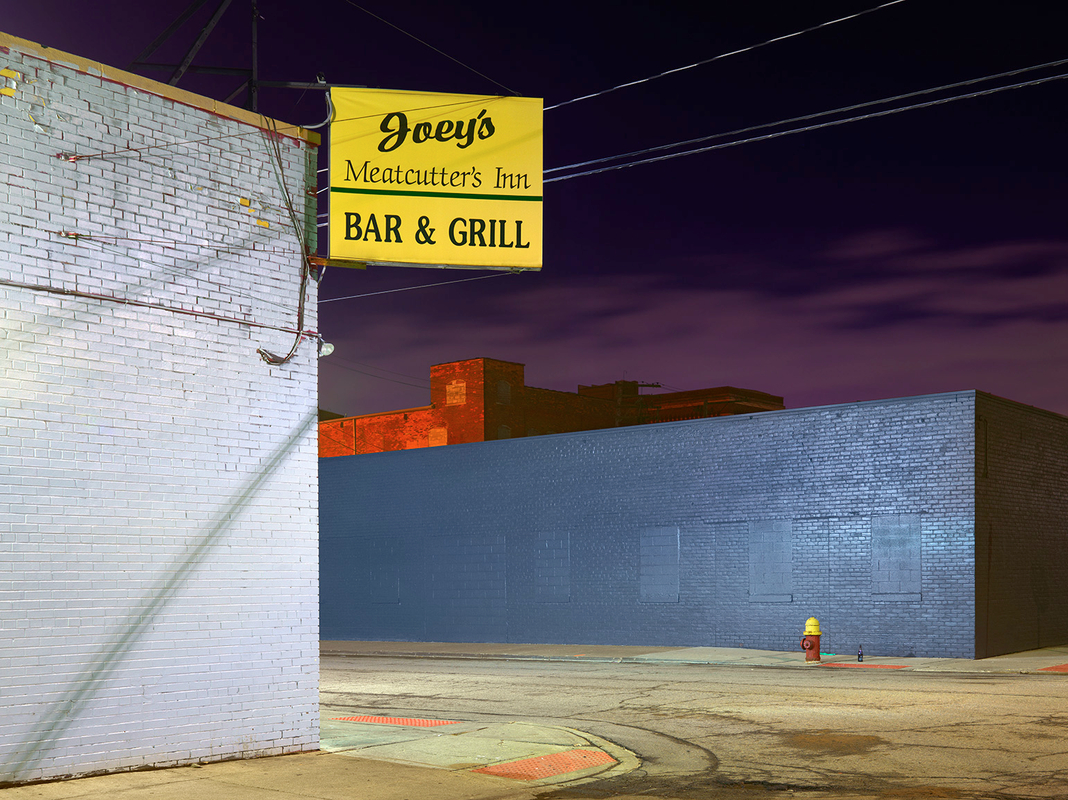
Immediately, I think of Edward Hopper: The lonely cityscape at night or the familiar glow of gas station lights cast into the American wilderness. The eye might want to linger among the colors, shapes and clouds even though the mind knows this is pretty much an empty street in a ‘post-industrial’ zone.
Perhaps it has do with another strand of expression: The break into free verse from past forms. The move from American Romanticism to Modernism which occurred this early past century. William Carlos Williams produced many good poems from a process of earnest, scrapbook-style intensity in trying to discover, redefine, and order a new poetic form within a modern ‘urban landscape.’
The individual artist is quite alone in the task he’s set before himself, and like much of modernism, it’s a rather big task.
Pastoral
When I was younger it was plain to me I must make something of myself. Older now I walk back streets admiring the houses of the very poor: roof out of line with sides the yards cluttered with old chicken wire, ashes, furniture gone wrong; the fences and outhouses built of barrel staves and parts of boxes, all, if I am fortunate, smeared a bluish green that properly weathered pleases me best of all colors.
No one will believe this of vast import to the nation
‘The most useful definition of modernist fiction I’ve encountered comes from Brian McHale’s Postmodernist Fiction. He says modernist fiction tends to “foreground epistemological questions” such as “How can I interpret the world I’m part of? What is there to be known? Who knows it? What are the limits of that knowledge?” In contrast, postmodernist fiction tends to “foreground ontological questions” such as “What is a world? What kinds of worlds are there and how are they constituted? What happens when…boundaries between worlds are violated?’
As to the epistemological questions surrounding Modernism, below are four poems. Hopefully, each is a representative example of a move away from the Romanticism that had been prevalent up until the late 1800’s.
In addition to the move away from traditional Romantic rhyme and meter towards modern blank verse, there’s also a certain conception of the Self rendered in them; a presentation of our natures that might be worth examining in some detail.
I believe we can see clearly a move away from tradition towards the Self, the Poet isolated, the poem itself as a means of communication, and an anxiety so common within the 20th century.
‘At the heart of Bloom’s project is the ancient quarrel between “poetry” and “philosophy.” In Bloom’s opinion, we ought not have to choose between Homer and Plato; we can have both, as long as we recognize that poetry is superior.’
Says the guy who writes about poetry…
What does one find within, as one looks without, waking from sleep and dream?
What kind of world is this, and can the poet actually help us know it?
You tossed a blanket from the bed You lay upon your back, and waited; You dozed, and watched the night revealing The thousand sordid images Of which your soul was constituted; They flickered against the ceiling. And when all the world came back And the light crept up between the shutters And you heard the sparrows in the gutters, You had such a vision of the street As the street hardly understands; Sitting along the bed’s edge, where You curled the papers from your hair, Or clasped the yellow soles of feet In the palms of both soiled hands.
—
The world will stain you, and it is a fallen, modern world, rendered profoundly and exquisitely.
As consciousness creeps in, building a bridge to the day, to the world, to the facts left as though they were the first facts, the light as though it were the first light, what one finds is distressing, both within and without.
That distress must be ‘made new,’ which is to say, the suffering (original?) in which we all sometimes find ourselves must match our experiences within the modern city and world, at least, the world created within Eliot’s lyrical verse.
Of the four poems, only the first and last have a 3rd-person subject.
—
Wallace Stevens‘ ‘I’ is in a more contemplative state, but it’s an ‘I’ exploring similar themes, and experiencing some distress in trying to know how the world actually is, and what might lie within.
The journey to The Self may not be a journey for the faint of heart.
The Poems Of Our Climate (stanzas II and III)
II Say even that this complete simplicity Stripped one of all one’s torments, concealed The evilly compounded, vital I And made it fresh in a world of white, A world of clear water, brilliant-edged, Still one would want more, one would need more, More than a world of white and snowy scents.
III There would still remain the never-resting mind, So that one would want to escape, come back To what had been so long composed. The imperfect is our paradise. Note that, in this bitterness, delight, Since the imperfect is so hot in us, Lies in flawed words and stubborn sounds.
—
Even if the verse can describe a perfected world, delivering us, perhaps, a little closer to perfection, our poet is still not free from the impulses and desires which simply never cease.
Interestingly, we end-up not with a discussion of the heart, the spirit, libido etc. as a source for those desires (for Plato, the irrational), but rather, for Stevens, just a mind.
We also find more Romantic elements of language and an almost baroque/rococo arrangement of words and ideas, dandyish even, yet combined with an intense effort to abstract, define, and clarify. From here, the poet may proceed on his task of flawed words and stubborn sounds.
***I find myself thinking of elements of modern architecture and abstract-expressionist painting. The meaning, or at least some delivery from our restless existences, can be found within the abstract itself. Or at least within a retreat to the abstract for its own sake, away from the world.
The modernist, glass-walled house on the hill will exist in its own space, offering and defying meaning. The structure’s own shapes will be stripped down to often mathematically precise forms interacting with Nature. These shall guide Man, or at least offer individual men a little refuge.
It is perhaps in Stevens’ poem we can see the questions of knowledge about the world suggesting questions about whether there is a world at all, or, at least, what kind of worlds each Self might be able to inhabit.
—
Here’s one of Robert Lowell’s poems, occurring a generation later, in the mid 20th-century, as part of the confessionals.
The Self is extremely isolated. In fact, Lowell went more than a little crazy. Unlike the known nervous breakdown of Eliot from which Eliot recovered, Lowell’s life was essentially one long breakdown from which he never recovered.
Here he is, looking back:
Epilogue
Those blessed structures plot and rhyme- why are they no help to me now i want to make something imagined not recalled? I hear the noise of my own voice: The painter’s vision is not a lens it trembles to caress the light. But sometimes everything i write With the threadbare art of my eye seems a snapshot lurid rapid garish grouped heightened from life yet paralyzed by fact. All’s misalliance. Yet why not say what happened? Pray for the grace of accuracy Vermeer gave to the sun’s illumination stealing like the tide across a map to his girl solid with yearning. We are poor passing facts. warned by that to give each figure in the photograph his living name.
—
The weight of having to make that meaning, for yourself, and by yourself, is a horrible weight indeed. One can glorify one’s Self and family, but that, alas, only goes so far. Rhyme and form still carry one’s living name, as far as they do.
Of course, there’s still wonderful rhythm and form here (this is excellent verse), but blanker now, with a relentless focus on the ‘I.’ The poet is perhaps talking a little more to himself, and the poem keeps self-consciously calling attention to itself.
—
In fact, it reminded me of the poem below, by Robert Creeley, which was published a few years afterwards.
From this page:
‘Creeley was a leader in the generational shift that veered away from history and tradition as primary poetic sources and gave new prominence to the ongoing experiences of an individual’s life. Because of this emphasis, the major events of his life loom large in his literary work.’
There’s Nothing but the Self and the Eye seeking and making meaning, by itself within a void of emotionally compact and precise language (of course there’s still form and other things besides).
Can the poet fit inside the little abstract chapel of words he’s building for himself (let alone the world, tradition etc.)?
For all the talk about ‘space,’ there seems very little.
The Window
Position is where you put it, where it is, did you, for example, that
large tank there, silvered, with the white church along- side, lift
all that, to what purpose? How heavy the slow
world is with everything put in place. Some
man walks by, a car beside him on the dropped
road, a leaf of yellow color is going to
fall. It all drops into place. My
face is heavy with the sight. I can feel my eye breaking.
—
The distress is still there…but I’d argue that we are now a good distance away from the grandness of Eliot’s vision, his religiosity and virtuosity with form and meter at the dawn of Modernism. Very few people can/could do what Eliot did (addition: even if he can help us gain knowledge of our Selves or the world).
That said, it’s unclear there’s enough tradition and confidence to even undertake such a project, now, even as such talents come along. The state of things is more scattered. We’re in a very different place of selves and artists isolated, of anxiety and post-anxiety.
Aside from the very accomplished poets above, in terms of both knowledge (epistemology) and being (ontology), we often have writers feeling pressure to weigh-in on such questions without even being about to write that well; artists who can’t draw or paint that well, and frankly, quite a bit of bullshit besides.
So, where are we headed? Who’s ‘we’ exactly?
Predictions are hard, especially about the future.
As previously posted:
Why not just put a few algorithms to work in writing those artist statements?
‘In “Sea Change,” Graham becomes Prospero, casting spells by spelling out her thoughts to merge with ours, and with the voices of the elements. The result is a mingling of perceptions rather than a broadcasting of opinions. Instead of analysis, the poems encourage emotional involvement with the drastic changes overwhelming us, overwhelm- ing the planet.’
and:
‘Strengths and weaknesses, flows and ebbs, yet every poem in “Sea Change” bears memorable lines, with almost haunting (if we truly have but 10 years to “fix” global warming) images of flora and fauna under siege. Jorie Graham has composed a swan song for Earth.’
Oh boy.
What are these poems being asked to do?
And moving away from poetry into the realm of ‘performance art,’
And let’s not forget one of the masters (as though putting such words here imbues this blog with the same stuff):
But, soft! what light through yonder window breaks? It is the east, and Juliet is the sun. Arise, fair sun, and kill the envious moon, Who is already sick and pale with grief, That thou her maid art far more fair than she: Be not her maid, since she is envious; Her vestal livery is but sick and green And none but fools do wear it; cast it off. It is my lady, O, it is my love! O, that she knew she were! She speaks yet she says nothing: what of that? Her eye discourses; I will answer it. I am too bold, ’tis not to me she speaks: Two of the fairest stars in all the heaven, Having some business, do entreat her eyes To twinkle in their spheres till they return. What if her eyes were there, they in her head? The brightness of her cheek would shame those stars, As daylight doth a lamp; her eyes in heaven Would through the airy region stream so bright That birds would sing and think it were not night. See, how she leans her cheek upon her hand! O, that I were a glove upon that hand, That I might touch that cheek!
Art, money, marketing and fame. It’s worth thinking about Western culture and the travels of the individual artist through romanticism, modernism and post-modernism and to wherever it is that artist is headed now. As for Hirst, it was probably inevitable that someone who couldn’t draw all that well, and didn’t have many of the basics down, would rocket in and out of the spotlight, capturing the moment.
‘Damien Hirst’s output between 2005 and 2008 – the period of his greatest success – has subsequently resold at an average of thirty per cent less than its original purchase price. Moreover, a third of the almost 1700 Hirst pieces that have gone to auction since 2009 have failed to sell at all. Most recently, in November, his gloss-and-butterfly collage Sanctimony failed to reach its lowest pre-sale estimate at a Sotheby’s auction’
If you bought it, perhaps you deserve it, and even Hirst seems to be in on that game.
———–
Towards a theme:
Salvador Dali had some training and native talent but was also an idea man.
He was part of the surrealist movement, perhaps best represented by Luis Bunuel’s (Un Chien Andalou) statement:
“Our only rule was very simple: no idea or image that might lend itself to a rational explanation of any kind would be accepted. We had to open all doors to the irrational and keep only those images that surprised us, without trying to explain why.“
I suspect Spanish culture helped along the way by placing a lot of emphasis on the arts as it does, tilting the culture in that direction. It’s produced El Greco, Velazquez, Goya, and Picasso among others. Spanish genius tends to flourish in the visual arts.
Here’s a quote from Goya. that first modern, I keep putting up:
“Fantasy abandoned by reason produces impossible monsters: united with her, she is the mother of the arts and the origin of their marvels.”
Here’s Dali having become something of a caricature of himself:
I have come to a still, but not a deep center, A point outside the glittering current; My eyes stare at the bottom of a river, At the irregular stones, iridescent sandgrains, My mind moves in more than one place, In a country half-land, half-water. I am renewed by death, thought of my death, The dry scent of a dying garden in September, The wind fanning the ash of a low fire. What I love is near at hand, Always, in earth and air.
That time of year thou mayst in me behold When yellow leaves, or none, or few, do hang Upon those boughs which shake against the cold, Bare ruined choirs, where late the sweet birds sang. In me thou see’st the twilight of such day As after sunset fadeth in the west; Which by and by black night doth take away, Death’s second self, that seals up all in rest. In me thou see’st the glowing of such fire, That on the ashes of his youth doth lie, As the deathbed whereon it must expire, Consumed with that which it was nourished by. This thou perceiv’st, which makes thy love more strong, To love that well which thou must leave ere long.
Last night watching the Pleiades, Breath smoking in the moonlight, Bitter memory like vomit Choked my throat. I unrolled a sleeping bag On mats on the porch Under thick autumn stars. In dream you appeared (Three times in nine years) Wild, cold, and accusing. I woke shamed and angry: The pointless wars of the heart. Almost dawn. Venus and Jupiter. The first time I have Ever seen them close.
The thistledown’s flying, though the winds are all still, On the green grass now lying, now mounting the hill, The spring from the fountain now boils like a pot; Through stones past the counting it bubbles red-hot.
The ground parched and cracked is like overbaked bread, The greensward all wracked is, bents dried up and dead. The fallow fields glitter like water indeed, And gossamers twitter, flung from weed unto weed.
Hill-tops like hot iron glitter bright in the sun, And the rivers we’re eying burn to gold as they run; Burning hot is the ground, liquid gold is the air; Whoever looks round sees Eternity there.
The trees are in their autumn beauty, The woodland paths are dry, Under the October twilight the water Mirrors a still sky; Upon the brimming water among the stones Are nine-and-fifty swans.
The nineteenth autumn has come upon me Since I first made my count; I saw, before I had well finished, All suddenly mount And scatter wheeling in great broken rings Upon their clamorous wings.
I have looked upon those brilliant creatures, And now my heart is sore. All’s changed since I, hearing at twilight, The first time on this shore, The bell-beat of their wings above my head, Trod with a lighter tread.
Unwearied still, lover by lover, They paddle in the cold Companionable streams or climb the air; Their hearts have not grown old; Passion or conquest, wander where they will, Attend upon them still.
But now they drift on the still water, Mysterious, beautiful; Among what rushes will they build, By what lake’s edge or pool Delight men’s eyes when I awake some day To find they have flown away?
It is the word pejorative that hurts. My old boat goes round on a crutch And doesn’t get under way. It’s the time of the year And the time of the day.
Perhaps it’s the lunch that we had Or the lunch that we should have had. But I am, in any case, A most inappropriate man In a most unpropitious place.
Mon Dieu, hear the poet’s prayer. The romantic should be here. The romantic should be there. It ought to be everywhere. But the romantic must never remain,
Mon Dieu, and must never again return. This heavy historical sail Through the mustiest blue of the lake In a really vertiginous boat Is wholly the vapidest fake. . . .
It is least what one ever sees. It is only the way one feels, to say Where my spirit is I am, To say the light wind worries the sail, To say the water is swift today,
To expunge all people and be a pupil Of the gorgeous wheel and so to give That slight transcendence to the dirty sail, By light, the way one feels, sharp white, And then rush brightly through the summer air.
***Wallace Stevens is often going meta and abstract, confusing nearly all readers, while indulging heavily in a lush Romantic style which later transitions to more blank verse modernism. He’s sailing and he’s writing. He’s charting new waters, the old dandy.
On that note, Land Art is often about removing the monetary value, commodification and fungibility of a piece of art and making something big enough, weird enough, useless enough; maybe making a beautiful/ugly enough imitation of Nature or man’s design within Nature.
Here’s Wikipedia, keeping it simpler:
‘Land art, earthworks (coined by Robert Smithson), or Earth art is an art movement in which landscape and the work of art are inextricably linked.’
Sometimes, maybe, it doesn’t really inspire the imagination:
Or maybe it’s a little gimmicky, as I imagine ‘Christo’ revealing his work with a magician’s flourish of the hand.
‘Essential’ art?:
Moving along, a reader links to W.S. Merwin’s ‘Tergvinder’s Stone,’ where you get some weird metaphysical notions of space/non-space, subjectivity/objectivity going on.
Abstract Modernism? Mid-Century Modernism? Relentlessly rhythmic, ambitious and (P)rophetic pieces looking to reshape not Nature, but how readers should think about Nature?
(addition: Plymouth Rock? Uh-oh…what is the poem being asked to do? What about the reader?):
‘One time my friend Tergvinder brought a large round boulder into his living room. He rolled it up the steps with the help of some two-by-fours, and when he got it out into the middle of the room, where some people have coffee tables (though he had never had one there himself) he left it. He said that was where it belonged.
It is really a plain-looking stone. Not as large as Plymouth Rock by a great deal, but then it does not have all the claims of a big shaky promotion campaign to support. That was one of the things Tergvinder said about it. He made no claims at all for it, he said. It was other people who called it Tergvinder’s Stone. All he said was that according to him it belonged there.’
Click through for a Serra-released photo of four metal pillar-forms aligned in the deserts of Qatar, designed to inevitably rust. The piece has a slight ‘2001: A Space Odyssey‘ feel, but that could just be me.
‘The Qatar Museums Authority is estimated to spend about a billion dollars per year on art. At its head is the young Sheikha al-Mayassa Hamad bin Khalifa al-Thani, a sister of the Emir of Qatar and a Duke University graduate, who was recently named the most powerful person in the art world by ArtReview.’
Get while the getting is good, so long as the Sheiks have the dough.
Here’s Serra discussing a piece of his at 21 West Gagosian, or a densely-packed, carefully measured series of metal forms in a room. What does the viewer experience in this space?:
By June our brook’s run out of song and speed. Sought for much after that, it will be found Either to have gone groping underground (And taken with it all the Hyla breed That shouted in the mist a month ago, Like ghost of sleigh bells in a ghost of snow)— Or flourished and come up in jewelweed, Weak foliage that is blown upon and bent, Even against the way its waters went. Its bed is left a faded paper sheet Of dead leaves stuck together by the heat— A brook to none but who remember long. This as it will be seen is other far Than with brooks taken otherwhere in song. We love the things we love for what they are.
I Clear water in a brilliant bowl, Pink and white carnations. The light In the room more like a snowy air, Reflecting snow. A newly-fallen snow At the end of winter when afternoons return. Pink and white carnations – one desires So much more than that. The day itself Is simplified: a bowl of white, Cold, a cold porcelain, low and round, With nothing more than the carnations there.
II Say even that this complete simplicity Stripped one of all one’s torments, concealed The evilly compounded, vital I And made it fresh in a world of white, A world of clear water, brilliant-edged, Still one would want more, one would need more, More than a world of white and snowy scents.
III There would still remain the never-resting mind, So that one would want to escape, come back To what had been so long composed. The imperfect is our paradise. Note that, in this bitterness, delight, Since the imperfect is so hot in us, Lies in flawed words and stubborn sounds.
‘The most useful definition of modernist fiction I’ve encountered comes from Brian McHale’s Postmodernist Fiction. He says modernist fiction tends to “foreground epistemological questions” such as “How can I interpret the world I’m part of? What is there to be known? Who knows it? What are the limits of that knowledge?” In contrast, postmodernist fiction tends to “foreground ontological questions” such as “What is a world? What kinds of worlds are there and how are they constituted? What happens when…boundaries between worlds are violated?’
As to the epistemological questions surrounding Modernism, below are four poems. Hopefully, each is a representative example of a move away from the Romanticism that had been prevalent up until the late 1800’s.
In addition to the move away from traditional Romantic rhyme and meter towards modern blank verse, there’s also a certain conception of the Self rendered in them; a presentation of our natures that might be worth examining in some detail.
I believe we can see clearly a move away from tradition towards the Self, the Poet isolated, the poem itself as a means of communication, and an anxiety so common within the 20th century.
‘At the heart of Bloom’s project is the ancient quarrel between “poetry” and “philosophy.” In Bloom’s opinion, we ought not have to choose between Homer and Plato; we can have both, as long as we recognize that poetry is superior.’
Says the guy who writes about poetry…
What does one find within, as one looks without, waking from sleep and dream?
What kind of world is this, and can the poet actually help us know it?
You tossed a blanket from the bed
You lay upon your back, and waited;
You dozed, and watched the night revealing
The thousand sordid images
Of which your soul was constituted;
They flickered against the ceiling.
And when all the world came back
And the light crept up between the shutters
And you heard the sparrows in the gutters,
You had such a vision of the street
As the street hardly understands;
Sitting along the bed’s edge, where
You curled the papers from your hair,
Or clasped the yellow soles of feet
In the palms of both soiled hands.
—
The world will stain you, and it is a fallen, modern world, rendered profoundly and exquisitely.
As consciousness creeps in, building a bridge to the day, to the world, to the facts left as though they were the first facts, the light as though it were the first light, what one finds is distressing, both within and without.
That distress must be ‘made new,’ which is to say, the suffering (original?) in which we all sometimes find ourselves must match our experiences within the modern city and world, at least, the world created within Eliot’s lyrical verse.
Of the four poems, only the first and last have a 3rd-person subject.
—
Wallace Stevens‘ ‘I’ is in a more contemplative state, but it’s an ‘I’ exploring similar themes, and experiencing some distress in trying to know how the world actually is, and what might lie within.
The journey to The Self may not be a journey for the faint of heart.
The Poems Of Our Climate (stanzas II and III)
II Say even that this complete simplicity Stripped one of all one’s torments, concealed The evilly compounded, vital I And made it fresh in a world of white, A world of clear water, brilliant-edged, Still one would want more, one would need more, More than a world of white and snowy scents.
III There would still remain the never-resting mind, So that one would want to escape, come back To what had been so long composed. The imperfect is our paradise. Note that, in this bitterness, delight, Since the imperfect is so hot in us, Lies in flawed words and stubborn sounds.
—
Even if the verse can describe a perfected world, delivering us, perhaps, a little closer to perfection, our poet is still not free from the impulses and desires which simply never cease.
Interestingly, we end-up not with a discussion of the heart, the spirit, libido etc. as a source for those desires (for Plato, the irrational), but rather, for Stevens, just a mind.
We also find more Romantic elements of language and an almost baroque/rococo arrangement of words and ideas, dandyish even, yet combined with an intense effort to abstract, define, and clarify. From here, the poet may proceed on his task of flawed words and stubborn sounds.
***I find myself thinking of elements of modern architecture and abstract-expressionist painting. The meaning, or at least some delivery from our restless existences, can be found within the abstract itself. Or at least within a retreat to the abstract for its own sake, away from the world.
The modernist, glass-walled house on the hill will exist in its own space, offering and defying meaning. The structure’s own shapes will be stripped down to often mathematically precise forms interacting with Nature. These shall guide Man, or at least offer individual men a little refuge.
It is perhaps in Stevens’ poem we can see the questions of knowledge about the world suggesting questions about whether there is a world at all, or, at least, what kind of worlds each Self might be able to inhabit.
—
Here’s one of Robert Lowell’s poems, occurring a generation later, in the mid 20th-century, as part of the confessionals.
The Self is extremely isolated. In fact, Lowell went more than a little crazy. Unlike the known nervous breakdown of Eliot from which Eliot recovered, Lowell’s life was essentially one long breakdown from which he never recovered.
Here he is, looking back:
Epilogue
Those blessed structures plot and rhyme- why are they no help to me now i want to make something imagined not recalled? I hear the noise of my own voice: The painter’s vision is not a lens it trembles to caress the light. But sometimes everything i write With the threadbare art of my eye seems a snapshot lurid rapid garish grouped heightened from life yet paralyzed by fact. All’s misalliance. Yet why not say what happened? Pray for the grace of accuracy Vermeer gave to the sun’s illumination stealing like the tide across a map to his girl solid with yearning. We are poor passing facts. warned by that to give each figure in the photograph his living name.
—
The weight of having to make that meaning, for yourself, and by yourself, is a horrible weight indeed. One can glorify one’s Self and family, but that, alas, only goes so far. Rhyme and form still carry one’s living name, as far as they do.
Of course, there’s still wonderful rhythm and form here (this is excellent verse), but blanker now, with a relentless focus on the ‘I.’ The poet is perhaps talking a little more to himself, and the poem keeps self-consciously calling attention to itself.
—
In fact, it reminded me of the poem below, by Robert Creeley, which was published a few years afterwards.
From this page:
‘Creeley was a leader in the generational shift that veered away from history and tradition as primary poetic sources and gave new prominence to the ongoing experiences of an individual’s life. Because of this emphasis, the major events of his life loom large in his literary work.’
There’s Nothing but the Self and the Eye seeking and making meaning, by itself within a void of emotionally compact and precise language (of course there’s still form and other things besides).
Can the poet fit inside the little abstract chapel of words he’s building for himself (let alone the world, tradition etc.)?
For all the talk about ‘space,’ there seems very little.
The Window
Position is where you put it, where it is, did you, for example, that
large tank there, silvered, with the white church along- side, lift
all that, to what purpose? How heavy the slow
world is with everything put in place. Some
man walks by, a car beside him on the dropped
road, a leaf of yellow color is going to
fall. It all drops into place. My
face is heavy with the sight. I can feel my eye breaking.
—
The distress is still there…but I’d argue that we are now a good distance away from the grandness of Eliot’s vision, his religiosity and virtuosity with form and meter at the dawn of Modernism. Very few people can/could do what Eliot did (addition: even if he can help us gain knowledge of our Selves or the world).
That said, it’s unclear there’s enough tradition and confidence to even undertake such a project, now, even as such talents come along. The state of things is more scattered. We’re in a very different place of selves and artists isolated, of anxiety and post-anxiety.
Aside from the very accomplished poets above, in terms of both knowledge (epistemology) and being (ontology), we often have writers feeling pressure to weigh-in on such questions without even being about to write that well; artists who can’t draw or paint that well, and frankly, quite a bit of bullshit besides.
So, where are we headed? Who’s ‘we’ exactly?
Predictions are hard, especially about the future.
As previously posted:
Why not just put a few algorithms to work in writing those artist statements?
‘In “Sea Change,” Graham becomes Prospero, casting spells by spelling out her thoughts to merge with ours, and with the voices of the elements. The result is a mingling of perceptions rather than a broadcasting of opinions. Instead of analysis, the poems encourage emotional involvement with the drastic changes overwhelming us, overwhelm- ing the planet.’
and:
‘Strengths and weaknesses, flows and ebbs, yet every poem in “Sea Change” bears memorable lines, with almost haunting (if we truly have but 10 years to “fix” global warming) images of flora and fauna under siege. Jorie Graham has composed a swan song for Earth.’
Oh boy.
What are these poems being asked to do?
And moving away from poetry into the realm of ‘performance art,’
About suffering they were never wrong, The old Masters: how well they understood Its human position: how it takes place While someone else is eating or opening a window or just walking dully along; How, when the aged are reverently, passionately waiting For the miraculous birth, there always must be Children who did not specially want it to happen, skating On a pond at the edge of the wood: They never forgot That even the dreadful martyrdom must run its course Anyhow in a corner, some untidy spot Where the dogs go on with their doggy life and the torturer’s horse Scratches its innocent behind on a tree.
In Breughel’s Icarus, for instance: how everything turns away Quite leisurely from the disaster; the ploughman may Have heard the splash, the forsaken cry, But for him it was not an important failure; the sun shone As it had to on the white legs disappearing into the green Water, and the expensive delicate ship that must have seen Something amazing, a boy falling out of the sky, Had somewhere to get to and sailed calmly on.
When you are old and gray and full of sleep,
And nodding by the fire, take down this book,
And slowly read, and dream of the soft look
Your eyes had once, and of their shadows deep;
How many loved your moments of glad grace,
And loved your beauty with love false or true,
But one man loved the pilgrim soul in you,
And loved the sorrows of your changing face;
And bending down beside the glowing bars,
Murmur, a little sadly, how Love fled
And paced upon the mountains overhead
And hid his face among a crowd of stars.
The illustration is nothing to you without the application. You lack half wit. You crush all the particles down into close conformity, and then walk back and forth on them.
Sparkling chips of rock are crushed down to the level of the parent block. Were not ‘impersonal judgment in aesthetic matters, a metaphysical impossibility,’ you
might fairly achieve It. As for butterflies, I can hardly conceive of one’s attending upon you, but to question the congruence of the complement is vain, if it exists.
–Marianne Moore (click through for a discussion of Moore’s work and style)
Immediately, I think of Edward Hopper: The lonely cityscape at night or the familiar glow of gas station lights cast into the American wilderness. The eye might want to linger among the colors, shapes and clouds even though the mind knows this is pretty much an empty street in a ‘post-industrial’ zone.
Perhaps it has do with another strand of expression: The break into free verse from past forms. The move from American Romanticism to Modernism which occurred this early past century. William Carlos Williams produced many good poems from a process of earnest, scrapbook-style intensity in trying to discover, redefine, and order a new poetic form within a modern ‘urban landscape.’
The individual artist is quite alone in the task he’s set before himself, and like much of modernism, it’s a rather big task.
Pastoral
When I was younger
it was plain to me
I must make something of myself.
Older now
I walk back streets
admiring the houses
of the very poor:
roof out of line with sides
the yards cluttered
with old chicken wire, ashes,
furniture gone wrong;
the fences and outhouses
built of barrel staves
and parts of boxes, all,
if I am fortunate,
smeared a bluish green
that properly weathered
pleases me best of all colors.
No one
will believe this
of vast import to the nation
Perhaps I’m not wrong in having called Halloween horror stills and movie images to mind (it’s my mind, after all, so maybe I’m just thinking of Devil’s Night). I really enjoy the light on the dumpster and the side-front rectory wall. There seems to be a little more mood here, more drama, so maybe Edgar Allan Poe’s ‘psychological intensity,’ his surrealism, and terror are more appropriate for comparison.
Poe was a bit mad, after all, despite his fascinatingly untamed and powerful imagination. He achieved a uniqueness and completeness of vision few artists do. Maybe there’s a bit of the sullen, self-aggrandizing earnestness in him of the teenager (J.D. Salinger); the desire to shock, delight and terrify.
The mind is as though a chamber, the horror rises to fever pitch, the lush rhyme matches an increasingly desperate search for truth and beauty in the world (Poe had very much his own Romantically inspired metaphysics).
Alone
From childhood’s hour I have not been As others were—I have not seen As others saw—I could not bring My passions from a common spring— From the same source I have not taken My sorrow—I could not awaken My heart to joy at the same tone— And all I lov’d—I lov’d alone— Then—in my childhood—in the dawn Of a most stormy life—was drawn From ev’ry depth of good and ill The mystery which binds me still— From the torrent, or the fountain— From the red cliff of the mountain— From the sun that ’round me roll’d In its autumn tint of gold— From the lightning in the sky As it pass’d me flying by— From the thunder, and the storm— And the cloud that took the form (When the rest of Heaven was blue) Of a demon in my view—
Are you looking at beautiful photos and feeling sorry for Detroit, and yourself? See Time Magazine’s photo essay by Yves Marchand and Romain Meffre (less porn-like, more thoughtful).
My brother comes home from work and climbs the stairs to our room. I can hear the bed groan and his shoes drop one by one. You can have it, he says.
The moonlight streams in the window and his unshaven face is whitened like the face of the moon. He will sleep long after noon and waken to find me gone.
Thirty years will pass before I remember that moment when suddenly I knew each man has one brother who dies when he sleeps and sleeps when he rises to face this life,
and that together they are only one man sharing a heart that always labours, hands yellowed and cracked, a mouth that gasps for breath and asks, Am I gonna make it?
All night at the ice plant he had fed the chute its silvery blocks, and then I stacked cases of orange soda for the children of Kentucky, one gray boxcar at a time
with always two more waiting. We were twenty for such a short time and always in the wrong clothes, crusted with dirt and sweat. I think now we were never twenty.
In 1948 the city of Detroit, founded by de la Mothe Cadillac for the distant purposes of Henry Ford, no one wakened or died, no one walked the streets or stoked a furnace,
for there was no such year, and now that year has fallen off all the old newspapers, calendars, doctors’ appointments, bonds wedding certificates, drivers licenses.
The city slept. The snow turned to ice. The ice to standing pools or rivers racing in the gutters. Then the bright grass rose between the thousands of cracked squares,
and that grass died. I give you back 1948. I give you all the years from then to the coming one. Give me back the moon with its frail light falling across a face.
Give me back my young brother, hard and furious, with wide shoulders and a curse for God and burning eyes that look upon all creation and say, You can have it.
Well, it’s not a photograph quite abstract enough to get to mid-century American abstract expressionism, anyways.
Where did poems and paintings go, exactly, within the imaginations of many in this past generation now passing away?
Why I Am Not A Painter
I am not a painter, I am a poet. Why? I think I would rather be a painter, but I am not. Well,
for instance, Mike Goldberg is starting a painting. I drop in. “Sit down and have a drink” he says. I drink; we drink. I look up. “You have SARDINES in it.” “Yes, it needed something there.” “Oh.” I go and the days go by and I drop in again. The painting is going on, and I go, and the days go by. I drop in. The painting is finished. “Where’s SARDINES?” All that’s left is just letters, “It was too much,” Mike says.
But me? One day I am thinking of a color: orange. I write a line about orange. Pretty soon it is a whole page of words, not lines. Then another page. There should be so much more, not of orange, of words, of how terrible orange is and life. Days go by. It is even in prose, I am a real poet. My poem is finished and I haven’t mentioned orange yet. It’s twelve poems, I call it ORANGES. And one day in a gallery I see Mike’s painting, called SARDINES.
Poems require your mouth and mind to come alive. But aren’t there real things, to which these words refer within our visual memories, out in the world?
Are you lost within the peaks and valleys of the sounds, mesmerized by the singer and the song (poet and poem), as well as the underlying patterns, working upon your mind?
What are you doing with your visual imagination?
If you’re like me, maybe you just want a few minutes of pleasure; a return to when your mind (if you’re getting older) encoded sounds into a map within, during times of impressionable openness.
Strange how they stick around:
As posted: Let’s go further back, now, to a place and time which we’ve never experienced, but live partially within:
Maybe it’s Pilgrim’s pride, or perhaps the Puritan pursuit of image-less purity, or the Colonialists ecumenical style, or maybe even some Shaker weirdness that finds itself up for analysis.
Perhaps somewhere there’s a spare, Yankee work ethic resting on a simple, wooden shelf in the ‘American mind.’
Could such a thing be discovered within mid 20th-century modernism?
Robert Hughes takes a look at Donald Judd’s ‘Temple Of Aesthetic Fanaticism,’ and Richard Serra’s nod to Jackson Pollack and abstract expressionism in the rawness of material sculpture. You know, making stuff (a potentially sensitive subject with so many technological changes going on right now).
(link may not last):
As for Land Art, Michael Heizer’s life’s-work land-art project is apparently complete, if such a thing can be complete:
Apparently, Heizer’s been working since 1972 on this sculpture in the Eastern Nevada desert, which was originally called ‘Complex One.’ It’s morphed into his life’s work, called City. It’s very large. It can’t be moved. You can’t reproduce it. It represents a break from traditional sculpture. It can’t be put in a museum and it’s not clear that it has a function.
In Brasil, they just started from the top-down and built a city that doesn’t work that well for people: Brasilia: A Planned City
——————
I have to confess that seeing that structure upon the wide open emptiness of Eastern Nevada is comforting for the familiarity it brings. It’s a little bit of order upon the unknown, and the design, or lack thereof (about which a man may wonder), within Nature herself. I think this is why a military installation out in the desert can captivate the imagination as it’s been known to in Hollywood and in the public mind (dreaming of aliens and conspiracies).
To expand on that theme, Wallace Stevens might shed some light. He was an American poet on the hinge between Romanticism and Modernism:
Anecdote of the Jar
I placed a jar in Tennessee,
And round it was, upon a hill.
It made the slovenly wilderness
Surround that hill.
The wilderness rose up to it,
And sprawled around, no longer wild.
The jar was round upon the ground
And tall and of a port in air.
It took dominion every where.
The jar was gray and bare.
It did not give of bird or bush,
Like nothing else in Tennessee.
What do you do with an uncivilized, wild land? Import European learning and literature “atop” it? Christian tradition and the Natural Law? Import the triumph of the Western mathematical sciences and technology? Import its movements of the arts and the individual artist?
He disappeared in the dead of winter: The brooks were frozen, the airports almost deserted, And snow disfigured the public statues; The mercury sank in the mouth of the dying day. What instruments we have agree The day of his death was a dark cold day.
Far from his illness The wolves ran on through the evergreen forests, The peasant river was untempted by the fashionable quays; By mourning tongues The death of the poet was kept from his poems.
But for him it was his last afternoon as himself, An afternoon of nurses and rumours; The provinces of his body revolted, The squares of his mind were empty, Silence invaded the suburbs, The current of his feeling failed; he became his admirers.
Now he is scattered among a hundred cities And wholly given over to unfamiliar affections, To find his happiness in another kind of wood And be punished under a foreign code of conscience. The words of a dead man Are modified in the guts of the living.
But in the importance and noise of to-morrow When the brokers are roaring like beasts on the floor of the bourse, And the poor have the sufferings to which they are fairly accustomed And each in the cell of himself is almost convinced of his freedom A few thousand will think of this day As one thinks of a day when one did something slightly unusual.
What instruments we have agree The day of his death was a dark cold day.
II
You were silly like us; your gift survived it all: The parish of rich women, physical decay, Yourself. Mad Ireland hurt you into poetry. Now Ireland has her madness and her weather still, For poetry makes nothing happen: it survives In the valley of its making where executives Would never want to tamper, flows on south From ranches of isolation and the busy griefs, Raw towns that we believe and die in; it survives, A way of happening, a mouth.
III
Earth, receive an honoured guest: William Yeats is laid to rest. Let the Irish vessel lie Emptied of its poetry.
In the nightmare of the dark All the dogs of Europe bark, And the living nations wait, Each sequestered in its hate;
Intellectual disgrace Stares from every human face, And the seas of pity lie Locked and frozen in each eye.
Follow, poet, follow right To the bottom of the night, With your unconstraining voice Still persuade us to rejoice;
With the farming of a verse Make a vineyard of the curse, Sing of human unsuccess In a rapture of distress;
In the deserts of the heart Let the healing fountain start, In the prison of his days> Teach the free man how to praise.
That’s a nod to this site’s international readers. Maybe it’s worth posting some poems and music to share with others.
Thanks to everyone for stopping by. It’s appreciated.
Sailing After Lunch
It is the word pejorative that hurts. My old boat goes round on a crutch And doesn’t get under way. It’s the time of the year And the time of the day.
Perhaps it’s the lunch that we had Or the lunch that we should have had. But I am, in any case, A most inappropriate man In a most unpropitious place.
Mon Dieu, hear the poet’s prayer. The romantic should be here. The romantic should be there. It ought to be everywhere. But the romantic must never remain,
Mon Dieu, and must never again return. This heavy historical sail Through the mustiest blue of the lake In a really vertiginous boat Is wholly the vapidest fake. . . .
It is least what one ever sees. It is only the way one feels, to say Where my spirit is I am, To say the light wind worries the sail, To say the water is swift today,
To expunge all people and be a pupil Of the gorgeous wheel and so to give That slight transcendence to the dirty sail, By light, the way one feels, sharp white, And then rush brightly through the summer air.
***Wallace Stevens is often going meta and abstract, confusing nearly all readers, while indulging heavily in a lush Romantic style which later transitions to more blank verse modernism. He’s sailing and he’s writing. He’s charting new waters, the old dandy.
Neither Far Out Nor In Deep
The people along the sand
All turn and look one way.
They turn their back on the land.
They look at the sea all day.
As long as it takes to pass
A ship keeps raising its hull;
The wetter ground like glass
Reflects a standing gull.
The land may vary more;
But wherever the truth may be—
The water comes ashore,
And the people look at the sea.
They cannot look out far.
They cannot look in deep.
But when was that ever a bar
To any watch they keep
Some popular songs have buried themselves into people’s minds as well: Young love on a blanket. Shadow and sun. Days that seem to last forever. Songwriting that appeals to innocence and common experience.
Life’s got darker sides, too, and so does human nature. Atlantic City became an East-Coast economic center for legal gambling; an empire which rose and fell. The seediness was never that far from the surface.
Miss Nancy Ellicott
Strode across the hills and broke them,
Rode across the hills and broke them—
The barren New England hills—
Riding to hounds
Over the cow-pasture.
Miss Nancy Ellicott smoked
And danced all the modern dances;
And her aunts were not quite sure how they felt about it,
But they knew that it was modern.
Upon the glazen shelves kept watch
Matthew and Waldo, guardians of the faith,
The army of unalterable law.
I An old man sits In the shadow of a pine tree In China. He sees larkspur, Blue and white, At the edge of the shadow, Move in the wind. His beard moves in the wind. The pine tree moves in the wind. Thus water flows Over weeds.
II The night is of the colour Of a woman’s arm: Night, the female, Obscure, Fragrant and supple, Conceals herself. A pool shines, Like a bracelet Shaken in a dance.
III I measure myself Against a tall tree. I find that I am much taller, For I reach right up to the sun, With my eye; And I reach to the shore of the sea With my ear. Nevertheless, I dislike The way ants crawl In and out of my shadow.
IV When my dream was near the moon, The white folds of its gown Filled with yellow light. The soles of its feet Grew red. Its hair filled With certain blue crystallizations From stars, Not far off.
V Not all the knives of the lamp-posts, Nor the chisels of the long streets, Nor the mallets of the domes And high towers, Can carve What one star can carve, Shining through the grape-leaves.
VI Rationalists, wearing square hats, Think, in square rooms, Looking at the floor, Looking at the ceiling. They confine themselves To right-angled triangles. If they tried rhomboids, Cones, waving lines, ellipses As, for example, the ellipse of the half-moon Rationalists would wear sombreros.
I quite like this one. Perhaps it’s because of what I see as a Romantic sensibility fitted to imagistic purpose.
As to that final stanza: That’s a lot of very lush language to describe what are, to my mind, very visual-field, mathematical concepts. Stevens was a poet of lush language, celebrating it like the old dandy he was, but also translating the Romantic arrangment of language to the spare, image-based aims of modernism. Make it new and strip it down.
Perhaps, this is more the tension occurring here rather than that of a frustrated mathematician.
I’ll try and stir the pot a bit:
‘…modern rationalism is what commonplace minds made out of the inspiration of men of discrimination and genius.’
Oakeshott, Michael. Rationalism In Politics And Other Essays. Indianapolis: Liberty Fund, 1991. Print. Pg 6.
One might ask what kind of genius? Artistic, linguistic and poetic? Or rather mathematical and physical? Parts of this debate could be said to stretch back to the Greeks, at least. They exist [such debates] all around us today, within our universities, politics and lives.
Personally, I’m reminded of many modern debates over reason, what it can do , what it can’t, and also many rationalist/anti-rationalist reactions to it.
The Romantic impulse generally involves a return to Nature and the countryside, away from civilization. The poet and the artist also invite one back to one’s own sense experience anew; the ambitious attempting to celebrate the emotions and grand themes without a hint of irony (love, death, war).
At least, many try and show us as we are and can be to ourselves.
But, this is also having some downstream effects, at least in German theory: Tom Wolfe on Max Weber on one conspicuous use of art in the ‘modern’ world:
‘…aesthetics is going to replace ethics, art is going to replace religion, as the means through which educated people express their spiritual worthiness…‘
You tossed a blanket from the bed
You lay upon your back, and waited;
You dozed, and watched the night revealing
The thousand sordid images
Of which your soul was constituted;
They flickered against the ceiling.
And when all the world came back
And the light crept up between the shutters
And you heard the sparrows in the gutters,
You had such a vision of the street
As the street hardly understands;
Sitting along the bed’s edge, where
You curled the papers from your hair,
Or clasped the yellow soles of feet
In the palms of both soiled hands.
Has there been a better poet writing in English in the past 150 years? Probably not.
The depth of commitment to his metaphysical vision and the breadth of that vision is remarkable. Look at the rhyme and meter! Sinful.
I know that I shall meet my fate Somewhere among the clouds above; Those that I fight I do not hate, Those that I guard I do not love; My country is Kiltartan Cross, My countrymen Kiltartan’s poor, No likely end could bring them loss; Nor leave them happier than before. Nor law; nor duty bade me fight, Nor public men, nor cheering crowds, A lonely impulse of delight Drove to this tumult in the clouds; I balanced all, brought all to mind, The years to come seemed waste of breath, A waste of breath the years behind In balance with this life, this death.
Thanks for the tree between me & a sniper’s bullet. I don’t know what made the grass sway seconds before the Viet Cong raised his soundless rifle. Some voice always followed, telling me which foot to put down first. Thanks for deflecting the ricochet against that anarchy of dusk. I was back in San Francisco wrapped up in a woman’s wild colors, causing some dark bird’s love call to be shattered by daylight when my hands reached up & pulled a branch away from my face. Thanks for the vague white flower that pointed to the gleaming metal reflecting how it is to be broken like mist over the grass, as we played some deadly game for blind gods. What made me spot the monarch writhing on a single thread tied to a farmer’s gate, holding the day together like an unfingered guitar string, is beyond me. Maybe the hills grew weary & leaned a little in the heat. Again, thanks for the dud hand grenade tossed at my feet outside Chu Lai. I’m still falling through its silence. I don’t know why the intrepid sun touched the bayonet, but I know that something stood among those lost trees & moved only when I moved.
Vendler reviewed John Serio’s then new “Selected Poems” of Wallace Stevens.
“Stevens’s conscience made him confront the chief issues of his era: the waning of religion, the indifferent nature of the physical universe, the theories of Marxism and socialist realism, the effects of the Depression, the uncertainties of philosophical knowledge, and the possibility of a profound American culture, present and future.”
and
“Stevens’s poetry oscillates, throughout his life, between verbal ebullience and New England spareness, between the high rhetoric of England (and of religion) and the “plain sense of things” that he sometimes felt to be more American…”
That civilisation may not sink, Its great battle lost, Quiet the dog, tether the pony To a distant post; Our master Caesar is in the tent Where the maps are spread, His eyes fixed upon nothing, A hand under his head.
Like a long-legged fly upon the stream His mind moves upon silence.
That the topless towers be burnt And men recall that face, Move most gently if move you must In this lonely place. She thinks, part woman, three parts a child, That nobody looks; her feet Practise a tinker shuffle Picked up on a street.
Like a long-legged fly upon the stream Her mind moves upon silence.
That girls at puberty may find The first Adam in their thought, Shut the door of the Pope’s chapel, Keep those children out. There on that scaffolding reclines Michael Angelo. With no more sound than the mice make His hand moves to and fro.
Like a long-legged fly upon the stream His mind moves upon silence.
The cigarette smoke loops and slides above us, Dipping and swirling as the waiter passes. You strike a match and stare upon the flame. The tiny firelight leaps in your eyes a moment And dies away as silently as it came.
This melody, you say, has certain voices? They rise like nereids from a river, singing, Lift white faces, and dive to darkness again. Wherever you go you bear this river with you: A leaf falls, and it flows, and you have pain.
So says the tune to you? but what to me? What to the waiter, as he pours your coffee? The violinist who suavely draws his bow? That man, who folds his paper, overhears it. A thousand dreams revolve and fall and flow.
Someone there is who sees a virgin stepping Down marble stairs to a deep tomb of roses: At the last moment she lifts remembering eyes. Green leaves blow down; the place is checked with shadows; A long-drawn murmur of rain goes down the skies. And oaks are stripped and bare, and smoke with lightning; And clouds are blown and torn upon high forests; And the great sea shakes its walls. And then falls silence And through long silence falls This melody once more: Down endless stairs she goes, as once before.
So says the tune to him? but what to me? What are the worlds I see? What shapes fantastic, terrible dreams? I go my secret way, down secret alleys. My errand is not so simple as it seems.
Gloomy grammarians in golden gowns, Meekly you keep the mortal rendezvous, Eliciting the still sustaining pomps Of speech which are like music so profound They seem an exaltation without sound. Funest philosophers and ponderers, Their evocations are the speech of clouds. So speech of your processionals returns In the casual evocations of your tread Across the stale, mysterious seasons. These Are the music of meet resignation; these The responsive, still sustaining pomps for you To magnify, if in that drifting waste You are to be accompanied by more Than mute bare splendors of the sun and moon.
The Brown River, finger of a broken fist, Moved sluggish through the woods and dust. We made a bridge of the crashed oak, dancing over the limbs like monkeys or lovers, eschewing the deeps with our eyes; For on the other side they said lay paradise.
It was a modern replica, built by the offspring of some rich Dog-like dowager-some son-of-a-bitch Who like formal gardens of paths and shaven trees, Hedges in a maze and many elegant statues. I looked long at “The Girl With Silk,” a stone queen With legs apart but draped in the nick of time between.
The most expressive statuary was “The Last Centaur Expiring,” his face folded on his breast All the segment that was a man pleading love And fatal attraction for the brutal half. A visitor beside grew incensed At miscegenation, and spoke out against.
I walked away alone, over the fallen oak, Into the woods. From the woods outside of Eden came a snake. I found no principle of evil here except Two well-dressed women halted as they stepped, Binoculars fixed on birds escaping in the trees These eyes from outer space, evicted statues.
I do not know much about gods; but I think that the river Is a strong brown god—sullen, untamed and intractable, Patient to some degree, at first recognised as a frontier; Useful, untrustworthy, as a conveyor of commerce; Then only a problem confronting the builder of bridges. The problem once solved, the brown god is almost forgotten By the dwellers in cities—ever, however, implacable. Keeping his seasons and rages, destroyer, reminder Of what men choose to forget. Unhonoured, unpropitiated By worshippers of the machine, but waiting, watching and waiting. His rhythm was present in the nursery bedroom, In the rank ailanthus of the April dooryard, In the smell of grapes on the autumn table, And the evening circle in the winter gaslight.
The river is within us, the sea is all about us; The sea is the land’s edge also, the granite Into which it reaches, the beaches where it tosses Its hints of earlier and other creation: The starfish, the horseshoe crab, the whale’s backbone; The pools where it offers to our curiosity The more delicate algae and the sea anemone. It tosses up our losses, the torn seine, The shattered lobsterpot, the broken oar And the gear of foreign dead men. The sea has many voices, Many gods and many voices. The salt is on the briar rose, The fog is in the fir trees. The sea howl And the sea yelp, are different voices Often together heard: the whine in the rigging, The menace and caress of wave that breaks on water, The distant rote in the granite teeth, And the wailing warning from the approaching headland Are all sea voices, and the heaving groaner Rounded homewards, and the seagull: And under the oppression of the silent fog The tolling bell Measures time not our time, rung by the unhurried Ground swell, a time Older than the time of chronometers, older Than time counted by anxious worried women Lying awake, calculating the future, Trying to unweave, unwind, unravel And piece together the past and the future, Between midnight and dawn, when the past is all deception, The future futureless, before the morning watch When time stops and time is never ending; And the ground swell, that is and was from the beginning, Clangs The bell.
The illustration is nothing to you without the application. You lack half wit. You crush all the particles down into close conformity, and then walk back and forth on them.
Sparkling chips of rock are crushed down to the level of the parent block. Were not ‘impersonal judgment in aesthetic matters, a metaphysical impossibility,’ you
might fairly achieve It. As for butterflies, I can hardly conceive of one’s attending upon you, but to question the congruence of the complement is vain, if it exists.
–Marianne Moore (click through for a discussion of Moore’s work and style)
Throw something at it and see if it sticks. I like Helen Vendler’s interpretation….
What do you do with an uncivilized, wild land? Import European learning and literature “atop” it?
The nature/culture divide? Nature is wonderful but it is to culture where we must return. If you are an artist, you turn towards direct experience in this land, but…you also turn to that which inspires you…European learning and thought….the products of other cultures.
We are things of dry hours and the involuntary plan, Grayed in, and gray. “Dream” makes a giddy sound, not strong Like “rent,” “feeding a wife,” “satisfying a man.”
But could a dream send up through onion fumes Its white and violet, fight with fried potatoes And yesterday’s garbage ripening in the hall, Flutter, or sing an aria down these rooms
Even if we were willing to let it in, Had time to warm it, keep it very clean, Anticipate a message, let it begin?
We wonder. But not well! not for a minute! Since Number Five is out of the bathroom now, We think of lukewarm water, hope to get in it.
Gloomy grammarians in golden gowns, Meekly you keep the mortal rendezvous, Eliciting the still sustaining pomps Of speech which are like music so profound They seem an exaltation without sound. Funest philosophers and ponderers, Their evocations are the speech of clouds. So speech of your processionals returns In the casual evocations of your tread Across the stale, mysterious seasons. These Are the music of meet resignation; these The responsive, still sustaining pomps for you To magnify, if in that drifting waste You are to be accompanied by more Than mute bare splendors of the sun and moon.
I have come to a still, but not a deep center, A point outside the glittering current; My eyes stare at the bottom of a river, At the irregular stones, iridescent sandgrains, My mind moves in more than one place, In a country half-land, half-water. I am renewed by death, thought of my death, The dry scent of a dying garden in September, The wind fanning the ash of a low fire. What I love is near at hand, Always, in earth and air.
My Sorrow, when she’s here with me, Thinks these dark days of autumn rain Are beautiful as days can be; She loves the bare, the withered tree; She walks the sodden pasture lane.
Her pleasure will not let me stay. She talks and I am fain to list: She’s glad the birds are gone away, She’s glad her simple worsted gray Is silver now with clinging mist.
The desolate, deserted trees, The faded earth, the heavy sky, The beauties she so truly sees, She thinks I have no eye for these, And vexes me for reason why.
Not yesterday I learned to know The love of bare November days Before the coming of the snow, But it were vain to tell her so, And they are better for her praise.
“No water so still as the dead fountains of Versailles.” No swan, with swart blind look askance and gondoliering legs, so fine as the chintz china one with fawn- brown eyes and toothed gold collar on to show whose bird it was.
Lodged in the Louis Fifteenth candelabrum-tree of cockscomb- tinted buttons, dahlias, sea urchins, and everlastings, it perches on the branching foam of polished sculptured flowers – at ease and tall. The king is dead.
The half-stripped trees struck by a wind together, bending all, the leaves flutter drily and refuse to let go or driven like hail stream bitterly out to one side and fall where the salvias, hard carmine,— like no leaf that ever was— edge the bare garden.
I do not know much about gods; but I think that the river Is a strong brown god—sullen, untamed and intractable, Patient to some degree, at first recognised as a frontier; Useful, untrustworthy, as a conveyor of commerce; Then only a problem confronting the builder of bridges. The problem once solved, the brown god is almost forgotten By the dwellers in cities—ever, however, implacable. Keeping his seasons and rages, destroyer, reminder Of what men choose to forget. Unhonoured, unpropitiated By worshippers of the machine, but waiting, watching and waiting. His rhythm was present in the nursery bedroom, In the rank ailanthus of the April dooryard, In the smell of grapes on the autumn table, And the evening circle in the winter gaslight.