Modern Art Skepticism & Kids In Bad Neighborhoods-Don’t You Want To Be Cool?-Links to Tom Wolfe, Robert Hughes & Isaiah Berlin

From our rather reasonable AI overlords: ‘Common skepticism is a healthy critical attitude towards dubious claims, while philosophical skepticism challenges foundational knowledge and the justification for belief itself, demanding proof for everything, a stance few people adopt in daily life.’

I knew a philosophic skeptic, he was smarter than me & fun, but, man…what an asshole.

Commoners have good reasons to be skeptical when it comes to modern art:

Bananas duct-taped to walls seems like bullshit.

Titled Comedian, the humoristic piece can be considered a challenge to the sometimes-absurdist nature of the art market and the art collecting world. “To me, Comedian was not a joke; it was a sincere commentary and a reflection on what we value,” said the artist in an interview at the time. “At art fairs, speed and business reign, so I saw it like this: if I had to be at a fair, I could sell a banana like others sell their paintings. I could play within the system, but with my rules.”’

Who can forget the transcendent darkness of this photo (the shock-concept and the celebrity overshadowing the skill/visual impact).

He immersed a crucifix he bought in an antique shop in his own urine.

Fellow commoners, we have as a counterpoint, rather beautiful, innovative classics like Falling Water, by Frank Lloyd Wright. A pain in the ass to maintain, but still a place for the genuine:

As I see the world: We have beliefs, and we’ve usually locked them away beyond critique. So has most everyone else. Some beliefs have more truth in them than others.

We use shared beliefs to form and maintain relationships. We use them to get stuff and give other people stuff. We rely on shared beliefs to organize events/clubs, workplaces, and hierarchies of judgment and knowledge, without killing each other. Shared beliefs regulate and help us navigate our emotions, as well as our personal, interpersonal and social behavior. We outsource much of our thinking to shared beliefs, while forgetting they’re even there. We’re often proudest of passing our beliefs on if we think they’re true, lasting and important.

The rub is the relationship these beliefs have with truth, and knowledge. A modern rationalist might say something like: ‘We have access to enough scientific and economic knowledge to run the government, and effectively plan your life. (M)an is something holy, and we’ve only just begun perfecting (M)an. Go ahead be creative and vote for the $1 billion arts package or else.

A typical Catholic might say something like: ‘Let’s check in with Canon Law. The Pope is closest to God, then the Cardinals, then the Archbishops etc.’ We’re only redeemed through Christ. So….that’s what art should be doing. Capiche?

What if a radical questioning of belief becomes the norm, around which people are…still believing?

What, then, do people actually believe?

What do artists, often radically questioning belief while making stuff, actually believe?

Those increasingly ridiculous artist statements? Some curious mix of irony, doom and nihilism all the way down? Modern mysticism?

A digression: Let’s say a kid in bad neighborhood, at a vulnerable age, joins a gang. He gets protection, savage discipline and access to stuff. The gang serves dark masters of the soul of course (in our case: How to rob specific makes/models of cars and sell them for parts, leaving a trail of harm, making the kid violent and dangerous).

Let’s also say the same kid in a bad neighborhood, on weekends, hangs with his uncle. His uncle fixes cars. Our kid learns to honor something within himself, other people, and the world. Like his time with the gang, life unfolds as a series of challenges, struggles and possibilities. Yet, his lifespan probability opens from twenty-two to sixty-four. Much better of parts of the kid’s nature come forwards. People drive their cars away, grumbling over the price and the delays…but, still.

Clearly, one path is better for the kid, the neighborhood and the rest of us?

Surely?

Now, what if, at school, that same kid is particularly talented, smart and sensitive? What if he is guided by someone towards personal self-expression, and even the eventual self-doubt, poverty and emotional rollercoaster of a typical artist’s life?

Shouldn’t the kid at least be taught how to notice things? how to describe how a good painting looks? how to draw? how to draft? how to mix paint?

Surely?

These days, it seems we find ourselves in a ‘post, postmodern landscape.’

What is this curious, Western belief to ‘blank-slate’ everything? How can it be true that the kid’s emotions are a reservoir and his reason a man-made, oppressive dam? That he just needs to make a dark, mixed-media video collage and he’s arrived?

It seems making simple moral judgments in real-world scenarios raises serious questions about the Romantic/Modern/Postmodern projects.

The case for the visual art over the primacy of concept/idea: Lets say you’re looking at John Singer Sargent’s ‘Lady Agnew Of Lochnaw‘ (somewhere between realism/impressionism). You’re not looking at merely the idea of painting (good paintings already have ideas in them).

Maybe you want to touch her skin? How did he paint like that? Look at the color and light. What is the artist saying? This painting took six sittings, but, arguably, a lifetime and maybe the better elements of a civilization to achieve.

A simple case: The Duchamp/Warhol line (concept/idea over visual communication/technical skill) warrants tremendous common-sense skepticism (I’ve gone a little deeper…but you get the point). Enough already.

Bananas duct-taped to walls and crucifixes dunked in piss are not just wasting our time, perhaps they’re harming our imaginations.

There are so many reasons to doubt so much bullshit within modern/postmodern thinking, while at the same time learning from the good.

Tom Wolfe went on the T.V. with William F Buckley (too political for my taste) to discuss his book: The Painted Word.’

At min 5:39 Wolfe argues the following (one part of the art/money/celebrity feedback loop):

‘It’s really a religious thing. One thing I didn’t say in The Painted Word, that I should have said, is that art today, is the religion of the educated classes. I don’t mean that by analogy, it isn’t like being a Baptist in 1870, it is being a Baptist in 1870.’

From Art vs Machine: Here is a video making the case that Jackson Pollock achieved something, but it wasn’t really the innovative use of drip-paint.

Maybe it was kinda beautiful in its own way? Romantically Primitive?

Also, are Robert Hughes criticisms’ of Andy Warhol’s art really blocked by YouTube?

Making a hero of the androgynous anti-hero is orthodoxy these days, but also pretty tired (the Warhol to Bowie line seems over-rated):

What came before modernism/postmodernism? Why the below video might be worth listening to (min 34:22):

There was a great turn towards emotionalism. There was a sudden interest in the primitive and remote; the remote in time and the remote in place. There was a outbreak of craving for the infinite’

A movement emerged, about 1760–1840, which has deeply affected our conceptions of the Self, Art, heroes and villains, and most importantly, what makes life worth living.

Isaiah Berlin’s take on Romanticism:

Repost-William Logan At The New Criterion: ‘Pound’s Metro’

Full piece here (behind a wall)

Logan takes a look at one of the most important modern poems:

In a Station of the Metro

The apparition of these faces in the crowd;
Petals on a wet, black bough.

Ezra Pound

Logan:

‘The minor vogue and rapid extinction of Imagism, a movement whose influence we still feel, has been hashed over by literary critics for a century. Its rehearsal here is merely to bring the poem into focus within the slow progress toward the densities of language, the images like copperplate engraving, that made Pound Pound’

Thorough and well done.

The result would echo back to the States years later:

The Great Figure

Among the rain
and lights
I saw the figure 5
in gold
on a red
firetruck
moving
tense
unheeded
to gong clangs
siren howls
and wheels rumbling
through the dark city.

William Carlos Williams

This blog tends to look cautiously at many of the ideas of the Romantic poets, and the break to modernism, but not necessarily the poems themselves.  The echo ripples outwards:

Mid-August at Sourdough Mountain Lookout

Down valley a smoke haze
Three days heat, after five days rain
Pitch glows on the fir-cones
Across rocks and meadows
Swarms of new flies.

I cannot remember things I once read
A few friends, but they are in cities.
Drinking cold snow-water from a tin cup
Looking down for miles
Through high still air.

Gary Snyder

Once we start arriving at ‘ecological’ appreciations of nature, and the postmodern, confessional altar of Self and the turn inwards to the Self a subject for the art, and the desperate search for meaning, I get more and more turned off, for my own reasons.  Such good poems will carry on.

Any thoughts and comments are welcome.

Repost-A Bleak, Modern House-Four Poems

From the comments on this piece:

‘The most useful definition of modernist fiction I’ve encountered comes from Brian McHale’s Postmodernist Fiction. He says modernist fiction tends to “foreground epistemological questions” such as “How can I interpret the world I’m part of? What is there to be known? Who knows it? What are the limits of that knowledge?” In contrast, postmodernist fiction tends to “foreground ontological questions” such as “What is a world? What kinds of worlds are there and how are they constituted? What happens when…boundaries between worlds are violated?’

As to the epistemological questions surrounding Modernism, below are four poems. Hopefully, each is a representative example of a move away from the Romanticism that had been prevalent up until the late 1800’s.

In addition to the move away from traditional Romantic rhyme and meter towards modern blank verse, there’s also a certain conception of the Self rendered in them; a presentation of our natures that might be worth examining in some detail.

I believe we can see clearly a move away from tradition towards the Self, the Poet isolated, the poem itself as a means of communication, and an anxiety so common within the 20th century.

I should note that a friend points out Harold Bloom does it much better (well, yes…obviously). From this blurb:

‘At the heart of Bloom’s project is the ancient quarrel between “poetry” and “philosophy.” In Bloom’s opinion, we ought not have to choose between Homer and Plato; we can have both, as long as we recognize that poetry is superior.’

Says the guy who writes about poetry…


What does one find within, as one looks without, waking from sleep and dream?

What kind of world is this, and can the poet actually help us know it?

T.S. Eliot (Preludes: Stanza 3)

3.

You tossed a blanket from the bed
You lay upon your back, and waited;
You dozed, and watched the night revealing
The thousand sordid images
Of which your soul was constituted;
They flickered against the ceiling.
And when all the world came back
And the light crept up between the shutters
And you heard the sparrows in the gutters,
You had such a vision of the street
As the street hardly understands;
Sitting along the bed’s edge, where
You curled the papers from your hair,
Or clasped the yellow soles of feet
In the palms of both soiled hands.

The world will stain you, and it is a fallen, modern world, rendered profoundly and exquisitely.

As consciousness creeps in, building a bridge to the day, to the world, to the facts left as though they were the first facts, the light as though it were the first light, what one finds is distressing, both within and without.

That distress must be ‘made new,’ which is to say, the suffering (original?) in which we all sometimes find ourselves must match our experiences within the modern city and world, at least, the world created within Eliot’s lyrical verse.

Of the four poems, only the first and last have a 3rd-person subject.

Wallace Stevens‘ ‘I’ is in a more contemplative state, but it’s an ‘I’ exploring similar themes, and experiencing some distress in trying to know how the world actually is, and what might lie within.

The journey to The Self may not be a journey for the faint of heart.

The Poems Of Our Climate (stanzas II and III)

II
Say even that this complete simplicity
Stripped one of all one’s torments, concealed
The evilly compounded, vital I
And made it fresh in a world of white,
A world of clear water, brilliant-edged,
Still one would want more, one would need more,
More than a world of white and snowy scents.

III
There would still remain the never-resting mind,
So that one would want to escape, come back
To what had been so long composed.
The imperfect is our paradise.
Note that, in this bitterness, delight,
Since the imperfect is so hot in us,
Lies in flawed words and stubborn sounds.

Even if the verse can describe a perfected world, delivering us, perhaps, a little closer to perfection, our poet is still not free from the impulses and desires which simply never cease.

Interestingly, we end-up not with a discussion of the heart, the spirit, libido etc. as a source for those desires (for Plato, the irrational), but rather, for Stevens, just a mind.

We also find more Romantic elements of language and an almost baroque/rococo arrangement of words and ideas, dandyish even, yet combined with an intense effort to abstract, define, and clarify. From here, the poet may proceed on his task of flawed words and stubborn sounds.

***I find myself thinking of elements of modern architecture and abstract-expressionist painting. The meaning, or at least some delivery from our restless existences, can be found within the abstract itself. Or at least within a retreat to the abstract for its own sake, away from the world.

The modernist, glass-walled house on the hill will exist in its own space, offering and defying meaning. The structure’s own shapes will be stripped down to often mathematically precise forms interacting with Nature. These shall guide Man, or at least offer individual men a little refuge.

It is perhaps in Stevens’ poem we can see the questions of knowledge about the world suggesting questions about whether there is a world at all, or, at least, what kind of worlds each Self might be able to inhabit.

Here’s one of Robert Lowell’s poems, occurring a generation later, in the mid 20th-century, as part of the confessionals.

The Self is extremely isolated. In fact, Lowell went more than a little crazy. Unlike the known nervous breakdown of Eliot from which Eliot recovered, Lowell’s life was essentially one long breakdown from which he never recovered.

Here he is, looking back:

Epilogue

Those blessed structures plot and rhyme-
why are they no help to me now
i want to make
something imagined not recalled?
I hear the noise of my own voice:
The painter’s vision is not a lens
it trembles to caress the light.
But sometimes everything i write
With the threadbare art of my eye
seems a snapshot
lurid rapid garish grouped
heightened from life
yet paralyzed by fact.
All’s misalliance.
Yet why not say what happened?
Pray for the grace of accuracy
Vermeer gave to the sun’s illumination
stealing like the tide across a map
to his girl solid with yearning.
We are poor passing facts.
warned by that to give
each figure in the photograph
his living name.

The weight of having to make that meaning, for yourself, and by yourself, is a horrible weight indeed. One can glorify one’s Self and family, but that, alas, only goes so far. Rhyme and form still carry one’s living name, as far as they do.

Of course, there’s still wonderful rhythm and form here (this is excellent verse), but blanker now, with a relentless focus on the ‘I.’ The poet is perhaps talking a little more to himself, and the poem keeps self-consciously calling attention to itself.

In fact, it reminded me of the poem below, by Robert Creeley, which was published a few years afterwards.

From this page:

‘Creeley was a leader in the generational shift that veered away from history and tradition as primary poetic sources and gave new prominence to the ongoing experiences of an individual’s life. Because of this emphasis, the major events of his life loom large in his literary work.’

There’s Nothing but the Self and the Eye seeking and making meaning, by itself within a void of emotionally compact and precise language (of course there’s still form and other things besides).

Can the poet fit inside the little abstract chapel of words he’s building for himself (let alone the world, tradition etc.)?

For all the talk about ‘space,’ there seems very little.

The Window

Position is where you
put it, where it is,
did you, for example, that

large tank there, silvered,
with the white church along-
side, lift

all that, to what
purpose? How
heavy the slow

world is with
everything put
in place. Some

man walks by, a
car beside him on
the dropped

road, a leaf of
yellow color is
going to

fall. It
all drops into
place. My

face is heavy
with the sight. I can
feel my eye breaking.

The distress is still there…but I’d argue that we are now a good distance away from the grandness of Eliot’s vision, his religiosity and virtuosity with form and meter at the dawn of Modernism. Very few people can/could do what Eliot did (addition: even if he can help us gain knowledge of our Selves or the world).

That said, it’s unclear there’s enough tradition and confidence to even undertake such a project, now, even as such talents come along. The state of things is more scattered. We’re in a very different place of selves and artists isolated, of anxiety and post-anxiety.

Aside from the very accomplished poets above, in terms of both knowledge (epistemology) and being (ontology), we often have writers feeling pressure to weigh-in on such questions without even being about to write that well; artists who can’t draw or paint that well, and frankly, quite a bit of bullshit besides.

So, where are we headed? Who’s ‘we’ exactly?

Predictions are hard, especially about the future.


As previously posted:

Why not just put a few algorithms to work in writing those artist statements?

Bathe in the bathos of a warming world:

A reader sends a link to a SF Gate review of poet Jorie Graham’s ‘Sea Change:

‘In “Sea Change,” Graham becomes Prospero, casting spells by spelling out her thoughts to merge with ours, and with the voices of the elements. The result is a mingling of perceptions rather than a broadcasting of opinions. Instead of analysis, the poems encourage emotional involvement with the drastic changes overwhelming us, overwhelm- ing the planet.’

and:

‘Strengths and weaknesses, flows and ebbs, yet every poem in “Sea Change” bears memorable lines, with almost haunting (if we truly have but 10 years to “fix” global warming) images of flora and fauna under siege. Jorie Graham has composed a swan song for Earth.’

Oh boy.

What are these poems being asked to do?


And moving away from poetry into the realm of ‘performance art,’


Tilda Swinton At MOMA-From Arma Virumque: ‘Nightmare In A Box’

Denis Dutton suggests art could head towards Darwin (and may offer new direction from the troubles of the modern art aimlessness and shallow depth) Review of Denis Dutton’s ‘The Art Instinct’

Roger Scruton says keep politics out of the arts, and political judgment apart from aesthetic judgment…this includes race studies/feminist departments/gay studies etc.: Roger Scruton In The American Spectator Via A & L Daily: Farewell To Judgment

Ah, Look At All The Lonely People-‘Jeff Koons Is Back’ Via Vanity Fair

Some Updated Links On Postmodernism

Repost-The Only Post That Yielded Much In The Way Of ‘Halloween’ On This Site-Happy Halloween

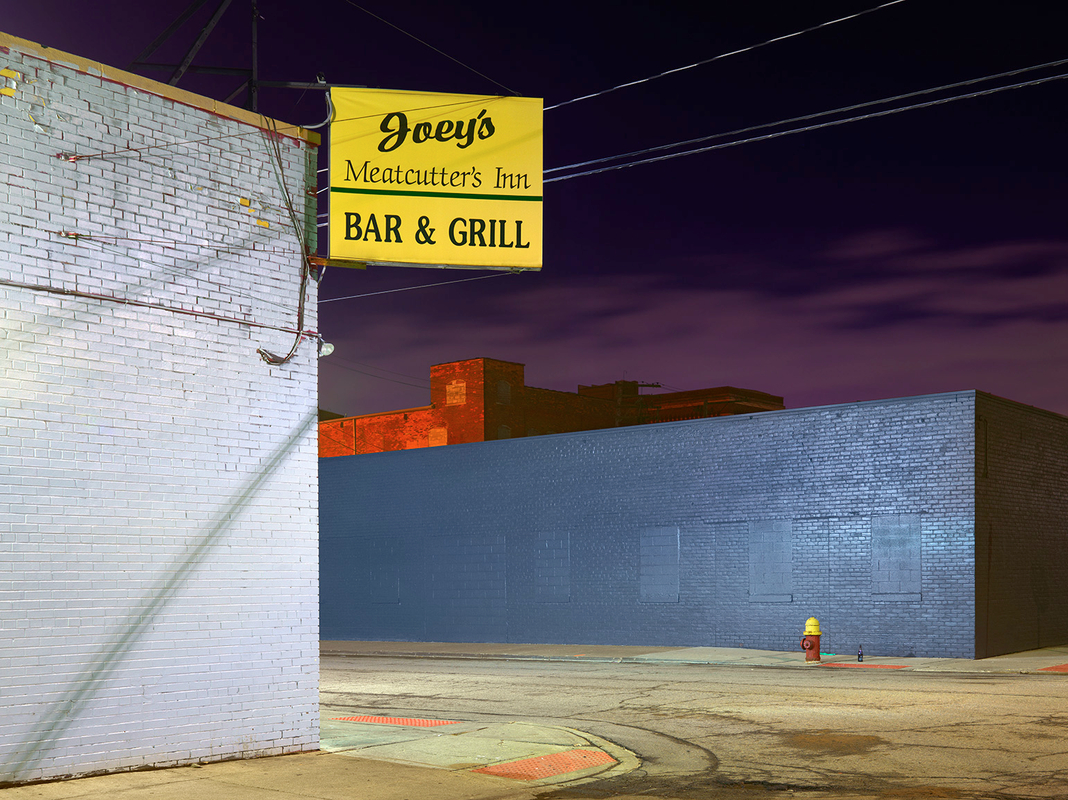
Detroit Nocturne‘ found here. Via Mick Hartley.

I’m partial to ‘Joey’s Meatcutter Inn, Bar & Grill 2017‘:

Joey's Meatcutter's Inn, Eastside, Detroit 2017

Immediately, I think of Edward Hopper: The lonely cityscape at night or the familiar glow of gas station lights cast into the American wilderness. The eye might want to linger among the colors, shapes and clouds even though the mind knows this is pretty much an empty street in a ‘post-industrial’ zone.

Perhaps it has do with another strand of expression: The break into free verse from past forms. The move from American Romanticism to Modernism which occurred this early past century. William Carlos Williams produced many good poems from a process of earnest, scrapbook-style intensity in trying to discover, redefine, and order a new poetic form within a modern ‘urban landscape.’

The individual artist is quite alone in the task he’s set before himself, and like much of modernism, it’s a rather big task.

Pastoral

When I was younger
it was plain to me
I must make something of myself.
Older now
I walk back streets
admiring the houses
of the very poor:
roof out of line with sides
the yards cluttered
with old chicken wire, ashes,
furniture gone wrong;
the fences and outhouses
built of barrel staves
and parts of boxes, all,
if I am fortunate,
smeared a bluish green
that properly weathered
pleases me best of all colors.

No one
will believe this
of vast import to the nation

William Carlos Williams

Do you believe any of that to be of vast import to the nation? Are you no one?

Another one of Jordano’s photos which stuck out was: ‘Church Rectory With Lightning, Eastside, Detroit, 2016

https://chrisnavin.com/wp-content/uploads/2018/04/b784b-6a00d83451ebab69e201b8d2e873dc970c-pi.jpg

Perhaps I’m not wrong in having called Halloween horror stills and movie images to mind (it’s my mind, after all, so maybe I’m just thinking of Devil’s Night). I really enjoy the light on the dumpster and the side-front rectory wall. There seems to be a little more mood here, more drama, so maybe Edgar Allan Poe’s ‘psychological intensity,’ his surrealism, and terror are more appropriate for comparison.

Poe was a bit mad, after all, despite his fascinatingly untamed and powerful imagination. He achieved a uniqueness and completeness of vision few artists do. Maybe there’s a bit of the sullen, self-aggrandizing earnestness in him of the teenager (J.D. Salinger); the desire to shock, delight and terrify.

The mind is as though a chamber, the horror rises to fever pitch, the lush rhyme matches an increasingly desperate search for truth and beauty in the world (Poe had very much his own Romantically inspired metaphysics).

Alone

From childhood’s hour I have not been
As others were—I have not seen
As others saw—I could not bring
My passions from a common spring—
From the same source I have not taken
My sorrow—I could not awaken
My heart to joy at the same tone—
And all I lov’d—I lov’d alone—
Then—in my childhood—in the dawn
Of a most stormy life—was drawn
From ev’ry depth of good and ill
The mystery which binds me still—
From the torrent, or the fountain—
From the red cliff of the mountain—
From the sun that ’round me roll’d
In its autumn tint of gold—
From the lightning in the sky
As it pass’d me flying by—
From the thunder, and the storm—
And the cloud that took the form
(When the rest of Heaven was blue)
Of a demon in my view—

Nice photos, Dave. Thank you.

As previously posted:

Via Curbed Detroit. (via David Thompson)

70 photos of the abandoned, foreboding Temple. Mysterious symbols and a certain sad grandeur that’s come to represent Detroit these days.

-Photographer Ben Marcin has a series called ‘Last House Standing.’ Solitary row-homes…the only ones left on the block.

From Buzzfeed: ‘Why I Bought A House in Detroit For $500:’

How did Detroit get here? Very comprehensive and easy to navigate.

More from Megan McArdle on the behavior that comes with pension bonuses.Charlie LeDuff, Detroit’s populist, citizen journalist’s youtube channel here. At least he’s sticking around.

Are you looking at beautiful photos and feeling sorry for Detroit, and yourself? See Time Magazine’s photo essay by Yves Marchand and Romain Meffre (less porn-like, more thoughtful).

Hipster hope, artists, collectivists and small business types can’t save it either: A Short Culture Wars Essay-Two Links On Detroit & ‘Ruin Porn’

GM is not a municipality, but good money got put in, probably after bad and it reeks of politics: From The Detroit News: ‘How The Treasury, GM Stock Deal Got Done’

Modernism At The Movies

You Can Have It

My brother comes home from work
and climbs the stairs to our room.
I can hear the bed groan and his shoes drop
one by one. You can have it, he says.

The moonlight streams in the window
and his unshaven face is whitened
like the face of the moon. He will sleep
long after noon and waken to find me gone.

Thirty years will pass before I remember
that moment when suddenly I knew each man
has one brother who dies when he sleeps
and sleeps when he rises to face this life,

and that together they are only one man
sharing a heart that always labours, hands
yellowed and cracked, a mouth that gasps
for breath and asks, Am I gonna make it?

All night at the ice plant he had fed
the chute its silvery blocks, and then I
stacked cases of orange soda for the children
of Kentucky, one gray boxcar at a time

with always two more waiting. We were twenty
for such a short time and always in
the wrong clothes, crusted with dirt
and sweat. I think now we were never twenty.

In 1948 the city of Detroit, founded
by de la Mothe Cadillac for the distant purposes
of Henry Ford, no one wakened or died,
no one walked the streets or stoked a furnace,

for there was no such year, and now
that year has fallen off all the old newspapers,
calendars, doctors’ appointments, bonds
wedding certificates, drivers licenses.

The city slept. The snow turned to ice.
The ice to standing pools or rivers
racing in the gutters. Then the bright grass rose
between the thousands of cracked squares,

and that grass died. I give you back 1948.
I give you all the years from then
to the coming one. Give me back the moon
with its frail light falling across a face.

Give me back my young brother, hard
and furious, with wide shoulders and a curse
for God and burning eyes that look upon
all creation and say, You can have it.

Philip Levine

Repost-A Reaction To Jeff Koons-For Commerce Or Contemplation?

Denis Dutton suggests art could head towards Darwin (and may offer new direction from the troubles of the modern art aimlessness and shallow depth) Review of Denis Dutton’s ‘The Art Instinct’

Two ways around postmodernism, nihilism?: Through postmodernism? One is Allan Bloom Update And Repost: ‘A Few Thoughts On Allan Bloom–The Nietzsche / Strauss Connection’…A structure in the desert…not even a city Update On LACMA, Michael Heizer And The ‘Levitated Mass’-Modern Art And The Public;.

William Logan At The New Criterion: ‘Pound’s Metro’

Full piece here.

Logan takes a look at one of the most important modern poems:

In a Station of the Metro

The apparition of these faces in the crowd;
Petals on a wet, black bough.

Ezra Pound

Logan:

‘The minor vogue and rapid extinction of Imagism, a movement whose influence we still feel, has been hashed over by literary critics for a century. Its rehearsal here is merely to bring the poem into focus within the slow progress toward the densities of language, the images like copperplate engraving, that made Pound Pound.’

Thorough and well done.

The result would echo back to the States years later:

The Great Figure

Among the rain

and lights

I saw the figure 5

in gold

on a red

firetruck

moving

tense

unheeded

to gong clangs

siren howls

and wheels rumbling

through the dark city.

William Carlos Williams

This blog tends to look cautiously at many of the ideas of the Romantic poets, and the break to modernism, but not necessarily the poems themselves.  The echo ripples outwards:

Mid-August at Sourdough Mountain Lookout

Down valley a smoke haze
Three days heat, after five days rain
Pitch glows on the fir-cones
Across rocks and meadows
Swarms of new flies.

I cannot remember things I once read
A few friends, but they are in cities.
Drinking cold snow-water from a tin cup
Looking down for miles
Through high still air.

Gary Snyder

Once we start arriving at ‘ecological’ appreciations of nature, and the postmodern, confessional altar of Self and the turn inwards to the Self a subject for the art, and the desperate search for meaning, I get more and more turned off, for my own reasons.  Such good poems will carry on.

Any thoughts and comments are welcome.

Repost-A Few Thoughts On Thomas Cole’s ‘The Voyage Of Life’

A few decades ago, while visiting D.C., I saw Thomas Cole’s ‘The Voyage Of Life:

It’s a four-part series: Childhood, Youth, Manhood, Old Age.

One person’s life, and all of our lives, can be broken-down into four allegorical stages, pregnant with visual and universal symbols.

From Cole’s bio:

‘Although Cole had ample commissions in the late 1820s to paint pictures of American scenery, his ambition was to create a “higher style of landscape” that could express moral or religious meanings.’

From this more interactive page:

‘In the late 1830s, Cole was intent on advancing the genre of landscape painting in a way that conveyed universal truths about human existence, religious faith, and the natural world. First conceived in 1836, the four pictures comprising The Voyage of Life: Childhood, Youth, Manhood, and Old Age fulfilled that aspiration.’

These scenes in the Romantic style can have an emotional pull for me, as generally does the work of the Hudson River School. Such allegory certainly tends to function as a vehicle into memory (Cole’s work has really stuck with me…in a sort of haunting way, mixed with some thought of how I’m supposed to live and what might be coming next).

Also, the wild, untamed nature we Americans have often faced is perhaps requiring of a spirited and grand attempt at putting our experiences within Nature into some context: To soar as high as our hopes often do.

Or at least, to find in paintings: Familiarity. I like to see the roll of a hill like I’ve seen, or an opening of clouds, sky and light like I’ve seen.

Perhaps Wild Nature can be ordered in a Romantic, neo-classical or more modern way. Perhaps Nature can be made, with the tools at our disposal, to conform to some of our deeper ideas about Nature, mirroring our hopes in some recognizable fashion; giving some basic comfort and meaning.

Maybe, after all, we can find a home here.

On the other hand, allegory with overt moral/religious meaning can also come across as heavy-handed, sentimental, and moralistic. Too lush and pretentious; perhaps a bit anachronistic.

Do I really have to hunt for all the symbols and put the puzzle together?

‘So, you’re going to reveal universal truths, eh?’

This can seem distant from the experiences of the modern viewer, often finding himself a little further down the modern/postmodern ‘river’, where such attempts at universality might seem a wash.

Much more common these days are the very personal shards and glimpses of the inner life of an artist, attached to high ambition and great talent surely in some cases; as well to form and tradition, but generally making less bold claims to knowledge than ‘The Voyage Of Life‘.

In painting, I’m reminded of the abstract expressionist movement seeking meaning in reducing experience to the abstract in order to reveal something essential within Nature, or essential about our relationship to Nature: A transcendent place where shape, form and color can be isolated from anything immediately recognizable in the world.

Or maybe, I’m being too generous?

‘The movement’s name is derived from the combination of the emotional intensity and self-denial of the German Expressionists with the anti-figurative aesthetic of the European abstract schools such as Futurism, the Bauhaus, and Synthetic Cubism. Additionally, it has an image of being rebellious, anarchic, highly idiosyncratic and, some feel, nihilistic.[5] In practice, the term is applied to any number of artists working (mostly) in New York who had quite different styles, and even to work that is neither especially abstract nor expressionist.’

The exploration of the Self is often pursued, as well as that of Nature, but the general hope that it might all make sense (life, death, Nature, purpose etc) in many more modern movements is often left abandoned.

Or so often, as we’ve seen in the past few generations: The pursuit of The Self can easily become subsumed to the pursuit of fame, celebrity, and money.

***

Towards a theme: Perhaps you’ve also heard of the Rothko chapel, in Houston, Texas.

Mark Rothko undertook the idea that within the modern context, one could create temples of universal meaning through aesthetics, art, and beauty:

‘The Rothko Chapel, founded by Houston philanthropists John and Dominique de Menil, was dedicated in 1971 as an intimate sanctuary available to people of every belief. A tranquil meditative environment inspired by the mural canvases of Russian born American painter Mark Rothko (1903-1970), the Chapel welcomes over 60,000 visitors each year, people of every faith and from all parts of the world.’

See Also On This Site: Trying to stick something against his poems: Wednesday Poem: Wallace Stevens-Anecdote of The JarWednesday Poem: Wallace Stevens, The Snow ManFriday Poem: Wallace Stevens And A Quote By David Hume

Some Updated Links On Postmodernism

Repost: From The NY Times Via A & L Daily: Helen Vendler On Wallace Stevens ‘The Plain Sense Of Things’

Some Sunday Songs-Metal, Myth, American Romanticism And The Civil War

Within A Bank Of Modern Fog-Another Link To Robert Hughes On Jeff Koons

Repost-A Bleak, Modern House-Four Poems

This will be a longer one, so thanks in advance.

From the comments on this piece:

‘The most useful definition of modernist fiction I’ve encountered comes from Brian McHale’s Postmodernist Fiction. He says modernist fiction tends to “foreground epistemological questions” such as “How can I interpret the world I’m part of? What is there to be known? Who knows it? What are the limits of that knowledge?” In contrast, postmodernist fiction tends to “foreground ontological questions” such as “What is a world? What kinds of worlds are there and how are they constituted? What happens when…boundaries between worlds are violated?’

As to the epistemological questions surrounding Modernism, below are four poems. Hopefully, each is a representative example of a move away from the Romanticism that had been prevalent up until the late 1800’s.

In addition to the move away from traditional Romantic rhyme and meter towards modern blank verse, there’s also a certain conception of the Self rendered in them; a presentation of our natures that might be worth examining in some detail.

I believe we can see clearly a move away from tradition towards the Self, the Poet isolated, the poem itself as a means of communication, and an anxiety so common within the 20th century.

I should note that a friend points out Harold Bloom does it much better (well, yes…obviously). From this blurb:

‘At the heart of Bloom’s project is the ancient quarrel between “poetry” and “philosophy.” In Bloom’s opinion, we ought not have to choose between Homer and Plato; we can have both, as long as we recognize that poetry is superior.’

Says the guy who writes about poetry…


What does one find within, as one looks without, waking from sleep and dream?

What kind of world is this, and can the poet actually help us know it?

T.S. Eliot (Preludes: Stanza 3)

3.

You tossed a blanket from the bed
You lay upon your back, and waited;
You dozed, and watched the night revealing
The thousand sordid images
Of which your soul was constituted;
They flickered against the ceiling.
And when all the world came back
And the light crept up between the shutters
And you heard the sparrows in the gutters,
You had such a vision of the street
As the street hardly understands;
Sitting along the bed’s edge, where
You curled the papers from your hair,
Or clasped the yellow soles of feet
In the palms of both soiled hands.

The world will stain you, and it is a fallen, modern world, rendered profoundly and exquisitely.

As consciousness creeps in, building a bridge to the day, to the world, to the facts left as though they were the first facts, the light as though it were the first light, what one finds is distressing, both within and without.

That distress must be ‘made new,’ which is to say, the suffering (original?) in which we all sometimes find ourselves must match our experiences within the modern city and world, at least, the world created within Eliot’s lyrical verse.

Of the four poems, only the first and last have a 3rd-person subject.

Wallace Stevens‘ ‘I’ is in a more contemplative state, but it’s an ‘I’ exploring similar themes, and experiencing some distress in trying to know how the world actually is, and what might lie within.

The journey to The Self may not be a journey for the faint of heart.

The Poems Of Our Climate (stanzas II and III)

II
Say even that this complete simplicity
Stripped one of all one’s torments, concealed
The evilly compounded, vital I
And made it fresh in a world of white,
A world of clear water, brilliant-edged,
Still one would want more, one would need more,
More than a world of white and snowy scents.

III
There would still remain the never-resting mind,
So that one would want to escape, come back
To what had been so long composed.
The imperfect is our paradise.
Note that, in this bitterness, delight,
Since the imperfect is so hot in us,
Lies in flawed words and stubborn sounds.

Even if the verse can describe a perfected world, delivering us, perhaps, a little closer to perfection, our poet is still not free from the impulses and desires which simply never cease.

Interestingly, we end-up not with a discussion of the heart, the spirit, libido etc. as a source for those desires (for Plato, the irrational), but rather, for Stevens, just a mind.

We also find more Romantic elements of language and an almost baroque/rococo arrangement of words and ideas, dandyish even, yet combined with an intense effort to abstract, define, and clarify. From here, the poet may proceed on his task of flawed words and stubborn sounds.

***I find myself thinking of elements of modern architecture and abstract-expressionist painting. The meaning, or at least some delivery from our restless existences, can be found within the abstract itself. Or at least within a retreat to the abstract for its own sake, away from the world.

The modernist, glass-walled house on the hill will exist in its own space, offering and defying meaning. The structure’s own shapes will be stripped down to often mathematically precise forms interacting with Nature. These shall guide Man, or at least offer individual men a little refuge.

It is perhaps in Stevens’ poem we can see the questions of knowledge about the world suggesting questions about whether there is a world at all, or, at least, what kind of worlds each Self might be able to inhabit.

Here’s one of Robert Lowell’s poems, occurring a generation later, in the mid 20th-century, as part of the confessionals.

The Self is extremely isolated. In fact, Lowell went more than a little crazy. Unlike the known nervous breakdown of Eliot from which Eliot recovered, Lowell’s life was essentially one long breakdown from which he never recovered.

Here he is, looking back:

Epilogue

Those blessed structures plot and rhyme-
why are they no help to me now
i want to make
something imagined not recalled?
I hear the noise of my own voice:
The painter’s vision is not a lens
it trembles to caress the light.
But sometimes everything i write
With the threadbare art of my eye
seems a snapshot
lurid rapid garish grouped
heightened from life
yet paralyzed by fact.
All’s misalliance.
Yet why not say what happened?
Pray for the grace of accuracy
Vermeer gave to the sun’s illumination
stealing like the tide across a map
to his girl solid with yearning.
We are poor passing facts.
warned by that to give
each figure in the photograph
his living name.

The weight of having to make that meaning, for yourself, and by yourself, is a horrible weight indeed. One can glorify one’s Self and family, but that, alas, only goes so far. Rhyme and form still carry one’s living name, as far as they do.

Of course, there’s still wonderful rhythm and form here (this is excellent verse), but blanker now, with a relentless focus on the ‘I.’ The poet is perhaps talking a little more to himself, and the poem keeps self-consciously calling attention to itself.

In fact, it reminded me of the poem below, by Robert Creeley, which was published a few years afterwards.

From this page:

‘Creeley was a leader in the generational shift that veered away from history and tradition as primary poetic sources and gave new prominence to the ongoing experiences of an individual’s life. Because of this emphasis, the major events of his life loom large in his literary work.’

There’s Nothing but the Self and the Eye seeking and making meaning, by itself within a void of emotionally compact and precise language (of course there’s still form and other things besides).

Can the poet fit inside the little abstract chapel of words he’s building for himself (let alone the world, tradition etc.)?

For all the talk about ‘space,’ there seems very little.

The Window

Position is where you
put it, where it is,
did you, for example, that

large tank there, silvered,
with the white church along-
side, lift

all that, to what
purpose? How
heavy the slow

world is with
everything put
in place. Some

man walks by, a
car beside him on
the dropped

road, a leaf of
yellow color is
going to

fall. It
all drops into
place. My

face is heavy
with the sight. I can
feel my eye breaking.

The distress is still there…but I’d argue that we are now a good distance away from the grandness of Eliot’s vision, his religiosity and virtuosity with form and meter at the dawn of Modernism. Very few people can/could do what Eliot did (addition: even if he can help us gain knowledge of our Selves or the world).

That said, it’s unclear there’s enough tradition and confidence to even undertake such a project, now, even as such talents come along. The state of things is more scattered. We’re in a very different place of selves and artists isolated, of anxiety and post-anxiety.

Aside from the very accomplished poets above, in terms of both knowledge (epistemology) and being (ontology), we often have writers feeling pressure to weigh-in on such questions without even being about to write that well; artists who can’t draw or paint that well, and frankly, quite a bit of bullshit besides.

So, where are we headed? Who’s ‘we’ exactly?

Predictions are hard, especially about the future.


As previously posted:

Why not just put a few algorithms to work in writing those artist statements?

Bathe in the bathos of a warming world:

A reader sends a link to a SF Gate review of poet Jorie Graham’s ‘Sea Change:

‘In “Sea Change,” Graham becomes Prospero, casting spells by spelling out her thoughts to merge with ours, and with the voices of the elements. The result is a mingling of perceptions rather than a broadcasting of opinions. Instead of analysis, the poems encourage emotional involvement with the drastic changes overwhelming us, overwhelm- ing the planet.’

and:

‘Strengths and weaknesses, flows and ebbs, yet every poem in “Sea Change” bears memorable lines, with almost haunting (if we truly have but 10 years to “fix” global warming) images of flora and fauna under siege. Jorie Graham has composed a swan song for Earth.’

Oh boy.

What are these poems being asked to do?


And moving away from poetry into the realm of ‘performance art,’


Tilda Swinton At MOMA-From Arma Virumque: ‘Nightmare In A Box’

Denis Dutton suggests art could head towards Darwin (and may offer new direction from the troubles of the modern art aimlessness and shallow depth) Review of Denis Dutton’s ‘The Art Instinct’

Roger Scruton says keep politics out of the arts, and political judgment apart from aesthetic judgment…this includes race studies/feminist departments/gay studies etc.: Roger Scruton In The American Spectator Via A & L Daily: Farewell To Judgment

Ah, Look At All The Lonely People-‘Jeff Koons Is Back’ Via Vanity Fair

Some Updated Links On Postmodernism

Repost: Two Links-Robert Hughes’ Take On America Through Its Art & Michael Heizer’s ‘City’

Maybe it’s Pilgrim’s pride, or perhaps the Puritan pursuit of image-less purity, or the Colonialists ecumenical style, or maybe even some Shaker weirdness that finds itself up for analysis.

Perhaps somewhere there’s a spare, Yankee work ethic resting on a simple, wooden shelf in the ‘American mind.’

Could such a thing be discovered within mid 20th-century modernism?

Robert Hughes takes a look at Donald Judd’s ‘Temple Of Aesthetic Fanaticism,’ and Richard Serra’s nod to Jackson Pollack and abstract expressionism in the rawness of material sculpture. You know, making stuff (a potentially sensitive subject with so many technological changes going on right now).

(link may not last):

As for Land Art, Michael Heizer’s life’s-work land-art project is apparently complete, if such a thing can be complete:

There’s a good piece in the New Yorker here.

There is an air of secrecy about the whole thing.

You can’t even visit?


Apparently, Heizer’s been working since 1972 on this sculpture in the Eastern Nevada desert, which was originally called ‘Complex One.’ It’s morphed into his life’s work, called City. It’s very large. It can’t be moved. You can’t reproduce it. It represents a break from traditional sculpture. It can’t be put in a museum and it’s not clear that it has a function.

In Brasil, they just started from the top-down and built a city that doesn’t work that well for people: Brasilia: A Planned City

——————

I have to confess that seeing that structure upon the wide open emptiness of Eastern Nevada is comforting for the familiarity it brings. It’s a little bit of order upon the unknown, and the design, or lack thereof (about which a man may wonder), within Nature herself. I think this is why a military installation out in the desert can captivate the imagination as it’s been known to in Hollywood and in the public mind (dreaming of aliens and conspiracies).

To expand on that theme, Wallace Stevens might shed some light. He was an American poet on the hinge between romanticism and modernism:

Anecdote of the Jar

I placed a jar in Tennessee,
And round it was, upon a hill.
It made the slovenly wilderness
Surround that hill.

The wilderness rose up to it,
And sprawled around, no longer wild.
The jar was round upon the ground
And tall and of a port in air.

It took dominion every where.
The jar was gray and bare.
It did not give of bird or bush,
Like nothing else in Tennessee.

Wallace Stevens

You’ve changed all of nature with just one jar.

What do you do with an uncivilized, wild land? Import European learning and literature “atop” it? Christian tradition and the Natural Law? Import the triumph of the Western mathematical sciences and technology? Import its movements of the arts and the individual artist?

You can’t help but do this.

Related On This Site: L.A.’s New Public Art Piece ‘The Levitated Mass,’ Or As The American Interest Puts It: ‘A Moving Rock’

Denis Dutton suggested art could head towards Darwin (and may offer new direction from the troubles of the modern art aimlessness and shallow depth…the money and the fame) Review of Denis Dutton’s ‘The Art Instinct’

Denver’s Devil Horse may be flirting with kitsch: From The Wall Street Journal: Denver’s Mustang Or ‘Devil Horse’…and I like his work:…Joan Miro: Woman

From Grist.Org Via The New Republic Via The A & L Daily: ‘Getting Past “Ruin Porn” In Detroit’…Marketplace aesthetics in service of “women”: Dove’s Campaign For Real Beauty: Pascal Dangin And AestheticsRoger Scruton In The City Journal: Cities For Living–Is Modernism Dead?Brasilia: A Planned City

Phospine Above Venus, Blurbs & A Poem By Wallace Stevens

Somewhere up in the clouds of Venus, there’s Phosphine [possibly]. So far, there’s no known naturally occurring reason for this, but that doesn’t mean there isn’t one. On Earth, when bacteria farts in our guts and in swamps, that’s when you get Phosphine. I’ll bet it smells nice.

Maybe in those clouds of sulfuric acid, racing above surface temperatures high-enough to melt lead, there’s some ammonia? Maybe this ammonia is neutralizing the cloud PH balance enough for some kind of bacteria to survive?

These are questions to which a little exploration can provide answers.

You know the moment you notice that the world has fallen away for awhile? You’re leisurely enjoying a photograph, or a painting, or a poem…

…and there’s a passage like this:

‘In the critical terminology of the time, Ghirri’s close-up photographs of the details of atlases and other maps question the link between signifier and signified, referring to a supposedly ‘natural’ environment that has long since become a simulacrum, and revealing the specific aesthetics harboured within ‘objective’ representation.’

The NIGHT of the BLURB! It’s postmodern, it’s (S)elf referential, it’s….alive. It’s dead. It’s…subjectivity and objectivity combined!

And now for a ‘modern’ poem.

The Snow Man

One must have a mind of winter
To regard the frost and the boughs
Of the pine-trees crusted with snow;

And have been cold a long time
To behold the junipers shagged with ice,
The spruces rough in the distant glitter

Of the January sun; and not to think
Of any misery in the sound of the wind,
In the sound of a few leaves,

Which is the sound of the land
Full of the same wind
That is blowing in the same bare place

For the listener, who listens in the snow,
And, nothing himself, beholds
Nothing that is not there and the nothing that is.

 –Wallace Stevens

Welcome To The Western Skies Motel-Some Old & New Links On Place In America

Ernst Haas-Western Skies Motel, Colorado, 1977. It’s a wonderful use of color, along with those clouds and that light. A mood is created, and not much extra visual information is provided.

Ernst Haas-There’s so much visual information, but is there? What is communicated through your eye and to your brain? Route 66 Albuquerque, New Mexico, 1969

As posted:

Via Mick Hartley, British photographer Mark Power’s Good Morning, America, vols. 1 (mostly Arkansas) & 2 (mostly across the South).

Power:

‘I keep a physical and metaphorical distance between myself and the subject. It’s a way of delineating my ‘foreignness’ and is a similar stance to the one I took while working in Poland making The Sound of Two Songs (2004-09). It’s comes very naturally to me; I’ve always felt I’m better at observing than participating, so to stand back and watch from afar suits me very well.’

I often find myself drawn to photos with some distance.

As posted:

Via Mick Hartley, Steve Fitch Photography has neon motel signs glowing into the Western night.

He also has a book simply titled ‘Motel Signs:’

What’s more American than an exiled member of the Russian aristocracy intimately making his way into the English language and peering out from a thousand Motor Lodges?

Nabokov in America:  On The Road To Lolita.

Michael Dirda review of the review here.

“Nabokov in America” is rewarding on all counts, as biography, as photo album (there are many pictures of people, Western landscapes and motels) and as appreciative criticism. Not least, Roper even avoids the arch style so often adopted by critics faintly trying to emulate their inimitable subject.’

Well, there’s Donald Judd and Marfa, Texas, which looks interesting:

As previously posted, The Critic Laughs, by Hamilton:

Do you long for the days of unabashed American consumerism? Are you nostalgic for nights lit only by a soft, neon glow on the underbellies of clouds? Return to a time when America broadcast its brash, unironic call to the heavens.

But it can be empty, and lonely, and full of hard work and suffering:

MT-3 Storm Breaking-3

Montana Pastoral    

I am no shepherd of a child’s surmises.
I have seen fear where the coiled serpent rises,

Thirst where the grasses burn in early May
And thistle, mustard and the wild oat stay.

There is dust in this air. I saw in the heat
Grasshoppers busy in the threshing wheat.

So to this hour. Through the warm dusk I drove
To blizzards sifting on the hissing stove,

And found no images of pastoral will,
But fear, thirst, hunger, and this huddled chill.  

J.V. Cunningham

Detroit Nocturne‘ found here. Via Mick Hartley.

I’m partial to ‘Joey’s Meatcutter Inn, Bar & Grill 2017‘:

Joey's Meatcutter's Inn, Eastside, Detroit 2017

Immediately, I think of Edward Hopper: The lonely cityscape at night or the familiar glow of gas station lights cast into the American wilderness. The eye might want to linger among the colors, shapes and clouds even though the mind knows this is pretty much an empty street in a ‘post-industrial’ zone.

Perhaps it has do with another strand of expression: The break into free verse from past forms. The move from American Romanticism to Modernism which occurred this early past century. William Carlos Williams produced many good poems from a process of earnest, scrapbook-style intensity in trying to discover, redefine, and order a new poetic form within a modern ‘urban landscape.’

The individual artist is quite alone in the task he’s set before himself, and like much of modernism, it’s a rather big task.

Pastoral

When I was younger
it was plain to me
I must make something of myself.
Older now
I walk back streets
admiring the houses
of the very poor:
roof out of line with sides
the yards cluttered
with old chicken wire, ashes,
furniture gone wrong;
the fences and outhouses
built of barrel staves
and parts of boxes, all,
if I am fortunate,
smeared a bluish green
that properly weathered
pleases me best of all colors.

No one
will believe this
of vast import to the nation

William Carlos Williams

Do you believe any of that to be of vast import to the nation? Are you no one?

Repost: A Bleak, Modern House-Four Poems

This will be a longer one, so thanks in advance.

From the comments on this piece:

‘The most useful definition of modernist fiction I’ve encountered comes from Brian McHale’s Postmodernist Fiction. He says modernist fiction tends to “foreground epistemological questions” such as “How can I interpret the world I’m part of? What is there to be known? Who knows it? What are the limits of that knowledge?” In contrast, postmodernist fiction tends to “foreground ontological questions” such as “What is a world? What kinds of worlds are there and how are they constituted? What happens when…boundaries between worlds are violated?’

As to the epistemological questions surrounding Modernism, below are four poems. Hopefully, each is a representative example of a move away from the Romanticism that had been prevalent up until the late 1800’s.

In addition to the move away from traditional Romantic rhyme and meter towards modern blank verse, there’s also a certain conception of the Self rendered in them; a presentation of our natures that might be worth examining in some detail.

I believe we can see clearly a move away from tradition towards the Self, the Poet isolated, the poem itself as a means of communication, and an anxiety so common within the 20th century.

I should note that a friend points out Harold Bloom does it much better (well, yes…obviously). From this blurb:

‘At the heart of Bloom’s project is the ancient quarrel between “poetry” and “philosophy.” In Bloom’s opinion, we ought not have to choose between Homer and Plato; we can have both, as long as we recognize that poetry is superior.’

Says the guy who writes about poetry…


What does one find within, as one looks without, waking from sleep and dream?

What kind of world is this, and can the poet actually help us know it?

T.S. Eliot (Preludes: Stanza 3)

3.

You tossed a blanket from the bed
You lay upon your back, and waited;
You dozed, and watched the night revealing
The thousand sordid images
Of which your soul was constituted;
They flickered against the ceiling.
And when all the world came back
And the light crept up between the shutters
And you heard the sparrows in the gutters,
You had such a vision of the street
As the street hardly understands;
Sitting along the bed’s edge, where
You curled the papers from your hair,
Or clasped the yellow soles of feet
In the palms of both soiled hands.

The world will stain you, and it is a fallen, modern world, rendered profoundly and exquisitely.

As consciousness creeps in, building a bridge to the day, to the world, to the facts left as though they were the first facts, the light as though it were the first light, what one finds is distressing, both within and without.

That distress must be ‘made new,’ which is to say, the suffering (original?) in which we all sometimes find ourselves must match our experiences within the modern city and world, at least, the world created within Eliot’s lyrical verse.

Of the four poems, only the first and last have a 3rd-person subject.

Wallace Stevens‘ ‘I’ is in a more contemplative state, but it’s an ‘I’ exploring similar themes, and experiencing some distress in trying to know how the world actually is, and what might lie within.

The journey to The Self may not be a journey for the faint of heart.

The Poems Of Our Climate (stanzas II and III)

II
Say even that this complete simplicity
Stripped one of all one’s torments, concealed
The evilly compounded, vital I
And made it fresh in a world of white,
A world of clear water, brilliant-edged,
Still one would want more, one would need more,
More than a world of white and snowy scents.

III
There would still remain the never-resting mind,
So that one would want to escape, come back
To what had been so long composed.
The imperfect is our paradise.
Note that, in this bitterness, delight,
Since the imperfect is so hot in us,
Lies in flawed words and stubborn sounds.

Even if the verse can describe a perfected world, delivering us, perhaps, a little closer to perfection, our poet is still not free from the impulses and desires which simply never cease.

Interestingly, we end-up not with a discussion of the heart, the spirit, libido etc. as a source for those desires (for Plato, the irrational), but rather, for Stevens, just a mind.

We also find more Romantic elements of language and an almost baroque/rococo arrangement of words and ideas, dandyish even, yet combined with an intense effort to abstract, define, and clarify. From here, the poet may proceed on his task of flawed words and stubborn sounds.

***I find myself thinking of elements of modern architecture and abstract-expressionist painting. The meaning, or at least some delivery from our restless existences, can be found within the abstract itself. Or at least within a retreat to the abstract for its own sake, away from the world.

The modernist, glass-walled house on the hill will exist in its own space, offering and defying meaning. The structure’s own shapes will be stripped down to often mathematically precise forms interacting with Nature. These shall guide Man, or at least offer individual men a little refuge.

It is perhaps in Stevens’ poem we can see the questions of knowledge about the world suggesting questions about whether there is a world at all, or, at least, what kind of worlds each Self might be able to inhabit.

Here’s one of Robert Lowell’s poems, occurring a generation later, in the mid 20th-century, as part of the confessionals.

The Self is extremely isolated. In fact, Lowell went more than a little crazy. Unlike the known nervous breakdown of Eliot from which Eliot recovered, Lowell’s life was essentially one long breakdown from which he never recovered.

Here he is, looking back:

Epilogue

Those blessed structures plot and rhyme-
why are they no help to me now
i want to make
something imagined not recalled?
I hear the noise of my own voice:
The painter’s vision is not a lens
it trembles to caress the light.
But sometimes everything i write
With the threadbare art of my eye
seems a snapshot
lurid rapid garish grouped
heightened from life
yet paralyzed by fact.
All’s misalliance.
Yet why not say what happened?
Pray for the grace of accuracy
Vermeer gave to the sun’s illumination
stealing like the tide across a map
to his girl solid with yearning.
We are poor passing facts.
warned by that to give
each figure in the photograph
his living name.

The weight of having to make that meaning, for yourself, and by yourself, is a horrible weight indeed. One can glorify one’s Self and family, but that, alas, only goes so far. Rhyme and form still carry one’s living name, as far as they do.

Of course, there’s still wonderful rhythm and form here (this is excellent verse), but blanker now, with a relentless focus on the ‘I.’ The poet is perhaps talking a little more to himself, and the poem keeps self-consciously calling attention to itself.

In fact, it reminded me of the poem below, by Robert Creeley, which was published a few years afterwards.

From this page:

‘Creeley was a leader in the generational shift that veered away from history and tradition as primary poetic sources and gave new prominence to the ongoing experiences of an individual’s life. Because of this emphasis, the major events of his life loom large in his literary work.’

There’s Nothing but the Self and the Eye seeking and making meaning, by itself within a void of emotionally compact and precise language (of course there’s still form and other things besides).

Can the poet fit inside the little abstract chapel of words he’s building for himself (let alone the world, tradition etc.)?

For all the talk about ‘space,’ there seems very little.

The Window

Position is where you
put it, where it is,
did you, for example, that

large tank there, silvered,
with the white church along-
side, lift

all that, to what
purpose? How
heavy the slow

world is with
everything put
in place. Some

man walks by, a
car beside him on
the dropped

road, a leaf of
yellow color is
going to

fall. It
all drops into
place. My

face is heavy
with the sight. I can
feel my eye breaking.

The distress is still there…but I’d argue that we are now a good distance away from the grandness of Eliot’s vision, his religiosity and virtuosity with form and meter at the dawn of Modernism. Very few people can/could do what Eliot did (addition: even if he can help us gain knowledge of our Selves or the world).

That said, it’s unclear there’s enough tradition and confidence to even undertake such a project, now, even as such talents come along. The state of things is more scattered. We’re in a very different place of selves and artists isolated, of anxiety and post-anxiety.

Aside from the very accomplished poets above, in terms of both knowledge (epistemology) and being (ontology), we often have writers feeling pressure to weigh-in on such questions without even being about to write that well; artists who can’t draw or paint that well, and frankly, quite a bit of bullshit besides.

So, where are we headed? Who’s ‘we’ exactly?

Predictions are hard, especially about the future.


As previously posted:

Why not just put a few algorithms to work in writing those artist statements?

Bathe in the bathos of a warming world:

A reader sends a link to a SF Gate review of poet Jorie Graham’s ‘Sea Change:

‘In “Sea Change,” Graham becomes Prospero, casting spells by spelling out her thoughts to merge with ours, and with the voices of the elements. The result is a mingling of perceptions rather than a broadcasting of opinions. Instead of analysis, the poems encourage emotional involvement with the drastic changes overwhelming us, overwhelm- ing the planet.’

and:

‘Strengths and weaknesses, flows and ebbs, yet every poem in “Sea Change” bears memorable lines, with almost haunting (if we truly have but 10 years to “fix” global warming) images of flora and fauna under siege. Jorie Graham has composed a swan song for Earth.’

Oh boy.

What are these poems being asked to do?


And moving away from poetry into the realm of ‘performance art,’


Tilda Swinton At MOMA-From Arma Virumque: ‘Nightmare In A Box’

Denis Dutton suggests art could head towards Darwin (and may offer new direction from the troubles of the modern art aimlessness and shallow depth) Review of Denis Dutton’s ‘The Art Instinct’

Roger Scruton says keep politics out of the arts, and political judgment apart from aesthetic judgment…this includes race studies/feminist departments/gay studies etc.: Roger Scruton In The American Spectator Via A & L Daily: Farewell To Judgment

Ah, Look At All The Lonely People-‘Jeff Koons Is Back’ Via Vanity Fair

Some Updated Links On Postmodernism

Repost-Land Art Links Along A With A Quite Modernist W.S. Merwin Poem

Via kotte.org, some of New York’s iconic, modernist structures placed in new surroundings…


On that note, Land Art is often about removing the monetary value, commodification and fungibility of a piece of art and making something big enough, weird enough, useless enough; maybe making a beautiful/ugly enough imitation of Nature or man’s design within Nature.

Here’s Wikipedia, keeping it simpler:

‘Land art, earthworks (coined by Robert Smithson), or Earth art is an art movement in which landscape and the work of art are inextricably linked.’

Sometimes, maybe, it doesn’t really inspire the imagination:

Or maybe it’s a little gimmicky, as I imagine ‘Christo’ revealing his work with a magician’s flourish of the hand.

‘Essential’ art?:


Moving along, a reader links to W.S. Merwin’s ‘Tergvinder’s Stone,’ where you get some weird metaphysical notions of space/non-space, subjectivity/objectivity going on.

Abstract Modernism? Mid-Century Modernism? Relentlessly rhythmic, ambitious and (P)rophetic pieces looking to reshape not Nature, but how readers should think about Nature?

(addition: Plymouth Rock? Uh-oh…what is the poem being asked to do? What about the reader?):

‘One time my friend Tergvinder brought a large round boulder into his living room. He rolled it up the steps with the help of some two-by-fours, and when he got it out into the middle of the room, where some people have coffee tables (though he had never had one there himself) he left it. He said that was where it belonged.

It is really a plain-looking stone. Not as large as Plymouth Rock by a great deal, but then it does not have all the claims of a big shaky promotion campaign to support. That was one of the things Tergvinder said about it. He made no claims at all for it, he said. It was other people who called it Tergvinder’s Stone. All he said was that according to him it belonged there.’


As previously posted, of the land artists, Richard Serra seems quite substantial:

Click through for a Serra-released photo of four metal pillar-forms aligned in the deserts of Qatar, designed to inevitably rust. The piece has a slight ‘2001: A Space Odyssey feel, but that could just be me.

‘The Qatar Museums Authority is estimated to spend about a billion dollars per year on art. At its head is the young Sheikha al-Mayassa Hamad bin Khalifa al-Thani, a sister of the Emir of Qatar and a Duke University graduate, who was recently named the most powerful person in the art world by ArtReview.’

Get while the getting is good, so long as the Sheiks have the dough.

Check out Hyperallergic’s visit to ‘Shift,’ a series of concrete forms he left in an Ontario field.

Here’s Serra discussing a piece of his at 21 West Gagosian, or a densely-packed, carefully measured series of metal forms in a room. What does the viewer experience in this space?:

Related On This Site:A structure in the desert…not even a city Update On LACMA, Michael Heizer And The ‘Levitated Mass’-Modern Art And The Public

Denis Dutton suggested art could head towards Darwin (and may offer new direction from the troubles of the modern art aimlessness and shallow depth…the money and the fame) Review of Denis Dutton’s ‘The Art Instinct’

No thanks to living in planned communities upon someone else’s overall vision.: Roger Scruton In The City Journal: Cities For Living–Is Modernism Dead?Repost-Via Reason: ‘Salvador Allende’s Cybersocialist Command Center’

Repost: Within A Bank Of Modern Fog-Robert Hughes On Jeff Koons & Bullshit Is No Laughing Matter

‘The notion of carefully wrought bullshit involves, then, a certain inner strain. Thoughtful attention to detail requires discipline and objectivity. It entails accepting standards and limitations that forbid the indulgence of impulse or whim. It is this selflessness that, in connection with bullshit, strikes us as inapposite. But in fact it is not out of the question at all. The realms of advertising and of public relations, and the nowadays closely related realm of politics, are replete with instances of bullshit so unmitigated that they can serve among the most indisputable and classic paradigms of the concept. And in these realms there are exquisitely sophisticated craftsmen, who with the help of advanced and demanding techniques of market research, of public opinion polling, of psychological testing, and so forth, dedicate themselves tirelessly to getting every word and image they produce exactly right.’

From Harry Frankfurt’s On Bullshit.’

There is ocassionally such a commitment to bullshit I imagine the bullshitter blowing up a balloon; the bright shiny surface mesmerizing; the spirit of creative play engaged. It grows bigger and more beautiful as it expands with each breath.

There are many balloons like it, but this bullshit-balloon is mine. We’re going places.

Making up fans, a record label, a press outlet, awards and a fake web design company just to get your metal band (yourself, really) some Euro-gigs is next-level stuff:

‘I’ve spent the past 24 hours enraptured by the story of Threatin, the Los Angeles-based “band” (actually a vanity project for the solo artist “Jered Threatin”) who used wildly misleading YouTube live videos, paid-for Facebook likes and YouTube views, grossly exaggerated ticket counts and an imaginary booking agent to set himself up with a European tour which is now falling flat on its face with next to no one showing up to gigs.’

On that note, what I’m saying is 100% true: I don’t think it’s mere satire to point out that Dale Lonagan’s bestselling ‘Ismology In The 21st Century: Self-Wonder, Collective Consciousness & Global Harmony’ continues to inspire modern-day pilgrims to arrive at his thriving compound in the desert: Peace Pavilion West.

Imagine Frank Lloyd Wright wasn’t a profoundly talented architect, but rather a visionary wordsmith and ecological warrior, capable of genuine modern leadership. Imagine through a colossal writing output at Sandstone Mountain, one man realized Eastern visions and Western (S)cience and (A)rt could create a locally-sourced, globally aware community.

I’m certainly not making this character up. His books have changed the lives of millions.

In fact, here’s a quote of his:

Please check out Jeff Koons:

—————

There’s always been a bit of the showman about Jeff Koons; the kind of young man who could put on a bow tie and try to give many museum-goers their time/money/aspirations’ worth at the membership desk.

This blog forgives people trying to explain what their art ‘means,’ exactly, but confesses to pleasure in seeing Koons put on the spot under the suspicious eye of an ornery old Robert Hughes.

I don’t fault Koons for finding himself firmly within modernism, searching for universal forms and broader historical context within those confines, but I admit it’s nice to see him held to account for his bullshit, and perhaps the broader, deeper bullshit he shares with many modern and postmodern artists: Pursuing novelty and recognition and thus making art into a business and often commercializing it, aiming for celebrity while offering meta-critiques on celebrity, making the personal and private very public (masturbation into social commentary, sex into meta-critques of religious shame, ‘culture’ and pornography).

Two quotes by Hughes that stood out:

Religion is diminished into celebrity..a kind of reverse apotheosis.

‘This alienation of the work from the common viewer is actually a form of spiritual vandalism.’

It’s tough to say that art is really about religion (though much clearly is), but rather more about an experience Hughes wants as many people as possible to have, and that such experiences can elevate and expand.

Aside from the above, there’s something that strikes me as not just late 20th century-modern about Koons, but also very American.

As previously posted:

Is street-art, or the use of graffiti & mixed-materials performed illegally out in public (on public and privately owned property) partly due to the success of capital markets?

-Banksy’s website here.

-Newsweek’s piece: ‘See You Banksy, Hello Invader.

Response To A Reader On ‘Radical Chic’ And A Link to Banksy’s ‘Dismaland’

I’d argue that it’s possible, especially with the constant cries of modernism to ‘make it new,‘ I think this is one way we’ve arrived at pop art, and the desire to blend conceptual art and popular music together. This is in evidence from The Talking Heads to Lady Gaga to Jay Z promoting his new album alongside Marina Abramovic at MOMA.

Many modern artists, from Andy Warhol to Jeff Koons to Damien Hirst are people with some artistic talent and native gifts, but not as much in the way of classical and/or formal training. They may be trying to have a conversation with the old masters, but they are clearly also the products of, and speaking to, ‘modern’ audiences. Much of this has become a world of shallow depth, especially among the less talented. Drawing and drafting can be underdeveloped skills while ‘mixed-media’ presentations, celebrity, marketing, money and fame are all thrown into the same pot.

Also On This Site: Roger Scruton says keep politics out of the arts, and political judgment apart from aesthetic judgment…this includes race studies/feminist departments/gay studies etc.: Roger Scruton In The American Spectator Via A & L Daily: Farewell To Judgment

Goya’s Fight With Cudgels and Goya’s Colossus. A very good Goya page here.

Joan Miro: WomanGoethe’s Color Theory: Artists And ThinkersSome Quotes From Kant And A Visual Exercise

A Reaction To Jeff Koons ‘St John The Baptist’

Denis Dutton suggests art could head towards Darwin (and may offer new direction from the troubles of the modern art aimlessness and shallow depth) Review of Denis Dutton’s ‘The Art Instinct’

Friday Poem-Pearl By Pearl Of Light

Flying Over The Nebraska Of My Life

So much of our lives dissolves.
What did I do the day before
I met you? You remember
what I was wearing that holiday.
What did I wear the next morning?
What did I write the day my mother died?

I fly at night over the plains.
There is a cluster of lights,
a starfish shape glittering. Then
darkness and darkness.
Then another clump bearing
long daisy petals of roadway.

Then nothing again. How much
of my living has fled like water
into sand. The sand is not
even damp to the hand.
Tears and wine and sparkling
water all vanish the same.

I know looking out the plane’s
dirty window that there are houses,
barns, roads, trees, stores
distinct in that darkness I once
drove through. I knew them and will
never know them again.

The plane is flying from lighted
place to lighted place, but
our arc is from the dark into
brightness then back into darkness.
I want to possess my own life like a
necklace, pearl by pearl of light.

Marge Piercy

A repost-For a special friend, you know who you are.

Repost: A Bleak, Modern House-Four Poems

This will be a longer one, so thanks in advance.

From the comments on this piece:

‘The most useful definition of modernist fiction I’ve encountered comes from Brian McHale’s Postmodernist Fiction. He says modernist fiction tends to “foreground epistemological questions” such as “How can I interpret the world I’m part of? What is there to be known? Who knows it? What are the limits of that knowledge?” In contrast, postmodernist fiction tends to “foreground ontological questions” such as “What is a world? What kinds of worlds are there and how are they constituted? What happens when…boundaries between worlds are violated?’

As to the epistemological questions surrounding Modernism, below are four poems. Hopefully, each is a representative example of a move away from the Romanticism that had been prevalent up until the late 1800’s.

In addition to the move away from traditional Romantic rhyme and meter towards modern blank verse, there’s also a certain conception of the Self rendered in them; a presentation of our natures that might be worth examining in some detail.

I believe we can see clearly a move away from tradition towards the Self, the Poet isolated, the poem itself as a means of communication, and an anxiety so common within the 20th century.

I should note that a friend points out Harold Bloom does it much better (well, yes…obviously). From this blurb:

‘At the heart of Bloom’s project is the ancient quarrel between “poetry” and “philosophy.” In Bloom’s opinion, we ought not have to choose between Homer and Plato; we can have both, as long as we recognize that poetry is superior.’

Says the guy who writes about poetry…


What does one find within, as one looks without, waking from sleep and dream?

What kind of world is this, and can the poet actually help us know it?

T.S. Eliot (Preludes: Stanza 3)

3.

You tossed a blanket from the bed
You lay upon your back, and waited;
You dozed, and watched the night revealing
The thousand sordid images
Of which your soul was constituted;
They flickered against the ceiling.
And when all the world came back
And the light crept up between the shutters
And you heard the sparrows in the gutters,
You had such a vision of the street
As the street hardly understands;
Sitting along the bed’s edge, where
You curled the papers from your hair,
Or clasped the yellow soles of feet
In the palms of both soiled hands.

The world will stain you, and it is a fallen, modern world, rendered profoundly and exquisitely.

As consciousness creeps in, building a bridge to the day, to the world, to the facts left as though they were the first facts, the light as though it were the first light, what one finds is distressing, both within and without.

That distress must be ‘made new,’ which is to say, the suffering (original?) in which we all sometimes find ourselves must match our experiences within the modern city and world, at least, the world created within Eliot’s lyrical verse.

Of the four poems, only the first and last have a 3rd-person subject.

Wallace Stevens‘ ‘I’ is in a more contemplative state, but it’s an ‘I’ exploring similar themes, and experiencing some distress in trying to know how the world actually is, and what might lie within.

The journey to The Self may not be a journey for the faint of heart.

The Poems Of Our Climate (stanzas II and III)

II
Say even that this complete simplicity
Stripped one of all one’s torments, concealed
The evilly compounded, vital I
And made it fresh in a world of white,
A world of clear water, brilliant-edged,
Still one would want more, one would need more,
More than a world of white and snowy scents.

III
There would still remain the never-resting mind,
So that one would want to escape, come back
To what had been so long composed.
The imperfect is our paradise.
Note that, in this bitterness, delight,
Since the imperfect is so hot in us,
Lies in flawed words and stubborn sounds.

Even if the verse can describe a perfected world, delivering us, perhaps, a little closer to perfection, our poet is still not free from the impulses and desires which simply never cease.

Interestingly, we end-up not with a discussion of the heart, the spirit, libido etc. as a source for those desires (for Plato, the irrational), but rather, for Stevens, just a mind.

We also find more Romantic elements of language and an almost baroque/rococo arrangement of words and ideas, dandyish even, yet combined with an intense effort to abstract, define, and clarify. From here, the poet may proceed on his task of flawed words and stubborn sounds.

***I find myself thinking of elements of modern architecture and abstract-expressionist painting. The meaning, or at least some delivery from our restless existences, can be found within the abstract itself. Or at least within a retreat to the abstract for its own sake, away from the world.

The modernist, glass-walled house on the hill will exist in its own space, offering and defying meaning. The structure’s own shapes will be stripped down to often mathematically precise forms interacting with Nature. These shall guide Man, or at least offer individual men a little refuge.

It is perhaps in Stevens’ poem we can see the questions of knowledge about the world suggesting questions about whether there is a world at all, or, at least, what kind of worlds each Self might be able to inhabit.

Here’s one of Robert Lowell’s poems, occurring a generation later, in the mid 20th-century, as part of the confessionals.

The Self is extremely isolated. In fact, Lowell went more than a little crazy. Unlike the known nervous breakdown of Eliot from which Eliot recovered, Lowell’s life was essentially one long breakdown from which he never recovered.

Here he is, looking back:

Epilogue

Those blessed structures plot and rhyme-
why are they no help to me now
i want to make
something imagined not recalled?
I hear the noise of my own voice:
The painter’s vision is not a lens
it trembles to caress the light.
But sometimes everything i write
With the threadbare art of my eye
seems a snapshot
lurid rapid garish grouped
heightened from life
yet paralyzed by fact.
All’s misalliance.
Yet why not say what happened?
Pray for the grace of accuracy
Vermeer gave to the sun’s illumination
stealing like the tide across a map
to his girl solid with yearning.
We are poor passing facts.
warned by that to give
each figure in the photograph
his living name.

The weight of having to make that meaning, for yourself, and by yourself, is a horrible weight indeed. One can glorify one’s Self and family, but that, alas, only goes so far. Rhyme and form still carry one’s living name, as far as they do.

Of course, there’s still wonderful rhythm and form here (this is excellent verse), but blanker now, with a relentless focus on the ‘I.’ The poet is perhaps talking a little more to himself, and the poem keeps self-consciously calling attention to itself.

In fact, it reminded me of the poem below, by Robert Creeley, which was published a few years afterwards.

From this page:

‘Creeley was a leader in the generational shift that veered away from history and tradition as primary poetic sources and gave new prominence to the ongoing experiences of an individual’s life. Because of this emphasis, the major events of his life loom large in his literary work.’

There’s Nothing but the Self and the Eye seeking and making meaning, by itself within a void of emotionally compact and precise language (of course there’s still form and other things besides).

Can the poet fit inside the little abstract chapel of words he’s building for himself (let alone the world, tradition etc.)?

For all the talk about ‘space,’ there seems very little.

The Window

Position is where you
put it, where it is,
did you, for example, that

large tank there, silvered,
with the white church along-
side, lift

all that, to what
purpose? How
heavy the slow

world is with
everything put
in place. Some

man walks by, a
car beside him on
the dropped

road, a leaf of
yellow color is
going to

fall. It
all drops into
place. My

face is heavy
with the sight. I can
feel my eye breaking.

The distress is still there…but I’d argue that we are now a good distance away from the grandness of Eliot’s vision, his religiosity and virtuosity with form and meter at the dawn of Modernism. Very few people can/could do what Eliot did (addition: even if he can help us gain knowledge of our Selves or the world).

That said, it’s unclear there’s enough tradition and confidence to even undertake such a project, now, even as such talents come along. The state of things is more scattered. We’re in a very different place of selves and artists isolated, of anxiety and post-anxiety.

Aside from the very accomplished poets above, in terms of both knowledge (epistemology) and being (ontology), we often have writers feeling pressure to weigh-in on such questions without even being about to write that well; artists who can’t draw or paint that well, and frankly, quite a bit of bullshit besides.

So, where are we headed? Who’s ‘we’ exactly?

Predictions are hard, especially about the future.


As previously posted:

Why not just put a few algorithms to work in writing those artist statements?

Bathe in the bathos of a warming world:

A reader sends a link to a SF Gate review of poet Jorie Graham’s ‘Sea Change:

‘In “Sea Change,” Graham becomes Prospero, casting spells by spelling out her thoughts to merge with ours, and with the voices of the elements. The result is a mingling of perceptions rather than a broadcasting of opinions. Instead of analysis, the poems encourage emotional involvement with the drastic changes overwhelming us, overwhelm- ing the planet.’

and:

‘Strengths and weaknesses, flows and ebbs, yet every poem in “Sea Change” bears memorable lines, with almost haunting (if we truly have but 10 years to “fix” global warming) images of flora and fauna under siege. Jorie Graham has composed a swan song for Earth.’

Oh boy.

What are these poems being asked to do?


And moving away from poetry into the realm of ‘performance art,’


Tilda Swinton At MOMA-From Arma Virumque: ‘Nightmare In A Box’

Denis Dutton suggests art could head towards Darwin (and may offer new direction from the troubles of the modern art aimlessness and shallow depth) Review of Denis Dutton’s ‘The Art Instinct’

Roger Scruton says keep politics out of the arts, and political judgment apart from aesthetic judgment…this includes race studies/feminist departments/gay studies etc.: Roger Scruton In The American Spectator Via A & L Daily: Farewell To Judgment

Ah, Look At All The Lonely People-‘Jeff Koons Is Back’ Via Vanity Fair

Some Updated Links On Postmodernism

Air Still Thick With Dreams On Fire

A good work of art can free your from the shackles of habitual perception.  It can make you alive anew to the strangeness of life, drawing you onwards through beauty, symmetry, and a bit of wonder.  Ars celare artem.

I believe the rush to contemporize all one’s experience and emotions into narrow ideological and political channels; to forego talent and skill for concept and blurb is a shame.

Meanwhile, over at The Whitney:

‘Ms. Hockley explained that these choices weren’t due to a fascination with all things “hot, young, new,” but rather grew out of traveling around the country and seeing how many artists were facing “an incredible amount of pressure coming from all sides,” including the burden of debt from M.F.A. programs, the collapse of smaller galleries that might help launch their careers and the difficulty of finding and keeping affordable studio space.’

And on one artist in particular:

‘For the biennial, Mr. Fernandes, a former ballet dancer who is based in Chicago, will present a new version of a piece titled “The Master and Form,” which consists of archaic-looking wooden scaffolding and devices that allow performers to hold the five basic ballet positions for long periods of time. “For me it is a social-political space, a piece that questions the agency of the body, the agency of the dancer and our labor,” said Mr. Fernandes.’

As posted:

James Panero on the New Whitney museum:

‘As America went abstract, the museum also never lost its taste for the real, a fact reflected in the strengths and weaknesses of its permanent collection now on display. This explains its abundance of American Scene hokum and WPA art as well as the artists who have defined the museum’s self-image, in particular Edward Hopper.

But it also explains its appetite for art that is strident, narrow, and of the moment, demonstrating a taste that has only become more bitter with age.’

Panero:

‘For many years, the French writer Guy de Maupassant insisted on eating lunch every day at the restaurant in the Eiffel Tower. The reason, he explained, was simple: the restaurant offered the only spot in Paris where he could look out and not have to see the Eiffel Tower.’

=================

How about popular culture from 30 years ago? Now, this is important. This blog is still looking for 80’s awesome badness, for nothing can predict the cultural trends of today like the lyrics of ‘Angel Of The City,’ the theme from Sylvester Stallone’s 1986 ‘Cobra.’

Succumb to the power of 80’s rock ballad poetry.

The streets they scream….with desire…the air is thick with dreams on fire:’

=====================

Ah, Look At All The Lonely People-‘Jeff Koons Is Back’ Via Vanity Fair…Awesome 80’s Badness-From The Running Man: Restless Heart (Running Away With You)

Roger Scruton says keep politics out of the arts, and political judgment apart from aesthetic judgment…this includes race studies/feminist departments/gay studies etc.: Roger Scruton In The American Spectator Via A & L Daily: Farewell To Judgment

Goya’s Fight With Cudgels and Goya’s Colossus. A very good Goya page here.

Joan Miro: WomanGoethe’s Color Theory: Artists And ThinkersSome Quotes From Kant And A Visual Exercise

A Reaction To Jeff Koons ‘St John The Baptist’

Denis Dutton suggests art could head towards Darwin (and may offer new direction from the troubles of the modern art aimlessness and shallow depth) Review of Denis Dutton’s ‘The Art Instinct’

Sunday Poem-Theodore Roethke

Autumn Poem

I have come to a still, but not a deep center,
A point outside the glittering current;
My eyes stare at the bottom of a river,
At the irregular stones, iridescent sandgrains,
My mind moves in more than one place,
In a country half-land, half-water.
I am renewed by death, thought of my death,
The dry scent of a dying garden in September,
The wind fanning the ash of a low fire.
What I love is near at hand,
Always, in earth and air.

Theodore Roethke

Not always one of my favorites, but thanks to a reader!


Repost: A Bleak, Modern House-Four Poems

This will be a longer one, so thanks in advance.

From the comments on this piece:

‘The most useful definition of modernist fiction I’ve encountered comes from Brian McHale’s Postmodernist Fiction. He says modernist fiction tends to “foreground epistemological questions” such as “How can I interpret the world I’m part of? What is there to be known? Who knows it? What are the limits of that knowledge?” In contrast, postmodernist fiction tends to “foreground ontological questions” such as “What is a world? What kinds of worlds are there and how are they constituted? What happens when…boundaries between worlds are violated?’

As to the epistemological questions surrounding Modernism, below are four poems. Hopefully, each is a representative example of a move away from the Romanticism that had been prevalent up until the late 1800’s.

In addition to the move away from traditional Romantic rhyme and meter towards modern blank verse, there’s also a certain conception of the Self rendered in them; a presentation of our natures that might be worth examining in some detail.

I believe we can see clearly a move away from tradition towards the Self, the Poet isolated, the poem itself as a means of communication, and an anxiety so common within the 20th century.

I should note that a friend points out Harold Bloom does it much better (well, yes…obviously). From this blurb:

‘At the heart of Bloom’s project is the ancient quarrel between “poetry” and “philosophy.” In Bloom’s opinion, we ought not have to choose between Homer and Plato; we can have both, as long as we recognize that poetry is superior.’

Says the guy who writes about poetry…


What does one find within, as one looks without, waking from sleep and dream?

What kind of world is this, and can the poet actually help us know it?

T.S. Eliot (Preludes: Stanza 3)

3.

You tossed a blanket from the bed
You lay upon your back, and waited;
You dozed, and watched the night revealing
The thousand sordid images
Of which your soul was constituted;
They flickered against the ceiling.
And when all the world came back
And the light crept up between the shutters
And you heard the sparrows in the gutters,
You had such a vision of the street
As the street hardly understands;
Sitting along the bed’s edge, where
You curled the papers from your hair,
Or clasped the yellow soles of feet
In the palms of both soiled hands.

The world will stain you, and it is a fallen, modern world, rendered profoundly and exquisitely.

As consciousness creeps in, building a bridge to the day, to the world, to the facts left as though they were the first facts, the light as though it were the first light, what one finds is distressing, both within and without.

That distress must be ‘made new,’ which is to say, the suffering (original?) in which we all sometimes find ourselves must match our experiences within the modern city and world, at least, the world created within Eliot’s lyrical verse.

Of the four poems, only the first and last have a 3rd-person subject.

Wallace Stevens‘ ‘I’ is in a more contemplative state, but it’s an ‘I’ exploring similar themes, and experiencing some distress in trying to know how the world actually is, and what might lie within.

The journey to The Self may not be a journey for the faint of heart.

The Poems Of Our Climate (stanzas II and III)

II
Say even that this complete simplicity
Stripped one of all one’s torments, concealed
The evilly compounded, vital I
And made it fresh in a world of white,
A world of clear water, brilliant-edged,
Still one would want more, one would need more,
More than a world of white and snowy scents.

III
There would still remain the never-resting mind,
So that one would want to escape, come back
To what had been so long composed.
The imperfect is our paradise.
Note that, in this bitterness, delight,
Since the imperfect is so hot in us,
Lies in flawed words and stubborn sounds.

Even if the verse can describe a perfected world, delivering us, perhaps, a little closer to perfection, our poet is still not free from the impulses and desires which simply never cease.

Interestingly, we end-up not with a discussion of the heart, the spirit, libido etc. as a source for those desires (for Plato, the irrational), but rather, for Stevens, just a mind.

We also find more Romantic elements of language and an almost baroque/rococo arrangement of words and ideas, dandyish even, yet combined with an intense effort to abstract, define, and clarify. From here, the poet may proceed on his task of flawed words and stubborn sounds.

***I find myself thinking of elements of modern architecture and abstract-expressionist painting. The meaning, or at least some delivery from our restless existences, can be found within the abstract itself. Or at least within a retreat to the abstract for its own sake, away from the world.

The modernist, glass-walled house on the hill will exist in its own space, offering and defying meaning. The structure’s own shapes will be stripped down to often mathematically precise forms interacting with Nature. These shall guide Man, or at least offer individual men a little refuge.

It is perhaps in Stevens’ poem we can see the questions of knowledge about the world suggesting questions about whether there is a world at all, or, at least, what kind of worlds each Self might be able to inhabit.

Here’s one of Robert Lowell’s poems, occurring a generation later, in the mid 20th-century, as part of the confessionals.

The Self is extremely isolated. In fact, Lowell went more than a little crazy. Unlike the known nervous breakdown of Eliot from which Eliot recovered, Lowell’s life was essentially one long breakdown from which he never recovered.

Here he is, looking back:

Epilogue

Those blessed structures plot and rhyme-
why are they no help to me now
i want to make
something imagined not recalled?
I hear the noise of my own voice:
The painter’s vision is not a lens
it trembles to caress the light.
But sometimes everything i write
With the threadbare art of my eye
seems a snapshot
lurid rapid garish grouped
heightened from life
yet paralyzed by fact.
All’s misalliance.
Yet why not say what happened?
Pray for the grace of accuracy
Vermeer gave to the sun’s illumination
stealing like the tide across a map
to his girl solid with yearning.
We are poor passing facts.
warned by that to give
each figure in the photograph
his living name.

The weight of having to make that meaning, for yourself, and by yourself, is a horrible weight indeed. One can glorify one’s Self and family, but that, alas, only goes so far. Rhyme and form still carry one’s living name, as far as they do.

Of course, there’s still wonderful rhythm and form here (this is excellent verse), but blanker now, with a relentless focus on the ‘I.’ The poet is perhaps talking a little more to himself, and the poem keeps self-consciously calling attention to itself.

In fact, it reminded me of the poem below, by Robert Creeley, which was published a few years afterwards.

From this page:

‘Creeley was a leader in the generational shift that veered away from history and tradition as primary poetic sources and gave new prominence to the ongoing experiences of an individual’s life. Because of this emphasis, the major events of his life loom large in his literary work.’

There’s Nothing but the Self and the Eye seeking and making meaning, by itself within a void of emotionally compact and precise language (of course there’s still form and other things besides).

Can the poet fit inside the little abstract chapel of words he’s building for himself (let alone the world, tradition etc.)?

For all the talk about ‘space,’ there seems very little.

The Window

Position is where you
put it, where it is,
did you, for example, that

large tank there, silvered,
with the white church along-
side, lift

all that, to what
purpose? How
heavy the slow

world is with
everything put
in place. Some

man walks by, a
car beside him on
the dropped

road, a leaf of
yellow color is
going to

fall. It
all drops into
place. My

face is heavy
with the sight. I can
feel my eye breaking.

The distress is still there…but I’d argue that we are now a good distance away from the grandness of Eliot’s vision, his religiosity and virtuosity with form and meter at the dawn of Modernism. Very few people can/could do what Eliot did (addition: even if he can help us gain knowledge of our Selves or the world).

That said, it’s unclear there’s enough tradition and confidence to even undertake such a project, now, even as such talents come along. The state of things is more scattered. We’re in a very different place of selves and artists isolated, of anxiety and post-anxiety.

Aside from the very accomplished poets above, in terms of both knowledge (epistemology) and being (ontology), we often have writers feeling pressure to weigh-in on such questions without even being about to write that well; artists who can’t draw or paint that well, and frankly, quite a bit of bullshit besides.

So, where are we headed? Who’s ‘we’ exactly?

Predictions are hard, especially about the future.


As previously posted:

Why not just put a few algorithms to work in writing those artist statements?

Bathe in the bathos of a warming world:

A reader sends a link to a SF Gate review of poet Jorie Graham’s ‘Sea Change:

‘In “Sea Change,” Graham becomes Prospero, casting spells by spelling out her thoughts to merge with ours, and with the voices of the elements. The result is a mingling of perceptions rather than a broadcasting of opinions. Instead of analysis, the poems encourage emotional involvement with the drastic changes overwhelming us, overwhelm- ing the planet.’

and:

‘Strengths and weaknesses, flows and ebbs, yet every poem in “Sea Change” bears memorable lines, with almost haunting (if we truly have but 10 years to “fix” global warming) images of flora and fauna under siege. Jorie Graham has composed a swan song for Earth.’

Oh boy.

What are these poems being asked to do?


And moving away from poetry into the realm of ‘performance art,’


Tilda Swinton At MOMA-From Arma Virumque: ‘Nightmare In A Box’

Denis Dutton suggests art could head towards Darwin (and may offer new direction from the troubles of the modern art aimlessness and shallow depth) Review of Denis Dutton’s ‘The Art Instinct’

Roger Scruton says keep politics out of the arts, and political judgment apart from aesthetic judgment…this includes race studies/feminist departments/gay studies etc.: Roger Scruton In The American Spectator Via A & L Daily: Farewell To Judgment

Ah, Look At All The Lonely People-‘Jeff Koons Is Back’ Via Vanity Fair

Some Updated Links On Postmodernism

Via Architizer-‘A Brief History Of Modern Architecture Through The Movies’ And A Few Quotations Gathered Over The Years

Full post here.

Chronologically done with choice examples of each style.

—–

Ever since I was young, I found myself wanting to live in that Mt. Rushmore house at the end of North By Northwest.  I suspect some among us have wanted to occupy a modernist lair.

From an article in Der Spiegel on the Bauhaus, where modernism got its start:

‘The real feat achieved by Gropius and his cohorts was to have recognized and exposed the sociopolitical and moral power of architecture and design. They wanted to exert “effective influence” on “general conditions,” fashion a more just world and turn all of this into a “vital concern of the entire people.”‘

I’m always a little skeptical of such grand visions.  Utopianism runs deep.

Robert Hughes wasn’t a fan of some of what’s modern.  Empire State Plaza in Albany, New York seems pretty out-of-place, and pretty authoritarian-looking:

I think we may be seeing the mix of the corporate/bureaucratic alliance so common in post-war America coming-up for re-examination and undergoing some kind of resurgence in our current politics:


Donald Pittenger, at Art Contrarian, and formerly of 2 Blowhards, has been looking at modernism. From the banner of his blog:

‘The point-of-view is that modernism in art is an idea that has, after a century or more, been thoroughly tested and found wanting. Not to say that it should be abolished — just put in its proper, diminished place’


Tom Wolfe on Max Weber on one conspicuous use of art in the ‘modern’ world:

‘…aesthetics is going to replace ethics, art is going to replace religion, as the means through which educated people express their spiritual worthiness…

See Also: They designed a city in the heart of Brazil that really doesn’t work for people: Brasilia: A Planned City

No thanks to living in planned communities upon someone else’s overall vision.: Roger Scruton In The City Journal: Cities For Living–Is Modernism Dead?Repost-Via Reason: ‘Salvador Allende’s Cybersocialist Command Center’…Cities should be magnets for creativity and culture? –From The Atlantic: Richard Florida On The Decline Of The Blue-Collar ManFrom Grist.Org Via The New Republic Via The A & L Daily: ‘Getting Past “Ruin Porn” In Detroit’… some people don’t want you to have the economic freedom to live in the suburbs: From Foreign Policy: ‘Urban Legends, Why Suburbs, Not Cities, Are The Answer’

A structure in the desert…not even a city Update On LACMA, Michael Heizer And The ‘Levitated Mass’-Modern Art And The Public;..where is modernism headed? Via Youtube: Justin, The Horse That Could Paint

Denis Dutton suggested art could head towards Darwin (and may offer new direction from the troubles of the modern art aimlessness and shallow depth…the money and the fame) Review of Denis Dutton’s ‘The Art Instinct’

A Bleak, Modern House-Four Poems

This will be a longer one, so thanks in advance.

From the comments on this piece:

‘The most useful definition of modernist fiction I’ve encountered comes from Brian McHale’s Postmodernist Fiction. He says modernist fiction tends to “foreground epistemological questions” such as “How can I interpret the world I’m part of? What is there to be known? Who knows it? What are the limits of that knowledge?” In contrast, postmodernist fiction tends to “foreground ontological questions” such as “What is a world? What kinds of worlds are there and how are they constituted? What happens when…boundaries between worlds are violated?’

As to the epistemological questions surrounding Modernism, below are four poems. Hopefully, each is a representative example of a move away from the Romanticism that had been prevalent up until the late 1800’s.

In addition to the move away from traditional Romantic rhyme and meter towards modern blank verse, there’s also a certain conception of the Self rendered in them; a presentation of our natures that might be worth examining in some detail.

I believe we can see clearly a move away from tradition towards the Self, the Poet isolated, the poem itself as a means of communication, and an anxiety so common within the 20th century.

I should note that a friend points out Harold Bloom does it much better (well, yes…obviously).  From this blurb:

‘At the heart of Bloom’s project is the ancient quarrel between “poetry” and “philosophy.” In Bloom’s opinion, we ought not have to choose between Homer and Plato; we can have both, as long as we recognize that poetry is superior.’

Says the guy who writes about poetry…


What does one find within, as one looks without, waking from sleep and dream?

What kind of world is this, and can the poet actually help us know it?

T.S. Eliot (Preludes: Stanza 3)

3.

You tossed a blanket from the bed
You lay upon your back, and waited;
You dozed, and watched the night revealing
The thousand sordid images
Of which your soul was constituted;
They flickered against the ceiling.
And when all the world came back
And the light crept up between the shutters
And you heard the sparrows in the gutters,
You had such a vision of the street
As the street hardly understands;
Sitting along the bed’s edge, where
You curled the papers from your hair,
Or clasped the yellow soles of feet
In the palms of both soiled hands.

The world will stain you, and it is a fallen, modern world, rendered profoundly and exquisitely.

As consciousness creeps in, building a bridge to the day, to the world, to the facts left as though they were the first facts, the light as though it were the first light, what one finds is distressing, both within and without.

That distress must be ‘made new,’ which is to say, the suffering (original?) in which we all sometimes find ourselves must match our experiences within the modern city and world, at least, the world created within Eliot’s lyrical verse.

Of the four poems, only the first and last have a 3rd-person subject.

Wallace Stevens‘ ‘I’ is in a more contemplative state, but it’s an ‘I’ exploring similar themes, and experiencing some distress in trying to know how the world actually is, and what might lie within.

The journey to The Self may not be a journey for the faint of heart.

The Poems Of Our Climate (stanzas II and III)

II
Say even that this complete simplicity
Stripped one of all one’s torments, concealed
The evilly compounded, vital I
And made it fresh in a world of white,
A world of clear water, brilliant-edged,
Still one would want more, one would need more,
More than a world of white and snowy scents.

III
There would still remain the never-resting mind,
So that one would want to escape, come back
To what had been so long composed.
The imperfect is our paradise.
Note that, in this bitterness, delight,
Since the imperfect is so hot in us,
Lies in flawed words and stubborn sounds.

Even if the verse can describe a perfected world, delivering us, perhaps, a little closer to perfection, our poet is still not free from the impulses and desires which simply never cease.

Interestingly, we end-up not with a discussion of the heart, the spirit, libido etc. as a source for those desires (for Plato, the irrational), but rather, for Stevens, just a mind.

We also find more Romantic elements of language and an almost baroque/rococo arrangement of words and ideas, dandyish even, yet combined with an intense effort to abstract, define, and clarify.  From here, the poet may proceed on his task of flawed words and stubborn sounds.

***I find myself thinking of elements of modern architecture and abstract-expressionist painting. The meaning, or at least some delivery from our restless existences, can be found within the abstract itself. Or at least within a retreat to the abstract for its own sake, away from the world.

The modernist, glass-walled house on the hill will exist in its own space, offering and defying meaning.  The structure’s own shapes will be stripped down to often mathematically precise forms interacting with Nature.  These shall guide Man, or at least offer individual men a little refuge.

It is perhaps in Stevens’ poem we can see the questions of knowledge about the world suggesting questions about whether there is a world at all, or, at least, what kind of worlds each Self might be able to inhabit.

Here’s one of Robert Lowell’s poems, occurring a generation later, in the mid 20th-century, as part of the confessionals.

The Self is extremely isolated.  In fact, Lowell went more than a little crazy.  Unlike the known nervous breakdown of Eliot from which Eliot recovered, Lowell’s life was essentially one long breakdown from which he never recovered.

Here he is, looking back:

Epilogue

Those blessed structures plot and rhyme-
why are they no help to me now
i want to make
something imagined not recalled?
I hear the noise of my own voice:
The painter’s vision is not a lens
it trembles to caress the light.
But sometimes everything i write
With the threadbare art of my eye
seems a snapshot
lurid rapid garish grouped
heightened from life
yet paralyzed by fact.
All’s misalliance.
Yet why not say what happened?
Pray for the grace of accuracy
Vermeer gave to the sun’s illumination
stealing like the tide across a map
to his girl solid with yearning.
We are poor passing facts.
warned by that to give
each figure in the photograph
his living name.

The weight of having to make that meaning, for yourself, and by yourself, is a horrible weight indeed. One can glorify one’s Self and family, but that, alas, only goes so far. Rhyme and form still carry one’s living name, as far as they do.

Of course, there’s still wonderful rhythm and form here (this is excellent verse), but blanker now, with a relentless focus on the ‘I.’  The poet is perhaps talking a little more to himself, and the poem keeps self-consciously calling attention to itself.

In fact, it reminded me of the poem below, by Robert Creeley, which was published a few years afterwards.

From this page:

‘Creeley was a leader in the generational shift that veered away from history and tradition as primary poetic sources and gave new prominence to the ongoing experiences of an individual’s life. Because of this emphasis, the major events of his life loom large in his literary work.’

There’s Nothing but the Self and the Eye seeking and making meaning, by itself within a void of emotionally compact and precise language (of course there’s still form and other things besides).

Can the poet fit inside the little abstract chapel of words he’s building for himself (let alone the world, tradition etc.)?

For all the talk about ‘space,’ there seems very little.

The Window

Position is where you
put it, where it is,
did you, for example, that

large tank there, silvered,
with the white church along-
side, lift

all that, to what
purpose? How
heavy the slow

world is with
everything put
in place. Some

man walks by, a
car beside him on
the dropped

road, a leaf of
yellow color is
going to

fall. It
all drops into
place. My

face is heavy
with the sight. I can
feel my eye breaking.

The distress is still there…but I’d argue that we are now a good distance away from the grandness of Eliot’s vision, his religiosity and virtuosity with form and meter at the dawn of Modernism.  Very few people can/could do what Eliot did (addition: even if he can help us gain knowledge of our Selves or the world).

That said, it’s unclear there’s enough tradition and confidence to even undertake such a project, now, even as such talents come along. The state of things is more scattered. We’re in a very different place of selves and artists isolated, of anxiety and post-anxiety.

Aside from the very accomplished poets above, in terms of both knowledge (epistemology) and being (ontology), we often have writers feeling pressure to weigh-in on such questions without even being about to write that well; artists who can’t draw or paint that well, and frankly, quite a bit of bullshit besides.

So, where are we headed? Who’s ‘we’ exactly?

Predictions are hard, especially about the future.


As previously posted:

Why not just put a few algorithms to work in writing those artist statements?

Bathe in the bathos of a warming world:

A reader sends a link to a SF Gate review of poet Jorie Graham’s ‘Sea Change:

‘In “Sea Change,” Graham becomes Prospero, casting spells by spelling out her thoughts to merge with ours, and with the voices of the elements. The result is a mingling of perceptions rather than a broadcasting of opinions. Instead of analysis, the poems encourage emotional involvement with the drastic changes overwhelming us, overwhelm- ing the planet.’

and:

‘Strengths and weaknesses, flows and ebbs, yet every poem in “Sea Change” bears memorable lines, with almost haunting (if we truly have but 10 years to “fix” global warming) images of flora and fauna under siege. Jorie Graham has composed a swan song for Earth.’

Oh boy.

What are these poems being asked to do?


And moving away from poetry into the realm of ‘performance art,’

Oh boy oh boy oh boy:


Tilda Swinton At MOMA-From Arma Virumque: ‘Nightmare In A Box’

Denis Dutton suggests art could head towards Darwin (and may offer new direction from the troubles of the modern art aimlessness and shallow depth) Review of Denis Dutton’s ‘The Art Instinct’

Roger Scruton says keep politics out of the arts, and political judgment apart from aesthetic judgment…this includes race studies/feminist departments/gay studies etc.:  Roger Scruton In The American Spectator Via A & L Daily: Farewell To Judgment

Ah, Look At All The Lonely People-‘Jeff Koons Is Back’ Via Vanity Fair

Some Updated Links On Postmodernism

From The LA Review Of Books-‘Death By Prefix? The Paradoxical Life Of Modernist Studies’

Full piece here.

What is modernism, exactly?

This blog is still trying to work towards a definition:

‘Like many scholars of modernism, I’m often asked two questions: What is modernism? And why is modernist studies, it seems, all the rage right now? I don’t have a good, succinct answer to either question — and I’ve no doubt frustrated plenty of friends because of that — but the reasons why I don’t are pretty telling.’

From the comments:

‘The most useful definition of modernist fiction I’ve encountered comes from Brian McHale’s Postmodernist Fiction. He says modernist fiction tends to “foreground epistemological questions” such as “How can I interpret the world I’m part of? What is there to be known?Who knows it? What are the limits of that knowledge?” In contrast, postmodernist fiction tends to “foreground ontological questions” such as “What is a world? What kinds of worlds are there and how are they constituted? What happens when…boundaries between worlds are violated?’


As previously posted:

-Daniel Dennett: ‘Postmodernism And Truth’

Repost-‘Roger Scruton In The City Journal: Cities For Living–Is Modernism Dead?’

Land Art Links Along A With A Quite Modernist W.S. Merwin Poem

William Logan At The New Criterion: ‘Pound’s Metro’…Monday Poem: ‘A Pact’ By Ezra Pound

Of some note:

James Lileks responds to an Atlantic piece

‘There is no morality in art. There is morality in religion; there are philosophical objectives embedded in politics. The two are intertwined in a society and reflected in its art. When you sever art from its cultural moorings and make “newness” the overriding criterion by which the merits of a work are judged, then anything is possible. This results in crap. Not always’

James Joyce, Virginia Woolf, Ezra Pound, the Bauhaus, the imagists, the futurists etc.  Some of those influences have morphed into post-modernism or where such currents have flowed and keep flowing.

Lileks’ take:

‘The primary urge of the revolutionary and the modernist and the adolescent: impatience.’

So, do we aim for maturity?  Reverence?  Good old Longfellow?

Food for thought.  Science, technology, mathematics are doing quite fine, and moving ahead, but what about the humanities?

Clive James At The Prospect On Joseph Conrad-Some Links

James revisits many quite original, quite accomplished works.

Of note to this blogger:

‘They are, in fact, idealists: and idealism is a cast of mind that Conrad questions even more than he questions radicalism. The logical end of radicalism, in his view, is terrorism; but idealism is the mental aberration that allows terrorism to be brought about. Conrad’s originality was to see that a new tyranny could be generated by people who thought that their rebellion against the old tyranny was rational. Thus his writings seem prescient about what was to happen in the Soviet Union. He didn’t predict the Nazi tyranny because he had underestimated the power of the irrational to organise itself into a state. But then, nobody predicted that except its perpetrators; and anyway, mere prediction was not his business. His business was the psychological analysis made possible by an acute historical awareness. Under Western Eyes is valuable not because it came true but because it rang true even at the time, only now we can better hear the deep, sad note.’

Clive James’ site here.

Michael Dirda on ‘Clive James Last Readings’ review: A Critic’s Final Homage To Literature, Life:’

In 30 brief essays James goes on to tell us — in his most digressive, conversational manner — about the books he’s discovered or returned to quite probably for the last time.’

============

Not entirely unrelated:

John Gray begins a discussion of his book ‘The Silence Of Animals‘ with a quote from Conrad:

————————————-

Added bonus if you act now in the face of no possible objective knowledge.

Part of Bryan Magee’s series:

=========================

Nietzsche directed his thought against Christian morality, secular morality (Kantian and utilitarian), was quite anti-democratic, and anti-Socratic.

Related On This Site:  From The NY Times Book Review-Thomas Nagel On John Gray’s New ‘Silence Of Animals’.

A Few Thoughts On The Stanford Encyclopedia Of Philosophy Entry: Nietzsche’s Moral And Political Philosophy..

From Edward Feser: ‘Nagel And His Critics Part IV’A Few Thoughts On Isaiah Berlin’s “Two Concepts Of Liberty”

John Gray Reviews Jonathan Haidt’s New Book At The New Republic: ‘The Knowns And The Unknowns’

Update And Repost- From YouTube: Leo Strauss On The Meno-More On The Fact/Value Distinction?’

From Art Contrarian-‘Painted Maps, Then And Recently’

Full post here.

Some photos by Vermeer and Johns at the link:

‘My college art history course conveyed the Modernist Establishment party line that the practice of painting was teleological, that its ordained end was the Platonic ideal manifested by the New York School of Abstract Expressionist art. That’s the message I got by the end of the school year. And it was confirmed by the many examples of that style displayed on the pages of Time magazine in the late 1950s.’

and:

‘One such painter was Jasper Johns (b. 1930) who chose to paint objects that were already flat…’

As for the Abstract Expressionists, my grandfather was friends with Eddie Dugmore, and we had a painting of his up on the wall.  I remember that it was abstract, and dark, and kind of raw.

Here’s a video on an exhibition of his:

=======

Related On This Site: In The Mail: Vivian Maier…From Vanity Fair: ‘Reverse-Engineering A Genius (Has A Vermeer Mystery Been Solved?)

Goya, that modern, had to make a living from the royal family: Goya’s ColossusGoya’s Fight With CudgelsGoethe’s Color Theory: Artists And ThinkersNASA Composite Image Of The Earth At Night…Beauty?Garrett Mattingly On Machiavelli-The Prince: Political Science Or Political Satire?

Repost-From The NY Times: Schlieren Photograpy

Rattling Around-An Artsy Editorial: ‘Pop Culture & Iconic Art History Mashups From The Father Of Stencil Art’

Full piece here (Hat-tip to Anthony Williams)

Before Banksy, there was Blek Le Rat:

‘Following the cut-and-paste technique of Dada-ist collages and the sourcing of commercial imagery in Pop Art, appropriation of visual material or pop culture images has long been utilized by street and graffiti artists. Le Rat continues this style of sampling in his more recent body of works, employing pop culture references and Old Master artworks in a series of graphic spray paint works on canvas.’

An interview here:

——————

Hopefully, dear reader, you will indulge a few ideas that have sprung to mind, as clearly no one knows better what’s happening on the streets.

The first is the Youtube mashup, or in certain cases the sampling of music across different genres and styles, then cramming and crafting them back together into potentially new creations just by using the stuff of Youtube videos.

All this requires is access to a computer and the focus to really listen to music that draws one in. No particular musical training nor long years’ sacrifice is required.  In fact, Youtube has some real practitioners out there, taking apart and putting music videos back together, sifting through an enormous compilation of free and/or cheap recorded music.  The bar for being a D.J. just got lower.

The lower cost and easier availability of basic programs and equipment has spurred-on new genres of music, often driven by a few creative, talented and ambitious people and groups out to make something rather beautiful out of these component parts and their own experiences.

Hip-hop and 80’s synth-pop are just two examples.

————————-

The second idea that springs to mind is the shared history Youtube mashups, stencil artists like Le Rat, and graffiti artists might have with pop and modern art’s impulse to make meaning, often deeper meaning, out of what is at-hand in a large commercial society such as ours. All this takes might be a can of spray-paint, some basic technique, and a willingness to break the law where the law doesn’t often go.

On the higher-end, the art can be meant to spread and ‘democratize’ deeper artistic influences and ideas (a certain smugness there), while on the lower-end, a tag can be the nothing more a than a guy taking a piss on a wall with a spray-can.  The high-low dynamic can be intoxicating.

Yet, there are beautiful things to be found, however, especially when and where one looks for beauty.

There seems a basic desire in us to make something that will last and that will endure, to copy what works, and to aim for beauty and try and transcend and give meaning to our own experiences and circumstances.

The need to discover and share meaning through aesthetic influence and preference likely isn’t going anywhere either. From gangs to high-school cliques to art houses, from individual taggers to the loftiest aesthete and critic, there’s a whole lot of judgment and self-identification constantly going on in human affairs through through the process of judging what we like and don’t like, which group we may be a part of and which we may not at any point in time.

Back to the piece:

‘Hugely influential on today’s generation of graffiti artists, Le Rat’s counter-iconography continues to cut across time periods, media, and styles while still paying tribute to the iconic works and masters he uses in his work.’

Images surround us in the form of  thousands of prints, photos, comic book art, cartoons, advertisements etc that first drove a lot of modernism and its subsequent reactions in Pop Art.

Robert Hughes really didn’t like the lack of acquired skill and mastery of materials many moderns lack.

There have been a lot of virulent reactions to ‘modern’ life and technology ranging from utopian futurism to nihilism to consumerism and a kind of dejected anti-consumerism and spiritual malaise.

—————

Camille Paglia wants to tilt the culture more towards art education, but manages to resist the more virulent strains of secular ideology filling the modern hole, pushing back against the radicalism of feminist ideology when it encroaches upon aesthetics:

—————-

You don’t need Debussy when you’ve got Paul Mauriat.

What if eternity is listening to well-done orchestral elevator music?

=========

Some Links On 5Pointz, Graffiti, & The Arts–Property Rights & The Rule-Of-Law

Heather MacDonald At The City Journal: ‘Radical Graffiti Chic’

So, You’re Telling Me What’s Cool?-Theodore Dalrymple At The City Journal: ‘Banksy In Neverland’ What are these people doing with art?:  Often combining them with a Left-of-Center political philosophy as they are at NPR for popular consumption.

On this site, see: From ReasonTV Via Youtube: ‘Ken Burns on PBS Funding, Being a “Yellow-Dog Democrat,” & Missing Walter Cronkite’Repost-From NPR: Grants To The NEA To Stimulate The Economy?

From Grist.Org Via The New Republic Via The A & L Daily: ‘Getting Past “Ruin Porn” In Detroit’…Marketplace aesthetics in service of “women”: Dove’s Campaign For Real Beauty: Pascal Dangin And Aesthetics… Roger Scruton In The City Journal: Cities For Living–Is Modernism Dead?Brasilia: A Planned City
Sunday Quotation: Edmund Burke On The French Revolution

Robert Hughes-R.I.P.

Australian art historian, thinker, and (sometimes savage) critic of modern art.  Video above is the first of his 8 part “Shock Of The New” series, which presents a modern art historian’s sweep of 20th century political and intellectual history and how images, ideas, art, and artists themselves are woven throughout.

Addition: Simon Schama has a piece on Hughes life and work.

Also On This Site:  Denis Dutton suggested art could head towards Darwin (and may offer new direction from the troubles of the modern art aimlessness and shallow depth…the money and the fame) Review of Denis Dutton’s ‘The Art Instinct’

Denver’s Devil Horse may be flirting with kitsch: From The Wall Street Journal: Denver’s Mustang Or ‘Devil Horse’…and I like his work:…Joan Miro: Woman

From Grist.Org Via The New Republic Via The A & L Daily: ‘Getting Past “Ruin Porn” In Detroit’…Marketplace aesthetics in service of “women”: Dove’s Campaign For Real Beauty: Pascal Dangin And Aesthetics… Roger Scruton In The City Journal: Cities For Living–Is Modernism Dead?Brasilia: A Planned City

What are these people doing with art?:  Often combining them with a Left-of-Center political philosophy as they are at NPR for popular consumption.  On this site, see: From ReasonTV Via Youtube: ‘Ken Burns on PBS Funding, Being a “Yellow-Dog Democrat,” & Missing Walter Cronkite’Repost-From NPR: Grants To The NEA To Stimulate The Economy?

Hughes wrote a review for Time entitled the “Princeling Of Kitsch.”

Add to Technorati Favorites

L.A.’s New Public Art Piece ‘The Levitated Mass,’ Or As The American Interest Puts It: ‘A Moving Rock’

Full piece here.

Perhaps you haven’t heard about the Levitated Mass at the Los Angeles County Art Museum:

‘…an artwork by Michael Heizer comprised of a 456-foot-long concrete-lined slot constructed on LACMA’s campus, upon and at the center of which is placed a 340-ton granite megalith. As visitors walk along the slot, it gradually descends to fifteen feet deep, running underneath the megalith before ascending back up.’

This is L.A., but…still.  Our author at the American Interest wonders:

‘It would be interesting to know whose idea was to move the 340-ton rock from a quarry (at a distance of almost a hundred miles) to the Los Angeles County Museum—an operation costing millions, necessitating extra police forces to deal with the traffic problems caused by the slow progress (five miles per hour) of a gigantic truck (“196-wheel transporter”) specially made for this project.’

Wonder no further:

————————————–

Well, at least it was paid for by private donations.  Even so, a great nation deserves great art.  This piece fills a spiritual and cultural void at the heart of the Angelino multicultural experience, creating a communal space (absence) in which the public can find meaning through public Art by incorporating Nature itself (a large rock…prescence) into their rootless, isolated, traffic-weary daily lives.  It is a mass for the masses!

While passing under the megalith, it may slowly dawn on some Californians that what seemed like levitation or another mildly interesting new art installation actually has a terrible weight to it, and could potentially crush them to death.  This may even inspire fear or resignation (like the California debt burden), or perhaps like the Hajj it will become a pilgrimage destination, even uniting people in a state of passive reverence for something so mildly holy (as only good, secular, public Art projects can do).

There was also a gala opening for the rock as though it were Oscar night.  From the American Interest:

“In the final analysis, moving this rock to a museum may be seen as an apt symbol of the cultural/aesthetic relativism that has of late engulfed much of our society. Admiration of the rock also illustrates a rare agreement between elite groups (such as curators and benefactors of museums) and ordinary people about what should be regarded as an object of art. Perhaps most importantly it reflects a growing incapacity of many Americans to distinguish between events which are appropriate occasions for reaffirming social bonds and experiencing exhilaration and those which are meaningless and wasteful spectacles.”

Indeed, but I suppose that’s up to the people of Los Angeles to decide.  They may like it.  The L.A. Times blog writes more here (comments are worth a read).

See also:  Tergvinder’s Stone, a poem by W.S. Merwin.  Maybe you could see this coming.

Addition:  Apparently not everyone recognizes an attempt at postmodern public art blurb satire when they see it.

Related On This Site:  Via Reason: ‘Salvador Allende’s Cybersocialist Command Center’…Left of Center politics and art: From ReasonTV Via Youtube: ‘Ken Burns on PBS Funding, Being a “Yellow-Dog Democrat,” & Missing Walter Cronkite’Repost-From NPR: Grants To The NEA To Stimulate The Economy?

Joan Miro: WomanGoya’s ColossusGoya’s Fight With Cudgels

Philosopher Of Art Denis Dutton of the Arts & Letters Daily says the arts and Darwin can be sucessfully synthesized: Review of Denis Dutton’s ‘The Art Instinct’

How might Nietzsche figure in the discussion, at least with regard to Camille Paglia.  See the comments:  Repost-Camille Paglia At Arion: Why Break, Blow, Burn Was Successful…Here’s Nietzsche scholar J.P. Stern on Nietzsche’s anti-Christian, anti-secular morality (Kant, utilitarians), anti-democratic, and anti-Greek (except the “heroic” Greek) biases…

Nothing that Allan Bloom didn’t point out in the Closing Of The American Mind: Update And Repost: ‘A Few Thoughts On Allan Bloom–The Nietzsche / Strauss Connection’

Add to Technorati Favorites