
Seattle Photo-Roofline
Is it summer yet? Thanks for looking.


‘Sometimes I go down into the tunnels to think. It’s quiet down there. I get lost in the lights sometimes. You know…thinking.‘


It’s what I got right now…thanks for looking.

In a puddle with some motion blur. Thanks for looking.

Night Shadows by Edward Hopper.
The black and white was made in 1924, and is probably most evocative of noir.
I think Raymond Chandler’s High Window is the best of the detective novel.
Here are some quotations of his, if you’re interested.
“Los Angeles was just a big dry sunny place with ugly homes and no style, but good-hearted and peaceful. It had the climate they yap about now. People used to sleep out on porches. Little groups who thought they were intellectual used to call it the Athens of America.”
Here is the link. It’s been a long time since they just reviewed the book and not the author.
The poem that most came to mind:
Acquainted with the Night
I have been one acquainted with the night.
I have walked out in rain—and back in rain.
I have outwalked the furthest city light.
I have looked down the saddest city lane.
I have passed by the watchman on his beat
And dropped my eyes, unwilling to explain.
I have stood still and stopped the sound of feet
When far away an interrupted cry
Came over houses from another street,
But not to call me back or say good-bye;
And further still at an unearthly height,
One luminary clock against the sky
Proclaimed the time was neither wrong nor right.
I have been one acquainted with the night.
—
As posted:
‘Detroit Nocturne‘ found here. Via Mick Hartley.
I’m partial to ‘Joey’s Meatcutter Inn, Bar & Grill 2017‘:
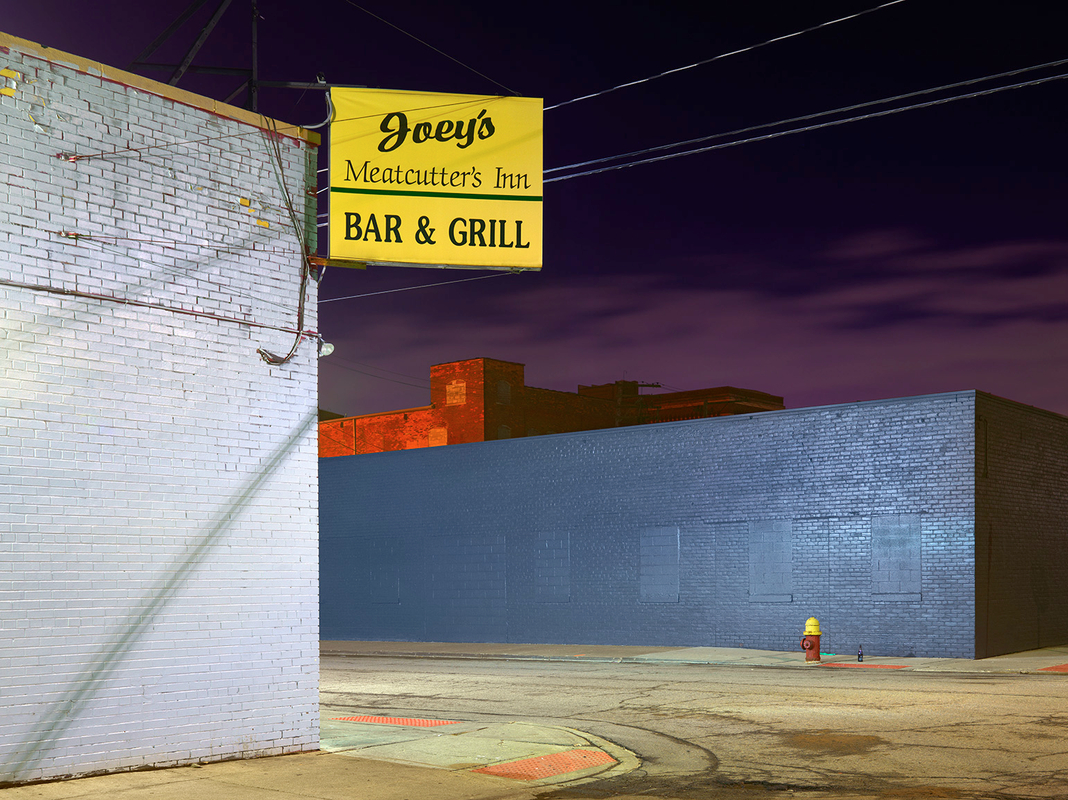
The lonely cityscape at night or the familiar glow of gas station lights cast into the American wilderness. The eye might want to linger among the colors, shapes and clouds even though the mind knows this is pretty much an empty street in a ‘post-industrial’ zone.
Hazy sun seen through a dirty, glass-ceilinged mezzanine.

Playing around with the old, mostly dead DSLR Nikon..


There’s a lot of backstory here, but hey, it’s an image.


Here’s my postmodern blurb (probably not preposterous enough):
‘The use of language and symbols is a potentially unique feature of human beings. Embedded within our perceptual apparatus are modes of engagement, in constant interface with the Natural World, informing our actions towards both knowable and unknowable (E)nds.’

Wishing a calm, peaceful Sunday to you and yours.

No composites. Just looking for the right light in the same place.

A little overexposed.

No composites. No cropping. Just a reflected passer-by and sunlit wall in the market.

Colors of a winter sunset a while back.

The colors are little interesting.

I’m not so much a street photographer, whatever that is exactly, but some businesses have resorted to private security.

Fire truck mirrors and a little bit of sky.

Pastoral
When I was younger
it was plain to me
I must make something of myself.
Older now
I walk back streets
admiring the houses
of the very poor:
roof out of line with sides
the yards cluttered
with old chicken wire, ashes,
furniture gone wrong;
the fences and outhouses
built of barrel staves
and parts of boxes, all,
if I am fortunate,
smeared a bluish green
that properly weathered
pleases me best of all colors.
No one
will believe this
of vast import to the nation
As posted, down in Ballard, by the docks. An early sketch that keeps me going…

A bit of a mood. About F22.

VIII
I know noble accents
And lucid, inescapable rhythms;
But I know, too,
That the blackbird is involved
In what I know.

You might not like the subject, nor the colors, nor the lack of people. The composition, though, for me, has some interesting elements.
Thanks for looking.


Trying out the new camera…

Looking for some leading lines and color.
To whom it may concern: The old DSLR Nikon 3100d starter camera took a tumble onto the pavement last week. It’s probably not salvageable given its age and the cost of repair.
I left the camera bag open, and while later snatching everything out of the back seat, out it fell to the ground. To those who know how sensitive and expensive camera equipment is, I feel your pain.
I’m likely moving to a used Nikon Z (mirrorless)with a 24-200mm lens soon.
Thanks for looking.


Pretty much a slight rotation 1 degree (updated: minor crop on the top) and that’s it. Waiting for the right light and clouds to get a decent shot through a lobby. Thanks for looking.

Trying to pick out some details…

Hey, it’s what I got when I get the time.

Some people like this kind of thing…

See some other photos here. Presented mostly without comment.
A reader points out: Yeah, I know his face is not in focus. I know. Come on, man. I’m working on it.
My rationalization: The textures of the blanket, and the bunching up of the blanket and his face towards the center of the frame, precariously and uncomfortably resting over an abyss, that’s what I was aiming at.
Do you believe that horses**t?

Ye Olde Coffee Shoppe.

Thirteen Ways Of Looking At A Blackbird here.
The images don’t necessarily stand on their own, so I hope this inspires folks to go and use their imaginations at the link.
II
I was of three minds,
Like a tree
In which there are three blackbirds.

XI
He rode over Connecticut
In a glass coach.
Once, a fear pierced him,
In that he mistook
The shadow of his equipage
For blackbirds.

You can probably tell who I was looking at last week…

For some reason, I’m drawn to these guys and whenever I get a chance, I try for a decent shot.

Thanks for looking.

A cormorant on the lake.

With the fog and the Nikon, it reminds me of a faded postcard.
Greetings from Seattle!

Hey, it’s what I got right now.


All in-camera. Just a mesh banner in front of a chain-link fence, in front of a tile wall.
Thanks for looking.


More of a publicity shot.

Potential advantages: Catching more genuine expressions.
Potential disadvantages: It’s tougher to focus and use available light in reflected surfaces manually (no pre-sets/settings).

Some people like this kind of thing…I’m not so sure who they are.

To see and be seen. To see yourself reflected in the eyes of others seeing you.

Trying to follow lines in the fog.


All in-camera. Just a sunset reflection in a curved yacht-window.

Addition: No, I don’t own a yacht. I don’t really know anyone who owns a yacht. I’m neither pro- nor anti- yacht ownership.
David Hockney ‘On Secret Knowledge: On Rediscovering The Lost Secrets Of The Old Masters’:
——————
Optical devices were likely common practice more than is commonly known these days, way before the camera, the television etc.
As previously posted:
Just as optics revolutionized the sciences and the boundaries of human knowledge, from Galileo to Newton and onwards, Tim Jenison wonders if optics may have revolutionized the arts as well.
‘But still, exactly how did Vermeer do it? One day, in the bathtub, Jenison had a eureka moment: a mirror. If the lens focused its image onto a small, angled mirror, and the mirror was placed just between the painter’s eye and the canvas, by glancing back and forth he could copy that bit of image until the color and tone precisely matched the reflected bit of reality.’
Good Vermeer page here for a refresher on the Dutch master.
Penn & Teller helped make a documentary which has gotten good reviews, entitled ‘Tim’s Vermeer.‘
Perhaps only the Girl With The Pearl Earring knows for sure if the painter used such a technique:
—————–
Interesting quotation from Quora, on Richard Feynman’s discussion of light in ‘QED: The Strange Theory Of Light And Matter’:
‘Mirrors and pools of water work pretty much the same way. Light interacts with electrons on the surface. Under the laws of quantum mechanics, each photon interacts with ALL of the electrons on the surface, and the net result is the sum of all possible pathways. If the surface is perfectly smooth, then most of the pathways cancel each other out, except for the one where the angle of incidence equals the angle of reflection. ‘
Click through for the illustrations to help explain Feynman’s theory, which fascinated me when I first came across it; much as I understand of it.
Have you ever seen sunlight reflecting off a body of water from a few thousand feet up in a plane? A rainbow in a puddle with some oil in it? A laser reflecting off a smooth surface like a mirror?
Related On This Site: In The Mail: Vivian Maier
Goya, that modern, had to make a living from the royal family: Goya’s Colossus…Goya’s Fight With Cudgels…Goethe’s Color Theory: Artists And Thinkers…NASA Composite Image Of The Earth At Night…Beauty?…Garrett Mattingly On Machiavelli-The Prince: Political Science Or Political Satire?

Looking for that red, blue and green.


A little over-saturation can make for more interesting faces.


Somewhere up in the clouds of Venus, there’s Phosphine [possibly]. So far, there’s no known naturally occurring reason for this, but that doesn’t mean there isn’t one. On Earth, when bacteria farts in our guts and in swamps, that’s when you get Phosphine. I’ll bet it smells nice.
Maybe in those clouds of sulfuric acid, racing above surface temperatures high-enough to melt lead, there’s some ammonia? Maybe this ammonia is neutralizing the cloud PH balance enough for some kind of bacteria to survive?
These are questions to which a little exploration can provide answers.
—
You know the moment you notice that the world has fallen away for awhile? You’re leisurely enjoying a photograph, or a painting, or a poem…
…and there’s a passage like this:
‘In the critical terminology of the time, Ghirri’s close-up photographs of the details of atlases and other maps question the link between signifier and signified, referring to a supposedly ‘natural’ environment that has long since become a simulacrum, and revealing the specific aesthetics harboured within ‘objective’ representation.’
The NIGHT of the BLURB! It’s postmodern, it’s (S)elf referential, it’s….alive. It’s dead. It’s…subjectivity and objectivity combined!
—
And now for a ‘modern’ poem.
The Snow Man
One must have a mind of winter
To regard the frost and the boughs
Of the pine-trees crusted with snow;
And have been cold a long time
To behold the junipers shagged with ice,
The spruces rough in the distant glitter
Of the January sun; and not to think
Of any misery in the sound of the wind,
In the sound of a few leaves,
Which is the sound of the land
Full of the same wind
That is blowing in the same bare place
For the listener, who listens in the snow,
And, nothing himself, beholds
Nothing that is not there and the nothing that is.
Going for that ‘painted-from-a-photograph’ look.

Did you hear they found Bob Chambers’ body washed-up by the hotel?

It’s an awful business…

