Having used every subterfuge To shake you, lies, fatigue, or even that of passion, Now I see no way but a clean break. I add that I am willing to bear the guilt.
You nod assent. Autumn turns windy, huge, A clear vase of dry leaves vibrating on and on. We sit, watching. When I next speak Love buries itself in me, up to the hilt.
A return to Nature? To origins of faith? To a simple freedom in a wild land, and new understandings, with death in view? To visions of Romantic Primitivism becoming modern?:
VII
Supple and turbulent, a ring of men Shall chant in orgy on a summer morn Their boisterous devotion to the sun, Not as a god, but as a god might be, Naked among them, like a savage source. Their chant shall be a chant of paradise, Out of their blood, returning to the sky; And in their chant shall enter, voice by voice, The windy lake wherein their lord delights, The trees, like serafin, and echoing hills, That choir among themselves long afterward. They shall know well the heavenly fellowship Of men that perish and of summer morn. And whence they came and whither they shall go The dew upon their feet shall manifest.
Ernst Haas-Western Skies Motel, Colorado, 1977. It’s a wonderful use of color, along with those clouds and that light. A mood is created, and not much extra visual information is provided.
Ernst Haas-There’s so much visual information, but is there? What is communicated through your eye and to your brain? Route 66 Albuquerque, New Mexico, 1969
—
As posted:
Via Mick Hartley, British photographer Mark Power’s Good Morning, America, vols. 1 (mostly Arkansas) & 2 (mostly across the South).
Power:
‘I keep a physical and metaphorical distance between myself and the subject. It’s a way of delineating my ‘foreignness’ and is a similar stance to the one I took while working in Poland making The Sound of Two Songs (2004-09). It’s comes very naturally to me; I’ve always felt I’m better at observing than participating, so to stand back and watch from afar suits me very well.’
I often find myself drawn to photos with some distance.
As posted:
Via Mick Hartley, Steve Fitch Photography has neon motel signs glowing into the Western night.
What’s more American than an exiled member of the Russian aristocracy intimately making his way into the English language and peering out from a thousand Motor Lodges?
“Nabokov in America” is rewarding on all counts, as biography, as photo album (there are many pictures of people, Western landscapes and motels) and as appreciative criticism. Not least, Roper even avoids the arch style so often adopted by critics faintly trying to emulate their inimitable subject.’
—
Well, there’s Donald Judd and Marfa, Texas, which looks interesting:
As previously posted, The Critic Laughs, by Hamilton:
Do you long for the days of unabashed American consumerism? Are you nostalgic for nights lit only by a soft, neon glow on the underbellies of clouds? Return to a time when America broadcast its brash, unironic call to the heavens.
But it can be empty, and lonely, and full of hard work and suffering:
Montana Pastoral
I am no shepherd of a child’s surmises. I have seen fear where the coiled serpent rises,
Thirst where the grasses burn in early May And thistle, mustard and the wild oat stay.
There is dust in this air. I saw in the heat Grasshoppers busy in the threshing wheat.
So to this hour. Through the warm dusk I drove To blizzards sifting on the hissing stove,
And found no images of pastoral will, But fear, thirst, hunger, and this huddled chill.
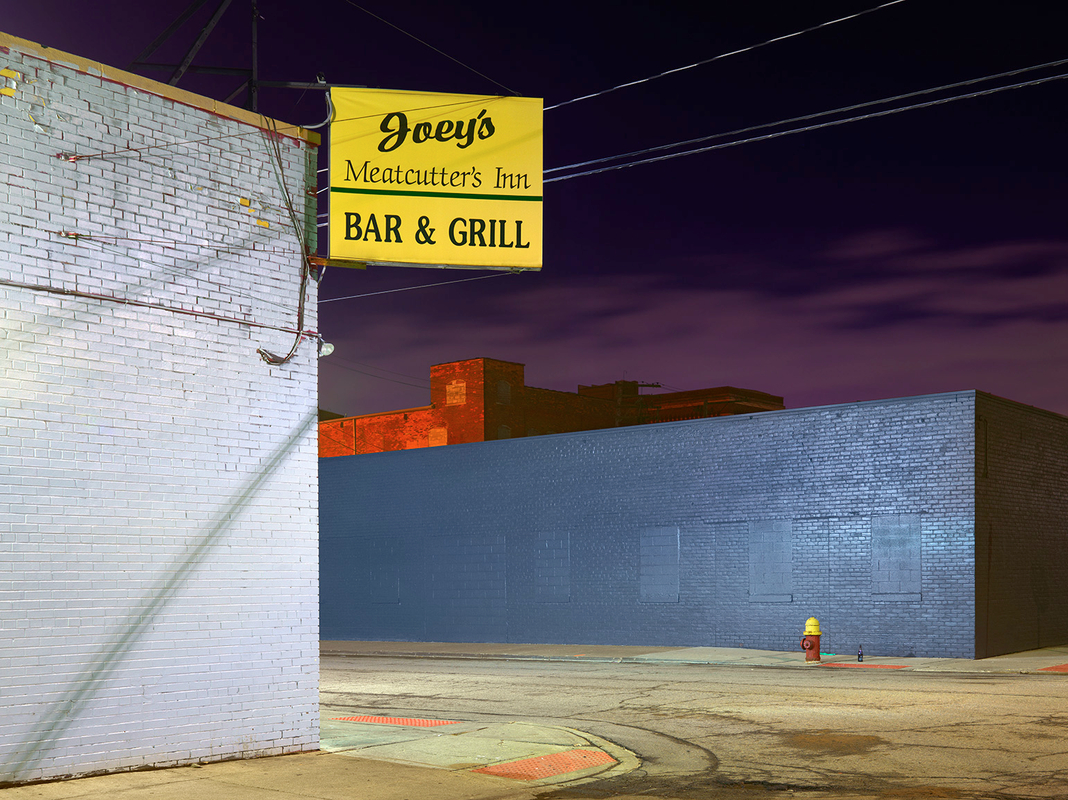
Immediately, I think of Edward Hopper: The lonely cityscape at night or the familiar glow of gas station lights cast into the American wilderness. The eye might want to linger among the colors, shapes and clouds even though the mind knows this is pretty much an empty street in a ‘post-industrial’ zone.
Perhaps it has do with another strand of expression: The break into free verse from past forms. The move from American Romanticism to Modernism which occurred this early past century. William Carlos Williams produced many good poems from a process of earnest, scrapbook-style intensity in trying to discover, redefine, and order a new poetic form within a modern ‘urban landscape.’
The individual artist is quite alone in the task he’s set before himself, and like much of modernism, it’s a rather big task.
Pastoral
When I was younger it was plain to me I must make something of myself. Older now I walk back streets admiring the houses of the very poor: roof out of line with sides the yards cluttered with old chicken wire, ashes, furniture gone wrong; the fences and outhouses built of barrel staves and parts of boxes, all, if I am fortunate, smeared a bluish green that properly weathered pleases me best of all colors.
No one will believe this of vast import to the nation
In June, amid the golden fields, I saw a groundhog lying dead. Dead lay he; my senses shook, And mind outshot our naked frailty. There lowly in the vigorous summer His form began its senseless change, And made my senses waver dim Seeing nature ferocious in him. Inspecting close his maggots’ might And seething cauldron of his being, Half with loathing, half with a strange love, I poked him with an angry stick. The fever arose, became a flame And Vigour circumscribed the skies, Immense energy in the sun, And through my frame a sunless trembling. My stick had done nor good nor harm. Then stood I silent in the day Watching the object, as before; And kept my reverence for knowledge Trying for control, to be still, To quell the passion of the blood; Until I had bent down on my knees Praying for joy in the sight of decay. And so I left; and I returned In Autumn strict of eye, to see The sap gone out of the groundhog, But the bony sodden hulk remained. But the year had lost its meaning, And in intellectual chains I lost both love and loathing, Mured up in the wall of wisdom. Another summer took the fields again Massive and burning, full of life, But when I chanced upon the spot There was only a little hair left, And bones bleaching in the sunlight Beautiful as architecture; I watched them like a geometer, And cut a walking stick from a birch. It has been three years, now. There is no sign of the groundhog. I stood there in the whirling summer, My hand capped a withered heart, And thought of China and of Greece, Of Alexander in his tent; Of Montaigne in his tower, Of Saint Theresa in her wild lament.
Andrew Wyeth homepage here with some images included.
There are definitely interesting things going on with light in Wyeth’s work. It fills his paintings. I also find my eye and mind hovering between realist depiction and abstract arrangement of objects on the canvas.
Ferguson:
‘Beneath the frequent prettiness, most of the pictures are just this side of harrowing, not just lonesome and melancholy but portraits of life as it seeps inevitably away. The wind that lifts the lace curtain in Wind from the Sea makes the hair on your arms stand up. Jamie Wyeth, Andrew’s son and a celebrated artist himself, confesses to being puzzled by the benign view of Wyeth’s work. “My father’s work is terrifying,” he said. It’s not sentimental. It’s luminous! But in a creepy way.’
Wyeth reached a level of popular appreciation few artists ever receive in their lifetimes.
Like many Americans, I find myself drawn to what I would call a New England plainness and Yankee work ethic and aesthetic, which is evident is some of Wyeth’s landscapes, at least. Long winters and deep woods. Shorter distances and stonier soil in the meadows. Perhaps a Puritan, high-minded spiritual reserve.
Or perhaps the Shaker work song ‘Simple Gifts’ adapted by Aaron Copland might be a good example of what I’m trying to get at.
————————————–
So, is this representative of Wyeth? Perhaps. He did much of his work in Chadds Ford, Pennsylvania and Maine, but according to Wikipedia there may be other influences as well:
‘N.C. also fostered an inner self-confidence to follow one’s own talents without thought of how the work is received. N.C. wrote in a letter to Wyeth in 1944:[8]
“The great men [ Thoreau, Goethe, Emerson, Tolstoy] forever radiate a sharp sense of that profound requirement of an artist, to fully understand that consequences of what he creates are unimportant. Let the motive for action be in the action itself and not in the event. I know from my own experience that when I create with any degree of strength and beauty I have no thought of consequences. Anyone who creates for effect — to score a hit — does not know what he is missing!”‘
So, I’m speculating. Addition: There’s also a strong modernist-influenced creative imagination at work here too, and like Hopper, the American question of what to do with all that space and wilderness.
Yet, a man able to walk familiar land, seeing it anew with keen eyes, hoping his senses pick up more than he knows, having a medium with which to express his thoughts seems a man who’s had some success in life, regardless of popular appreciation.
Of course, a concupiscent eye must come into tension with other parts of a man’s character.
Or at least when there was a tittering about his ‘Helga‘ paintings a while back.
Ferguson:
‘Stopping to rest near a group of European spring beauties, he saw on a trail above him a young woman on a walk. Assuming she was alone, she moved off the trail, lifted her skirt, and defecated in the grass. Wyeth was charmed. “The white curve of her bottom was amazing,” he told Meryman. The little lumps she left tumbled downhill and stopped in the patch of spring beauties.’
Well, there you go, America.
A discussion of ‘Christina’s World,’ a well-known work of his does more justice than this brief post.
It always comes, and when it comes they know. To will it is enough to bring them there. The knack is this, to fasten and not let go.
Their limbs are charmed; they cannot stay or go. Desire is limbo: they’re unhappy there. It always comes, and when it comes they know.
Their choice of hells would be the one they know. Dante describes it, the wind circling there. The knack is this, to fasten and not let go.
The wind carries them where they want to go. Yet it seems cruel to strangers passing there. It always comes, and when it comes they know The knack is this, to fasten and not let go.
Twirling your blue skirts, travelling the sward Under the towers of your seminary, Go listen to your teachers old and contrary Without believing a word.
Tie the white fillets then about your hair And think no more of what will come to pass Than bluebirds that go walking on the grass And chattering on the air.
Practice your beauty, blue girls, before it fail; And I will cry with my loud lips and publish Beauty which all our power shall never establish, It is so frail.
For I could tell you a story which is true; I know a woman with a terrible tongue, Blear eyes fallen from blue, All her perfections tarnished — yet it is not long Since she was lovelier than any of you.
Sundays too my father got up early and put his clothes on in the blueblack cold, then with cracked hands that ached from labor in the weekday weather made banked fires blaze. No one ever thanked him.
I’d wake and hear the cold splintering, breaking. When the rooms were warm, he’d call, and slowly I would rise and dress, fearing the chronic angers of that house,
speaking indifferently to him, who had driven out the cold and polished my good shoes as well. What did I know, what did I know of love’s austere and lonely offices?
‘The most useful definition of modernist fiction I’ve encountered comes from Brian McHale’s Postmodernist Fiction. He says modernist fiction tends to “foreground epistemological questions” such as “How can I interpret the world I’m part of? What is there to be known? Who knows it? What are the limits of that knowledge?” In contrast, postmodernist fiction tends to “foreground ontological questions” such as “What is a world? What kinds of worlds are there and how are they constituted? What happens when…boundaries between worlds are violated?’
As to the epistemological questions surrounding Modernism, below are four poems. Hopefully, each is a representative example of a move away from the Romanticism that had been prevalent up until the late 1800’s.
In addition to the move away from traditional Romantic rhyme and meter towards modern blank verse, there’s also a certain conception of the Self rendered in them; a presentation of our natures that might be worth examining in some detail.
I believe we can see clearly a move away from tradition towards the Self, the Poet isolated, the poem itself as a means of communication, and an anxiety so common within the 20th century.
‘At the heart of Bloom’s project is the ancient quarrel between “poetry” and “philosophy.” In Bloom’s opinion, we ought not have to choose between Homer and Plato; we can have both, as long as we recognize that poetry is superior.’
Says the guy who writes about poetry…
What does one find within, as one looks without, waking from sleep and dream?
What kind of world is this, and can the poet actually help us know it?
You tossed a blanket from the bed You lay upon your back, and waited; You dozed, and watched the night revealing The thousand sordid images Of which your soul was constituted; They flickered against the ceiling. And when all the world came back And the light crept up between the shutters And you heard the sparrows in the gutters, You had such a vision of the street As the street hardly understands; Sitting along the bed’s edge, where You curled the papers from your hair, Or clasped the yellow soles of feet In the palms of both soiled hands.
—
The world will stain you, and it is a fallen, modern world, rendered profoundly and exquisitely.
As consciousness creeps in, building a bridge to the day, to the world, to the facts left as though they were the first facts, the light as though it were the first light, what one finds is distressing, both within and without.
That distress must be ‘made new,’ which is to say, the suffering (original?) in which we all sometimes find ourselves must match our experiences within the modern city and world, at least, the world created within Eliot’s lyrical verse.
Of the four poems, only the first and last have a 3rd-person subject.
—
Wallace Stevens‘ ‘I’ is in a more contemplative state, but it’s an ‘I’ exploring similar themes, and experiencing some distress in trying to know how the world actually is, and what might lie within.
The journey to The Self may not be a journey for the faint of heart.
The Poems Of Our Climate (stanzas II and III)
II Say even that this complete simplicity Stripped one of all one’s torments, concealed The evilly compounded, vital I And made it fresh in a world of white, A world of clear water, brilliant-edged, Still one would want more, one would need more, More than a world of white and snowy scents.
III There would still remain the never-resting mind, So that one would want to escape, come back To what had been so long composed. The imperfect is our paradise. Note that, in this bitterness, delight, Since the imperfect is so hot in us, Lies in flawed words and stubborn sounds.
—
Even if the verse can describe a perfected world, delivering us, perhaps, a little closer to perfection, our poet is still not free from the impulses and desires which simply never cease.
Interestingly, we end-up not with a discussion of the heart, the spirit, libido etc. as a source for those desires (for Plato, the irrational), but rather, for Stevens, just a mind.
We also find more Romantic elements of language and an almost baroque/rococo arrangement of words and ideas, dandyish even, yet combined with an intense effort to abstract, define, and clarify. From here, the poet may proceed on his task of flawed words and stubborn sounds.
***I find myself thinking of elements of modern architecture and abstract-expressionist painting. The meaning, or at least some delivery from our restless existences, can be found within the abstract itself. Or at least within a retreat to the abstract for its own sake, away from the world.
The modernist, glass-walled house on the hill will exist in its own space, offering and defying meaning. The structure’s own shapes will be stripped down to often mathematically precise forms interacting with Nature. These shall guide Man, or at least offer individual men a little refuge.
It is perhaps in Stevens’ poem we can see the questions of knowledge about the world suggesting questions about whether there is a world at all, or, at least, what kind of worlds each Self might be able to inhabit.
—
Here’s one of Robert Lowell’s poems, occurring a generation later, in the mid 20th-century, as part of the confessionals.
The Self is extremely isolated. In fact, Lowell went more than a little crazy. Unlike the known nervous breakdown of Eliot from which Eliot recovered, Lowell’s life was essentially one long breakdown from which he never recovered.
Here he is, looking back:
Epilogue
Those blessed structures plot and rhyme- why are they no help to me now i want to make something imagined not recalled? I hear the noise of my own voice: The painter’s vision is not a lens it trembles to caress the light. But sometimes everything i write With the threadbare art of my eye seems a snapshot lurid rapid garish grouped heightened from life yet paralyzed by fact. All’s misalliance. Yet why not say what happened? Pray for the grace of accuracy Vermeer gave to the sun’s illumination stealing like the tide across a map to his girl solid with yearning. We are poor passing facts. warned by that to give each figure in the photograph his living name.
—
The weight of having to make that meaning, for yourself, and by yourself, is a horrible weight indeed. One can glorify one’s Self and family, but that, alas, only goes so far. Rhyme and form still carry one’s living name, as far as they do.
Of course, there’s still wonderful rhythm and form here (this is excellent verse), but blanker now, with a relentless focus on the ‘I.’ The poet is perhaps talking a little more to himself, and the poem keeps self-consciously calling attention to itself.
—
In fact, it reminded me of the poem below, by Robert Creeley, which was published a few years afterwards.
From this page:
‘Creeley was a leader in the generational shift that veered away from history and tradition as primary poetic sources and gave new prominence to the ongoing experiences of an individual’s life. Because of this emphasis, the major events of his life loom large in his literary work.’
There’s Nothing but the Self and the Eye seeking and making meaning, by itself within a void of emotionally compact and precise language (of course there’s still form and other things besides).
Can the poet fit inside the little abstract chapel of words he’s building for himself (let alone the world, tradition etc.)?
For all the talk about ‘space,’ there seems very little.
The Window
Position is where you put it, where it is, did you, for example, that
large tank there, silvered, with the white church along- side, lift
all that, to what purpose? How heavy the slow
world is with everything put in place. Some
man walks by, a car beside him on the dropped
road, a leaf of yellow color is going to
fall. It all drops into place. My
face is heavy with the sight. I can feel my eye breaking.
—
The distress is still there…but I’d argue that we are now a good distance away from the grandness of Eliot’s vision, his religiosity and virtuosity with form and meter at the dawn of Modernism. Very few people can/could do what Eliot did (addition: even if he can help us gain knowledge of our Selves or the world).
That said, it’s unclear there’s enough tradition and confidence to even undertake such a project, now, even as such talents come along. The state of things is more scattered. We’re in a very different place of selves and artists isolated, of anxiety and post-anxiety.
Aside from the very accomplished poets above, in terms of both knowledge (epistemology) and being (ontology), we often have writers feeling pressure to weigh-in on such questions without even being about to write that well; artists who can’t draw or paint that well, and frankly, quite a bit of bullshit besides.
So, where are we headed? Who’s ‘we’ exactly?
Predictions are hard, especially about the future.
As previously posted:
Why not just put a few algorithms to work in writing those artist statements?
‘In “Sea Change,” Graham becomes Prospero, casting spells by spelling out her thoughts to merge with ours, and with the voices of the elements. The result is a mingling of perceptions rather than a broadcasting of opinions. Instead of analysis, the poems encourage emotional involvement with the drastic changes overwhelming us, overwhelm- ing the planet.’
and:
‘Strengths and weaknesses, flows and ebbs, yet every poem in “Sea Change” bears memorable lines, with almost haunting (if we truly have but 10 years to “fix” global warming) images of flora and fauna under siege. Jorie Graham has composed a swan song for Earth.’
Oh boy.
What are these poems being asked to do?
And moving away from poetry into the realm of ‘performance art,’
What do they think has happened, the old fools, To make them like this? Do they somehow suppose It’s more grown-up when your mouth hangs open and drools, And you keep on pissing yourself, and can’t remember Who called this morning? Or that, if they only chose, They could alter things back to when they danced all night, Or went to their wedding, or sloped arms some September? Or do they fancy there’s really been no change, And they’ve always behaved as if they were crippled or tight, Or sat through days of thin continuous dreaming Watching the light move? If they don’t (and they can’t), it’s strange; Why aren’t they screaming?
At death you break up: the bits that were you Start speeding away from each other for ever With no one to see. It’s only oblivion, true: We had it before, but then it was going to end, And was all the time merging with a unique endeavour To bring to bloom the million-petalled flower Of being here. Next time you can’t pretend There’ll be anything else. And these are the first signs: Not knowing how, not hearing who, the power Of choosing gone. Their looks show that they’re for it: Ash hair, toad hands, prune face dried into lines – How can they ignore it?
Perhaps being old is having lighted rooms Inside your head, and people in them, acting People you know, yet can’t quite name; each looms Like a deep loss restored, from known doors turning, Setting down a lamp, smiling from a stair, extracting A known book from the shelves; or sometimes only The rooms themselves, chairs and a fire burning, The blown bush at the window, or the sun’s Faint friendliness on the wall some lonely Rain-ceased midsummer evening. That is where they live: Not here and now, but where all happened once. This is why they give
An air of baffled absence, trying to be there Yet being here. For the rooms grow farther, leaving Incompetent cold, the constant wear and tear Of taken breath, and them crouching below Extinction’s alp, the old fools, never perceiving How near it is. This must be what keeps them quiet: The peak that stays in view wherever we go For them is rising ground. Can they never tell What is dragging them back, and how it will end? Not at night? Not when the strangers come? Never, throughout The whole hideous inverted childhood? Well, We shall find out.
There is a gold light in certain old paintings That represents a diffusion of sunlight. It is like happiness, when we are happy. It comes from everywhere and from nowhere at once, this light, And the poor soldiers sprawled at the foot of the cross Share in its charity equally with the cross.
Orpheus hesitated beside the black river. With so much to look forward to he looked back. We think he sang then, but the song is lost. At least he had seen once more the beloved back. I say the song went this way: O prolong Now the sorrow if that is all there is to prolong.
The world is very dusty, uncle. Let us work. One day the sickness shall pass from the earth for good. The orchard will bloom; someone will play the guitar. Our work will be seen as strong and clean and good. And all that we suffered through having existed Shall be forgotten as though it had never existed.
“In prosperity a man often destroys the good he has done; amidst difficulties he often repairs what he long since did in the way of wickedness.” pic.twitter.com/OkhQTpe0D8
HEAR the sledges with the bells — Silver bells ! What a world of merriment their melody foretells ! How they tinkle, tinkle, tinkle, In the icy air of night ! While the stars that oversprinkle All the heavens, seem to twinkle With a crystalline delight ; Keeping time, time, time, In a sort of Runic rhyme, To the tintinnabulation that so musically wells From the bells, bells, bells, bells, Bells, bells, bells — From the jingling and the tinkling of the bells.
Time and the weather wear away The houses that our fathers built. A ghostly furniture remains: All the sad sofas we have stained With tears of boredom and of guilt,
The fraying mottoes, the stopped clocks… And still sometimes those monstrous shapes Haunt the damp parlors of the heart. What Sunday prisons they recall! And what miraculous escapes!
The blue booby lives on the bare rocks of Galapagos and fears nothing. It is a simple life: they live on fish, and there are few predators. Also, the males do not make fools of themselves chasing after the young ladies. Rather, they gather the blue objects of the world and construct from them a nest—an occasional Gaulois package, a string of beads, a piece of cloth from a sailor’s suit. This replaces the need for dazzling plumage; in fact, in the past fifty million years the male has grown considerably duller, nor can he sing well. The female, though,
asks little of him— the blue satisfies her completely, has a magical effect on her. When she returns from her day of gossip and shopping, she sees he has found her a new shred of blue foil: for this she rewards him with her dark body, the stars turn slowly in the blue foil beside them like the eyes of a mild savior.
And let’s not forget one of the masters (as though putting such words here imbues this blog with the same stuff):
But, soft! what light through yonder window breaks? It is the east, and Juliet is the sun. Arise, fair sun, and kill the envious moon, Who is already sick and pale with grief, That thou her maid art far more fair than she: Be not her maid, since she is envious; Her vestal livery is but sick and green And none but fools do wear it; cast it off. It is my lady, O, it is my love! O, that she knew she were! She speaks yet she says nothing: what of that? Her eye discourses; I will answer it. I am too bold, ’tis not to me she speaks: Two of the fairest stars in all the heaven, Having some business, do entreat her eyes To twinkle in their spheres till they return. What if her eyes were there, they in her head? The brightness of her cheek would shame those stars, As daylight doth a lamp; her eyes in heaven Would through the airy region stream so bright That birds would sing and think it were not night. See, how she leans her cheek upon her hand! O, that I were a glove upon that hand, That I might touch that cheek!
I have come to a still, but not a deep center, A point outside the glittering current; My eyes stare at the bottom of a river, At the irregular stones, iridescent sandgrains, My mind moves in more than one place, In a country half-land, half-water. I am renewed by death, thought of my death, The dry scent of a dying garden in September, The wind fanning the ash of a low fire. What I love is near at hand, Always, in earth and air.
That time of year thou mayst in me behold When yellow leaves, or none, or few, do hang Upon those boughs which shake against the cold, Bare ruined choirs, where late the sweet birds sang. In me thou see’st the twilight of such day As after sunset fadeth in the west; Which by and by black night doth take away, Death’s second self, that seals up all in rest. In me thou see’st the glowing of such fire, That on the ashes of his youth doth lie, As the deathbed whereon it must expire, Consumed with that which it was nourished by. This thou perceiv’st, which makes thy love more strong, To love that well which thou must leave ere long.
Last night watching the Pleiades, Breath smoking in the moonlight, Bitter memory like vomit Choked my throat. I unrolled a sleeping bag On mats on the porch Under thick autumn stars. In dream you appeared (Three times in nine years) Wild, cold, and accusing. I woke shamed and angry: The pointless wars of the heart. Almost dawn. Venus and Jupiter. The first time I have Ever seen them close.
The thistledown’s flying, though the winds are all still, On the green grass now lying, now mounting the hill, The spring from the fountain now boils like a pot; Through stones past the counting it bubbles red-hot.
The ground parched and cracked is like overbaked bread, The greensward all wracked is, bents dried up and dead. The fallow fields glitter like water indeed, And gossamers twitter, flung from weed unto weed.
Hill-tops like hot iron glitter bright in the sun, And the rivers we’re eying burn to gold as they run; Burning hot is the ground, liquid gold is the air; Whoever looks round sees Eternity there.
The trees are in their autumn beauty, The woodland paths are dry, Under the October twilight the water Mirrors a still sky; Upon the brimming water among the stones Are nine-and-fifty swans.
The nineteenth autumn has come upon me Since I first made my count; I saw, before I had well finished, All suddenly mount And scatter wheeling in great broken rings Upon their clamorous wings.
I have looked upon those brilliant creatures, And now my heart is sore. All’s changed since I, hearing at twilight, The first time on this shore, The bell-beat of their wings above my head, Trod with a lighter tread.
Unwearied still, lover by lover, They paddle in the cold Companionable streams or climb the air; Their hearts have not grown old; Passion or conquest, wander where they will, Attend upon them still.
But now they drift on the still water, Mysterious, beautiful; Among what rushes will they build, By what lake’s edge or pool Delight men’s eyes when I awake some day To find they have flown away?
I can imagine someone who found these fields unbearable, who climbed the hillside in the heat, cursing the dust, cracking the brittle weeds underfoot, wishing a few more trees for shade.
An Easterner especially, who would scorn the meagerness of summer, the dry twisted shapes of black elm, scrub oak, and chaparral, a landscape August has already drained of green.
One who would hurry over the clinging thistle, foxtail, golden poppy, knowing everything was just a weed, unable to conceive that these trees and sparse brown bushes were alive.
And hate the bright stillness of the noon without wind, without motion, the only other living thing a hawk, hungry for prey, suspended in the blinding, sunlit blue.
And yet how gentle it seems to someone raised in a landscape short of rain— the skyline of a hill broken by no more trees than one can count, the grass, the empty sky, the wish for water.
Facing west, from California’s shores,
Inquiring, tireless, seeking what is yet unfound,
I, a child, very old, over waves, towards the house of maternity, the land of migrations, look afar,
Look off the shores of my Western Sea—the circle almost circled;
For, starting westward from Hindustan, from the vales of Kashmere,
From Asia—from the north—from the God, the sage, and the hero,
From the south—from the flowery peninsulas, and the spice islands;
Long having wander’d since—round the earth having wander’d,
Now I face home again—very pleas’d and joyous;
(But where is what I started for, so long ago? And why it is yet unfound?)
Men at forty
Learn to close softly
The doors to rooms they will not be
Coming back to.
At rest on a stair landing,
They feel it moving
Beneath them now like the deck of a ship,
Though the swell is gentle.
And deep in mirrors
They rediscover
The face of the boy as he practices tying
His father’s tie there in secret
And the face of the father,
Still warm with the mystery of lather.
They are more fathers than sons themselves now.
Something is filling them, something
That is like the twilight sound
Of the crickets, immense,
Filling the woods at the foot of the slope
Behind their mortgaged houses.
It is the word pejorative that hurts. My old boat goes round on a crutch And doesn’t get under way. It’s the time of the year And the time of the day.
Perhaps it’s the lunch that we had Or the lunch that we should have had. But I am, in any case, A most inappropriate man In a most unpropitious place.
Mon Dieu, hear the poet’s prayer. The romantic should be here. The romantic should be there. It ought to be everywhere. But the romantic must never remain,
Mon Dieu, and must never again return. This heavy historical sail Through the mustiest blue of the lake In a really vertiginous boat Is wholly the vapidest fake. . . .
It is least what one ever sees. It is only the way one feels, to say Where my spirit is I am, To say the light wind worries the sail, To say the water is swift today,
To expunge all people and be a pupil Of the gorgeous wheel and so to give That slight transcendence to the dirty sail, By light, the way one feels, sharp white, And then rush brightly through the summer air.
***Wallace Stevens is often going meta and abstract, confusing nearly all readers, while indulging heavily in a lush Romantic style which later transitions to more blank verse modernism. He’s sailing and he’s writing. He’s charting new waters, the old dandy.
The warping night air having brought the boom Of an owl’s voice into her darkened room, We tell the wakened child that all she heard Was an odd question from a forest bird, Asking of us, if rightly listened to, “Who cooks for you?” and then “Who cooks for you?”
Words, which can make our terrors bravely clear, Can also thus domesticate a fear, And send a small child back to sleep at night Not listening for the sound of stealthy flight Or dreaming of some small thing in a claw Borne up to some dark branch and eaten raw.
On that note, Land Art is often about removing the monetary value, commodification and fungibility of a piece of art and making something big enough, weird enough, useless enough; maybe making a beautiful/ugly enough imitation of Nature or man’s design within Nature.
Here’s Wikipedia, keeping it simpler:
‘Land art, earthworks (coined by Robert Smithson), or Earth art is an art movement in which landscape and the work of art are inextricably linked.’
Sometimes, maybe, it doesn’t really inspire the imagination:
Or maybe it’s a little gimmicky, as I imagine ‘Christo’ revealing his work with a magician’s flourish of the hand.
‘Essential’ art?:
Moving along, a reader links to W.S. Merwin’s ‘Tergvinder’s Stone,’ where you get some weird metaphysical notions of space/non-space, subjectivity/objectivity going on.
Abstract Modernism? Mid-Century Modernism? Relentlessly rhythmic, ambitious and (P)rophetic pieces looking to reshape not Nature, but how readers should think about Nature?
(addition: Plymouth Rock? Uh-oh…what is the poem being asked to do? What about the reader?):
‘One time my friend Tergvinder brought a large round boulder into his living room. He rolled it up the steps with the help of some two-by-fours, and when he got it out into the middle of the room, where some people have coffee tables (though he had never had one there himself) he left it. He said that was where it belonged.
It is really a plain-looking stone. Not as large as Plymouth Rock by a great deal, but then it does not have all the claims of a big shaky promotion campaign to support. That was one of the things Tergvinder said about it. He made no claims at all for it, he said. It was other people who called it Tergvinder’s Stone. All he said was that according to him it belonged there.’
Click through for a Serra-released photo of four metal pillar-forms aligned in the deserts of Qatar, designed to inevitably rust. The piece has a slight ‘2001: A Space Odyssey‘ feel, but that could just be me.
‘The Qatar Museums Authority is estimated to spend about a billion dollars per year on art. At its head is the young Sheikha al-Mayassa Hamad bin Khalifa al-Thani, a sister of the Emir of Qatar and a Duke University graduate, who was recently named the most powerful person in the art world by ArtReview.’
Get while the getting is good, so long as the Sheiks have the dough.
Here’s Serra discussing a piece of his at 21 West Gagosian, or a densely-packed, carefully measured series of metal forms in a room. What does the viewer experience in this space?:
The sea is calm to-night.
The tide is full, the moon lies fair
Upon the straits; on the French coast the light
Gleams and is gone; the cliffs of England stand;
Glimmering and vast, out in the tranquil bay.
Come to the window, sweet is the night-air!
Only, from the long line of spray
Where the sea meets the moon-blanched land,
Listen! you hear the grating roar
Of pebbles which the waves draw back, and fling,
At their return, up the high strand,
Begin, and cease, and then again begin,
With tremulous cadence slow, and bring
The eternal note of sadness in.
Sophocles long ago
Heard it on the Agaean, and it brought
Into his mind the turbid ebb and flow
Of human misery; we
Find also in the sound a thought,
Hearing it by this distant northern sea.
The Sea of Faith
Was once, too, at the full, and round earth’s shore
Lay like the folds of a bright girdle furled.
But now I only hear
Its melancholy, long, withdrawing roar,
Retreating, to the breath
Of the night-wind, down the vast edges drear
And naked shingles of the world.
Ah, love, let us be true
To one another! for the world, which seems
To lie before us like a land of dreams,
So various, so beautiful, so new,
Hath really neither joy, nor love, nor light,
Nor certitude, nor peace, nor help for pain;
And we are here as on a darkling plain
Swept with confused alarms of struggle and flight,
Where ignorant armies clash by night.
In June, amid the golden fields, I saw a groundhog lying dead. Dead lay he; my senses shook, And mind outshot our naked frailty. There lowly in the vigorous summer His form began its senseless change, And made my senses waver dim Seeing nature ferocious in him. Inspecting close his maggots’ might And seething cauldron of his being, Half with loathing, half with a strange love, I poked him with an angry stick. The fever arose, became a flame And Vigour circumscribed the skies, Immense energy in the sun, And through my frame a sunless trembling. My stick had done nor good nor harm. Then stood I silent in the day Watching the object, as before; And kept my reverence for knowledge Trying for control, to be still, To quell the passion of the blood; Until I had bent down on my knees Praying for joy in the sight of decay. And so I left; and I returned In Autumn strict of eye, to see The sap gone out of the groundhog, But the bony sodden hulk remained. But the year had lost its meaning, And in intellectual chains I lost both love and loathing, Mured up in the wall of wisdom. Another summer took the fields again Massive and burning, full of life, But when I chanced upon the spot There was only a little hair left, And bones bleaching in the sunlight Beautiful as architecture; I watched them like a geometer, And cut a walking stick from a birch. It has been three years, now. There is no sign of the groundhog. I stood there in the whirling summer, My hand capped a withered heart, And thought of China and of Greece, Of Alexander in his tent; Of Montaigne in his tower, Of Saint Theresa in her wild lament.
This is the poem that came to mind, even though Gary Snyder wrote from here instead, where apparently he would be for 60 days at a time:
Mid-August at Sourdough Mountain Lookout
Down valley a smoke haze
Three days heat, after five days rain
Pitch glows on the fir-cones
Across rocks and meadows
Swarms of new flies.
I cannot remember things I once read
A few friends, but they are in cities.
Drinking cold snow-water from a tin cup
Looking down for miles
Through high still air.
By June our brook’s run out of song and speed. Sought for much after that, it will be found Either to have gone groping underground (And taken with it all the Hyla breed That shouted in the mist a month ago, Like ghost of sleigh bells in a ghost of snow)— Or flourished and come up in jewelweed, Weak foliage that is blown upon and bent, Even against the way its waters went. Its bed is left a faded paper sheet Of dead leaves stuck together by the heat— A brook to none but who remember long. This as it will be seen is other far Than with brooks taken otherwhere in song. We love the things we love for what they are.
So much of our lives dissolves. What did I do the day before I met you? You remember what I was wearing that holiday. What did I wear the next morning? What did I write the day my mother died?
I fly at night over the plains. There is a cluster of lights, a starfish shape glittering. Then darkness and darkness. Then another clump bearing long daisy petals of roadway.
Then nothing again. How much of my living has fled like water into sand. The sand is not even damp to the hand. Tears and wine and sparkling water all vanish the same.
I know looking out the plane’s dirty window that there are houses, barns, roads, trees, stores distinct in that darkness I once drove through. I knew them and will never know them again.
The plane is flying from lighted place to lighted place, but our arc is from the dark into brightness then back into darkness. I want to possess my own life like a necklace, pearl by pearl of light.
I Clear water in a brilliant bowl, Pink and white carnations. The light In the room more like a snowy air, Reflecting snow. A newly-fallen snow At the end of winter when afternoons return. Pink and white carnations – one desires So much more than that. The day itself Is simplified: a bowl of white, Cold, a cold porcelain, low and round, With nothing more than the carnations there.
II Say even that this complete simplicity Stripped one of all one’s torments, concealed The evilly compounded, vital I And made it fresh in a world of white, A world of clear water, brilliant-edged, Still one would want more, one would need more, More than a world of white and snowy scents.
III There would still remain the never-resting mind, So that one would want to escape, come back To what had been so long composed. The imperfect is our paradise. Note that, in this bitterness, delight, Since the imperfect is so hot in us, Lies in flawed words and stubborn sounds.
By the road to the contagious hospital under the surge of the blue mottled clouds driven from the northeast-a cold wind. Beyond, the waste of broad, muddy fields brown with dried weeds, standing and fallen
patches of standing water the scattering of tall trees
All along the road the reddish purplish, forked, upstanding, twiggy stuff of bushes and small trees with dead, brown leaves under them leafless vines-
Lifeless in appearance, sluggish dazed spring approaches-
They enter the new world naked, cold, uncertain of all save that they enter. All about them the cold, familiar wind-
Now the grass, tomorrow the stiff curl of wildcarrot leaf One by one objects are defined- It quickens: clarity, outline of leaf
But now the stark dignity of entrance-Still, the profound change has come upon them: rooted, they grip down and begin to awaken
Nothing is so beautiful as spring—
When weeds, in wheels, shoot long and lovely and lush;
Thrush’s eggs look little low heavens, and thrush
Through the echoing timber does so rinse and wring
The ear, it strikes like lightnings to hear him sing;
The glassy peartree leaves and blooms, they brush
The descending blue; that blue is all in a rush
With richness; the racing lambs too have fair their fling.
What is all this juice and all this joy?
A strain of the earth’s sweet being in the beginning
In Eden garden.—Have, get, before it cloy,
Before it cloud, Christ, lord, and sour with sinning,
Innocent mind and Mayday in girl and boy,
Most, O maid’s child, thy choice and worthy the winning.
‘The most useful definition of modernist fiction I’ve encountered comes from Brian McHale’s Postmodernist Fiction. He says modernist fiction tends to “foreground epistemological questions” such as “How can I interpret the world I’m part of? What is there to be known? Who knows it? What are the limits of that knowledge?” In contrast, postmodernist fiction tends to “foreground ontological questions” such as “What is a world? What kinds of worlds are there and how are they constituted? What happens when…boundaries between worlds are violated?’
As to the epistemological questions surrounding Modernism, below are four poems. Hopefully, each is a representative example of a move away from the Romanticism that had been prevalent up until the late 1800’s.
In addition to the move away from traditional Romantic rhyme and meter towards modern blank verse, there’s also a certain conception of the Self rendered in them; a presentation of our natures that might be worth examining in some detail.
I believe we can see clearly a move away from tradition towards the Self, the Poet isolated, the poem itself as a means of communication, and an anxiety so common within the 20th century.
‘At the heart of Bloom’s project is the ancient quarrel between “poetry” and “philosophy.” In Bloom’s opinion, we ought not have to choose between Homer and Plato; we can have both, as long as we recognize that poetry is superior.’
Says the guy who writes about poetry…
What does one find within, as one looks without, waking from sleep and dream?
What kind of world is this, and can the poet actually help us know it?
You tossed a blanket from the bed
You lay upon your back, and waited;
You dozed, and watched the night revealing
The thousand sordid images
Of which your soul was constituted;
They flickered against the ceiling.
And when all the world came back
And the light crept up between the shutters
And you heard the sparrows in the gutters,
You had such a vision of the street
As the street hardly understands;
Sitting along the bed’s edge, where
You curled the papers from your hair,
Or clasped the yellow soles of feet
In the palms of both soiled hands.
—
The world will stain you, and it is a fallen, modern world, rendered profoundly and exquisitely.
As consciousness creeps in, building a bridge to the day, to the world, to the facts left as though they were the first facts, the light as though it were the first light, what one finds is distressing, both within and without.
That distress must be ‘made new,’ which is to say, the suffering (original?) in which we all sometimes find ourselves must match our experiences within the modern city and world, at least, the world created within Eliot’s lyrical verse.
Of the four poems, only the first and last have a 3rd-person subject.
—
Wallace Stevens‘ ‘I’ is in a more contemplative state, but it’s an ‘I’ exploring similar themes, and experiencing some distress in trying to know how the world actually is, and what might lie within.
The journey to The Self may not be a journey for the faint of heart.
The Poems Of Our Climate (stanzas II and III)
II Say even that this complete simplicity Stripped one of all one’s torments, concealed The evilly compounded, vital I And made it fresh in a world of white, A world of clear water, brilliant-edged, Still one would want more, one would need more, More than a world of white and snowy scents.
III There would still remain the never-resting mind, So that one would want to escape, come back To what had been so long composed. The imperfect is our paradise. Note that, in this bitterness, delight, Since the imperfect is so hot in us, Lies in flawed words and stubborn sounds.
—
Even if the verse can describe a perfected world, delivering us, perhaps, a little closer to perfection, our poet is still not free from the impulses and desires which simply never cease.
Interestingly, we end-up not with a discussion of the heart, the spirit, libido etc. as a source for those desires (for Plato, the irrational), but rather, for Stevens, just a mind.
We also find more Romantic elements of language and an almost baroque/rococo arrangement of words and ideas, dandyish even, yet combined with an intense effort to abstract, define, and clarify. From here, the poet may proceed on his task of flawed words and stubborn sounds.
***I find myself thinking of elements of modern architecture and abstract-expressionist painting. The meaning, or at least some delivery from our restless existences, can be found within the abstract itself. Or at least within a retreat to the abstract for its own sake, away from the world.
The modernist, glass-walled house on the hill will exist in its own space, offering and defying meaning. The structure’s own shapes will be stripped down to often mathematically precise forms interacting with Nature. These shall guide Man, or at least offer individual men a little refuge.
It is perhaps in Stevens’ poem we can see the questions of knowledge about the world suggesting questions about whether there is a world at all, or, at least, what kind of worlds each Self might be able to inhabit.
—
Here’s one of Robert Lowell’s poems, occurring a generation later, in the mid 20th-century, as part of the confessionals.
The Self is extremely isolated. In fact, Lowell went more than a little crazy. Unlike the known nervous breakdown of Eliot from which Eliot recovered, Lowell’s life was essentially one long breakdown from which he never recovered.
Here he is, looking back:
Epilogue
Those blessed structures plot and rhyme- why are they no help to me now i want to make something imagined not recalled? I hear the noise of my own voice: The painter’s vision is not a lens it trembles to caress the light. But sometimes everything i write With the threadbare art of my eye seems a snapshot lurid rapid garish grouped heightened from life yet paralyzed by fact. All’s misalliance. Yet why not say what happened? Pray for the grace of accuracy Vermeer gave to the sun’s illumination stealing like the tide across a map to his girl solid with yearning. We are poor passing facts. warned by that to give each figure in the photograph his living name.
—
The weight of having to make that meaning, for yourself, and by yourself, is a horrible weight indeed. One can glorify one’s Self and family, but that, alas, only goes so far. Rhyme and form still carry one’s living name, as far as they do.
Of course, there’s still wonderful rhythm and form here (this is excellent verse), but blanker now, with a relentless focus on the ‘I.’ The poet is perhaps talking a little more to himself, and the poem keeps self-consciously calling attention to itself.
—
In fact, it reminded me of the poem below, by Robert Creeley, which was published a few years afterwards.
From this page:
‘Creeley was a leader in the generational shift that veered away from history and tradition as primary poetic sources and gave new prominence to the ongoing experiences of an individual’s life. Because of this emphasis, the major events of his life loom large in his literary work.’
There’s Nothing but the Self and the Eye seeking and making meaning, by itself within a void of emotionally compact and precise language (of course there’s still form and other things besides).
Can the poet fit inside the little abstract chapel of words he’s building for himself (let alone the world, tradition etc.)?
For all the talk about ‘space,’ there seems very little.
The Window
Position is where you put it, where it is, did you, for example, that
large tank there, silvered, with the white church along- side, lift
all that, to what purpose? How heavy the slow
world is with everything put in place. Some
man walks by, a car beside him on the dropped
road, a leaf of yellow color is going to
fall. It all drops into place. My
face is heavy with the sight. I can feel my eye breaking.
—
The distress is still there…but I’d argue that we are now a good distance away from the grandness of Eliot’s vision, his religiosity and virtuosity with form and meter at the dawn of Modernism. Very few people can/could do what Eliot did (addition: even if he can help us gain knowledge of our Selves or the world).
That said, it’s unclear there’s enough tradition and confidence to even undertake such a project, now, even as such talents come along. The state of things is more scattered. We’re in a very different place of selves and artists isolated, of anxiety and post-anxiety.
Aside from the very accomplished poets above, in terms of both knowledge (epistemology) and being (ontology), we often have writers feeling pressure to weigh-in on such questions without even being about to write that well; artists who can’t draw or paint that well, and frankly, quite a bit of bullshit besides.
So, where are we headed? Who’s ‘we’ exactly?
Predictions are hard, especially about the future.
As previously posted:
Why not just put a few algorithms to work in writing those artist statements?
‘In “Sea Change,” Graham becomes Prospero, casting spells by spelling out her thoughts to merge with ours, and with the voices of the elements. The result is a mingling of perceptions rather than a broadcasting of opinions. Instead of analysis, the poems encourage emotional involvement with the drastic changes overwhelming us, overwhelm- ing the planet.’
and:
‘Strengths and weaknesses, flows and ebbs, yet every poem in “Sea Change” bears memorable lines, with almost haunting (if we truly have but 10 years to “fix” global warming) images of flora and fauna under siege. Jorie Graham has composed a swan song for Earth.’
Oh boy.
What are these poems being asked to do?
And moving away from poetry into the realm of ‘performance art,’
Long ago in Atlantic City: I got my palm read by a girl under an aluminum scaffold covered with a cheap, white tarp. It cost $15. She took my hand in hers and led me through the other booths to a canvas folding chair. She traced my palm lines and told me I would be rich. There was salt in the air, and a smell of tar rising from the boardwalk. A fly kept landing on her cheek and she kept extending her lower lip, exhaling a breath to blow it away. She was busy looking into my hand, my eyes, then off into the sea or seemingly within herself, as if divining some deeper meaning. The fly would land again, crawl slowly over her cheek, and rub its two front legs together and over its eyes.
About suffering they were never wrong, The old Masters: how well they understood Its human position: how it takes place While someone else is eating or opening a window or just walking dully along; How, when the aged are reverently, passionately waiting For the miraculous birth, there always must be Children who did not specially want it to happen, skating On a pond at the edge of the wood: They never forgot That even the dreadful martyrdom must run its course Anyhow in a corner, some untidy spot Where the dogs go on with their doggy life and the torturer’s horse Scratches its innocent behind on a tree.
In Breughel’s Icarus, for instance: how everything turns away Quite leisurely from the disaster; the ploughman may Have heard the splash, the forsaken cry, But for him it was not an important failure; the sun shone As it had to on the white legs disappearing into the green Water, and the expensive delicate ship that must have seen Something amazing, a boy falling out of the sky, Had somewhere to get to and sailed calmly on.
Twenty men crossing a bridge,
Into a village,
Are twenty men crossing twenty bridges,
Into twenty villages,
Or one man
Crossing a single bridge into a village.
This is old song
That will not declare itself . . .
Twenty men crossing a bridge,
Into a village,
Are
Twenty men crossing a bridge
Into a village.
That will not declare itself
Yet is certain as meaning . . .
The boots of the men clump
On the boards of the bridge.
The first white wall of the village
Rises through fruit-trees.
Of what was it I was thinking?
So the meaning escapes.
The first white wall of the village . . .
The fruit-trees. . . .
Thoughts while you’re walking? marching? with a destination?
When you are old and gray and full of sleep,
And nodding by the fire, take down this book,
And slowly read, and dream of the soft look
Your eyes had once, and of their shadows deep;
How many loved your moments of glad grace,
And loved your beauty with love false or true,
But one man loved the pilgrim soul in you,
And loved the sorrows of your changing face;
And bending down beside the glowing bars,
Murmur, a little sadly, how Love fled
And paced upon the mountains overhead
And hid his face among a crowd of stars.
The illustration is nothing to you without the application. You lack half wit. You crush all the particles down into close conformity, and then walk back and forth on them.
Sparkling chips of rock are crushed down to the level of the parent block. Were not ‘impersonal judgment in aesthetic matters, a metaphysical impossibility,’ you
might fairly achieve It. As for butterflies, I can hardly conceive of one’s attending upon you, but to question the congruence of the complement is vain, if it exists.
–Marianne Moore (click through for a discussion of Moore’s work and style)
Traveling through the dark I found a deer dead on the edge of the Wilson River road. It is usually best to roll them into the canyon: that road is narrow; to swerve might make more dead.
By glow of the tail-light I stumbled back of the car and stood by the heap, a doe, a recent killing; she had stiffened already, almost cold. I dragged her off; she was large in the belly.
My fingers touching her side brought me the reason— her side was warm; her fawn lay there waiting, alive, still, never to be born. Beside that mountain road I hesitated.
The car aimed ahead its lowered parking lights; under the hood purred the steady engine. I stood in the glare of the warm exhaust turning red; around our group I could hear the wilderness listen.
I thought hard for us all—my only swerving—, then pushed her over the edge into the river.
Already I am no longer looked at with lechery or love. My daughters and sons have put me away with marbles and dolls, Are gone from the house. My husband and lovers are pleasant or somewhat polite And night is night.
It is a real chill out, The genuine thing. I am not deceived, I do not think it is still summer Because sun stays and birds continue to sing.
It is summer-gone that I see, it is summer-gone. The sweet flowers indrying and dying down, The grasses forgetting their blaze and consenting to brown.
It is a real chill out. The fall crisp comes. I am aware there is winter to heed. There is no warm house That is fitted with my need. I am cold in this cold house this house Whose washed echoes are tremulous down lost halls. I am a woman, and dusty, standing among new affairs. I am a woman who hurries through her prayers.
Tin intimations of a quiet core to be my Desert and my dear relief Come: there shall be such islanding from grief, And small communion with the master shore. Twang they. And I incline this ear to tin, Consult a dual dilemma. Whether to dry In humming pallor or to leap and die.
Well, it’s not a photograph quite abstract enough to get to mid-century American abstract expressionism, anyways.
Where did poems and paintings go, exactly, within the imaginations of many in this past generation now passing away?
Why I Am Not A Painter
I am not a painter, I am a poet. Why? I think I would rather be a painter, but I am not. Well,
for instance, Mike Goldberg is starting a painting. I drop in. “Sit down and have a drink” he says. I drink; we drink. I look up. “You have SARDINES in it.” “Yes, it needed something there.” “Oh.” I go and the days go by and I drop in again. The painting is going on, and I go, and the days go by. I drop in. The painting is finished. “Where’s SARDINES?” All that’s left is just letters, “It was too much,” Mike says.
But me? One day I am thinking of a color: orange. I write a line about orange. Pretty soon it is a whole page of words, not lines. Then another page. There should be so much more, not of orange, of words, of how terrible orange is and life. Days go by. It is even in prose, I am a real poet. My poem is finished and I haven’t mentioned orange yet. It’s twelve poems, I call it ORANGES. And one day in a gallery I see Mike’s painting, called SARDINES.
Poems require your mouth and mind to come alive. But aren’t there real things, to which these words refer within our visual memories, out in the world?
Are you lost within the peaks and valleys of the sounds, mesmerized by the singer and the song (poet and poem), as well as the underlying patterns, working upon your mind?
What are you doing with your visual imagination?
If you’re like me, maybe you just want a few minutes of pleasure; a return to when your mind (if you’re getting older) encoded sounds into a map within, during times of impressionable openness.
Strange how they stick around:
As posted: Let’s go further back, now, to a place and time which we’ve never experienced, but live partially within:
Maybe it’s Pilgrim’s pride, or perhaps the Puritan pursuit of image-less purity, or the Colonialists ecumenical style, or maybe even some Shaker weirdness that finds itself up for analysis.
Perhaps somewhere there’s a spare, Yankee work ethic resting on a simple, wooden shelf in the ‘American mind.’
Could such a thing be discovered within mid 20th-century modernism?
Robert Hughes takes a look at Donald Judd’s ‘Temple Of Aesthetic Fanaticism,’ and Richard Serra’s nod to Jackson Pollack and abstract expressionism in the rawness of material sculpture. You know, making stuff (a potentially sensitive subject with so many technological changes going on right now).
(link may not last):
As for Land Art, Michael Heizer’s life’s-work land-art project is apparently complete, if such a thing can be complete:
Apparently, Heizer’s been working since 1972 on this sculpture in the Eastern Nevada desert, which was originally called ‘Complex One.’ It’s morphed into his life’s work, called City. It’s very large. It can’t be moved. You can’t reproduce it. It represents a break from traditional sculpture. It can’t be put in a museum and it’s not clear that it has a function.
In Brasil, they just started from the top-down and built a city that doesn’t work that well for people: Brasilia: A Planned City
——————
I have to confess that seeing that structure upon the wide open emptiness of Eastern Nevada is comforting for the familiarity it brings. It’s a little bit of order upon the unknown, and the design, or lack thereof (about which a man may wonder), within Nature herself. I think this is why a military installation out in the desert can captivate the imagination as it’s been known to in Hollywood and in the public mind (dreaming of aliens and conspiracies).
To expand on that theme, Wallace Stevens might shed some light. He was an American poet on the hinge between Romanticism and Modernism:
Anecdote of the Jar
I placed a jar in Tennessee,
And round it was, upon a hill.
It made the slovenly wilderness
Surround that hill.
The wilderness rose up to it,
And sprawled around, no longer wild.
The jar was round upon the ground
And tall and of a port in air.
It took dominion every where.
The jar was gray and bare.
It did not give of bird or bush,
Like nothing else in Tennessee.
What do you do with an uncivilized, wild land? Import European learning and literature “atop” it? Christian tradition and the Natural Law? Import the triumph of the Western mathematical sciences and technology? Import its movements of the arts and the individual artist?
I have come to a still, but not a deep center, A point outside the glittering current; My eyes stare at the bottom of a river, At the irregular stones, iridescent sandgrains, My mind moves in more than one place, In a country half-land, half-water. I am renewed by death, thought of my death, The dry scent of a dying garden in September, The wind fanning the ash of a low fire. What I love is near at hand, Always, in earth and air.
That time of year thou mayst in me behold When yellow leaves, or none, or few, do hang Upon those boughs which shake against the cold, Bare ruined choirs, where late the sweet birds sang. In me thou see’st the twilight of such day As after sunset fadeth in the west; Which by and by black night doth take away, Death’s second self, that seals up all in rest. In me thou see’st the glowing of such fire, That on the ashes of his youth doth lie, As the deathbed whereon it must expire, Consumed with that which it was nourished by. This thou perceiv’st, which makes thy love more strong, To love that well which thou must leave ere long.
Last night watching the Pleiades, Breath smoking in the moonlight, Bitter memory like vomit Choked my throat. I unrolled a sleeping bag On mats on the porch Under thick autumn stars. In dream you appeared (Three times in nine years) Wild, cold, and accusing. I woke shamed and angry: The pointless wars of the heart. Almost dawn. Venus and Jupiter. The first time I have Ever seen them close.
Having used every subterfuge To shake you, lies, fatigue, or even that of passion, Now I see no way but a clean break. I add that I am willing to bear the guilt.
You nod assent. Autumn turns windy, huge, A clear vase of dry leaves vibrating on and on. We sit, watching. When I next speak Love buries itself in me, up to the hilt.
He disappeared in the dead of winter: The brooks were frozen, the airports almost deserted, And snow disfigured the public statues; The mercury sank in the mouth of the dying day. What instruments we have agree The day of his death was a dark cold day.
Far from his illness The wolves ran on through the evergreen forests, The peasant river was untempted by the fashionable quays; By mourning tongues The death of the poet was kept from his poems.
But for him it was his last afternoon as himself, An afternoon of nurses and rumours; The provinces of his body revolted, The squares of his mind were empty, Silence invaded the suburbs, The current of his feeling failed; he became his admirers.
Now he is scattered among a hundred cities And wholly given over to unfamiliar affections, To find his happiness in another kind of wood And be punished under a foreign code of conscience. The words of a dead man Are modified in the guts of the living.
But in the importance and noise of to-morrow When the brokers are roaring like beasts on the floor of the bourse, And the poor have the sufferings to which they are fairly accustomed And each in the cell of himself is almost convinced of his freedom A few thousand will think of this day As one thinks of a day when one did something slightly unusual.
What instruments we have agree The day of his death was a dark cold day.
II
You were silly like us; your gift survived it all: The parish of rich women, physical decay, Yourself. Mad Ireland hurt you into poetry. Now Ireland has her madness and her weather still, For poetry makes nothing happen: it survives In the valley of its making where executives Would never want to tamper, flows on south From ranches of isolation and the busy griefs, Raw towns that we believe and die in; it survives, A way of happening, a mouth.
III
Earth, receive an honoured guest: William Yeats is laid to rest. Let the Irish vessel lie Emptied of its poetry.
In the nightmare of the dark All the dogs of Europe bark, And the living nations wait, Each sequestered in its hate;
Intellectual disgrace Stares from every human face, And the seas of pity lie Locked and frozen in each eye.
Follow, poet, follow right To the bottom of the night, With your unconstraining voice Still persuade us to rejoice;
With the farming of a verse Make a vineyard of the curse, Sing of human unsuccess In a rapture of distress;
In the deserts of the heart Let the healing fountain start, In the prison of his days> Teach the free man how to praise.
When I consider every thing that grows
Holds in perfection but a little moment,
That this huge stage presenteth nought but shows
Whereon the stars in secret influence comment;
When I perceive that men as plants increase,
Cheered and checked even by the selfsame sky,
Vaunt in their youthful sap, at height decrease,
And wear their brave state out of memory:
Then the conceit of this inconstant stay
Sets you most rich in youth before my sight,
Where wasteful Time debateth with Decay
To change your day of youth to sullied night,
And all in war with Time for love of you,
As he takes from you, I ingraft you new.
That’s a nod to this site’s international readers. Maybe it’s worth posting some poems and music to share with others.
Thanks to everyone for stopping by. It’s appreciated.
Sailing After Lunch
It is the word pejorative that hurts. My old boat goes round on a crutch And doesn’t get under way. It’s the time of the year And the time of the day.
Perhaps it’s the lunch that we had Or the lunch that we should have had. But I am, in any case, A most inappropriate man In a most unpropitious place.
Mon Dieu, hear the poet’s prayer. The romantic should be here. The romantic should be there. It ought to be everywhere. But the romantic must never remain,
Mon Dieu, and must never again return. This heavy historical sail Through the mustiest blue of the lake In a really vertiginous boat Is wholly the vapidest fake. . . .
It is least what one ever sees. It is only the way one feels, to say Where my spirit is I am, To say the light wind worries the sail, To say the water is swift today,
To expunge all people and be a pupil Of the gorgeous wheel and so to give That slight transcendence to the dirty sail, By light, the way one feels, sharp white, And then rush brightly through the summer air.
***Wallace Stevens is often going meta and abstract, confusing nearly all readers, while indulging heavily in a lush Romantic style which later transitions to more blank verse modernism. He’s sailing and he’s writing. He’s charting new waters, the old dandy.
Neither Far Out Nor In Deep
The people along the sand
All turn and look one way.
They turn their back on the land.
They look at the sea all day.
As long as it takes to pass
A ship keeps raising its hull;
The wetter ground like glass
Reflects a standing gull.
The land may vary more;
But wherever the truth may be—
The water comes ashore,
And the people look at the sea.
They cannot look out far.
They cannot look in deep.
But when was that ever a bar
To any watch they keep
Some popular songs have buried themselves into people’s minds as well: Young love on a blanket. Shadow and sun. Days that seem to last forever. Songwriting that appeals to innocence and common experience.
Life’s got darker sides, too, and so does human nature. Atlantic City became an East-Coast economic center for legal gambling; an empire which rose and fell. The seediness was never that far from the surface.
Miss Nancy Ellicott
Strode across the hills and broke them,
Rode across the hills and broke them—
The barren New England hills—
Riding to hounds
Over the cow-pasture.
Miss Nancy Ellicott smoked
And danced all the modern dances;
And her aunts were not quite sure how they felt about it,
But they knew that it was modern.
Upon the glazen shelves kept watch
Matthew and Waldo, guardians of the faith,
The army of unalterable law.
Something there is that doesn’t love a wall, That sends the frozen-ground-swell under it, And spills the upper boulders in the sun; And makes gaps even two can pass abreast. The work of hunters is another thing: I have come after them and made repair Where they have left not one stone on a stone, But they would have the rabbit out of hiding, To please the yelping dogs. The gaps I mean, No one has seen them made or heard them made, But at spring mending-time we find them there. I let my neighbour know beyond the hill; And on a day we meet to walk the line And set the wall between us once again. We keep the wall between us as we go. To each the boulders that have fallen to each. And some are loaves and some so nearly balls We have to use a spell to make them balance: “Stay where you are until our backs are turned!” We wear our fingers rough with handling them. Oh, just another kind of out-door game, One on a side. It comes to little more: There where it is we do not need the wall: He is all pine and I am apple orchard. My apple trees will never get across And eat the cones under his pines, I tell him. He only says, “Good fences make good neighbours.” Spring is the mischief in me, and I wonder If I could put a notion in his head: “Why do they make good neighbours? Isn’t it Where there are cows? But here there are no cows. Before I built a wall I’d ask to know What I was walling in or walling out, And to whom I was like to give offence. Something there is that doesn’t love a wall, That wants it down.” I could say “Elves” to him, But it’s not elves exactly, and I’d rather He said it for himself. I see him there Bringing a stone grasped firmly by the top In each hand, like an old-stone savage armed. He moves in darkness as it seems to me, Not of woods only and the shade of trees. He will not go behind his father’s saying, And he likes having thought of it so well He says again, “Good fences make good neighbours.”
Via Mick Hartley, British photographer Mark Power’s Good Morning, America, vols. 1 (mostly Arkansas) & 2 (mostly across the South).
Power:
‘I keep a physical and metaphorical distance between myself and the subject. It’s a way of delineating my ‘foreignness’ and is a similar stance to the one I took while working in Poland making The Sound of Two Songs (2004-09). It’s comes very naturally to me; I’ve always felt I’m better at observing than participating, so to stand back and watch from afar suits me very well.’
I often find myself drawn to photos with some distance.
As posted:
Via Mick Hartley, Steve Fitch Photography has neon motel signs glowing into the Western night.
What’s more American than an exiled member of the Russian aristocracy intimately making his way into the English language and peering out from a thousand Motor Lodges?
“Nabokov in America” is rewarding on all counts, as biography, as photo album (there are many pictures of people, Western landscapes and motels) and as appreciative criticism. Not least, Roper even avoids the arch style so often adopted by critics faintly trying to emulate their inimitable subject.’
—
Well, there’s Donald Judd and Marfa, Texas, which looks interesting:
As previously posted, The Critic Laughs, by Hamilton:
Do you long for the days of unabashed American consumerism? Are you nostalgic for nights lit only by a soft, neon glow on the underbellies of clouds? Return to a time when America broadcast its brash, unironic call to the heavens.
But it can be empty, and lonely, and full of hard work and suffering:
Montana Pastoral
I am no shepherd of a child’s surmises.
I have seen fear where the coiled serpent rises,
Thirst where the grasses burn in early May
And thistle, mustard and the wild oat stay.
There is dust in this air. I saw in the heat
Grasshoppers busy in the threshing wheat.
So to this hour. Through the warm dusk I drove
To blizzards sifting on the hissing stove,
And found no images of pastoral will,
But fear, thirst, hunger, and this huddled chill.
Immediately, I think of Edward Hopper: The lonely cityscape at night or the familiar glow of gas station lights cast into the American wilderness. The eye might want to linger among the colors, shapes and clouds even though the mind knows this is pretty much an empty street in a ‘post-industrial’ zone.
Perhaps it has do with another strand of expression: The break into free verse from past forms. The move from American Romanticism to Modernism which occurred this early past century. William Carlos Williams produced many good poems from a process of earnest, scrapbook-style intensity in trying to discover, redefine, and order a new poetic form within a modern ‘urban landscape.’
The individual artist is quite alone in the task he’s set before himself, and like much of modernism, it’s a rather big task.
Pastoral
When I was younger
it was plain to me
I must make something of myself.
Older now
I walk back streets
admiring the houses
of the very poor:
roof out of line with sides
the yards cluttered
with old chicken wire, ashes,
furniture gone wrong;
the fences and outhouses
built of barrel staves
and parts of boxes, all,
if I am fortunate,
smeared a bluish green
that properly weathered
pleases me best of all colors.
No one
will believe this
of vast import to the nation