Tuesday Poem-Robert Frost

A Late Walk

When I go up through the mowing field,
The headless aftermath,
Smooth-laid like thatch with the heavy dew,
Half closes the garden path.

And when I come to the garden ground,
The whir of sober birds
Up from the tangle of withered weeds
Is sadder than any words

A tree beside the wall stands bare,
But a leaf that lingered brown,
Disturbed, I doubt not, by my thought,
Comes softly rattling down.

I end not far from my going forth
By picking the faded blue
Of the last remaining aster flower
To carry again to you.

Robert Frost

Seattle Photo & A Poem By Donald Justice

Men At Forty

Men at forty
Learn to close softly
The doors to rooms they will not be
Coming back to.

At rest on a stair landing,
They feel it moving
Beneath them now like the deck of a ship,
Though the swell is gentle.

And deep in mirrors
They rediscover
The face of the boy as he practices tying
His father’s tie there in secret

And the face of the father,
Still warm with the mystery of lather.
They are more fathers than sons themselves now.
Something is filling them, something

That is like the twilight sound
Of the crickets, immense,
Filling the woods at the foot of the slope
Behind their mortgaged houses.

Donald Justice

Saturday Poem-W.B. Yeats

When You Are Old

When you are old and gray and full of sleep,
And nodding by the fire, take down this book,
And slowly read, and dream of the soft look
Your eyes had once, and of their shadows deep;

How many loved your moments of glad grace,
And loved your beauty with love false or true,
But one man loved the pilgrim soul in you,
And loved the sorrows of your changing face;

And bending down beside the glowing bars,
Murmur, a little sadly, how Love fled
And paced upon the mountains overhead
And hid his face among a crowd of stars.

WIlliam Butler Yeats

Seattle Photo & A Poem By Elizabeth Bishop-For Commerce Or Contemplation

Large Bad Picture

Remembering the Strait of Belle Isle or 
some northerly harbor of Labrador, 
before he became a schoolteacher 
a great-uncle painted a big picture.
 

Receding for miles on either side 
into a flushed, still sky 
are overhanging pale blue cliffs 
hundreds of feet high, 

their bases fretted by little arches, 
the entrances to caves 
running in along the level of a bay 
masked by perfect waves. 

On the middle of that quiet floor 
sits a fleet of small black ships, 
square-rigged, sails furled, motionless, 
their spars like burnt match-sticks. 

And high above them, over the tall cliffs’ 
semi-translucent ranks, 
are scribbled hundreds of fine black birds 
hanging in n’s in banks. 

One can hear their crying, crying, 
the only sound there is 
except for occasional sizhine 
as a large aquatic animal breathes. 

In the pink light 
the small red sun goes rolling, rolling, 
round and round and round at the same height 
in perpetual sunset, comprehensive, consoling, 

while the ships consider it. 
Apparently they have reached their destination. 
It would be hard to say what brought them there, 
commerce or contemplation.

Elizabeth Bishop

Friday Poem-W.B. Yeats

Never give all the heart

Never give all the heart, for love
Will hardly seem worth thinking of
To passionate women if it seem
Certain, and they never dream
That it fades out from kiss to kiss;
For everything that’s lovely is
But a brief, dreamy, kind delight.
O never give the heart outright,
For they, for all smooth lips can say,
Have given their hearts up to the play.
And who could play it well enough
If deaf and dumb and blind with love?
He that made this knows all the cost,
For he gave all his heart and lost.

William Butler Yeats

Monday Poem-Donald Justice

‘There is a gold light in certain old paintings’

There is a gold light in certain old paintings
That represents a diffusion of sunlight.
It is like happiness, when we are happy.
It comes from everywhere and from nowhere at once, this light,
            And the poor soldiers sprawled at the foot of the cross
            Share in its charity equally with the cross.

Orpheus hesitated beside the black river.
With so much to look forward to he looked back.
We think he sang then, but the song is lost.
At  least he had seen once more the  beloved back.
              I say the song went this way: O prolong
             Now the sorrow if that is all there is to prolong.

The world is very dusty, uncle. Let us work.
One day the sickness shall pass from the earth for good.
The orchard will bloom; someone will play the guitar.
Our work will be seen as strong and clean and good.
              And all that we suffered through having existed
              Shall be forgotten as though it had never existed.

Donald Justice

Wednesday Poem-Wallace Stevens

Of Mere Being

The palm at the end of the mind,
Beyond the last thought, rises
In the bronze decor,

A gold-feathered bird
Sings in the palm, without human meaning,
Without human feeling, a foreign song.

You know then that it is not the reason
That makes us happy or unhappy.
The bird sings. Its feathers shine.

The palm stands on the edge of space.
The wind moves slowly in the branches.
The bird’s fire-fangled feathers dangle down.

Wallace Stevens

Wednesday Poem-Robert Frost

The Oven Bird

There is a singer everyone has heard,
Loud, a mid-summer and a mid-wood bird,
Who makes the solid tree trunks sound again.
He says that leaves are old and that for flowers
Mid-summer is to spring as one to ten.
He says the early petal-fall is past
When pear and cherry bloom went down in showers
On sunny days a moment overcast;
And comes that other fall we name the fall.
He says the highway dust is over all.
The bird would sing and be as other birds,
But that he knows in singing not to sing.
The question that he frames in all but words
is what to make of a diminished thing.

Robert Frost

Michael Dirda On Auden & A Wednesday Poem-Enormous, Simple Grief

Michael Dirda at The Washington Post (DDiD, man…DDiD):

In his youth, Auden planned to become a mining engineer, and he’s always terrific at depicting industrial landscapes — he gravitates to tram lines and slag heaps — but he can also survey rough terrain through the eyes of a secret agent: “Control of the passes was, he saw, the key” or “Watching with binoculars the movement of the grass for an ambush,/ The pistol cocked, the code-word committed to memory …”

Atlantis

Being set on the idea
Of getting to Atlantis,
You have discovered of course
Only the Ship of Fools is
Making the voyage this year,
As gales of abnormal force
Are predicted, and that you
Must therefore be ready to
Behave absurdly enough
To pass for one of The Boys,
At least appearing to love
Hard liquor, horseplay and noise.

Should storms, as may well happen,
Drive you to anchor a week
In some old harbour-city
Of Ionia, then speak
With her witty scholars, men
Who have proved there cannot be
Such a place as Atlantis:
Learn their logic, but notice
How its subtlety betrays
Their enormous simple grief;
Thus they shall teach you the ways
To doubt that you may believe.

If, later, you run aground
Among the headlands of Thrace,
Where with torches all night long
A naked barbaric race
Leaps frenziedly to the sound
Of conch and dissonant gong:
On that stony savage shore
Strip off your clothes and dance, for
Unless you are capable
Of forgetting completely
About Atlantis, you will
Never finish your journey.

Again, should you come to gay
Carthage or Corinth, take part
In their endless gaiety;
And if in some bar a  tart,
As she strokes your hair, should say
“This is Atlantis, dearie,”
Listen with attentiveness
To her life-story: unless
You become acquainted now
With each refuge that tries to
Counterfeit Atlantis, how
Will you recognise the true?

Assuming you beach at last
Near Atlantis, and begin
That terrible trek inland
Through squalid woods and frozen
Thundras where all are soon lost;
If, forsaken then, you stand,
Dismissal everywhere,
Stone and now, silence and air,
O remember the great dead
And honour the fate you are,
Travelling and tormented,
Dialectic and bizarre.

Stagger onward rejoicing;
And even then if, perhaps
Having actually got
To the last col, you collapse
With all Atlantis shining
Below you yet you cannot
Descend, you should still be proud
Even to have been allowed
Just to peep at Atlantis
In a poetic vision:
Give thanks and lie down in peace,
Having seen your salvation.

All the little  household gods
Have started crying, but say
Good-bye now, and put to sea.
Farewell, my dear, farewell: may
Hermes, master of the roads,
And the four dwarf Kabiri,
Protect and serve you always;
And may the Ancient of Days
Provide for all you must do
His invisible guidance,
Lifting up, dear, upon you
The light of His countenance.

W.H. Auden

Saturday Poem & A Photo-Wallace Stevens

Sailing After Lunch

It is the word pejorative that hurts.
My old boat goes round on a crutch
And doesn’t get under way.
It’s the time of the year
And the time of the day.

Perhaps it’s the lunch that we had
Or the lunch that we should have had.
But I am, in any case,
A most inappropriate man
In a most unpropitious place.

Mon Dieu, hear the poet’s prayer.
The romantic should be here.
The romantic should be there.
It ought to be everywhere.
But the romantic must never remain,

Mon Dieu, and must never again return.
This heavy historical sail
Through the mustiest blue of the lake
In a really vertiginous boat
Is wholly the vapidest fake. . . .

It is least what one ever sees.
It is only the way one feels, to say
Where my spirit is I am,
To say the light wind worries the sail,
To say the water is swift today,

To expunge all people and be a pupil
Of the gorgeous wheel and so to give
That slight transcendence to the dirty sail,
By light, the way one feels, sharp white,
And then rush brightly through the summer air.

Wallace Stevens

Behold, the Wallace Stevens/Ernest Hemingway dustup down in Key West. I don’t know what it means.

Out-of-focus boats in the bay.

Friday Poem-Theodore Roethke

The Waking 1948

I strolled across
An open field;
The sun was out;
Heat was happy.

This way! This way!
The wren’s throat shimmered,
Either to other,
The blossoms sang.

The stones sang,
The little ones did,
And flowers jumped
Like small goats.

A ragged fringe
Of daisies waved;
I wasn’t alone
In a grove of apples.

Far in the wood
A nestling sighed;
The dew loosened
Its morning smells.

I came where the river
Ran over stones:
My ears knew
An early joy.

And all the waters
Of all the streams
Sang in my veins
That summer day.

Theodore Roethke

‘Life is not a walk across an open field‘ or something like that.

Saturday Poem-T.S. Eliot

BURNT NORTON
(No. 1 of ‘Four Quartets’)

Time present and time past
Are both perhaps present in time future,
And time future contained in time past.
If all time is eternally present
All time is unredeemable.
What might have been is an abstraction
Remaining a perpetual possibility
Only in a world of speculation.
What might have been and what has been
Point to one end, which is always present.
Footfalls echo in the memory
Down the passage which we did not take
Towards the door we never opened
Into the rose-garden. My words echo
Thus, in your mind.
But to what purpose
Disturbing the dust on a bowl of rose-leaves
I do not know.
Other echoes
Inhabit the garden. Shall we follow?
Quick, said the bird, find them, find them,
Round the corner. Through the first gate,
Into our first world, shall we follow
The deception of the thrush? Into our first world.
There they were, dignified, invisible,
Moving without pressure, over the dead leaves,
In the autumn heat, through the vibrant air,
And the bird called, in response to
The unheard music hidden in the shrubbery,
And the unseen eyebeam crossed, for the roses
Had the look of flowers that are looked at.
There they were as our guests, accepted and accepting.
So we moved, and they, in a formal pattern,
Along the empty alley, into the box circle,
To look down into the drained pool.
Dry the pool, dry concrete, brown edged,
And the pool was filled with water out of sunlight,
And the lotos rose, quietly, quietly,
The surface glittered out of heart of light,
And they were behind us, reflected in the pool.
Then a cloud passed, and the pool was empty.
Go, said the bird, for the leaves were full of children,
Hidden excitedly, containing laughter.
Go, go, go, said the bird: human kind
Cannot bear very much reality.
Time past and time future
What might have been and what has been
Point to one end, which is always present.

T.S. Eliot

Friday Poem-Hart Crane

At Melville’s Tomb

Often beneath the wave, wide from this ledge
The dice of drowned men’s bones he saw bequeath
An embassy. Their numbers as he watched,
Beat on the dusty shore and were obscured.

And wrecks passed without sound of bells,
The calyx of death’s bounty giving back
A scattered chapter, livid hieroglyph,
The portent wound in corridors of shells.

Then in the circuit calm of one vast coil,
Its lashings charmed and malice reconciled,
Frosted eyes there were that lifted altars;
And silent answers crept across the stars.

Compass, quadrant and sextant contrive
No farther tides … High in the azure steeps
Monody shall not wake the mariner.
This fabulous shadow only the sea keeps.

Hart Crane

Seattle Photo-Garbage Man In The Market & A Poem By Seamus Heaney-You Get The Idea

Digging

Between my finger and my thumb   
The squat pen rests; snug as a gun.

Under my window, a clean rasping sound   
When the spade sinks into gravelly ground:   
My father, digging. I look down

Till his straining rump among the flowerbeds   
Bends low, comes up twenty years away   
Stooping in rhythm through potato drills   
Where he was digging.

The coarse boot nestled on the lug, the shaft   
Against the inside knee was levered firmly.
He rooted out tall tops, buried the bright edge deep
To scatter new potatoes that we picked,
Loving their cool hardness in our hands.

By God, the old man could handle a spade.   
Just like his old man.

My grandfather cut more turf in a day
Than any other man on Toner’s bog.
Once I carried him milk in a bottle
Corked sloppily with paper. He straightened up
To drink it, then fell to right away
Nicking and slicing neatly, heaving sods
Over his shoulder, going down and down
For the good turf. Digging
.

The cold smell of potato mould, the squelch and slap
Of soggy peat, the curt cuts of an edge
Through living roots awaken in my head.
But I’ve no spade to follow men like them.

Between my finger and my thumb
The squat pen rests.
I’ll dig with it.

Seamus Heaney

Sunday Poem-Philip Larkin

The Mower

The mower stalled, twice; kneeling, I found   
A hedgehog jammed up against the blades,   
Killed. It had been in the long grass.

I had seen it before, and even fed it, once.   
Now I had mauled its unobtrusive world   
Unmendably. Burial was no help:

Next morning I got up and it did not.
The first day after a death, the new absence   
Is always the same; we should be careful

Of each other, we should be kind   
While there is still time.

Philip Larkin

Thursday Poem-Donald Justice

Men At Forty

Men at forty
Learn to close softly
The doors to rooms they will not be
Coming back to.

At rest on a stair landing,
They feel it moving
Beneath them now like the deck of a ship,
Though the swell is gentle.

And deep in mirrors
They rediscover
The face of the boy as he practices tying
His father’s tie there in secret

And the face of the father,
Still warm with the mystery of lather.
They are more fathers than sons themselves now.
Something is filling them, something

That is like the twilight sound
Of the crickets, immense,
Filling the woods at the foot of the slope
Behind their mortgaged houses.

Donald Justice

This one stays with me…

Wednesday Poem-Richard Eberhart’s ‘The Groundhog’

The Groundhog

In June, amid the golden fields,
I saw a groundhog lying dead.
Dead lay he; my senses shook,
And mind outshot our naked frailty.
There lowly in the vigorous summer
His form began its senseless change,
And made my senses waver dim
Seeing nature ferocious in him.
Inspecting close his maggots’ might
And seething cauldron of his being,
Half with loathing, half with a strange love,
I poked him with an angry stick.
The fever arose, became a flame
And Vigour circumscribed the skies,
Immense energy in the sun,
And through my frame a sunless trembling.
My stick had done nor good nor harm.
Then stood I silent in the day
Watching the object, as before;
And kept my reverence for knowledge
Trying for control, to be still,
To quell the passion of the blood;
Until I had bent down on my knees
Praying for joy in the sight of decay.
And so I left; and I returned
In Autumn strict of eye, to see
The sap gone out of the groundhog,
But the bony sodden hulk remained.
But the year had lost its meaning,
And in intellectual chains
I lost both love and loathing,
Mured up in the wall of wisdom.
Another summer took the fields again
Massive and burning, full of life,
But when I chanced upon the spot
There was only a little hair left,
And bones bleaching in the sunlight
Beautiful as architecture;
I watched them like a geometer,
And cut a walking stick from a birch.
It has been three years, now.
There is no sign of the groundhog.
I stood there in the whirling summer,
My hand capped a withered heart,
And thought of China and of Greece,
Of Alexander in his tent;
Of Montaigne in his tower,
Of Saint Theresa in her wild lament.

Richard Eberhart

Sunday Poems Around A Theme-Emily Dickinson, Wallace Stevens & Robert Frost

Luck is not chance (1350)

Luck is not chance—
It’s Toil—
Fortune’s expensive smile
Is earned—
The Father of the Mine
Is that old-fashioned Coin
We spurned—

Emily Dickinson

To A High-Toned Old Christian Woman

Poetry is the supreme fiction, madame.
Take the moral law and make a nave of it
And from the nave build haunted heaven. Thus,
The conscience is converted into palms,
Like windy citherns hankering for hymns.
We agree in principle. That’s clear. But take
The opposing law and make a peristyle,
And from the peristyle project a masque
Beyond the planets. Thus, our bawdiness,
Unpurged by epitaph, indulged at last,
Is equally converted into palms,
Squiggling like saxophones. And palm for palm,
Madame, we are where we began. Allow,
Therefore, that in the planetary scene
Your disaffected flagellants, well-stuffed,
Smacking their muzzy bellies in parade,
Proud of such novelties of the sublime,
Such tink and tank and tunk-a-tunk-tunk,
May, merely may, madame, whip from themselves
A jovial hullabaloo among the spheres.
This will make widows wince. But fictive things
Wink as they will. Wink most when widows wince.

Wallace Stevens

Design

I found a dimpled spider, fat and white,
On a white heal-all, holding up a moth
Like a white piece of rigid satin cloth–
Assorted characters of death and blight
Mixed ready to begin the morning right,
Like the ingredients of a witches’ broth–
A snow-drop spider, a flower like a froth,
And dead wings carried like a paper kite.

What had that flower to do with being white,
The wayside blue and innocent heal-all?
What brought the kindred spider to that height,
Then steered the white moth thither in the night?
What but design of darkness to appall?–
If design govern in a thing so small.

Robert Frost

A Link To ‘Night Shadows’ By Edward Hopper, A Poem By Robert Frost & Some Images

Night Shadows by Edward Hopper.

The black and white was made in 1924, and is probably most evocative of noir.

I think Raymond Chandler’s High Window is the best of the detective novel.

Here are some quotations of his, if you’re interested.

“Los Angeles was just a big dry sunny place with ugly homes and no style, but good-hearted and peaceful. It had the climate they yap about now. People used to sleep out on porches. Little groups who thought they were intellectual used to call it the Athens of America.”

Here is the link.   It’s been a long time since they just reviewed the book and not the author.

The poem that most came to mind:

Acquainted with the Night

I have been one acquainted with the night.
I have walked out in rain—and back in rain.
I have outwalked the furthest city light.

I have looked down the saddest city lane.
I have passed by the watchman on his beat
And dropped my eyes, unwilling to explain.

I have stood still and stopped the sound of feet
When far away an interrupted cry
Came over houses from another street,

But not to call me back or say good-bye;
And further still at an unearthly height,
One luminary clock against the sky

Proclaimed the time was neither wrong nor right.
I have been one acquainted with the night.

Robert Frost

As posted:

Detroit Nocturne‘ found here.  Via Mick Hartley.

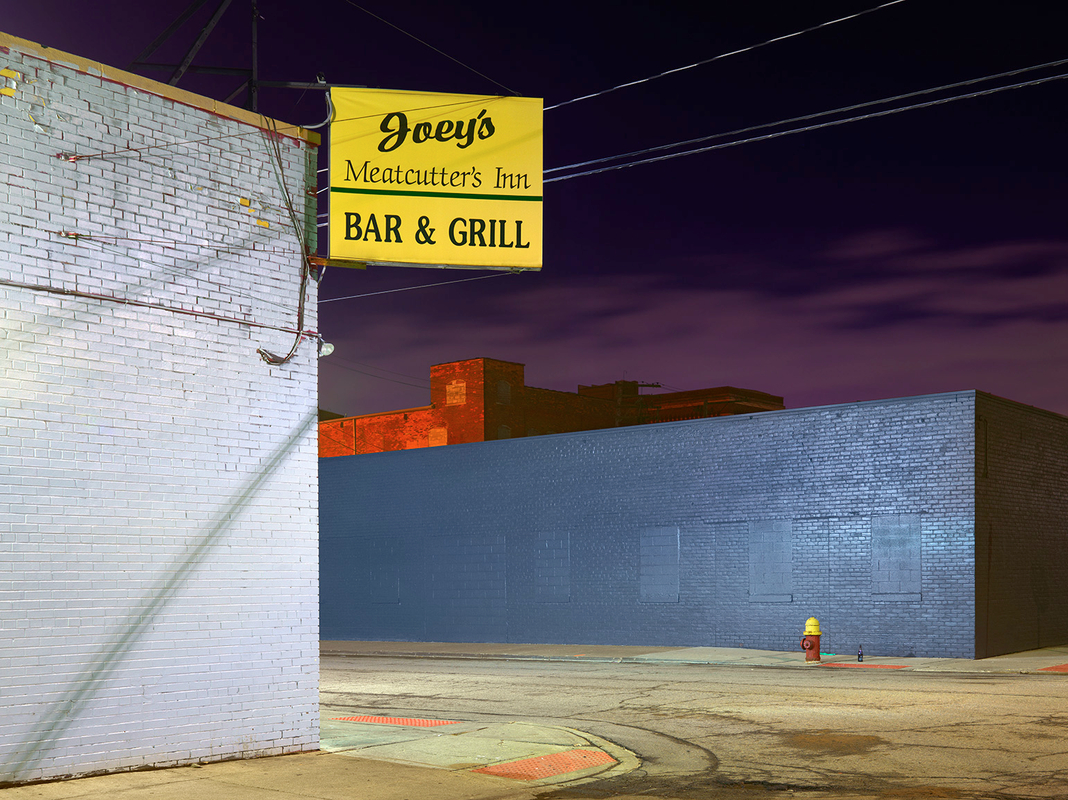
I’m partial to ‘Joey’s Meatcutter Inn, Bar & Grill 2017‘:

Joey's Meatcutter's Inn, Eastside, Detroit 2017

The lonely cityscape at night or the familiar glow of gas station lights cast into the American wilderness.  The eye might want to linger among the colors, shapes and clouds even though the mind knows this is pretty much an empty street in a ‘post-industrial’ zone.

Repost-Via A Reader-From Brain Pickings, An Old BBC Nabokov Interview

Thanks, reader.


As previously posted:

Full piece here

‘Therein lies the central tension of Speak, Memory. Its prose is meticulous, suggesting memory as an exercise in exacting dictation from an omniscient oracle, yet its message points to memory as mutable, prone to the passage of time and the vagaries of imagination’

I merely enjoy good writing.


Michael Dirda’s review of a review here.

Book here.

“Nabokov in America” is rewarding on all counts, as biography, as photo album (there are many pictures of people, Western landscapes and motels) and as appreciative criticism. Not least, Roper even avoids the arch style so often adopted by critics faintly trying to emulate their inimitable subject.’

What’s more American than an exiled member of the Russian aristocracy intimately making his way into the English language and peering out from a thousand Motor Lodges?

===============

As previously posted an interview with Nabokov at The Paris Review.

A little bit about politics and also the politics amidst fellow writers and critics:

‘…when in doubt, I always follow the simple method of choosing that line of conduct which may be the most displeasing to the Reds and the Russells.’

and:

‘Who’s in, who’s out, and where are the snows of yesteryear. All very amusing. I am a little sorry to be left out. Nobody can decide if I am a middle-aged American writer or an old Russian writer—or an ageless international freak.’

On his professional collection of butterflies:

‘The pleasures and rewards of literary inspiration are nothing beside the rapture of discovering a new organ under the microscope or an undescribed species on a mountainside in Iran or Peru. It is not improbable that had there been no revolution in Russia, I would have devoted myself entirely to lepidopterology and never written any novels at all.’

Via Youtube: An interviewer, Nabokov and Lionel Trilling discuss ‘Lolita:’

Thursday Poem-Thomas Dekker

The Merry Month of May

O the month of May, the merry month of May,
    So frolic, so gay, and so green, so green, so green!
O, and then did I unto my true love say:
    “Sweet Peg, thou shalt be my summer’s queen!

    Now the nightingale, the pretty nightingale,
    The sweetest singer in all the forest’s choir,
Entreats thee, sweet Peggy, to hear thy true love’s tale;
    Lo, yonder she sitteth, her breast against a brier.

    But O, I spy the cuckoo, the cuckoo, the cuckoo;
    See where she sitteth: come away, my joy;
Come away, I prithee: I do not like the cuckoo
    Should sing where my Peggy and I kiss and toy.”

O the month of May, the merry month of May,
    So frolic, so gay, and so green, so green, so green!
And then did I unto my true love say:
    “Sweet Peg, thou shalt be my summer’s queen!”

Thomas Dekker

Did you fall in love with this green, green English?

Maybe it all comes back around:

Sunday Poem-Robert Frost

A Brook In The City

The farmhouse lingers, though averse to square
With the new city street it has to wear
A number in. But what about the brook
That held the house as in an elbow-crook?
I ask as one who knew the brook, its strength
And impulse, having dipped a finger length
And made it leap my knuckle, having tossed
A flower to try its currents where they crossed.
The meadow grass could be cemented down
From growing under pavements of a town;
The apple trees be sent to hearth-stone flame.
Is water wood to serve a brook the same?
How else dispose of an immortal force
No longer needed? Staunch it at its source
With cinder loads dumped down? The brook was thrown
Deep in a sewer dungeon under stone
In fetid darkness still to live and run –
And all for nothing it had ever done
Except forget to go in fear perhaps.
No one would know except for ancient maps
That such a brook ran water. But I wonder
If from its being kept forever under,
The thoughts may not have risen that so keep
This new-built city from both work and sleep. 

Robert Frost

Wednesday Photo & A Poem-Smeared A Bluish Green

Pastoral

When I was younger
it was plain to me
I must make something of myself.
Older now
I walk back streets
admiring the houses
of the very poor:
roof out of line with sides
the yards cluttered
with old chicken wire, ashes,
furniture gone wrong;
the fences and outhouses
built of barrel staves
and parts of boxes, all,
if I am fortunate,
smeared a bluish green
that properly weathered
pleases me best of all colors.

No one
will believe this
of vast import to the nation

William Carlos Williams

As posted, down in Ballard, by the docks. An early sketch that keeps me going…

Monday Poem-William Carlos Williams

Spring And All

By the road to the contagious hospital
under the surge of the blue
mottled clouds driven from the
northeast—a cold wind. Beyond, the
waste of broad, muddy fields
brown with dried weeds, standing and fallen

patches of standing water
the scattering of tall trees

All along the road the reddish
purplish, forked, upstanding, twiggy
stuff of bushes and small trees
with dead, brown leaves under them
leafless vines—

Lifeless in appearance, sluggish
dazed spring approaches—

They enter the new world naked,
cold, uncertain of all
save that they enter. All about them
the cold, familiar wind—

Now the grass, tomorrow
the stiff curl of wildcarrot leaf

One by one objects are defined—
It quickens: clarity, outline of leaf

But now the stark dignity of
entrance—Still, the profound change
has come upon them: rooted they
grip down and begin to awaken

William Carlos Williams

Wednesday Poem-Wallace Stevens

A Postcard From The Volcano

Children picking up our bones
Will never know that these were once
As quick as foxes on the hill;

And that in autumn, when the grapes
Made sharp air sharper by their smell
These had a being, breathing frost;

And least will guess that with our bones
We left much more, left what still is
The look of things, left what we felt

At what we saw. The spring clouds blow
Above the shuttered mansion-house,
Beyond our gate and the windy sky

Cries out a literate despair.
We knew for long the mansion’s look
And what we said of it became

A part of what it is . . . Children,
Still weaving budded aureoles,
Will speak our speech and never know,

Will say of the mansion that it seems
As if he that lived there left behind
A spirit storming in blank walls,

A dirty house in a gutted world,
A tatter of shadows peaked to white,
Smeared with the gold of the opulent sun.

Wallace Stevens

Four Poems & A Short Story Collected Throughout The Years-Aging

Men At Forty

Men at forty
Learn to close softly
The doors to rooms they will not be
Coming back to.

At rest on a stair landing,
They feel it moving
Beneath them now like the deck of a ship,
Though the swell is gentle.

And deep in mirrors
They rediscover
The face of the boy as he practises tying
His father’s tie there in secret

And the face of the father,
Still warm with the mystery of lather.
They are more fathers than sons themselves now.
Something is filling them, something

That is like the twilight sound
Of the crickets, immense,
Filling the woods at the foot of the slope
Behind their mortgaged houses.

Donald Justice

IV

My fiftieth year had come and gone,
I sat, a solitary man,
In a crowded London shop,
An open book and empty cup
On the marble table-top.
While on the shop and street I gazed
My body of a sudden blazed;
And twenty minutes more or less
It seemed, so great my happiness,
That I was blessed and could bless.

William Butler Yeats

Whole poem here (Vacillation).

An Old Man

In the inner room of the noisy café
an old man sits bent over a table;
a newspaper before him, no companion beside him.

And in the scorn of his miserable old age,
he meditates how little he enjoyed the years
when he had strength, the art of the word, and good looks.

He knows he has aged much; he is aware of it, he sees it,
and yet the time when he was young seems like
yesterday. How short a time, how short a time.

And he ponders how Wisdom had deceived him;
and how he always trusted her—what folly!—
the liar who would say, “Tomorrow. You have ample time.”

He recalls impulses he curbed; and how much
joy he sacrificed. Every lost chance
now mocks his senseless prudence.

…But with so much thinking and remembering
the old man reels. And he dozes off
bent over the table of the café.

C.P. Cavafy (translation from the Greek found here).

The Old Fools

What do they think has happened, the old fools,
To make them like this? Do they somehow suppose
It’s more grown-up when your mouth hangs open and drools,
And you keep on pissing yourself, and can’t remember
Who called this morning? Or that, if they only chose,
They could alter things back to when they danced all night,
Or went to their wedding, or sloped arms some September?
Or do they fancy there’s really been no change,
And they’ve always behaved as if they were crippled or tight,
Or sat through days of thin continuous dreaming
Watching the light move? If they don’t (and they can’t), it’s strange;
                               Why aren’t they screaming?

At death you break up: the bits that were you
Start speeding away from each other for ever
With no one to see. It’s only oblivion, true:
We had it before, but then it was going to end,
And was all the time merging with a unique endeavour
To bring to bloom the million-petalled flower
Of being here. Next time you can’t pretend
There’ll be anything else. And these are the first signs:
Not knowing how, not hearing who, the power
Of choosing gone. Their looks show that they’re for it:
Ash hair, toad hands, prune face dried into lines –
                               How can they ignore it?

Perhaps being old is having lighted rooms
Inside your head, and people in them, acting
People you know, yet can’t quite name; each looms
Like a deep loss restored, from known doors turning,
Setting down a lamp, smiling from a stair, extracting
A known book from the shelves; or sometimes only
The rooms themselves, chairs and a fire burning,
The blown bush at the window, or the sun’s
Faint friendliness on the wall some lonely
Rain-ceased midsummer evening. That is where they live:
Not here and now, but where all happened once.
                              This is why they give

An air of baffled absence, trying to be there
Yet being here. For the rooms grow farther, leaving
Incompetent cold, the constant wear and tear
Of taken breath, and them crouching below
Extinction’s alp, the old fools, never perceiving
How near it is. This must be what keeps them quiet:
The peak that stays in view wherever we go
For them is rising ground. Can they never tell
What is dragging them back, and how it will end? Not at night?
Not when the strangers come? Never, throughout
The whole hideous inverted childhood? Well,
                             We shall find out.

Philip Larkin

It’s barely twelve pages long, dear reader.

What are you doing with your time and imagination?

You’re fine, Mr. Corte.  In fact, you’re looking a little better than yesterday…:

‘Giuseppe Corte didn’t need anything, but he began to chat freely with the young woman, asking for information about the clinic. In this way, he learned about the hospital’s unique practice of assigning its patients to different floors in accordance with the gravity of their illness. On the seventh floor, the top floor, only the very mildest cases were treated. Those whose forms of the illness weren’t grave, but who certainly couldn’t be neglected, were assigned to the sixth floor. More serious infections were treated on the fifth floor, and so on and so forth. Gravely ill patients were housed on the second floor; and on the first floor, those for whom all hope had been abandoned.’

You probably spent a lot of energy when younger, wishing to be older, and as you get older, find yourself spending time wishing you were younger.
Friday Poem-Elizabeth Bishop

One Art

The art of losing isn’t hard to master;
so many things seem filled with the intent
to be lost that their loss is no disaster,

Lose something every day. Accept the fluster
of lost door keys, the hour badly spent.
The art of losing isn’t hard to master.

Then practice losing farther, losing faster:
places, and names, and where it was you meant
to travel. None of these will bring disaster.

I lost my mother’s watch. And look! my last, or
next-to-last, of three loved houses went.
The art of losing isn’t hard to master.

I lost two cities, lovely ones. And, vaster,
some realms I owned, two rivers, a continent.
I miss them, but it wasn’t a disaster.

– Even losing you (the joking voice, a gesture
I love) I shan’t have lied. It’s evident
the art of losing’s not too hard to master
though it may look like (Write it!) like disaster.

Elizabeth Bishop

Wednesday Poem-Walt Whitman

Sounds Of The Winter

Sounds of the winter too,
Sunshine upon the mountains—many a distant strain
From cheery railroad train—from nearer field, barn, house
The whispering air—even the mute crops, garner’d apples, corn,
Children’s and women’s tones—rhythm of many a farmer and of
flail,
And old man’s garrulous lips among the rest, Think not we give
out yet,
Forth from these snowy hairs we keep up yet the lilt.

-Walt Whitman

Thursday Poem-Emily Dickinson

“Hope” is the thing with feathers – (314)

“Hope” is the thing with feathers –
That perches in the soul –
And sings the tune without the words –
And never stops – at all –

And sweetest – in the Gale – is heard –
And sore must be the storm –
That could abash the little Bird
That kept so many warm –

I’ve heard it in the chillest land –
And on the strangest Sea –
Yet – never – in Extremity,
It asked a crumb – of me.

Emily Dickinson

Repost: Two Links-Robert Hughes’ Take On America Through Its Art & Michael Heizer’s ‘City’

Maybe it’s Pilgrim’s pride, or perhaps the Puritan pursuit of image-less purity, or the Colonialists ecumenical style, or maybe even some Shaker weirdness that finds itself up for analysis.

Perhaps somewhere there’s a spare, Yankee work ethic resting on a simple, wooden shelf in the ‘American mind.’

Could such a thing be discovered within mid 20th-century modernism?

Robert Hughes takes a look at Donald Judd’s ‘Temple Of Aesthetic Fanaticism,’ and Richard Serra’s nod to Jackson Pollack and abstract expressionism in the rawness of material sculpture. You know, making stuff (a potentially sensitive subject with so many technological changes going on right now).

(link may not last):

As for Land Art, Michael Heizer’s life’s-work land-art project is apparently complete, if such a thing can be complete:

There’s a good piece in the New Yorker here.

There is an air of secrecy about the whole thing.

You can’t even visit?


Apparently, Heizer’s been working since 1972 on this sculpture in the Eastern Nevada desert, which was originally called ‘Complex One.’ It’s morphed into his life’s work, called City. It’s very large. It can’t be moved. You can’t reproduce it. It represents a break from traditional sculpture. It can’t be put in a museum and it’s not clear that it has a function.

In Brasil, they just started from the top-down and built a city that doesn’t work that well for people: Brasilia: A Planned City

——————

I have to confess that seeing that structure upon the wide open emptiness of Eastern Nevada is comforting for the familiarity it brings. It’s a little bit of order upon the unknown, and the design, or lack thereof (about which a man may wonder), within Nature herself. I think this is why a military installation out in the desert can captivate the imagination as it’s been known to in Hollywood and in the public mind (dreaming of aliens and conspiracies).

To expand on that theme, Wallace Stevens might shed some light. He was an American poet on the hinge between romanticism and modernism:

Anecdote of the Jar

I placed a jar in Tennessee,
And round it was, upon a hill.
It made the slovenly wilderness
Surround that hill.

The wilderness rose up to it,
And sprawled around, no longer wild.
The jar was round upon the ground
And tall and of a port in air.

It took dominion every where.
The jar was gray and bare.
It did not give of bird or bush,
Like nothing else in Tennessee.

Wallace Stevens

You’ve changed all of nature with just one jar.

What do you do with an uncivilized, wild land? Import European learning and literature “atop” it? Christian tradition and the Natural Law? Import the triumph of the Western mathematical sciences and technology? Import its movements of the arts and the individual artist?

You can’t help but do this.

Related On This Site: L.A.’s New Public Art Piece ‘The Levitated Mass,’ Or As The American Interest Puts It: ‘A Moving Rock’

Denis Dutton suggested art could head towards Darwin (and may offer new direction from the troubles of the modern art aimlessness and shallow depth…the money and the fame) Review of Denis Dutton’s ‘The Art Instinct’

Denver’s Devil Horse may be flirting with kitsch: From The Wall Street Journal: Denver’s Mustang Or ‘Devil Horse’…and I like his work:…Joan Miro: Woman

From Grist.Org Via The New Republic Via The A & L Daily: ‘Getting Past “Ruin Porn” In Detroit’…Marketplace aesthetics in service of “women”: Dove’s Campaign For Real Beauty: Pascal Dangin And AestheticsRoger Scruton In The City Journal: Cities For Living–Is Modernism Dead?Brasilia: A Planned City

Three Poems On A Theme-What Are You Looking At?

Sonnet XIV

Not from the stars do I my judgment pluck;
And yet methinks I have astronomy,
But not to tell of good or evil luck,
Of plagues, of dearths, or seasons’ quality;
Nor can I fortune to brief minutes tell,
Pointing to each his thunder, rain and wind,
Or say with princes if it shall go well,
By oft predict that I in heaven find:
But from thine eyes my knowledge I derive,
And, constant stars, in them I read such art
As truth and beauty shall together thrive,
If from thyself to store thou wouldst convert;
   Or else of thee this I prognosticate:
   Thy end is truth’s and beauty’s doom and date.

William Shakespeare

When You Are Old

When you are old and gray and full of sleep,
And nodding by the fire, take down this book,
And slowly read, and dream of the soft look
Your eyes had once, and of their shadows deep;

How many loved your moments of glad grace,
And loved your beauty with love false or true,
But one man loved the pilgrim soul in you,
And loved the sorrows of your changing face;

And bending down beside the glowing bars,
Murmur, a little sadly, how Love fled
And paced upon the mountains overhead
And hid his face among a crowd of stars.

William Butler Yeats

I Knew A Woman

I knew a woman, lovely in her bones,
When small birds sighed, she would sigh back at them;
Ah, when she moved, she moved more ways than one:
The shapes a bright container can contain!
Of her choice virtues only gods should speak,
Or English poets who grew up on Greek
(I’d have them sing in chorus, cheek to cheek).

How well her wishes went! She stroked my chin,
She taught me Turn, and Counter-turn, and Stand;
She taught me Touch, that undulant white skin;
I nibbled meekly from her proffered hand;
She was the sickle; I, poor I, the rake,
Coming behind her for her pretty sake
(But what prodigious mowing we did make).

Love likes a gander, and adores a goose:
Her full lips pursed, the errant note to seize;
She played it quick, she played it light and loose;
My eyes, they dazzled at her flowing knees;
Her several parts could keep a pure repose,
Or one hip quiver with a mobile nose
(She moved in circles, and those circles moved).

Let seed be grass, and grass turn into hay:   
I’m martyr to a motion not my own;
What’s freedom for? To know eternity.
I swear she cast a shadow white as stone.
But who would count eternity in days?
These old bones live to learn her wanton ways:
(I measure time by how a body sways).

Theodore Roethke

Wednesday Poem-W.B. Yeats

Long-Legged Fly

That civilisation may not sink,
Its great battle lost,
Quiet the dog, tether the pony
To a distant post;
Our master Caesar is in the tent
Where the maps are spread,
His eyes fixed upon nothing,
A hand under his head.

Like a long-legged fly upon the stream
His mind moves upon silence.

That the topless towers be burnt
And men recall that face,
Move most gently if move you must
In this lonely place.
She thinks, part woman, three parts a child,
That nobody looks; her feet
Practise a tinker shuffle
Picked up on a street.

Like a long-legged fly upon the stream
Her mind moves upon silence.

That girls at puberty may find
The first Adam in their thought,
Shut the door of the Pope’s chapel,
Keep those children out.
There on that scaffolding reclines
Michael Angelo.
With no more sound than the mice make
His hand moves to and fro.

Like a long-legged fly upon the stream
His mind moves upon silence.

William Butler Yeats

Thursday Poem-Thomas Hardy

A Broken Appointment

You did not come, 
And marching Time drew on, and wore me numb,— 
Yet less for loss of your dear presence there 
Than that I thus found lacking in your make 
That high compassion which can overbear 
Reluctance for pure lovingkindness’ sake 
Grieved I, when, as the hope-hour stroked its sum, 
You did not come. 

You love not me, 
And love alone can lend you loyalty; 

–I know and knew it. But, unto the store 
Of human deeds divine in all but name, 
Was it not worth a little hour or more 
To add yet this: Once you, a woman, came 
To soothe a time-torn man; even though it be 
You love not me? 

Thomas Hardy

Thursday Poem-Emily Dickinson

It sifts from Leaden Sieves – (291)

It sifts from Leaden Sieves –
It powders all the Wood.
It fills with Alabaster Wool
The Wrinkles of the Road –

It makes an even Face
Of Mountain, and of Plain –
Unbroken Forehead from the East
Unto the East again –

It reaches to the Fence –
It wraps it Rail by Rail
Till it is lost in Fleeces –
It deals Celestial Vail

To Stump, and Stack – and Stem –
A Summer’s empty Room –
Acres of Joints, where Harvests were,
Recordless, but for them –

It Ruffles Wrists of Posts
As Ankles of a Queen –
Then stills it’s Artisans – like Ghosts –
Denying they have been –

Emily Dickinson

Via Richard Dillman at Althouse.

Sunday Poem-William Butler Yeats

An Irish Airman Forsees His Death

I know that I shall meet my fate
Somewhere among the clouds above;
Those that I fight I do not hate,
Those that I guard I do not love;
My country is Kiltartan Cross,
My countrymen Kiltartan’s poor,
No likely end could bring them loss;
Nor leave them happier than before.
Nor law; nor duty bade me fight,
Nor public men, nor cheering crowds,
A lonely impulse of delight
Drove to this tumult in the clouds;
I balanced all, brought all to mind,
The years to come seemed waste of breath,
A waste of breath the years behind
In balance with this life, this death.

William Butler Yeats

Three Snippets Of Poetry & Prose

From ‘The Wind Bloweth Where It Listeth’

“Live like the wind, he said, “unfettered,
And love me while you can;
And when you will, and can be bettered,
Go to the better man.’

Countee Cullen (found here)

From ‘Under Ben Bulben’

Cast a cold eye
On life, on death.
Horseman, pass by!

W.B. Yeats (found here)

From Shirley Jackson’s ‘The Lottery:’

“Well, now.” Mr. Summers said soberly, “guess we better get started, get this over with, so’s we can go back to work. Anybody ain’t here?’

The PDF of ‘The Lottery’ was found at Middlebury College, of all places.

Maybe it’s time for another read?:

Wednesday Poem-A.E. Stallings

The Mistake

The mistake was light and easy in my hand,
A seed meant to be borne upon the wind.
I did not have to bury it or throw,
Just open up my hand and let it go.

The mistake was dry and small and without weight,
A breeze quickly snatched it from my sight,
And even had I wanted to prevent,
Nobody could tell me where it went.

I did not think on the mistake again,
Until the spring came, soft, and full of rain,
And in the yard such dandelions grew
That bloomed and closed, and opened up, and blew

A.E. Stallings

Phospine Above Venus, Blurbs & A Poem By Wallace Stevens

Somewhere up in the clouds of Venus, there’s Phosphine [possibly]. So far, there’s no known naturally occurring reason for this, but that doesn’t mean there isn’t one. On Earth, when bacteria farts in our guts and in swamps, that’s when you get Phosphine. I’ll bet it smells nice.

Maybe in those clouds of sulfuric acid, racing above surface temperatures high-enough to melt lead, there’s some ammonia? Maybe this ammonia is neutralizing the cloud PH balance enough for some kind of bacteria to survive?

These are questions to which a little exploration can provide answers.

You know the moment you notice that the world has fallen away for awhile? You’re leisurely enjoying a photograph, or a painting, or a poem…

…and there’s a passage like this:

‘In the critical terminology of the time, Ghirri’s close-up photographs of the details of atlases and other maps question the link between signifier and signified, referring to a supposedly ‘natural’ environment that has long since become a simulacrum, and revealing the specific aesthetics harboured within ‘objective’ representation.’

The NIGHT of the BLURB! It’s postmodern, it’s (S)elf referential, it’s….alive. It’s dead. It’s…subjectivity and objectivity combined!

And now for a ‘modern’ poem.

The Snow Man

One must have a mind of winter
To regard the frost and the boughs
Of the pine-trees crusted with snow;

And have been cold a long time
To behold the junipers shagged with ice,
The spruces rough in the distant glitter

Of the January sun; and not to think
Of any misery in the sound of the wind,
In the sound of a few leaves,

Which is the sound of the land
Full of the same wind
That is blowing in the same bare place

For the listener, who listens in the snow,
And, nothing himself, beholds
Nothing that is not there and the nothing that is.

 –Wallace Stevens

Saturday Poem-Robert Frost

An Old Man’s Winter Night

All out of doors looked darkly in at him
Through the thin frost, almost in separate stars,
That gathers on the pane in empty rooms.
What kept his eyes from giving back the gaze
Was the lamp tilted near them in his hand.
What kept him from remembering what it was
That brought him to that creaking room was age.
He stood with barrels round him — at a loss.
And having scared the cellar under him
In clomping there, he scared it once again
In clomping off; — and scared the outer night,
Which has its sounds, familiar, like the roar
Of trees and crack of branches, common things,
But nothing so like beating on a box.
A light he was to no one but himself
Where now he sat, concerned with he knew what,
A quiet light, and then not even that.
He consigned to the moon, such as she was,
So late-arising, to the broken moon
As better than the sun in any case
For such a charge, his snow upon the roof,
His icicles along the wall to keep;
And slept. The log that shifted with a jolt
Once in the stove, disturbed him and he shifted,
And eased his heavy breathing, but still slept.
One aged man — one man — can’t keep a house,
A farm, a countryside, or if he can,
It’s thus he does it of a winter night.

Robert Frost

Saturday Poem-Design for November

Let confusion be the design
and all my thoughts go,
swallowed by desire: recess
from promises in
the November of your arms.
Release from the rose: broken
reeds, strawpale,
through which, from easy
branches that mock the blood
a few leaves fall. There
the mind is cradled,
stripped also and returned
to the ground, a trivial
and momentary clatter. Sleep
and be brought down, and so
condone the world, eased of
the jagged sky and all
its petty imageries, flying
birds, its fogs and windy
phalanxes . . .

–William Carlos Williams

Tuesday Poem-Robert Frost

My November Guest

My Sorrow, when she’s here with me,
Thinks these dark days of autumn rain
Are beautiful as days can be;
She loves the bare, the withered tree;
She walks the sodden pasture lane.

Her pleasure will not let me stay.
She talks and I am fain to list:
She’s glad the birds are gone away,
She’s glad her simple worsted gray
Is silver now with clinging mist.

The desolate, deserted trees,
The faded earth, the heavy sky,
The beauties she so truly sees,
She thinks I have no eye for these,
And vexes me for reason why.

Not yesterday I learned to know
The love of bare November days
Before the coming of the snow,
But it were vain to tell her so,
And they are better for her praise.

Robert Frost

Sunday Poem-Marianne Moore

A Grave

Man, looking into the sea—
taking the view from those who have as much right to it as you have it to yourself—
it is human nature to stand in the middle of a thing
but you cannot stand in the middle of this:
the sea has nothing to give but a well excavated grave.
The firs stand in a procession—each with an emerald turkey-foot at the top—
reserved as their contours, saying nothing;
repression, however, is not the most obvious characteristic of the sea;
the sea is a collector, quick to return a rapacious look.
There are others besides you who have worn that look—
whose expression is no longer a protest; the fish no longer investigate them
for their bones have not lasted;
men lower nets, unconscious of the fact that they are desecrating a grave,
and row quickly away—the blades of the oars   
moving together like the feet of water-spiders as if there were no such thing as death.
The wrinkles progress upon themselves in a phalanx—beautiful under networks of foam,
and fade breathlessly while the sea rustles in and out of the seaweed;
the birds swim through the air at top speed, emitting cat-calls as heretofore—
the tortoise-shell scourges about the feet of the cliffs, in motion beneath them
and the ocean, under the pulsation of light-houses and noise of bell-buoys,
advances as usual, looking as if it were not that ocean in which dropped things are bound to sink—
in which if they turn and twist, it is neither with volition nor consciousness.

Marianne Moore

Thursday Poem By Gwendolyn Brooks

The Bean Eaters

They eat beans mostly, this old yellow pair.
Dinner is a casual affair.
Plain chipware on a plain and creaking wood,
Tin flatware.

Two who are Mostly Good.
Two who have lived their day,
But keep on putting on their clothes
And putting things away.

And remembering …
Remembering, with twinklings and twinges,
As they lean over the beans in their rented back room that is full of beads and receipts and dolls and cloths, tobacco crumbs, vases and fringes.

Gwendolyn Brooks

Monday Poem-Jay Parini

Lament Of The Middle Man

In late October in the park
the autumn’s faults begin to show:
the houses suddenly go stark
beyond a thinning poplar row;
the edges of the leaves go brown
on every chestnut tree in town.

The honking birds go south again
where I have gone in better times;
the hardy ones, perhaps, remain
to nestle in the snowy pines.
I think of one bold, raucous bird
whose wintry song I’ve often heard.

I live among so many things
that flash and fade, that come and go.
One never knows what season brings
relief and which will merely show
how difficult it is to span
a life, given the Fall of Man.

The old ones dawdle on a bench,
and young ones drool into their bibs;
an idle boffer, quite a mensch,
moves fast among the crowd with fibs.
A painted lady hangs upon
his word as if his sword was drawn.

Among so many falling fast
I sometimes wonder why I care;
the first, as ever, shall be last;
the last are always hard to bear.
I never know if I should stay
to see what ails the livelong day.

I never quite know how to ask
why some men wear bright, silver wings
while others, equal to the task,
must play the role of underlings.
“It’s what you know, not who,” they swore.
I should have known what to ignore.

I started early, did my bit
for freedom and the right to pray.
I leaned a little on my wit,
and learned the sort of thing to say,
yet here I am, unsatisfied
and certain all my elders lied.

A middle man in middle way
between the darkness and the dark,
the seasons have tremendous sway:
I change like chestnuts in the park.
Come winter, I’ll be branches, bones;
come spring, a wetness over stones.

Jay Parini

A Larkinesque quality?

Wednesday Photo And A Poem-Anne Sexton

For Eleanor Boylan Talking With God

God has a brown voice,
as soft and full as beer.
Eleanor, who is more beautiful than my mother,
is standing in her kitchen talking
and I am breathing in my cigarettes like poison.
She stands in her lemon-colored sun dress
motioning to God with her wet hands
glossy from the washing of egg plates.
She tells him! She tells him like a drunk
who doesn’t need to see to talk.
It’s casual but friendly.
God is as close as the ceiling.

Though no one can ever know,
I don’t think he has a face.
He had a face when I was six and a half.
Now he is large, covering up the sky
like a great resting jellyfish.
When I was eight I thought the dead people
stayed up there like blimps.
Now my chair is as hard as a scarecrow
and outside the summer flies sing like a choir.
Eleanor, before he leaves tell him
Oh Eleanor, Eleanor,
tell him before death uses you up.

Anne Sexton

**The confessional and often psychiatric despair of many mid-20th century poets can grow tiresome; solipsistic and gauche much of this subject matter can be.  It can also fuel some pretty good poems.

Here’s a mildly creepy photo I took, which brought the poem to mind:

Friday Poem-William Butler Yeats

The Wild Swans At Coole

The trees are in their autumn beauty,
The woodland paths are dry,
Under the October twilight the water
Mirrors a still sky;
Upon the brimming water among the stones
Are nine-and-fifty swans.

The nineteenth autumn has come upon me
Since I first made my count;
I saw, before I had well finished,
All suddenly mount
And scatter wheeling in great broken rings
Upon their clamorous wings.

I have looked upon those brilliant creatures,
And now my heart is sore.
All’s changed since I, hearing at twilight,
The first time on this shore,
The bell-beat of their wings above my head,
Trod with a lighter tread.

Unwearied still, lover by lover,
They paddle in the cold
Companionable streams or climb the air;
Their hearts have not grown old;
Passion or conquest, wander where they will,
Attend upon them still.

But now they drift on the still water,
Mysterious, beautiful;
Among what rushes will they build,
By what lake’s edge or pool
Delight men’s eyes when I awake some day
To find they have flown away?

William Butler Yeats

Tuesday Poem-Theodore Roethke

Autumn Poem

I have come to a still, but not a deep center,
A point outside the glittering current;
My eyes stare at the bottom of a river,
At the irregular stones, iridescent sandgrains,
My mind moves in more than one place,
In a country half-land, half-water.
I am renewed by death, thought of my death,
The dry scent of a dying garden in September,
The wind fanning the ash of a low fire.
What I love is near at hand,
Always, in earth and air.

Theodore Roethke

Wednesday Poem-James Merrill

A Renewal

Having used every subterfuge
To shake you, lies, fatigue, or even that of passion,
Now I see no way but a clean break.
I add that I am willing to bear the guilt.

You nod assent. Autumn turns windy, huge,
A clear vase of dry leaves vibrating on and on.
We sit, watching. When I next speak
Love buries itself in me, up to the hilt.

James Merrill

Downward To Darkness: From A Reader-Wallace Stevens’ ‘Sunday Morning’

A return to Nature?  To origins of faith?  To a simple freedom in a wild land, and new understandings, with death in view? To visions of Romantic Primitivism becoming modern?:

VII

Supple and turbulent, a ring of men
Shall chant in orgy on a summer morn
Their boisterous devotion to the sun,
Not as a god, but as a god might be,
Naked among them, like a savage source.
Their chant shall be a chant of paradise,
Out of their blood, returning to the sky;
And in their chant shall enter, voice by voice,
The windy lake wherein their lord delights,
The trees, like serafin, and echoing hills,
That choir among themselves long afterward.
They shall know well the heavenly fellowship
Of men that perish and of summer morn.
And whence they came and whither they shall go
The dew upon their feet shall manifest.

Wallace Stevens

Full poem here.

Read it aloud, for God’s sake, as the meaning lies in the experience of saying.

Welcome To The Western Skies Motel-Some Old & New Links On Place In America

Ernst Haas-Western Skies Motel, Colorado, 1977. It’s a wonderful use of color, along with those clouds and that light. A mood is created, and not much extra visual information is provided.

Ernst Haas-There’s so much visual information, but is there? What is communicated through your eye and to your brain? Route 66 Albuquerque, New Mexico, 1969

As posted:

Via Mick Hartley, British photographer Mark Power’s Good Morning, America, vols. 1 (mostly Arkansas) & 2 (mostly across the South).

Power:

‘I keep a physical and metaphorical distance between myself and the subject. It’s a way of delineating my ‘foreignness’ and is a similar stance to the one I took while working in Poland making The Sound of Two Songs (2004-09). It’s comes very naturally to me; I’ve always felt I’m better at observing than participating, so to stand back and watch from afar suits me very well.’

I often find myself drawn to photos with some distance.

As posted:

Via Mick Hartley, Steve Fitch Photography has neon motel signs glowing into the Western night.

He also has a book simply titled ‘Motel Signs:’

What’s more American than an exiled member of the Russian aristocracy intimately making his way into the English language and peering out from a thousand Motor Lodges?

Nabokov in America:  On The Road To Lolita.

Michael Dirda review of the review here.

“Nabokov in America” is rewarding on all counts, as biography, as photo album (there are many pictures of people, Western landscapes and motels) and as appreciative criticism. Not least, Roper even avoids the arch style so often adopted by critics faintly trying to emulate their inimitable subject.’

Well, there’s Donald Judd and Marfa, Texas, which looks interesting:

As previously posted, The Critic Laughs, by Hamilton:

Do you long for the days of unabashed American consumerism? Are you nostalgic for nights lit only by a soft, neon glow on the underbellies of clouds? Return to a time when America broadcast its brash, unironic call to the heavens.

But it can be empty, and lonely, and full of hard work and suffering:

MT-3 Storm Breaking-3

Montana Pastoral    

I am no shepherd of a child’s surmises.
I have seen fear where the coiled serpent rises,

Thirst where the grasses burn in early May
And thistle, mustard and the wild oat stay.

There is dust in this air. I saw in the heat
Grasshoppers busy in the threshing wheat.

So to this hour. Through the warm dusk I drove
To blizzards sifting on the hissing stove,

And found no images of pastoral will,
But fear, thirst, hunger, and this huddled chill.  

J.V. Cunningham

Detroit Nocturne‘ found here. Via Mick Hartley.

I’m partial to ‘Joey’s Meatcutter Inn, Bar & Grill 2017‘:

Joey's Meatcutter's Inn, Eastside, Detroit 2017

Immediately, I think of Edward Hopper: The lonely cityscape at night or the familiar glow of gas station lights cast into the American wilderness. The eye might want to linger among the colors, shapes and clouds even though the mind knows this is pretty much an empty street in a ‘post-industrial’ zone.

Perhaps it has do with another strand of expression: The break into free verse from past forms. The move from American Romanticism to Modernism which occurred this early past century. William Carlos Williams produced many good poems from a process of earnest, scrapbook-style intensity in trying to discover, redefine, and order a new poetic form within a modern ‘urban landscape.’

The individual artist is quite alone in the task he’s set before himself, and like much of modernism, it’s a rather big task.

Pastoral

When I was younger
it was plain to me
I must make something of myself.
Older now
I walk back streets
admiring the houses
of the very poor:
roof out of line with sides
the yards cluttered
with old chicken wire, ashes,
furniture gone wrong;
the fences and outhouses
built of barrel staves
and parts of boxes, all,
if I am fortunate,
smeared a bluish green
that properly weathered
pleases me best of all colors.

No one
will believe this
of vast import to the nation

William Carlos Williams

Do you believe any of that to be of vast import to the nation? Are you no one?

Wednesday Poem-Richard Eberhart’s ‘The Groundhog’

The Groundhog

In June, amid the golden fields,
I saw a groundhog lying dead.
Dead lay he; my senses shook,
And mind outshot our naked frailty.
There lowly in the vigorous summer
His form began its senseless change,
And made my senses waver dim
Seeing nature ferocious in him.
Inspecting close his maggots’ might
And seething cauldron of his being,
Half with loathing, half with a strange love,
I poked him with an angry stick.
The fever arose, became a flame
And Vigour circumscribed the skies,
Immense energy in the sun,
And through my frame a sunless trembling.
My stick had done nor good nor harm.
Then stood I silent in the day
Watching the object, as before;
And kept my reverence for knowledge
Trying for control, to be still,
To quell the passion of the blood;
Until I had bent down on my knees
Praying for joy in the sight of decay.
And so I left; and I returned
In Autumn strict of eye, to see
The sap gone out of the groundhog,
But the bony sodden hulk remained.
But the year had lost its meaning,
And in intellectual chains
I lost both love and loathing,
Mured up in the wall of wisdom.
Another summer took the fields again
Massive and burning, full of life,
But when I chanced upon the spot
There was only a little hair left,
And bones bleaching in the sunlight
Beautiful as architecture;
I watched them like a geometer,
And cut a walking stick from a birch.
It has been three years, now.
There is no sign of the groundhog.
I stood there in the whirling summer,
My hand capped a withered heart,
And thought of China and of Greece,
Of Alexander in his tent;
Of Montaigne in his tower,
Of Saint Theresa in her wild lament.

Richard Eberhart

Friday Poem-Seamus Heaney

May

When I looked down from the bridge
Trout were flipping the sky
Into smithereens, the stones
Of the wall warmed me.

Wading green stems, lugs of leaf
That untangle and bruise
(Their tiny gushers of juice)
My toecaps sparkle now

Over the soft fontanel
Of Ireland. I should wear
Hide shoes, the hair next my skin,
For walking this ground:

Wasn’t there a spa-well,
Its coping grassy, pendent?
And then the spring issuing
Right across the tarmac.

I’m out to find that village,
Its low sills fragrant
With ladysmock and celandine,
Marshlights in the summer dark.

Seamus Heaney

Wednesday Poem-Rita Dove

Geometry

I prove a theorem and the house expands:
the windows jerk free to hover near the ceiling,
the ceiling floats away with a sigh.

As the walls clear themselves of everything
but transparency, the scent of carnations
leaves with them.  I 
am out in the open

and above the windows have hinged into butterflies,
sunlight glinting where they’ve intersected.
They are going to some point true and unproven.

Rita Dove

‘Spring Beauties’-A Brief Post And A Link On Andrew Wyeth

Andrew Ferguson on Andrew Wyeth: ‘Terror In The Abstract:’

Andrew Wyeth homepage here with some images included.

There are definitely interesting things going on with light in Wyeth’s work. It fills his paintings. I also find my eye and mind hovering between realist depiction and abstract arrangement of objects on the canvas.

Ferguson:

‘Beneath the frequent prettiness, most of the pictures are just this side of harrowing, not just lonesome and melancholy but portraits of life as it seeps inevitably away. The wind that lifts the lace curtain in Wind from the Sea makes the hair on your arms stand up. Jamie Wyeth, Andrew’s son and a celebrated artist himself, confesses to being puzzled by the benign view of Wyeth’s work. “My father’s work is terrifying,” he said. It’s not sentimental. It’s luminous! But in a creepy way.’

Wyeth reached a level of popular appreciation few artists ever receive in their lifetimes.

Like many Americans, I find myself drawn to what I would call a New England plainness and Yankee work ethic and aesthetic, which is evident is some of Wyeth’s landscapes, at least. Long winters and deep woods. Shorter distances and stonier soil in the meadows. Perhaps a Puritan, high-minded spiritual reserve.

Robert Frost, Emily Dickinson and Nathaniel Hawthorne spring immediately to mind, but, I confess so did that gothic Mainer and fiction horror-writer Stephen King.

Or perhaps the Shaker work song ‘Simple Gifts’ adapted by Aaron Copland might be a good example of what I’m trying to get at.

————————————–

So, is this representative of Wyeth?  Perhaps. He did much of his work in Chadds Ford, Pennsylvania and Maine, but according to Wikipedia there may be other influences as well:

‘N.C. also fostered an inner self-confidence to follow one’s own talents without thought of how the work is received. N.C. wrote in a letter to Wyeth in 1944:[8]

“The great men [ Thoreau, Goethe, Emerson, Tolstoy] forever radiate a sharp sense of that profound requirement of an artist, to fully understand that consequences of what he creates are unimportant. Let the motive for action be in the action itself and not in the event. I know from my own experience that when I create with any degree of strength and beauty I have no thought of consequences. Anyone who creates for effect — to score a hit — does not know what he is missing!”‘

So, I’m speculating. Addition: There’s also a strong modernist-influenced creative imagination at work here too, and like Hopper, the American question of what to do with all that space and wilderness.

Yet, a man able to walk familiar land, seeing it anew with keen eyes, hoping his senses pick up more than he knows, having a medium with which to express his thoughts seems a man who’s had some success in life, regardless of popular appreciation.

Of course, a concupiscent eye must come into tension with other parts of a man’s character.

Or at least when there was a tittering about his ‘Helga‘ paintings a while back.

Ferguson:

‘Stopping to rest near a group of European spring beauties, he saw on a trail above him a young woman on a walk. Assuming she was alone, she moved off the trail, lifted her skirt, and defecated in the grass. Wyeth was charmed. “The white curve of her bottom was amazing,” he told Meryman. The little lumps she left tumbled downhill and stopped in the patch of spring beauties.’

Well, there you go, America.

A discussion of ‘Christina’s World,’ a well-known work of his does more justice than this brief post.

————————

Repost-A Reaction To Jeff Koons-For Commerce Or Contemplation?

Roger Scruton says keep politics out of the arts, and political judgment apart from aesthetic judgment…this includes race studies/feminist departments/gay studies etc.:  Roger Scruton In The American Spectator Via A & L Daily: Farewell To Judgment

Goya’s Fight With Cudgels and Goya’s Colossus.  A very good Goya page here.

Joan Miro: Woman… Goethe’s Color Theory: Artists And ThinkersSome Quotes From Kant And A Visual Exercise

A Reaction To Jeff Koons ‘St John The Baptist’

Denis Dutton suggests art could head towards Darwin (and may offer new direction from the troubles of the modern art aimlessness and shallow depth) Review of Denis Dutton’s ‘The Art Instinct’

Two Friday Photos And A Poem By Donald Justice-Women In Love

kk

Women In Love

It always comes, and when it comes they know.
To will it is enough to bring them there.
The knack is this, to fasten and not let go

Their limbs are charmed; they cannot stay or go.
Desire is limbo: they’re unhappy there.
It always comes, and when it comes they know

Their choice of hells would be the one they know.
Dante describes it, the wind circling there.
The knack is this, to fasten and not let go.
 

The wind carries them where they want to go.
Yet it seems cruel to strangers passing there.
It always comes, and when it comes they know
The knack is this, to fasten and not let go.

Donald Justice

Sunday Poem-John Crowe Ransom

Blue Girls

Twirling your blue skirts, travelling the sward 
Under the towers of your seminary, 
Go listen to your teachers old and contrary 
Without believing a word. 

Tie the white fillets then about your hair 
And think no more of what will come to pass 
Than bluebirds that go walking on the grass 
And chattering on the air. 

Practice your beauty, blue girls, before it fail; 
And I will cry with my loud lips and publish 
Beauty which all our power shall never establish, 
It is so frail. 

For I could tell you a story which is true; 
I know a woman with a terrible tongue, 
Blear eyes fallen from blue, 
All her perfections tarnished — yet it is not long 
Since she was lovelier than any of you.

John Crowe Ransom

Saturday Poem-Robert Hayden

Those Winter Sundays

Sundays too my father got up early
and put his clothes on in the blueblack cold,
then with cracked hands that ached
from labor in the weekday weather made
banked fires blaze. No one ever thanked him.

I’d wake and hear the cold splintering, breaking.
When the rooms were warm, he’d call,
and slowly I would rise and dress,
fearing the chronic angers of that house,

speaking indifferently to him,
who had driven out the cold
and polished my good shoes as well.
What did I know, what did I know
of love’s austere and lonely offices?

Robert Hayden

Repost: A Bleak, Modern House-Four Poems

This will be a longer one, so thanks in advance.

From the comments on this piece:

‘The most useful definition of modernist fiction I’ve encountered comes from Brian McHale’s Postmodernist Fiction. He says modernist fiction tends to “foreground epistemological questions” such as “How can I interpret the world I’m part of? What is there to be known? Who knows it? What are the limits of that knowledge?” In contrast, postmodernist fiction tends to “foreground ontological questions” such as “What is a world? What kinds of worlds are there and how are they constituted? What happens when…boundaries between worlds are violated?’

As to the epistemological questions surrounding Modernism, below are four poems. Hopefully, each is a representative example of a move away from the Romanticism that had been prevalent up until the late 1800’s.

In addition to the move away from traditional Romantic rhyme and meter towards modern blank verse, there’s also a certain conception of the Self rendered in them; a presentation of our natures that might be worth examining in some detail.

I believe we can see clearly a move away from tradition towards the Self, the Poet isolated, the poem itself as a means of communication, and an anxiety so common within the 20th century.

I should note that a friend points out Harold Bloom does it much better (well, yes…obviously). From this blurb:

‘At the heart of Bloom’s project is the ancient quarrel between “poetry” and “philosophy.” In Bloom’s opinion, we ought not have to choose between Homer and Plato; we can have both, as long as we recognize that poetry is superior.’

Says the guy who writes about poetry…


What does one find within, as one looks without, waking from sleep and dream?

What kind of world is this, and can the poet actually help us know it?

T.S. Eliot (Preludes: Stanza 3)

3.

You tossed a blanket from the bed
You lay upon your back, and waited;
You dozed, and watched the night revealing
The thousand sordid images
Of which your soul was constituted;
They flickered against the ceiling.
And when all the world came back
And the light crept up between the shutters
And you heard the sparrows in the gutters,
You had such a vision of the street
As the street hardly understands;
Sitting along the bed’s edge, where
You curled the papers from your hair,
Or clasped the yellow soles of feet
In the palms of both soiled hands.

The world will stain you, and it is a fallen, modern world, rendered profoundly and exquisitely.

As consciousness creeps in, building a bridge to the day, to the world, to the facts left as though they were the first facts, the light as though it were the first light, what one finds is distressing, both within and without.

That distress must be ‘made new,’ which is to say, the suffering (original?) in which we all sometimes find ourselves must match our experiences within the modern city and world, at least, the world created within Eliot’s lyrical verse.

Of the four poems, only the first and last have a 3rd-person subject.

Wallace Stevens‘ ‘I’ is in a more contemplative state, but it’s an ‘I’ exploring similar themes, and experiencing some distress in trying to know how the world actually is, and what might lie within.

The journey to The Self may not be a journey for the faint of heart.

The Poems Of Our Climate (stanzas II and III)

II
Say even that this complete simplicity
Stripped one of all one’s torments, concealed
The evilly compounded, vital I
And made it fresh in a world of white,
A world of clear water, brilliant-edged,
Still one would want more, one would need more,
More than a world of white and snowy scents.

III
There would still remain the never-resting mind,
So that one would want to escape, come back
To what had been so long composed.
The imperfect is our paradise.
Note that, in this bitterness, delight,
Since the imperfect is so hot in us,
Lies in flawed words and stubborn sounds.

Even if the verse can describe a perfected world, delivering us, perhaps, a little closer to perfection, our poet is still not free from the impulses and desires which simply never cease.

Interestingly, we end-up not with a discussion of the heart, the spirit, libido etc. as a source for those desires (for Plato, the irrational), but rather, for Stevens, just a mind.

We also find more Romantic elements of language and an almost baroque/rococo arrangement of words and ideas, dandyish even, yet combined with an intense effort to abstract, define, and clarify. From here, the poet may proceed on his task of flawed words and stubborn sounds.

***I find myself thinking of elements of modern architecture and abstract-expressionist painting. The meaning, or at least some delivery from our restless existences, can be found within the abstract itself. Or at least within a retreat to the abstract for its own sake, away from the world.

The modernist, glass-walled house on the hill will exist in its own space, offering and defying meaning. The structure’s own shapes will be stripped down to often mathematically precise forms interacting with Nature. These shall guide Man, or at least offer individual men a little refuge.

It is perhaps in Stevens’ poem we can see the questions of knowledge about the world suggesting questions about whether there is a world at all, or, at least, what kind of worlds each Self might be able to inhabit.

Here’s one of Robert Lowell’s poems, occurring a generation later, in the mid 20th-century, as part of the confessionals.

The Self is extremely isolated. In fact, Lowell went more than a little crazy. Unlike the known nervous breakdown of Eliot from which Eliot recovered, Lowell’s life was essentially one long breakdown from which he never recovered.

Here he is, looking back:

Epilogue

Those blessed structures plot and rhyme-
why are they no help to me now
i want to make
something imagined not recalled?
I hear the noise of my own voice:
The painter’s vision is not a lens
it trembles to caress the light.
But sometimes everything i write
With the threadbare art of my eye
seems a snapshot
lurid rapid garish grouped
heightened from life
yet paralyzed by fact.
All’s misalliance.
Yet why not say what happened?
Pray for the grace of accuracy
Vermeer gave to the sun’s illumination
stealing like the tide across a map
to his girl solid with yearning.
We are poor passing facts.
warned by that to give
each figure in the photograph
his living name.

The weight of having to make that meaning, for yourself, and by yourself, is a horrible weight indeed. One can glorify one’s Self and family, but that, alas, only goes so far. Rhyme and form still carry one’s living name, as far as they do.

Of course, there’s still wonderful rhythm and form here (this is excellent verse), but blanker now, with a relentless focus on the ‘I.’ The poet is perhaps talking a little more to himself, and the poem keeps self-consciously calling attention to itself.

In fact, it reminded me of the poem below, by Robert Creeley, which was published a few years afterwards.

From this page:

‘Creeley was a leader in the generational shift that veered away from history and tradition as primary poetic sources and gave new prominence to the ongoing experiences of an individual’s life. Because of this emphasis, the major events of his life loom large in his literary work.’

There’s Nothing but the Self and the Eye seeking and making meaning, by itself within a void of emotionally compact and precise language (of course there’s still form and other things besides).

Can the poet fit inside the little abstract chapel of words he’s building for himself (let alone the world, tradition etc.)?

For all the talk about ‘space,’ there seems very little.

The Window

Position is where you
put it, where it is,
did you, for example, that

large tank there, silvered,
with the white church along-
side, lift

all that, to what
purpose? How
heavy the slow

world is with
everything put
in place. Some

man walks by, a
car beside him on
the dropped

road, a leaf of
yellow color is
going to

fall. It
all drops into
place. My

face is heavy
with the sight. I can
feel my eye breaking.

The distress is still there…but I’d argue that we are now a good distance away from the grandness of Eliot’s vision, his religiosity and virtuosity with form and meter at the dawn of Modernism. Very few people can/could do what Eliot did (addition: even if he can help us gain knowledge of our Selves or the world).

That said, it’s unclear there’s enough tradition and confidence to even undertake such a project, now, even as such talents come along. The state of things is more scattered. We’re in a very different place of selves and artists isolated, of anxiety and post-anxiety.

Aside from the very accomplished poets above, in terms of both knowledge (epistemology) and being (ontology), we often have writers feeling pressure to weigh-in on such questions without even being about to write that well; artists who can’t draw or paint that well, and frankly, quite a bit of bullshit besides.

So, where are we headed? Who’s ‘we’ exactly?

Predictions are hard, especially about the future.


As previously posted:

Why not just put a few algorithms to work in writing those artist statements?

Bathe in the bathos of a warming world:

A reader sends a link to a SF Gate review of poet Jorie Graham’s ‘Sea Change:

‘In “Sea Change,” Graham becomes Prospero, casting spells by spelling out her thoughts to merge with ours, and with the voices of the elements. The result is a mingling of perceptions rather than a broadcasting of opinions. Instead of analysis, the poems encourage emotional involvement with the drastic changes overwhelming us, overwhelm- ing the planet.’

and:

‘Strengths and weaknesses, flows and ebbs, yet every poem in “Sea Change” bears memorable lines, with almost haunting (if we truly have but 10 years to “fix” global warming) images of flora and fauna under siege. Jorie Graham has composed a swan song for Earth.’

Oh boy.

What are these poems being asked to do?


And moving away from poetry into the realm of ‘performance art,’


Tilda Swinton At MOMA-From Arma Virumque: ‘Nightmare In A Box’

Denis Dutton suggests art could head towards Darwin (and may offer new direction from the troubles of the modern art aimlessness and shallow depth) Review of Denis Dutton’s ‘The Art Instinct’

Roger Scruton says keep politics out of the arts, and political judgment apart from aesthetic judgment…this includes race studies/feminist departments/gay studies etc.: Roger Scruton In The American Spectator Via A & L Daily: Farewell To Judgment

Ah, Look At All The Lonely People-‘Jeff Koons Is Back’ Via Vanity Fair

Some Updated Links On Postmodernism

Thursday Poem-William Blake

London

I wander thro’ each charter’d street,
Near where the charter’d Thames does flow. 
And mark in every face I meet
Marks of weakness, marks of woe.

In every cry of every Man,
In every Infants cry of fear,
In every voice: in every ban,
The mind-forg’d manacles I hear 

How the Chimney-sweepers cry
Every blackning Church appalls, 
And the hapless Soldiers sigh
Runs in blood down Palace walls 

But most thro’ midnight streets I hear
How the youthful Harlots curse
Blasts the new-born Infants tear 
And blights with plagues the Marriage hearse

William Blake

The arch-Romantic? Let’s just say he was ‘intense’