I have come to a still, but not a deep center, A point outside the glittering current; My eyes stare at the bottom of a river, At the irregular stones, iridescent sandgrains, My mind moves in more than one place, In a country half-land, half-water. I am renewed by death, thought of my death, The dry scent of a dying garden in September, The wind fanning the ash of a low fire. What I love is near at hand, Always, in earth and air.
‘The minor vogue and rapid extinction of Imagism, a movement whose influence we still feel, has been hashed over by literary critics for a century. Its rehearsal here is merely to bring the poem into focus within the slow progress toward the densities of language, the images like copperplate engraving, that made Pound Pound’
Thorough and well done.
The result would echo back to the States years later:
‘Imagism was a sub-genre of Modernism concerned with creating clear imagery with sharp language. The essential idea was to re-create the physical experience of an object through words. As with all of Modernism, Imagism implicitly rejected Victorian poetry, which tended toward narrative.‘
And:
‘The most exemplified phase of Modernism, referred to as “High Modernism,” occurred during the inter-war years (1918-1939). This was the time when writers synonymous with Modernism, such as Virginia Woolf, James Joyce, T.S. Eliot, and D.H. Lawrence, thrived. While Victorians typically concerned themselves with rendering reality as they understood it into fiction, Modernists recognized that reality was subjective, and instead strove to represent human psychology in fiction.‘
During the post-war years, the confessionals, with a fair amount of free and blank verse became dominant, with a kind of feelings-first, psychological exploration of the (S)elf.
This blog tends to look cautiously at many of the ideas of the Romantic poets, and the break to modernism, but not necessarily the poems themselves. The echo ripples outwards:
…
Mid-August at Sourdough Mountain Lookout
Down valley a smoke haze Three days heat, after five days rain Pitch glows on the fir-cones Across rocks and meadows Swarms of new flies.
I cannot remember things I once read A few friends, but they are in cities. Drinking cold snow-water from a tin cup Looking down for miles Through high still air.
Once we start arriving at ‘ecological’ appreciations of nature, and the postmodern, confessional altar of Self and the turn inwards to the Self a subject for the art, and the desperate search for meaning, I get more and more turned off, for my own reasons. Such good poems will carry on.
Any thoughts and comments are welcome.
—
Addition: Meanwhile, comics are so much the cultural bellwethers, there are now videos about podcasts (male gossip-mongering). People, generally, and guys specifically, seek discussions of truth from guys getting paid to deliver jokes (often vulgar, usually funny). Also, of course, the ‘how to live, what to do?’ questions.
In the postmodern void, politics (a thing) has become for many more people a defining, tribal thing, and we’re all along for the ride.
Also, podcasts make you feel connected in a world of increasing technological dislocation (as well as the same old dislocations). There’s a much more personal, easily available way to make you feel connected, and less lonely.
Certainly, more than dead poets, for most people most of the time, nowadays.
I do not know much about gods; but I think that the river Is a strong brown god—sullen, untamed and intractable, Patient to some degree, at first recognised as a frontier; Useful, untrustworthy, as a conveyor of commerce; Then only a problem confronting the builder of bridges. The problem once solved, the brown god is almost forgotten By the dwellers in cities—ever, however, implacable. Keeping his seasons and rages, destroyer, reminder Of what men choose to forget. Unhonoured, unpropitiated By worshippers of the machine, but waiting, watching and waiting. His rhythm was present in the nursery bedroom, In the rank ailanthus of the April dooryard, In the smell of grapes on the autumn table, And the evening circle in the winter gaslight.
Late August, given heavy rain and sun For a full week, the blackberries would ripen. At first, just one, a glossy purple clot Among others, red, green, hard as a knot. You ate that first one and its flesh was sweet Like thickened wine: summer’s blood was in it Leaving stains upon the tongue and lust for Picking. Then red ones inked up and that hunger Sent us out with milk cans, pea tins, jam-pots Where briars scratched and wet grass bleached our boots. Round hayfields, cornfields and potato-drills We trekked and picked until the cans were full, Until the tinkling bottom had been covered With green ones, and on top big dark blobs burned Like a plate of eyes. Our hands were peppered With thorn pricks, our palms sticky as Bluebeard’s.
We hoarded the fresh berries in the byre. But when the bath was filled we found a fur, A rat-grey fungus, glutting on our cache. The juice was stinking too. Once off the bush The fruit fermented, the sweet flesh would turn sour. I always felt like crying. It wasn’t fair That all the lovely canfuls smelt of rot. Each year I hoped they’d keep, knew they would not.
There is a gold light in certain old paintings That represents a diffusion of sunlight. It is like happiness, when we are happy. It comes from everywhere and from nowhere at once, this light, And the poor soldiers sprawled at the foot of the cross Share in its charity equally with the cross.
Orpheus hesitated beside the black river. With so much to look forward to he looked back. We think he sang then, but the song is lost. At least he had seen once more the beloved back. I say the song went this way: O prolong Now the sorrow if that is all there is to prolong.
The world is very dusty, uncle. Let us work. One day the sickness shall pass from the earth for good. The orchard will bloom; someone will play the guitar. Our work will be seen as strong and clean and good. And all that we suffered through having existed Shall be forgotten as though it had never existed.
There is a singer everyone has heard, Loud, a mid-summer and a mid-wood bird, Who makes the solid tree trunks sound again. He says that leaves are old and that for flowers Mid-summer is to spring as one to ten. He says the early petal-fall is past When pear and cherry bloom went down in showers On sunny days a moment overcast; And comes that other fall we name the fall. He says the highway dust is over all. The bird would sing and be as other birds, But that he knows in singing not to sing. The question that he frames in all but words is what to make of a diminished thing.
The warping night air having brought the boom Of an owl’s voice into her darkened room, We tell the wakened child that all she heard Was an odd question from a forest bird, Asking of us, if rightly listened to, “Who cooks for you?” and then “Who cooks for you?”
Words, which can make our terrors bravely clear, Can also thus domesticate a fear, And send a small child back to sleep at night Not listening for the sound of stealthy flight Or dreaming of some small thing in a claw Borne up to some dark branch and eaten raw.
It is the word pejorative that hurts. My old boat goes round on a crutch And doesn’t get under way. It’s the time of the year And the time of the day.
Perhaps it’s the lunch that we had Or the lunch that we should have had. But I am, in any case, A most inappropriate man In a most unpropitious place.
Mon Dieu, hear the poet’s prayer. The romantic should be here. The romantic should be there. It ought to be everywhere. But the romantic must never remain,
Mon Dieu, and must never again return. This heavy historical sail Through the mustiest blue of the lake In a really vertiginous boat Is wholly the vapidest fake. . . .
It is least what one ever sees. It is only the way one feels, to say Where my spirit is I am, To say the light wind worries the sail, To say the water is swift today,
To expunge all people and be a pupil Of the gorgeous wheel and so to give That slight transcendence to the dirty sail, By light, the way one feels, sharp white, And then rush brightly through the summer air.
***Wallace Stevens is often going meta and abstract, confusing nearly all readers, while indulging heavily in a lush Romantic style which later transitions to more blank verse modernism. He’s sailing and he’s writing. He’s charting new waters, the old dandy.
Men at forty Learn to close softly The doors to rooms they will not be Coming back to.
At rest on a stair landing, They feel it moving Beneath them now like the deck of a ship, Though the swell is gentle.
And deep in mirrors They rediscover The face of the boy as he practises tying His father’s tie there in secret
And the face of the father, Still warm with the mystery of lather. They are more fathers than sons themselves now. Something is filling them, something
That is like the twilight sound Of the crickets, immense, Filling the woods at the foot of the slope Behind their mortgaged houses.
The seas are quiet when the winds give o’er; So calm are we when passions are no more. For then we know how vain it was to boast Of fleeting things, so certain to be lost. Clouds of affection from our younger eyes Conceal that emptiness which age descries.
The soul’s dark cottage, batter’d and decay’d, Lets in new light through chinks that Time hath made: Stronger by weakness, wiser men become As they draw near to their eternal home. Leaving the old, both worlds at once they view That stand upon the threshold of the new.
Twenty men crossing a bridge, Into a village, Are twenty men crossing twenty bridges, Into twenty villages, Or one man Crossing a single bridge into a village.
This is old song That will not declare itself . . .
Twenty men crossing a bridge, Into a village, Are Twenty men crossing a bridge Into a village.
That will not declare itself Yet is certain as meaning . . .
The boots of the men clump On the boards of the bridge. The first white wall of the village Rises through fruit-trees. Of what was it I was thinking? So the meaning escapes.
The first white wall of the village . . . The fruit-trees. . . .
Thoughts while you’re walking? marching? with a destination?
Macavity’s a Mystery Cat: he’s called the Hidden Paw– For he’s the master criminal who can defy the Law. He’s the bafflement of Scotland Yard, the Flying Squad’s despair: For when they reach the scene of crime–Macavity’s not there!
Macavity, Macavity, there’s no one like Macavity, He’s broken every human law, he breaks the law of gravity. His powers of levitation would make a fakir stare, And when you reach the scene of crime–Macavity’s not there! You may seek him in the basement, you may look up in the air But I tell you once and once again,–Macavity’s not there!
Macavity’s a ginger cat, he’s very tall and thin; You would know him if you saw him, for his eyes are sunken in. His brow is deeply lined with thought, his head is highly domed; His coat is dusty from neglect, his whiskers are uncombed. He sways his head from side to side, with movements like a snake; And when you think he’s half asleep, he’s always wide awake.
Macavity, Macavity, there’s no one like Macavity, For he’s a fiend in feline shape, a monster of depravity. You may meet him in a bystreet, you may see him in the square But when a crime’s discovered, then–Macavity’s not there!
He’s outwardly respectable. (They say he cheats at cards.) And his footprints are not found in any file of Scotland Yard’s. And when the larder’s looted, or the jewel-case is rifled, Or when the milk is missing, or another Peke’s been stifled, Or the greenhouse glass is broken, and the trellis past repair Ay, there’s the wonder of the thing! Macavity’s not there!
And when the Foreign Office find a Treaty’s gone astray, Or the Admiralty lose some plans and drawings by the way, There may be a scrap of paper in the hall or on the stair But it’s useless to investigate–Macavity’s not there! And when the loss has been disclosed, the Secret Service say: ‘It must have been Macavity!’ but he’s a mile away. You’ll be sure to find him resting, or a-licking of his thumbs, Or engaged in doing complicated long division sums.
Macavity, Macavity, there’s no one like Macavity, There never was a Cat of such deceitfulness and suavity. He always has an alibi, and one or two to spare: At whatever time the deed took place–MACAVITY WASN’T THERE! And they say that all the Cats whose wicked deeds are widely known, (I might mention Mungojerrie, I might mention Griddlebone) Are nothing more than agents for the Cat who all the time Just controls their operations: the Napoleon of Crime.
No, Time, thou shalt not boast that I do change: Thy pyramids built up with newer might To me are nothing novel, nothing strange; They are but dressings of a former sight. Our dates are brief, and therefore we admire What thou dost foist upon us that is old; And rather make them born to our desire Than think that we before have heard them told. Thy registers and thee I both defy, Not wondering at the present nor the past, For thy records and what we see doth lie, Made more or less by thy continual haste. This I do vow and this shall ever be; I will be true despite thy scythe and thee.
When I was younger it was plain to me I must make something of myself. Older now I walk back streets admiring the houses of the very poor: roof out of line with sides the yards cluttered with old chicken wire, ashes, furniture gone wrong; the fences and outhouses built of barrel staves and parts of boxes, all, if I am fortunate, smeared a bluish green that properly weathered pleases me best of all colors.
No one will believe this of vast import to the nation
How do I love thee? Let me count the ways. I love thee to the depth and breadth and height My soul can reach, when feeling out of sight For the ends of being and ideal grace. I love thee to the level of every day’s Most quiet need, by sun and candle-light. I love thee freely, as men strive for right. I love thee purely, as they turn from praise. I love thee with the passion put to use In my old griefs, and with my childhood’s faith. I love thee with a love I seemed to lose With my lost saints. I love thee with the breath, Smiles, tears, of all my life; and, if God choose, I shall but love thee better after death.
In the moonlight I met Berserk, In the moonlight On the bushy plain. Oh, sharp he was As the sleepless!
And, “Why are you red In this milky blue?” I said. “Why sun-colored, As if awake In the midst of sleep?”
“You that wander,” So he said, “On the bushy plain, Forget so soon. But I set my traps In the midst of dreams.”
I knew from this That the blue ground Was full of blocks And blocking steel. I knew the dread Of the bushy plain, And the beauty Of the moonlight Falling there, Falling As sleep falls In the innocent air.
April is the cruellest month, breeding Lilacs out of the dead land, mixing Memory and desire, stirring Dull roots with spring rain. Winter kept us warm, covering Earth in forgetful snow, feeding A little life with dried tubers. Summer surprised us, coming over the Starnbergersee With a shower of rain; we stopped in the colonnade, And went on in sunlight, into the Hofgarten, And drank coffee, and talked for an hour. Bin gar keine Russin, stamm’ aus Litauen, echt deutsch. And when we were children, staying at the arch-duke’s, My cousin’s, he took me out on a sled, And I was frightened. He said, Marie, Marie, hold on tight. And down we went. In the mountains, there you feel free. I read, much of the night, and go south in the winter.
I Clear water in a brilliant bowl, Pink and white carnations. The light In the room more like a snowy air, Reflecting snow. A newly-fallen snow At the end of winter when afternoons return. Pink and white carnations – one desires So much more than that. The day itself Is simplified: a bowl of white, Cold, a cold porcelain, low and round, With nothing more than the carnations there.
II Say even that this complete simplicity Stripped one of all one’s torments, concealed The evilly compounded, vital I And made it fresh in a world of white, A world of clear water, brilliant-edged, Still one would want more, one would need more, More than a world of white and snowy scents.
III There would still remain the never-resting mind, So that one would want to escape, come back To what had been so long composed. The imperfect is our paradise. Note that, in this bitterness, delight, Since the imperfect is so hot in us, Lies in flawed words and stubborn sounds.
‘The minor vogue and rapid extinction of Imagism, a movement whose influence we still feel, has been hashed over by literary critics for a century. Its rehearsal here is merely to bring the poem into focus within the slow progress toward the densities of language, the images like copperplate engraving, that made Pound Pound.’
Thorough and well done.
The result would echo back to the States years later:
This blog tends to look cautiously at many of the ideas of the Romantic poets, and the break to modernism, but not necessarily the poems themselves. The echo ripples outwards:
…
Mid-August at Sourdough Mountain Lookout
Down valley a smoke haze Three days heat, after five days rain Pitch glows on the fir-cones Across rocks and meadows Swarms of new flies.
I cannot remember things I once read A few friends, but they are in cities. Drinking cold snow-water from a tin cup Looking down for miles Through high still air.
Once we start arriving at ‘ecological’ appreciations of nature, and the postmodern, confessional altar of Self and the turn inwards to the Self a subject for the art, and the desperate search for meaning, I get more and more turned off, for my own reasons. Such good poems will carry on.
The brain within its groove Runs evenly and true; But let a splinter swerve, ‘T were easier for you To put the water back When floods have slit the hills, And scooped a turnpike for themselves, And blotted out the mills!
The black and white was made in 1924, and is probably most evocative of noir.
I think Raymond Chandler’s High Window is the best of the detective novel.
Here are some quotations of his, if you’re interested.
“Los Angeles was just a big dry sunny place with ugly homes and no style, but good-hearted and peaceful. It had the climate they yap about now. People used to sleep out on porches. Little groups who thought they were intellectual used to call it the Athens of America.”
Here is the link. It’s been a long time since they just reviewed the book and not the author.
The poem that most came to mind:
Acquainted with the Night
I have been one acquainted with the night. I have walked out in rain—and back in rain. I have outwalked the furthest city light.
I have looked down the saddest city lane. I have passed by the watchman on his beat And dropped my eyes, unwilling to explain.
I have stood still and stopped the sound of feet When far away an interrupted cry Came over houses from another street,
But not to call me back or say good-bye; And further still at an unearthly height, One luminary clock against the sky
Proclaimed the time was neither wrong nor right. I have been one acquainted with the night.
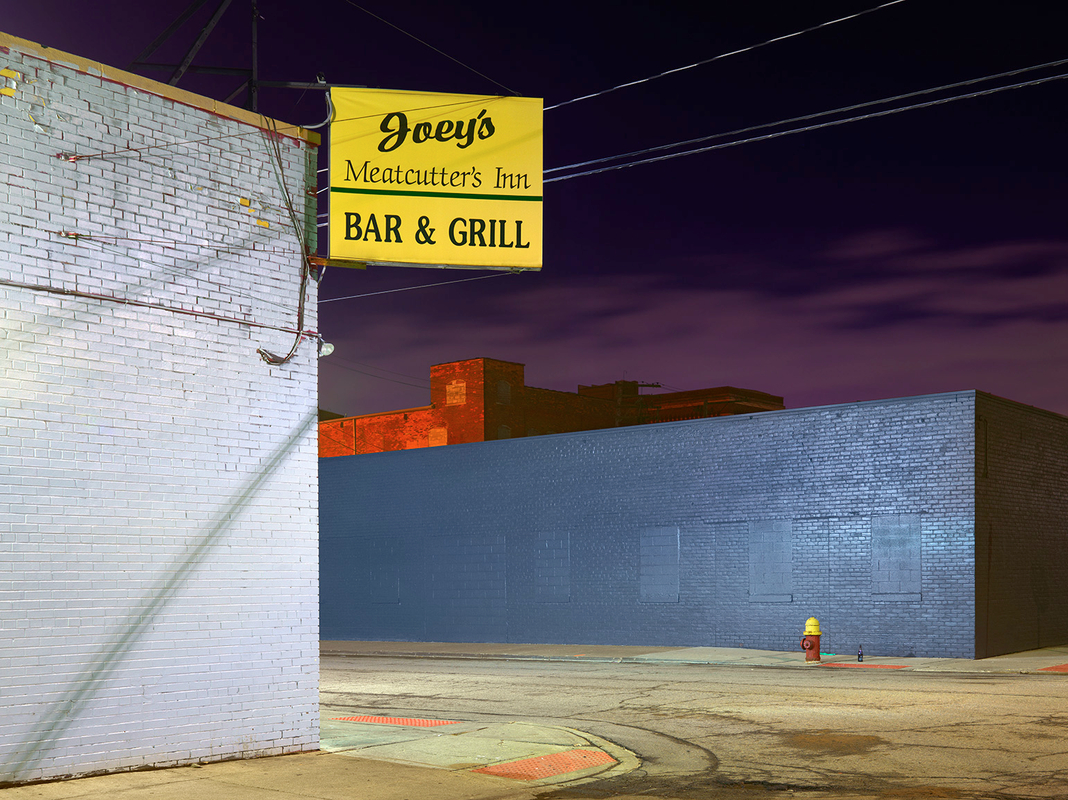
The lonely cityscape at night or the familiar glow of gas station lights cast into the American wilderness. The eye might want to linger among the colors, shapes and clouds even though the mind knows this is pretty much an empty street in a ‘post-industrial’ zone.
The Wise Men will unlearn your name. Above your head no star will flame. One weary sound will be the same— the hoarse roar of the gale. The shadows fall from your tired eyes as your lone bedside candle dies, for here the calendar breeds nights till stores of candles fail.
What prompts this melancholy key? A long familiar melody. It sounds again. So let it be. Let it sound from this night. Let it sound in my hour of death— as gratefulness of eyes and lips for that which sometimes makes us lift our gaze to the far sky.
You glare in silence at the wall. Your stocking gapes: no gifts at all. It’s clear that you are now too old to trust in good Saint Nick; that it’s too late for miracles. —But suddenly, lifting your eyes to heaven’s light, you realize: your life is a sheer gift.
What do they think has happened, the old fools, To make them like this? Do they somehow suppose It’s more grown-up when your mouth hangs open and drools, And you keep on pissing yourself, and can’t remember Who called this morning? Or that, if they only chose, They could alter things back to when they danced all night, Or went to their wedding, or sloped arms some September? Or do they fancy there’s really been no change, And they’ve always behaved as if they were crippled or tight, Or sat through days of thin continuous dreaming Watching the light move? If they don’t (and they can’t), it’s strange; Why aren’t they screaming?
At death you break up: the bits that were you Start speeding away from each other for ever With no one to see. It’s only oblivion, true: We had it before, but then it was going to end, And was all the time merging with a unique endeavour To bring to bloom the million-petalled flower Of being here. Next time you can’t pretend There’ll be anything else. And these are the first signs: Not knowing how, not hearing who, the power Of choosing gone. Their looks show that they’re for it: Ash hair, toad hands, prune face dried into lines – How can they ignore it?
Perhaps being old is having lighted rooms Inside your head, and people in them, acting People you know, yet can’t quite name; each looms Like a deep loss restored, from known doors turning, Setting down a lamp, smiling from a stair, extracting A known book from the shelves; or sometimes only The rooms themselves, chairs and a fire burning, The blown bush at the window, or the sun’s Faint friendliness on the wall some lonely Rain-ceased midsummer evening. That is where they live: Not here and now, but where all happened once. This is why they give
An air of baffled absence, trying to be there Yet being here. For the rooms grow farther, leaving Incompetent cold, the constant wear and tear Of taken breath, and them crouching below Extinction’s alp, the old fools, never perceiving How near it is. This must be what keeps them quiet: The peak that stays in view wherever we go For them is rising ground. Can they never tell What is dragging them back, and how it will end? Not at night? Not when the strangers come? Never, throughout The whole hideous inverted childhood? Well, We shall find out.
Out walking in the frozen swamp one gray day I paused and said, ‘I will turn back from here. No, I will go on farther – and we shall see’. The hard snow held me, save where now and then One foot went through. The view was all in lines Straight up and down of tall slim trees Too much alike to mark or name a place by So as to say for certain I was here Or somewhere else: I was just far from home. A small bird flew before me. He was careful To put a tree between us when he lighted, And say no word to tell me who he was Who was so foolish as to think what he thought. He thought that I was after him for a feather— The white one in his tail; like one who takes Everything said as personal to himself. One flight out sideways would have undeceived him. And then there was a pile of wood for which I forgot him and let his little fear Carry him off the way I might have gone, Without so much as wishing him good-night. He went behind it to make his last stand. It was a cord of maple, cut and split And piled and measured, four by four by eight. And not another like it could I see. No runner tracks in this year’s snow looped near it. And it was older sure than this year’s cutting, Or even last year’s or the year’s before. The wood was gray and the bark warping off it And the pile somewhat sunken. Clematis Had wound strings round and round it like a bundle. What held it though on one side was a tree Still growing, and on one a stake and prop, These latter about to fall. I thought that only Someone who lived in turning to fresh tasks Could so forget his handiwork on which He spent himself the labour of his axe, And leave it there far from a useful fireplace To warm the frozen swamp as best it could With the slow smokeless burning of decay.
Tell all the truth but tell it slant — Success in Circuit lies Too bright for our infirm Delight The Truth’s superb surprise As Lightning to the Children eased With explanation kind The Truth must dazzle gradually Or every man be blind —
Sundays too my father got up early and put his clothes on in the blueblack cold, then with cracked hands that ached from labor in the weekday weather made banked fires blaze. No one ever thanked him.
I’d wake and hear the cold splintering,breaking. When the rooms were warm, he’d call, and slowly I would rise and dress, fearing the chronic angers of that house,
speaking indifferently to him, who had driven out the cold and polished my good shoes as well. What did I know, what did I know of love’s austere and lonely offices?
Today, rousing from sleep, if your first sight was that of a young couple consumed by one another, silent within the silences of conversation, would it be as dark as the following?
I hope not!
Thanks to a reader.
From Richard Wilbur’s ‘Love Calls Us to the Things of This World’
…“Oh, let there be nothing on earth but laundry, Nothing but rosy hands in the rising steam And clear dances done in the sight of heaven.”
Yet, as the sun acknowledges With a warm look the world’s hunks and colors, The soul descends once more in bitter love To accept the waking body, saying now In a changed voice as the man yawns and rises, “Bring them down from their ruddy gallows; Let there be clean linen for the backs of thieves; Let lovers go fresh and sweet to be undone, And the heaviest nuns walk in a pure floating Of dark habits, keeping their difficult balance.”
When despair for the world grows in me and I wake in the night at the least sound in fear of what my life and my children’s lives may be, I go and lie down where the wood drake rests in his beauty on the water, and the great heron feeds. I come into the peace of wild things who do not tax their lives with forethought of grief. I come into the presence of still water. And I feel above me the day-blind stars waiting with their light. For a time I rest in the grace of the world, and am free.
Having used every subterfuge To shake you, lies, fatigue, or even that of passion, Now I see no way but a clean break. I add that I am willing to bear the guilt.
You nod assent. Autumn turns windy, huge, A clear vase of dry leaves vibrating on and on. We sit, watching. When I next speak Love buries itself in me, up to the hilt.
The trees are in their autumn beauty, The woodland paths are dry, Under the October twilight the water Mirrors a still sky; Upon the brimming water among the stones Are nine-and-fifty swans.
The nineteenth autumn has come upon me Since I first made my count; I saw, before I had well finished, All suddenly mount And scatter wheeling in great broken rings Upon their clamorous wings.
I have looked upon those brilliant creatures, And now my heart is sore. All’s changed since I, hearing at twilight, The first time on this shore, The bell-beat of their wings above my head, Trod with a lighter tread.
Unwearied still, lover by lover, They paddle in the cold Companionable streams or climb the air; Their hearts have not grown old; Passion or conquest, wander where they will, Attend upon them still.
But now they drift on the still water, Mysterious, beautiful; Among what rushes will they build, By what lake’s edge or pool Delight men’s eyes when I awake some day To find they have flown away?
A little authoritative and paternal, but a Romantic poet. A modernist, brilliant with language but precise in meaning, abstract, somewhat philosophical. They say he had a deathbed conversion. Here’s another line of his:
“The poem must resist the intelligence / Almost successfully.“
And then just to frustrate matters more:
Beauty is no quality in things themselves, it exists merely in the mind which contemplates them; and each mind perceives a different beauty.
Among the rain and lights I saw the figure 5 in gold on a red firetruck moving tense unheeded to gong clangs siren howls and wheels rumbling through the dark city.
‘Imagism was a sub-genre of Modernism concerned with creating clear imagery with sharp language. The essential idea was to re-create the physical experience of an object through words. As with all of Modernism, Imagism implicitly rejected Victorian poetry, which tended toward narrative.‘
And:
‘The most exemplified phase of Modernism, referred to as “High Modernism,” occurred during the inter-war years (1918-1939). This was the time when writers synonymous with Modernism, such as Virginia Woolf, James Joyce, T.S. Eliot, and D.H. Lawrence, thrived. While Victorians typically concerned themselves with rendering reality as they understood it into fiction, Modernists recognized that reality was subjective, and instead strove to represent human psychology in fiction.‘
During the post-war years, the confessionals, with a fair amount of free and blank verse became dominant, with a kind of feelings-first, psychological exploration of the (S)elf.
Dear Reader, this photograph represents the closest I’ve gotten to elements of the modernist imagination so far. I hope you enjoy. The Straussian movement pushes back to a kind of classicist revival, an embrace of tradition, and rejection of much modernity.
***On second-thought, the photo of these parts of very real thing is abstracted into a kind of modernesque design.
My long two-pointed ladder’s sticking through a tree Toward heaven still, And there’s a barrel that I didn’t fill Beside it, and there may be two or three Apples I didn’t pick upon some bough. But I am done with apple-picking now. Essence of winter sleep is on the night, The scent of apples: I am drowsing off. I cannot rub the strangeness from my sight I got from looking through a pane of glass I skimmed this morning from the drinking trough And held against the world of hoary grass. It melted, and I let it fall and break. But I was well Upon my way to sleep before it fell, And I could tell What form my dreaming was about to take. Magnified apples appear and disappear, Stem end and blossom end, And every fleck of russet showing clear. My instep arch not only keeps the ache, It keeps the pressure of a ladder-round. I feel the ladder sway as the boughs bend. And I keep hearing from the cellar bin The rumbling sound Of load on load of apples coming in. For I have had too much Of apple-picking: I am overtired Of the great harvest I myself desired. There were ten thousand thousand fruit to touch, Cherish in hand, lift down, and not let fall. For all That struck the earth, No matter if not bruised or spiked with stubble, Went surely to the cider-apple heap As of no worth. One can see what will trouble This sleep of mine, whatever sleep it is. Were he not gone, The woodchuck could say whether it’s like his Long sleep, as I describe its coming on, Or just some human sleep.
Not from the stars do I my judgment pluck; And yet methinks I have astronomy, But not to tell of good or evil luck, Of plagues, of dearths, or seasons’ quality; Nor can I fortune to brief minutes tell, Pointing to each his thunder, rain and wind, Or say with princes if it shall go well, By oft predict that I in heaven find: But from thine eyes my knowledge I derive, And, constant stars, in them I read such art As truth and beauty shall together thrive, If from thyself to store thou wouldst convert; Or else of thee this I prognosticate: Thy end is truth’s and beauty’s doom and date.
When you are old and gray and full of sleep, And nodding by the fire, take down this book, And slowly read, and dream of the soft look Your eyes had once, and of their shadows deep;
How many loved your moments of glad grace, And loved your beauty with love false or true, But one man loved the pilgrim soul in you, And loved the sorrows of your changing face;
And bending down beside the glowing bars, Murmur, a little sadly, how Love fled And paced upon the mountains overhead And hid his face among a crowd of stars.
I knew a woman, lovely in her bones, When small birds sighed, she would sigh back at them; Ah, when she moved, she moved more ways than one: The shapes a bright container can contain! Of her choice virtues only gods should speak, Or English poets who grew up on Greek (I’d have them sing in chorus, cheek to cheek).
How well her wishes went! She stroked my chin, She taught me Turn, and Counter-turn, and Stand; She taught me Touch, that undulant white skin; I nibbled meekly from her proffered hand; She was the sickle; I, poor I, the rake, Coming behind her for her pretty sake (But what prodigious mowing we did make).
Love likes a gander, and adores a goose: Her full lips pursed, the errant note to seize; She played it quick, she played it light and loose; My eyes, they dazzled at her flowing knees; Her several parts could keep a pure repose, Or one hip quiver with a mobile nose (She moved in circles, and those circles moved).
Let seed be grass, and grass turn into hay: I’m martyr to a motion not my own; What’s freedom for? To know eternity. I swear she cast a shadow white as stone. But who would count eternity in days? These old bones live to learn her wanton ways: (I measure time by how a body sways).
Say of the gulls that they are flying in light blue air over dark blue sea
II
Music more than a breath, but less Than the wind, sub-music like sub-speech, A repetition of unconscious things, Letters of rock and water, words Of the visible elements and of ours.
III
The rocks of the cliffs are the heads of dogs That turn into fishes and leap Into the sea.
IV
Star over Monhegan, Atlantic star, Lantern without a bearer, you drift, You, too, are drifting, in spite of your course; Unless in the darkness, brightly-crowned You are the will, if there is a will, Or the portent of a will that was, One of the portents of the will that was.
Jim just loves to garden, yes he does. He likes nothing better than to put on his little overalls and his straw hat. He says, “Let’s go get those tools, Jim.” But then doubt begins to set in. He says, “What is a garden, anyway?” And thoughts about a “modernistic” garden begin to trouble him, eat away at his resolve. He stands in the driveway a long time. “Horticulture is a groping in the dark into the obscure and unfamiliar, kneeling before a disinterested secret, slapping it, punching it like a Chinese puzzle, birdbrained, babbling gibberish, dig and destroy, pull out and apply salt, hoe and spray, before it spreads, burn roots, where not desired, with gloved hands, poisonous, the self-sacrifice of it, the self-love, into the interior, thunderclap, excruciating, through the nose, the earsplitting necrology of it, the withering, shriveling, the handy hose holder and Persian insect powder and smut fungi, the enemies of the iris, wireworms are worse than their parents, there is no way out, flowers as big as heads, pock-marked, disfigured, blinking insolently at me, the me who so loves to garden because it prevents the heaving of the ground and the untimely death of porch furniture, and dark, murky days in a large city and the dream home under a permanent storm is also a factor to keep in mind.”
The art of losing isn’t hard to master; so many things seem filled with the intent to be lost that their loss is no disaster,
Lose something every day. Accept the fluster of lost door keys, the hour badly spent. The art of losing isn’t hard to master.
Then practice losing farther, losing faster: places, and names, and where it was you meant to travel. None of these will bring disaster.
I lost my mother’s watch. And look! my last, or next-to-last, of three loved houses went. The art of losing isn’t hard to master.
I lost two cities, lovely ones. And, vaster, some realms I owned, two rivers, a continent. I miss them, but it wasn’t a disaster.
– Even losing you (the joking voice, a gesture I love) I shan’t have lied. It’s evident the art of losing’s not too hard to master though it may look like (Write it!) like disaster.
Twas noontide of summer, And mid-time of night; And stars, in their orbits, Shone pale, thro’ the light Of the brighter, cold moon, ‘Mid planets her slaves, Herself in the Heavens, Her beam on the waves. I gazed awhile On her cold smile; Too cold- too cold for me- There pass’d, as a shroud, A fleecy cloud, And I turned away to thee, Proud Evening Star, In thy glory afar, And dearer thy beam shall be; For joy to my heart Is the proud part Thou bearest in Heaven at night, And more I admire Thy distant fire, Than that colder, lowly light.
The sea is calm to-night. The tide is full, the moon lies fair Upon the straits; – on the French coast the light Gleams and is gone; the cliffs of England stand, Glimmering and vast, out in the tranquil bay. Come to the window, sweet is the night-air! Only, from the long line of spray Where the sea meets the moon-blanch’d land, Listen! you hear the grating roar Of pebbles which the waves draw back, and fling, At their return, up the high strand, Begin, and cease, and then again begin, With tremulous cadence slow, and bring The eternal note of sadness in.Sophocles long ago Heard it on the {AE}gean, and it brought Into his mind the turbid ebb and flow Of human misery; we Find also in the sound a thought, Hearing it by this distant northern sea.The Sea of Faith Was once, too, at the full, and round earth’s shore Lay like the folds of a bright girdle furl’d. But now I only hear Its melancholy, long, withdrawing roar, Retreating, to the breath Of the night-wind, down the vast edges drear And naked shingles of the world.Ah, love, let us be true To one another! for the world, which seems To lie before us like a land of dreams, So various, so beautiful, so new, Hath really neither joy, nor love, nor light, Nor certitude, nor peace, nor help for pain; And we are here as on a darkling plain Swept with confused alarms of struggle and flight, Where ignorant armies clash by night.
Shine alone in the sunrise toward which you lend no part!
I
Shine alone, shine nakedly, shine like bronze that reflects neither my face nor any inner part of my being, shine like fire, that mirrors nothing.
II
Lend no part to any humanity that suffuses you in its own light. Be not chimera of morning, Half-man, half-star. Be not an intelligence, Like a widow’s bird Or an old horse.
In June, amid the golden fields, I saw a groundhog lying dead. Dead lay he; my senses shook, And mind outshot our naked frailty. There lowly in the vigorous summer His form began its senseless change, And made my senses waver dim Seeing nature ferocious in him. Inspecting close his maggots’ might And seething cauldron of his being, Half with loathing, half with a strange love, I poked him with an angry stick. The fever arose, became a flame And Vigour circumscribed the skies, Immense energy in the sun, And through my frame a sunless trembling. My stick had done nor good nor harm. Then stood I silent in the day Watching the object, as before; And kept my reverence for knowledge Trying for control, to be still, To quell the passion of the blood; Until I had bent down on my knees Praying for joy in the sight of decay. And so I left; and I returned In Autumn strict of eye, to see The sap gone out of the groundhog, But the bony sodden hulk remained. But the year had lost its meaning, And in intellectual chains I lost both love and loathing, Mured up in the wall of wisdom. Another summer took the fields again Massive and burning, full of life, But when I chanced upon the spot There was only a little hair left, And bones bleaching in the sunlight Beautiful as architecture; I watched them like a geometer, And cut a walking stick from a birch. It has been three years, now. There is no sign of the groundhog. I stood there in the whirling summer, My hand capped a withered heart, And thought of China and of Greece, Of Alexander in his tent; Of Montaigne in his tower, Of Saint Theresa in her wild lament.
The underground roads Are, as the dead prefer them, Always tortuous. – – – When he looked the cave in the eye, Hercules Had a moment of doubt. – – – Leaning out over The dreadful precipice, One contemptuous tree.
Complacencies of the peignoir, and late Coffee and oranges in a sunny chair, And the green freedom of a cockatoo Upon a rug mingle to dissipate The holy hush of ancient sacrifice. She dreams a little, and she feels the dark Encroachment of that old catastrophe, As a calm darkens among water-lights. The pungent oranges and bright, green wings Seem things in some procession of the dead, Winding across wide water, without sound. The day is like wide water, without sound, Stilled for the passing of her dreaming feet Over the seas, to silent Palestine, Dominion of the blood and sepulchre.
II
Why should she give her bounty to the dead? What is divinity if it can come Only in silent shadows and in dreams? Shall she not find in comforts of the sun, In pungent fruit and bright, green wings, or else In any balm or beauty of the earth, Things to be cherished like the thought of heaven? Divinity must live within herself: Passions of rain, or moods in falling snow; Grievings in loneliness, or unsubdued Elations when the forest blooms; gusty Emotions on wet roads on autumn nights; All pleasures and all pains, remembering The bough of summer and the winter branch. These are the measures destined for her soul.
III
Jove in the clouds had his inhuman birth. No mother suckled him, no sweet land gave Large-mannered motions to his mythy mind. He moved among us, as a muttering king, Magnificent, would move among his hinds, Until our blood, commingling, virginal, With heaven, brought such requital to desire The very hinds discerned it, in a star. Shall our blood fail? Or shall it come to be The blood of paradise? And shall the earth Seem all of paradise that we shall know? The sky will be much friendlier then than now, A part of labor and a part of pain, And next in glory to enduring love, Not this dividing and indifferent blue.
IV
She says, “I am content when wakened birds, Before they fly, test the reality Of misty fields, by their sweet questionings; But when the birds are gone, and their warm fields Return no more, where, then, is paradise?” There is not any haunt of prophecy, Nor any old chimera of the grave, Neither the golden underground, nor isle Melodious, where spirits gat them home, Nor visionary south, nor cloudy palm Remote on heaven’s hill, that has endured As April’s green endures; or will endure Like her remembrance of awakened birds, Or her desire for June and evening, tipped By the consummation of the swallow’s wings.
V
She says, “But in contentment I still feel The need of some imperishable bliss.” Death is the mother of beauty; hence from her, Alone, shall come fulfilment to our dreams And our desires. Although she strews the leaves Of sure obliteration on our paths, The path sick sorrow took, the many paths Where triumph rang its brassy phrase, or love Whispered a little out of tenderness, She makes the willow shiver in the sun For maidens who were wont to sit and gaze Upon the grass, relinquished to their feet. She causes boys to pile new plums and pears On disregarded plate. The maidens taste And stray impassioned in the littering leaves.
VI
Is there no change of death in paradise? Does ripe fruit never fall? Or do the boughs Hang always heavy in that perfect sky, Unchanging, yet so like our perishing earth, With rivers like our own that seek for seas They never find, the same receding shores That never touch with inarticulate pang? Why set the pear upon those river-banks Or spice the shores with odors of the plum? Alas, that they should wear our colors there, The silken weavings of our afternoons, And pick the strings of our insipid lutes! Death is the mother of beauty, mystical, Within whose burning bosom we devise Our earthly mothers waiting, sleeplessly.
VII
Supple and turbulent, a ring of men Shall chant in orgy on a summer morn Their boisterous devotion to the sun, Not as a god, but as a god might be, Naked among them, like a savage source. Their chant shall be a chant of paradise, Out of their blood, returning to the sky; And in their chant shall enter, voice by voice, The windy lake wherein their lord delights, The trees, like serafin, and echoing hills, That choir among themselves long afterward. They shall know well the heavenly fellowship Of men that perish and of summer morn. And whence they came and whither they shall go The dew upon their feet shall manifest.
VIII
She hears, upon that water without sound, A voice that cries, “The tomb in Palestine Is not the porch of spirits lingering. It is the grave of Jesus, where he lay.” We live in an old chaos of the sun, Or old dependency of day and night, Or island solitude, unsponsored, free, Of that wide water, inescapable. Deer walk upon our mountains, and the quail Whistle about us their spontaneous cries; Sweet berries ripen in the wilderness; And, in the isolation of the sky, At evening, casual flocks of pigeons make Ambiguous undulations as they sink, Downward to darkness, on extended wings.
Twirling your blue skirts, travelling the sward Under the towers of your seminary, Go listen to your teachers old and contrary Without believing a word.
Tie the white fillets then about your hair And think no more of what will come to pass Than bluebirds that go walking on the grass And chattering on the air.
Practice your beauty, blue girls, before it fail; And I will cry with my loud lips and publish Beauty which all our power shall never establish, It is so frail.
For I could tell you a story which is true; I know a woman with a terrible tongue, Blear eyes fallen from blue, All her perfections tarnished — yet it is not long Since she was lovelier than any of you.
‘The most useful definition of modernist fiction I’ve encountered comes from Brian McHale’s Postmodernist Fiction. He says modernist fiction tends to “foreground epistemological questions” such as “How can I interpret the world I’m part of? What is there to be known? Who knows it? What are the limits of that knowledge?” In contrast, postmodernist fiction tends to “foreground ontological questions” such as “What is a world? What kinds of worlds are there and how are they constituted? What happens when…boundaries between worlds are violated?’
As to the epistemological questions surrounding Modernism, below are four poems. Hopefully, each is a representative example of a move away from the Romanticism that had been prevalent up until the late 1800’s.
In addition to the move away from traditional Romantic rhyme and meter towards modern blank verse, there’s also a certain conception of the Self rendered in them; a presentation of our natures that might be worth examining in some detail.
I believe we can see clearly a move away from tradition towards the Self, the Poet isolated, the poem itself as a means of communication, and an anxiety so common within the 20th century.
‘At the heart of Bloom’s project is the ancient quarrel between “poetry” and “philosophy.” In Bloom’s opinion, we ought not have to choose between Homer and Plato; we can have both, as long as we recognize that poetry is superior.’
Says the guy who writes about poetry…
What does one find within, as one looks without, waking from sleep and dream?
What kind of world is this, and can the poet actually help us know it?
You tossed a blanket from the bed You lay upon your back, and waited; You dozed, and watched the night revealing The thousand sordid images Of which your soul was constituted; They flickered against the ceiling. And when all the world came back And the light crept up between the shutters And you heard the sparrows in the gutters, You had such a vision of the street As the street hardly understands; Sitting along the bed’s edge, where You curled the papers from your hair, Or clasped the yellow soles of feet In the palms of both soiled hands.
—
The world will stain you, and it is a fallen, modern world, rendered profoundly and exquisitely.
As consciousness creeps in, building a bridge to the day, to the world, to the facts left as though they were the first facts, the light as though it were the first light, what one finds is distressing, both within and without.
That distress must be ‘made new,’ which is to say, the suffering (original?) in which we all sometimes find ourselves must match our experiences within the modern city and world, at least, the world created within Eliot’s lyrical verse.
Of the four poems, only the first and last have a 3rd-person subject.
—
Wallace Stevens‘ ‘I’ is in a more contemplative state, but it’s an ‘I’ exploring similar themes, and experiencing some distress in trying to know how the world actually is, and what might lie within.
The journey to The Self may not be a journey for the faint of heart.
The Poems Of Our Climate (stanzas II and III)
II Say even that this complete simplicity Stripped one of all one’s torments, concealed The evilly compounded, vital I And made it fresh in a world of white, A world of clear water, brilliant-edged, Still one would want more, one would need more, More than a world of white and snowy scents.
III There would still remain the never-resting mind, So that one would want to escape, come back To what had been so long composed. The imperfect is our paradise. Note that, in this bitterness, delight, Since the imperfect is so hot in us, Lies in flawed words and stubborn sounds.
—
Even if the verse can describe a perfected world, delivering us, perhaps, a little closer to perfection, our poet is still not free from the impulses and desires which simply never cease.
Interestingly, we end-up not with a discussion of the heart, the spirit, libido etc. as a source for those desires (for Plato, the irrational), but rather, for Stevens, just a mind.
We also find more Romantic elements of language and an almost baroque/rococo arrangement of words and ideas, dandyish even, yet combined with an intense effort to abstract, define, and clarify. From here, the poet may proceed on his task of flawed words and stubborn sounds.
***I find myself thinking of elements of modern architecture and abstract-expressionist painting. The meaning, or at least some delivery from our restless existences, can be found within the abstract itself. Or at least within a retreat to the abstract for its own sake, away from the world.
The modernist, glass-walled house on the hill will exist in its own space, offering and defying meaning. The structure’s own shapes will be stripped down to often mathematically precise forms interacting with Nature. These shall guide Man, or at least offer individual men a little refuge.
It is perhaps in Stevens’ poem we can see the questions of knowledge about the world suggesting questions about whether there is a world at all, or, at least, what kind of worlds each Self might be able to inhabit.
—
Here’s one of Robert Lowell’s poems, occurring a generation later, in the mid 20th-century, as part of the confessionals.
The Self is extremely isolated. In fact, Lowell went more than a little crazy. Unlike the known nervous breakdown of Eliot from which Eliot recovered, Lowell’s life was essentially one long breakdown from which he never recovered.
Here he is, looking back:
Epilogue
Those blessed structures plot and rhyme- why are they no help to me now i want to make something imagined not recalled? I hear the noise of my own voice: The painter’s vision is not a lens it trembles to caress the light. But sometimes everything i write With the threadbare art of my eye seems a snapshot lurid rapid garish grouped heightened from life yet paralyzed by fact. All’s misalliance. Yet why not say what happened? Pray for the grace of accuracy Vermeer gave to the sun’s illumination stealing like the tide across a map to his girl solid with yearning. We are poor passing facts. warned by that to give each figure in the photograph his living name.
—
The weight of having to make that meaning, for yourself, and by yourself, is a horrible weight indeed. One can glorify one’s Self and family, but that, alas, only goes so far. Rhyme and form still carry one’s living name, as far as they do.
Of course, there’s still wonderful rhythm and form here (this is excellent verse), but blanker now, with a relentless focus on the ‘I.’ The poet is perhaps talking a little more to himself, and the poem keeps self-consciously calling attention to itself.
—
In fact, it reminded me of the poem below, by Robert Creeley, which was published a few years afterwards.
From this page:
‘Creeley was a leader in the generational shift that veered away from history and tradition as primary poetic sources and gave new prominence to the ongoing experiences of an individual’s life. Because of this emphasis, the major events of his life loom large in his literary work.’
There’s Nothing but the Self and the Eye seeking and making meaning, by itself within a void of emotionally compact and precise language (of course there’s still form and other things besides).
Can the poet fit inside the little abstract chapel of words he’s building for himself (let alone the world, tradition etc.)?
For all the talk about ‘space,’ there seems very little.
The Window
Position is where you put it, where it is, did you, for example, that
large tank there, silvered, with the white church along- side, lift
all that, to what purpose? How heavy the slow
world is with everything put in place. Some
man walks by, a car beside him on the dropped
road, a leaf of yellow color is going to
fall. It all drops into place. My
face is heavy with the sight. I can feel my eye breaking.
—
The distress is still there…but I’d argue that we are now a good distance away from the grandness of Eliot’s vision, his religiosity and virtuosity with form and meter at the dawn of Modernism. Very few people can/could do what Eliot did (addition: even if he can help us gain knowledge of our Selves or the world).
That said, it’s unclear there’s enough tradition and confidence to even undertake such a project, now, even as such talents come along. The state of things is more scattered. We’re in a very different place of selves and artists isolated, of anxiety and post-anxiety.
Aside from the very accomplished poets above, in terms of both knowledge (epistemology) and being (ontology), we often have writers feeling pressure to weigh-in on such questions without even being about to write that well; artists who can’t draw or paint that well, and frankly, quite a bit of bullshit besides.
So, where are we headed? Who’s ‘we’ exactly?
Predictions are hard, especially about the future.
As previously posted:
Why not just put a few algorithms to work in writing those artist statements?
‘In “Sea Change,” Graham becomes Prospero, casting spells by spelling out her thoughts to merge with ours, and with the voices of the elements. The result is a mingling of perceptions rather than a broadcasting of opinions. Instead of analysis, the poems encourage emotional involvement with the drastic changes overwhelming us, overwhelm- ing the planet.’
and:
‘Strengths and weaknesses, flows and ebbs, yet every poem in “Sea Change” bears memorable lines, with almost haunting (if we truly have but 10 years to “fix” global warming) images of flora and fauna under siege. Jorie Graham has composed a swan song for Earth.’
Oh boy.
What are these poems being asked to do?
And moving away from poetry into the realm of ‘performance art,’
When I consider every thing that grows Holds in perfection but a little moment, That this huge stage presenteth nought but shows Whereon the stars in secret influence comment; When I perceive that men as plants increase, Cheered and checked even by the selfsame sky, Vaunt in their youthful sap, at height decrease, And wear their brave state out of memory: Then the conceit of this inconstant stay Sets you most rich in youth before my sight, Where wasteful Time debateth with Decay To change your day of youth to sullied night, And all in war with Time for love of you, As he takes from you, I ingraft you new.
Something of how the homing bee at dusk Seems to inquire, perplexed, how there can be No flowers here, not even withered stalks of flowers, Conjures a garden where no garden is And trellises too frail almost to bear The memory of a rose, much less a rose. Great oaks more monumentally great oaks now Than ever when the living rose was new Cast shade that is the more completely shade Upon a house of broken windows merely And empty nests up under broken eaves No damask any more prevents the moon, But it unravels, peeling from a wall, Red roses within roses within roses.
Interesting written interview on Southern Stoicism, with mention of Walker Percy.
Flannery O’Connor’s Southern Gothic style often flirts with the grotesque, and can traffic in the macabre, but there’s reason behind it, and a brilliantly skeptical, humane eye.
‘They had reached the bus stop. There was no bus in sight and Julian, his hands still jammed in his pockets and his head thrust forward, scowled down the empty street. The frustration of having to wait on the bus as well as ride on it began to creep up his neck like a hot hand. The presence of his mother was borne in upon him as she gave a pained sigh. He looked at her bleakly. She was holding herself very erect under the preposterous hat, wearing it like a banner of her imaginary dignity. There was in him an evil urge to break her spirit. He suddenly unloosened his tie and pulled it off and put it in his pocket’
Nelson, composing his expression under the shadow of his hat brim, watched him with a mixture of fatigue and suspicion, but as the train glided past them and disappeared like a frightened serpent into the woods, even his face lightened and he muttered, “I’m glad I’ve went once, but I’ll never go back again!”
Twenty men crossing a bridge, Into a village, Are twenty men crossing twenty bridges, Into twenty villages, Or one man Crossing a single bridge into a village.
This is old song That will not declare itself . . .
Twenty men crossing a bridge, Into a village, Are Twenty men crossing a bridge Into a village.
That will not declare itself Yet is certain as meaning . . .
The boots of the men clump On the boards of the bridge. The first white wall of the village Rises through fruit-trees. Of what was it I was thinking? So the meaning escapes.
The first white wall of the village . . . The fruit-trees. . . .
Thoughts while you’re walking? marching? with a destination?
Out walking in the frozen swamp one gray day I paused and said, ‘I will turn back from here. No, I will go on farther – and we shall see’. The hard snow held me, save where now and then One foot went through. The view was all in lines Straight up and down of tall slim trees Too much alike to mark or name a place by So as to say for certain I was here Or somewhere else: I was just far from home. A small bird flew before me. He was careful To put a tree between us when he lighted, And say no word to tell me who he was Who was so foolish as to think what he thought. He thought that I was after him for a feather— The white one in his tail; like one who takes Everything said as personal to himself. One flight out sideways would have undeceived him. And then there was a pile of wood for which I forgot him and let his little fear Carry him off the way I might have gone, Without so much as wishing him good-night. He went behind it to make his last stand. It was a cord of maple, cut and split And piled and measured, four by four by eight. And not another like it could I see. No runner tracks in this year’s snow looped near it. And it was older sure than this year’s cutting, Or even last year’s or the year’s before. The wood was gray and the bark warping off it And the pile somewhat sunken. Clematis Had wound strings round and round it like a bundle. What held it though on one side was a tree Still growing, and on one a stake and prop, These latter about to fall. I thought that only Someone who lived in turning to fresh tasks Could so forget his handiwork on which He spent himself the labour of his axe, And leave it there far from a useful fireplace To warm the frozen swamp as best it could With the slow smokeless burning of decay.
Snow falls: years of anger following hours that float idly down — the blizzard drifts its weight deeper and deeper for three days or sixty years, eh? Then the sun! a clutter of yellow and blue flakes — Hairy looking trees stand out in long alleys over a wild solitude. The man turns and there — his solitary track stretched out upon the world.
A little bit about politics and also the politics amidst fellow writers and critics:
‘…when in doubt, I always follow the simple method of choosing that line of conduct which may be the most displeasing to the Reds and the Russells.’
and:
‘Who’s in, who’s out, and where are the snows of yesteryear. All very amusing. I am a little sorry to be left out. Nobody can decide if I am a middle-aged American writer or an old Russian writer—or an ageless international freak.’
On his professional collection of butterflies:
‘The pleasures and rewards of literary inspiration are nothing beside the rapture of discovering a new organ under the microscope or an undescribed species on a mountainside in Iran or Peru. It is not improbable that had there been no revolution in Russia, I would have devoted myself entirely to lepidopterology and never written any novels at all.’
Via Youtube: An interviewer, Nabokov and Lionel Trilling discuss ‘Lolita:’