“The problem of how a judgment can be synthetic and a priori, then, presents itself to Kant as the problem of how two concepts, neither of which includes the other, can be connected in a way which does not rest upon past experience and is not vulnerable to future experience.”
“First, if any opinion is compelled to silence, that opinion may, for aught we can certainly know, be true. To deny this is to assume our own infallibility.’
‘Secondly, though the silenced opinion be an error, it may, and very commonly does, contain a portion of truth; and since the general or prevailing opinion on any subject is rarely or never the whole truth, it is only by the collision of adverse opinions that the remainder of the truth has any chance of being supplied. ‘
‘Thirdly, even if the received opinion be not only true, but the whole truth; unless it is suffered to be, and actually is, vigorously and earnestly contested, it will, by most of those who receive it, be held in the manner of a prejudice, with little comprehension or feeling of its rational grounds. ‘
And not only this, but, fourthly, the meaning of the doctrine itself will be in danger of being lost, or enfeebled, and deprived of its vital effect on the character and conduct: the dogma becoming a mere formal profession, inefficacious for good, but cumbering the ground, and preventing the growth of any real and heartfelt conviction, from reason or personal experience.”
Having used every subterfuge To shake you, lies, fatigue, or even that of passion, Now I see no way but a clean break. I add that I am willing to bear the guilt.
You nod assent. Autumn turns windy, huge, A clear vase of dry leaves vibrating on and on. We sit, watching. When I next speak Love buries itself in me, up to the hilt.
‘The fact is, even the sternest ascetic tends to be slightly inconsistent in his condemnation of pleasure. He may sentence you to a life of hard labour, inadequate sleep, and general discomfort, but he’ll also tell you to do your best to ease the pains and privations of others. He’ll regard all such attempts to improve the human situation as laudable acts of humanity – for obviously nothing could be more humane, or more natural for a human being, than to relieve other people’s sufferings, put an end to their miseries, and restore their joie de vivre, that is, their capacity for pleasure. So, why shouldn’t it be equally natural to do the same thing for oneself?’
More, Thomas. Utopia. Penguin (trans. Paul Turner), 1965. Print.
“His problem (Plato’s) with the arts was that they operated by images rather than by ideas, and thus that they might cloud the truth rather than clarifying it.”
Yes, and religious traditions, for example, also have interpretations of how one ought to reproduce the image.
“Whatever one thinks of Plato’s solution to this problem, I suggest that this is one of the problems that elicited his proposals for severe censorship of the arts he so obviously loved and had been trained in.”
That time of year thou mayst in me behold When yellow leaves, or none, or few, do hang Upon those boughs which shake against the cold, Bare ruined choirs, where late the sweet birds sang. In me thou see’st the twilight of such day As after sunset fadeth in the west; Which by and by black night doth take away, Death’s second self, that seals up all in rest. In me thou see’st the glowing of such fire, That on the ashes of his youth doth lie, As the deathbed whereon it must expire, Consumed with that which it was nourished by. This thou perceiv’st, which makes thy love more strong, To love that well which thou must leave ere long.
Land-art pieces are site-specific. They require you to be there and experience them, designed as they are to be within the specific spaces they occupy.
In so doing, they break from previous modernist ‘Readymades‘ and reproduced images (I don’t know about you, but I’m tiring of so many commentaries on consumerism, the desire for craft over mass production, a certain collective vagueness against such disposability…the dream of unique Selfhood, celebrity even, amidst a thousand urinals).
As a viewer, you’re supposed to interact with these pieces and start feeling and thinking differently than perhaps you might have otherwise. Walk around, through, and over them. View one hillock from another. Walk back over to the first hillock and look from whence you came. The view is never quite what you were imagining.
Time is clearly intended to be an element, here; the long sweep of geologic and/or historical time as the artist understands it, as well as the relative brevity of personal time during just a 10-minute visit.
These pieces can act as signposts towards Nature and what we can begin to observe of our specific natural environments (steel rusts in unique, but perhaps underlying, patterns…winds blow at different angles and around different obstacles in one grove as opposed to another, these lichens are growing here…other lichens over there, are they the same species?).
If you pull the piece out of its specific environment, it may just wither and die, looking out-of-place as many other products of civilization do amidst natural settings (a jar in Tennessee). Perhaps, though, they won’t look quite so out-of-place as mass-produced objects because of such careful design and attention to detail.
That said, these pieces will eventually look quite awkward undergoing the changes they will undergo if Nature’s Laws are any guide (Romantic/Modernist recreations of Nature can promise the comforts of Home).
Here’s Wikipedia, keeping it simple:
‘Land art, earthworks (coined by Robert Smithson), or Earth art is an art movement in which landscape and the work of art are inextricably linked.’
‘Robert Smithson and Richard Serra both believed that sculpture should have a dialog with its environment. This program explores the challenging dialectic of the site-specific sculpture of Smithson and Serra through examples of their work. In an interview, Serra discusses the aspects of time and context in relation to his art as well as the influence of Smithson.’
Maybe it’s worth pointing out that Serra seems interested in symmetry, visualizing and realizing abstract shapes with the help of some mathematics and the practice of drawing/drafting. Interesting problems can arise from tooling around with shapes on paper (a practice of Serra’s), the kind I’m guessing folks fascinated by puzzles and software and math love to solve.
But Serra’s not a mathematician nor an engineer nor an architect. He’s not writing a proof for its own sake nor building bridges nor houses for practical use.
Rather, the intuitive and creative impulses of the artist take over in his work, a kind of creative exploration, as well as the dialog between fellow artists, living and dead.
Much (A)rt, of course, is useless for most, if not all, purposes. It’s one of the things that can make it meaningful for people. There can be a significant gap between what the artist may have felt, thought and realized, and which emotions, thoughts and experiences any viewer/listener might have in interacting with a particular piece.
Serra, in his work, wants to alter the thinking of anyone moving through the space he creates by manipulating specific substances like steel (he has a facility with the material), and by getting viewers to a point of reorientation of spatial and temporal awareness.
Of course, this involves reorientation towards certain ideas as he understands them, and by promising people a return to themselves, or a state of experience and creative play perhaps similar to that of the artist.
Here’s a Charlie Rose interview:
More about Land Artists:
Any thoughts and comments are welcome. Feel free to highlight my ignorance…
Sundays too my father got up early and put his clothes on in the blueblack cold, then with cracked hands that ached from labor in the weekday weather made banked fires blaze. No one ever thanked him.
I’d wake and hear the cold splintering,breaking. When the rooms were warm, he’d call, and slowly I would rise and dress, fearing the chronic angers of that house,
speaking indifferently to him, who had driven out the cold and polished my good shoes as well. What did I know, what did I know of love’s austere and lonely offices?
The art of losing isn’t hard to master; so many things seem filled with the intent to be lost that their loss is no disaster,
Lose something every day. Accept the fluster of lost door keys, the hour badly spent. The art of losing isn’t hard to master.
Then practice losing farther, losing faster: places, and names, and where it was you meant to travel. None of these will bring disaster.
I lost my mother’s watch. And look! my last, or next-to-last, of three loved houses went. The art of losing isn’t hard to master.
I lost two cities, lovely ones. And, vaster, some realms I owned, two rivers, a continent. I miss them, but it wasn’t a disaster.
– Even losing you (the joking voice, a gesture I love) I shan’t have lied. It’s evident the art of losing’s not too hard to master though it may look like (Write it!) like disaster.
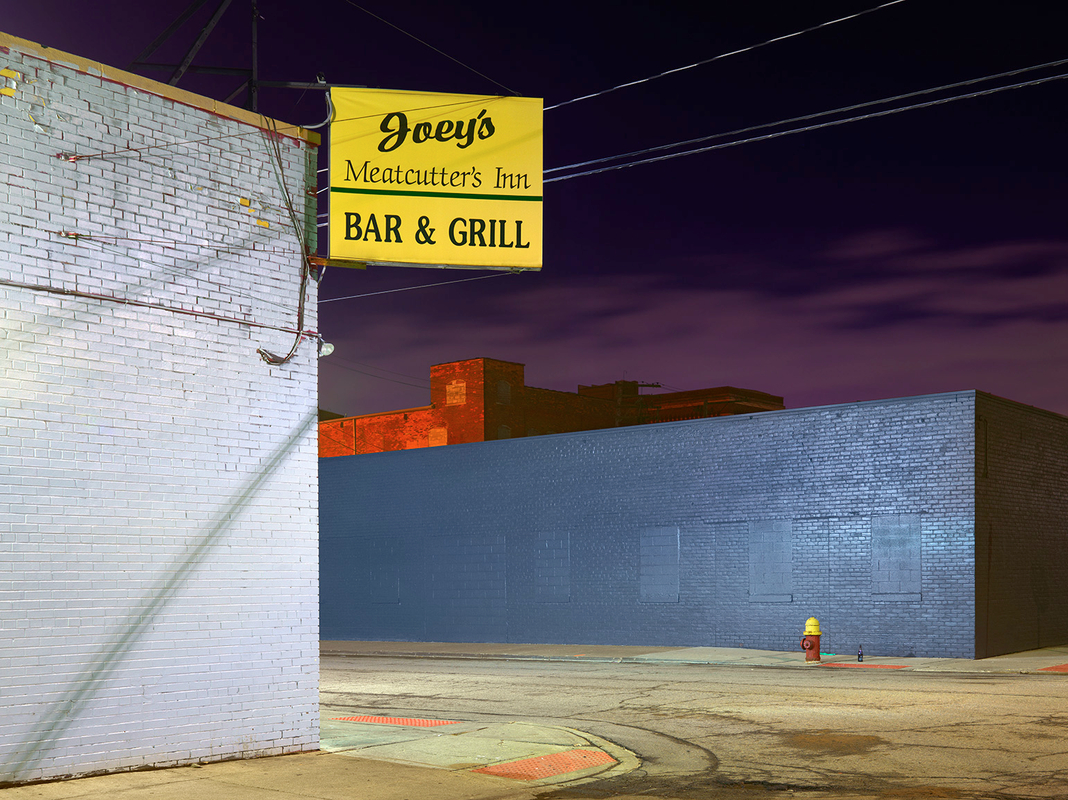
Immediately, I think of Edward Hopper: The lonely cityscape at night or the familiar glow of gas station lights cast into the American wilderness. The eye might want to linger among the colors, shapes and clouds even though the mind knows this is pretty much an empty street in a ‘post-industrial’ zone.
Perhaps it has do with another strand of expression: The break into free verse from past forms. The move from American Romanticism to Modernism which occurred this early past century. William Carlos Williams produced many good poems from a process of earnest, scrapbook-style intensity in trying to discover, redefine, and order a new poetic form within a modern ‘urban landscape.’
The individual artist is quite alone in the task he’s set before himself, and like much of modernism, it’s a rather big task.
Pastoral
When I was younger it was plain to me I must make something of myself. Older now I walk back streets admiring the houses of the very poor: roof out of line with sides the yards cluttered with old chicken wire, ashes, furniture gone wrong; the fences and outhouses built of barrel staves and parts of boxes, all, if I am fortunate, smeared a bluish green that properly weathered pleases me best of all colors.
No one will believe this of vast import to the nation
Perhaps I’m not wrong in having called Halloween horror stills and movie images to mind (it’s my mind, after all, so maybe I’m just thinking of Devil’s Night). I really enjoy the light on the dumpster and the side-front rectory wall. There seems to be a little more mood here, more drama, so maybe Edgar Allan Poe’s ‘psychological intensity,’ his surrealism, and terror are more appropriate for comparison.
Poe was a bit mad, after all, despite his fascinatingly untamed and powerful imagination. He achieved a uniqueness and completeness of vision few artists do. Maybe there’s a bit of the sullen, self-aggrandizing earnestness in him of the teenager (J.D. Salinger); the desire to shock, delight and terrify.
The mind is as though a chamber, the horror rises to fever pitch, the lush rhyme matches an increasingly desperate search for truth and beauty in the world (Poe had very much his own Romantically inspired metaphysics).
Alone
From childhood’s hour I have not been As others were—I have not seen As others saw—I could not bring My passions from a common spring— From the same source I have not taken My sorrow—I could not awaken My heart to joy at the same tone— And all I lov’d—I lov’d alone— Then—in my childhood—in the dawn Of a most stormy life—was drawn From ev’ry depth of good and ill The mystery which binds me still— From the torrent, or the fountain— From the red cliff of the mountain— From the sun that ’round me roll’d In its autumn tint of gold— From the lightning in the sky As it pass’d me flying by— From the thunder, and the storm— And the cloud that took the form (When the rest of Heaven was blue) Of a demon in my view—
Are you looking at beautiful photos and feeling sorry for Detroit, and yourself? See Time Magazine’s photo essay by Yves Marchand and Romain Meffre (less porn-like, more thoughtful).
My brother comes home from work and climbs the stairs to our room. I can hear the bed groan and his shoes drop one by one. You can have it, he says.
The moonlight streams in the window and his unshaven face is whitened like the face of the moon. He will sleep long after noon and waken to find me gone.
Thirty years will pass before I remember that moment when suddenly I knew each man has one brother who dies when he sleeps and sleeps when he rises to face this life,
and that together they are only one man sharing a heart that always labours, hands yellowed and cracked, a mouth that gasps for breath and asks, Am I gonna make it?
All night at the ice plant he had fed the chute its silvery blocks, and then I stacked cases of orange soda for the children of Kentucky, one gray boxcar at a time
with always two more waiting. We were twenty for such a short time and always in the wrong clothes, crusted with dirt and sweat. I think now we were never twenty.
In 1948 the city of Detroit, founded by de la Mothe Cadillac for the distant purposes of Henry Ford, no one wakened or died, no one walked the streets or stoked a furnace,
for there was no such year, and now that year has fallen off all the old newspapers, calendars, doctors’ appointments, bonds wedding certificates, drivers licenses.
The city slept. The snow turned to ice. The ice to standing pools or rivers racing in the gutters. Then the bright grass rose between the thousands of cracked squares,
and that grass died. I give you back 1948. I give you all the years from then to the coming one. Give me back the moon with its frail light falling across a face.
Give me back my young brother, hard and furious, with wide shoulders and a curse for God and burning eyes that look upon all creation and say, You can have it.
We were supposed to do a job in Italy and, full of our feeling for ourselves (our sense of being Poets from America) we went from Rome to Fano, met the mayor, mulled a couple matters over (what’s a cheap date, they asked us; what’s flat drink). Among Italian literati
we could recognize our counterparts: the academic, the apologist, the arrogant, the amorous, the brazen and the glib — and there was one
administrator (the conservative), in suit of regulation gray, who like a good tour guide with measured pace and uninflected tone narrated sights and histories the hired van hauled us past. Of all, he was most politic and least poetic, so it seemed. Our last few days in Rome (when all but three of the New World Bards had flown) I found a book of poems this unprepossessing one had written: it was there in the pensione room (a room he’d recommended) where it must have been abandoned by the German visitor (was there a bus of them?) to whom he had inscribed and dated it a month before. I couldn’t read Italian, either, so I put the book back into the wardrobe’s dark. We last Americans
were due to leave tomorrow. For our parting evening then our host chose something in a family restaurant, and there we sat and chatted, sat and chewed, till, sensible it was our last big chance to be poetic, make our mark, one of us asked “What’s poetry? Is it the fruits and vegetables and marketplace of Campo dei Fiori, or the statue there?” Because I was
the glib one, I identified the answer instantly, I didn’t have to think — “The truth is both, it’s both,” I blurted out. But that was easy. That was easiest to say. What followed taught me something about difficulty, for our underestimated host spoke out, all of a sudden, with a rising passion, and he said:
The statue represents Giordano Bruno, brought to be burned in the public square because of his offense against authority, which is to say the Church. His crime was his belief the universe does not revolve around the human being: God is no fixed point or central government, but rather is poured in waves through all things. All things move. “If God is not the soul itself, He is the soul of the soul of the world.” Such was his heresy. The day they brought him forth to die, they feared he might incite the crowd (the man was famous for his eloquence). And so his captors placed upon his face an iron mask, in which
he could not speak. That’s how they burned him. That is how he died: without a word, in front of everyone. And poetry — (we’d all put down our forks by now, to listen to the man in gray; he went on softly) — poetry is what he thought, but did not say.
I claim no special literary insight, other than these five short stories have stuck with me, as they have for many other readers besides. Links included.
Catch-up with Turkey, Nippers, and Ginger Nut; their daily routines at the office.
Our narrator:
‘I am one of those unambitious lawyers who never addresses a jury, or in any way draws down public applause; but in the cool tranquillity of a snug retreat, do a snug business among rich men’s bonds and mortgages and title-deeds. All who know me consider me an eminently safe man. The late John Jacob Astor, a personage little given to poetic enthusiasm, had no hesitation in pronouncing my first grand point to be prudence; my next, method.’
We all want to be alone, and to be with others, and Bartleby…Bartleby would just prefer not to:
As they were for many other high-school boys, the first lines were enough for me:
‘A man stood upon a railroad bridge in northern Alabama, looking down into the swift water twenty feet below. The man’s hands were behind his back, the wrists bound with a cord. A rope closely encircled his neck.’
‘Now I do not know whether I was then a man dreaming I was a butterfly, or whether I am now a butterfly, dreaming I am a man?
O’Connor’s Southern Gothic style often flirts with the grotesque, and can traffic in the macabre, but there’s reason behind it, and a brilliantly skeptical, humane eye. Few writers get so many things right, in my opinion.
The world is changing, and so is the South.
Julian’s mother is living in the past:
‘They had reached the bus stop. There was no bus in sight and Julian, his hands still jammed in his pockets and his head thrust forward, scowled down the empty street. The frustration of having to wait on the bus as well as ride on it began to creep up his neck like a hot hand. The presence of his mother was borne in upon him as she gave a pained sigh. He looked at her bleakly. She was holding herself very erect under the preposterous hat, wearing it like a banner of her imaginary dignity. There was in him an evil urge to break her spirit. He suddenly unloosened his tie and pulled it off and put it in his pocket’
A lot can be ‘swallowed’ up in the desert, lost in translation; across time, language and civilizations.
Things don’t always end well for the intellectually curious and naive…:
‘It occurred to him that he ought to ask himself why he was doing this irrational thing, but he was intelligent enough to know that since he Was doing it, it was not so important to probe for explanations at that moment.’
‘When the short days of winter came, dusk fell before we had well eaten our dinners. When we met in the street the houses had grown sombre. The space of sky above us was the colour of ever-changing violet and towards it the lamps of the street lifted their feeble lanterns. The cold air stung us and we played till our bodies glowed.’
O hushed October morning mild, Thy leaves have ripened to the fall; Tomorrow’s wind, if it be wild, Should waste them all. The crows above the forest call; Tomorrow they may form and go. O hushed October morning mild, Begin the hours of this day slow. Make the day seem to us less brief. Hearts not averse to being beguiled, Beguile us in the way you know. Release one leaf at break of day; At noon release another leaf; One from our trees, one far away. Retard the sun with gentle mist; Enchant the land with amethyst. Slow, slow! For the grapes’ sake, if they were all, Whose leaves already are burnt with frost, Whose clustered fruit must else be lost— For the grapes’ sake along the wall.
Beauty, ugliness, youth, strength, and decay: Via Mick Hartley Bruce Davidson at Magnum’s ‘Subway‘.
Many of the images in Subway are sensual, dangerous and raw, but then again, so was the NYC subway in about 1979 or 1980. Davidson plays with different exposures, techniques and settings, eventually deciding on using color to depict what he saw. He also reportedly toned-up physically, geared-up, and mentally prepared himself to get off and on those subway cars during the project. He had some undercover city cops with him a few times.
Imagine how conspicuous a new Nikon/Canon DSLR and a flash would make you in one of those cars at night (he, in fact, had one camera stolen).
Come for the raw, dangerous subject matter and the vicarious risk (oh yeah, it can happen again…just stay tuned). Stay for Davidson’s compositions, subtle use of light and color, and the genuine humanity he found within his larger vision.
Is a certain dangerous, glamorous adventure beneath you?
What about in your prime?
What can the ‘rebellious’ artists overlook in their search for ‘humanity’? What can they see pretty clearly through the lens?
—
—
It’s not like these problems haven’t been with us for a while. Without police protection, you’ll probably get worse outcomes and more retributive violence. A reader sends a link to The Confessions Of Bernhard Goetz, subway vigilante:
There’s a lot here: Genuine threat (thugs), fear, real victimization (previous muggings and a likely soon-to-be mugging), but also serious ignorance and over-reaction.
I imagine Goetz was a bit like a feral animal fleeing out of that subway car, up the station stairs and into the night.
From min 33:40:
The question to be litigated was whether the community would make a judgment about his (Goetz) own good faith belief….are we in a position to condemn him for over-reacting?
—
Great interview on matters of NYC crime from a reporter and a cop active at the time. From Jeffrey Epstein to the Bernie Goetz backstory (starts at min 26:00):
NYC couldn’t protect Goetz from a robbery 6 months before (permanent trauma and kneecap damage), and wouldn’t let him get a gun. He likely saw his assailant likely get out of the precinct before he did that time around.
So, a law-abiding equipment-tester gets and muggable-looking guy gets a gun, ready for the eventual ‘give me five-dollars’ subway fun.
And…he overreacts…but…can you blame him?
—
From The Warriors to Dirty Harry to Death Wish, a certain gritty, pulpy style was born. One of the main desires of men, especially, is to quash injustice and heroically protect that which falls under their honor. When the authorities can’t combat crime in public transport, or choose to enforce the law selectively, then the desire for vengeance, punishment and order finds outlets.
I have come to a still, but not a deep center, A point outside the glittering current; My eyes stare at the bottom of a river, At the irregular stones, iridescent sandgrains, My mind moves in more than one place, In a country half-land, half-water. I am renewed by death, thought of my death, The dry scent of a dying garden in September, The wind fanning the ash of a low fire. What I love is near at hand, Always, in earth and air.
‘The minor vogue and rapid extinction of Imagism, a movement whose influence we still feel, has been hashed over by literary critics for a century. Its rehearsal here is merely to bring the poem into focus within the slow progress toward the densities of language, the images like copperplate engraving, that made Pound Pound’
Thorough and well done.
The result would echo back to the States years later:
‘Imagism was a sub-genre of Modernism concerned with creating clear imagery with sharp language. The essential idea was to re-create the physical experience of an object through words. As with all of Modernism, Imagism implicitly rejected Victorian poetry, which tended toward narrative.‘
And:
‘The most exemplified phase of Modernism, referred to as “High Modernism,” occurred during the inter-war years (1918-1939). This was the time when writers synonymous with Modernism, such as Virginia Woolf, James Joyce, T.S. Eliot, and D.H. Lawrence, thrived. While Victorians typically concerned themselves with rendering reality as they understood it into fiction, Modernists recognized that reality was subjective, and instead strove to represent human psychology in fiction.‘
During the post-war years, the confessionals, with a fair amount of free and blank verse became dominant, with a kind of feelings-first, psychological exploration of the (S)elf.
This blog tends to look cautiously at many of the ideas of the Romantic poets, and the break to modernism, but not necessarily the poems themselves. The echo ripples outwards:
…
Mid-August at Sourdough Mountain Lookout
Down valley a smoke haze Three days heat, after five days rain Pitch glows on the fir-cones Across rocks and meadows Swarms of new flies.
I cannot remember things I once read A few friends, but they are in cities. Drinking cold snow-water from a tin cup Looking down for miles Through high still air.
Once we start arriving at ‘ecological’ appreciations of nature, and the postmodern, confessional altar of Self and the turn inwards to the Self a subject for the art, and the desperate search for meaning, I get more and more turned off, for my own reasons. Such good poems will carry on.
Any thoughts and comments are welcome.
—
Addition: Meanwhile, comics are so much the cultural bellwethers, there are now videos about podcasts (male gossip-mongering). People, generally, and guys specifically, seek discussions of truth from guys getting paid to deliver jokes (often vulgar, usually funny). Also, of course, the ‘how to live, what to do?’ questions.
In the postmodern void, politics (a thing) has become for many more people a defining, tribal thing, and we’re all along for the ride.
Also, podcasts make you feel connected in a world of increasing technological dislocation (as well as the same old dislocations). There’s a much more personal, easily available way to make you feel connected, and less lonely.
Certainly, more than dead poets, for most people most of the time, nowadays.
‘One of the specialties of the realistic novel, from Richardson on, was the demonstration of the influence of society on even the most personal aspects of the life of the individual. Lionel Trilling was right when he said, in 1948, that what produced great characters in the nineteenth-century European novel was the portrayal of “class traits modified by personality.” But he went on to argue that the old class structure by now had disintegrated, particularly in the United States, rendering the technique useless. Again, I would say that precisely the opposite is the case. If we substitute for class, in Trilling’s formulation, the broader term status, that technique has never been more essential in portraying the innermost life of the individual. This is above all true when the subject is the modern city. It strikes me as folly to believe that you can portray the individual in the city today without also portraying the city itself.’
‘New York City was—and still is—the only place on earth where a writer might set himself up as a professional tour guide and attract the interest of the entire planet. That’s mainly what Wolfe was, at least in the beginning: his job was to observe the sophisticates in their nutty bubble for the pleasure of the rubes in the hinterlands, and then, from time to time, venture out into the hinterlands and explain what is really going on out there to the sophisticates inside the bubble. He moves back and forth like a bridge player, ruffing the city and the country against each other. He occupies a place in between. He dresses exotically and is talented and intellectually powerful, like the sophisticates in the bubble. But he isn’t really one of them. To an extent that shocks the people inside the bubble, when they learn of it, he shares the values of the hinterland. He believes in God, Country, and even, up to a point, Republican Presidents. He even has his doubts about the reach of evolutionary theory.’
‘Hefner showed me through his chambers. The place was kept completely draped and shuttered. The only light, day or night, was electric. It would be impossible to keep track of the days in there. And presently Hefner jumped onto . . . the center of his world, the bed in his bedroom. Aimed at the bed was a TV camera he was very proud of.’
‘…aesthetics is going to replace ethics, art is going to replace religion, as the means through which educated people express their spiritual worthiness…‘
The satire of the liberal intelligentsia is pretty rich, as well as the Southern Gentleman’s WASP ‘rejuvenation.’ You just know Christopher Hitchens had to get-in on that action:
From the Late Show in 1989 with Howard Jacobson:
===============
Was Tom Wolfe seeing things clearly, as they really are?
Certainly the liberal pieties and the conflicted, activist base is still ripe for the picking…for what is preventing the mocking of the Brooklyn hipster and the echoing of ‘This Land Is Your Land’ across the fruited plain?:
What are you looking for in a novel: Ideas and the deployment of ideas? A reflection of your life/times/society? Good prose? Characters that pop into your life? Glimpses of the author? Pleasure?
‘The deeper divisions, as Wolfe’s novel compellingly presents them, are between those who believe that happiness consists in one form of pleasure or another — including the aesthetic pleasure of sensitively glimpsing one’s own sensitivities and the sensitivities of others — and those who, like Tom Wolfe and his heroes, believe that happiness consists in the exercise of courage, self-control, and the other qualities of mind and character that constitute human excellence.’
‘Oakeshott connected his perceptive account of tacit knowledge with a larger conception of modally distinct worlds of discourse, and, in this way, his account differed from Ryle’s. However, both thinkers contributed to the re-emergence of a kind of traditionalist and pluralist epistemology which rejects the reductionism of scientism and acknowledges the multitudinous ways in which human beings know things. For both writers, authentic knowledge always involves a capacity which cannot be reduced to articulable explicit propositions. Knowledge depends upon being capable of using it in some way.’
‘Modes, then, are provisionally coherent and distinguishable kinds or categories of understanding and inquiry. In Experience and Its Modes, Oakeshott aims to identify the presuppositions in terms of which a mode can be made coherent and distinguished from other modes. In philosophy, categorial distinctions are distinctions of kind rather than degree and what are called categories are often thought of as the most fundamental classes to which things can belong. But philosophers differ on whether the identified kinds are natural or real (ontological) or conceptual (epistemological). The former are categories of being (Aristotle), the latter categories of understanding (Kant). Philosophers also disagree about whether a categorial scheme must be exhaustive and fixed or, alternatively, can be open and mutable. The modes that Oakeshott identifies in Experience and Its Modes—history, science, and practice, to which he later added “poetry” (art)—are epistemological categories, not ontological ones. And although the modes are mutually exclusive, they do not form a closed set. They are constructions that have emerged over time in human experience. They could change or even disappear and other modes might yet appear.’
and:
‘The idea of a hierarchy of modes is not particular to Idealism. Where there are different understandings, it can occur to someone interested in reconciling them to imagine that they represent different levels of understanding. In contrast to unifying philosophies, including philosophical Idealism, Oakeshott’s position is pluralist and anti-hierarchical. In this respect he has more in common with Wilhelm Dilthey, who struggled with the issue of relativity in metaphysics and how to distinguish the human from the natural sciences, than with the British Idealists—Bradley, Bosanquet, and McTaggart among others—with whom he is often associated (Boucher 2012). For Oakeshott, all knowledge is tentative and conditional. Theorizing is “an engagement of arrivals and departures” in which “the notion of an unconditional or definitive understanding may hover in the background, but … has no part in the adventure” (OHC 2–3). In attempting to construct a coherent view of the world the philosopher “puts out to sea” (OHC 40) and is perpetually en voyage: there are no “final solutions” in philosophy any more than in practical affairs.’
I’m guessing Oakeshott would NOT have taken the case of monarchy up, nor the divine right of kings via Robert Filmer. Nor, likely, would he have taken up Thomas Hobbes’s case for the Leviathan based on a synthesis of the burgeoning practice of the natural sciences of the time. This isn’t an empiricist account of the world either (all knowledge arises in experience, sensation is separated from its object).
An Oakeshotian might see technical manuals everywhere, and few practitioners. He might see a lot of category errors, especially amongst those who mistake their own brilliance, method and scope as being enough to design political systems, laws and rules for the rest of us. Especially when such folks have little to no experience of those political systems, laws and rules.
‘The “hidden spring” of rationalism, as Oakeshott explains, is a belief in technical knowledge–which, by its very nature, is “susceptible of precise formulation”–as the sufficient or even the sole form of knowledge. This goes with a ‘preoccupation with certainty’ and an obsession with method, of the sort that can be expounded in a book; what it excludes is the kind of practical knowledge that is acquired only through prolonged contact with an experienced practitioner (RP, 11-17). Here one is reminded of Hobbes’s frequent insistence that true “science,” which yields certain knowledge, is different from “prudence,” which merely extracts probabilities from experience. Hobbes believed that geometry was the prototype of a true science, and that his own civil science was modeled on it;…’
And now for something mildly different:
During my humanities education, I developed an increasing suspicion of the postmodern rejection of tradition, rules, laws, rituals and beliefs, at least with regard to reading, writing and thinking. In engaging with some dull, and other absolutely mesmerizing, works of the creative imagination, I realized many of my own rituals and beliefs were being challenged. There are many experiences, and views, and ways to understand both myself and the world.
This is a good reason to get a good education!
It also slowly dawned on me that the lack of pedagogy, endless deconstructionist academic discussions, canon-less syllabi and increasing identitarian drift (is this person a professor because he/she’s the best poet/teacher or because he/she’s black/female or some mix of both?) were taking up valuable time.
I aimed to be open-minded, but not so much as to notice my brains falling out.
Honestly, I didn’t come across too many radicals and wasn’t particularly radical myself, though I went deep enough to see how people can become animated by some cause or injustice, often deep within their own lives (a bad childhood, homosexuality, social isolation, legal injustice, rejected prodigal talent etc).
It’s tough to say what conspires to make great artists and observers of life and their own experiences; but maybe it’s a little less tough to understand how some people forego the difficulty of creation in favor of political activism, religious certainty and belief, ideological certainty and second-rate moral scolding.
Oh, there are reasons.
Maybe I was just aging out or wasn’t so creative myself, anyways.
I do not know much about gods; but I think that the river Is a strong brown god—sullen, untamed and intractable, Patient to some degree, at first recognised as a frontier; Useful, untrustworthy, as a conveyor of commerce; Then only a problem confronting the builder of bridges. The problem once solved, the brown god is almost forgotten By the dwellers in cities—ever, however, implacable. Keeping his seasons and rages, destroyer, reminder Of what men choose to forget. Unhonoured, unpropitiated By worshippers of the machine, but waiting, watching and waiting. His rhythm was present in the nursery bedroom, In the rank ailanthus of the April dooryard, In the smell of grapes on the autumn table, And the evening circle in the winter gaslight.
Late August, given heavy rain and sun For a full week, the blackberries would ripen. At first, just one, a glossy purple clot Among others, red, green, hard as a knot. You ate that first one and its flesh was sweet Like thickened wine: summer’s blood was in it Leaving stains upon the tongue and lust for Picking. Then red ones inked up and that hunger Sent us out with milk cans, pea tins, jam-pots Where briars scratched and wet grass bleached our boots. Round hayfields, cornfields and potato-drills We trekked and picked until the cans were full, Until the tinkling bottom had been covered With green ones, and on top big dark blobs burned Like a plate of eyes. Our hands were peppered With thorn pricks, our palms sticky as Bluebeard’s.
We hoarded the fresh berries in the byre. But when the bath was filled we found a fur, A rat-grey fungus, glutting on our cache. The juice was stinking too. Once off the bush The fruit fermented, the sweet flesh would turn sour. I always felt like crying. It wasn’t fair That all the lovely canfuls smelt of rot. Each year I hoped they’d keep, knew they would not.
There is a gold light in certain old paintings That represents a diffusion of sunlight. It is like happiness, when we are happy. It comes from everywhere and from nowhere at once, this light, And the poor soldiers sprawled at the foot of the cross Share in its charity equally with the cross.
Orpheus hesitated beside the black river. With so much to look forward to he looked back. We think he sang then, but the song is lost. At least he had seen once more the beloved back. I say the song went this way: O prolong Now the sorrow if that is all there is to prolong.
The world is very dusty, uncle. Let us work. One day the sickness shall pass from the earth for good. The orchard will bloom; someone will play the guitar. Our work will be seen as strong and clean and good. And all that we suffered through having existed Shall be forgotten as though it had never existed.
‘My college art history course conveyed the Modernist Establishment party line that the practice of painting was teleological, that its ordained end was the Platonic ideal manifested by the New York School of Abstract Expressionist art. That’s the message I got by the end of the school year. And it was confirmed by the many examples of that style displayed on the pages of Time magazine in the late 1950s.’
and:
‘One such painter was Jasper Johns (b. 1930) who chose to paint objects that were already flat…’
As for the Abstract Expressionists, my grandfather was friends with Eddie Dugmore, and we had a painting of his up on the wall. I remember that it was abstract, and dark, and kind of raw.
There is a singer everyone has heard, Loud, a mid-summer and a mid-wood bird, Who makes the solid tree trunks sound again. He says that leaves are old and that for flowers Mid-summer is to spring as one to ten. He says the early petal-fall is past When pear and cherry bloom went down in showers On sunny days a moment overcast; And comes that other fall we name the fall. He says the highway dust is over all. The bird would sing and be as other birds, But that he knows in singing not to sing. The question that he frames in all but words is what to make of a diminished thing.
The warping night air having brought the boom Of an owl’s voice into her darkened room, We tell the wakened child that all she heard Was an odd question from a forest bird, Asking of us, if rightly listened to, “Who cooks for you?” and then “Who cooks for you?”
Words, which can make our terrors bravely clear, Can also thus domesticate a fear, And send a small child back to sleep at night Not listening for the sound of stealthy flight Or dreaming of some small thing in a claw Borne up to some dark branch and eaten raw.
Did you know Hawthorne had a son who wrote for Hearst and rubbed shoulders with Twain?:
‘Over the course of his long life, Julian Hawthorne seems to have met every major literary and public figure of his time. As a child, he sometimes listened in as his father conversed with Emerson, Thoreau and Melville. At birthday parties, he played games with little Louisa May Alcott.’
‘We stayed for the afternoon talk-in which Richard Schrader revealed how slanted and inaccurate Mencken’s account of the Scopes evolution trial had been…’
The business of monkeys…
I’m often returned to the simple pleasures of bookishness while reading Dirda.
“As a student of his native literature, Mencken favours writers with the authentic American yawp – Walt Whitman and Mark Twain, the humorists George Ade and Ring Lardner. Huckleberry Finn is the novel he loves most (followed, somewhat surprisingly, by Joseph Conrad’s Lord Jim). He judges Emerson to be overrated – “an importer of stale German elixirs, sometimes direct and sometimes through the Carlylean branch house”. He can’t bear the circumlocutions of Henry James and the gentility of William Dean Howells”
Menand wonders in his new book, why it often can take 9 years for a humanities PhD to get their doctorate. He suggests part of the answer lies in the numbers: fewer opportunities and fewer university programs since 1970. Overtrained and underpaid.
It is the word pejorative that hurts. My old boat goes round on a crutch And doesn’t get under way. It’s the time of the year And the time of the day.
Perhaps it’s the lunch that we had Or the lunch that we should have had. But I am, in any case, A most inappropriate man In a most unpropitious place.
Mon Dieu, hear the poet’s prayer. The romantic should be here. The romantic should be there. It ought to be everywhere. But the romantic must never remain,
Mon Dieu, and must never again return. This heavy historical sail Through the mustiest blue of the lake In a really vertiginous boat Is wholly the vapidest fake. . . .
It is least what one ever sees. It is only the way one feels, to say Where my spirit is I am, To say the light wind worries the sail, To say the water is swift today,
To expunge all people and be a pupil Of the gorgeous wheel and so to give That slight transcendence to the dirty sail, By light, the way one feels, sharp white, And then rush brightly through the summer air.
***Wallace Stevens is often going meta and abstract, confusing nearly all readers, while indulging heavily in a lush Romantic style which later transitions to more blank verse modernism. He’s sailing and he’s writing. He’s charting new waters, the old dandy.
No, it doesn’t mean endless revolution, nor mere liberation. It requires courage, sacrifice and humility. Even when you’re in the sh*t.
All the best to you and yours.
“When in the course of human events it becomes necessary for one people to dissolve the bands which have connected them with another and to assume among the powers of the earth, the separate and equal station to which the Laws of Nature and of Nature’s God entitle them, a decent respect to the opinions of mankind requires that they should declare the causes which impel them to the separation…”