Men at forty Learn to close softly The doors to rooms they will not be Coming back to.
At rest on a stair landing, They feel it moving Beneath them now like the deck of a ship, Though the swell is gentle.
And deep in mirrors They rediscover The face of the boy as he practises tying His father’s tie there in secret
And the face of the father, Still warm with the mystery of lather. They are more fathers than sons themselves now. Something is filling them, something
That is like the twilight sound Of the crickets, immense, Filling the woods at the foot of the slope Behind their mortgaged houses.
The seas are quiet when the winds give o’er; So calm are we when passions are no more. For then we know how vain it was to boast Of fleeting things, so certain to be lost. Clouds of affection from our younger eyes Conceal that emptiness which age descries.
The soul’s dark cottage, batter’d and decay’d, Lets in new light through chinks that Time hath made: Stronger by weakness, wiser men become As they draw near to their eternal home. Leaving the old, both worlds at once they view That stand upon the threshold of the new.
Dan Robinson was the guy heading south, then rapidly east, in the hopes of staying on a parallel northward track to the May 31st, 2013 El Reno, Oklahoma tornado. I can appreciate a man driving towards such a thing.
‘I was not trying to get close. I knew from how the tornado first appeared that it would be very large, violent and dangerous. My goal was simply to remain in a good position for photography and video, which I felt would be best with the tornado backlit by the bright skies to the southwest. I wanted to be just close enough to have a high-contrast view. ‘
It turns out that particular evening, many of the variables leading to supercell formation, and even EF5 tornado formation, were in place. So many were in place, in fact, that this became one of the most violent and dangerous tornadoes ever recorded.
It changed directions suddenly. It slowed down to 5 mph and sped up to nearly 50 mph. 2.6 miles wide at one point? 300 mph wind?
Eight people died.
The guy in a Toyota Yaris, slipping on a wet, gravely Oklahoma road unable to disable traction control doesn’t exactly come off a hero. The guy suddenly racing for his life, enveloped in the outer wind-field, is easily criticized. Bigger balls than many? Maybe. Stupid enough to get killed? Possibly.
Thanks, Dan, for chasing on your own dime, sharing your information, and respecting the wishes of the families of those in the car behind you. That was the last anyone saw of them.
Twenty men crossing a bridge, Into a village, Are twenty men crossing twenty bridges, Into twenty villages, Or one man Crossing a single bridge into a village.
This is old song That will not declare itself . . .
Twenty men crossing a bridge, Into a village, Are Twenty men crossing a bridge Into a village.
That will not declare itself Yet is certain as meaning . . .
The boots of the men clump On the boards of the bridge. The first white wall of the village Rises through fruit-trees. Of what was it I was thinking? So the meaning escapes.
The first white wall of the village . . . The fruit-trees. . . .
Thoughts while you’re walking? marching? with a destination?
Macavity’s a Mystery Cat: he’s called the Hidden Paw– For he’s the master criminal who can defy the Law. He’s the bafflement of Scotland Yard, the Flying Squad’s despair: For when they reach the scene of crime–Macavity’s not there!
Macavity, Macavity, there’s no one like Macavity, He’s broken every human law, he breaks the law of gravity. His powers of levitation would make a fakir stare, And when you reach the scene of crime–Macavity’s not there! You may seek him in the basement, you may look up in the air But I tell you once and once again,–Macavity’s not there!
Macavity’s a ginger cat, he’s very tall and thin; You would know him if you saw him, for his eyes are sunken in. His brow is deeply lined with thought, his head is highly domed; His coat is dusty from neglect, his whiskers are uncombed. He sways his head from side to side, with movements like a snake; And when you think he’s half asleep, he’s always wide awake.
Macavity, Macavity, there’s no one like Macavity, For he’s a fiend in feline shape, a monster of depravity. You may meet him in a bystreet, you may see him in the square But when a crime’s discovered, then–Macavity’s not there!
He’s outwardly respectable. (They say he cheats at cards.) And his footprints are not found in any file of Scotland Yard’s. And when the larder’s looted, or the jewel-case is rifled, Or when the milk is missing, or another Peke’s been stifled, Or the greenhouse glass is broken, and the trellis past repair Ay, there’s the wonder of the thing! Macavity’s not there!
And when the Foreign Office find a Treaty’s gone astray, Or the Admiralty lose some plans and drawings by the way, There may be a scrap of paper in the hall or on the stair But it’s useless to investigate–Macavity’s not there! And when the loss has been disclosed, the Secret Service say: ‘It must have been Macavity!’ but he’s a mile away. You’ll be sure to find him resting, or a-licking of his thumbs, Or engaged in doing complicated long division sums.
Macavity, Macavity, there’s no one like Macavity, There never was a Cat of such deceitfulness and suavity. He always has an alibi, and one or two to spare: At whatever time the deed took place–MACAVITY WASN’T THERE! And they say that all the Cats whose wicked deeds are widely known, (I might mention Mungojerrie, I might mention Griddlebone) Are nothing more than agents for the Cat who all the time Just controls their operations: the Napoleon of Crime.
‘The most useful definition of modernist fiction I’ve encountered comes from Brian McHale’s Postmodernist Fiction. He says modernist fiction tends to “foreground epistemological questions” such as “How can I interpret the world I’m part of? What is there to be known? Who knows it? What are the limits of that knowledge?” In contrast, postmodernist fiction tends to “foreground ontological questions” such as “What is a world? What kinds of worlds are there and how are they constituted? What happens when…boundaries between worlds are violated?’
As to the epistemological questions surrounding Modernism, below are four poems. Hopefully, each is a representative example of a move away from the Romanticism that had been prevalent up until the late 1800’s.
In addition to the move away from traditional Romantic rhyme and meter towards modern blank verse, there’s also a certain conception of the Self rendered in them; a presentation of our natures that might be worth examining in some detail.
I believe we can see clearly a move away from tradition towards the Self, the Poet isolated, the poem itself as a means of communication, and an anxiety so common within the 20th century.
‘At the heart of Bloom’s project is the ancient quarrel between “poetry” and “philosophy.” In Bloom’s opinion, we ought not have to choose between Homer and Plato; we can have both, as long as we recognize that poetry is superior.’
Says the guy who writes about poetry…
What does one find within, as one looks without, waking from sleep and dream?
What kind of world is this, and can the poet actually help us know it?
You tossed a blanket from the bed You lay upon your back, and waited; You dozed, and watched the night revealing The thousand sordid images Of which your soul was constituted; They flickered against the ceiling. And when all the world came back And the light crept up between the shutters And you heard the sparrows in the gutters, You had such a vision of the street As the street hardly understands; Sitting along the bed’s edge, where You curled the papers from your hair, Or clasped the yellow soles of feet In the palms of both soiled hands.
—
The world will stain you, and it is a fallen, modern world, rendered profoundly and exquisitely.
As consciousness creeps in, building a bridge to the day, to the world, to the facts left as though they were the first facts, the light as though it were the first light, what one finds is distressing, both within and without.
That distress must be ‘made new,’ which is to say, the suffering (original?) in which we all sometimes find ourselves must match our experiences within the modern city and world, at least, the world created within Eliot’s lyrical verse.
Of the four poems, only the first and last have a 3rd-person subject.
—
Wallace Stevens‘ ‘I’ is in a more contemplative state, but it’s an ‘I’ exploring similar themes, and experiencing some distress in trying to know how the world actually is, and what might lie within.
The journey to The Self may not be a journey for the faint of heart.
The Poems Of Our Climate (stanzas II and III)
II Say even that this complete simplicity Stripped one of all one’s torments, concealed The evilly compounded, vital I And made it fresh in a world of white, A world of clear water, brilliant-edged, Still one would want more, one would need more, More than a world of white and snowy scents.
III There would still remain the never-resting mind, So that one would want to escape, come back To what had been so long composed. The imperfect is our paradise. Note that, in this bitterness, delight, Since the imperfect is so hot in us, Lies in flawed words and stubborn sounds.
—
Even if the verse can describe a perfected world, delivering us, perhaps, a little closer to perfection, our poet is still not free from the impulses and desires which simply never cease.
Interestingly, we end-up not with a discussion of the heart, the spirit, libido etc. as a source for those desires (for Plato, the irrational), but rather, for Stevens, just a mind.
We also find more Romantic elements of language and an almost baroque/rococo arrangement of words and ideas, dandyish even, yet combined with an intense effort to abstract, define, and clarify. From here, the poet may proceed on his task of flawed words and stubborn sounds.
***I find myself thinking of elements of modern architecture and abstract-expressionist painting. The meaning, or at least some delivery from our restless existences, can be found within the abstract itself. Or at least within a retreat to the abstract for its own sake, away from the world.
The modernist, glass-walled house on the hill will exist in its own space, offering and defying meaning. The structure’s own shapes will be stripped down to often mathematically precise forms interacting with Nature. These shall guide Man, or at least offer individual men a little refuge.
It is perhaps in Stevens’ poem we can see the questions of knowledge about the world suggesting questions about whether there is a world at all, or, at least, what kind of worlds each Self might be able to inhabit.
—
Here’s one of Robert Lowell’s poems, occurring a generation later, in the mid 20th-century, as part of the confessionals.
The Self is extremely isolated. In fact, Lowell went more than a little crazy. Unlike the known nervous breakdown of Eliot from which Eliot recovered, Lowell’s life was essentially one long breakdown from which he never recovered.
Here he is, looking back:
Epilogue
Those blessed structures plot and rhyme- why are they no help to me now i want to make something imagined not recalled? I hear the noise of my own voice: The painter’s vision is not a lens it trembles to caress the light. But sometimes everything i write With the threadbare art of my eye seems a snapshot lurid rapid garish grouped heightened from life yet paralyzed by fact. All’s misalliance. Yet why not say what happened? Pray for the grace of accuracy Vermeer gave to the sun’s illumination stealing like the tide across a map to his girl solid with yearning. We are poor passing facts. warned by that to give each figure in the photograph his living name.
—
The weight of having to make that meaning, for yourself, and by yourself, is a horrible weight indeed. One can glorify one’s Self and family, but that, alas, only goes so far. Rhyme and form still carry one’s living name, as far as they do.
Of course, there’s still wonderful rhythm and form here (this is excellent verse), but blanker now, with a relentless focus on the ‘I.’ The poet is perhaps talking a little more to himself, and the poem keeps self-consciously calling attention to itself.
—
In fact, it reminded me of the poem below, by Robert Creeley, which was published a few years afterwards.
From this page:
‘Creeley was a leader in the generational shift that veered away from history and tradition as primary poetic sources and gave new prominence to the ongoing experiences of an individual’s life. Because of this emphasis, the major events of his life loom large in his literary work.’
There’s Nothing but the Self and the Eye seeking and making meaning, by itself within a void of emotionally compact and precise language (of course there’s still form and other things besides).
Can the poet fit inside the little abstract chapel of words he’s building for himself (let alone the world, tradition etc.)?
For all the talk about ‘space,’ there seems very little.
The Window
Position is where you put it, where it is, did you, for example, that
large tank there, silvered, with the white church along- side, lift
all that, to what purpose? How heavy the slow
world is with everything put in place. Some
man walks by, a car beside him on the dropped
road, a leaf of yellow color is going to
fall. It all drops into place. My
face is heavy with the sight. I can feel my eye breaking.
—
The distress is still there…but I’d argue that we are now a good distance away from the grandness of Eliot’s vision, his religiosity and virtuosity with form and meter at the dawn of Modernism. Very few people can/could do what Eliot did (addition: even if he can help us gain knowledge of our Selves or the world).
That said, it’s unclear there’s enough tradition and confidence to even undertake such a project, now, even as such talents come along. The state of things is more scattered. We’re in a very different place of selves and artists isolated, of anxiety and post-anxiety.
Aside from the very accomplished poets above, in terms of both knowledge (epistemology) and being (ontology), we often have writers feeling pressure to weigh-in on such questions without even being about to write that well; artists who can’t draw or paint that well, and frankly, quite a bit of bullshit besides.
So, where are we headed? Who’s ‘we’ exactly?
Predictions are hard, especially about the future.
As previously posted:
Why not just put a few algorithms to work in writing those artist statements?
‘In “Sea Change,” Graham becomes Prospero, casting spells by spelling out her thoughts to merge with ours, and with the voices of the elements. The result is a mingling of perceptions rather than a broadcasting of opinions. Instead of analysis, the poems encourage emotional involvement with the drastic changes overwhelming us, overwhelm- ing the planet.’
and:
‘Strengths and weaknesses, flows and ebbs, yet every poem in “Sea Change” bears memorable lines, with almost haunting (if we truly have but 10 years to “fix” global warming) images of flora and fauna under siege. Jorie Graham has composed a swan song for Earth.’
Oh boy.
What are these poems being asked to do?
And moving away from poetry into the realm of ‘performance art,’
No, Time, thou shalt not boast that I do change: Thy pyramids built up with newer might To me are nothing novel, nothing strange; They are but dressings of a former sight. Our dates are brief, and therefore we admire What thou dost foist upon us that is old; And rather make them born to our desire Than think that we before have heard them told. Thy registers and thee I both defy, Not wondering at the present nor the past, For thy records and what we see doth lie, Made more or less by thy continual haste. This I do vow and this shall ever be; I will be true despite thy scythe and thee.
Imagine a bathtub draining. All the water molecules feel a downward pull to the center of Earth’s mass. The tub floor is tapered slightly, causing the water molecules to flow in one direction. There are about a dozen holes in the drain cover, where the downward pull is exponentially greater.
All the molecules in the tub gather here, eventually passing the cover. The convenient shape to balance these known forces is a vortex.
Zip, off you go.
Out on the Great Plains, East of the Rockies, hundreds of miles of cooler drier moves down from the North.
Warm, moist air rolls up from the South and East, mostly from the Gulf of Mexico.
These differing air masses have different densities, temperatures, and directions of motion. Warm air holds more moisture, and rises. Cool air is harder to lift. Breezes kick up. Clouds heap on the horizon.
Huge complexes called supercells form. These cloud-machines can rise up to 50,000 feet, seeming to collect all the smaller storms around. They have a center called a mesocyclone which rotates. They have a gust front ahead, and downdrafts behind.
On the gust front, perhaps something like our water in the bathtub, rising air is being fed into the supercell quickly enough; the air molecules forced upward intensely enough, that vortices form (the pressure releasing against gravity).
A lot of the power of this cloud machine becomes concentrated. Cyclonic ropes and columns spin down from cooler parts of the storm. These anti-cyclonic (our hemisphere) ropes and columns of rising air stack up in one area.
Zip…off you go.
If you’re anywhere near a tornado you’d hear a guttural roar of wind. It’s described as a loud, terrifying sound you haven’t quite heard before.
Your ears would pop. You’d be pelted with rain or hail, then pierced with dirt, mud, rocks, splinters of wood and bits of tree bark. Aluminum siding might fly by, or structural materials and other larger objects might slam into you. If you found yourself inside, you’d be desperately gathering your loved ones in the safest place possible.
You’d be hoping whoever built this building built it well.
You’d be hoping wherever this tornado moves, it’s away from here.
—
This monster just passed through Greenfield, Iowa. The people there could use some help. Sometimes help is for the right reasons, and pretty easy.
“I pack my trunk, embrace my friends, embark on the sea, and at last wake up in Naples, and there beside me is the Stern Fact, the Sad Self, unrelenting, identical, that I fled from.”
Andrew Wyeth homepage here with some images included.
There are definitely interesting things going on with light in Wyeth’s work. It fills his paintings. I also find my eye and mind hovering between realist depiction and abstract arrangement of objects on the canvas.
Ferguson:
‘Beneath the frequent prettiness, most of the pictures are just this side of harrowing, not just lonesome and melancholy but portraits of life as it seeps inevitably away. The wind that lifts the lace curtain in Wind from the Sea makes the hair on your arms stand up. Jamie Wyeth, Andrew’s son and a celebrated artist himself, confesses to being puzzled by the benign view of Wyeth’s work. “My father’s work is terrifying,” he said. It’s not sentimental. It’s luminous! But in a creepy way.’
Wyeth reached a level of popular appreciation few artists ever receive in their lifetimes.
Like many Americans, I find myself drawn to what I would call a New England plainness and Yankee work ethic and aesthetic, which is evident is some of Wyeth’s landscapes, at least. Long winters and deep woods. Shorter distances and stonier soil in the meadows. Perhaps a Puritan, high-minded spiritual reserve.
Or perhaps the Shaker work song ‘Simple Gifts’ adapted by Aaron Copland might be a good example of what I’m trying to get at.
————————————–
So, is this representative of Wyeth? Perhaps. He did much of his work in Chadds Ford, Pennsylvania and Maine, but according to Wikipedia there may be other influences as well:
‘N.C. also fostered an inner self-confidence to follow one’s own talents without thought of how the work is received. N.C. wrote in a letter to Wyeth in 1944:[8]
“The great men [ Thoreau, Goethe, Emerson, Tolstoy] forever radiate a sharp sense of that profound requirement of an artist, to fully understand that consequences of what he creates are unimportant. Let the motive for action be in the action itself and not in the event. I know from my own experience that when I create with any degree of strength and beauty I have no thought of consequences. Anyone who creates for effect — to score a hit — does not know what he is missing!”‘
So, I’m speculating. Addition: There’s also a strong modernist-influenced creative imagination at work here too, and like Hopper, the American question of what to do with all that space and wilderness.
Yet, a man able to walk familiar land, seeing it anew with keen eyes, hoping his senses pick up more than he knows, having a medium with which to express his thoughts seems a man who’s had some success in life, regardless of popular appreciation.
Of course, a concupiscent eye must come into tension with other parts of a man’s character.
Or at least when there was a tittering about his ‘Helga‘ paintings a while back.
Ferguson:
‘Stopping to rest near a group of European spring beauties, he saw on a trail above him a young woman on a walk. Assuming she was alone, she moved off the trail, lifted her skirt, and defecated in the grass. Wyeth was charmed. “The white curve of her bottom was amazing,” he told Meryman. The little lumps she left tumbled downhill and stopped in the patch of spring beauties.’
When I was younger it was plain to me I must make something of myself. Older now I walk back streets admiring the houses of the very poor: roof out of line with sides the yards cluttered with old chicken wire, ashes, furniture gone wrong; the fences and outhouses built of barrel staves and parts of boxes, all, if I am fortunate, smeared a bluish green that properly weathered pleases me best of all colors.
No one will believe this of vast import to the nation
‘What I have to say is largely in support of the following proposition: Literary criticism should be completed by criticism from a definitive ethical and theological standpoint.’
Eliot, T.S. Selected Prose Of T.S. Eliot. New York: Harcourt Brace & Company, 1975. Print.
Addition: Maybe, just maybe, as a friend points out. Compared to the current radical models clamoring for the syllabus, such a suggestion has become radical.
The Prospect has a good article here on Parmenides (no longer free). Stanford’s page here.
“By these arguments, Parmenides arrives at his picture of the world as a single, undifferentiated, unchanging unity. Needless to say, scholars have disagreed over exactly what he meant. They have questioned whether he meant that the universe was one thing, or only that it was undifferentiated.”
“According to Hume, the idea of a persisting, self-identical object, distinct from our impressions of it, and the idea of a duration of time, the mere passage of time without change, are mutually supporting “fictions”. Each rests upon a “mistake”, the commingling of “qualities of the imagination” or “impressions of reflection” with “external” impressions (perceptions), and, strictly speaking, we are conceptually and epistemically entitled to neither.“
and also:
“Unlike Hume, however, he (Kant) undertakes to establish the legitimacy or objective validity of the schematized category of substance and, correspondingly, of the representation of time as a formal unity with duration as one of its modes.“
How do I love thee? Let me count the ways. I love thee to the depth and breadth and height My soul can reach, when feeling out of sight For the ends of being and ideal grace. I love thee to the level of every day’s Most quiet need, by sun and candle-light. I love thee freely, as men strive for right. I love thee purely, as they turn from praise. I love thee with the passion put to use In my old griefs, and with my childhood’s faith. I love thee with a love I seemed to lose With my lost saints. I love thee with the breath, Smiles, tears, of all my life; and, if God choose, I shall but love thee better after death.
In the moonlight I met Berserk, In the moonlight On the bushy plain. Oh, sharp he was As the sleepless!
And, “Why are you red In this milky blue?” I said. “Why sun-colored, As if awake In the midst of sleep?”
“You that wander,” So he said, “On the bushy plain, Forget so soon. But I set my traps In the midst of dreams.”
I knew from this That the blue ground Was full of blocks And blocking steel. I knew the dread Of the bushy plain, And the beauty Of the moonlight Falling there, Falling As sleep falls In the innocent air.
Some people like this kind of thing. Most others think: ‘Focusing on color and light to the exclusion of content, gesture and anything meaningful isn’t for me.’
I get it. It’s practice, really. Thanks for looking.
April is the cruellest month, breeding Lilacs out of the dead land, mixing Memory and desire, stirring Dull roots with spring rain. Winter kept us warm, covering Earth in forgetful snow, feeding A little life with dried tubers. Summer surprised us, coming over the Starnbergersee With a shower of rain; we stopped in the colonnade, And went on in sunlight, into the Hofgarten, And drank coffee, and talked for an hour. Bin gar keine Russin, stamm’ aus Litauen, echt deutsch. And when we were children, staying at the arch-duke’s, My cousin’s, he took me out on a sled, And I was frightened. He said, Marie, Marie, hold on tight. And down we went. In the mountains, there you feel free. I read, much of the night, and go south in the winter.
I Clear water in a brilliant bowl, Pink and white carnations. The light In the room more like a snowy air, Reflecting snow. A newly-fallen snow At the end of winter when afternoons return. Pink and white carnations – one desires So much more than that. The day itself Is simplified: a bowl of white, Cold, a cold porcelain, low and round, With nothing more than the carnations there.
II Say even that this complete simplicity Stripped one of all one’s torments, concealed The evilly compounded, vital I And made it fresh in a world of white, A world of clear water, brilliant-edged, Still one would want more, one would need more, More than a world of white and snowy scents.
III There would still remain the never-resting mind, So that one would want to escape, come back To what had been so long composed. The imperfect is our paradise. Note that, in this bitterness, delight, Since the imperfect is so hot in us, Lies in flawed words and stubborn sounds.
Digging through the past and digging at the thing, a body almost lovingly rendered, made alive on the tongue, looking inward and trying to look forward.
I remain convinced that a blog/online presence is secondary to life. A way to document one’s experiences with the things that really matter (many ideas really matter).
Most social media doesn’t seem worth making one’s Self small to fit in the sewer pipes of online communication (a work in progress, these pipes).
Don’t get me wrong, we all gotta pay the rent. I have some admiration for the desire not to starve. God Bless the ones who make me laugh.
The most interesting writers of the day are usually idea merchants; spreading down their cloths upon the cobbles. I admire people gifted enough to display the thoughts of others as though their own.
Living takes it out of you. When you need ideas, may you find what you need. Most importantly, the thoughts you have become your habits, and your habits become your character.
No one gets out alive.
I think that’s why we have this old and important story about the Resurrection…
For me, if it doesn’t have a blues base, it doesn’t connect as well. In rock and pop music, I want the blues involved. George Benson is primarily a jazz guitarist, but he’s…just a deep natural talent (a musician’s musician). He’s got some big-band and pop influence, and some R & B, so he’s generally okay for your parents.
Like many other blues musicians, often times, the guitar becomes an extension of the voice (scat vocalizations).
Northwest crows live in territorial family groups; foraging constantly for food. From dawn to dusk, you can find the usual customers, at the usual places, at the usual times.
They are cautious, and like a high, safe perch from which to view the world. Upon discovery of a new food source, they scope out the scene carefully, swooping down to ground-level only after the coast is clear.
‘The minor vogue and rapid extinction of Imagism, a movement whose influence we still feel, has been hashed over by literary critics for a century. Its rehearsal here is merely to bring the poem into focus within the slow progress toward the densities of language, the images like copperplate engraving, that made Pound Pound.’
Thorough and well done.
The result would echo back to the States years later:
This blog tends to look cautiously at many of the ideas of the Romantic poets, and the break to modernism, but not necessarily the poems themselves. The echo ripples outwards:
…
Mid-August at Sourdough Mountain Lookout
Down valley a smoke haze Three days heat, after five days rain Pitch glows on the fir-cones Across rocks and meadows Swarms of new flies.
I cannot remember things I once read A few friends, but they are in cities. Drinking cold snow-water from a tin cup Looking down for miles Through high still air.
Once we start arriving at ‘ecological’ appreciations of nature, and the postmodern, confessional altar of Self and the turn inwards to the Self a subject for the art, and the desperate search for meaning, I get more and more turned off, for my own reasons. Such good poems will carry on.
The brain within its groove Runs evenly and true; But let a splinter swerve, ‘T were easier for you To put the water back When floods have slit the hills, And scooped a turnpike for themselves, And blotted out the mills!
Do you guys remember the old Amtrak baggage car/American Airlines logos?
Engage your sense-memory. No one will find you here. No one.
***Except for the good folks at DataCorp Inc, specifically the Eye Tracking training-unit (shout out to Teddy). Also, I should advise that engagement metrics could be used to curate responsible citizenship through train-travel at Amtrak and the DOT, too (efficient and caring).
****Michael’s cousin Peter knows a guy, and some ‘Colombians?‘ are running terabytes of data in old Dell hard-drives (yes, really) around Cape Horn. Your data could be in there, too.
“Democratic and aristocratic states are not in their own nature free. Political liberty is to be found only in moderate governments; and even in these it is not always found. It is there only when there is no abuse of power. But constant experience shows us that every man invested with power is apt to abuse it, and to carry his authority as far as it will go.”
“That all men are created equal; that they are endowed by their Creator with certain unalienable rights; that among these are life, liberty, and the pursuit of happiness; that, to secure these rights, governments are instituted among men, deriving their just powers from the consent of the governed…”
The black and white was made in 1924, and is probably most evocative of noir.
I think Raymond Chandler’s High Window is the best of the detective novel.
Here are some quotations of his, if you’re interested.
“Los Angeles was just a big dry sunny place with ugly homes and no style, but good-hearted and peaceful. It had the climate they yap about now. People used to sleep out on porches. Little groups who thought they were intellectual used to call it the Athens of America.”
Here is the link. It’s been a long time since they just reviewed the book and not the author.
The poem that most came to mind:
Acquainted with the Night
I have been one acquainted with the night. I have walked out in rain—and back in rain. I have outwalked the furthest city light.
I have looked down the saddest city lane. I have passed by the watchman on his beat And dropped my eyes, unwilling to explain.
I have stood still and stopped the sound of feet When far away an interrupted cry Came over houses from another street,
But not to call me back or say good-bye; And further still at an unearthly height, One luminary clock against the sky
Proclaimed the time was neither wrong nor right. I have been one acquainted with the night.
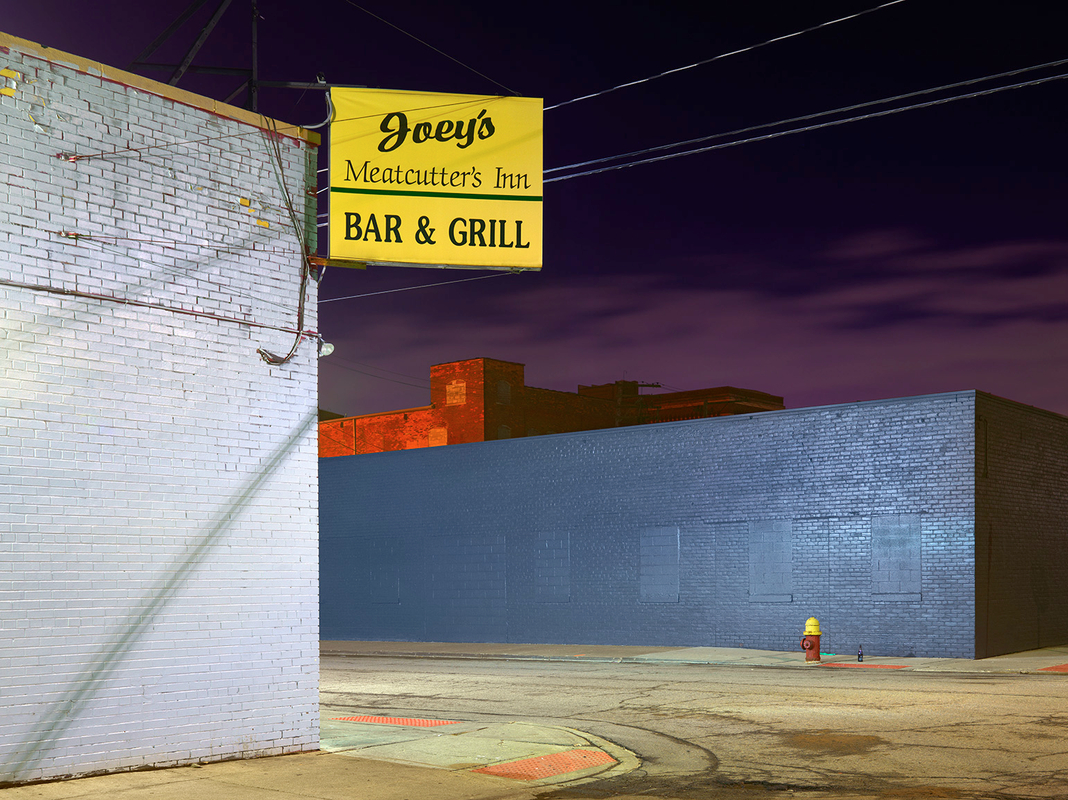
The lonely cityscape at night or the familiar glow of gas station lights cast into the American wilderness. The eye might want to linger among the colors, shapes and clouds even though the mind knows this is pretty much an empty street in a ‘post-industrial’ zone.
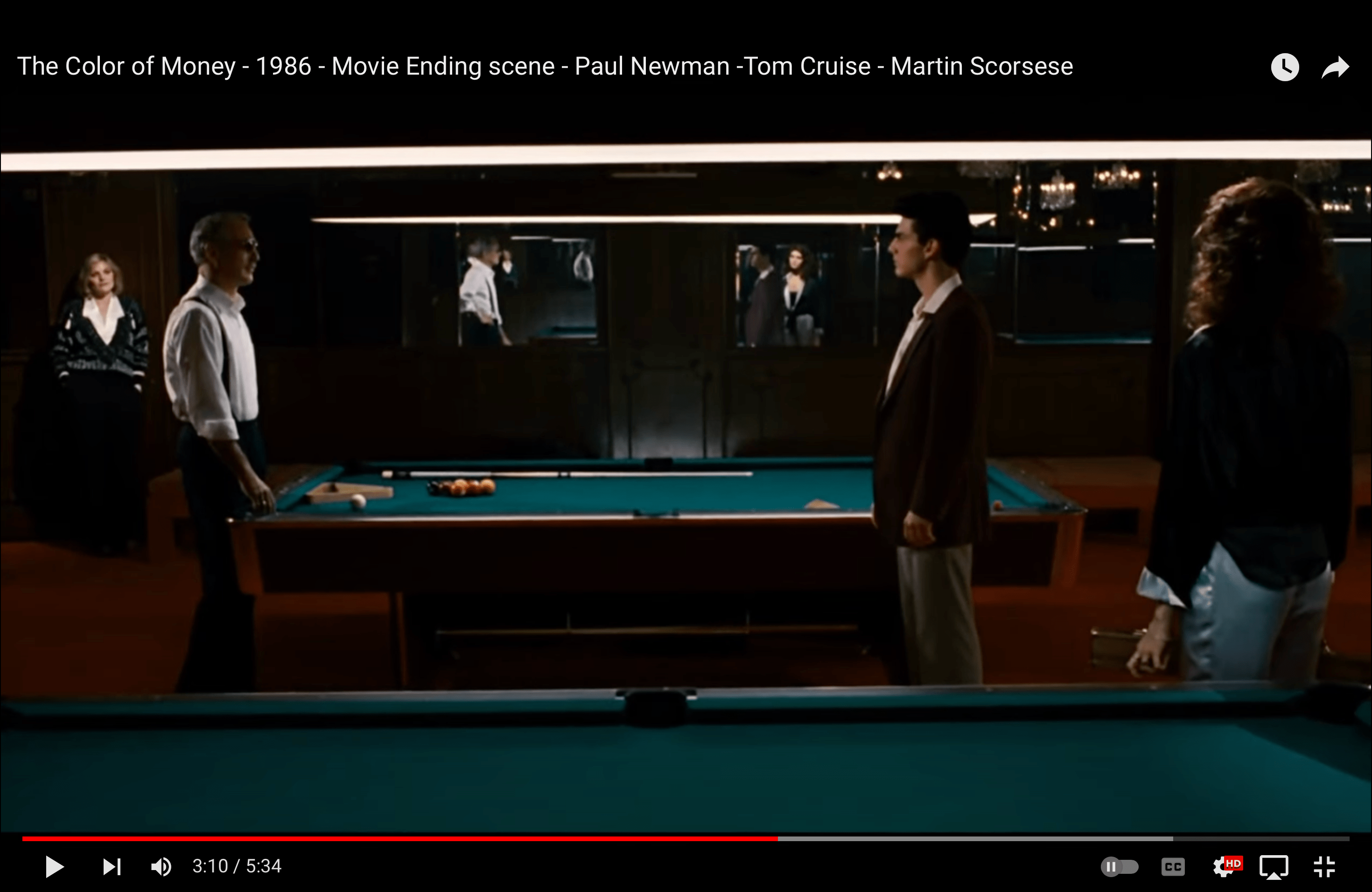
Movie Title: The Color Of Money (Director-Martin Scorsese). 1986.
What’s good and what’s genuine in characters who hustle for a living? Can the American pulp novella/novel be a source of both popular and high entertainment?
Visual Storytelling (end-scene pool showdown): The wiser and more experienced mentor, perhaps washed-up, is being pushed out of the business during his comeback, but he’s not going quietly (we need some dramatic tension). His lady waits for him near the edge of frame, while both of them only take about 1/5 of the frame (all four characters are on the diagonal).
Does he still have it?
—
Brash, untempered (arrogant), less experienced rising talent and his lady take about 1/3 of the frame, closer to the audience. They’ve been hustled; learning the art of the con pretty well.
Should he accept the challenge? Is this it?
Possible conclusions: Maybe that’s what we get in life, a view every now and again. At the height of our powers (or past our powers), we get a moment when the conception of the game and the game become one. In a tacky hall of mirrors, no less. I hope it’s not all a hall of mirrors.
Generations stuck in a stand-off…
My point: A good visual storyteller takes his craft seriously, associating the story and the images to push the story forward. He has an appreciation for beauty. I appreciate Scorsese for working hard because the harder he works, the more my intelligence is respected.
To be honest, the movie dragged on for me and is very much of its time (this is pool for Christ’s Sake, how much can you glamorize pool?). Mythos is tough to achieve.
That said, I appreciate a director practicing his craft and trying to provide some continuity in American life through the visual arts. I appreciate someone who understands that developed characters invite us to see something of ourselves in frame.