
Seattle Photo-More Purple Practice
15
When I consider every thing that grows
Holds in perfection but a little moment,
That this huge stage presenteth nought but shows
Whereon the stars in secret influence comment;
When I perceive that men as plants increase,
Cheered and checked even by the selfsame sky,
Vaunt in their youthful sap, at height decrease,
And wear their brave state out of memory:
Then the conceit of this inconstant stay
Sets you most rich in youth before my sight,
Where wasteful Time debateth with Decay
To change your day of youth to sullied night,
And all in war with Time for love of you,
As he takes from you, I ingraft you new.
–William Shakespeare
‘By the time “Paralyzed: 50 Floors” earned wide release, Bellagamba’s unique blend of post-war Italian neorealism, sci-fi surrealism, and giallo was no longer finding an audience.
Bellagamba died penniless in his native Abruzzo in 1999, interred within a bowl of Diavolicchio (red chili) inside the stomach of a white dove. ‘
Still from the set of “Paralyzed: 50 floors:’. Antonio Stagglione (sp) plays the protagonist as child and future child within the then-longest-recorded Italian sci-fi action dream sequence.
‘We look inside the shards of the past to discover a future that lies stranded in the present.‘
-Giacomo Bellagamba. R.I.P.
***Addendum: Hey, I’d just like to help prepare us all for a world with the coming AI assistive technology. Easily manipulable images and standardized, formalized text are happening right now. Keep your bullshit detectors finely-tuned.

Southern Gothic
Something of how the homing bee at dusk
Seems to inquire, perplexed, how there can be
No flowers here, not even withered stalks of flowers,
Conjures a garden where no garden is
And trellises too frail almost to bear
The memory of a rose, much less a rose.
Great oaks more monumentally great oaks now
Than ever when the living rose was new
Cast shade that is the more completely shade
Upon a house of broken windows merely
And empty nests up under broken eaves
No damask any more prevents the moon,
But it unravels, peeling from a wall,
Red roses within roses within roses.
Interesting written interview on Southern Stoicism, with mention of Walker Percy.
Flannery O’Connor’s Southern Gothic style often flirts with the grotesque, and can traffic in the macabre, but there’s reason behind it, and a brilliantly skeptical, humane eye.
The world is changing, and so is the South.
Julian’s mother is living in the past in
‘They had reached the bus stop. There was no bus in sight and Julian, his hands still jammed in his pockets and his head thrust forward, scowled down the empty street. The frustration of having to wait on the bus as well as ride on it began to creep up his neck like a hot hand. The presence of his mother was borne in upon him as she gave a pained sigh. He looked at her bleakly. She was holding herself very erect under the preposterous hat, wearing it like a banner of her imaginary dignity. There was in him an evil urge to break her spirit. He suddenly unloosened his tie and pulled it off and put it in his pocket’
Well, that’s a story:
Nelson, composing his expression under the shadow of his hat brim, watched
him with a mixture of fatigue and suspicion, but as the train glided past them and disappeared like a frightened serpent into the woods, even his face lightened and he muttered, “I’m glad I’ve went once, but I’ll never go back again!”
July is heating-up, and Aurora Avenue heats-up even more with three dead runaways in three weeks.
Another Ted Bundy?
Detective Harry Rama is out of incense, out of free sandwiches, and most importantly, out of time.
A Bellinger True Crime Series Classic.

I get excited by the weather. Catching weather in-camera is another matter…
Thanks for stopping by, and for looking.

‘The most savage controversies are those about matters as to which there is no good evidence either way.’
Metaphors Of A Magnifico
Twenty men crossing a bridge,
Into a village,
Are twenty men crossing twenty bridges,
Into twenty villages,
Or one man
Crossing a single bridge into a village.
This is old song
That will not declare itself . . .
Twenty men crossing a bridge,
Into a village,
Are
Twenty men crossing a bridge
Into a village.
That will not declare itself
Yet is certain as meaning . . .
The boots of the men clump
On the boards of the bridge.
The first white wall of the village
Rises through fruit-trees.
Of what was it I was thinking?
So the meaning escapes.
The first white wall of the village . . .
The fruit-trees. . . .
Thoughts while you’re walking? marching? with a destination?
See Also: Wednesday Poem: Wallace Stevens-Anecdote of The Jar
There’s something going on in this town…

After the Crime Syndicate strikes on Christmas Day, only hours remain.
Detective Harry Rama finds himself out of free literature, out of patience, and, most importantly, out of time.
A Bellinger True Crime Series Classic.

—
I find myself drawn to the ‘painterly’ look, which might be against the current trend towards ‘focus.’ These are actual pre-dawn colors and light as caught by the Z6 (some sort of ad backdrop).
Thanks for looking.

The Wood-Pile
Out walking in the frozen swamp one gray day
I paused and said, ‘I will turn back from here.
No, I will go on farther – and we shall see’.
The hard snow held me, save where now and then
One foot went through. The view was all in lines
Straight up and down of tall slim trees
Too much alike to mark or name a place by
So as to say for certain I was here
Or somewhere else: I was just far from home.
A small bird flew before me. He was careful
To put a tree between us when he lighted,
And say no word to tell me who he was
Who was so foolish as to think what he thought.
He thought that I was after him for a feather—
The white one in his tail; like one who takes
Everything said as personal to himself.
One flight out sideways would have undeceived him.
And then there was a pile of wood for which
I forgot him and let his little fear
Carry him off the way I might have gone,
Without so much as wishing him good-night.
He went behind it to make his last stand.
It was a cord of maple, cut and split
And piled and measured, four by four by eight.
And not another like it could I see.
No runner tracks in this year’s snow looped near it.
And it was older sure than this year’s cutting,
Or even last year’s or the year’s before.
The wood was gray and the bark warping off it
And the pile somewhat sunken. Clematis
Had wound strings round and round it like a bundle.
What held it though on one side was a tree
Still growing, and on one a stake and prop,
These latter about to fall. I thought that only
Someone who lived in turning to fresh tasks
Could so forget his handiwork on which
He spent himself the labour of his axe,
And leave it there far from a useful fireplace
To warm the frozen swamp as best it could
With the slow smokeless burning of decay.

Blizzard
Snow falls:
years of anger following
hours that float idly down —
the blizzard
drifts its weight
deeper and deeper for three days
or sixty years, eh? Then
the sun! a clutter of
yellow and blue flakes —
Hairy looking trees stand out
in long alleys
over a wild solitude.
The man turns and there —
his solitary track stretched out
upon the world.


A little bit about politics and also the politics amidst fellow writers and critics:
‘…when in doubt, I always follow the simple method of choosing that line of conduct which may be the most displeasing to the Reds and the Russells.’
and:
‘Who’s in, who’s out, and where are the snows of yesteryear. All very amusing. I am a little sorry to be left out. Nobody can decide if I am a middle-aged American writer or an old Russian writer—or an ageless international freak.’
On his professional collection of butterflies:
‘The pleasures and rewards of literary inspiration are nothing beside the rapture of discovering a new organ under the microscope or an undescribed species on a mountainside in Iran or Peru. It is not improbable that had there been no revolution in Russia, I would have devoted myself entirely to lepidopterology and never written any novels at all.’
Via Youtube: An interviewer, Nabokov and Lionel Trilling discuss ‘Lolita:’


David Hockney ‘On Secret Knowledge: On Rediscovering The Lost Secrets Of The Old Masters’:
——————
Optical devices were likely common practice more than is commonly known these days, way before the camera, the television etc.
As previously posted:
Just as optics revolutionized the sciences and the boundaries of human knowledge, from Galileo to Newton and onwards, Tim Jenison wonders if optics may have revolutionized the arts as well.
‘But still, exactly how did Vermeer do it? One day, in the bathtub, Jenison had a eureka moment: a mirror. If the lens focused its image onto a small, angled mirror, and the mirror was placed just between the painter’s eye and the canvas, by glancing back and forth he could copy that bit of image until the color and tone precisely matched the reflected bit of reality.’
Good Vermeer page here for a refresher on the Dutch master.
Penn & Teller helped make a documentary which has gotten good reviews, entitled ‘Tim’s Vermeer.‘
Perhaps only the Girl With The Pearl Earring knows for sure if the painter used such a technique:
—————–
Interesting quotation from Quora, on Richard Feynman’s discussion of light in ‘QED: The Strange Theory Of Light And Matter’:
‘Mirrors and pools of water work pretty much the same way. Light interacts with electrons on the surface. Under the laws of quantum mechanics, each photon interacts with ALL of the electrons on the surface, and the net result is the sum of all possible pathways. If the surface is perfectly smooth, then most of the pathways cancel each other out, except for the one where the angle of incidence equals the angle of reflection. ‘
Click through for the illustrations to help explain Feynman’s theory, which fascinated me when I first came across it; much as I understand of it.
Have you ever seen sunlight reflecting off a body of water from a few thousand feet up in a plane? A rainbow in a puddle with some oil in it? A laser reflecting off a smooth surface like a mirror?
Related On This Site: In The Mail: Vivian Maier
Goya, that modern, had to make a living from the royal family: Goya’s Colossus…Goya’s Fight With Cudgels…Goethe’s Color Theory: Artists And Thinkers…NASA Composite Image Of The Earth At Night…Beauty?…Garrett Mattingly On Machiavelli-The Prince: Political Science Or Political Satire?
Just practicing using the foreground as a framing device. This is probably the best one. Thanks for looking.


The Snow Man
One must have a mind of winter
To regard the frost and the boughs
Of the pine-trees crusted with snow;
And have been cold a long time
To behold the junipers shagged with ice,
The spruces rough in the distant glitter
Of the January sun; and not to think
Of any misery in the sound of the wind,
In the sound of a few leaves,
Which is the sound of the land
Full of the same wind
That is blowing in the same bare place
For the listener, who listens in the snow,
And, nothing himself, beholds
Nothing that is not there and the nothing that is.
Thanks for looking.

Unnatural colors. Open shutter. Lady on a curb in a swirling snowstorm. Sometimes, it passes like a dream.

Stopping By Woods On A Snowy Evening
Whose woods these are I think I know.
His house is in the village though;
He will not see me stopping here
To watch his woods fill up with snow.
My little horse must think it queer
To stop without a farmhouse near
Between the woods and frozen lake
The darkest evening of the year.
He gives his harness bells a shake
To ask if there is some mistake.
The only other sound’s the sweep
Of easy wind and downy flake.
The woods are lovely, dark and deep.
But I have promises to keep,
And miles to go before I sleep,
And miles to go before I sleep.
I prefer ‘Silent Night’ to be pure, and simple, and clear. I imagine drifts of snow frozen and crusted over, everything still, under a starry sky.
A bit of a prayer, really, but one of warmth:
It reminded me of this:
IV
My fiftieth year had come and gone,
I sat, a solitary man,
In a crowded London shop,
An open book and empty cup
On the marble table-top.
While on the shop and street I gazed
My body of a sudden blazed;
And twenty minutes more or less
It seemed, so great my happiness,
That I was blessed and could bless.
Whole poem here.
Not exactly Christmas…
Become a gentlemen, and recover your nobility, honor, and dignity, but with twinges of nostalgia, melancholy and loss.
Please don’t think of windmills, but there’s a lot of Spain in this one:
And if you’re tired of Christmas music, have some metal. Give this one a chance. It’s exquisitely played and thoughtfully arranged:

Just practicing some design elements. Thanks for stopping by and for looking.
This is from about Union Street south to Jefferson Street in the business district, where on the weekends it really empties out.
The light is a little overexposed.

First Snow In Alsace
The snow came down last night like moths
Burned on the moon; it fell till dawn,
Covered the town with simple cloths.
Absolute snow lies rumpled on
What shellbursts scattered and deranged,
Entangled railings, crevassed lawn.
As if it did not know they’d changed,
Snow smoothly clasps the roofs of homes
Fear-gutted, trustless and estranged.
The ration stacks are milky domes;
Across the ammunition pile
The snow has climbed in sparkling combs.
You think: beyond the town a mile
Or two, this snowfall fills the eyes
Of soldiers dead a little while.
Persons and persons in disguise,
Walking the new air white and fine,
Trade glances quick with shared surprise.
At children’s windows, heaped, benign,
As always, winter shines the most,
And frost makes marvelous designs.
The night guard coming from his post,
Ten first-snows back in thought, walks slow
And warms him with a boyish boast:
He was the first to see the snow.
Thanks for looking. Just more of the semi-street stuff I’ve been doing.

Thanks for looking.

If you’d like a breakdown of the relative sizes of our planet, our moon and all these other moons, click through for a helpful visual.
Also, there’s a lot of space out there:
You’ll likely need an energy source (not necessarily our star, the warping effects of other massive bodies will do) and tens, if not hundreds, of millions of years to sustain an environment conducive to life. You’ll likely need lots of protection from cosmic rays and short-wave radiation as some kind of shield. If your planet, moon and/or body doesn’t possess an atmosphere, and is too small to maintain an electro-magnetic dynamo like Earth, then sub-surface water under a protective shell might be enough.
On the recent findings of at least 1/17 observational days of water plumes near the surface of the Jovian moon, Europa:
More here:
‘They used a spectrograph at the Keck Observatory that measures the chemical composition of planetary atmospheres through the infrared light they emit or absorb. Molecules such as water emit specific frequencies of infrared light as they interact with solar radiation.’
and:
‘Paganini and his team reported in the journal Nature Astronomy on November 18 that they detected enough water releasing from Europa (5,202 pounds, or 2,360 kilograms, per second) to fill an Olympic-size swimming pool within minutes. Yet, the scientists also found that the water appears infrequently, at least in amounts large enough to detect from Earth, said Paganini: “For me, the interesting thing about this work is not only the first direct detection of water above Europa, but also the lack thereof within the limits of our detection method.’
This is potentially good news for the upcoming Europa clipper mission. Otherwise, how are you going to get at all that water beneath an icy shell at least 10-15 miles thick?
‘From its orbit of Jupiter, Europa Clipper will sail close by the moon in rapid, low-altitude flybys. If plumes are indeed spewing vapor from Europa’s ocean or subsurface lakes, Europa Clipper could sample the frozen liquid and dust particles. The mission team is gearing up now to look at potential orbital paths, and the new research will play into those discussions.
“If plumes exist, and we can directly sample what’s coming from the interior of Europa, then we can more easily get at whether Europa has the ingredients for life,” Pappalardo said. “That’s what the mission is after. That’s the big picture.”
Aren’t you getting a little excited at the prospect?:
Actual light and fog on Thanksgiving morning…

Those Winter Sundays
Sundays too my father got up early
and put his clothes on in the blueblack cold,
then with cracked hands that ached
from labor in the weekday weather made
banked fires blaze. No one ever thanked him.
I’d wake and hear the cold splintering,breaking.
When the rooms were warm, he’d call,
and slowly I would rise and dress,
fearing the chronic angers of that house,
speaking indifferently to him,
who had driven out the cold
and polished my good shoes as well.
What did I know, what did I know
of love’s austere and lonely offices?

Thanks for stopping by and to everyone that has. I think I’ll skip linking to other people’s videos, poems and ideas on someone else’s platform.
I hope yours is a feast with good drink, loved ones and family (despite the craziness).
All the best!
‘A man who carries a cat by the tail learns something he can learn in no other way’
Some Twain on cats quotes.
Some from T.S. Eliot’s ‘Old Possum’s Book Of Practical Cats.‘

To A Steamroller
The illustration
is nothing to you without the application.
You lack half wit. You crush all the particles down
into close conformity, and then walk back and forth
on them.
Sparkling chips of rock
are crushed down to the level of the parent block.
Were not ‘impersonal judgment in aesthetic
matters, a metaphysical impossibility,’ you
might fairly achieve
It. As for butterflies, I can hardly conceive
of one’s attending upon you, but to question
the congruence of the complement is vain, if it exists.
–Marianne Moore (click through for a discussion of Moore’s work and style)

The Blue Booby
The blue booby lives
on the bare rocks
of Galapagos
and fears nothing.
It is a simple life:
they live on fish,
and there are few predators.
Also, the males do not
make fools of themselves
chasing after the young
ladies. Rather,
they gather the blue
objects of the world
and construct from them a nest—an occasional
Gaulois package,
a string of beads,
a piece of cloth from
a sailor’s suit. This
replaces the need for
dazzling plumage;
in fact, in the past
fifty million years
the male has grown
considerably duller,
nor can he sing well.
The female, though,
asks little of him—
the blue satisfies her
completely, has
a magical effect
on her. When she returns
from her day of
gossip and shopping,
she sees he has found her
a new shred of blue foil:
for this she rewards him
with her dark body,
the stars turn slowly
in the blue foil beside them
like the eyes of a mild savior.
Seagulls are dainty eaters, never shuffling past unsuspecting humans, hoping to gobble some unguarded food.
Humble birds, really.

As seen from below. Thanks for looking.


The Porch over the River
In the dusk of the river, the wind
gone, the trees grow still–
the beautiful poise of lightness,
the heavy world pushing toward it.
Beyond, on the face of the water,
lies the reflection of another tree,
inverted, pulsing with the short strokes
of waves the wind has stopped driving.
In a time when men no longer
can imagine the lives of their sons
this is still the world–
the world of my time, the grind
of engines marking the country
like an audible map, the high dark
marked by the flight of men,
lights stranger than stars.
The phoebes cross and re-cross
the openings, alert
for what may still be earned
from the light. The whippoorwills
begin, and the frogs. And the dark
falls, again, as it must.
The look of the world withdraws
into the vein of memory.
The mirrored tree, darkening, stirs
with the water’s inward life. What has
made it so? –a quietness in it
no question can be asked in.
THE DRY SALVAGES
(No. 3 of ‘Four Quartets’)
I
I do not know much about gods; but I think that the river
Is a strong brown god—sullen, untamed and intractable,
Patient to some degree, at first recognised as a frontier;
Useful, untrustworthy, as a conveyor of commerce;
Then only a problem confronting the builder of bridges.
The problem once solved, the brown god is almost forgotten
By the dwellers in cities—ever, however, implacable.
Keeping his seasons and rages, destroyer, reminder
Of what men choose to forget. Unhonoured, unpropitiated
By worshippers of the machine, but waiting, watching and waiting.
His rhythm was present in the nursery bedroom,
In the rank ailanthus of the April dooryard,
In the smell of grapes on the autumn table,
And the evening circle in the winter gaslight.
Paterson
(Book 1)
“Paterson lies in the valley under the Passaic Falls
its spent waters forming the outline of his back. He
lies on his right side, head near the thunder
of the waters filling his dreams! Eternally asleep,
his dreams walk about the city where he persists
incognito. Butterflies settle on his stone ear.
Immortal he neither moves nor rouses and is seldom
seen, though he breathes and the subtleties of his machinations
drawing their substance from the noise of the pouring river
animate a thousand automations. Who because they
neither know their sources nor the sills of their
disappointments walk outside their bodies aimlessly
for the most part,
locked and forgot in their desires-unroused.‘

Seattle climate: Pacific Marine. Around late September to early October, the switch flips and the High pressure ridge no longer holds. The sunny, temperate summer (July 4th–September 20th) is gone, Jack. A few bigger storms move in (more wind and relatively more rain). In come the clouds, and the drizzle, and because we’re at 48 degrees north latitude, the darkness.
As for snow, there’s plenty of moisture around, but getting the moisture AND the cold air together is tough. The cold air dams behind the Cascades and up high and in Eastern Washington. Sometimes it drains through the Fraser River valley and spills over Seattle. You might not get any snow for a winter or two, or you might get 1-2 weeks of below freezing temps, and 2-24 inches of snow on the ground before it melts with the next rain. Lots of variability.
Dress in layers with moisture protection. The difference between the rare sun on your skin and walking through a damp, chill fog could be 15-20 degrees. Expect low light, and sunrise as you go to work and sunset before you leave.
Join a club…and get some good exercise. Wait for late April or May to start seeing real sunny days again.

Traveling Through The Dark
Traveling through the dark I found a deer
dead on the edge of the Wilson River road.
It is usually best to roll them into the canyon:
that road is narrow; to swerve might make more dead.
By glow of the tail-light I stumbled back of the car
and stood by the heap, a doe, a recent killing;
she had stiffened already, almost cold.
I dragged her off; she was large in the belly.
My fingers touching her side brought me the reason—
her side was warm; her fawn lay there waiting,
alive, still, never to be born.
Beside that mountain road I hesitated.
The car aimed ahead its lowered parking lights;
under the hood purred the steady engine.
I stood in the glare of the warm exhaust turning red;
around our group I could hear the wilderness listen
I thought hard for us all—my only swerving—,
then pushed her over the edge into the river.
‘Detroit Nocturne‘ found here. Via Mick Hartley.
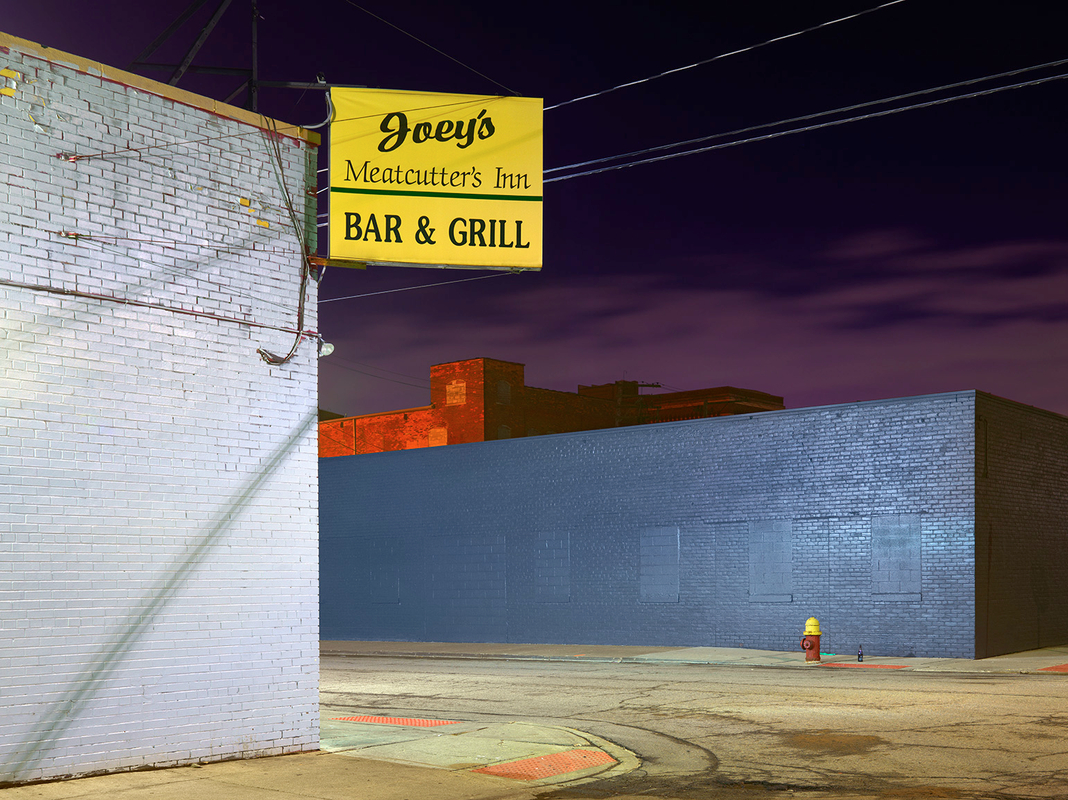
I’m partial to ‘Joey’s Meatcutter Inn, Bar & Grill 2017‘:
—
Immediately, I think of Edward Hopper: The lonely cityscape at night or the familiar glow of gas station lights cast into the American wilderness. The eye might want to linger among the colors, shapes and clouds even though the mind knows this is pretty much an empty street in a ‘post-industrial’ zone.
Perhaps it has do with another strand of expression: The break into free verse from past forms. The move from American Romanticism to Modernism which occurred this early past century. William Carlos Williams produced many good poems from a process of earnest, scrapbook-style intensity in trying to discover, redefine, and order a new poetic form within a modern ‘urban landscape.’
The individual artist is quite alone in the task he’s set before himself, and like much of modernism, it’s a rather big task.
Pastoral
When I was younger
it was plain to me
I must make something of myself.
Older now
I walk back streets
admiring the houses
of the very poor:
roof out of line with sides
the yards cluttered
with old chicken wire, ashes,
furniture gone wrong;
the fences and outhouses
built of barrel staves
and parts of boxes, all,
if I am fortunate,
smeared a bluish green
that properly weathered
pleases me best of all colors.
No one
will believe this
of vast import to the nation
Do you believe any of that to be of vast import to the nation. Are you no one?
Another one of Jordano’s photos which stuck out was: ‘Church Rectory With Lightning, Eastside, Detroit, 2016

—
Perhaps I’m not wrong in having called Halloween horror still and movie images to mind (it’s my mind, after all, so maybe I’m just thinking of Devil’s Night). I really enjoy the light on the dumpster and the side-front rectory wall. There seems to be a little more mood here, more drama, so maybe Edgar Allan Poe’s ‘psychological intensity,’ surrealism, and terror are more appropriate for comparison.
Poe was a bit mad, after all, despite his fascinatingly untamed and powerful imagination. He achieved a uniqueness and completeness of vision few artists do. Maybe there’s a bit of the sullen, self-aggrandizing earnestness in him of the teenager (J.D. Salinger); the desire to shock, delight and terrify.
The mind is as though a chamber, the horror rising to fever pitch, the lush rhyme matching an increasingly desperate search for truth and beauty in the world (Poe had very much his own Romantically inspired metaphysics).
Alone
From childhood’s hour I have not been
As others were—I have not seen
As others saw—I could not bring
My passions from a common spring—
From the same source I have not taken
My sorrow—I could not awaken
My heart to joy at the same tone—
And all I lov’d—I lov’d alone—
Then—in my childhood—in the dawn
Of a most stormy life—was drawn
From ev’ry depth of good and ill
The mystery which binds me still—
From the torrent, or the fountain—
From the red cliff of the mountain—
From the sun that ’round me roll’d
In its autumn tint of gold—
From the lightning in the sky
As it pass’d me flying by—
From the thunder, and the storm—
And the cloud that took the form
(When the rest of Heaven was blue)
Of a demon in my view—
Nice photos, Dave. Thank you.
As previously posted:
Via Curbed Detroit. (via David Thompson)
70 photos of the abandoned, foreboding Temple. Mysterious symbols and a certain sad grandeur that’s come to represent Detroit these days.
-Photographer Ben Marcin has a series called ‘Last House Standing.’ Solitary row-homes…the only ones left on the block.
From Buzzfeed: ‘Why I Bought A House in Detroit For $500:’
How did Detroit get here? Very comprehensive and easy to navigate.
More from Megan McArdle on the behavior that comes with pension bonuses.Charlie LeDuff, Detroit’s populist, citizen journalist’s youtube channel here. At least he’s sticking around.
Are you looking at beautiful photos and feeling sorry for Detroit, and yourself? See Time Magazine’s photo essay by Yves Marchand and Romain Meffre (less porn-like, more thoughtful).
Hipster hope, artists, collectivists and small business types can’t save it either: A Short Culture Wars Essay-Two Links On Detroit & ‘Ruin Porn’
GM is not a municipality, but good money got put in, probably after bad and it reeks of politics: From The Detroit News: ‘How The Treasury, GM Stock Deal Got Done’
“Education: that which reveals to the wise, and conceals from the stupid, the vast limits of their knowledge.”
Delight In Disorder
A sweet disorder in the dress
Kindles in clothes a wantonness;
A lawn about the shoulders thrown
Into a fine distraction;
An erring lace, which here and there
Enthrals the crimson stomacher;
A cuff neglectful, and thereby
Ribands to flow confusedly;
A winning wave, deserving note,
In the tempestuous petticoat;
A careless shoe-string, in whose tie
I see a wild civility:
Do more bewitch me, than when art
Is too precise in every part.
This one’s cropped to see what could have been, and to better frame the shapes and colors which attracted me to the shot.
Thanks for looking.

Dischord or Harmony?

For one who didn’t care much for poetry:
Separation
Your absence has gone through me
Like thread through a needle
Everything I do is stitched with its color
For another who handles the losses with grace and courage:
One Art
The art of losing isn’t hard to master;
so many things seem filled with the intent
to be lost that their loss is no disaster,
Lose something every day. Accept the fluster
of lost door keys, the hour badly spent.
The art of losing isn’t hard to master.
Then practice losing farther, losing faster:
places, and names, and where it was you meant
to travel. None of these will bring disaster.
I lost my mother’s watch. And look! my last, or
next-to-last, of three loved houses went.
The art of losing isn’t hard to master.
I lost two cities, lovely ones. And, vaster,
some realms I owned, two rivers, a continent.
I miss them, but it wasn’t a disaster.
– Even losing you (the joking voice, a gesture
I love) I shan’t have lied. It’s evident
the art of losing’s not too hard to master
though it may look like (Write it!) like disaster.
For a special friend, you know who you are.
Flying Over The Nebraska Of My Life
So much of our lives dissolves.
What did I do the day before
I met you? You remember
what I was wearing that holiday.
What did I wear the next morning?
What did I write the day my mother died?
I fly at night over the plains.
There is a cluster of lights,
a starfish shape glittering. Then
darkness and darkness.
Then another clump bearing
long daisy petals of roadway.
Then nothing again. How much
of my living has fled like water
into sand. The sand is not
even damp to the hand.
Tears and wine and sparkling
water all vanish the same.
I know looking out the plane’s
dirty window that there are houses,
barns, roads, trees, stores
distinct in that darkness I once
drove through. I knew them and will
never know them again.
The plane is flying from lighted
place to lighted place, but
our arc is from the dark into
brightness then back into darkness.
I want to possess my own life like a
necklace, pearl by pearl of light.
Thanks for looking.


Ringed Plover By Water’s Edge
They sprint eight feet and –
stop. Like that. They
sprintayard (like that) and
stop.
They have no acceleration
and no brakes.
Top speed’s their only one.
They’re alive – put life
through a burning-glass, they’re
its focus – but they share
the world of delicate clockwork.
In spasmodic
Indian file
they parallel the parallel ripples.
When they stop
they, suddenly, are
gravel.
The best Youtube video I could find of the ringed plover:
I wish the green light on the taxi were in focus. The colors and shapes might have some interest, though.

You’ve probably heard the intro to Boston’s ‘Foreplay/LongTime’ played in regular time, but what about half-time?
Mesmerizing and rather beautiful:
Because you didn’t ask:
‘I’ll begin the critique with the last point. “We never see properties, although we see that certain things have certain properties.” (179) If van Inwagen can ‘peter out,’ so can I: I honestly don’t know what to make of the second clause of the quoted sentence. I am now, with a brain properly caffeinated, staring at my blue coffee cup in good light. Van Inwagen’s claim is that I do not see the blueness of the cup, though I do see that the cup is blue. Here I balk. If I don’t see blueness, or blue, when I look at the cup, how can I see (literally see, with the eyes of the head, not the eye of the mind) that the cup is blue?’
From Darwinian Conservatism: ‘The Evolution of Mind and Mathematics: Dehaene Versus Plantinga and Nagel’Repost: From the Cambridge Companion To Plato-T.H. Irwin’s “Plato: The intellectual Background’
And because you really didn’t ask:
I got nuttin’ over here.
September’s Baccalaureate
September’s Baccalaureate
A combination is
Of Crickets—Crows—and Retrospects
And a dissembling Breeze
That hints without assuming—
An Innuendo sear
That makes the Heart put up its Fun
And turn Philosopher.
A Late Walk
When I go up through the mowing field,
The headless aftermath,
Smooth-laid like thatch with the heavy dew,
Half closes the garden path.
And when I come to the garden ground,
The whir of sober birds
Up from the tangle of withered weeds
Is sadder than any words
A tree beside the wall stands bare,
But a leaf that lingered brown,
Disturbed, I doubt not, by my thought,
Comes softly rattling down.
I end not far from my going forth
By picking the faded blue
Of the last remaining aster flower
To carry again to you.
Cloud & sign.

Just trying things out. Thanks for looking.

Thanks for looking.

Men At Forty
Men at forty
Learn to close softly
The doors to rooms they will not be
Coming back to.
At rest on a stair landing,
They feel it moving
Beneath them now like the deck of a ship,
Though the swell is gentle.
And deep in mirrors
They rediscover
The face of the boy as he practices tying
His father’s tie there in secret
And the face of the father,
Still warm with the mystery of lather.
They are more fathers than sons themselves now.
Something is filling them, something
That is like the twilight sound
Of the crickets, immense,
Filling the woods at the foot of the slope
Behind their mortgaged houses.

I’m just aiming to increase the average photo I’m taking. Maybe during this process you get a sense of the place.
Thanks for stopping by.
***One day a few photos might be ‘wall-worthy.’ You’re in line at a restaurant (aspiring chain) bathroom and your eyes focus for 3-5 seconds on one of the photos framed in front of you.
Immortality!

When You Are Old
When you are old and gray and full of sleep,
And nodding by the fire, take down this book,
And slowly read, and dream of the soft look
Your eyes had once, and of their shadows deep;
How many loved your moments of glad grace,
And loved your beauty with love false or true,
But one man loved the pilgrim soul in you,
And loved the sorrows of your changing face;
And bending down beside the glowing bars,
Murmur, a little sadly, how Love fled
And paced upon the mountains overhead
And hid his face among a crowd of stars.
Thanks for looking.

Via a reader: John Searle on The Philosophy Of Language as part of Bryan Magee’s series:
It’s always a pleasure to observe someone with deep understanding explain a subject clearly.
There’s some interesting discussion on modernism and postmodernism too, or the tendency for the ‘moderns’ to focus on language itself as a problem to be re-examined and possibly solved, or the study of linguistics to be put upon a foundation similar to that of many sciences.
As we’ve seen in the arts, the poem, a novel, the very written words themselves can become subjects which poets, novelists, and writers examine, doubt, and in some cases ‘deconstruct.’
As to that tribe in South America, cited as evidence against Chomsky’s claims of necessary recursion and the existence of a universal grammar, Searle has some things to say in the interview below.
As previously posted: Paul Ibbotson & Michael Tomasello at Scientific American: ‘Evidence Rebuts Chomsky’s Theory Of Language Learning:’
‘But evidence has overtaken Chomsky’s theory, which has been inching toward a slow death for years. It is dying so slowly because, as physicist Max Planck once noted, older scholars tend to hang on to the old ways: “Science progresses one funeral at a time.”
Worth a read.
As posted: Caitlin Flanagan reviews Tom Wolfe’s new book ‘The Kingdom Of Speech.‘ Jerry Coyne, ecologist, writing in the Washington Post, was not impressed:
“Noam Chomsky: The Last Totalitarian”The Politics Of Noam Chomsky-The Dangers Of Kantian Transcendental Idealism?
=====
Some Updated Links On Postmodernism…Daniel Dennett: ‘Postmodernism…And Truth’
A Bleak, Modern House-Four Poems
=====
Bryan Magee Via Youtube: ‘Miles Burnyeat On Plato’…Bryan Magee Via Youtube: ‘John Passmore on Hume: Section 1’