Seattle Photo & A Poem By Elizabeth Bishop-For Commerce Or Contemplation

Large Bad Picture

Remembering the Strait of Belle Isle or 
some northerly harbor of Labrador, 
before he became a schoolteacher 
a great-uncle painted a big picture.
 

Receding for miles on either side 
into a flushed, still sky 
are overhanging pale blue cliffs 
hundreds of feet high, 

their bases fretted by little arches, 
the entrances to caves 
running in along the level of a bay 
masked by perfect waves. 

On the middle of that quiet floor 
sits a fleet of small black ships, 
square-rigged, sails furled, motionless, 
their spars like burnt match-sticks. 

And high above them, over the tall cliffs’ 
semi-translucent ranks, 
are scribbled hundreds of fine black birds 
hanging in n’s in banks. 

One can hear their crying, crying, 
the only sound there is 
except for occasional sizhine 
as a large aquatic animal breathes. 

In the pink light 
the small red sun goes rolling, rolling, 
round and round and round at the same height 
in perpetual sunset, comprehensive, consoling, 

while the ships consider it. 
Apparently they have reached their destination. 
It would be hard to say what brought them there, 
commerce or contemplation.

Elizabeth Bishop

Friday Poem-W.B. Yeats

Never give all the heart

Never give all the heart, for love
Will hardly seem worth thinking of
To passionate women if it seem
Certain, and they never dream
That it fades out from kiss to kiss;
For everything that’s lovely is
But a brief, dreamy, kind delight.
O never give the heart outright,
For they, for all smooth lips can say,
Have given their hearts up to the play.
And who could play it well enough
If deaf and dumb and blind with love?
He that made this knows all the cost,
For he gave all his heart and lost.

William Butler Yeats

Monday Poem-Donald Justice

‘There is a gold light in certain old paintings’

There is a gold light in certain old paintings
That represents a diffusion of sunlight.
It is like happiness, when we are happy.
It comes from everywhere and from nowhere at once, this light,
            And the poor soldiers sprawled at the foot of the cross
            Share in its charity equally with the cross.

Orpheus hesitated beside the black river.
With so much to look forward to he looked back.
We think he sang then, but the song is lost.
At  least he had seen once more the  beloved back.
              I say the song went this way: O prolong
             Now the sorrow if that is all there is to prolong.

The world is very dusty, uncle. Let us work.
One day the sickness shall pass from the earth for good.
The orchard will bloom; someone will play the guitar.
Our work will be seen as strong and clean and good.
              And all that we suffered through having existed
              Shall be forgotten as though it had never existed.

Donald Justice

Wednesday Poem-Wallace Stevens

Of Mere Being

The palm at the end of the mind,
Beyond the last thought, rises
In the bronze decor,

A gold-feathered bird
Sings in the palm, without human meaning,
Without human feeling, a foreign song.

You know then that it is not the reason
That makes us happy or unhappy.
The bird sings. Its feathers shine.

The palm stands on the edge of space.
The wind moves slowly in the branches.
The bird’s fire-fangled feathers dangle down.

Wallace Stevens

Wednesday Poem-Robert Frost

The Oven Bird

There is a singer everyone has heard,
Loud, a mid-summer and a mid-wood bird,
Who makes the solid tree trunks sound again.
He says that leaves are old and that for flowers
Mid-summer is to spring as one to ten.
He says the early petal-fall is past
When pear and cherry bloom went down in showers
On sunny days a moment overcast;
And comes that other fall we name the fall.
He says the highway dust is over all.
The bird would sing and be as other birds,
But that he knows in singing not to sing.
The question that he frames in all but words
is what to make of a diminished thing.

Robert Frost

Michael Dirda On Auden & A Wednesday Poem-Enormous, Simple Grief

Michael Dirda at The Washington Post (DDiD, man…DDiD):

In his youth, Auden planned to become a mining engineer, and he’s always terrific at depicting industrial landscapes — he gravitates to tram lines and slag heaps — but he can also survey rough terrain through the eyes of a secret agent: “Control of the passes was, he saw, the key” or “Watching with binoculars the movement of the grass for an ambush,/ The pistol cocked, the code-word committed to memory …”

Atlantis

Being set on the idea
Of getting to Atlantis,
You have discovered of course
Only the Ship of Fools is
Making the voyage this year,
As gales of abnormal force
Are predicted, and that you
Must therefore be ready to
Behave absurdly enough
To pass for one of The Boys,
At least appearing to love
Hard liquor, horseplay and noise.

Should storms, as may well happen,
Drive you to anchor a week
In some old harbour-city
Of Ionia, then speak
With her witty scholars, men
Who have proved there cannot be
Such a place as Atlantis:
Learn their logic, but notice
How its subtlety betrays
Their enormous simple grief;
Thus they shall teach you the ways
To doubt that you may believe.

If, later, you run aground
Among the headlands of Thrace,
Where with torches all night long
A naked barbaric race
Leaps frenziedly to the sound
Of conch and dissonant gong:
On that stony savage shore
Strip off your clothes and dance, for
Unless you are capable
Of forgetting completely
About Atlantis, you will
Never finish your journey.

Again, should you come to gay
Carthage or Corinth, take part
In their endless gaiety;
And if in some bar a  tart,
As she strokes your hair, should say
“This is Atlantis, dearie,”
Listen with attentiveness
To her life-story: unless
You become acquainted now
With each refuge that tries to
Counterfeit Atlantis, how
Will you recognise the true?

Assuming you beach at last
Near Atlantis, and begin
That terrible trek inland
Through squalid woods and frozen
Thundras where all are soon lost;
If, forsaken then, you stand,
Dismissal everywhere,
Stone and now, silence and air,
O remember the great dead
And honour the fate you are,
Travelling and tormented,
Dialectic and bizarre.

Stagger onward rejoicing;
And even then if, perhaps
Having actually got
To the last col, you collapse
With all Atlantis shining
Below you yet you cannot
Descend, you should still be proud
Even to have been allowed
Just to peep at Atlantis
In a poetic vision:
Give thanks and lie down in peace,
Having seen your salvation.

All the little  household gods
Have started crying, but say
Good-bye now, and put to sea.
Farewell, my dear, farewell: may
Hermes, master of the roads,
And the four dwarf Kabiri,
Protect and serve you always;
And may the Ancient of Days
Provide for all you must do
His invisible guidance,
Lifting up, dear, upon you
The light of His countenance.

W.H. Auden

Saturday Poem & A Photo-Wallace Stevens

Sailing After Lunch

It is the word pejorative that hurts.
My old boat goes round on a crutch
And doesn’t get under way.
It’s the time of the year
And the time of the day.

Perhaps it’s the lunch that we had
Or the lunch that we should have had.
But I am, in any case,
A most inappropriate man
In a most unpropitious place.

Mon Dieu, hear the poet’s prayer.
The romantic should be here.
The romantic should be there.
It ought to be everywhere.
But the romantic must never remain,

Mon Dieu, and must never again return.
This heavy historical sail
Through the mustiest blue of the lake
In a really vertiginous boat
Is wholly the vapidest fake. . . .

It is least what one ever sees.
It is only the way one feels, to say
Where my spirit is I am,
To say the light wind worries the sail,
To say the water is swift today,

To expunge all people and be a pupil
Of the gorgeous wheel and so to give
That slight transcendence to the dirty sail,
By light, the way one feels, sharp white,
And then rush brightly through the summer air.

Wallace Stevens

Behold, the Wallace Stevens/Ernest Hemingway dustup down in Key West. I don’t know what it means.

Out-of-focus boats in the bay.

Friday Poem-Theodore Roethke

The Waking 1948

I strolled across
An open field;
The sun was out;
Heat was happy.

This way! This way!
The wren’s throat shimmered,
Either to other,
The blossoms sang.

The stones sang,
The little ones did,
And flowers jumped
Like small goats.

A ragged fringe
Of daisies waved;
I wasn’t alone
In a grove of apples.

Far in the wood
A nestling sighed;
The dew loosened
Its morning smells.

I came where the river
Ran over stones:
My ears knew
An early joy.

And all the waters
Of all the streams
Sang in my veins
That summer day.

Theodore Roethke

‘Life is not a walk across an open field‘ or something like that.

Saturday Poem-T.S. Eliot

BURNT NORTON
(No. 1 of ‘Four Quartets’)

Time present and time past
Are both perhaps present in time future,
And time future contained in time past.
If all time is eternally present
All time is unredeemable.
What might have been is an abstraction
Remaining a perpetual possibility
Only in a world of speculation.
What might have been and what has been
Point to one end, which is always present.
Footfalls echo in the memory
Down the passage which we did not take
Towards the door we never opened
Into the rose-garden. My words echo
Thus, in your mind.
But to what purpose
Disturbing the dust on a bowl of rose-leaves
I do not know.
Other echoes
Inhabit the garden. Shall we follow?
Quick, said the bird, find them, find them,
Round the corner. Through the first gate,
Into our first world, shall we follow
The deception of the thrush? Into our first world.
There they were, dignified, invisible,
Moving without pressure, over the dead leaves,
In the autumn heat, through the vibrant air,
And the bird called, in response to
The unheard music hidden in the shrubbery,
And the unseen eyebeam crossed, for the roses
Had the look of flowers that are looked at.
There they were as our guests, accepted and accepting.
So we moved, and they, in a formal pattern,
Along the empty alley, into the box circle,
To look down into the drained pool.
Dry the pool, dry concrete, brown edged,
And the pool was filled with water out of sunlight,
And the lotos rose, quietly, quietly,
The surface glittered out of heart of light,
And they were behind us, reflected in the pool.
Then a cloud passed, and the pool was empty.
Go, said the bird, for the leaves were full of children,
Hidden excitedly, containing laughter.
Go, go, go, said the bird: human kind
Cannot bear very much reality.
Time past and time future
What might have been and what has been
Point to one end, which is always present.

T.S. Eliot

Friday Poem-Hart Crane

At Melville’s Tomb

Often beneath the wave, wide from this ledge
The dice of drowned men’s bones he saw bequeath
An embassy. Their numbers as he watched,
Beat on the dusty shore and were obscured.

And wrecks passed without sound of bells,
The calyx of death’s bounty giving back
A scattered chapter, livid hieroglyph,
The portent wound in corridors of shells.

Then in the circuit calm of one vast coil,
Its lashings charmed and malice reconciled,
Frosted eyes there were that lifted altars;
And silent answers crept across the stars.

Compass, quadrant and sextant contrive
No farther tides … High in the azure steeps
Monody shall not wake the mariner.
This fabulous shadow only the sea keeps.

Hart Crane

Pulp Fiction & Photographic Visions-A Link To Bruce Davidson’s ‘Subway’

Beauty, ugliness, youth, strength, and decay: Via Mick Hartley Bruce Davidson at Magnum’s ‘Subway‘.

Many of the images in Subway are sensual, dangerous and raw, but then again, so was the NYC subway in about 1979 or 1980. Davidson plays with different exposures, techniques and settings, eventually deciding on using color to depict what he saw. He also reportedly toned-up physically, geared-up, and mentally prepared himself to get off and on those subway cars during the project. He had some undercover city cops with him a few times.

Imagine how conspicuous a new Nikon/Canon DSLR and a flash would make you in one of those cars at night (he, in fact, had one camera stolen).

Come for the raw, dangerous subject matter and the vicarious risk (oh yeah, it can happen again…just stay tuned). Stay for Davidson’s compositions, subtle use of light and color, and the genuine humanity he found within his larger vision.

Is a certain dangerous, glamorous adventure beneath you?

What about in your prime?

It’s not like these problems haven’t been with us for a while.  Without police protection, you’ll probably get worse outcomes and more retributive violence. A reader sends a link to The Confessions Of Bernhard Goetz, subway vigilante:

There’s a lot here: Genuine threat (thugs), fear, real victimization (previous muggings and a likely soon-to-be mugging), but also serious ignorance and over-reaction.

I imagine Goetz was a bit like a feral animal fleeing out of that subway car, up the station stairs and into the night.

From min 33:40:

The question to be litigated was whether the community would make a judgment about his (Goetz) own good faith belief….are we in a position to condemn him for over-reacting?

From The Warriors to Dirty Harry to Death Wish, a certain gritty, pulpy style was born. One of the main desires of men, especially, is to quash injustice and heroically protect that which falls under their honor. When the authorities can’t combat crime in public transport, or choose to enforce the law selectively, then the desire for vengeance, punishment and order finds outlets.

Seattle Photo-Garbage Man In The Market & A Poem By Seamus Heaney-You Get The Idea

Digging

Between my finger and my thumb   
The squat pen rests; snug as a gun.

Under my window, a clean rasping sound   
When the spade sinks into gravelly ground:   
My father, digging. I look down

Till his straining rump among the flowerbeds   
Bends low, comes up twenty years away   
Stooping in rhythm through potato drills   
Where he was digging.

The coarse boot nestled on the lug, the shaft   
Against the inside knee was levered firmly.
He rooted out tall tops, buried the bright edge deep
To scatter new potatoes that we picked,
Loving their cool hardness in our hands.

By God, the old man could handle a spade.   
Just like his old man.

My grandfather cut more turf in a day
Than any other man on Toner’s bog.
Once I carried him milk in a bottle
Corked sloppily with paper. He straightened up
To drink it, then fell to right away
Nicking and slicing neatly, heaving sods
Over his shoulder, going down and down
For the good turf. Digging
.

The cold smell of potato mould, the squelch and slap
Of soggy peat, the curt cuts of an edge
Through living roots awaken in my head.
But I’ve no spade to follow men like them.

Between my finger and my thumb
The squat pen rests.
I’ll dig with it.

Seamus Heaney

Happy 4th Of July 2022

“When in the course of human events it becomes necessary for one people to dissolve the bands which have connected them with another and to assume among the powers of the earth, the separate and equal station to which the Laws of Nature and of Nature’s God entitle them, a decent respect to the opinions of mankind requires that they should declare the causes which impel them to the separation…”

The rest here.

Addition:  From Maverick Philosopher:  The Difference Between Patriotism And Jingoism.

***I see myself, partly, as a steward of a larger project, a set of responsibilities and freedoms, given to each us. How we live and what we think about has a lot to do with that project.

Happy 4th!

Saturday Quotation-Harry Frankfurt

‘The notion of carefully wrought bullshit involves, then, a certain inner strain. Thoughtful attention to detail requires discipline and objectivity. It entails accepting standards and limitations that forbid the indulgence of impulse or whim. It is this selflessness that, in connection with bullshit, strikes us as inapposite. But in fact it is not out of the question at all. The realms of advertising and of public relations, and the nowadays closely related realm of politics, are replete with instances of bullshit so unmitigated that they can serve among the most indisputable and classic paradigms of the concept. And in these realms there are exquisitely sophisticated craftsmen, who with the help of advanced and demanding techniques of market research, of public opinion polling, of psychological testing, and so forth, dedicate themselves tirelessly to getting every word and image they produce exactly right.’

From On Bullshit.

How Close Is Too Close?-A Few Links On The 2013 El Reno Tornado

Dan Robinson was the guy heading south, then rapidly east, in the hopes of staying on a parallel northward track to the May 31st, 2013 El Reno, Oklahoma tornado. I can appreciate a man driving towards such a thing.

In his words:

‘I was not trying to get close. I knew from how the tornado first appeared that it would be very large, violent and dangerous. My goal was simply to remain in a good position for photography and video, which I felt would be best with the tornado backlit by the bright skies to the southwest. I wanted to be just close enough to have a high-contrast view.

It turns out that particular evening, many of the variables leading to supercell formation, and even EF5 tornado formation, were in place. So many were in place, in fact, that this became one of the most violent and dangerous tornadoes ever recorded.

It changed directions suddenly. It slowed down to 5 mph and sped up to nearly 50 mph. 2.6 miles wide at one point? 300 mph wind?

Eight people died.

The guy in a Toyota Yaris, slipping on a wet, gravely Oklahoma road unable to disable traction control doesn’t exactly come off a hero. The guy suddenly racing for his life, enveloped in the outer wind-field, is easily criticized. Bigger balls than many? Maybe. Stupid enough to get killed? Possibly.

Thanks, Dan, for chasing on your own dime, sharing your information, and respecting the wishes of the families of those in the car behind you. That was the last anyone saw of them.

It is what it is.

From the Weather Service video below: A small percentage of the world’s surface supports the kinds of extreme clashing air masses found on the U.S. plains.  Very few thunderstorms become supercells, and very few of those supercells form tornadoes.  Even fewer tornadoes become violent F4 and F5 monsters which spawn sub-vortices and anti-cyclones.

The El Reno, Oklahoma tornado from 2013 took the lives of eight people, including experienced stormchasers known for their judgment and contributions to the rest of us.

A sad day.

Sunday Poem-Philip Larkin

The Mower

The mower stalled, twice; kneeling, I found   
A hedgehog jammed up against the blades,   
Killed. It had been in the long grass.

I had seen it before, and even fed it, once.   
Now I had mauled its unobtrusive world   
Unmendably. Burial was no help:

Next morning I got up and it did not.
The first day after a death, the new absence   
Is always the same; we should be careful

Of each other, we should be kind   
While there is still time.

Philip Larkin

‘Grabby’ Aliens, A Beautiful Funnel Of Air & A Few Past Links

I tend to be skeptical of guys who, upon their deaths, freeze their heads into perpetuity. Probabilistically, though, I suppose it could be a bet worth taking.

We could use more outside-the-box thinkers with real-world experience making bets on where to fruitfully think.

Our institutions have more rot than usual, and dangerous capture. There are too many prizes, too many piles of old money, and not enough brains and courage.

I’m of a mind to say Nature is beyond value judgment (I judge things all the time, but Nature doesn’t seem to care). The people I love and who love me, do care about me (as long as we’re here).

God? Maybe. The universe: Unclear. The little I know of the laws of the universe suggest more of the same Nature I’ve known here on Earth.

Beauty plays a key part in understanding the world. It can both anchor us into our own bodies and experiences, while keeping us searching for new experiences. Truth has a clear empirical element in my thinking, and refers to a world I believe genuinely exists. Collecting data about the world is a lot like actually referring back to the book you’re quoting, or asking the other person what they’re really thinking…then listening.

Beautiful and dangerous. Maybe the tornado is telling you something? Maybe not.

Roger Scruton At The WSJ: ‘Memo To Hawking: There’s Still Room For God’

Related On This Site: From Darwinian Conservatism: ‘The Evolution of Mind and Mathematics: Dehaene Versus Plantinga and Nagel’

Sunday Quotation: Edmund Burke On The French Revolution

Denis Dutton suggested art could head towards Darwin (and may offer new direction from the troubles of the modern art aimlessness and shallow depth…the money and the fame) Review of Denis Dutton’s ‘The Art Instinct’…

Roger Sandall, Australian critic of romantic primitivism and the Western’s Left’s penchant for the Noble Savage: His home page where his essays can be found. Here’s “The Rise Of The Anthropologues“ and…

Thursday Poem-Donald Justice

Men At Forty

Men at forty
Learn to close softly
The doors to rooms they will not be
Coming back to.

At rest on a stair landing,
They feel it moving
Beneath them now like the deck of a ship,
Though the swell is gentle.

And deep in mirrors
They rediscover
The face of the boy as he practices tying
His father’s tie there in secret

And the face of the father,
Still warm with the mystery of lather.
They are more fathers than sons themselves now.
Something is filling them, something

That is like the twilight sound
Of the crickets, immense,
Filling the woods at the foot of the slope
Behind their mortgaged houses.

Donald Justice

This one stays with me…

Wednesday Poem-Richard Eberhart’s ‘The Groundhog’

The Groundhog

In June, amid the golden fields,
I saw a groundhog lying dead.
Dead lay he; my senses shook,
And mind outshot our naked frailty.
There lowly in the vigorous summer
His form began its senseless change,
And made my senses waver dim
Seeing nature ferocious in him.
Inspecting close his maggots’ might
And seething cauldron of his being,
Half with loathing, half with a strange love,
I poked him with an angry stick.
The fever arose, became a flame
And Vigour circumscribed the skies,
Immense energy in the sun,
And through my frame a sunless trembling.
My stick had done nor good nor harm.
Then stood I silent in the day
Watching the object, as before;
And kept my reverence for knowledge
Trying for control, to be still,
To quell the passion of the blood;
Until I had bent down on my knees
Praying for joy in the sight of decay.
And so I left; and I returned
In Autumn strict of eye, to see
The sap gone out of the groundhog,
But the bony sodden hulk remained.
But the year had lost its meaning,
And in intellectual chains
I lost both love and loathing,
Mured up in the wall of wisdom.
Another summer took the fields again
Massive and burning, full of life,
But when I chanced upon the spot
There was only a little hair left,
And bones bleaching in the sunlight
Beautiful as architecture;
I watched them like a geometer,
And cut a walking stick from a birch.
It has been three years, now.
There is no sign of the groundhog.
I stood there in the whirling summer,
My hand capped a withered heart,
And thought of China and of Greece,
Of Alexander in his tent;
Of Montaigne in his tower,
Of Saint Theresa in her wild lament.

Richard Eberhart

Sunday Poems Around A Theme-Emily Dickinson, Wallace Stevens & Robert Frost

Luck is not chance (1350)

Luck is not chance—
It’s Toil—
Fortune’s expensive smile
Is earned—
The Father of the Mine
Is that old-fashioned Coin
We spurned—

Emily Dickinson

To A High-Toned Old Christian Woman

Poetry is the supreme fiction, madame.
Take the moral law and make a nave of it
And from the nave build haunted heaven. Thus,
The conscience is converted into palms,
Like windy citherns hankering for hymns.
We agree in principle. That’s clear. But take
The opposing law and make a peristyle,
And from the peristyle project a masque
Beyond the planets. Thus, our bawdiness,
Unpurged by epitaph, indulged at last,
Is equally converted into palms,
Squiggling like saxophones. And palm for palm,
Madame, we are where we began. Allow,
Therefore, that in the planetary scene
Your disaffected flagellants, well-stuffed,
Smacking their muzzy bellies in parade,
Proud of such novelties of the sublime,
Such tink and tank and tunk-a-tunk-tunk,
May, merely may, madame, whip from themselves
A jovial hullabaloo among the spheres.
This will make widows wince. But fictive things
Wink as they will. Wink most when widows wince.

Wallace Stevens

Design

I found a dimpled spider, fat and white,
On a white heal-all, holding up a moth
Like a white piece of rigid satin cloth–
Assorted characters of death and blight
Mixed ready to begin the morning right,
Like the ingredients of a witches’ broth–
A snow-drop spider, a flower like a froth,
And dead wings carried like a paper kite.

What had that flower to do with being white,
The wayside blue and innocent heal-all?
What brought the kindred spider to that height,
Then steered the white moth thither in the night?
What but design of darkness to appall?–
If design govern in a thing so small.

Robert Frost

Memorial Day 2022

For the memory of those who have died for our country.

Addition:  From Maverick Philosopher:  The Difference Between Patriotism And Jingoism.

From a collection of Civil War Letters:

“I took some tobacco down with me the other day but I found out when I got there communication had been stopped. As I was sitting on the banks, one of the Yankees from the other side called to me to know if I had any tobacco. I told him I had. He said that he had a good knife to trade for it. I told him that trading was prohibited. He said “Your officers won’t see you, come over, I want a chew of tobacco very bad.” I asked some of them who they were going to vote for President. One of them said “Old Abe” but most of them said they were for McLellan.”

A Link To ‘Night Shadows’ By Edward Hopper, A Poem By Robert Frost & Some Images

Night Shadows by Edward Hopper.

The black and white was made in 1924, and is probably most evocative of noir.

I think Raymond Chandler’s High Window is the best of the detective novel.

Here are some quotations of his, if you’re interested.

“Los Angeles was just a big dry sunny place with ugly homes and no style, but good-hearted and peaceful. It had the climate they yap about now. People used to sleep out on porches. Little groups who thought they were intellectual used to call it the Athens of America.”

Here is the link.   It’s been a long time since they just reviewed the book and not the author.

The poem that most came to mind:

Acquainted with the Night

I have been one acquainted with the night.
I have walked out in rain—and back in rain.
I have outwalked the furthest city light.

I have looked down the saddest city lane.
I have passed by the watchman on his beat
And dropped my eyes, unwilling to explain.

I have stood still and stopped the sound of feet
When far away an interrupted cry
Came over houses from another street,

But not to call me back or say good-bye;
And further still at an unearthly height,
One luminary clock against the sky

Proclaimed the time was neither wrong nor right.
I have been one acquainted with the night.

Robert Frost

As posted:

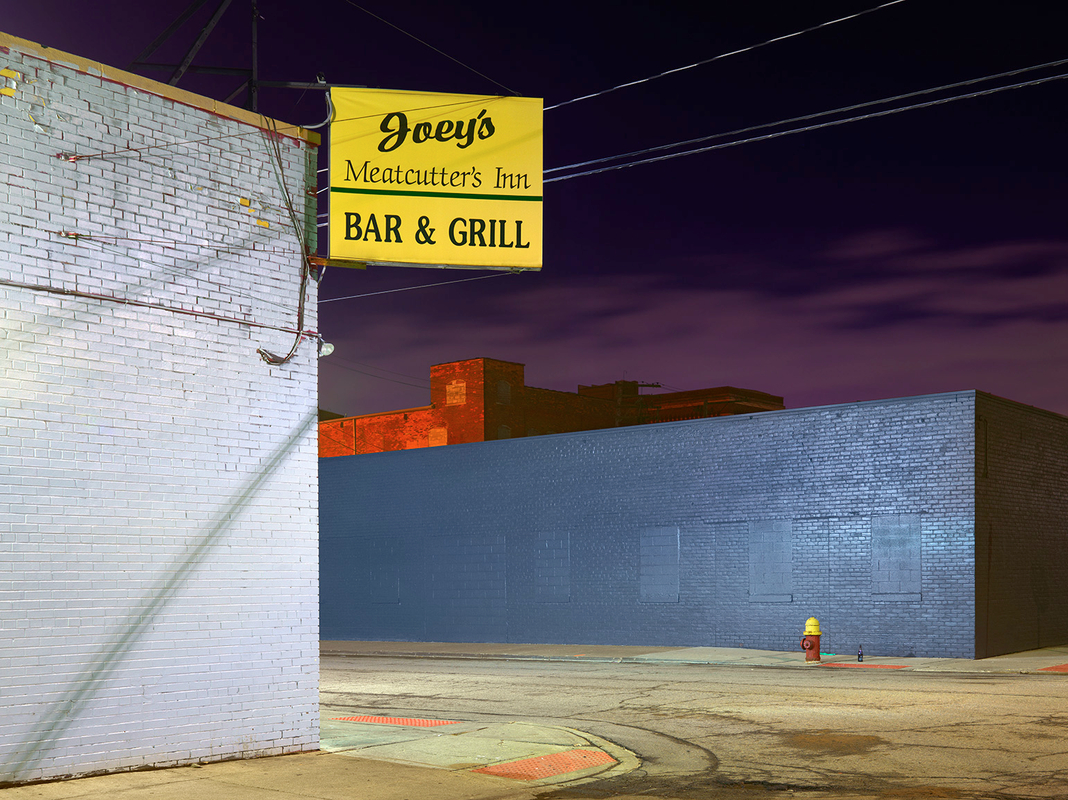
Detroit Nocturne‘ found here.  Via Mick Hartley.

I’m partial to ‘Joey’s Meatcutter Inn, Bar & Grill 2017‘:

Joey's Meatcutter's Inn, Eastside, Detroit 2017

The lonely cityscape at night or the familiar glow of gas station lights cast into the American wilderness.  The eye might want to linger among the colors, shapes and clouds even though the mind knows this is pretty much an empty street in a ‘post-industrial’ zone.

Repost-Via A Reader-From Brain Pickings, An Old BBC Nabokov Interview

Thanks, reader.


As previously posted:

Full piece here

‘Therein lies the central tension of Speak, Memory. Its prose is meticulous, suggesting memory as an exercise in exacting dictation from an omniscient oracle, yet its message points to memory as mutable, prone to the passage of time and the vagaries of imagination’

I merely enjoy good writing.


Michael Dirda’s review of a review here.

Book here.

“Nabokov in America” is rewarding on all counts, as biography, as photo album (there are many pictures of people, Western landscapes and motels) and as appreciative criticism. Not least, Roper even avoids the arch style so often adopted by critics faintly trying to emulate their inimitable subject.’

What’s more American than an exiled member of the Russian aristocracy intimately making his way into the English language and peering out from a thousand Motor Lodges?

===============

As previously posted an interview with Nabokov at The Paris Review.

A little bit about politics and also the politics amidst fellow writers and critics:

‘…when in doubt, I always follow the simple method of choosing that line of conduct which may be the most displeasing to the Reds and the Russells.’

and:

‘Who’s in, who’s out, and where are the snows of yesteryear. All very amusing. I am a little sorry to be left out. Nobody can decide if I am a middle-aged American writer or an old Russian writer—or an ageless international freak.’

On his professional collection of butterflies:

‘The pleasures and rewards of literary inspiration are nothing beside the rapture of discovering a new organ under the microscope or an undescribed species on a mountainside in Iran or Peru. It is not improbable that had there been no revolution in Russia, I would have devoted myself entirely to lepidopterology and never written any novels at all.’

Via Youtube: An interviewer, Nabokov and Lionel Trilling discuss ‘Lolita:’

Thursday Poem-Thomas Dekker

The Merry Month of May

O the month of May, the merry month of May,
    So frolic, so gay, and so green, so green, so green!
O, and then did I unto my true love say:
    “Sweet Peg, thou shalt be my summer’s queen!

    Now the nightingale, the pretty nightingale,
    The sweetest singer in all the forest’s choir,
Entreats thee, sweet Peggy, to hear thy true love’s tale;
    Lo, yonder she sitteth, her breast against a brier.

    But O, I spy the cuckoo, the cuckoo, the cuckoo;
    See where she sitteth: come away, my joy;
Come away, I prithee: I do not like the cuckoo
    Should sing where my Peggy and I kiss and toy.”

O the month of May, the merry month of May,
    So frolic, so gay, and so green, so green, so green!
And then did I unto my true love say:
    “Sweet Peg, thou shalt be my summer’s queen!”

Thomas Dekker

Did you fall in love with this green, green English?

Maybe it all comes back around: