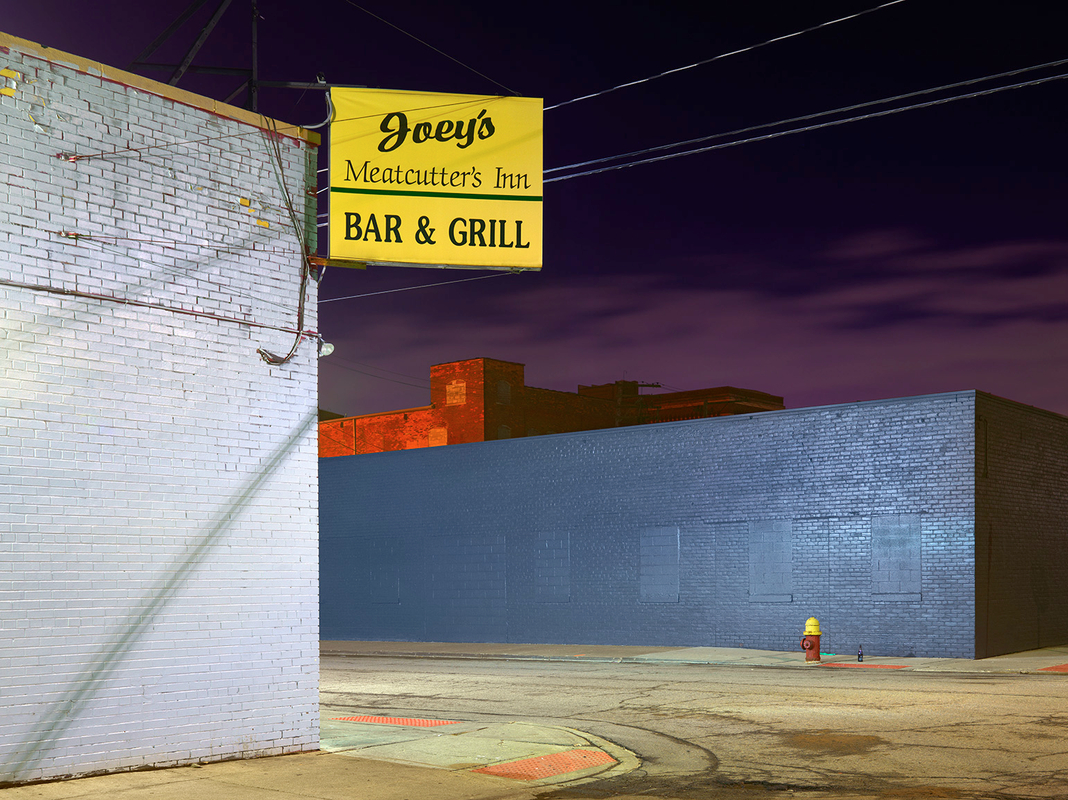
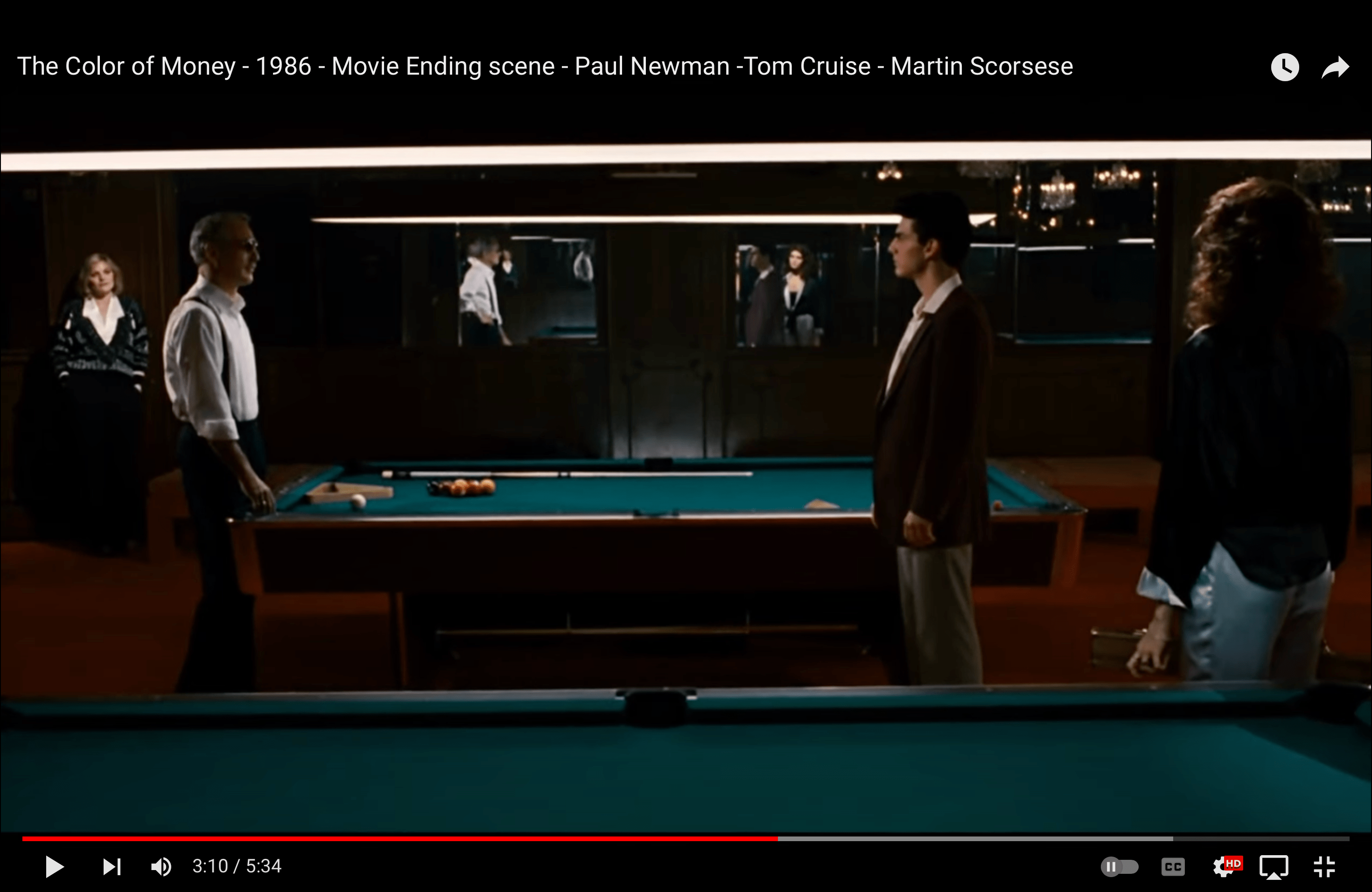
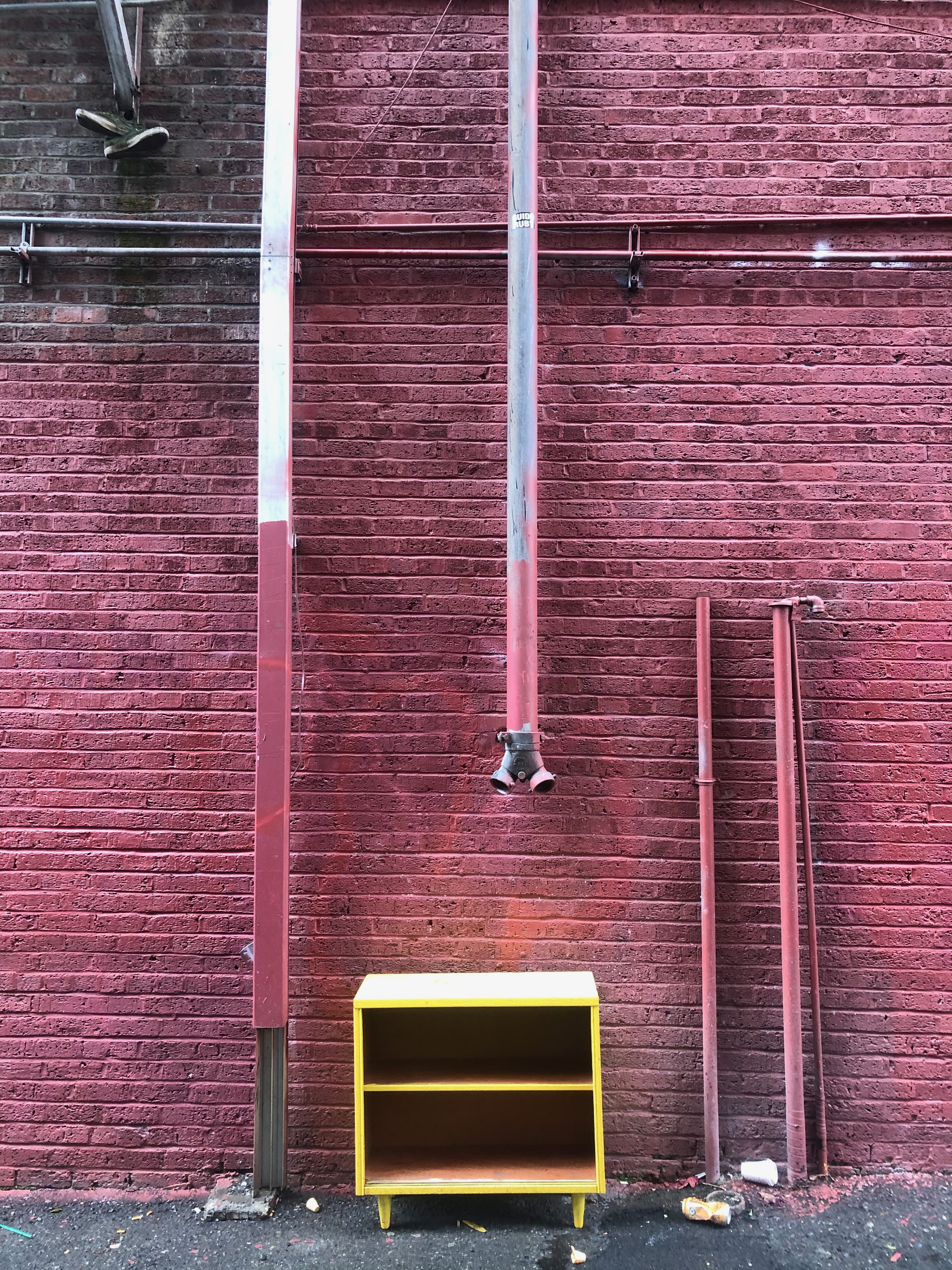
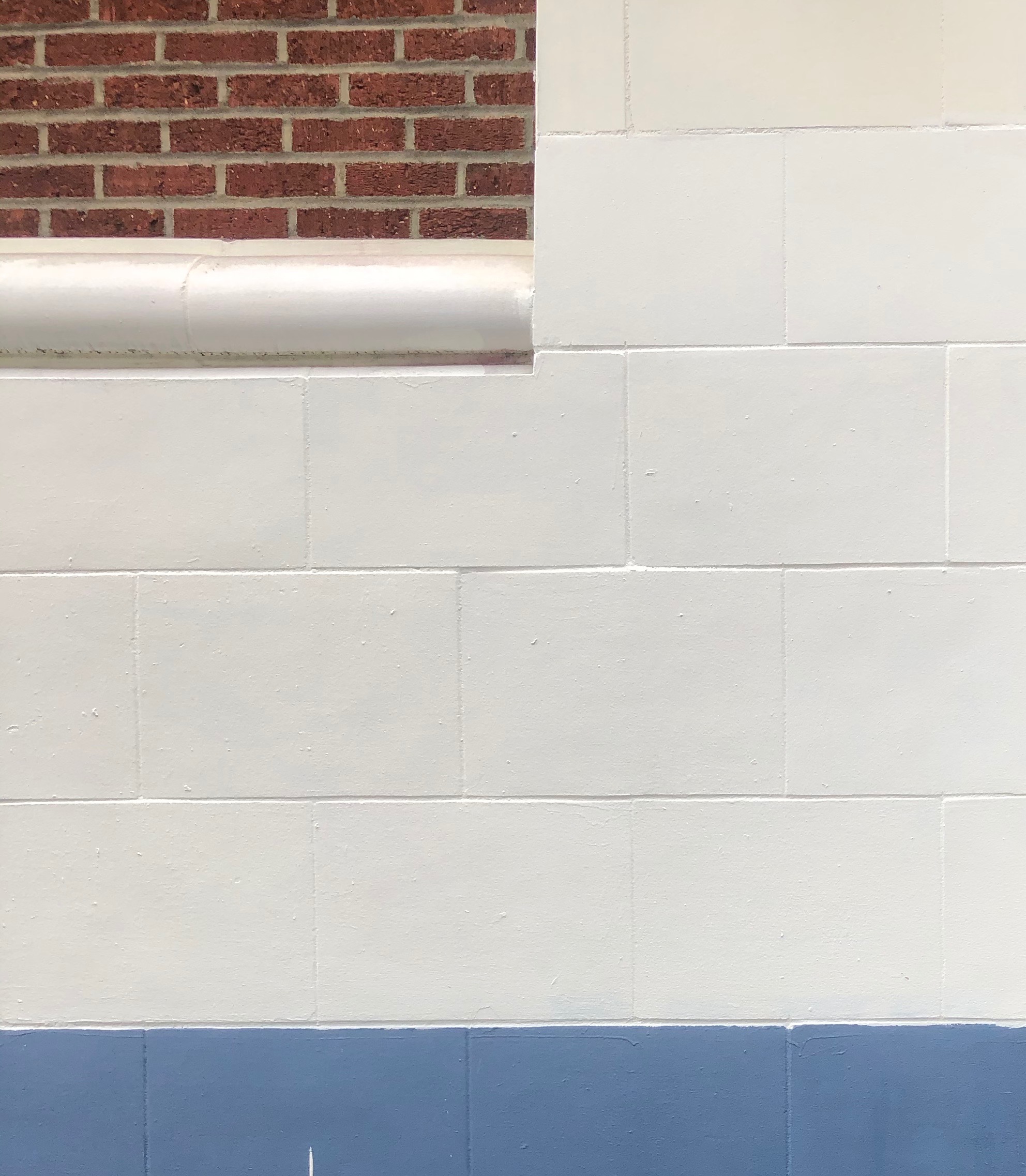
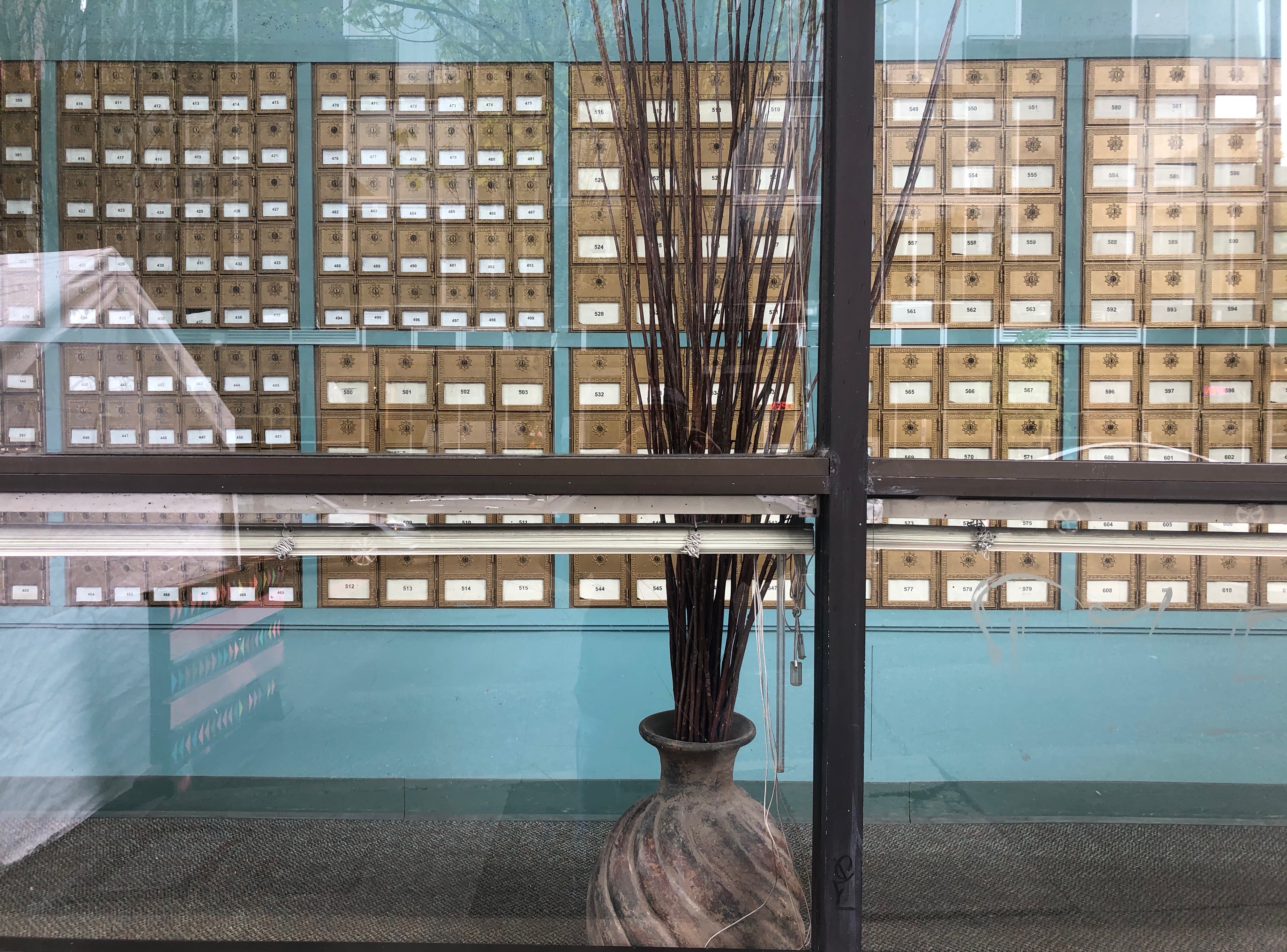
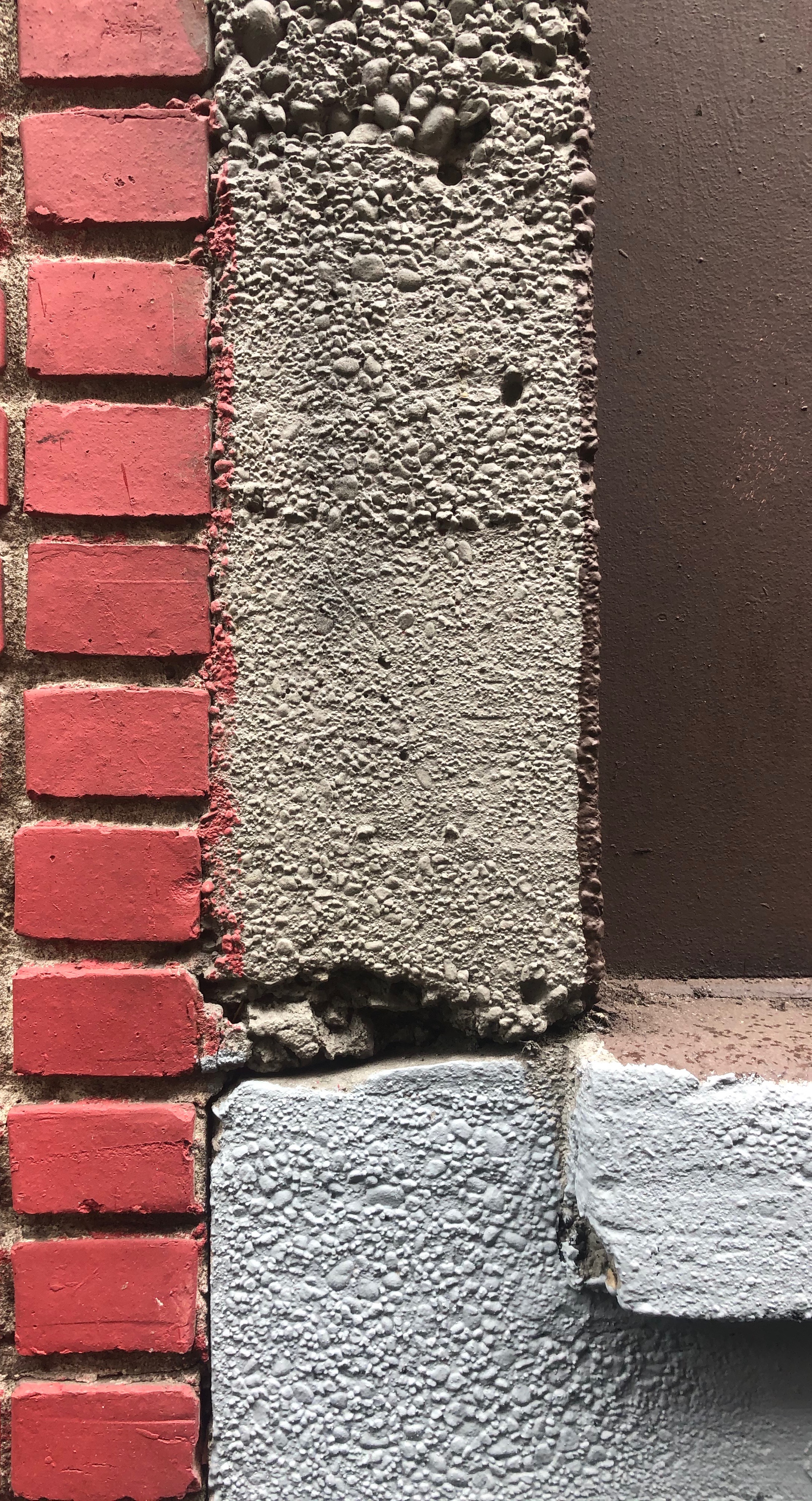
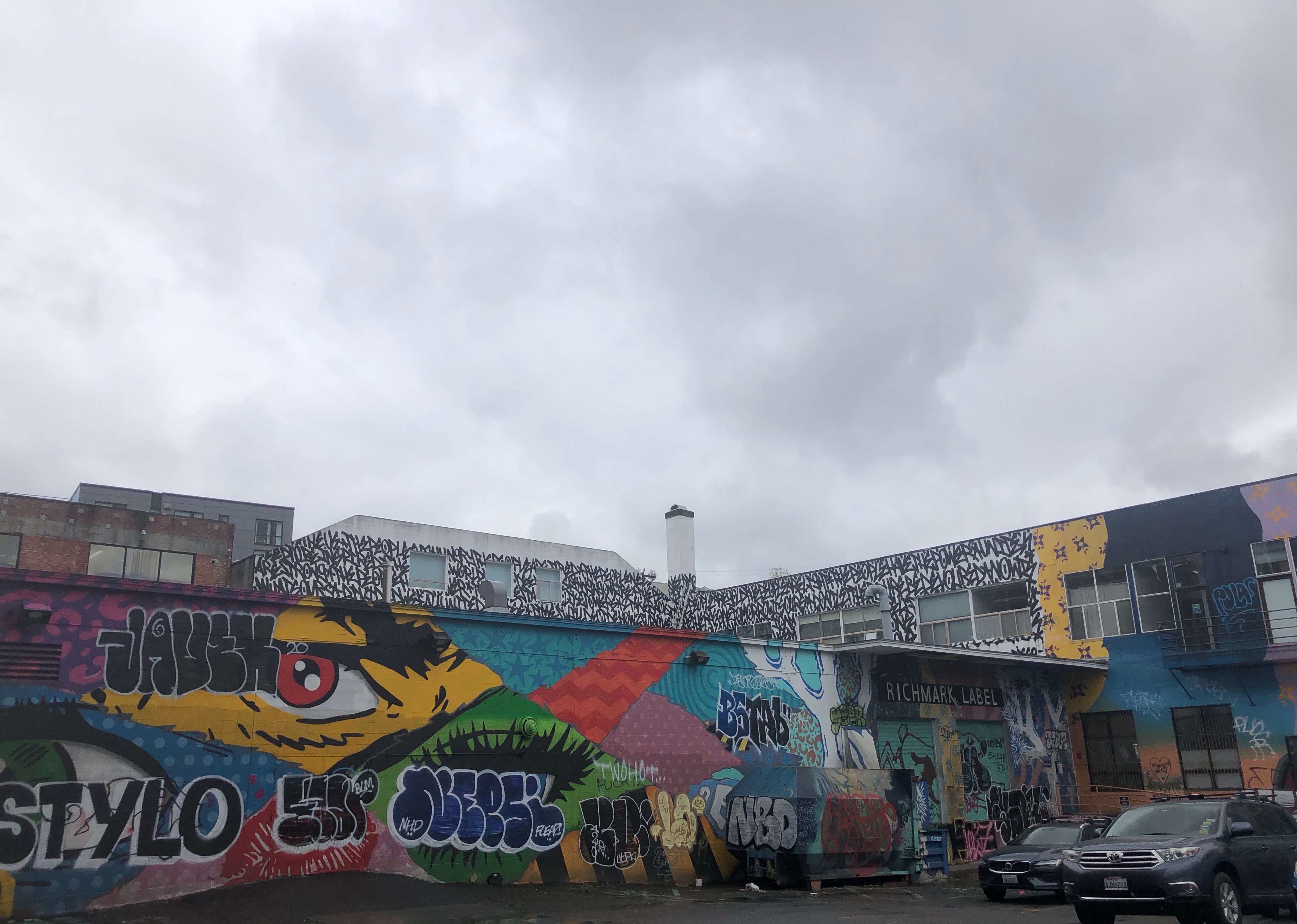
Images 1 and 3 below, especially, read as illustrations to me, while image 2 acts as more of a bridge. As readers know, I tend towards quiet, observational photographs. There is a progression present moving outdoors-in, to a more intimate space.
Edward Hopper practiced deep color complentarity in his paintings, balancing cool and warm. I first noticed his use of red here, and it got me thinking:
‘Red is powerful. Hopper’s using it with purpose.‘
This got me thinking a little further: ‘How much red is too much?‘
Henri Matisse went full red one time, but there’s much more: Expert lines, curves, and composition (no focal point) make me feel at home. In fact, I think this domestically-minded Frenchman’s put most of his life’s purpose into his painting.
—
What’s the most aggressive, yet soothing, use of red I’ve seen consistently throughout my life?
Probably a Coke can, billboard, or truck. Check out this Arthur Meyerson photo with a Coke truck in context.
Another color problem: Color draws the eye quickly. Color is powerful. It snatches your eye and mind. The original black-and-white photographers thought color photography would distract, vulgarize, and commercialize; away from subject and composition, especially given the camera technology at the time.
It turns out the old guys weren’t entirely wrong, as many advertisers and fashion photographers barf color all over the place. Some expertly upchuck. Others, alas, puke like Brits on holiday in Ibiza.
Kids with crayons and iPads, shock and awe pop-artist and portraitists, movie directors, and even ideologues making their propaganda, use color freely. We’re all being gradually exposed to the newer synthetic AI stuff coming down the pike. We are living, I believe, amidst an information revolution (storage, access, process and attention). I mean, unless you’re color blind, you see the world in color.
Remember that one sunset and her makeup and the city behind her all blended together?
On that note, Dear Reader, this has been one of the best approaches I’ve found so far along my later, more limited, photographic journey in life:
‘Beware of color theories. Theories in color photography are dangerous. The plain fact that there are so many of them proves my point. A color philosophy comes much closer to the truth. Beware of scientific color tests. They are as quickly outdated as a timetable. Their truth is short lived. Most theories are the result of an attempt to bring one’s practical experiences into a formula. There is no formula. There are only confirmations to formulas which one has already discovered oneself. I myself love to read theories without ever using them when working.‘
Hopefully, I’ve jarred something loose inside your head.
Harry Gruyaert’s celebrated, but I’d argue he’s still underrated for his mastery of color.
From Kenn Sava, Gruyaert’s not a portraitist, per se:
‘It’s not the person that interests me most. It’s the person in its environment. To me, all the elements are important. I don’t have any particular intention. It’s just what I see.
I think humans have such a great idea about ourselves, but nature is so much more powerful.’
According to the interview, American pop-art influenced Gruyaert, potentially freeing him from elements of European formalism (pushing him into some great color work). If you’re interested in seeing fine color, atmospheric and ‘lived-in’ photography, I’d recommend Rivages.
—
As for pop-art, it can often be colorful, innovative, intuitive and non-serious…on the surface.
Frank O’Hara’s mid-century American poems are surprisingly visual. The idea of a wild freedom wrapped within casual conversation; a moment to moment associative intensity is achieved through O’Hara’s form. This is often where we long to be, on the edges of possibilities, living intensely with others (even through memory, sometimes especially through nostalgia and memory).
Also, the poem suggests this freedom as a return to our animal natures; which involves a certain view of Nature, functioning as a Romantically primitive return to Nature. Frankly, it’s a pretty good love poem.
Animals
Have you forgotten what we were like then when we were still first rate and the day came fat with an apple in its mouth
it’s no use worrying about Time but we did have a few tricks up our sleeves and turned some sharp corners
the whole pasture looked like our meal we didn’t need speedometers we could manage cocktails out of ice and water
I wouldn’t want to be faster or greener than now if you were with me O you were the best of all my days.’
As for color, perhaps this also doesn’t mean color must be completely abstracted into the ambitious meaning-making mission of Mark Rothko. I mean, the sky is blue, the trees green, and the balloons red and yellow.
‘Mark Rothko sought to make paintings that would bring people to tears. “I’m interested only in expressing basic human emotions—tragedy, ecstasy, doom, and so on,” he declared. “And the fact that a lot of people break down and cry when confronted with my pictures shows that I can communicate those basic human emotions….If you…are moved only by their color relationships, then you miss the point.”
Seal the compound…I mean chapel. (come to Houston, land of little zoning, fair pilegrim).
—
Readers will know this blog maintains skepticism for pop-art Neo-dadaism and the consecration of ordinary objects along the Duchamp line (‘American Standard’?). Making Duchampian exceptions rules, even clever rules, can desecrate what’s important.
Everyday people, living right, must keep the important things in view, namely wife/husband/children/parents/death/taxes/health/time; not merely their own impulses nor artistic visions (artists remain acutely aware of such indifference). Meaning is usually to be found within love for another, and this usually means everyday people (& the everyday within us) lives between the sacred and profane: The 9-5 grind and the unexpected conversation about grandma’s death, the enveloping silence afterwards.
Artists, at their best, point towards wisdom, truth and beauty regarding everyday things. All the artists I’m linking to are doing so in one way or another, although ‘how’ and ‘how well’ are endlessly disputed.
I’ve already seen a thousand urinals in my life, Marcel, even a few in my dreams.
The triumph of the conceptual over the actual, the mass-produced over the created; perhaps these aren’t entirely healthy trends. The retreat into (S)elf, and the retreat into irony alongside (A)rt as commodity, perhaps these are dead-ends as much as they are freshly-paved streets. The lamentations of art as (R)eligion could be a leading indicator of a deeper hunger for meaning; a hunger with as many bad as good outcomes for artists and everyday people…
Some food for thought, Dear Reader.
As a contrast, here’s some American art that’s more grounded; some realism with psychological depth, albeit with impressionist influence.
I think Raymond Chandler’s High Window is among the best of the American detective novel.
Here are some quotations of his, if you’re interested.
“Los Angeles was just a big dry sunny place with ugly homes and no style, but good-hearted and peaceful. It had the climate they yap about now. People used to sleep out on porches. Little groups who thought they were intellectual used to call it the Athens of America.”
Here is the link. It’s been a long time since they just reviewed the book and not the author.
Boy, oh boy, James Ellroy: America’s best current historical crime fiction writer, showing up to entertain, shock and vulgarize:
The poem that most came to mind after looking at Hopper:
Acquainted with the Night
I have been one acquainted with the night. I have walked out in rain—and back in rain. I have outwalked the furthest city light.
I have looked down the saddest city lane. I have passed by the watchman on his beat And dropped my eyes, unwilling to explain.
I have stood still and stopped the sound of feet When far away an interrupted cry Came over houses from another street,
But not to call me back or say good-bye; And further still at an unearthly height, One luminary clock against the sky
Proclaimed the time was neither wrong nor right. I have been one acquainted with the night.
Where was the data coming from? Who was controlling the flow?
—
Wiley parked in an unused Microsoft lot, with visibility and cover behind a parked construction crane. He figured he’d have some minutes before he aroused suspicion. Stop #71335 sat halfway down a ramp, towards 520, heading West. About six people milled around, two getting on a bus, then a few more filtering in: Three Indians, two Chinese professional women and a white guy in sweat pants with his belly hanging out in the cold.
Shouldn’t there be more people? These buses are leaving campus, heading towards Seattle. Is this the wrong stop? Was it the stop heading East? As these thoughts flashed across Wiley’s mind, someone knocked on the window.
Startled, Wiley’s hand reached for his sidearm under his shirt. ‘No, no!’ the man said, backing away. ‘Please it is me’. He was wearing a red coat with a pea-green hat.
‘I’m sorry. I have to be careful’ his arms dropping to his sides. ‘So careful. This is very bad now. You are Wiley and I will present everything.Let’s turn off our phones off and drive.’
Wiley nodded and motioned the man around the car. He appeared to be in his late twenties, thin with glasses. Wiley scanned and saw no one else around. So much for ‘Emerald City Investigations offers top-notch surveillance skills.’
‘Call me John.’ the man said climbing in. A laptop was under his arm as he placed his backpack between his legs. ‘Thank you for coming. It is me. Please head away from here through the neighborhoods. Your phone must be off. We will find a network.’
Among the rain and lights I saw the figure 5 in gold on a red firetruck moving tense unheeded to gong clangs siren howls and wheels rumbling through the dark city.
‘Imagism was a sub-genre of Modernism concerned with creating clear imagery with sharp language. The essential idea was to re-create the physical experience of an object through words. As with all of Modernism, Imagism implicitly rejected Victorian poetry, which tended toward narrative.‘
And:
‘The most exemplified phase of Modernism, referred to as “High Modernism,” occurred during the inter-war years (1918-1939). This was the time when writers synonymous with Modernism, such as Virginia Woolf, James Joyce, T.S. Eliot, and D.H. Lawrence, thrived. While Victorians typically concerned themselves with rendering reality as they understood it into fiction, Modernists recognized that reality was subjective, and instead strove to represent human psychology in fiction.‘
In response: I don’t believe reality to be subjective, though I’ve met a lot of people who seem to.
Where’s the proof for such a claim?
For my part, I believe reality is there, and that my senses are giving me evidence and essential elements of reality. One of the strengths of the camera is the ability to move faster than the eye and brain (stuff I’m too slow to notice and process…lots of randomness).
While I’m inspired deeply by much modern art, and was raised in a postmodern milieu, I’ve not been persuaded by postmodern truth and knowledge claims. Postmodernism seems like a game with unclear rules, a few admirable people, and a lot of weirdos answering to Nehru-jacket-wearing authorities spewing gobbledy-gook.
During the post-war years, the confessional poets, with a fair amount of free and blank verse became dominant, with a kind of feelings-first, psychological exploration of the (S)elf. We’re now seeing many downstream effects in our culture (I’ll leave this to your imagination…for good and ill).
The Straussian truth and knowledge claims, as one example, pushes back to a kind of classicist revival, an embrace of tradition, and rejection of much modern and postmodern thinking.
And now for something…somewhat related…
What I’ve Seen Lately In The Lonely Parts Of Town. I like abstraction, and certain shapes I see. I like arranging photos in series/sequences to highlight certain shared variables (color, light, shape etc.). This attraction starts with my senses out in the world, but ultimately must answer to my physical limitations, limitations of my technique/skill and limitations of the camera. It must answer to limitations of time, weather and light conditions, and the wishes of other people.
I’m usually behind reality, or in the wrong position, or I just missed what was a lovely, serendipitous moment. There are the known knowns I missed, the known unknowns, and also the unknown unknowns (stuff I’ll never see, but for example, I can admire in the work of other photographers).
Anyways, what a long-winded ass I’ve become. I hope you find something of value in this short four-photo-sequence.
From our rather reasonable AI overlords: ‘Common skepticism is a healthy critical attitude towards dubious claims, while philosophical skepticism challenges foundational knowledge and the justification for belief itself, demanding proof for everything, a stance few people adopt in daily life.’
I knew a philosophic skeptic, he was smarter than me & fun, but, man…what an asshole.
Commoners have good reasons to be skeptical when it comes to modern art:
‘Titled Comedian, the humoristic piece can be considered a challenge to the sometimes-absurdist nature of the art market and the art collecting world. “To me, Comedian was not a joke; it was a sincere commentary and a reflection on what we value,” said the artist in an interview at the time. “At art fairs, speed and business reign, so I saw it like this: if I had to be at a fair, I could sell a banana like others sell their paintings. I could play within the system, but with my rules.”’
Who can forget the transcendent darkness of this photo (the shock-concept and the celebrity overshadowing the skill/visual impact).
‘He immersed a crucifix he bought in an antique shop in his own urine.‘
Fellow commoners, we have as a counterpoint, rather beautiful, innovative classics like Falling Water, by Frank Lloyd Wright. A pain in the ass to maintain, but still a place for the genuine:
As I see the world: We have beliefs, and we’ve usually locked them away beyond critique. So has most everyone else. Some beliefs have more truth in them than others.
We use shared beliefs to form and maintain relationships. We use them to get stuff and give other people stuff. We rely on shared beliefs to organize events/clubs, workplaces, and hierarchies of judgment and knowledge, without killing each other. Shared beliefs regulate and help us navigate our emotions, as well as our personal, interpersonal and social behavior. We outsource much of our thinking to shared beliefs, while forgetting they’re even there. We’re often proudest of passing our beliefs on if we think they’re true, lasting and important.
The rub is the relationship these beliefs have with truth, and knowledge. A modern rationalist might say something like: ‘We have access to enough scientific and economic knowledge to run the government, and effectively plan your life. (M)an is something holy, and we’ve only just begun perfecting (M)an.Go ahead be creative and vote for the $1 billion arts package or else.‘
A typical Catholic might say something like: ‘Let’s check in with Canon Law. The Pope is closest to God, then the Cardinals, then the Archbishops etc.’ We’re only redeemed through Christ. So….that’s what art should be doing. Capiche?
What if a radical questioning of belief becomes the norm, around which people are…still believing?
What, then, do people actually believe?
What do artists, often radically questioning belief while making stuff, actually believe?
Those increasingly ridiculous artist statements? Some curious mix of irony, doom and nihilism all the way down? Modern mysticism?
A digression: Let’s say a kid in bad neighborhood, at a vulnerable age, joins a gang. He gets protection, savage discipline and access to stuff. The gang serves dark masters of the soul of course (in our case: How to rob specific makes/models of cars and sell them for parts, leaving a trail of harm, making the kid violent and dangerous).
Let’s also say the same kid in a bad neighborhood, on weekends, hangs with his uncle. His uncle fixes cars. Our kid learns to honor something within himself, other people, and the world. Like his time with the gang, life unfolds as a series of challenges, struggles and possibilities. Yet, his lifespan probability opens from twenty-two to sixty-four. Much better of parts of the kid’s nature come forwards. People drive their cars away, grumbling over the price and the delays…but, still.
Clearly, one path is better for the kid, the neighborhood and the rest of us?
Surely?
Now, what if, at school, that same kid is particularly talented, smart and sensitive? What if he is guided by someone towards personal self-expression, and even the eventual self-doubt, poverty and emotional rollercoaster of a typical artist’s life?
Shouldn’t the kid at least be taught how to notice things? how to describe how a good painting looks? how to draw? how to draft? how to mix paint?
Surely?
These days, it seems we find ourselves in a ‘post, postmodern landscape.’
What is this curious, Western belief to ‘blank-slate’ everything? How can it be true that the kid’s emotions are a reservoir and his reason a man-made, oppressive dam? That he just needs to make a dark, mixed-media video collage and he’s arrived?
It seems making simple moral judgments in real-world scenarios raises serious questions about the Romantic/Modern/Postmodern projects.
The case for the visual art over the primacy of concept/idea: Lets say you’re looking at John Singer Sargent’s ‘Lady Agnew Of Lochnaw‘ (somewhere between realism/impressionism). You’re not looking at merely the idea of painting (good paintings already have ideas in them).
—
Maybe you want to touch her skin? How did he paint like that? Look at the color and light. What is the artist saying? This painting took six sittings, but, arguably, a lifetime and maybe the better elements of a civilization to achieve.
A simple case: The Duchamp/Warhol line (concept/idea over visual communication/technical skill) warrants tremendous common-sense skepticism (I’ve gone a little deeper…but you get the point). Enough already.
Bananas duct-taped to walls and crucifixes dunked in piss are not just wasting our time, perhaps they’re harming our imaginations.
There are so many reasons to doubt so much bullshit within modern/postmodern thinking, while at the same time learning from the good.
—
Tom Wolfe went on the T.V. with William F Buckley (too political for my taste) to discuss his book: ‘The Painted Word.’
At min 5:39 Wolfe argues the following (one part of the art/money/celebrity feedback loop):
‘It’s really a religious thing. One thing I didn’t say in The Painted Word, that I should have said, is that art today, is the religion of the educated classes. I don’t mean that by analogy, it isn’t like being a Baptist in 1870, it is being a Baptist in 1870.’
—
From Art vs Machine: Here is a video making the case that Jackson Pollock achieved something, but it wasn’t really the innovative use of drip-paint.
Maybe it was kinda beautiful in its own way? Romantically Primitive?
—
Also, are Robert Hughes criticisms’ of Andy Warhol’s art really blocked by YouTube?
Making a hero of the androgynous anti-hero is orthodoxy these days, but also pretty tired (the Warhol to Bowie line seems over-rated):
—
What came before modernism/postmodernism? Why the below video might be worth listening to (min 34:22):
‘There was a great turn towards emotionalism. There was a sudden interest in the primitive and remote; the remote in time and the remote in place. There was a outbreak of craving for the infinite’
A movement emerged, about 1760–1840, which has deeply affected our conceptions of the Self, Art, heroes and villains, and most importantly, what makes life worth living.
‘The most useful definition of modernist fiction I’ve encountered comes from Brian McHale’s Postmodernist Fiction. He says modernist fiction tends to “foreground epistemological questions” such as “How can I interpret the world I’m part of? What is there to be known? Who knows it? What are the limits of that knowledge?” In contrast, postmodernist fiction tends to “foreground ontological questions” such as “What is a world? What kinds of worlds are there and how are they constituted? What happens when…boundaries between worlds are violated?’
As to the epistemological questions surrounding Modernism, below are four poems. Hopefully, each is a representative example of a move away from the Romanticism that had been prevalent up until the late 1800’s.
In addition to the move away from traditional Romantic rhyme and meter towards modern blank verse, there’s also a certain conception of the Self rendered in them; a presentation of our natures that might be worth examining in some detail.
I believe we can see clearly a move away from tradition towards the Self, the Poet isolated, the poem itself as a means of communication, and an anxiety so common within the 20th century.
‘At the heart of Bloom’s project is the ancient quarrel between “poetry” and “philosophy.” In Bloom’s opinion, we ought not have to choose between Homer and Plato; we can have both, as long as we recognize that poetry is superior.’
Says the guy who writes about poetry…
What does one find within, as one looks without, waking from sleep and dream?
What kind of world is this, and can the poet actually help us know it?
You tossed a blanket from the bed You lay upon your back, and waited; You dozed, and watched the night revealing The thousand sordid images Of which your soul was constituted; They flickered against the ceiling. And when all the world came back And the light crept up between the shutters And you heard the sparrows in the gutters, You had such a vision of the street As the street hardly understands; Sitting along the bed’s edge, where You curled the papers from your hair, Or clasped the yellow soles of feet In the palms of both soiled hands.
—
The world will stain you, and it is a fallen, modern world, rendered profoundly and exquisitely.
As consciousness creeps in, building a bridge to the day, to the world, to the facts left as though they were the first facts, the light as though it were the first light, what one finds is distressing, both within and without.
That distress must be ‘made new,’ which is to say, the suffering (original?) in which we all sometimes find ourselves must match our experiences within the modern city and world, at least, the world created within Eliot’s lyrical verse.
Of the four poems, only the first and last have a 3rd-person subject.
—
Wallace Stevens‘ ‘I’ is in a more contemplative state, but it’s an ‘I’ exploring similar themes, and experiencing some distress in trying to know how the world actually is, and what might lie within.
The journey to The Self may not be a journey for the faint of heart.
The Poems Of Our Climate (stanzas II and III)
II Say even that this complete simplicity Stripped one of all one’s torments, concealed The evilly compounded, vital I And made it fresh in a world of white, A world of clear water, brilliant-edged, Still one would want more, one would need more, More than a world of white and snowy scents.
III There would still remain the never-resting mind, So that one would want to escape, come back To what had been so long composed. The imperfect is our paradise. Note that, in this bitterness, delight, Since the imperfect is so hot in us, Lies in flawed words and stubborn sounds.
—
Even if the verse can describe a perfected world, delivering us, perhaps, a little closer to perfection, our poet is still not free from the impulses and desires which simply never cease.
Interestingly, we end-up not with a discussion of the heart, the spirit, libido etc. as a source for those desires (for Plato, the irrational), but rather, for Stevens, just a mind.
We also find more Romantic elements of language and an almost baroque/rococo arrangement of words and ideas, dandyish even, yet combined with an intense effort to abstract, define, and clarify. From here, the poet may proceed on his task of flawed words and stubborn sounds.
***I find myself thinking of elements of modern architecture and abstract-expressionist painting. The meaning, or at least some delivery from our restless existences, can be found within the abstract itself. Or at least within a retreat to the abstract for its own sake, away from the world.
The modernist, glass-walled house on the hill will exist in its own space, offering and defying meaning. The structure’s own shapes will be stripped down to often mathematically precise forms interacting with Nature. These shall guide Man, or at least offer individual men a little refuge.
It is perhaps in Stevens’ poem we can see the questions of knowledge about the world suggesting questions about whether there is a world at all, or, at least, what kind of worlds each Self might be able to inhabit.
—
Here’s one of Robert Lowell’s poems, occurring a generation later, in the mid 20th-century, as part of the confessionals.
The Self is extremely isolated. In fact, Lowell went more than a little crazy. Unlike the known nervous breakdown of Eliot from which Eliot recovered, Lowell’s life was essentially one long breakdown from which he never recovered.
Here he is, looking back:
Epilogue
Those blessed structures plot and rhyme- why are they no help to me now i want to make something imagined not recalled? I hear the noise of my own voice: The painter’s vision is not a lens it trembles to caress the light. But sometimes everything i write With the threadbare art of my eye seems a snapshot lurid rapid garish grouped heightened from life yet paralyzed by fact. All’s misalliance. Yet why not say what happened? Pray for the grace of accuracy Vermeer gave to the sun’s illumination stealing like the tide across a map to his girl solid with yearning. We are poor passing facts. warned by that to give each figure in the photograph his living name.
—
The weight of having to make that meaning, for yourself, and by yourself, is a horrible weight indeed. One can glorify one’s Self and family, but that, alas, only goes so far. Rhyme and form still carry one’s living name, as far as they do.
Of course, there’s still wonderful rhythm and form here (this is excellent verse), but blanker now, with a relentless focus on the ‘I.’ The poet is perhaps talking a little more to himself, and the poem keeps self-consciously calling attention to itself.
—
In fact, it reminded me of the poem below, by Robert Creeley, which was published a few years afterwards.
From this page:
‘Creeley was a leader in the generational shift that veered away from history and tradition as primary poetic sources and gave new prominence to the ongoing experiences of an individual’s life. Because of this emphasis, the major events of his life loom large in his literary work.’
There’s Nothing but the Self and the Eye seeking and making meaning, by itself within a void of emotionally compact and precise language (of course there’s still form and other things besides).
Can the poet fit inside the little abstract chapel of words he’s building for himself (let alone the world, tradition etc.)?
For all the talk about ‘space,’ there seems very little.
The Window
Position is where you put it, where it is, did you, for example, that
large tank there, silvered, with the white church along- side, lift
all that, to what purpose? How heavy the slow
world is with everything put in place. Some
man walks by, a car beside him on the dropped
road, a leaf of yellow color is going to
fall. It all drops into place. My
face is heavy with the sight. I can feel my eye breaking.
—
The distress is still there…but I’d argue that we are now a good distance away from the grandness of Eliot’s vision, his religiosity and virtuosity with form and meter at the dawn of Modernism. Very few people can/could do what Eliot did (addition: even if he can help us gain knowledge of our Selves or the world).
That said, it’s unclear there’s enough tradition and confidence to even undertake such a project, now, even as such talents come along. The state of things is more scattered. We’re in a very different place of selves and artists isolated, of anxiety and post-anxiety.
Aside from the very accomplished poets above, in terms of both knowledge (epistemology) and being (ontology), we often have writers feeling pressure to weigh-in on such questions without even being about to write that well; artists who can’t draw or paint that well, and frankly, quite a bit of bullshit besides.
So, where are we headed? Who’s ‘we’ exactly?
Predictions are hard, especially about the future.
As previously posted:
Why not just put a few algorithms to work in writing those artist statements?
‘In “Sea Change,” Graham becomes Prospero, casting spells by spelling out her thoughts to merge with ours, and with the voices of the elements. The result is a mingling of perceptions rather than a broadcasting of opinions. Instead of analysis, the poems encourage emotional involvement with the drastic changes overwhelming us, overwhelm- ing the planet.’
and:
‘Strengths and weaknesses, flows and ebbs, yet every poem in “Sea Change” bears memorable lines, with almost haunting (if we truly have but 10 years to “fix” global warming) images of flora and fauna under siege. Jorie Graham has composed a swan song for Earth.’
Oh boy.
What are these poems being asked to do?
And moving away from poetry into the realm of ‘performance art,’
The black and white was made in 1924, and is probably most evocative of noir.
I think Raymond Chandler’s High Window is the best of the detective novel.
Here are some quotations of his, if you’re interested.
“Los Angeles was just a big dry sunny place with ugly homes and no style, but good-hearted and peaceful. It had the climate they yap about now. People used to sleep out on porches. Little groups who thought they were intellectual used to call it the Athens of America.”
Here is the link. It’s been a long time since they just reviewed the book and not the author.
The poem that most came to mind:
Acquainted with the Night
I have been one acquainted with the night. I have walked out in rain—and back in rain. I have outwalked the furthest city light.
I have looked down the saddest city lane. I have passed by the watchman on his beat And dropped my eyes, unwilling to explain.
I have stood still and stopped the sound of feet When far away an interrupted cry Came over houses from another street,
But not to call me back or say good-bye; And further still at an unearthly height, One luminary clock against the sky
Proclaimed the time was neither wrong nor right. I have been one acquainted with the night.
‘The fact is, even the sternest ascetic tends to be slightly inconsistent in his condemnation of pleasure. He may sentence you to a life of hard labour, inadequate sleep, and general discomfort, but he’ll also tell you to do your best to ease the pains and privations of others. He’ll regard all such attempts to improve the human situation as laudable acts of humanity – for obviously nothing could be more humane, or more natural for a human being, than to relieve other people’s sufferings, put an end to their miseries, and restore their joie de vivre, that is, their capacity for pleasure. So, why shouldn’t it be equally natural to do the same thing for oneself?’
More, Thomas. Utopia. Penguin (trans. Paul Turner), 1965. Print.
“His problem (Plato’s) with the arts was that they operated by images rather than by ideas, and thus that they might cloud the truth rather than clarifying it.”
Yes, and religious traditions, for example, also have interpretations of how one ought to reproduce the image.
“Whatever one thinks of Plato’s solution to this problem, I suggest that this is one of the problems that elicited his proposals for severe censorship of the arts he so obviously loved and had been trained in.”
Immediately, I think of Edward Hopper: The lonely cityscape at night or the familiar glow of gas station lights cast into the American wilderness. The eye might want to linger among the colors, shapes and clouds even though the mind knows this is pretty much an empty street in a ‘post-industrial’ zone.
Perhaps it has do with another strand of expression: The break into free verse from past forms. The move from American Romanticism to Modernism which occurred this early past century. William Carlos Williams produced many good poems from a process of earnest, scrapbook-style intensity in trying to discover, redefine, and order a new poetic form within a modern ‘urban landscape.’
The individual artist is quite alone in the task he’s set before himself, and like much of modernism, it’s a rather big task.
Pastoral
When I was younger it was plain to me I must make something of myself. Older now I walk back streets admiring the houses of the very poor: roof out of line with sides the yards cluttered with old chicken wire, ashes, furniture gone wrong; the fences and outhouses built of barrel staves and parts of boxes, all, if I am fortunate, smeared a bluish green that properly weathered pleases me best of all colors.
No one will believe this of vast import to the nation
Perhaps I’m not wrong in having called Halloween horror stills and movie images to mind (it’s my mind, after all, so maybe I’m just thinking of Devil’s Night). I really enjoy the light on the dumpster and the side-front rectory wall. There seems to be a little more mood here, more drama, so maybe Edgar Allan Poe’s ‘psychological intensity,’ his surrealism, and terror are more appropriate for comparison.
Poe was a bit mad, after all, despite his fascinatingly untamed and powerful imagination. He achieved a uniqueness and completeness of vision few artists do. Maybe there’s a bit of the sullen, self-aggrandizing earnestness in him of the teenager (J.D. Salinger); the desire to shock, delight and terrify.
The mind is as though a chamber, the horror rises to fever pitch, the lush rhyme matches an increasingly desperate search for truth and beauty in the world (Poe had very much his own Romantically inspired metaphysics).
Alone
From childhood’s hour I have not been As others were—I have not seen As others saw—I could not bring My passions from a common spring— From the same source I have not taken My sorrow—I could not awaken My heart to joy at the same tone— And all I lov’d—I lov’d alone— Then—in my childhood—in the dawn Of a most stormy life—was drawn From ev’ry depth of good and ill The mystery which binds me still— From the torrent, or the fountain— From the red cliff of the mountain— From the sun that ’round me roll’d In its autumn tint of gold— From the lightning in the sky As it pass’d me flying by— From the thunder, and the storm— And the cloud that took the form (When the rest of Heaven was blue) Of a demon in my view—
Are you looking at beautiful photos and feeling sorry for Detroit, and yourself? See Time Magazine’s photo essay by Yves Marchand and Romain Meffre (less porn-like, more thoughtful).
My brother comes home from work and climbs the stairs to our room. I can hear the bed groan and his shoes drop one by one. You can have it, he says.
The moonlight streams in the window and his unshaven face is whitened like the face of the moon. He will sleep long after noon and waken to find me gone.
Thirty years will pass before I remember that moment when suddenly I knew each man has one brother who dies when he sleeps and sleeps when he rises to face this life,
and that together they are only one man sharing a heart that always labours, hands yellowed and cracked, a mouth that gasps for breath and asks, Am I gonna make it?
All night at the ice plant he had fed the chute its silvery blocks, and then I stacked cases of orange soda for the children of Kentucky, one gray boxcar at a time
with always two more waiting. We were twenty for such a short time and always in the wrong clothes, crusted with dirt and sweat. I think now we were never twenty.
In 1948 the city of Detroit, founded by de la Mothe Cadillac for the distant purposes of Henry Ford, no one wakened or died, no one walked the streets or stoked a furnace,
for there was no such year, and now that year has fallen off all the old newspapers, calendars, doctors’ appointments, bonds wedding certificates, drivers licenses.
The city slept. The snow turned to ice. The ice to standing pools or rivers racing in the gutters. Then the bright grass rose between the thousands of cracked squares,
and that grass died. I give you back 1948. I give you all the years from then to the coming one. Give me back the moon with its frail light falling across a face.
Give me back my young brother, hard and furious, with wide shoulders and a curse for God and burning eyes that look upon all creation and say, You can have it.
We were supposed to do a job in Italy and, full of our feeling for ourselves (our sense of being Poets from America) we went from Rome to Fano, met the mayor, mulled a couple matters over (what’s a cheap date, they asked us; what’s flat drink). Among Italian literati
we could recognize our counterparts: the academic, the apologist, the arrogant, the amorous, the brazen and the glib — and there was one
administrator (the conservative), in suit of regulation gray, who like a good tour guide with measured pace and uninflected tone narrated sights and histories the hired van hauled us past. Of all, he was most politic and least poetic, so it seemed. Our last few days in Rome (when all but three of the New World Bards had flown) I found a book of poems this unprepossessing one had written: it was there in the pensione room (a room he’d recommended) where it must have been abandoned by the German visitor (was there a bus of them?) to whom he had inscribed and dated it a month before. I couldn’t read Italian, either, so I put the book back into the wardrobe’s dark. We last Americans
were due to leave tomorrow. For our parting evening then our host chose something in a family restaurant, and there we sat and chatted, sat and chewed, till, sensible it was our last big chance to be poetic, make our mark, one of us asked “What’s poetry? Is it the fruits and vegetables and marketplace of Campo dei Fiori, or the statue there?” Because I was
the glib one, I identified the answer instantly, I didn’t have to think — “The truth is both, it’s both,” I blurted out. But that was easy. That was easiest to say. What followed taught me something about difficulty, for our underestimated host spoke out, all of a sudden, with a rising passion, and he said:
The statue represents Giordano Bruno, brought to be burned in the public square because of his offense against authority, which is to say the Church. His crime was his belief the universe does not revolve around the human being: God is no fixed point or central government, but rather is poured in waves through all things. All things move. “If God is not the soul itself, He is the soul of the soul of the world.” Such was his heresy. The day they brought him forth to die, they feared he might incite the crowd (the man was famous for his eloquence). And so his captors placed upon his face an iron mask, in which
he could not speak. That’s how they burned him. That is how he died: without a word, in front of everyone. And poetry — (we’d all put down our forks by now, to listen to the man in gray; he went on softly) — poetry is what he thought, but did not say.
‘The most useful definition of modernist fiction I’ve encountered comes from Brian McHale’s Postmodernist Fiction. He says modernist fiction tends to “foreground epistemological questions” such as “How can I interpret the world I’m part of? What is there to be known? Who knows it? What are the limits of that knowledge?” In contrast, postmodernist fiction tends to “foreground ontological questions” such as “What is a world? What kinds of worlds are there and how are they constituted? What happens when…boundaries between worlds are violated?’
As to the epistemological questions surrounding Modernism, below are four poems. Hopefully, each is a representative example of a move away from the Romanticism that had been prevalent up until the late 1800’s.
In addition to the move away from traditional Romantic rhyme and meter towards modern blank verse, there’s also a certain conception of the Self rendered in them; a presentation of our natures that might be worth examining in some detail.
I believe we can see clearly a move away from tradition towards the Self, the Poet isolated, the poem itself as a means of communication, and an anxiety so common within the 20th century.
‘At the heart of Bloom’s project is the ancient quarrel between “poetry” and “philosophy.” In Bloom’s opinion, we ought not have to choose between Homer and Plato; we can have both, as long as we recognize that poetry is superior.’
Says the guy who writes about poetry…
What does one find within, as one looks without, waking from sleep and dream?
What kind of world is this, and can the poet actually help us know it?
You tossed a blanket from the bed You lay upon your back, and waited; You dozed, and watched the night revealing The thousand sordid images Of which your soul was constituted; They flickered against the ceiling. And when all the world came back And the light crept up between the shutters And you heard the sparrows in the gutters, You had such a vision of the street As the street hardly understands; Sitting along the bed’s edge, where You curled the papers from your hair, Or clasped the yellow soles of feet In the palms of both soiled hands.
—
The world will stain you, and it is a fallen, modern world, rendered profoundly and exquisitely.
As consciousness creeps in, building a bridge to the day, to the world, to the facts left as though they were the first facts, the light as though it were the first light, what one finds is distressing, both within and without.
That distress must be ‘made new,’ which is to say, the suffering (original?) in which we all sometimes find ourselves must match our experiences within the modern city and world, at least, the world created within Eliot’s lyrical verse.
Of the four poems, only the first and last have a 3rd-person subject.
—
Wallace Stevens‘ ‘I’ is in a more contemplative state, but it’s an ‘I’ exploring similar themes, and experiencing some distress in trying to know how the world actually is, and what might lie within.
The journey to The Self may not be a journey for the faint of heart.
The Poems Of Our Climate (stanzas II and III)
II Say even that this complete simplicity Stripped one of all one’s torments, concealed The evilly compounded, vital I And made it fresh in a world of white, A world of clear water, brilliant-edged, Still one would want more, one would need more, More than a world of white and snowy scents.
III There would still remain the never-resting mind, So that one would want to escape, come back To what had been so long composed. The imperfect is our paradise. Note that, in this bitterness, delight, Since the imperfect is so hot in us, Lies in flawed words and stubborn sounds.
—
Even if the verse can describe a perfected world, delivering us, perhaps, a little closer to perfection, our poet is still not free from the impulses and desires which simply never cease.
Interestingly, we end-up not with a discussion of the heart, the spirit, libido etc. as a source for those desires (for Plato, the irrational), but rather, for Stevens, just a mind.
We also find more Romantic elements of language and an almost baroque/rococo arrangement of words and ideas, dandyish even, yet combined with an intense effort to abstract, define, and clarify. From here, the poet may proceed on his task of flawed words and stubborn sounds.
***I find myself thinking of elements of modern architecture and abstract-expressionist painting. The meaning, or at least some delivery from our restless existences, can be found within the abstract itself. Or at least within a retreat to the abstract for its own sake, away from the world.
The modernist, glass-walled house on the hill will exist in its own space, offering and defying meaning. The structure’s own shapes will be stripped down to often mathematically precise forms interacting with Nature. These shall guide Man, or at least offer individual men a little refuge.
It is perhaps in Stevens’ poem we can see the questions of knowledge about the world suggesting questions about whether there is a world at all, or, at least, what kind of worlds each Self might be able to inhabit.
—
Here’s one of Robert Lowell’s poems, occurring a generation later, in the mid 20th-century, as part of the confessionals.
The Self is extremely isolated. In fact, Lowell went more than a little crazy. Unlike the known nervous breakdown of Eliot from which Eliot recovered, Lowell’s life was essentially one long breakdown from which he never recovered.
Here he is, looking back:
Epilogue
Those blessed structures plot and rhyme- why are they no help to me now i want to make something imagined not recalled? I hear the noise of my own voice: The painter’s vision is not a lens it trembles to caress the light. But sometimes everything i write With the threadbare art of my eye seems a snapshot lurid rapid garish grouped heightened from life yet paralyzed by fact. All’s misalliance. Yet why not say what happened? Pray for the grace of accuracy Vermeer gave to the sun’s illumination stealing like the tide across a map to his girl solid with yearning. We are poor passing facts. warned by that to give each figure in the photograph his living name.
—
The weight of having to make that meaning, for yourself, and by yourself, is a horrible weight indeed. One can glorify one’s Self and family, but that, alas, only goes so far. Rhyme and form still carry one’s living name, as far as they do.
Of course, there’s still wonderful rhythm and form here (this is excellent verse), but blanker now, with a relentless focus on the ‘I.’ The poet is perhaps talking a little more to himself, and the poem keeps self-consciously calling attention to itself.
—
In fact, it reminded me of the poem below, by Robert Creeley, which was published a few years afterwards.
From this page:
‘Creeley was a leader in the generational shift that veered away from history and tradition as primary poetic sources and gave new prominence to the ongoing experiences of an individual’s life. Because of this emphasis, the major events of his life loom large in his literary work.’
There’s Nothing but the Self and the Eye seeking and making meaning, by itself within a void of emotionally compact and precise language (of course there’s still form and other things besides).
Can the poet fit inside the little abstract chapel of words he’s building for himself (let alone the world, tradition etc.)?
For all the talk about ‘space,’ there seems very little.
The Window
Position is where you put it, where it is, did you, for example, that
large tank there, silvered, with the white church along- side, lift
all that, to what purpose? How heavy the slow
world is with everything put in place. Some
man walks by, a car beside him on the dropped
road, a leaf of yellow color is going to
fall. It all drops into place. My
face is heavy with the sight. I can feel my eye breaking.
—
The distress is still there…but I’d argue that we are now a good distance away from the grandness of Eliot’s vision, his religiosity and virtuosity with form and meter at the dawn of Modernism. Very few people can/could do what Eliot did (addition: even if he can help us gain knowledge of our Selves or the world).
That said, it’s unclear there’s enough tradition and confidence to even undertake such a project, now, even as such talents come along. The state of things is more scattered. We’re in a very different place of selves and artists isolated, of anxiety and post-anxiety.
Aside from the very accomplished poets above, in terms of both knowledge (epistemology) and being (ontology), we often have writers feeling pressure to weigh-in on such questions without even being about to write that well; artists who can’t draw or paint that well, and frankly, quite a bit of bullshit besides.
So, where are we headed? Who’s ‘we’ exactly?
Predictions are hard, especially about the future.
As previously posted:
Why not just put a few algorithms to work in writing those artist statements?
‘In “Sea Change,” Graham becomes Prospero, casting spells by spelling out her thoughts to merge with ours, and with the voices of the elements. The result is a mingling of perceptions rather than a broadcasting of opinions. Instead of analysis, the poems encourage emotional involvement with the drastic changes overwhelming us, overwhelm- ing the planet.’
and:
‘Strengths and weaknesses, flows and ebbs, yet every poem in “Sea Change” bears memorable lines, with almost haunting (if we truly have but 10 years to “fix” global warming) images of flora and fauna under siege. Jorie Graham has composed a swan song for Earth.’
Oh boy.
What are these poems being asked to do?
And moving away from poetry into the realm of ‘performance art,’
Andrew Wyeth homepage here with some images included.
There are definitely interesting things going on with light in Wyeth’s work. It fills his paintings. I also find my eye and mind hovering between realist depiction and abstract arrangement of objects on the canvas.
Ferguson:
‘Beneath the frequent prettiness, most of the pictures are just this side of harrowing, not just lonesome and melancholy but portraits of life as it seeps inevitably away. The wind that lifts the lace curtain in Wind from the Sea makes the hair on your arms stand up. Jamie Wyeth, Andrew’s son and a celebrated artist himself, confesses to being puzzled by the benign view of Wyeth’s work. “My father’s work is terrifying,” he said. It’s not sentimental. It’s luminous! But in a creepy way.’
Wyeth reached a level of popular appreciation few artists ever receive in their lifetimes.
Like many Americans, I find myself drawn to what I would call a New England plainness and Yankee work ethic and aesthetic, which is evident is some of Wyeth’s landscapes, at least. Long winters and deep woods. Shorter distances and stonier soil in the meadows. Perhaps a Puritan, high-minded spiritual reserve.
Or perhaps the Shaker work song ‘Simple Gifts’ adapted by Aaron Copland might be a good example of what I’m trying to get at.
————————————–
So, is this representative of Wyeth? Perhaps. He did much of his work in Chadds Ford, Pennsylvania and Maine, but according to Wikipedia there may be other influences as well:
‘N.C. also fostered an inner self-confidence to follow one’s own talents without thought of how the work is received. N.C. wrote in a letter to Wyeth in 1944:[8]
“The great men [ Thoreau, Goethe, Emerson, Tolstoy] forever radiate a sharp sense of that profound requirement of an artist, to fully understand that consequences of what he creates are unimportant. Let the motive for action be in the action itself and not in the event. I know from my own experience that when I create with any degree of strength and beauty I have no thought of consequences. Anyone who creates for effect — to score a hit — does not know what he is missing!”‘
So, I’m speculating. Addition: There’s also a strong modernist-influenced creative imagination at work here too, and like Hopper, the American question of what to do with all that space and wilderness.
Yet, a man able to walk familiar land, seeing it anew with keen eyes, hoping his senses pick up more than he knows, having a medium with which to express his thoughts seems a man who’s had some success in life, regardless of popular appreciation.
Of course, a concupiscent eye must come into tension with other parts of a man’s character.
Or at least when there was a tittering about his ‘Helga‘ paintings a while back.
Ferguson:
‘Stopping to rest near a group of European spring beauties, he saw on a trail above him a young woman on a walk. Assuming she was alone, she moved off the trail, lifted her skirt, and defecated in the grass. Wyeth was charmed. “The white curve of her bottom was amazing,” he told Meryman. The little lumps she left tumbled downhill and stopped in the patch of spring beauties.’
When I was younger it was plain to me I must make something of myself. Older now I walk back streets admiring the houses of the very poor: roof out of line with sides the yards cluttered with old chicken wire, ashes, furniture gone wrong; the fences and outhouses built of barrel staves and parts of boxes, all, if I am fortunate, smeared a bluish green that properly weathered pleases me best of all colors.
No one will believe this of vast import to the nation
‘What I have to say is largely in support of the following proposition: Literary criticism should be completed by criticism from a definitive ethical and theological standpoint.’
Eliot, T.S. Selected Prose Of T.S. Eliot. New York: Harcourt Brace & Company, 1975. Print.
Addition: Maybe, just maybe, as a friend points out. Compared to the current radical models clamoring for the syllabus, such a suggestion has become radical.
Movie Title: The Color Of Money (Director-Martin Scorsese). 1986.
What’s good and what’s genuine in characters who hustle for a living? Can the American pulp novella/novel be a source of both popular and high entertainment?
Visual Storytelling (end-scene pool showdown): The wiser and more experienced mentor, perhaps washed-up, is being pushed out of the business during his comeback, but he’s not going quietly (we need some dramatic tension). His lady waits for him near the edge of frame, while both of them only take about 1/5 of the frame (all four characters are on the diagonal).
Does he still have it?
—
Brash, untempered (arrogant), less experienced rising talent and his lady take about 1/3 of the frame, closer to the audience. They’ve been hustled; learning the art of the con pretty well.
Should he accept the challenge? Is this it?
Possible conclusions: Maybe that’s what we get in life, a view every now and again. At the height of our powers (or past our powers), we get a moment when the conception of the game and the game become one. In a tacky hall of mirrors, no less. I hope it’s not all a hall of mirrors.
Generations stuck in a stand-off…
My point: A good visual storyteller takes his craft seriously, associating the story and the images to push the story forward. He has an appreciation for beauty. I appreciate Scorsese for working hard because the harder he works, the more my intelligence is respected.
To be honest, the movie dragged on for me and is very much of its time (this is pool for Christ’s Sake, how much can you glamorize pool?). Mythos is tough to achieve.
That said, I appreciate a director practicing his craft and trying to provide some continuity in American life through the visual arts. I appreciate someone who understands that developed characters invite us to see something of ourselves in frame.
Just had a quick visit to family in the D.C. area, and Georgetown has a lot of high-end shops. A vague notion of London flashed through my mind. This is an area with appeal; where attractive women go to shop, see the sights, and be seen.
How does one capture the aesthetic (brick facades, colonial style, gothic script, ye ‘Olde English Shoppe’ vibe)?
The light was winter-light, mid-latitude, coming from over the left-shoulder/south/southwest. There were a lot of subjects, and lots of visual interest.
In photo number one, the reflection seems balanced, but the focus should probably be on one subject, preferably the guy (tough to manage if he’s only reflected). In number two, the umbrella on the right should probably in focus.
Neither are ‘winners’, really, but both have solid elements. They demonstrate that, over time, while taking photographs, you can continue to add judgment upon judgment, experience upon experience, into a ‘tool belt.’ You must make decisions, quick decisions on the street, regarding focus (what’s in focus?), light (shutter, how much to let in?), subject (what’s the story you want to tell?), and composition (what’s in frame, and what did you leave out?).
Each variable is crucial, and in this case, there are some focus and subject (static/boring) issues, to be sure.
“To me, neon really figured in the migration movement on Route 66. The farther you go out West, the more neon you’d see, especially as a presence on motels. You can see towns like Tucumcari, New Mexico, coming from 20 miles away.”
I may harbor skepticism regarding a more anthropological, back-to-Earth Romantic primitivism found in certain quarters (Berkeley, especially), but I certainly appreciate good composition. Click through for more photos and less pre-judgment.
—
As posted, what’s more American than an exiled member of the Russian aristocracy intimately making his way into the English language and peering out from a thousand Motor Lodges?
“Nabokov in America” is rewarding on all counts, as biography, as photo album (there are many pictures of people, Western landscapes and motels) and as appreciative criticism. Not least, Roper even avoids the arch style so often adopted by critics faintly trying to emulate their inimitable subject.’
—
Well, there’s Donald Judd and Marfa, Texas, which looks interesting:
As previously posted, The Critic Laughs, by Hamilton:
Do you long for the days of unabashed American consumerism? Are you nostalgic for nights lit only by a soft, neon glow on the underbellies of clouds? Return to a time when America broadcast its brash, unironic call to the heavens.
But it can be empty, and lonely, and full of hard work and suffering:
Montana Pastoral
I am no shepherd of a child’s surmises. I have seen fear where the coiled serpent rises,
Thirst where the grasses burn in early May And thistle, mustard and the wild oat stay.
There is dust in this air. I saw in the heat Grasshoppers busy in the threshing wheat.
So to this hour. Through the warm dusk I drove To blizzards sifting on the hissing stove,
And found no images of pastoral will, But fear, thirst, hunger, and this huddled chill.
And because this blog likes to keep things a bit mysterious, I think ‘New Slang’ by the Shins (James Mercer) captures three strands I can identify: Western U.S. cowboy folk (Home On The Range), English (England) folk, and Pacific NW hipsterdom, which is interesting to me, and because in the arts, I like to like a song, and think about what’s going on afterwards:
That hipsterdom part likely connects with a lot of powerful modern and postmodern strands which could be affecting all of our institutions sooner or later, but, you know…it’s also just a song.
‘Although Cole had ample commissions in the late 1820s to paint pictures of American scenery, his ambition was to create a “higher style of landscape” that could express moral or religious meanings.’
‘In the late 1830s, Cole was intent on advancing the genre of landscape painting in a way that conveyed universal truths about human existence, religious faith, and the natural world. First conceived in 1836, the four pictures comprising The Voyage of Life: Childhood, Youth, Manhood, and Old Age fulfilled that aspiration.’
These scenes in the Romantic style can have an emotional pull for me, as generally does the work of the Hudson River School. Such allegory certainly tends to function as a vehicle into memory (Cole’s work has really stuck with me…in a sort of haunting way, mixed with some thought of how I’m supposed to live and what might be coming next).
Also, the wild, untamed nature we Americans have often faced is perhaps requiring of a spirited and grand attempt at putting our experiences within Nature into some context: To soar as high as our hopes often do.
Or at least, to find in paintings: Familiarity. I like to see the roll of a hill like I’ve seen, or an opening of clouds, sky and light like I’ve seen.
Perhaps Wild Nature can be ordered in a Romantic, neo-classical or more modern way. Perhaps Nature can be made, with the tools at our disposal, to conform to some of our deeper ideas about Nature, mirroring our hopes in some recognizable fashion; giving some basic comfort and meaning.
Maybe, after all, we can find a home here.
On the other hand, allegory with overt moral/religious meaning can also come across as heavy-handed, sentimental, and moralistic. Too lush and pretentious; perhaps a bit anachronistic.
Do I really have to hunt for all the symbols and put the puzzle together?
‘So, you’re going to reveal universal truths, eh?’
—
This can seem distant from the experiences of the modern viewer, often finding himself a little further down the modern/postmodern ‘river’, where such attempts at universality might seem a wash.
Much more common these days are the very personal shards and glimpses of the inner life of an artist, attached to high ambition and great talent surely in some cases; as well to form and tradition, but generally making less bold claims to knowledge than ‘The Voyage Of Life‘.
In painting, I’m reminded of the abstract expressionist movement seeking meaning in reducing experience to the abstract in order to reveal something essential within Nature, or essential about our relationship to Nature: A transcendent place where shape, form and color can be isolated from anything immediately recognizable in the world.
‘The movement’s name is derived from the combination of the emotional intensity and self-denial of the German Expressionists with the anti-figurative aesthetic of the European abstract schools such as Futurism, the Bauhaus, and Synthetic Cubism. Additionally, it has an image of being rebellious, anarchic, highly idiosyncratic and, some feel, nihilistic.[5] In practice, the term is applied to any number of artists working (mostly) in New York who had quite different styles, and even to work that is neither especially abstract nor expressionist.’
The exploration of the Self is often pursued, as well as that of Nature, but the general hope that it might all make sense (life, death, Nature, purpose etc) in many more modern movements is often left abandoned.
Or so often, as we’ve seen in the past few generations: The pursuit of The Self can easily become subsumed to the pursuit of fame, celebrity, and money.
***
Towards a theme: Perhaps you’ve also heard of the Rothko chapel, in Houston, Texas.
Mark Rothko undertook the idea that within the modern context, one could create temples of universal meaning through aesthetics, art, and beauty:
‘The Rothko Chapel, founded by Houston philanthropists John and Dominique de Menil, was dedicated in 1971 as an intimate sanctuary available to people of every belief. A tranquil meditative environment inspired by the mural canvases of Russian born American painter Mark Rothko (1903-1970), the Chapel welcomes over 60,000 visitors each year, people of every faith and from all parts of the world.’
Brutalist architecture flourished from the 1950s to the mid-1970s, having descended from the modernist architectural movement of the early 20th century. The term originates from the French word for “raw”, as Le Corbusier described his choice of material béton brut, meaning raw concrete in French.’
Our local host and local guest pick favorite (unfavorite) examples of ‘raw concrete’ buildings in NYC and alternately discuss some facts about each one.
Some buildings mentioned: 375 Pearl Street is being worked on. The ‘Krull‘ Long Lines building is not for use.
—
As posted
Some people who commissioned Boston’s City Hall were probably thinking they were bringing something new and wonderful into the world: Inspiring, modern, transformative.
The folks at bureaucratic levels up-top would steer this concrete ship, scanning the Horizon for The Future. The People down below, justly and benevolently guided, would feel welcome and do people-y, citizen-y things as though in a terrarium.
Maybe that’s why it’s not so popular.
Well, at least it isn’t Buzludzha, The Communist Spaceship plopped down as though from a world of Pure Ideology, Nature properly subdued:
As previously posted:
–Visit Lileks.com. A fine humorist with a sharp pen and a keen eye.
Here’s Australian art critic Robert Hughes discussing the Albany plaza, and almost hyperbolically criticizing the aims of modernist architecture.
***Fun fact, he pronounces the “Boogie Woogie” the “Boo-gie Woo-gie.”
‘The real feat achieved by Gropius and his cohorts was to have recognized and exposed the sociopolitical and moral power of architecture and design. They wanted to exert “effective influence” on “general conditions,” fashion a more just world and turn all of this into a “vital concern of the entire people.”‘
See Also: They designed a city in the heart of Brazil that really doesn’t work for people: Brasilia: A Planned City
Immediately, I think of Edward Hopper: The lonely cityscape at night or the familiar glow of gas station lights cast into the American wilderness. The eye might want to linger among the colors, shapes and clouds even though the mind knows this is pretty much an empty street in a ‘post-industrial’ zone.
Perhaps it has do with another strand of expression: The break into free verse from past forms. The move from American Romanticism to Modernism which occurred this early past century. William Carlos Williams produced many good poems from a process of earnest, scrapbook-style intensity in trying to discover, redefine, and order a new poetic form within a modern ‘urban landscape.’
The individual artist is quite alone in the task he’s set before himself, and like much of modernism, it’s a rather big task.
Pastoral
When I was younger it was plain to me I must make something of myself. Older now I walk back streets admiring the houses of the very poor: roof out of line with sides the yards cluttered with old chicken wire, ashes, furniture gone wrong; the fences and outhouses built of barrel staves and parts of boxes, all, if I am fortunate, smeared a bluish green that properly weathered pleases me best of all colors.
No one will believe this of vast import to the nation
Perhaps I’m not wrong in having called Halloween horror still and movie images to mind (it’s my mind, after all, so maybe I’m just thinking of Devil’s Night). I really enjoy the light on the dumpster and the side-front rectory wall. There seems to be a little more mood here, more drama, so maybe Edgar Allan Poe’s ‘psychological intensity,’ surrealism, and terror are more appropriate for comparison.
Poe was a bit mad, after all, despite his fascinatingly untamed and powerful imagination. He achieved a uniqueness and completeness of vision few artists do. Maybe there’s a bit of the sullen, self-aggrandizing earnestness in him of the teenager (J.D. Salinger); the desire to shock, delight and terrify.
The mind is as though a chamber, the horror rising to fever pitch, the lush rhyme matching an increasingly desperate search for truth and beauty in the world (Poe had very much his own Romantically inspired metaphysics).
Alone
From childhood’s hour I have not been As others were—I have not seen As others saw—I could not bring My passions from a common spring— From the same source I have not taken My sorrow—I could not awaken My heart to joy at the same tone— And all I lov’d—I lov’d alone— Then—in my childhood—in the dawn Of a most stormy life—was drawn From ev’ry depth of good and ill The mystery which binds me still— From the torrent, or the fountain— From the red cliff of the mountain— From the sun that ’round me roll’d In its autumn tint of gold— From the lightning in the sky As it pass’d me flying by— From the thunder, and the storm— And the cloud that took the form (When the rest of Heaven was blue) Of a demon in my view—
Are you looking at beautiful photos and feeling sorry for Detroit, and yourself? See Time Magazine’s photo essay by Yves Marchand and Romain Meffre (less porn-like, more thoughtful).
Beauty, ugliness, youth, strength, and decay: Via Mick Hartley Bruce Davidson at Magnum’s ‘Subway‘.
Many of the images in Subway are sensual, dangerous and raw, but then again, so was the NYC subway in about 1979 or 1980. Davidson plays with different exposures, techniques and settings, eventually deciding on using color to depict what he saw. He also reportedly toned-up physically, geared-up, and mentally prepared himself to get off and on those subway cars during the project. He had some undercover city cops with him a few times.
Imagine how conspicuous a new Nikon/Canon DSLR and a flash would make you in one of those cars at night (he, in fact, had one camera stolen).
Come for the raw, dangerous subject matter and the vicarious risk (oh yeah, it can happen again…just stay tuned). Stay for Davidson’s compositions, subtle use of light and color, and the genuine humanity he found within his larger vision.
Is a certain dangerous, glamorous adventure beneath you?
What about in your prime?
—
—
It’s not like these problems haven’t been with us for a while. Without police protection, you’ll probably get worse outcomes and more retributive violence. A reader sends a link to The Confessions Of Bernhard Goetz, subway vigilante:
There’s a lot here: Genuine threat (thugs), fear, real victimization (previous muggings and a likely soon-to-be mugging), but also serious ignorance and over-reaction.
I imagine Goetz was a bit like a feral animal fleeing out of that subway car, up the station stairs and into the night.
From min 33:40:
The question to be litigated was whether the community would make a judgment about his (Goetz) own good faith belief….are we in a position to condemn him for over-reacting?
—
From The Warriors to Dirty Harry to Death Wish, a certain gritty, pulpy style was born. One of the main desires of men, especially, is to quash injustice and heroically protect that which falls under their honor. When the authorities can’t combat crime in public transport, or choose to enforce the law selectively, then the desire for vengeance, punishment and order finds outlets.
‘The most useful definition of modernist fiction I’ve encountered comes from Brian McHale’s Postmodernist Fiction. He says modernist fiction tends to “foreground epistemological questions” such as “How can I interpret the world I’m part of? What is there to be known? Who knows it? What are the limits of that knowledge?” In contrast, postmodernist fiction tends to “foreground ontological questions” such as “What is a world? What kinds of worlds are there and how are they constituted? What happens when…boundaries between worlds are violated?’
As to the epistemological questions surrounding Modernism, below are four poems. Hopefully, each is a representative example of a move away from the Romanticism that had been prevalent up until the late 1800’s.
In addition to the move away from traditional Romantic rhyme and meter towards modern blank verse, there’s also a certain conception of the Self rendered in them; a presentation of our natures that might be worth examining in some detail.
I believe we can see clearly a move away from tradition towards the Self, the Poet isolated, the poem itself as a means of communication, and an anxiety so common within the 20th century.
‘At the heart of Bloom’s project is the ancient quarrel between “poetry” and “philosophy.” In Bloom’s opinion, we ought not have to choose between Homer and Plato; we can have both, as long as we recognize that poetry is superior.’
Says the guy who writes about poetry…
What does one find within, as one looks without, waking from sleep and dream?
What kind of world is this, and can the poet actually help us know it?
You tossed a blanket from the bed You lay upon your back, and waited; You dozed, and watched the night revealing The thousand sordid images Of which your soul was constituted; They flickered against the ceiling. And when all the world came back And the light crept up between the shutters And you heard the sparrows in the gutters, You had such a vision of the street As the street hardly understands; Sitting along the bed’s edge, where You curled the papers from your hair, Or clasped the yellow soles of feet In the palms of both soiled hands.
—
The world will stain you, and it is a fallen, modern world, rendered profoundly and exquisitely.
As consciousness creeps in, building a bridge to the day, to the world, to the facts left as though they were the first facts, the light as though it were the first light, what one finds is distressing, both within and without.
That distress must be ‘made new,’ which is to say, the suffering (original?) in which we all sometimes find ourselves must match our experiences within the modern city and world, at least, the world created within Eliot’s lyrical verse.
Of the four poems, only the first and last have a 3rd-person subject.
—
Wallace Stevens‘ ‘I’ is in a more contemplative state, but it’s an ‘I’ exploring similar themes, and experiencing some distress in trying to know how the world actually is, and what might lie within.
The journey to The Self may not be a journey for the faint of heart.
The Poems Of Our Climate (stanzas II and III)
II Say even that this complete simplicity Stripped one of all one’s torments, concealed The evilly compounded, vital I And made it fresh in a world of white, A world of clear water, brilliant-edged, Still one would want more, one would need more, More than a world of white and snowy scents.
III There would still remain the never-resting mind, So that one would want to escape, come back To what had been so long composed. The imperfect is our paradise. Note that, in this bitterness, delight, Since the imperfect is so hot in us, Lies in flawed words and stubborn sounds.
—
Even if the verse can describe a perfected world, delivering us, perhaps, a little closer to perfection, our poet is still not free from the impulses and desires which simply never cease.
Interestingly, we end-up not with a discussion of the heart, the spirit, libido etc. as a source for those desires (for Plato, the irrational), but rather, for Stevens, just a mind.
We also find more Romantic elements of language and an almost baroque/rococo arrangement of words and ideas, dandyish even, yet combined with an intense effort to abstract, define, and clarify. From here, the poet may proceed on his task of flawed words and stubborn sounds.
***I find myself thinking of elements of modern architecture and abstract-expressionist painting. The meaning, or at least some delivery from our restless existences, can be found within the abstract itself. Or at least within a retreat to the abstract for its own sake, away from the world.
The modernist, glass-walled house on the hill will exist in its own space, offering and defying meaning. The structure’s own shapes will be stripped down to often mathematically precise forms interacting with Nature. These shall guide Man, or at least offer individual men a little refuge.
It is perhaps in Stevens’ poem we can see the questions of knowledge about the world suggesting questions about whether there is a world at all, or, at least, what kind of worlds each Self might be able to inhabit.
—
Here’s one of Robert Lowell’s poems, occurring a generation later, in the mid 20th-century, as part of the confessionals.
The Self is extremely isolated. In fact, Lowell went more than a little crazy. Unlike the known nervous breakdown of Eliot from which Eliot recovered, Lowell’s life was essentially one long breakdown from which he never recovered.
Here he is, looking back:
Epilogue
Those blessed structures plot and rhyme- why are they no help to me now i want to make something imagined not recalled? I hear the noise of my own voice: The painter’s vision is not a lens it trembles to caress the light. But sometimes everything i write With the threadbare art of my eye seems a snapshot lurid rapid garish grouped heightened from life yet paralyzed by fact. All’s misalliance. Yet why not say what happened? Pray for the grace of accuracy Vermeer gave to the sun’s illumination stealing like the tide across a map to his girl solid with yearning. We are poor passing facts. warned by that to give each figure in the photograph his living name.
—
The weight of having to make that meaning, for yourself, and by yourself, is a horrible weight indeed. One can glorify one’s Self and family, but that, alas, only goes so far. Rhyme and form still carry one’s living name, as far as they do.
Of course, there’s still wonderful rhythm and form here (this is excellent verse), but blanker now, with a relentless focus on the ‘I.’ The poet is perhaps talking a little more to himself, and the poem keeps self-consciously calling attention to itself.
—
In fact, it reminded me of the poem below, by Robert Creeley, which was published a few years afterwards.
From this page:
‘Creeley was a leader in the generational shift that veered away from history and tradition as primary poetic sources and gave new prominence to the ongoing experiences of an individual’s life. Because of this emphasis, the major events of his life loom large in his literary work.’
There’s Nothing but the Self and the Eye seeking and making meaning, by itself within a void of emotionally compact and precise language (of course there’s still form and other things besides).
Can the poet fit inside the little abstract chapel of words he’s building for himself (let alone the world, tradition etc.)?
For all the talk about ‘space,’ there seems very little.
The Window
Position is where you put it, where it is, did you, for example, that
large tank there, silvered, with the white church along- side, lift
all that, to what purpose? How heavy the slow
world is with everything put in place. Some
man walks by, a car beside him on the dropped
road, a leaf of yellow color is going to
fall. It all drops into place. My
face is heavy with the sight. I can feel my eye breaking.
—
The distress is still there…but I’d argue that we are now a good distance away from the grandness of Eliot’s vision, his religiosity and virtuosity with form and meter at the dawn of Modernism. Very few people can/could do what Eliot did (addition: even if he can help us gain knowledge of our Selves or the world).
That said, it’s unclear there’s enough tradition and confidence to even undertake such a project, now, even as such talents come along. The state of things is more scattered. We’re in a very different place of selves and artists isolated, of anxiety and post-anxiety.
Aside from the very accomplished poets above, in terms of both knowledge (epistemology) and being (ontology), we often have writers feeling pressure to weigh-in on such questions without even being about to write that well; artists who can’t draw or paint that well, and frankly, quite a bit of bullshit besides.
So, where are we headed? Who’s ‘we’ exactly?
Predictions are hard, especially about the future.
As previously posted:
Why not just put a few algorithms to work in writing those artist statements?
‘In “Sea Change,” Graham becomes Prospero, casting spells by spelling out her thoughts to merge with ours, and with the voices of the elements. The result is a mingling of perceptions rather than a broadcasting of opinions. Instead of analysis, the poems encourage emotional involvement with the drastic changes overwhelming us, overwhelm- ing the planet.’
and:
‘Strengths and weaknesses, flows and ebbs, yet every poem in “Sea Change” bears memorable lines, with almost haunting (if we truly have but 10 years to “fix” global warming) images of flora and fauna under siege. Jorie Graham has composed a swan song for Earth.’
Oh boy.
What are these poems being asked to do?
And moving away from poetry into the realm of ‘performance art,’
‘Land art, earthworks (coined by Robert Smithson), or Earth art is an art movement in which landscape and the work of art are inextricably linked.’
We visited a Richard Serra piece in Seattle this past weekend, entitled Wake.
Click through for a Serra-released photo of four metal pillar-forms aligned in the deserts of Qatar, designed to inevitably rust. The piece has a slight ‘2001: A Space Odyssey‘ feel, but that could just be me.
Here’s Serra discussing a piece of his at 21 West Gagosian, or a densely-packed, carefully measured series of metal forms in a room. What does the viewer experience in this space?:
Immediately, I think of Edward Hopper: The lonely cityscape at night or the familiar glow of gas station lights cast into the American wilderness. The eye might want to linger among the colors, shapes and clouds even though the mind knows this is pretty much an empty street in a ‘post-industrial’ zone.
Perhaps it has do with another strand of expression: The break into free verse from past forms. The move from American Romanticism to Modernism which occurred this early past century. William Carlos Williams produced many good poems from a process of earnest, scrapbook-style intensity in trying to discover, redefine, and order a new poetic form within a modern ‘urban landscape.’
The individual artist is quite alone in the task he’s set before himself, and like much of modernism, it’s a rather big task.
Pastoral
When I was younger
it was plain to me
I must make something of myself.
Older now
I walk back streets
admiring the houses
of the very poor:
roof out of line with sides
the yards cluttered
with old chicken wire, ashes,
furniture gone wrong;
the fences and outhouses
built of barrel staves
and parts of boxes, all,
if I am fortunate,
smeared a bluish green
that properly weathered
pleases me best of all colors.
No one
will believe this
of vast import to the nation
Perhaps I’m not wrong in having called Halloween horror stills and movie images to mind (it’s my mind, after all, so maybe I’m just thinking of Devil’s Night). I really enjoy the light on the dumpster and the side-front rectory wall. There seems to be a little more mood here, more drama, so maybe Edgar Allan Poe’s ‘psychological intensity,’ his surrealism, and terror are more appropriate for comparison.
Poe was a bit mad, after all, despite his fascinatingly untamed and powerful imagination. He achieved a uniqueness and completeness of vision few artists do. Maybe there’s a bit of the sullen, self-aggrandizing earnestness in him of the teenager (J.D. Salinger); the desire to shock, delight and terrify.
The mind is as though a chamber, the horror rises to fever pitch, the lush rhyme matches an increasingly desperate search for truth and beauty in the world (Poe had very much his own Romantically inspired metaphysics).
Alone
From childhood’s hour I have not been As others were—I have not seen As others saw—I could not bring My passions from a common spring— From the same source I have not taken My sorrow—I could not awaken My heart to joy at the same tone— And all I lov’d—I lov’d alone— Then—in my childhood—in the dawn Of a most stormy life—was drawn From ev’ry depth of good and ill The mystery which binds me still— From the torrent, or the fountain— From the red cliff of the mountain— From the sun that ’round me roll’d In its autumn tint of gold— From the lightning in the sky As it pass’d me flying by— From the thunder, and the storm— And the cloud that took the form (When the rest of Heaven was blue) Of a demon in my view—
Are you looking at beautiful photos and feeling sorry for Detroit, and yourself? See Time Magazine’s photo essay by Yves Marchand and Romain Meffre (less porn-like, more thoughtful).
My brother comes home from work and climbs the stairs to our room. I can hear the bed groan and his shoes drop one by one. You can have it, he says.
The moonlight streams in the window and his unshaven face is whitened like the face of the moon. He will sleep long after noon and waken to find me gone.
Thirty years will pass before I remember that moment when suddenly I knew each man has one brother who dies when he sleeps and sleeps when he rises to face this life,
and that together they are only one man sharing a heart that always labours, hands yellowed and cracked, a mouth that gasps for breath and asks, Am I gonna make it?
All night at the ice plant he had fed the chute its silvery blocks, and then I stacked cases of orange soda for the children of Kentucky, one gray boxcar at a time
with always two more waiting. We were twenty for such a short time and always in the wrong clothes, crusted with dirt and sweat. I think now we were never twenty.
In 1948 the city of Detroit, founded by de la Mothe Cadillac for the distant purposes of Henry Ford, no one wakened or died, no one walked the streets or stoked a furnace,
for there was no such year, and now that year has fallen off all the old newspapers, calendars, doctors’ appointments, bonds wedding certificates, drivers licenses.
The city slept. The snow turned to ice. The ice to standing pools or rivers racing in the gutters. Then the bright grass rose between the thousands of cracked squares,
and that grass died. I give you back 1948. I give you all the years from then to the coming one. Give me back the moon with its frail light falling across a face.
Give me back my young brother, hard and furious, with wide shoulders and a curse for God and burning eyes that look upon all creation and say, You can have it.
Via Mick Hartley, British photographer Mark Power’s Good Morning, America, vols. 1 (mostly Arkansas) & 2 (mostly across the South).
Power:
‘I keep a physical and metaphorical distance between myself and the subject. It’s a way of delineating my ‘foreignness’ and is a similar stance to the one I took while working in Poland making The Sound of Two Songs (2004-09). It’s comes very naturally to me; I’ve always felt I’m better at observing than participating, so to stand back and watch from afar suits me very well.’
I often find myself drawn to photos with some distance.
As posted:
Via Mick Hartley, Steve Fitch Photography has neon motel signs glowing into the Western night.
What’s more American than an exiled member of the Russian aristocracy intimately making his way into the English language and peering out from a thousand Motor Lodges?
“Nabokov in America” is rewarding on all counts, as biography, as photo album (there are many pictures of people, Western landscapes and motels) and as appreciative criticism. Not least, Roper even avoids the arch style so often adopted by critics faintly trying to emulate their inimitable subject.’
—
Well, there’s Donald Judd and Marfa, Texas, which looks interesting:
As previously posted, The Critic Laughs, by Hamilton:
Do you long for the days of unabashed American consumerism? Are you nostalgic for nights lit only by a soft, neon glow on the underbellies of clouds? Return to a time when America broadcast its brash, unironic call to the heavens.
But it can be empty, and lonely, and full of hard work and suffering:
Montana Pastoral
I am no shepherd of a child’s surmises.
I have seen fear where the coiled serpent rises,
Thirst where the grasses burn in early May
And thistle, mustard and the wild oat stay.
There is dust in this air. I saw in the heat
Grasshoppers busy in the threshing wheat.
So to this hour. Through the warm dusk I drove
To blizzards sifting on the hissing stove,
And found no images of pastoral will,
But fear, thirst, hunger, and this huddled chill.
Immediately, I think of Edward Hopper: The lonely cityscape at night or the familiar glow of gas station lights cast into the American wilderness. The eye might want to linger among the colors, shapes and clouds even though the mind knows this is pretty much an empty street in a ‘post-industrial’ zone.
Perhaps it has do with another strand of expression: The break into free verse from past forms. The move from American Romanticism to Modernism which occurred this early past century. William Carlos Williams produced many good poems from a process of earnest, scrapbook-style intensity in trying to discover, redefine, and order a new poetic form within a modern ‘urban landscape.’
The individual artist is quite alone in the task he’s set before himself, and like much of modernism, it’s a rather big task.
Pastoral
When I was younger
it was plain to me
I must make something of myself.
Older now
I walk back streets
admiring the houses
of the very poor:
roof out of line with sides
the yards cluttered
with old chicken wire, ashes,
furniture gone wrong;
the fences and outhouses
built of barrel staves
and parts of boxes, all,
if I am fortunate,
smeared a bluish green
that properly weathered
pleases me best of all colors.
No one
will believe this
of vast import to the nation
-Koons gets the Annie Leibovitz treatment (an unfortunate photo at the link).
-This is not a commentary on Koons’ art, some of which I like well enough, it’s a much worse beast; another attempt at cultural criticism.
In the talk around Koons, what often stands-out to me is how much talk there is about Koons himself, and the search for meaning in all that talk. The concept of artist-as-individual is nothing new; an isolated Self, quite apart from society, mining his interior life and experiences in order to represent beauty, meaning, and some attempt at expressing universal truths through his work and craft. This is unsurprisingly part of what all artists do, and the extreme individuality of this process is what Western artists somewhat consciously have been doing for a few centuries now, from musicians to writers to sculptors, from romanticism to modernism to post-modernism and beyond.
The fact that Koons is doing this with such relentless self-promotion and while also courting celebrity is arguably a much more ‘modern’ phenomenon. A certain amount of melliflous, abstract bullshit seems part of the Koons’ game, as if you’d walked onto a used-art lot as Koons tours you around, asking what’s-it-gonna-take-to-get-you-into-one-of-his-pieces. He offers you an invitation and a return to part of your Self. He can make you whole again within the work produced by his Self.
Jeff Koons is a brand.
Perhaps this is what it takes these days to make a living by schmoozing with wealthy art-buyers, but in some ways, it has a distinctly American feel. High and low culture mix in a highly commercial, utilitarian way. The urge to merge abstract art and the avant-garde with mass, pop-culture is expressed. Fame and meta-critiques on fame, celebrity, money, and the Self amplified for all the other Selfs to see has implications for much of our culture, I suspect.
As to establishing Koons’ bona fides enough to merit attention by Vanity Fair, here are a few quotes from the piece:
Everyone’s getting in on the bullshit!
“Jeff is the Warhol of his time,” proclaims Adam Weinberg, the Whitney’s director.’
You need an L.G.B.T. blessing to be truly avant-garde these days:
‘The reference to Curtis ties Koons to the last true avant-garde—a pedigree the artist likes. Curtis, who refused to be called a drag queen, was a pioneer of the L.G.B.T. movement and, like Candy Darling, was made famous by Warhol’
And:
‘What Warhol and Koons do have in common, though, is an uncanny ability to nail an image or an object so that it catches the Zeitgeist.’
Partially true, perhaps, but what if the Zeitgeist is nothing but a leafy suburb full of good schools, intact families, and moderate lives? Isn’t this why some youngish people (ahem…many hipsters) often leave their small towns and suburbs looking for meaning, group membership and purpose in what can end-up vaguely collectivist and vaguely individualist lives in cities?
Everyone’s an artist, these days.
Also, you must establish modernist credentials for the brand:
‘Koons’s job at MoMA gave him the opportunity to immerse himself in the history of modernism, in particular the ideas of Marcel Duchamp, who changed art history by showing how everyday objects, or “readymades,” could be elevated into the realm of art, depending on context. Duchamp’s theories were a revelation to Koons.’
Yes, dear reader, Piketty and Brecht in the same paragraph:
‘Barbara Kruger, the artist whose unsentimental pronouncements have been cutting to the chase about the art world for decades, says “Oh boy” when I call to discuss Koons, whom she has known since they both were starting out in New York. She needed to think about it and later wrote me: “Jeff is like the man who fell to earth, who, in this grotesque time of art flippage and speculative mania, is either the icing on the cake or some kind of Piketty-esque harbinger of the return of Brecht’s ‘making strange.’
And finally, while I have no quarrel with neurosicence, pop-neuroscience is often a repository for the modern search for legitimate experiences and theories of the Self:
‘Dr. Eric R. Kandel, a Nobel Prize-winning neuroscientist, was so impressed with the show that he e-mailed Koons afterward. I asked Kandel why. He explained, “I have been interested in the ‘beholder’s share,’ an idea that came from the Viennese art historian Alois Riegl. It involves the concept that when a painter paints a painting or a sculptor makes a sculpture it is not complete unless a beholder, a viewer, responds to it.”
Kandel adds, “When you looked at the sculptures you saw yourself embedded in the gazing balls. Artists sometimes put mirrors in works, but they don’t design the work so that you find yourself in the arms or chest of a statue, which is what Jeff did.’
Go and find your Self and be made whole, dear reader, within Jeff Koons’ work and the Jeff Koons brand, and try and tell the dancer from the dance.
————————
Koons’ Made In Heaven only amplifies that sound, blurring the line between art and porn, private experience and public show, innocence (so easily corrupted) and naive, narcissistic indulgence.
‘This type of dislocated imagery is what motivates people. They’re amused by it, but they have a lot of guilt and shame that they respond to it. I was trying to remove that guilt and shame.’
Another quote which highlights an idea of some import to the nation:
‘Coming from a suburban, middle-class background, as he did, he felt that there was something, if not dignified, at least, too easily discarded about this kind of imagery and this kind of sentiment.’
Immediately, I think of Edward Hopper: The lonely cityscape at night or the familiar glow of gas station lights cast into the American wilderness. The eye might want to linger among the colors, shapes and clouds even though the mind knows this is pretty much an empty street in a ‘post-industrial’ zone.
Perhaps it has do with another strand of expression: The break into free verse from past forms. The move from American Romanticism to Modernism which occurred this early past century. William Carlos Williams produced many good poems from a process of earnest, scrapbook-style intensity in trying to discover, redefine, and order a new poetic form within a modern ‘urban landscape.’
The individual artist is quite alone in the task he’s set before himself, and like much of modernism, it’s a rather big task.
Pastoral
When I was younger
it was plain to me
I must make something of myself.
Older now
I walk back streets
admiring the houses
of the very poor:
roof out of line with sides
the yards cluttered
with old chicken wire, ashes,
furniture gone wrong;
the fences and outhouses
built of barrel staves
and parts of boxes, all,
if I am fortunate,
smeared a bluish green
that properly weathered
pleases me best of all colors.
No one
will believe this
of vast import to the nation
Perhaps I’m not wrong in having called Halloween horror still and movie images to mind (it’s my mind, after all, so maybe I’m just thinking of Devil’s Night). I really enjoy the light on the dumpster and the side-front rectory wall. There seems to be a little more mood here, more drama, so maybe Edgar Allan Poe’s ‘psychological intensity,’ surrealism, and terror are more appropriate for comparison.
Poe was a bit mad, after all, despite his fascinatingly untamed and powerful imagination. He achieved a uniqueness and completeness of vision few artists do. Maybe there’s a bit of the sullen, self-aggrandizing earnestness in him of the teenager (J.D. Salinger); the desire to shock, delight and terrify.
The mind is as though a chamber, the horror rising to fever pitch, the lush rhyme matching an increasingly desperate search for truth and beauty in the world (Poe had very much his own Romantically inspired metaphysics).
Alone
From childhood’s hour I have not been As others were—I have not seen As others saw—I could not bring My passions from a common spring— From the same source I have not taken My sorrow—I could not awaken My heart to joy at the same tone— And all I lov’d—I lov’d alone— Then—in my childhood—in the dawn Of a most stormy life—was drawn From ev’ry depth of good and ill The mystery which binds me still— From the torrent, or the fountain— From the red cliff of the mountain— From the sun that ’round me roll’d In its autumn tint of gold— From the lightning in the sky As it pass’d me flying by— From the thunder, and the storm— And the cloud that took the form (When the rest of Heaven was blue) Of a demon in my view—
Are you looking at beautiful photos and feeling sorry for Detroit, and yourself? See Time Magazine’s photo essay by Yves Marchand and Romain Meffre (less porn-like, more thoughtful).
My brother comes home from work and climbs the stairs to our room. I can hear the bed groan and his shoes drop one by one. You can have it, he says.
The moonlight streams in the window and his unshaven face is whitened like the face of the moon. He will sleep long after noon and waken to find me gone.
Thirty years will pass before I remember that moment when suddenly I knew each man has one brother who dies when he sleeps and sleeps when he rises to face this life,
and that together they are only one man sharing a heart that always labours, hands yellowed and cracked, a mouth that gasps for breath and asks, Am I gonna make it?
All night at the ice plant he had fed the chute its silvery blocks, and then I stacked cases of orange soda for the children of Kentucky, one gray boxcar at a time
with always two more waiting. We were twenty for such a short time and always in the wrong clothes, crusted with dirt and sweat. I think now we were never twenty.
In 1948 the city of Detroit, founded by de la Mothe Cadillac for the distant purposes of Henry Ford, no one wakened or died, no one walked the streets or stoked a furnace,
for there was no such year, and now that year has fallen off all the old newspapers, calendars, doctors’ appointments, bonds wedding certificates, drivers licenses.
The city slept. The snow turned to ice. The ice to standing pools or rivers racing in the gutters. Then the bright grass rose between the thousands of cracked squares,
and that grass died. I give you back 1948. I give you all the years from then to the coming one. Give me back the moon with its frail light falling across a face.
Give me back my young brother, hard and furious, with wide shoulders and a curse for God and burning eyes that look upon all creation and say, You can have it.
When I was about nineteen, or twenty, there was a farmhouse nearby that had been sitting vacant for a few years, ready to be demolished. It had been lived-in and seemed decently kept for most of my life, and was still sitting there in my mind, where I had left it, but that was a different farmhouse, one I’d been in only briefly.
The farmhouse I entered, one spring day, with the thrill of trespass, boarded-up and shuttered, was in shockingly bad shape: I remember sunken floors in most of the rooms and wallpaper peeling off most of the walls. A great bloom of mold traced a crack in one bulging wall, in particular, where the spring melt was still re-freezing and tearing things apart at night. There were broken windows in every room, where I remember a few birds, beating their wings in and out.
There was a lot of silence. After just a few years, things had fallen apart in an unsettling, pretty unforgiving way.
Maybe that’s why I’m linking to these things.
As posted previously:
-Photographer Ben Marcin has a series called ‘Last House Standing.’ Solitary row-homes…the only ones left on the block.
-Check out Buzludzha, the abandoned communist monument in Bulgaria’s Balkan mountains, which still draws up to 50,000 Bulgarian Socialists for a yearly pilgrimage. Human Planet’s Timothy Allen visited the structure in the snow and took some haunting photos. You will think you’ve stepped into a Bond film and one of Blofeld’s modernist lairs, but with somewhat Eastern Orthodox tile frescos of Lenin and Marx gazing out at you, abandoned to time, the elements and to nature.
‘If you’re ever wondering what the War Room of “Dr. Strangelove” would look like if the movie had been directed by Prince, here you go.’
————————-
Pastoral
When I was younger
it was plain to me
I must make something of myself.
Older now
I walk back streets
admiring the houses
of the very poor:
roof out of line with sides
the yards cluttered
with old chicken wire, ashes,
furniture gone wrong;
the fences and outhouses
built of barrel staves
and parts of boxes, all,
if I am fortunate,
smeared a bluish green
that properly weathered
pleases me best of all colors.
No one
will believe this
of vast import to the nation
Too much shredding? Maybe, but that’s some tone, timing and technique!
You need a guy with near virtuosic talent on his instrument, some feel for composition, and long, long hours to play so faithfully live.
I like the change to the Am chorus at 2:50 or so.
Towards a theme. New-agey and way 80’s yes, but I really like the composition, and the raucous feel beginning at the :32 mark as the drums and bass kick-in:
Why, it’s a like a tapestry of vocal harmonies:
Everything old is new again. It gets positively medieval at 3:20 seconds?:
Who’s writing these things? Just enjoy. You culture has much to teach you if you bother to listen. Stuff gets passed down, you know.
Chronologically done with choice examples of each style.
—–
Ever since I was young, I found myself wanting to live in that Mt. Rushmore house at the end of North By Northwest. I suspect some among us have wanted to occupy a modernist lair.
‘The real feat achieved by Gropius and his cohorts was to have recognized and exposed the sociopolitical and moral power of architecture and design. They wanted to exert “effective influence” on “general conditions,” fashion a more just world and turn all of this into a “vital concern of the entire people.”‘
I’m always a little skeptical of such grand visions. Utopianism runs deep.
Robert Hughes wasn’t a fan of some of what’s modern. Empire State Plaza in Albany, New York seems pretty out-of-place, and pretty authoritarian-looking:
I think we may be seeing the mix of the corporate/bureaucratic alliance so common in post-war America coming-up for re-examination and undergoing some kind of resurgence in our current politics:
Donald Pittenger, at Art Contrarian, and formerly of 2 Blowhards, has been looking at modernism. From the banner of his blog:
‘The point-of-view is that modernism in art is an idea that has, after a century or more, been thoroughly tested and found wanting. Not to say that it should be abolished — just put in its proper, diminished place’
‘…aesthetics is going to replace ethics, art is going to replace religion, as the means through which educated people express their spiritual worthiness…‘
See Also: They designed a city in the heart of Brazil that really doesn’t work for people: Brasilia: A Planned City
‘The most useful definition of modernist fiction I’ve encountered comes from Brian McHale’s Postmodernist Fiction. He says modernist fiction tends to “foreground epistemological questions” such as “How can I interpret the world I’m part of? What is there to be known? Who knows it? What are the limits of that knowledge?” In contrast, postmodernist fiction tends to “foreground ontological questions” such as “What is a world? What kinds of worlds are there and how are they constituted? What happens when…boundaries between worlds are violated?’
As to the epistemological questions surrounding Modernism, below are four poems. Hopefully, each is a representative example of a move away from the Romanticism that had been prevalent up until the late 1800’s.
In addition to the move away from traditional Romantic rhyme and meter towards modern blank verse, there’s also a certain conception of the Self rendered in them; a presentation of our natures that might be worth examining in some detail.
I believe we can see clearly a move away from tradition towards the Self, the Poet isolated, the poem itself as a means of communication, and an anxiety so common within the 20th century.
‘At the heart of Bloom’s project is the ancient quarrel between “poetry” and “philosophy.” In Bloom’s opinion, we ought not have to choose between Homer and Plato; we can have both, as long as we recognize that poetry is superior.’
Says the guy who writes about poetry…
What does one find within, as one looks without, waking from sleep and dream?
What kind of world is this, and can the poet actually help us know it?
You tossed a blanket from the bed
You lay upon your back, and waited;
You dozed, and watched the night revealing
The thousand sordid images
Of which your soul was constituted;
They flickered against the ceiling.
And when all the world came back
And the light crept up between the shutters
And you heard the sparrows in the gutters,
You had such a vision of the street
As the street hardly understands;
Sitting along the bed’s edge, where
You curled the papers from your hair,
Or clasped the yellow soles of feet
In the palms of both soiled hands.
—
The world will stain you, and it is a fallen, modern world, rendered profoundly and exquisitely.
As consciousness creeps in, building a bridge to the day, to the world, to the facts left as though they were the first facts, the light as though it were the first light, what one finds is distressing, both within and without.
That distress must be ‘made new,’ which is to say, the suffering (original?) in which we all sometimes find ourselves must match our experiences within the modern city and world, at least, the world created within Eliot’s lyrical verse.
Of the four poems, only the first and last have a 3rd-person subject.
—
Wallace Stevens‘ ‘I’ is in a more contemplative state, but it’s an ‘I’ exploring similar themes, and experiencing some distress in trying to know how the world actually is, and what might lie within.
The journey to The Self may not be a journey for the faint of heart.
The Poems Of Our Climate (stanzas II and III)
II Say even that this complete simplicity Stripped one of all one’s torments, concealed The evilly compounded, vital I And made it fresh in a world of white, A world of clear water, brilliant-edged, Still one would want more, one would need more, More than a world of white and snowy scents.
III There would still remain the never-resting mind, So that one would want to escape, come back To what had been so long composed. The imperfect is our paradise. Note that, in this bitterness, delight, Since the imperfect is so hot in us, Lies in flawed words and stubborn sounds.
—
Even if the verse can describe a perfected world, delivering us, perhaps, a little closer to perfection, our poet is still not free from the impulses and desires which simply never cease.
Interestingly, we end-up not with a discussion of the heart, the spirit, libido etc. as a source for those desires (for Plato, the irrational), but rather, for Stevens, just a mind.
We also find more Romantic elements of language and an almost baroque/rococo arrangement of words and ideas, dandyish even, yet combined with an intense effort to abstract, define, and clarify. From here, the poet may proceed on his task of flawed words and stubborn sounds.
***I find myself thinking of elements of modern architecture and abstract-expressionist painting. The meaning, or at least some delivery from our restless existences, can be found within the abstract itself. Or at least within a retreat to the abstract for its own sake, away from the world.
The modernist, glass-walled house on the hill will exist in its own space, offering and defying meaning. The structure’s own shapes will be stripped down to often mathematically precise forms interacting with Nature. These shall guide Man, or at least offer individual men a little refuge.
It is perhaps in Stevens’ poem we can see the questions of knowledge about the world suggesting questions about whether there is a world at all, or, at least, what kind of worlds each Self might be able to inhabit.
—
Here’s one of Robert Lowell’s poems, occurring a generation later, in the mid 20th-century, as part of the confessionals.
The Self is extremely isolated. In fact, Lowell went more than a little crazy. Unlike the known nervous breakdown of Eliot from which Eliot recovered, Lowell’s life was essentially one long breakdown from which he never recovered.
Here he is, looking back:
Epilogue
Those blessed structures plot and rhyme- why are they no help to me now i want to make something imagined not recalled? I hear the noise of my own voice: The painter’s vision is not a lens it trembles to caress the light. But sometimes everything i write With the threadbare art of my eye seems a snapshot lurid rapid garish grouped heightened from life yet paralyzed by fact. All’s misalliance. Yet why not say what happened? Pray for the grace of accuracy Vermeer gave to the sun’s illumination stealing like the tide across a map to his girl solid with yearning. We are poor passing facts. warned by that to give each figure in the photograph his living name.
—
The weight of having to make that meaning, for yourself, and by yourself, is a horrible weight indeed. One can glorify one’s Self and family, but that, alas, only goes so far. Rhyme and form still carry one’s living name, as far as they do.
Of course, there’s still wonderful rhythm and form here (this is excellent verse), but blanker now, with a relentless focus on the ‘I.’ The poet is perhaps talking a little more to himself, and the poem keeps self-consciously calling attention to itself.
—
In fact, it reminded me of the poem below, by Robert Creeley, which was published a few years afterwards.
From this page:
‘Creeley was a leader in the generational shift that veered away from history and tradition as primary poetic sources and gave new prominence to the ongoing experiences of an individual’s life. Because of this emphasis, the major events of his life loom large in his literary work.’
There’s Nothing but the Self and the Eye seeking and making meaning, by itself within a void of emotionally compact and precise language (of course there’s still form and other things besides).
Can the poet fit inside the little abstract chapel of words he’s building for himself (let alone the world, tradition etc.)?
For all the talk about ‘space,’ there seems very little.
The Window
Position is where you put it, where it is, did you, for example, that
large tank there, silvered, with the white church along- side, lift
all that, to what purpose? How heavy the slow
world is with everything put in place. Some
man walks by, a car beside him on the dropped
road, a leaf of yellow color is going to
fall. It all drops into place. My
face is heavy with the sight. I can feel my eye breaking.
—
The distress is still there…but I’d argue that we are now a good distance away from the grandness of Eliot’s vision, his religiosity and virtuosity with form and meter at the dawn of Modernism. Very few people can/could do what Eliot did (addition: even if he can help us gain knowledge of our Selves or the world).
That said, it’s unclear there’s enough tradition and confidence to even undertake such a project, now, even as such talents come along. The state of things is more scattered. We’re in a very different place of selves and artists isolated, of anxiety and post-anxiety.
Aside from the very accomplished poets above, in terms of both knowledge (epistemology) and being (ontology), we often have writers feeling pressure to weigh-in on such questions without even being about to write that well; artists who can’t draw or paint that well, and frankly, quite a bit of bullshit besides.
So, where are we headed? Who’s ‘we’ exactly?
Predictions are hard, especially about the future.
As previously posted:
Why not just put a few algorithms to work in writing those artist statements?
‘In “Sea Change,” Graham becomes Prospero, casting spells by spelling out her thoughts to merge with ours, and with the voices of the elements. The result is a mingling of perceptions rather than a broadcasting of opinions. Instead of analysis, the poems encourage emotional involvement with the drastic changes overwhelming us, overwhelm- ing the planet.’
and:
‘Strengths and weaknesses, flows and ebbs, yet every poem in “Sea Change” bears memorable lines, with almost haunting (if we truly have but 10 years to “fix” global warming) images of flora and fauna under siege. Jorie Graham has composed a swan song for Earth.’
Oh boy.
What are these poems being asked to do?
And moving away from poetry into the realm of ‘performance art,’
‘My college art history course conveyed the Modernist Establishment party line that the practice of painting was teleological, that its ordained end was the Platonic ideal manifested by the New York School of Abstract Expressionist art. That’s the message I got by the end of the school year. And it was confirmed by the many examples of that style displayed on the pages of Time magazine in the late 1950s.’
and:
‘One such painter was Jasper Johns (b. 1930) who chose to paint objects that were already flat…’
As for the Abstract Expressionists, my grandfather was friends with Eddie Dugmore, and we had a painting of his up on the wall. I remember that it was abstract, and dark, and kind of raw.
Perhaps you’re thinking that’s a standard 1978 ‘Custom Star Trek ‘boogie’ van: The kind you might see parked at a ‘Bad Company‘ concert, or maybe pulling next to you at a stoplight, blasting Journey’s ‘Wheel In The Sky‘ or Heart’s ‘Barracuda.’
Move-in a little closer, however, and that sweet exterior paint-job begins to reveal mysterious depths of the human condition.
No, I’d say someone involved here has the soul of a poet.
Is Spock in possession of that bare-chested space Amazonian?
Have we, the observers, already stumbled unawares into a supreme space drama unfolding in real time? Some potential new danger calling-up our best selves to triumph as we too gaze to the horizon along with them…to the heavens…to Dairy Queen or the gas station…to that final frontier?
‘If you’re ever wondering what the War Room of “Dr. Strangelove” would look like if the movie had been directed by Prince, here you go.’
After taking the photo tour, I remain convinced that ‘The Gobbler’ exists in its own realm of awesome badness. Such a shag-covered, abandoned love-child of the late 60’s and early 70’s is challenging just what I thought I knew about American culture.
==========================
Gaze long and hard into the heart of the 80’s, dear reader, and perhaps you’ll live to tell the tale:
From a reader:
‘Think Foreigner’s ‘Eye Of The Tiger’ meets a standard Journey/Eddie Money-esque power rock ballad, chock full of all the standard cliches: ‘highest fever’ ‘roll the dice’ ”new horizon’ brand new start’ ‘hit the right spot‘
All of this tacked onto the end of Schwarzenegger’s pure uncut 80’s sci-fi action thriller…
What if an Olympic gymnast, sporting a wicked mullet, went through a rigorous training montage, then on to a top-secret mission to secure the national defense in a distant, fictitious land?
‘Following the cut-and-paste technique of Dada-ist collages and the sourcing of commercial imagery in Pop Art, appropriation of visual material or pop culture images has long been utilized by street and graffiti artists. Le Rat continues this style of sampling in his more recent body of works, employing pop culture references and Old Master artworks in a series of graphic spray paint works on canvas.’
An interview here:
——————
Hopefully, dear reader, you will indulge a few ideas that have sprung to mind, as clearlyno one knows better what’s happening on the streets.
The first is the Youtube mashup, or in certain cases the sampling of music across different genres and styles, then cramming and crafting them back together into potentially new creations just by using the stuff of Youtube videos.
All this requires is access to a computer and the focus to really listen to music that draws one in. No particular musical training nor long years’ sacrifice is required. In fact, Youtube has some real practitioners out there, taking apart and putting music videos back together, sifting through an enormous compilation of free and/or cheap recorded music. The bar for being a D.J. just got lower.
The lower cost and easier availability of basic programs and equipment has spurred-on new genres of music, often driven by a few creative, talented and ambitious people and groups out to make something rather beautiful out of these component parts and their own experiences.
Hip-hop and 80’s synth-pop are just two examples.
————————-
The second idea that springs to mind is the shared history Youtube mashups, stencil artists like Le Rat, and graffiti artists might have with pop and modern art’s impulse to make meaning, often deeper meaning, out of what is at-hand in a large commercial society such as ours. All this takes might be a can of spray-paint, some basic technique, and a willingness to break the law where the law doesn’t often go.
On the higher-end, the art can be meant to spread and ‘democratize’ deeper artistic influences and ideas (a certain smugness there), while on the lower-end, a tag can be the nothing more a than a guy taking a piss on a wall with a spray-can. The high-low dynamic can be intoxicating.
Yet, there are beautiful things to be found, however, especially when and where one looks for beauty.
There seems a basic desire in us to make something that will last and that will endure, to copy what works, and to aim for beauty and try and transcend and give meaning to our own experiences and circumstances.
The need to discover and share meaning through aesthetic influence and preference likely isn’t going anywhere either. From gangs to high-school cliques to art houses, from individual taggers to the loftiest aesthete and critic, there’s a whole lot of judgment and self-identification constantly going on in human affairs through through the process of judging what we like and don’t like, which group we may be a part of and which we may not at any point in time.
Back to the piece:
‘Hugely influential on today’s generation of graffiti artists, Le Rat’s counter-iconography continues to cut across time periods, media, and styles while still paying tribute to the iconic works and masters he uses in his work.’
Images surround us in the form of thousands of prints, photos, comic book art, cartoons, advertisements etc that first drove a lot of modernism and its subsequent reactions in Pop Art.
Robert Hughes really didn’t like the lack of acquired skill and mastery of materials many moderns lack.
There have been a lot of virulent reactions to ‘modern’ life and technology ranging from utopian futurism to nihilism to consumerism and a kind of dejected anti-consumerism and spiritual malaise.
—————
Camille Paglia wants to tilt the culture more towards art education, but manages to resist the more virulent strains of secular ideology filling the modern hole, pushing back against the radicalism of feminist ideology when it encroaches upon aesthetics:
—————-
You don’t need Debussy when you’ve got Paul Mauriat.
What if eternity is listening to well-done orchestral elevator music?
In the New Yorker, Dangin admits to having worked for Dove, applying some of his techniques (with heavy use of mathematics and computer graphics) to touch-up their photos. You know the kind.
Perhaps you haven’t heard about the Levitated Mass at the Los Angeles County Art Museum:
‘…an artwork by Michael Heizer comprised of a 456-foot-long concrete-lined slot constructed on LACMA’s campus, upon and at the center of which is placed a 340-ton granite megalith. As visitors walk along the slot, it gradually descends to fifteen feet deep, running underneath the megalith before ascending back up.’
This is L.A., but…still. Our author at the American Interest wonders:
‘It would be interesting to know whose idea was to move the 340-ton rock from a quarry (at a distance of almost a hundred miles) to the Los Angeles County Museum—an operation costing millions, necessitating extra police forces to deal with the traffic problems caused by the slow progress (five miles per hour) of a gigantic truck (“196-wheel transporter”) specially made for this project.’
Wonder no further:
————————————–
Well, at least it was paid for by private donations. Even so, a great nation deserves great art. This piece fills a spiritual and cultural void at the heart of the Angelino multicultural experience, creating a communal space (absence) in which the public can find meaning through public Art by incorporating Nature itself (a large rock…prescence) into their rootless, isolated, traffic-weary daily lives. It is a mass for the masses!
While passing under the megalith, it may slowly dawn on some Californians that what seemed like levitation or another mildly interesting new art installation actually has a terrible weight to it, and could potentially crush them to death. This may even inspire fear or resignation (like the California debt burden), or perhaps like the Hajj it will become a pilgrimage destination, even uniting people in a state of passive reverence for something so mildly holy (as only good, secular, public Art projects can do).
There was also a gala opening for the rock as though it were Oscar night. From the American Interest:
“In the final analysis, moving this rock to a museum may be seen as an apt symbol of the cultural/aesthetic relativism that has of late engulfed much of our society. Admiration of the rock also illustrates a rare agreement between elite groups (such as curators and benefactors of museums) and ordinary people about what should be regarded as an object of art. Perhaps most importantly it reflects a growing incapacity of many Americans to distinguish between events which are appropriate occasions for reaffirming social bonds and experiencing exhilaration and those which are meaningless and wasteful spectacles.”
Indeed, but I suppose that’s up to the people of Los Angeles to decide. They may like it. The L.A. Times blog writes more here (comments are worth a read).
See also: Tergvinder’s Stone, a poem by W.S. Merwin. Maybe you could see this coming.
Addition: Apparently not everyone recognizes an attempt at postmodern public art blurb satire when they see it.
I used the analogy of Noam Chomsky and his theory of language to describe Denis Dutton’s aims in his new book, The Art Instinct. As much as I disagree with Chomsky’s anarcho-syndicalist politics, I think his achievement lies quite far apart from his politics (though even this could be argued).
Dutton’s book may be more of an attempt to use libertarian principles, Darwin’s Origin Of Species, and perhaps ultimately the transcendental idealism of Immanuel Kant to try and direct the arts in our country in a new direction (hopefully away from the toxic mix of politics and moral sentiment active in many of our universities and major publications, often on the left…which can divide us politically).
This could be a useful goal.
However, it doesn’t seem quite like philosophy, and seems much more like aesthetics (deep theories about art and the pursuit of beauty and truth within it).
Perhaps it’s not radical enough to be ignored and reviled as much as it could be?
‘the eye needs some time to complete the apprehension from the base to the peak, but during that time some of the earlier parts are invariably extinguished in the Imagination before it has apprehended the later ones, and hence the comprehension is never complete..’ “
What about this video of a surfer on Maui’s north shore?
Perhaps you get a sense of awe and wonder at observing this wave, but this may have more to do with your imagination and your onboard apparatus for observing the wave than perhaps any necessary characteristic of the wave itself (for Kant, the imagination is a very specific category of perception, which can ((amended)) function without the rules of the understanding, especially in aesthetic representation but which ultimately is applied to the rules of the understanding to give us the best knowledge we have, which are in turn guided by the Ideas Of Reason…).
Here’s another quote:
“…a light broke upon all natural philosophers. They learned that reason only perceives that which it produces after its own design; that it must not be content to follow, as it were, in the leading-strings of nature, but must proceed in advance with principles of judgement according to unvarying laws, and compel nature to reply its questions.”
Immanuel Kant–Preface to the Critique of Pure Reason.
Newton’s 3rd Law might be a good example of those ‘unvarying’ laws.