Repost-‘Spring Beauties’-A Brief Post And A Link On Andrew Wyeth

Andrew Ferguson on Andrew Wyeth: ‘Terror In The Abstract:’

Andrew Wyeth homepage here with some images included.

There are definitely interesting things going on with light in Wyeth’s work. It fills his paintings. I also find my eye and mind hovering between realist depiction and abstract arrangement of objects on the canvas.

Ferguson:

‘Beneath the frequent prettiness, most of the pictures are just this side of harrowing, not just lonesome and melancholy but portraits of life as it seeps inevitably away. The wind that lifts the lace curtain in Wind from the Sea makes the hair on your arms stand up. Jamie Wyeth, Andrew’s son and a celebrated artist himself, confesses to being puzzled by the benign view of Wyeth’s work. “My father’s work is terrifying,” he said. It’s not sentimental. It’s luminous! But in a creepy way.’

Wyeth reached a level of popular appreciation few artists ever receive in their lifetimes.

Like many Americans, I find myself drawn to what I would call a New England plainness and Yankee work ethic and aesthetic, which is evident is some of Wyeth’s landscapes, at least. Long winters and deep woods. Shorter distances and stonier soil in the meadows. Perhaps a Puritan, high-minded spiritual reserve.

Robert Frost, Emily Dickinson and Nathaniel Hawthorne spring immediately to mind, but, I confess so did that gothic Mainer and fiction horror-writer Stephen King.

Or perhaps the Shaker work song ‘Simple Gifts’ adapted by Aaron Copland might be a good example of what I’m trying to get at.

————————————–

So, is this representative of Wyeth? Perhaps. He did much of his work in Chadds Ford, Pennsylvania and Maine, but according to Wikipedia there may be other influences as well:

‘N.C. also fostered an inner self-confidence to follow one’s own talents without thought of how the work is received. N.C. wrote in a letter to Wyeth in 1944:[8]

“The great men [ Thoreau, Goethe, Emerson, Tolstoy] forever radiate a sharp sense of that profound requirement of an artist, to fully understand that consequences of what he creates are unimportant. Let the motive for action be in the action itself and not in the event. I know from my own experience that when I create with any degree of strength and beauty I have no thought of consequences. Anyone who creates for effect — to score a hit — does not know what he is missing!”‘

So, I’m speculating. Addition: There’s also a strong modernist-influenced creative imagination at work here too, and like Hopper, the American question of what to do with all that space and wilderness.

Yet, a man able to walk familiar land, seeing it anew with keen eyes, hoping his senses pick up more than he knows, having a medium with which to express his thoughts seems a man who’s had some success in life, regardless of popular appreciation.

Of course, a concupiscent eye must come into tension with other parts of a man’s character.

Or at least when there was a tittering about his ‘Helga‘ paintings a while back.

Ferguson:

‘Stopping to rest near a group of European spring beauties, he saw on a trail above him a young woman on a walk. Assuming she was alone, she moved off the trail, lifted her skirt, and defecated in the grass. Wyeth was charmed. “The white curve of her bottom was amazing,” he told Meryman. The little lumps she left tumbled downhill and stopped in the patch of spring beauties.’

Well, there you go, America.

————————

Repost-A Reaction To Jeff Koons-For Commerce Or Contemplation?

Roger Scruton says keep politics out of the arts, and political judgment apart from aesthetic judgment…this includes race studies/feminist departments/gay studies etc.: Roger Scruton In The American Spectator Via A & L Daily: Farewell To Judgment

Goya’s Fight With Cudgels and Goya’s Colossus. A very good Goya page here.

Joan Miro: WomanGoethe’s Color Theory: Artists And ThinkersSome Quotes From Kant And A Visual Exercise

A Reaction To Jeff Koons ‘St John The Baptist’

Denis Dutton suggests art could head towards Darwin (and may offer new direction from the troubles of the modern art aimlessness and shallow depth) Review of Denis Dutton’s ‘The Art Instinct’
A Link To ‘Night Shadows’ By Edward Hopper, A Poem By Robert Frost & Some Images

Night Shadows by Edward Hopper.

The black and white was made in 1924, and is probably most evocative of noir.

I think Raymond Chandler’s High Window is the best of the detective novel.

Here are some quotations of his, if you’re interested.

“Los Angeles was just a big dry sunny place with ugly homes and no style, but good-hearted and peaceful. It had the climate they yap about now. People used to sleep out on porches. Little groups who thought they were intellectual used to call it the Athens of America.”

Here is the link.   It’s been a long time since they just reviewed the book and not the author.

The poem that most came to mind:

Acquainted with the Night

I have been one acquainted with the night.
I have walked out in rain—and back in rain.
I have outwalked the furthest city light.

I have looked down the saddest city lane.
I have passed by the watchman on his beat
And dropped my eyes, unwilling to explain.

I have stood still and stopped the sound of feet
When far away an interrupted cry
Came over houses from another street,

But not to call me back or say good-bye;
And further still at an unearthly height,
One luminary clock against the sky

Proclaimed the time was neither wrong nor right.
I have been one acquainted with the night.

Robert Frost

As posted:

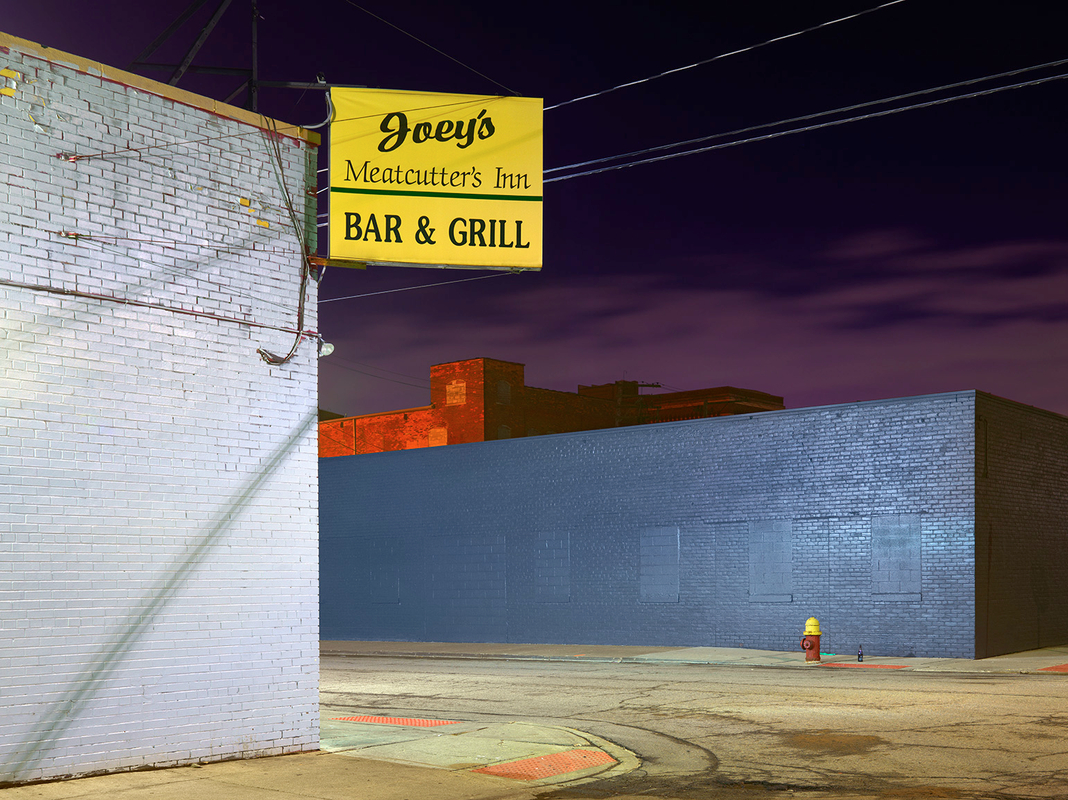
Detroit Nocturne‘ found here.  Via Mick Hartley.

I’m partial to ‘Joey’s Meatcutter Inn, Bar & Grill 2017‘:

Joey's Meatcutter's Inn, Eastside, Detroit 2017

The lonely cityscape at night or the familiar glow of gas station lights cast into the American wilderness.  The eye might want to linger among the colors, shapes and clouds even though the mind knows this is pretty much an empty street in a ‘post-industrial’ zone.

A Few Thoughts On Thomas Cole’s ‘The Voyage Of Life’

A good decade ago, while visiting D.C., I saw Thomas Cole’s ‘The Voyage Of Life:

It’s a four-part series: Childhood, Youth, Manhood, Old Age.

One person’s life, and all of our lives, can be broken-down into four allegorical stages, pregnant with visual and universal symbols.

From Cole’s bio:

‘Although Cole had ample commissions in the late 1820s to paint pictures of American scenery, his ambition was to create a “higher style of landscape” that could express moral or religious meanings.’

From this more interactive page:

‘In the late 1830s, Cole was intent on advancing the genre of landscape painting in a way that conveyed universal truths about human existence, religious faith, and the natural world. First conceived in 1836, the four pictures comprising The Voyage of Life: Childhood, Youth, Manhood, and Old Age fulfilled that aspiration.’

These scenes in the Romantic style can have an emotional pull for me, as generally does the work of the Hudson River School. Such allegory certainly tends to function as a vehicle into memory (Cole’s work has really stuck with me…in a sort of haunting way, mixed with some thought of how I’m supposed to live and what might be coming next).

Also, the wild, untamed nature we Americans have often faced is perhaps requiring of a spirited and grand attempt at putting our experiences within Nature into some context:  To soar as high as our hopes often do.

Or at least, to find in paintings:  Familiarity. I like to see the roll of a hill like I’ve seen, or an opening of clouds, sky and light like I’ve seen.

Perhaps Wild Nature can be ordered in a Romantic, neo-classical or more modern way.  Perhaps Nature can be made, with the tools at our disposal, to conform to some of our deeper ideas about Nature, mirroring our hopes in some recognizable fashion; giving some basic comfort and meaning.

Maybe, after all, we can find a home here.

On the other hand, allegory with overt moral/religious meaning can also come across as heavy-handed, sentimental, and moralistic. Too lush and pretentious; perhaps a bit anachronistic.

Do I really have to hunt for all the symbols and put the puzzle together?

‘So, you’re going to reveal universal truths, eh?’

This can seem distant from the experiences of the modern viewer, often finding himself a little further down the modern/postmodern ‘river’, where such attempts at universality might seem a wash.

Much more common these days are the very personal shards and glimpses of the inner life of an artist, attached to high ambition and great talent surely in some cases; as well to form and tradition, but generally making less bold claims to knowledge than ‘The Voyage Of Life‘.

In painting, I’m reminded of the abstract expressionist movement seeking meaning in reducing experience to the abstract in order to reveal something essential within Nature, or essential about our relationship to Nature: A transcendent place where shape, form and color can be isolated from anything immediately recognizable in the world.

Or maybe, I’m being too generous?

‘The movement’s name is derived from the combination of the emotional intensity and self-denial of the German Expressionists with the anti-figurative aesthetic of the European abstract schools such as Futurism, the Bauhaus, and Synthetic Cubism. Additionally, it has an image of being rebellious, anarchic, highly idiosyncratic and, some feel, nihilistic.[5] In practice, the term is applied to any number of artists working (mostly) in New York who had quite different styles, and even to work that is neither especially abstract nor expressionist.’

The exploration of the Self is often pursued, as well as that of Nature, but the general hope that it might all make sense (life, death, Nature, purpose etc) in many more modern movements is often left abandoned.

Or so often, as we’ve seen in the past few generations:  The pursuit of The Self can easily become subsumed to the pursuit of fame, celebrity, and money.

***

Towards a theme: Perhaps you’ve also heard of the Rothko chapel, in Houston, Texas.

Mark Rothko undertook the idea that within the modern context, one could create temples of universal meaning through aesthetics, art, and beauty:

‘The Rothko Chapel, founded by Houston philanthropists John and Dominique de Menil, was dedicated in 1971 as an intimate sanctuary available to people of every belief. A tranquil meditative environment inspired by the mural canvases of Russian born American painter Mark Rothko (1903-1970), the Chapel welcomes over 60,000 visitors each year, people of every faith and from all parts of the world.’

There’s even a suite of music by Morton Feldman, entitled ‘Rothko Chapel’

See Also On This Site:  Trying to stick something against his poems: Wednesday Poem: Wallace Stevens-Anecdote of The JarWednesday Poem: Wallace Stevens, The Snow ManFriday Poem: Wallace Stevens And A Quote By David Hume

Some Updated Links On Postmodernism

Repost: From The NY Times Via A & L Daily: Helen Vendler On Wallace Stevens ‘The Plain Sense Of Things’

Some Sunday Songs-Metal, Myth, American Romanticism And The Civil War

Within A Bank Of Modern Fog-Another Link To Robert Hughes On Jeff Koons