Modern Art Skepticism & Kids In Bad Neighborhoods-Don’t You Want To Be Cool?-Links to Tom Wolfe, Robert Hughes & Isaiah Berlin

From our rather reasonable AI overlords: ‘Common skepticism is a healthy critical attitude towards dubious claims, while philosophical skepticism challenges foundational knowledge and the justification for belief itself, demanding proof for everything, a stance few people adopt in daily life.’

I knew a philosophic skeptic, he was smarter than me & fun, but, man…what an asshole.

Commoners have good reasons to be skeptical when it comes to modern art:

Bananas duct-taped to walls seems like bullshit.

Titled Comedian, the humoristic piece can be considered a challenge to the sometimes-absurdist nature of the art market and the art collecting world. “To me, Comedian was not a joke; it was a sincere commentary and a reflection on what we value,” said the artist in an interview at the time. “At art fairs, speed and business reign, so I saw it like this: if I had to be at a fair, I could sell a banana like others sell their paintings. I could play within the system, but with my rules.”’

Who can forget the transcendent darkness of this photo (the shock-concept and the celebrity overshadowing the skill/visual impact).

He immersed a crucifix he bought in an antique shop in his own urine.

Fellow commoners, we have as a counterpoint, rather beautiful, innovative classics like Falling Water, by Frank Lloyd Wright. A pain in the ass to maintain, but still a place for the genuine:

As I see the world: We have beliefs, and we’ve usually locked them away beyond critique. So has most everyone else. Some beliefs have more truth in them than others.

We use shared beliefs to form and maintain relationships. We use them to get stuff and give other people stuff. We rely on shared beliefs to organize events/clubs, workplaces, and hierarchies of judgment and knowledge, without killing each other. Shared beliefs regulate and help us navigate our emotions, as well as our personal, interpersonal and social behavior. We outsource much of our thinking to shared beliefs, while forgetting they’re even there. We’re often proudest of passing our beliefs on if we think they’re true, lasting and important.

The rub is the relationship these beliefs have with truth, and knowledge. A modern rationalist might say something like: ‘We have access to enough scientific and economic knowledge to run the government, and effectively plan your life. (M)an is something holy, and we’ve only just begun perfecting (M)an. Go ahead be creative and vote for the $1 billion arts package or else.

A typical Catholic might say something like: ‘Let’s check in with Canon Law. The Pope is closest to God, then the Cardinals, then the Archbishops etc.’ We’re only redeemed through Christ. So….that’s what art should be doing. Capiche?

What if a radical questioning of belief becomes the norm, around which people are…still believing?

What, then, do people actually believe?

What do artists, often radically questioning belief while making stuff, actually believe?

Those increasingly ridiculous artist statements? Some curious mix of irony, doom and nihilism all the way down? Modern mysticism?

A digression: Let’s say a kid in bad neighborhood, at a vulnerable age, joins a gang. He gets protection, savage discipline and access to stuff. The gang serves dark masters of the soul of course (in our case: How to rob specific makes/models of cars and sell them for parts, leaving a trail of harm, making the kid violent and dangerous).

Let’s also say the same kid in a bad neighborhood, on weekends, hangs with his uncle. His uncle fixes cars. Our kid learns to honor something within himself, other people, and the world. Like his time with the gang, life unfolds as a series of challenges, struggles and possibilities. Yet, his lifespan probability opens from twenty-two to sixty-four. Much better of parts of the kid’s nature come forwards. People drive their cars away, grumbling over the price and the delays…but, still.

Clearly, one path is better for the kid, the neighborhood and the rest of us?

Surely?

Now, what if, at school, that same kid is particularly talented, smart and sensitive? What if he is guided by someone towards personal self-expression, and even the eventual self-doubt, poverty and emotional rollercoaster of a typical artist’s life?

Shouldn’t the kid at least be taught how to notice things? how to describe how a good painting looks? how to draw? how to draft? how to mix paint?

Surely?

These days, it seems we find ourselves in a ‘post, postmodern landscape.’

What is this curious, Western belief to ‘blank-slate’ everything? How can it be true that the kid’s emotions are a reservoir and his reason a man-made, oppressive dam? That he just needs to make a dark, mixed-media video collage and he’s arrived?

It seems making simple moral judgments in real-world scenarios raises serious questions about the Romantic/Modern/Postmodern projects.

The case for the visual art over the primacy of concept/idea: Lets say you’re looking at John Singer Sargent’s ‘Lady Agnew Of Lochnaw‘ (somewhere between realism/impressionism). You’re not looking at merely the idea of painting (good paintings already have ideas in them).

Maybe you want to touch her skin? How did he paint like that? Look at the color and light. What is the artist saying? This painting took six sittings, but, arguably, a lifetime and maybe the better elements of a civilization to achieve.

A simple case: The Duchamp/Warhol line (concept/idea over visual communication/technical skill) warrants tremendous common-sense skepticism (I’ve gone a little deeper…but you get the point). Enough already.

Bananas duct-taped to walls and crucifixes dunked in piss are not just wasting our time, perhaps they’re harming our imaginations.

There are so many reasons to doubt so much bullshit within modern/postmodern thinking, while at the same time learning from the good.

Tom Wolfe went on the T.V. with William F Buckley (too political for my taste) to discuss his book: The Painted Word.’

At min 5:39 Wolfe argues the following (one part of the art/money/celebrity feedback loop):

‘It’s really a religious thing. One thing I didn’t say in The Painted Word, that I should have said, is that art today, is the religion of the educated classes. I don’t mean that by analogy, it isn’t like being a Baptist in 1870, it is being a Baptist in 1870.’

From Art vs Machine: Here is a video making the case that Jackson Pollock achieved something, but it wasn’t really the innovative use of drip-paint.

Maybe it was kinda beautiful in its own way? Romantically Primitive?

Also, are Robert Hughes criticisms’ of Andy Warhol’s art really blocked by YouTube?

Making a hero of the androgynous anti-hero is orthodoxy these days, but also pretty tired (the Warhol to Bowie line seems over-rated):

What came before modernism/postmodernism? Why the below video might be worth listening to (min 34:22):

There was a great turn towards emotionalism. There was a sudden interest in the primitive and remote; the remote in time and the remote in place. There was a outbreak of craving for the infinite’

A movement emerged, about 1760–1840, which has deeply affected our conceptions of the Self, Art, heroes and villains, and most importantly, what makes life worth living.

Isaiah Berlin’s take on Romanticism:

Via a Reader-Modern Land Artists Point You Back To Nature, Placing You In Time, But Whose ‘Now’ Is This, Man? What Is Nature, Exactly?

Paul Wood discusses the works of Robert Smithson (Broken Circle, Spiral Hill) and Richard Serra (Fulcrum, Spin Out):

Land-art pieces are site-specific. They require you to be there and experience them, designed as they are to be within the specific spaces they occupy.

In so doing, they break from previous modernist ‘Readymades‘ and reproduced images (I don’t know about you, but I’m tiring of so many commentaries on consumerism, the desire for craft over mass production, a certain collective vagueness against such disposability…the dream of unique Selfhood, celebrity even, amidst a thousand urinals).

As a viewer, you’re supposed to interact with these pieces and start feeling and thinking differently than perhaps you might have otherwise. Walk around, through, and over them. View one hillock from another. Walk back over to the first hillock and look from whence you came.  The view is never quite what you were imagining.

Time is clearly intended to be an element, here; the long sweep of geologic and/or historical time as the artist understands it, as well as the relative brevity of personal time during just a 10-minute visit.

These pieces can act as signposts towards Nature and what we can begin to observe of our specific natural environments (steel rusts in unique, but perhaps underlying, patterns…winds blow at different angles and around different obstacles in one grove as opposed to another, these lichens are growing here…other lichens over there, are they the same species?).

If you pull the piece out of its specific environment, it may just wither and die, looking out-of-place as many other products of civilization do amidst natural settings (a jar in Tennessee).  Perhaps, though, they won’t look quite so out-of-place as mass-produced objects because of such careful design and attention to detail.

That said, these pieces will eventually look quite awkward undergoing the changes they will undergo if Nature’s Laws are any guide (Romantic/Modernist recreations of Nature can promise the comforts of Home).

Here’s Wikipedia, keeping it simple:

‘Land art, earthworks (coined by Robert Smithson), or Earth art is an art movement in which landscape and the work of art are inextricably linked.’

From the video description:

Robert Smithson and Richard Serra both believed that sculpture should have a dialog with its environment. This program explores the challenging dialectic of the site-specific sculpture of Smithson and Serra through examples of their work. In an interview, Serra discusses the aspects of time and context in relation to his art as well as the influence of Smithson.’

Maybe it’s worth pointing out that Serra seems interested in symmetry, visualizing and realizing abstract shapes with the help of some mathematics and the practice of drawing/drafting. Interesting problems can arise from tooling around with shapes on paper (a practice of Serra’s), the kind I’m guessing folks fascinated by puzzles and software and math love to solve.

But Serra’s not a mathematician nor an engineer nor an architect. He’s not writing a proof for its own sake nor building bridges nor houses for practical use.

Rather, the intuitive and creative impulses of the artist take over in his work, a kind of creative exploration, as well as the dialog between fellow artists, living and dead.

Much (A)rt, of course, is useless for most, if not all, purposes. It’s one of the things that can make it meaningful for people. There can be a significant gap between what the artist may have felt, thought and realized, and which emotions, thoughts and experiences any viewer/listener might have in interacting with a particular piece.

Serra, in his work, wants to alter the thinking of anyone moving through the space he creates by manipulating specific substances like steel (he has a facility with the material), and by getting viewers to a point of reorientation of spatial and temporal awareness.

Of course, this involves reorientation towards certain ideas as he understands them, and by promising people a return to themselves, or a state of experience and creative play perhaps similar to that of the artist.

Here’s a Charlie Rose interview:

More about Land Artists:

Any thoughts and comments are welcome. Feel free to highlight my ignorance…

Related On This Site:A structure in the desert…not even a city Update On LACMA, Michael Heizer And The ‘Levitated Mass’-Modern Art And The Public

Denis Dutton suggested art could head towards Darwin (and may offer new direction from the troubles of the modern art aimlessness and shallow depth…the money and the fame) Review of Denis Dutton’s ‘The Art Instinct’

No thanks to living in planned communities upon someone else’s overall vision.: Roger Scruton In The City Journal: Cities For Living–Is Modernism Dead?

Modern Art For Sale In The Middle-East-From The New Yorker: ‘Richard Serra In the Qatari Desert’

William Logan At The New Criterion: ‘Pound’s Metro’

Full piece here.

Logan takes a look at one of the most important modern poems:

In a Station of the Metro

The apparition of these faces in the crowd;
Petals on a wet, black bough.

Ezra Pound

Logan:

‘The minor vogue and rapid extinction of Imagism, a movement whose influence we still feel, has been hashed over by literary critics for a century. Its rehearsal here is merely to bring the poem into focus within the slow progress toward the densities of language, the images like copperplate engraving, that made Pound Pound.’

Thorough and well done.

The result would echo back to the States years later:

The Great Figure

Among the rain

and lights

I saw the figure 5

in gold

on a red

firetruck

moving

tense

unheeded

to gong clangs

siren howls

and wheels rumbling

through the dark city.

William Carlos Williams

This blog tends to look cautiously at many of the ideas of the Romantic poets, and the break to modernism, but not necessarily the poems themselves.  The echo ripples outwards:

Mid-August at Sourdough Mountain Lookout

Down valley a smoke haze
Three days heat, after five days rain
Pitch glows on the fir-cones
Across rocks and meadows
Swarms of new flies.

I cannot remember things I once read
A few friends, but they are in cities.
Drinking cold snow-water from a tin cup
Looking down for miles
Through high still air.

Gary Snyder

Once we start arriving at ‘ecological’ appreciations of nature, and the postmodern, confessional altar of Self and the turn inwards to the Self a subject for the art, and the desperate search for meaning, I get more and more turned off, for my own reasons.  Such good poems will carry on.

Any thoughts and comments are welcome.

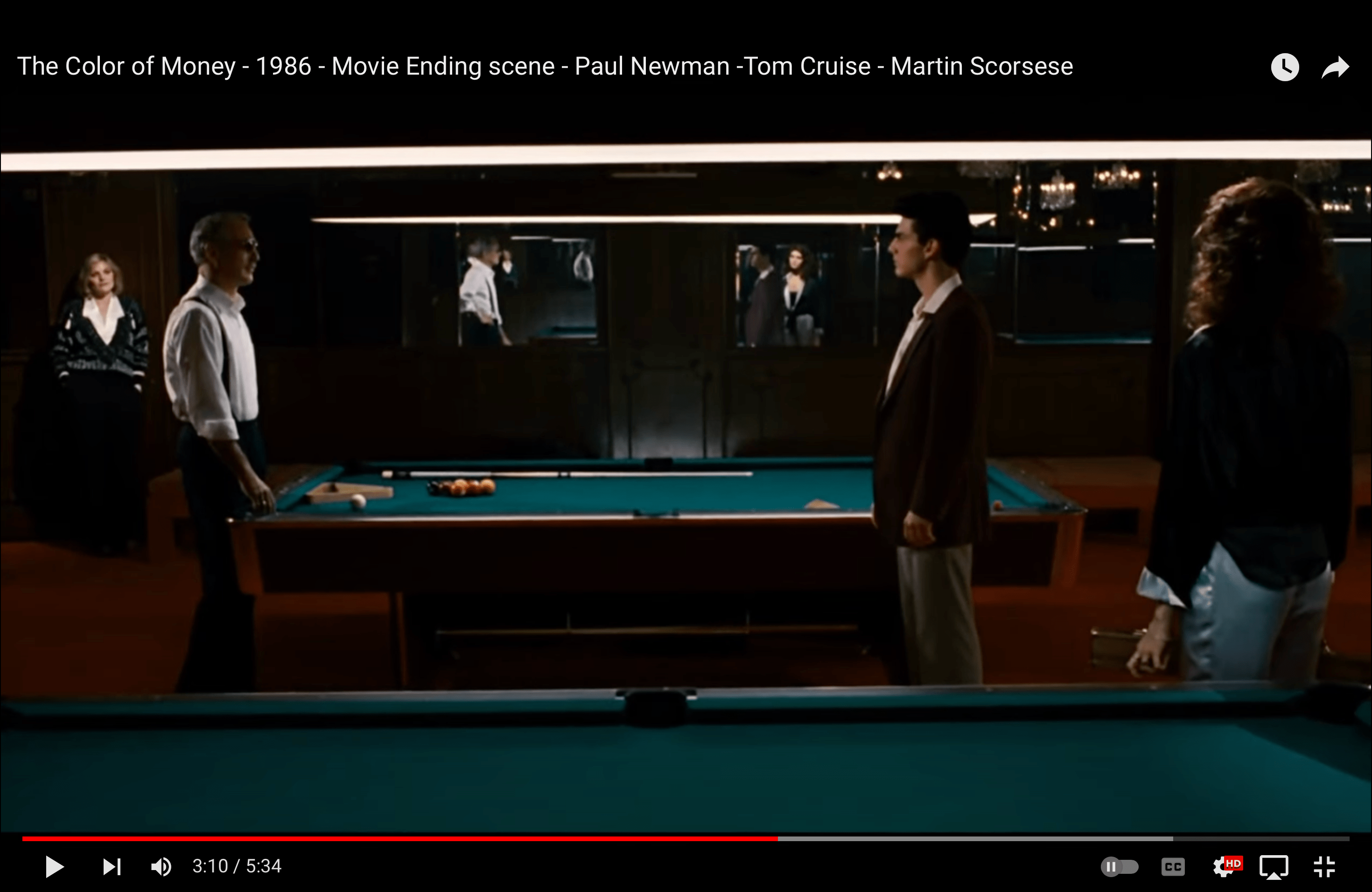
For A Friend-A Scene From The Color Of Money

Movie Title: The Color Of Money (Director-Martin Scorsese). 1986.

What’s good and what’s genuine in characters who hustle for a living? Can the American pulp novella/novel be a source of both popular and high entertainment?

Visual Storytelling (end-scene pool showdown): The wiser and more experienced mentor, perhaps washed-up, is being pushed out of the business during his comeback, but he’s not going quietly (we need some dramatic tension). His lady waits for him near the edge of frame, while both of them only take about 1/5 of the frame (all four characters are on the diagonal). 

Does he still have it? 

Brash, untempered (arrogant), less experienced rising talent and his lady take about 1/3 of the frame, closer to the audience. They’ve been hustled; learning the art of the con pretty well.  

Should he accept the challenge? Is this it? 

Possible conclusions: Maybe that’s what we get in life, a view every now and again. At the height of our powers (or past our powers), we get a moment when the conception of the game and the game become one. In a tacky hall of mirrors, no less. I hope it’s not all a hall of mirrors.

Generations stuck in a stand-off…

My point: A good visual storyteller takes his craft seriously, associating the story and the images to push the story forward. He has an appreciation for beauty. I appreciate Scorsese for working hard because the harder he works, the more my intelligence is respected.

To be honest, the movie dragged on for me and is very much of its time (this is pool for Christ’s Sake, how much can you glamorize pool?). Mythos is tough to achieve.

That said, I appreciate a director practicing his craft and trying to provide some continuity in American life through the visual arts. I appreciate someone who understands that developed characters invite us to see something of ourselves in frame.

Thanks for that.

Repost-Via A Reader Via ABC Gotham-‘Ugliest Buildings, Part I: Brutalism’

Full podcast here.

Brutalist architecture flourished from the 1950s to the mid-1970s, having descended from the modernist architectural movement of the early 20th century. The term originates from the French word for “raw”, as Le Corbusier described his choice of material béton brut, meaning raw concrete in French.’

Our local host and local guest pick favorite (unfavorite) examples of ‘raw concrete’ buildings in NYC and alternately discuss some facts about each one.

Some buildings mentioned: 375 Pearl Street is being worked on.  The ‘Krull‘ Long Lines building is not for use.

As posted

Some people who commissioned Boston’s City Hall were probably thinking they were bringing something new and wonderful into the world: Inspiring, modern, transformative.

The folks at bureaucratic levels up-top would steer this concrete ship, scanning the Horizon for The Future. The People down below, justly and benevolently guided, would feel welcome and do people-y, citizen-y things as though in a terrarium.

Maybe that’s why it’s not so popular.

Well, at least it isn’t Buzludzha, The Communist Spaceship plopped down as though from a world of Pure Ideology, Nature properly subdued:

As previously posted:

–Visit Lileks.com. A fine humorist with a sharp pen and a keen eye.

Here’s Australian art critic Robert Hughes discussing the Albany plaza, and almost hyperbolically criticizing the aims of modernist architecture.

***Fun fact, he pronounces the “Boogie Woogie” the “Boo-gie Woo-gie.”

Modernism goes to the movies.

Some pictures at the link.

There’s mention of the Mt. Rushmore house at the end of North By Northwest. I suspect some among us have wanted to live in a modernist lair.

From an article in Der Spiegel on the Bauhaus, where modernism got its start:

‘The real feat achieved by Gropius and his cohorts was to have recognized and exposed the sociopolitical and moral power of architecture and design. They wanted to exert “effective influence” on “general conditions,” fashion a more just world and turn all of this into a “vital concern of the entire people.”‘

See Also: They designed a city in the heart of Brazil that really doesn’t work for people: Brasilia: A Planned City

No thanks to living in planned communities upon someone else’s overall vision.: Roger Scruton In The City Journal: Cities For Living–Is Modernism Dead?Repost-Via Reason: ‘Salvador Allende’s Cybersocialist Command Center’…Cities should be magnets for creativity and culture? –From The Atlantic: Richard Florida On The Decline Of The Blue-Collar ManFrom Grist.Org Via The New Republic Via The A & L Daily: ‘Getting Past “Ruin Porn” In Detroit’… some people don’t want you to have the economic freedom to live in the suburbs: From Foreign Policy: ‘Urban Legends, Why Suburbs, Not Cities, Are The Answer’

A structure in the desert…not even a city Update On LACMA, Michael Heizer And The ‘Levitated Mass’-Modern Art And The Public;..where is modernism headed? Via Youtube: Justin, The Horse That Could Paint

Denis Dutton suggested art could head towards Darwin (and may offer new direction from the troubles of the modern art aimlessness and shallow depth…the money and the fame) Review of Denis Dutton’s ‘The Art Instinct’

Repost: Two Links-Robert Hughes’ Take On America Through Its Art & Michael Heizer’s ‘City’

Maybe it’s Pilgrim’s pride, or perhaps the Puritan pursuit of image-less purity, or the Colonialists ecumenical style, or maybe even some Shaker weirdness that finds itself up for analysis.

Perhaps somewhere there’s a spare, Yankee work ethic resting on a simple, wooden shelf in the ‘American mind.’

Could such a thing be discovered within mid 20th-century modernism?

Robert Hughes takes a look at Donald Judd’s ‘Temple Of Aesthetic Fanaticism,’ and Richard Serra’s nod to Jackson Pollack and abstract expressionism in the rawness of material sculpture. You know, making stuff (a potentially sensitive subject with so many technological changes going on right now).

(link may not last):

As for Land Art, Michael Heizer’s life’s-work land-art project is apparently complete, if such a thing can be complete:

There’s a good piece in the New Yorker here.

There is an air of secrecy about the whole thing.

You can’t even visit?


Apparently, Heizer’s been working since 1972 on this sculpture in the Eastern Nevada desert, which was originally called ‘Complex One.’ It’s morphed into his life’s work, called City. It’s very large. It can’t be moved. You can’t reproduce it. It represents a break from traditional sculpture. It can’t be put in a museum and it’s not clear that it has a function.

In Brasil, they just started from the top-down and built a city that doesn’t work that well for people: Brasilia: A Planned City

——————

I have to confess that seeing that structure upon the wide open emptiness of Eastern Nevada is comforting for the familiarity it brings. It’s a little bit of order upon the unknown, and the design, or lack thereof (about which a man may wonder), within Nature herself. I think this is why a military installation out in the desert can captivate the imagination as it’s been known to in Hollywood and in the public mind (dreaming of aliens and conspiracies).

To expand on that theme, Wallace Stevens might shed some light. He was an American poet on the hinge between romanticism and modernism:

Anecdote of the Jar

I placed a jar in Tennessee,
And round it was, upon a hill.
It made the slovenly wilderness
Surround that hill.

The wilderness rose up to it,
And sprawled around, no longer wild.
The jar was round upon the ground
And tall and of a port in air.

It took dominion every where.
The jar was gray and bare.
It did not give of bird or bush,
Like nothing else in Tennessee.

Wallace Stevens

You’ve changed all of nature with just one jar.

What do you do with an uncivilized, wild land? Import European learning and literature “atop” it? Christian tradition and the Natural Law? Import the triumph of the Western mathematical sciences and technology? Import its movements of the arts and the individual artist?

You can’t help but do this.

Related On This Site: L.A.’s New Public Art Piece ‘The Levitated Mass,’ Or As The American Interest Puts It: ‘A Moving Rock’

Denis Dutton suggested art could head towards Darwin (and may offer new direction from the troubles of the modern art aimlessness and shallow depth…the money and the fame) Review of Denis Dutton’s ‘The Art Instinct’

Denver’s Devil Horse may be flirting with kitsch: From The Wall Street Journal: Denver’s Mustang Or ‘Devil Horse’…and I like his work:…Joan Miro: Woman

From Grist.Org Via The New Republic Via The A & L Daily: ‘Getting Past “Ruin Porn” In Detroit’…Marketplace aesthetics in service of “women”: Dove’s Campaign For Real Beauty: Pascal Dangin And AestheticsRoger Scruton In The City Journal: Cities For Living–Is Modernism Dead?Brasilia: A Planned City

Repost: Within A Bank Of Modern Fog-Robert Hughes On Jeff Koons & Bullshit Is No Laughing Matter

‘The notion of carefully wrought bullshit involves, then, a certain inner strain. Thoughtful attention to detail requires discipline and objectivity. It entails accepting standards and limitations that forbid the indulgence of impulse or whim. It is this selflessness that, in connection with bullshit, strikes us as inapposite. But in fact it is not out of the question at all. The realms of advertising and of public relations, and the nowadays closely related realm of politics, are replete with instances of bullshit so unmitigated that they can serve among the most indisputable and classic paradigms of the concept. And in these realms there are exquisitely sophisticated craftsmen, who with the help of advanced and demanding techniques of market research, of public opinion polling, of psychological testing, and so forth, dedicate themselves tirelessly to getting every word and image they produce exactly right.’

From Harry Frankfurt’s On Bullshit.’

There is ocassionally such a commitment to bullshit I imagine the bullshitter blowing up a balloon; the bright shiny surface mesmerizing; the spirit of creative play engaged. It grows bigger and more beautiful as it expands with each breath.

There are many balloons like it, but this bullshit-balloon is mine. We’re going places.

Making up fans, a record label, a press outlet, awards and a fake web design company just to get your metal band (yourself, really) some Euro-gigs is next-level stuff:

‘I’ve spent the past 24 hours enraptured by the story of Threatin, the Los Angeles-based “band” (actually a vanity project for the solo artist “Jered Threatin”) who used wildly misleading YouTube live videos, paid-for Facebook likes and YouTube views, grossly exaggerated ticket counts and an imaginary booking agent to set himself up with a European tour which is now falling flat on its face with next to no one showing up to gigs.’

On that note, what I’m saying is 100% true: I don’t think it’s mere satire to point out that Dale Lonagan’s bestselling ‘Ismology In The 21st Century: Self-Wonder, Collective Consciousness & Global Harmony’ continues to inspire modern-day pilgrims to arrive at his thriving compound in the desert: Peace Pavilion West.

Imagine Frank Lloyd Wright wasn’t a profoundly talented architect, but rather a visionary wordsmith and ecological warrior, capable of genuine modern leadership. Imagine through a colossal writing output at Sandstone Mountain, one man realized Eastern visions and Western (S)cience and (A)rt could create a locally-sourced, globally aware community.

I’m certainly not making this character up. His books have changed the lives of millions.

In fact, here’s a quote of his:

Please check out Jeff Koons:

—————

There’s always been a bit of the showman about Jeff Koons; the kind of young man who could put on a bow tie and try to give many museum-goers their time/money/aspirations’ worth at the membership desk.

This blog forgives people trying to explain what their art ‘means,’ exactly, but confesses to pleasure in seeing Koons put on the spot under the suspicious eye of an ornery old Robert Hughes.

I don’t fault Koons for finding himself firmly within modernism, searching for universal forms and broader historical context within those confines, but I admit it’s nice to see him held to account for his bullshit, and perhaps the broader, deeper bullshit he shares with many modern and postmodern artists: Pursuing novelty and recognition and thus making art into a business and often commercializing it, aiming for celebrity while offering meta-critiques on celebrity, making the personal and private very public (masturbation into social commentary, sex into meta-critques of religious shame, ‘culture’ and pornography).

Two quotes by Hughes that stood out:

Religion is diminished into celebrity..a kind of reverse apotheosis.

‘This alienation of the work from the common viewer is actually a form of spiritual vandalism.’

It’s tough to say that art is really about religion (though much clearly is), but rather more about an experience Hughes wants as many people as possible to have, and that such experiences can elevate and expand.

Aside from the above, there’s something that strikes me as not just late 20th century-modern about Koons, but also very American.

As previously posted:

Is street-art, or the use of graffiti & mixed-materials performed illegally out in public (on public and privately owned property) partly due to the success of capital markets?

-Banksy’s website here.

-Newsweek’s piece: ‘See You Banksy, Hello Invader.

Response To A Reader On ‘Radical Chic’ And A Link to Banksy’s ‘Dismaland’

I’d argue that it’s possible, especially with the constant cries of modernism to ‘make it new,‘ I think this is one way we’ve arrived at pop art, and the desire to blend conceptual art and popular music together. This is in evidence from The Talking Heads to Lady Gaga to Jay Z promoting his new album alongside Marina Abramovic at MOMA.

Many modern artists, from Andy Warhol to Jeff Koons to Damien Hirst are people with some artistic talent and native gifts, but not as much in the way of classical and/or formal training. They may be trying to have a conversation with the old masters, but they are clearly also the products of, and speaking to, ‘modern’ audiences. Much of this has become a world of shallow depth, especially among the less talented. Drawing and drafting can be underdeveloped skills while ‘mixed-media’ presentations, celebrity, marketing, money and fame are all thrown into the same pot.

Also On This Site: Roger Scruton says keep politics out of the arts, and political judgment apart from aesthetic judgment…this includes race studies/feminist departments/gay studies etc.: Roger Scruton In The American Spectator Via A & L Daily: Farewell To Judgment

Goya’s Fight With Cudgels and Goya’s Colossus. A very good Goya page here.

Joan Miro: WomanGoethe’s Color Theory: Artists And ThinkersSome Quotes From Kant And A Visual Exercise

A Reaction To Jeff Koons ‘St John The Baptist’

Denis Dutton suggests art could head towards Darwin (and may offer new direction from the troubles of the modern art aimlessness and shallow depth) Review of Denis Dutton’s ‘The Art Instinct’

Repost-Within A Bank Of Modern Fog-Another Link To Robert Hughes On Jeff Koons

—————

There’s always been a bit of the showman about Jeff Koons; the kind of young man who could put on a bow tie and try to give many museum-goers their time/money/aspirations’ worth at the membership desk.

This blog forgives people trying to explain what their art ‘means,’ exactly, but confesses to pleasure in seeing Koons put on the spot under the suspicious eye of an ornery old Robert Hughes.

I don’t fault Koons for finding himself firmly within modernism, searching for universal forms and broader historical context within those confines, but I admit it’s nice to see him held to account for his bullshit, and perhaps the broader, deeper bullshit he shares with many modern and postmodern artists: Pursuing novelty and recognition and thus making art into a business and often commercializing it, aiming for celebrity while offering meta-critiques on celebrity, making the personal and private very public (masturbation into social commentary, sex into meta-critques of religious shame, ‘culture’ and pornography).

Two quotes by Hughes that stood out:

Religion is diminished into celebrity..a kind of reverse apotheosis.

‘This alienation of the work from the common viewer is actually a form of spiritual vandalism.’

It’s tough to say that art is really about religion (though much clearly is), but rather more about an experience Hughes wants as many people as possible to have, and that such experiences can elevate and expand.

Aside from the above, there’s something that strikes me as not just late 20th century-modern about Koons, but also very American.

As previously posted:

Is street-art, or the use of graffiti & mixed-materials performed illegally out in public (on public and privately owned property) partly due to the success of capital markets?

-Banksy’s website here.

-Newsweek’s piece: ‘See You Banksy, Hello Invader.

Response To A Reader On ‘Radical Chic’ And A Link to Banksy’s ‘Dismaland’

I’d argue that it’s possible, especially with the constant cries of modernism to ‘make it new,‘ I think this is one way we’ve arrived at pop art, and the desire to blend conceptual art and popular music together. This is in evidence from The Talking Heads to Lady Gaga to Jay Z promoting his new album alongside Marina Abramovic at MOMA.

Many modern artists, from Andy Warhol to Jeff Koons to Damien Hirst are people with some artistic talent and native gifts, but not as much in the way of classical and/or formal training. They may be trying to have a conversation with the old masters, but they are clearly also the products of, and speaking to, ‘modern’ audiences. Much of this has become a world of shallow depth, especially among the less talented. Drawing and drafting can be underdeveloped skills while ‘mixed-media’ presentations, celebrity, marketing, money and fame are all thrown into the same pot.

Also On This Site: Roger Scruton says keep politics out of the arts, and political judgment apart from aesthetic judgment…this includes race studies/feminist departments/gay studies etc.: Roger Scruton In The American Spectator Via A & L Daily: Farewell To Judgment

Goya’s Fight With Cudgels and Goya’s Colossus. A very good Goya page here.

Joan Miro: WomanGoethe’s Color Theory: Artists And ThinkersSome Quotes From Kant And A Visual Exercise

A Reaction To Jeff Koons ‘St John The Baptist’

Denis Dutton suggests art could head towards Darwin (and may offer new direction from the troubles of the modern art aimlessness and shallow depth) Review of Denis Dutton’s ‘The Art Instinct’

Robert Hughes-R.I.P.

Australian art historian, thinker, and (sometimes savage) critic of modern art.  Video above is the first of his 8 part “Shock Of The New” series, which presents a modern art historian’s sweep of 20th century political and intellectual history and how images, ideas, art, and artists themselves are woven throughout.

Addition: Simon Schama has a piece on Hughes life and work.

Also On This Site:  Denis Dutton suggested art could head towards Darwin (and may offer new direction from the troubles of the modern art aimlessness and shallow depth…the money and the fame) Review of Denis Dutton’s ‘The Art Instinct’

Denver’s Devil Horse may be flirting with kitsch: From The Wall Street Journal: Denver’s Mustang Or ‘Devil Horse’…and I like his work:…Joan Miro: Woman

From Grist.Org Via The New Republic Via The A & L Daily: ‘Getting Past “Ruin Porn” In Detroit’…Marketplace aesthetics in service of “women”: Dove’s Campaign For Real Beauty: Pascal Dangin And Aesthetics… Roger Scruton In The City Journal: Cities For Living–Is Modernism Dead?Brasilia: A Planned City

What are these people doing with art?:  Often combining them with a Left-of-Center political philosophy as they are at NPR for popular consumption.  On this site, see: From ReasonTV Via Youtube: ‘Ken Burns on PBS Funding, Being a “Yellow-Dog Democrat,” & Missing Walter Cronkite’Repost-From NPR: Grants To The NEA To Stimulate The Economy?

Hughes wrote a review for Time entitled the “Princeling Of Kitsch.”

Add to Technorati Favorites