Seattle Photos-Red Photo Practice, Seeing Red & A Few Thoughts On Color Attraction

Images 1 and 3 below, especially, read as illustrations to me, while image 2 acts as more of a bridge. As readers know, I tend towards quiet, observational photographs. There is a progression present moving outdoors-in, to a more intimate space.

Click through for more.

Edward Hopper practiced deep color complentarity in his paintings, balancing cool and warm. I first noticed his use of red here, and it got me thinking:

‘Red is powerful. Hopper’s using it with purpose.

This got me thinking a little further: ‘How much red is too much?

One ‘painterly’ problem: Red attracts the eye quickly, and William Eggleston went boldly red where other man had, perhaps, gone before.

Henri Matisse went full red one time, but there’s much more: Expert lines, curves, and composition (no focal point) make me feel at home. In fact, I think this domestically-minded Frenchman’s put most of his life’s purpose into his painting.

What’s the most aggressive, yet soothing, use of red I’ve seen consistently throughout my life?

Probably a Coke can, billboard, or truck. Check out this Arthur Meyerson photo with a Coke truck in context.

Another color problem: Color draws the eye quickly. Color is powerful. It snatches your eye and mind. The original black-and-white photographers thought color photography would distract, vulgarize, and commercialize; away from subject and composition, especially given the camera technology at the time.

Sacre bleu!

It turns out the old guys weren’t entirely wrong, as many advertisers and fashion photographers barf color all over the place. Some expertly upchuck. Others, alas, puke like Brits on holiday in Ibiza.

Kids with crayons and iPads, shock and awe pop-artist and portraitists, movie directors, and even ideologues making their propaganda, use color freely. We’re all being gradually exposed to the newer synthetic AI stuff coming down the pike. We are living, I believe, amidst an information revolution (storage, access, process and attention). I mean, unless you’re color blind, you see the world in color.

Remember that one sunset and her makeup and the city behind her all blended together?

On that note, Dear Reader, this has been one of the best approaches I’ve found so far along my later, more limited, photographic journey in life:

Beware of color theories. Theories in color photography are dangerous. The plain fact that there are so many of them proves my point. A color philosophy comes much closer to the truth. Beware of scientific color tests. They are as quickly outdated as a timetable. Their truth is short lived. Most theories are the result of an attempt to bring one’s practical experiences into a formula. There is no formula. There are only confirmations to formulas which one has already discovered oneself. I myself love to read theories without ever using them when working.

Hopefully, I’ve jarred something loose inside your head.

You do the rest.

American Gray-Links To ‘Night Shadows’ By Edward Hopper, Raymond Chandler & James Ellroy, Poems By Frank O’Hara, Robert Frost & An Interview With Belgian Photographer Harry Gruyaert

Harry Gruyaert’s celebrated, but I’d argue he’s still underrated for his mastery of color.

From Kenn Sava, Gruyaert’s not a portraitist, per se:

‘It’s not the person that interests me most. It’s the person in its environment. To me, all the elements are important. I don’t have any particular intention. It’s just what I see.

I think humans have such a great idea about ourselves, but nature is so much more powerful.’

According to the interview, American pop-art influenced Gruyaert, potentially freeing him from elements of European formalism (pushing him into some great color work). If you’re interested in seeing fine color, atmospheric and ‘lived-in’ photography, I’d recommend Rivages.

As for pop-art, it can often be colorful, innovative, intuitive and non-serious…on the surface.

Frank O’Hara’s mid-century American poems are surprisingly visual. The idea of a wild freedom wrapped within casual conversation; a moment to moment associative intensity is achieved through O’Hara’s form. This is often where we long to be, on the edges of possibilities, living intensely with others (even through memory, sometimes especially through nostalgia and memory).

Also, the poem suggests this freedom as a return to our animal natures; which involves a certain view of Nature, functioning as a Romantically primitive return to Nature. Frankly, it’s a pretty good love poem.

Animals

Have you forgotten what we were like then
when we were still first rate
and the day came fat with an apple in its mouth

it’s no use worrying about Time
but we did have a few tricks up our sleeves
and turned some sharp corners

the whole pasture looked like our meal
we didn’t need speedometers
we could manage cocktails out of ice and water

I wouldn’t want to be faster
or greener than now if you were with me O you
were the best of all my days.’

Frank O’Hara.

As for color, perhaps this also doesn’t mean color must be completely abstracted into the ambitious meaning-making mission of Mark Rothko. I mean, the sky is blue, the trees green, and the balloons red and yellow.

Mark Rothko sought to make paintings that would bring people to tears. “I’m interested only in expressing basic human emotions—tragedy, ecstasy, doom, and so on,” he declared. “And the fact that a lot of people break down and cry when confronted with my pictures shows that I can communicate those basic human emotions….If you…are moved only by their color relationships, then you miss the point.”

Seal the compound…I mean chapel. (come to Houston, land of little zoning, fair pilegrim).

Readers will know this blog maintains skepticism for pop-art Neo-dadaism and the consecration of ordinary objects along the Duchamp line (‘American Standard’?). Making Duchampian exceptions rules, even clever rules, can desecrate what’s important.

Everyday people, living right, must keep the important things in view, namely wife/husband/children/parents/death/taxes/health/time; not merely their own impulses nor artistic visions (artists remain acutely aware of such indifference). Meaning is usually to be found within love for another, and this usually means everyday people (& the everyday within us) lives between the sacred and profane: The 9-5 grind and the unexpected conversation about grandma’s death, the enveloping silence afterwards.

Artists, at their best, point towards wisdom, truth and beauty regarding everyday things. All the artists I’m linking to are doing so in one way or another, although ‘how’ and ‘how well’ are endlessly disputed.

I’ve already seen a thousand urinals in my life, Marcel, even a few in my dreams.

The triumph of the conceptual over the actual, the mass-produced over the created; perhaps these aren’t entirely healthy trends. The retreat into (S)elf, and the retreat into irony alongside (A)rt as commodity, perhaps these are dead-ends as much as they are freshly-paved streets. The lamentations of art as (R)eligion could be a leading indicator of a deeper hunger for meaning; a hunger with as many bad as good outcomes for artists and everyday people…

Some food for thought, Dear Reader.

As a contrast, here’s some American art that’s more grounded; some realism with psychological depth, albeit with impressionist influence.

Night Shadows by Edward Hopper:

The black and white was made in 1924.

I think Raymond Chandler’s High Window is among the best of the American detective novel.

Here are some quotations of his, if you’re interested.

“Los Angeles was just a big dry sunny place with ugly homes and no style, but good-hearted and peaceful. It had the climate they yap about now. People used to sleep out on porches. Little groups who thought they were intellectual used to call it the Athens of America.”

Here is the link.   It’s been a long time since they just reviewed the book and not the author.

Boy, oh boy, James Ellroy: America’s best current historical crime fiction writer, showing up to entertain, shock and vulgarize:

The poem that most came to mind after looking at Hopper:

Acquainted with the Night

I have been one acquainted with the night.
I have walked out in rain—and back in rain.
I have outwalked the furthest city light.

I have looked down the saddest city lane.
I have passed by the watchman on his beat
And dropped my eyes, unwilling to explain.

I have stood still and stopped the sound of feet
When far away an interrupted cry
Came over houses from another street,

But not to call me back or say good-bye;
And further still at an unearthly height,
One luminary clock against the sky

Proclaimed the time was neither wrong nor right.
I have been one acquainted with the night.

Robert Frost

Repost-A Link To ‘Night Shadows’ By Edward Hopper, A Poem By Robert Frost & Some Images

Night Shadows by Edward Hopper.

The black and white was made in 1924, and is probably most evocative of noir.

I think Raymond Chandler’s High Window is the best of the detective novel.

Here are some quotations of his, if you’re interested.

“Los Angeles was just a big dry sunny place with ugly homes and no style, but good-hearted and peaceful. It had the climate they yap about now. People used to sleep out on porches. Little groups who thought they were intellectual used to call it the Athens of America.”

Here is the link.   It’s been a long time since they just reviewed the book and not the author.

The poem that most came to mind:

Acquainted with the Night

I have been one acquainted with the night.
I have walked out in rain—and back in rain.
I have outwalked the furthest city light.

I have looked down the saddest city lane.
I have passed by the watchman on his beat
And dropped my eyes, unwilling to explain.

I have stood still and stopped the sound of feet
When far away an interrupted cry
Came over houses from another street,

But not to call me back or say good-bye;
And further still at an unearthly height,
One luminary clock against the sky

Proclaimed the time was neither wrong nor right.
I have been one acquainted with the night.

Robert Frost

Repost-The Only Post That Yielded Much In The Way Of ‘Halloween’ On This Site-Happy Halloween

Detroit Nocturne‘ found here. Via Mick Hartley.

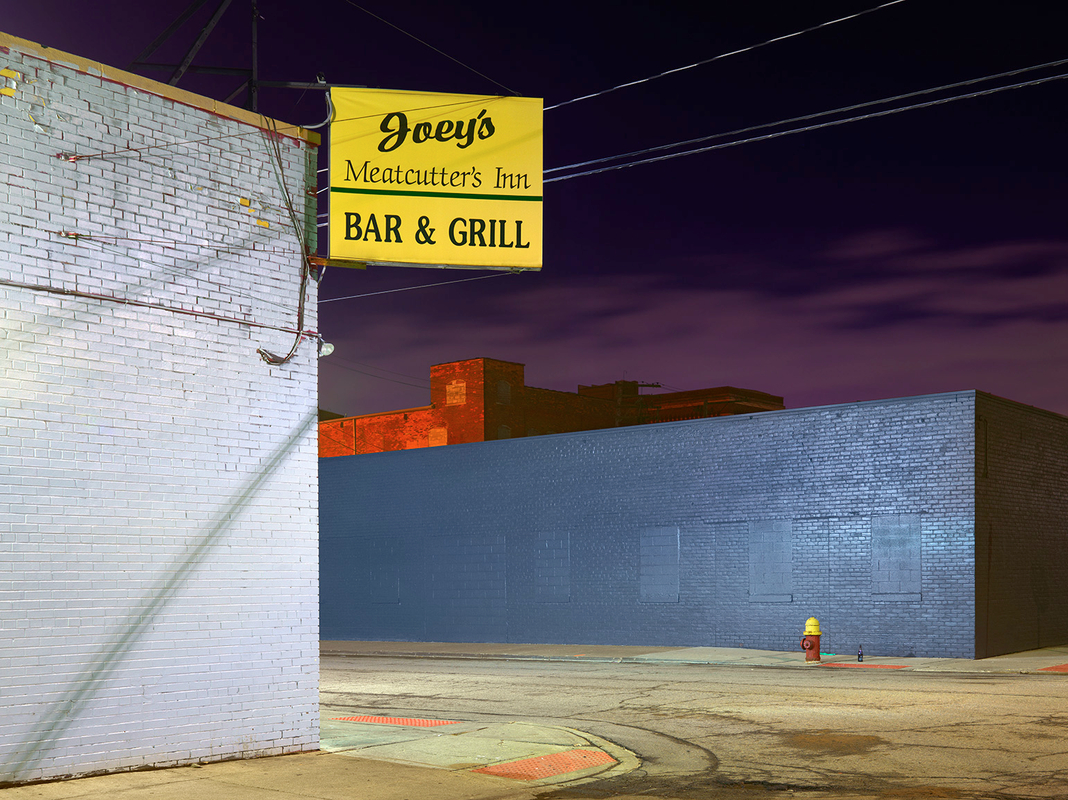
I’m partial to ‘Joey’s Meatcutter Inn, Bar & Grill 2017‘:

Joey's Meatcutter's Inn, Eastside, Detroit 2017

Immediately, I think of Edward Hopper: The lonely cityscape at night or the familiar glow of gas station lights cast into the American wilderness. The eye might want to linger among the colors, shapes and clouds even though the mind knows this is pretty much an empty street in a ‘post-industrial’ zone.

Perhaps it has do with another strand of expression: The break into free verse from past forms. The move from American Romanticism to Modernism which occurred this early past century. William Carlos Williams produced many good poems from a process of earnest, scrapbook-style intensity in trying to discover, redefine, and order a new poetic form within a modern ‘urban landscape.’

The individual artist is quite alone in the task he’s set before himself, and like much of modernism, it’s a rather big task.

Pastoral

When I was younger
it was plain to me
I must make something of myself.
Older now
I walk back streets
admiring the houses
of the very poor:
roof out of line with sides
the yards cluttered
with old chicken wire, ashes,
furniture gone wrong;
the fences and outhouses
built of barrel staves
and parts of boxes, all,
if I am fortunate,
smeared a bluish green
that properly weathered
pleases me best of all colors.

No one
will believe this
of vast import to the nation

William Carlos Williams

Do you believe any of that to be of vast import to the nation? Are you no one?

Another one of Jordano’s photos which stuck out was: ‘Church Rectory With Lightning, Eastside, Detroit, 2016

https://chrisnavin.com/wp-content/uploads/2018/04/b784b-6a00d83451ebab69e201b8d2e873dc970c-pi.jpg

Perhaps I’m not wrong in having called Halloween horror stills and movie images to mind (it’s my mind, after all, so maybe I’m just thinking of Devil’s Night). I really enjoy the light on the dumpster and the side-front rectory wall. There seems to be a little more mood here, more drama, so maybe Edgar Allan Poe’s ‘psychological intensity,’ his surrealism, and terror are more appropriate for comparison.

Poe was a bit mad, after all, despite his fascinatingly untamed and powerful imagination. He achieved a uniqueness and completeness of vision few artists do. Maybe there’s a bit of the sullen, self-aggrandizing earnestness in him of the teenager (J.D. Salinger); the desire to shock, delight and terrify.

The mind is as though a chamber, the horror rises to fever pitch, the lush rhyme matches an increasingly desperate search for truth and beauty in the world (Poe had very much his own Romantically inspired metaphysics).

Alone

From childhood’s hour I have not been
As others were—I have not seen
As others saw—I could not bring
My passions from a common spring—
From the same source I have not taken
My sorrow—I could not awaken
My heart to joy at the same tone—
And all I lov’d—I lov’d alone—
Then—in my childhood—in the dawn
Of a most stormy life—was drawn
From ev’ry depth of good and ill
The mystery which binds me still—
From the torrent, or the fountain—
From the red cliff of the mountain—
From the sun that ’round me roll’d
In its autumn tint of gold—
From the lightning in the sky
As it pass’d me flying by—
From the thunder, and the storm—
And the cloud that took the form
(When the rest of Heaven was blue)
Of a demon in my view—

Nice photos, Dave. Thank you.

As previously posted:

Via Curbed Detroit. (via David Thompson)

70 photos of the abandoned, foreboding Temple. Mysterious symbols and a certain sad grandeur that’s come to represent Detroit these days.

-Photographer Ben Marcin has a series called ‘Last House Standing.’ Solitary row-homes…the only ones left on the block.

From Buzzfeed: ‘Why I Bought A House in Detroit For $500:’

How did Detroit get here? Very comprehensive and easy to navigate.

More from Megan McArdle on the behavior that comes with pension bonuses.Charlie LeDuff, Detroit’s populist, citizen journalist’s youtube channel here. At least he’s sticking around.

Are you looking at beautiful photos and feeling sorry for Detroit, and yourself? See Time Magazine’s photo essay by Yves Marchand and Romain Meffre (less porn-like, more thoughtful).

Hipster hope, artists, collectivists and small business types can’t save it either: A Short Culture Wars Essay-Two Links On Detroit & ‘Ruin Porn’

GM is not a municipality, but good money got put in, probably after bad and it reeks of politics: From The Detroit News: ‘How The Treasury, GM Stock Deal Got Done’

Modernism At The Movies

You Can Have It

My brother comes home from work
and climbs the stairs to our room.
I can hear the bed groan and his shoes drop
one by one. You can have it, he says.

The moonlight streams in the window
and his unshaven face is whitened
like the face of the moon. He will sleep
long after noon and waken to find me gone.

Thirty years will pass before I remember
that moment when suddenly I knew each man
has one brother who dies when he sleeps
and sleeps when he rises to face this life,

and that together they are only one man
sharing a heart that always labours, hands
yellowed and cracked, a mouth that gasps
for breath and asks, Am I gonna make it?

All night at the ice plant he had fed
the chute its silvery blocks, and then I
stacked cases of orange soda for the children
of Kentucky, one gray boxcar at a time

with always two more waiting. We were twenty
for such a short time and always in
the wrong clothes, crusted with dirt
and sweat. I think now we were never twenty.

In 1948 the city of Detroit, founded
by de la Mothe Cadillac for the distant purposes
of Henry Ford, no one wakened or died,
no one walked the streets or stoked a furnace,

for there was no such year, and now
that year has fallen off all the old newspapers,
calendars, doctors’ appointments, bonds
wedding certificates, drivers licenses.

The city slept. The snow turned to ice.
The ice to standing pools or rivers
racing in the gutters. Then the bright grass rose
between the thousands of cracked squares,

and that grass died. I give you back 1948.
I give you all the years from then
to the coming one. Give me back the moon
with its frail light falling across a face.

Give me back my young brother, hard
and furious, with wide shoulders and a curse
for God and burning eyes that look upon
all creation and say, You can have it.

Philip Levine

Repost-A Reaction To Jeff Koons-For Commerce Or Contemplation?

Denis Dutton suggests art could head towards Darwin (and may offer new direction from the troubles of the modern art aimlessness and shallow depth) Review of Denis Dutton’s ‘The Art Instinct’

Two ways around postmodernism, nihilism?: Through postmodernism? One is Allan Bloom Update And Repost: ‘A Few Thoughts On Allan Bloom–The Nietzsche / Strauss Connection’…A structure in the desert…not even a city Update On LACMA, Michael Heizer And The ‘Levitated Mass’-Modern Art And The Public;.

A Link To ‘Night Shadows’ By Edward Hopper, A Poem By Robert Frost & Some Images

Night Shadows by Edward Hopper.

The black and white was made in 1924, and is probably most evocative of noir.

I think Raymond Chandler’s High Window is the best of the detective novel.

Here are some quotations of his, if you’re interested.

“Los Angeles was just a big dry sunny place with ugly homes and no style, but good-hearted and peaceful. It had the climate they yap about now. People used to sleep out on porches. Little groups who thought they were intellectual used to call it the Athens of America.”

Here is the link.   It’s been a long time since they just reviewed the book and not the author.

The poem that most came to mind:

Acquainted with the Night

I have been one acquainted with the night.
I have walked out in rain—and back in rain.
I have outwalked the furthest city light.

I have looked down the saddest city lane.
I have passed by the watchman on his beat
And dropped my eyes, unwilling to explain.

I have stood still and stopped the sound of feet
When far away an interrupted cry
Came over houses from another street,

But not to call me back or say good-bye;
And further still at an unearthly height,
One luminary clock against the sky

Proclaimed the time was neither wrong nor right.
I have been one acquainted with the night.

Robert Frost

As posted:

Detroit Nocturne‘ found here.  Via Mick Hartley.

I’m partial to ‘Joey’s Meatcutter Inn, Bar & Grill 2017‘:

Joey's Meatcutter's Inn, Eastside, Detroit 2017

The lonely cityscape at night or the familiar glow of gas station lights cast into the American wilderness.  The eye might want to linger among the colors, shapes and clouds even though the mind knows this is pretty much an empty street in a ‘post-industrial’ zone.

A Link To ‘Night Shadows’ By Edward Hopper, A Poem By Robert Frost & Some Images

Night Shadows by Edward Hopper.

The black and white was made in 1924, and is probably most evocative of noir.

I think Raymond Chandler’s High Window is the best of the detective novel.

Here are some quotations of his, if you’re interested.

“Los Angeles was just a big dry sunny place with ugly homes and no style, but good-hearted and peaceful. It had the climate they yap about now. People used to sleep out on porches. Little groups who thought they were intellectual used to call it the Athens of America.”

Here is the link.   It’s been a long time since they just reviewed the book and not the author.

The poem that most came to mind:

Acquainted with the Night

I have been one acquainted with the night.
I have walked out in rain—and back in rain.
I have outwalked the furthest city light.

I have looked down the saddest city lane.
I have passed by the watchman on his beat
And dropped my eyes, unwilling to explain.

I have stood still and stopped the sound of feet
When far away an interrupted cry
Came over houses from another street,

But not to call me back or say good-bye;
And further still at an unearthly height,
One luminary clock against the sky

Proclaimed the time was neither wrong nor right.
I have been one acquainted with the night.

Robert Frost

As posted:

Detroit Nocturne‘ found here.  Via Mick Hartley.

I’m partial to ‘Joey’s Meatcutter Inn, Bar & Grill 2017‘:

Joey's Meatcutter's Inn, Eastside, Detroit 2017

The lonely cityscape at night or the familiar glow of gas station lights cast into the American wilderness.  The eye might want to linger among the colors, shapes and clouds even though the mind knows this is pretty much an empty street in a ‘post-industrial’ zone.