The black and white was made in 1924, and is probably most evocative of noir.
I think Raymond Chandler’s High Window is the best of the detective novel.
Here are some quotations of his, if you’re interested.
“Los Angeles was just a big dry sunny place with ugly homes and no style, but good-hearted and peaceful. It had the climate they yap about now. People used to sleep out on porches. Little groups who thought they were intellectual used to call it the Athens of America.”
Here is the link. It’s been a long time since they just reviewed the book and not the author.
The poem that most came to mind:
Acquainted with the Night
I have been one acquainted with the night. I have walked out in rain—and back in rain. I have outwalked the furthest city light.
I have looked down the saddest city lane. I have passed by the watchman on his beat And dropped my eyes, unwilling to explain.
I have stood still and stopped the sound of feet When far away an interrupted cry Came over houses from another street,
But not to call me back or say good-bye; And further still at an unearthly height, One luminary clock against the sky
Proclaimed the time was neither wrong nor right. I have been one acquainted with the night.
The black and white was made in 1924, and is probably most evocative of noir.
I think Raymond Chandler’s High Window is the best of the detective novel.
Here are some quotations of his, if you’re interested.
“Los Angeles was just a big dry sunny place with ugly homes and no style, but good-hearted and peaceful. It had the climate they yap about now. People used to sleep out on porches. Little groups who thought they were intellectual used to call it the Athens of America.”
Here is the link. It’s been a long time since they just reviewed the book and not the author.
The poem that most came to mind:
Acquainted with the Night
I have been one acquainted with the night. I have walked out in rain—and back in rain. I have outwalked the furthest city light.
I have looked down the saddest city lane. I have passed by the watchman on his beat And dropped my eyes, unwilling to explain.
I have stood still and stopped the sound of feet When far away an interrupted cry Came over houses from another street,
But not to call me back or say good-bye; And further still at an unearthly height, One luminary clock against the sky
Proclaimed the time was neither wrong nor right. I have been one acquainted with the night.
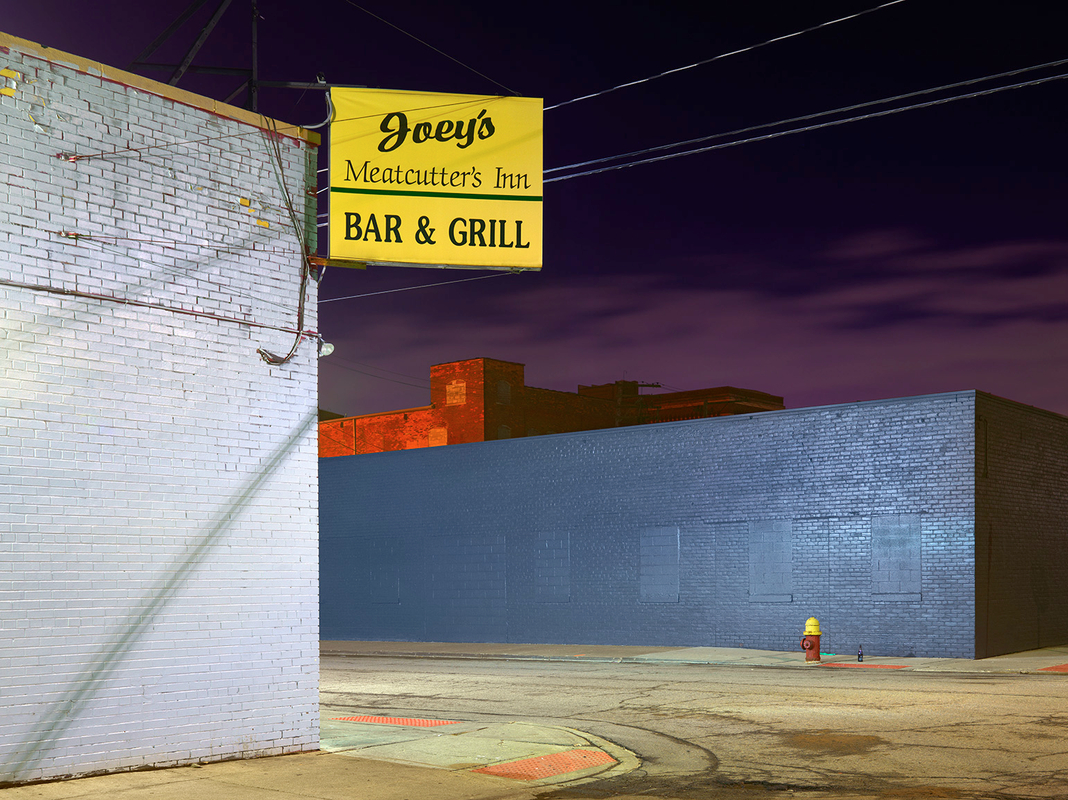
The lonely cityscape at night or the familiar glow of gas station lights cast into the American wilderness. The eye might want to linger among the colors, shapes and clouds even though the mind knows this is pretty much an empty street in a ‘post-industrial’ zone.
Perhaps you haven’t heard about the Levitated Mass at the Los Angeles County Art Museum:
‘…an artwork by Michael Heizer comprised of a 456-foot-long concrete-lined slot constructed on LACMA’s campus, upon and at the center of which is placed a 340-ton granite megalith. As visitors walk along the slot, it gradually descends to fifteen feet deep, running underneath the megalith before ascending back up.’
This is L.A., but…still. Our author at the American Interest wonders:
‘It would be interesting to know whose idea was to move the 340-ton rock from a quarry (at a distance of almost a hundred miles) to the Los Angeles County Museum—an operation costing millions, necessitating extra police forces to deal with the traffic problems caused by the slow progress (five miles per hour) of a gigantic truck (“196-wheel transporter”) specially made for this project.’
Wonder no further:
————————————–
Well, at least it was paid for by private donations. Even so, a great nation deserves great art. This piece fills a spiritual and cultural void at the heart of the Angelino multicultural experience, creating a communal space (absence) in which the public can find meaning through public Art by incorporating Nature itself (a large rock…prescence) into their rootless, isolated, traffic-weary daily lives. It is a mass for the masses!
While passing under the megalith, it may slowly dawn on some Californians that what seemed like levitation or another mildly interesting new art installation actually has a terrible weight to it, and could potentially crush them to death. This may even inspire fear or resignation (like the California debt burden), or perhaps like the Hajj it will become a pilgrimage destination, even uniting people in a state of passive reverence for something so mildly holy (as only good, secular, public Art projects can do).
There was also a gala opening for the rock as though it were Oscar night. From the American Interest:
“In the final analysis, moving this rock to a museum may be seen as an apt symbol of the cultural/aesthetic relativism that has of late engulfed much of our society. Admiration of the rock also illustrates a rare agreement between elite groups (such as curators and benefactors of museums) and ordinary people about what should be regarded as an object of art. Perhaps most importantly it reflects a growing incapacity of many Americans to distinguish between events which are appropriate occasions for reaffirming social bonds and experiencing exhilaration and those which are meaningless and wasteful spectacles.”
Indeed, but I suppose that’s up to the people of Los Angeles to decide. They may like it. The L.A. Times blog writes more here (comments are worth a read).
See also: Tergvinder’s Stone, a poem by W.S. Merwin. Maybe you could see this coming.
Addition: Apparently not everyone recognizes an attempt at postmodern public art blurb satire when they see it.