Repost-The Only Post That Yielded Much In The Way Of ‘Halloween’ On This Site-Happy Halloween

Detroit Nocturne‘ found here. Via Mick Hartley.

I’m partial to ‘Joey’s Meatcutter Inn, Bar & Grill 2017‘:
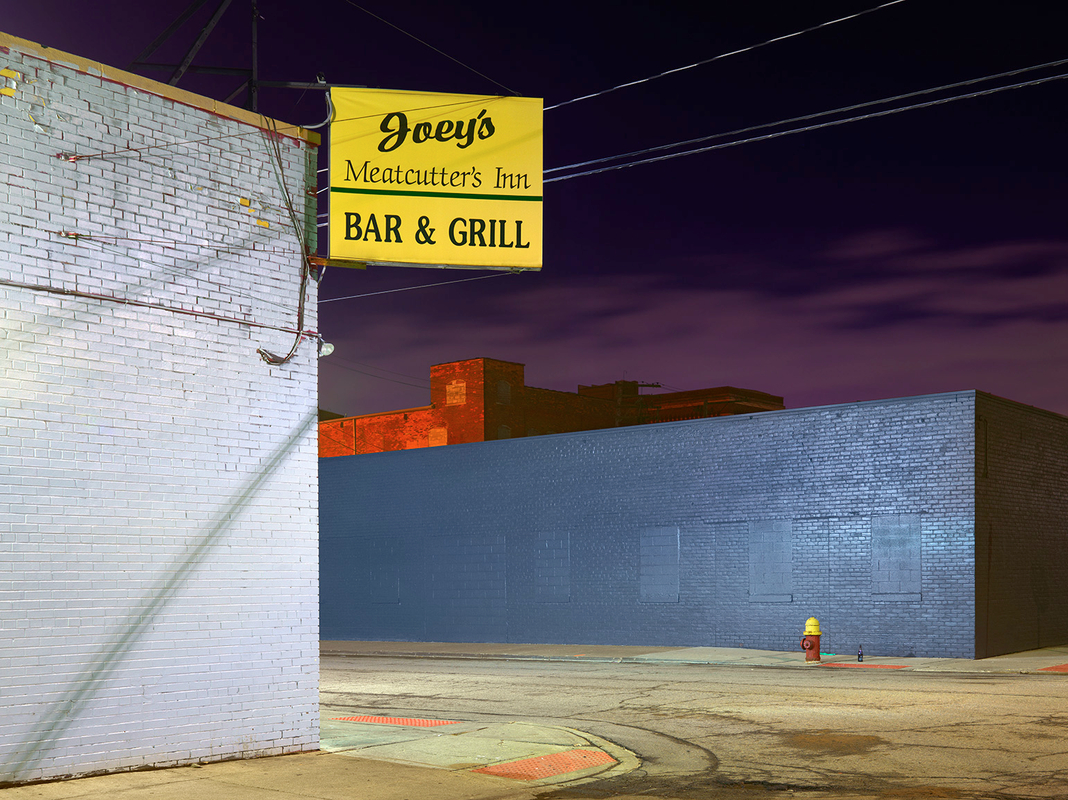
Joey's Meatcutter's Inn, Eastside, Detroit 2017

Immediately, I think of Edward Hopper: The lonely cityscape at night or the familiar glow of gas station lights cast into the American wilderness. The eye might want to linger among the colors, shapes and clouds even though the mind knows this is pretty much an empty street in a ‘post-industrial’ zone.

Perhaps it has do with another strand of expression: The break into free verse from past forms. The move from American Romanticism to Modernism which occurred this early past century. William Carlos Williams produced many good poems from a process of earnest, scrapbook-style intensity in trying to discover, redefine, and order a new poetic form within a modern ‘urban landscape.’

The individual artist is quite alone in the task he’s set before himself, and like much of modernism, it’s a rather big task.

Pastoral

When I was younger
it was plain to me
I must make something of myself.
Older now
I walk back streets
admiring the houses
of the very poor:
roof out of line with sides
the yards cluttered
with old chicken wire, ashes,
furniture gone wrong;
the fences and outhouses
built of barrel staves
and parts of boxes, all,
if I am fortunate,
smeared a bluish green
that properly weathered
pleases me best of all colors.

No one
will believe this
of vast import to the nation

William Carlos Williams

Do you believe any of that to be of vast import to the nation? Are you no one?

Another one of Jordano’s photos which stuck out was: ‘Church Rectory With Lightning, Eastside, Detroit, 2016

https://chrisnavin.com/wp-content/uploads/2018/04/b784b-6a00d83451ebab69e201b8d2e873dc970c-pi.jpg

Perhaps I’m not wrong in having called Halloween horror stills and movie images to mind (it’s my mind, after all, so maybe I’m just thinking of Devil’s Night). I really enjoy the light on the dumpster and the side-front rectory wall. There seems to be a little more mood here, more drama, so maybe Edgar Allan Poe’s ‘psychological intensity,’ his surrealism, and terror are more appropriate for comparison.

Poe was a bit mad, after all, despite his fascinatingly untamed and powerful imagination. He achieved a uniqueness and completeness of vision few artists do. Maybe there’s a bit of the sullen, self-aggrandizing earnestness in him of the teenager (J.D. Salinger); the desire to shock, delight and terrify.

The mind is as though a chamber, the horror rises to fever pitch, the lush rhyme matches an increasingly desperate search for truth and beauty in the world (Poe had very much his own Romantically inspired metaphysics).

Alone

From childhood’s hour I have not been
As others were—I have not seen
As others saw—I could not bring
My passions from a common spring—
From the same source I have not taken
My sorrow—I could not awaken
My heart to joy at the same tone—
And all I lov’d—I lov’d alone—
Then—in my childhood—in the dawn
Of a most stormy life—was drawn
From ev’ry depth of good and ill
The mystery which binds me still—
From the torrent, or the fountain—
From the red cliff of the mountain—
From the sun that ’round me roll’d
In its autumn tint of gold—
From the lightning in the sky
As it pass’d me flying by—
From the thunder, and the storm—
And the cloud that took the form
(When the rest of Heaven was blue)
Of a demon in my view—

Nice photos, Dave. Thank you.

As previously posted:

Via Curbed Detroit. (via David Thompson)

70 photos of the abandoned, foreboding Temple. Mysterious symbols and a certain sad grandeur that’s come to represent Detroit these days.

-Photographer Ben Marcin has a series called ‘Last House Standing.’ Solitary row-homes…the only ones left on the block.

From Buzzfeed: ‘Why I Bought A House in Detroit For $500:’

How did Detroit get here? Very comprehensive and easy to navigate.

More from Megan McArdle on the behavior that comes with pension bonuses.Charlie LeDuff, Detroit’s populist, citizen journalist’s youtube channel here. At least he’s sticking around.

Are you looking at beautiful photos and feeling sorry for Detroit, and yourself? See Time Magazine’s photo essay by Yves Marchand and Romain Meffre (less porn-like, more thoughtful).

Hipster hope, artists, collectivists and small business types can’t save it either: A Short Culture Wars Essay-Two Links On Detroit & ‘Ruin Porn’

GM is not a municipality, but good money got put in, probably after bad and it reeks of politics: From The Detroit News: ‘How The Treasury, GM Stock Deal Got Done’

Modernism At The Movies

You Can Have It

My brother comes home from work
and climbs the stairs to our room.
I can hear the bed groan and his shoes drop
one by one. You can have it, he says.

The moonlight streams in the window
and his unshaven face is whitened
like the face of the moon. He will sleep
long after noon and waken to find me gone.

Thirty years will pass before I remember
that moment when suddenly I knew each man
has one brother who dies when he sleeps
and sleeps when he rises to face this life,

and that together they are only one man
sharing a heart that always labours, hands
yellowed and cracked, a mouth that gasps
for breath and asks, Am I gonna make it?

All night at the ice plant he had fed
the chute its silvery blocks, and then I
stacked cases of orange soda for the children
of Kentucky, one gray boxcar at a time

with always two more waiting. We were twenty
for such a short time and always in
the wrong clothes, crusted with dirt
and sweat. I think now we were never twenty.

In 1948 the city of Detroit, founded
by de la Mothe Cadillac for the distant purposes
of Henry Ford, no one wakened or died,
no one walked the streets or stoked a furnace,

for there was no such year, and now
that year has fallen off all the old newspapers,
calendars, doctors’ appointments, bonds
wedding certificates, drivers licenses.

The city slept. The snow turned to ice.
The ice to standing pools or rivers
racing in the gutters. Then the bright grass rose
between the thousands of cracked squares,

and that grass died. I give you back 1948.
I give you all the years from then
to the coming one. Give me back the moon
with its frail light falling across a face.

Give me back my young brother, hard
and furious, with wide shoulders and a curse
for God and burning eyes that look upon
all creation and say, You can have it.

Philip Levine

Repost-A Reaction To Jeff Koons-For Commerce Or Contemplation?

Denis Dutton suggests art could head towards Darwin (and may offer new direction from the troubles of the modern art aimlessness and shallow depth) Review of Denis Dutton’s ‘The Art Instinct’

Two ways around postmodernism, nihilism?: Through postmodernism? One is Allan Bloom Update And Repost: ‘A Few Thoughts On Allan Bloom–The Nietzsche / Strauss Connection’…A structure in the desert…not even a city Update On LACMA, Michael Heizer And The ‘Levitated Mass’-Modern Art And The Public;.


Pulp Fiction & Photographic Visions-A Link To Bruce Davidson’s ‘Subway’ & ‘Let Me See Your Ring’ Some More Bernie Goetz Backstory

Beauty, ugliness, youth, strength, and decay: Via Mick Hartley Bruce Davidson at Magnum’s ‘Subway‘.

Many of the images in Subway are sensual, dangerous and raw, but then again, so was the NYC subway in about 1979 or 1980. Davidson plays with different exposures, techniques and settings, eventually deciding on using color to depict what he saw. He also reportedly toned-up physically, geared-up, and mentally prepared himself to get off and on those subway cars during the project. He had some undercover city cops with him a few times.

Imagine how conspicuous a new Nikon/Canon DSLR and a flash would make you in one of those cars at night (he, in fact, had one camera stolen).

Come for the raw, dangerous subject matter and the vicarious risk (oh yeah, it can happen again…just stay tuned). Stay for Davidson’s compositions, subtle use of light and color, and the genuine humanity he found within his larger vision.

Is a certain dangerous, glamorous adventure beneath you?

What about in your prime?

What can the ‘rebellious’ artists overlook in their search for ‘humanity’? What can they see pretty clearly through the lens?

It’s not like these problems haven’t been with us for a while.  Without police protection, you’ll probably get worse outcomes and more retributive violence. A reader sends a link to The Confessions Of Bernhard Goetz, subway vigilante:

There’s a lot here: Genuine threat (thugs), fear, real victimization (previous muggings and a likely soon-to-be mugging), but also serious ignorance and over-reaction.

I imagine Goetz was a bit like a feral animal fleeing out of that subway car, up the station stairs and into the night.

From min 33:40:

The question to be litigated was whether the community would make a judgment about his (Goetz) own good faith belief….are we in a position to condemn him for over-reacting?

Great interview on matters of NYC crime from a reporter and a cop active at the time. From Jeffrey Epstein to the Bernie Goetz backstory (starts at min 26:00):

NYC couldn’t protect Goetz from a robbery 6 months before (permanent trauma and kneecap damage), and wouldn’t let him get a gun. He likely saw his assailant likely get out of the precinct before he did that time around.

So, a law-abiding equipment-tester gets and muggable-looking guy gets a gun, ready for the eventual ‘give me five-dollars’ subway fun.

And…he overreacts…but…can you blame him?

From The Warriors to Dirty Harry to Death Wish, a certain gritty, pulpy style was born. One of the main desires of men, especially, is to quash injustice and heroically protect that which falls under their honor. When the authorities can’t combat crime in public transport, or choose to enforce the law selectively, then the desire for vengeance, punishment and order finds outlets.

The Casual Observer On Tornadoes-A Dark Beauty

Imagine a bathtub draining. All the water molecules feel a downward pull to the center of Earth’s mass. The tub floor is tapered slightly, causing the water molecules to flow in one direction. There are about a dozen holes in the drain cover, where the downward pull is exponentially greater.

All the molecules in the tub gather here, eventually passing the cover. The convenient shape to balance these known forces is a vortex.

Zip, off you go.

Out on the Great Plains, East of the Rockies, hundreds of miles of cooler drier moves down from the North.

Warm, moist air rolls up from the South and East, mostly from the Gulf of Mexico.

These differing air masses have different densities, temperatures, and directions of motion. Warm air holds more moisture, and rises. Cool air is harder to lift. Breezes kick up. Clouds heap on the horizon.

Huge complexes called supercells form. These cloud-machines can rise up to 50,000 feet, seeming to collect all the smaller storms around. They have a center called a mesocyclone which rotates. They have a gust front ahead, and downdrafts behind.

On the gust front, perhaps something like our water in the bathtub, rising air is being fed into the supercell quickly enough; the air molecules forced upward intensely enough, that vortices form (the pressure releasing against gravity).

A lot of the power of this cloud machine becomes concentrated. Cyclonic ropes and columns spin down from cooler parts of the storm. These anti-cyclonic (our hemisphere) ropes and columns of rising air stack up in one area.

Zip…off you go.

If you’re anywhere near a tornado you’d hear a guttural roar of wind. It’s described as a loud, terrifying sound you haven’t quite heard before.

Your ears would pop. You’d be pelted with rain or hail, then pierced with dirt, mud, rocks, splinters of wood and bits of tree bark. Aluminum siding might fly by, or structural materials and other larger objects might slam into you. If you found yourself inside, you’d be desperately gathering your loved ones in the safest place possible.

You’d be hoping whoever built this building built it well.

You’d be hoping wherever this tornado moves, it’s away from here.

This monster just passed through Greenfield, Iowa. The people there could use some help. Sometimes help is for the right reasons, and pretty easy.

Allow The Glow-Some Random Neon And Non-Neon Links On Place & The American West

Via Mick Hartley, Steve Fitch Photography has neon motel signs glowing into the Western night.

He also has a book simply titled ‘Motel Signs:’

“To me, neon really figured in the migration movement on Route 66. The farther you go out West, the more neon you’d see, especially as a presence on motels. You can see towns like Tucumcari, New Mexico, coming from 20 miles away.”

I may harbor skepticism regarding a more anthropological, back-to-Earth Romantic primitivism found in certain quarters (Berkeley, especially), but I certainly appreciate good composition. Click through for more photos and less pre-judgment.

As posted, what’s more American than an exiled member of the Russian aristocracy intimately making his way into the English language and peering out from a thousand Motor Lodges?

Nabokov in America:  On The Road To Lolita.

Michael Dirda review of the review here.

“Nabokov in America” is rewarding on all counts, as biography, as photo album (there are many pictures of people, Western landscapes and motels) and as appreciative criticism. Not least, Roper even avoids the arch style so often adopted by critics faintly trying to emulate their inimitable subject.’

Well, there’s Donald Judd and Marfa, Texas, which looks interesting:

As previously posted, The Critic Laughs, by Hamilton:

Do you long for the days of unabashed American consumerism? Are you nostalgic for nights lit only by a soft, neon glow on the underbellies of clouds? Return to a time when America broadcast its brash, unironic call to the heavens.

But it can be empty, and lonely, and full of hard work and suffering:

MT-3 Storm Breaking-3

Montana Pastoral    

I am no shepherd of a child’s surmises.
I have seen fear where the coiled serpent rises,

Thirst where the grasses burn in early May
And thistle, mustard and the wild oat stay.

There is dust in this air. I saw in the heat
Grasshoppers busy in the threshing wheat.

So to this hour. Through the warm dusk I drove
To blizzards sifting on the hissing stove,

And found no images of pastoral will,
But fear, thirst, hunger, and this huddled chill.  

J.V. Cunningham

And because this blog likes to keep things a bit mysterious, I think ‘New Slang’ by the Shins (James Mercer) captures three strands I can identify:  Western U.S. cowboy folk (Home On The Range), English (England) folk, and Pacific NW hipsterdom, which is interesting to me, and because in the arts, I like to like a song, and think about what’s going on afterwards:

That hipsterdom part likely connects with a lot of powerful modern and postmodern strands which could be affecting all of our institutions sooner or later, but, you know…it’s also just a song.

Click here.

Is that a real tower against a painted sky?

Go West.

Some Links To The Rolling Fork, MS Tornado-Life & Death

R.I.P.

Some tragedies happen because of a lack of knowledge, and a lack of knowledge distribution when it is matters most.

There were people sitting in homes and businesses in Rolling Fork MS, who knew it was storming, and knew they should probably keep an eye on the weather, and knew how to stay safe in most situations.

But they didn’t know there was an EF-4 or EF-5 monster bearing-down. They didn’t know they might have had minutes to live. These wind-speeds can sweep walls from foundations.

If these poor folks even knew what the storm-chaser driving-by knew, when he knew it, this could have made the difference.

It’s terrifying to think there could have been someone in that vehicle, hovering a few hundred feet in the air, being swept around this beast.

Accurate prediction[s] save lives.

Some of the experience of storm-chasers, and collected knowledge from that experience, already exists but needs to be channeled through complex and more predictive modeling to establish the science within these monsters.

This is where the new frontiers should be pushed.

Well, Maybe Attempt Some Kind Of Landing There-Some Europa Links

If you’d like a breakdown of the relative sizes of our planet, our moon and all these other moons, click through for a helpful visual.

Also, there’s a lot of space out there:

You’ll likely need an energy source (not necessarily our star, the warping effects of other massive bodies will do) and tens, if not hundreds, of millions of years to sustain an environment conducive to life.  You’ll likely need lots of protection from cosmic rays and short-wave radiation as some kind of shield.  If your planet, moon and/or body doesn’t possess an atmosphere, and is too small to maintain an electro-magnetic dynamo like Earth, then sub-surface water under a protective shell might be enough.

On the recent findings of at least 1/17 observational days of water plumes near the surface of the Jovian moon, Europa:

More here:

‘They used a spectrograph at the Keck Observatory that measures the chemical composition of planetary atmospheres through the infrared light they emit or absorb. Molecules such as water emit specific frequencies of infrared light as they interact with solar radiation.’

and:

Paganini and his team reported in the journal Nature Astronomy on November 18 that they detected enough water releasing from Europa (5,202 pounds, or 2,360 kilograms, per second) to fill an Olympic-size swimming pool within minutes. Yet, the scientists also found that the water appears infrequently, at least in amounts large enough to detect from Earth, said Paganini: “For me, the interesting thing about this work is not only the first direct detection of water above Europa, but also the lack thereof within the limits of our detection method.’

This is potentially good news for the upcoming Europa clipper mission.  Otherwise, how are you going to get at all that water beneath an icy shell at least 10-15 miles thick?

From its orbit of Jupiter, Europa Clipper will sail close by the moon in rapid, low-altitude flybys. If plumes are indeed spewing vapor from Europa’s ocean or subsurface lakes, Europa Clipper could sample the frozen liquid and dust particles. The mission team is gearing up now to look at potential orbital paths, and the new research will play into those discussions.

“If plumes exist, and we can directly sample what’s coming from the interior of Europa, then we can more easily get at whether Europa has the ingredients for life,” Pappalardo said. “That’s what the mission is after. That’s the big picture.”

Aren’t you getting a little excited at the prospect?:

‘Spring Beauties’-A Brief Post And A Link On Andrew Wyeth

Andrew Ferguson on Andrew Wyeth: ‘Terror In The Abstract:’

Andrew Wyeth homepage here with some images included.

There are definitely interesting things going on with light in Wyeth’s work. It fills his paintings. I also find my eye and mind hovering between realist depiction and abstract arrangement of objects on the canvas.

Ferguson:

‘Beneath the frequent prettiness, most of the pictures are just this side of harrowing, not just lonesome and melancholy but portraits of life as it seeps inevitably away. The wind that lifts the lace curtain in Wind from the Sea makes the hair on your arms stand up. Jamie Wyeth, Andrew’s son and a celebrated artist himself, confesses to being puzzled by the benign view of Wyeth’s work. “My father’s work is terrifying,” he said. It’s not sentimental. It’s luminous! But in a creepy way.’

Wyeth reached a level of popular appreciation few artists ever receive in their lifetimes.

Like many Americans, I find myself drawn to what I would call a New England plainness and Yankee work ethic and aesthetic, which is evident is some of Wyeth’s landscapes, at least. Long winters and deep woods. Shorter distances and stonier soil in the meadows. Perhaps a Puritan, high-minded spiritual reserve.

Robert Frost, Emily Dickinson and Nathaniel Hawthorne spring immediately to mind, but, I confess so did that gothic Mainer and fiction horror-writer Stephen King.

Or perhaps the Shaker work song ‘Simple Gifts’ adapted by Aaron Copland might be a good example of what I’m trying to get at.

————————————–

So, is this representative of Wyeth?  Perhaps. He did much of his work in Chadds Ford, Pennsylvania and Maine, but according to Wikipedia there may be other influences as well:

‘N.C. also fostered an inner self-confidence to follow one’s own talents without thought of how the work is received. N.C. wrote in a letter to Wyeth in 1944:[8]

“The great men [ Thoreau, Goethe, Emerson, Tolstoy] forever radiate a sharp sense of that profound requirement of an artist, to fully understand that consequences of what he creates are unimportant. Let the motive for action be in the action itself and not in the event. I know from my own experience that when I create with any degree of strength and beauty I have no thought of consequences. Anyone who creates for effect — to score a hit — does not know what he is missing!”‘

So, I’m speculating. Addition: There’s also a strong modernist-influenced creative imagination at work here too, and like Hopper, the American question of what to do with all that space and wilderness.

Yet, a man able to walk familiar land, seeing it anew with keen eyes, hoping his senses pick up more than he knows, having a medium with which to express his thoughts seems a man who’s had some success in life, regardless of popular appreciation.

Of course, a concupiscent eye must come into tension with other parts of a man’s character.

Or at least when there was a tittering about his ‘Helga‘ paintings a while back.

Ferguson:

‘Stopping to rest near a group of European spring beauties, he saw on a trail above him a young woman on a walk. Assuming she was alone, she moved off the trail, lifted her skirt, and defecated in the grass. Wyeth was charmed. “The white curve of her bottom was amazing,” he told Meryman. The little lumps she left tumbled downhill and stopped in the patch of spring beauties.’

Well, there you go, America.

A discussion of ‘Christina’s World,’ a well-known work of his does more justice than this brief post.

————————

Repost-A Reaction To Jeff Koons-For Commerce Or Contemplation?

Roger Scruton says keep politics out of the arts, and political judgment apart from aesthetic judgment…this includes race studies/feminist departments/gay studies etc.:  Roger Scruton In The American Spectator Via A & L Daily: Farewell To Judgment

Goya’s Fight With Cudgels and Goya’s Colossus.  A very good Goya page here.

Joan Miro: Woman… Goethe’s Color Theory: Artists And ThinkersSome Quotes From Kant And A Visual Exercise

A Reaction To Jeff Koons ‘St John The Baptist’

Denis Dutton suggests art could head towards Darwin (and may offer new direction from the troubles of the modern art aimlessness and shallow depth) Review of Denis Dutton’s ‘The Art Instinct’

Repost: A Bleak, Modern House-Four Poems

This will be a longer one, so thanks in advance.

From the comments on this piece:

‘The most useful definition of modernist fiction I’ve encountered comes from Brian McHale’s Postmodernist Fiction. He says modernist fiction tends to “foreground epistemological questions” such as “How can I interpret the world I’m part of? What is there to be known? Who knows it? What are the limits of that knowledge?” In contrast, postmodernist fiction tends to “foreground ontological questions” such as “What is a world? What kinds of worlds are there and how are they constituted? What happens when…boundaries between worlds are violated?’

As to the epistemological questions surrounding Modernism, below are four poems. Hopefully, each is a representative example of a move away from the Romanticism that had been prevalent up until the late 1800’s.

In addition to the move away from traditional Romantic rhyme and meter towards modern blank verse, there’s also a certain conception of the Self rendered in them; a presentation of our natures that might be worth examining in some detail.

I believe we can see clearly a move away from tradition towards the Self, the Poet isolated, the poem itself as a means of communication, and an anxiety so common within the 20th century.

I should note that a friend points out Harold Bloom does it much better (well, yes…obviously). From this blurb:

‘At the heart of Bloom’s project is the ancient quarrel between “poetry” and “philosophy.” In Bloom’s opinion, we ought not have to choose between Homer and Plato; we can have both, as long as we recognize that poetry is superior.’

Says the guy who writes about poetry…


What does one find within, as one looks without, waking from sleep and dream?

What kind of world is this, and can the poet actually help us know it?

T.S. Eliot (Preludes: Stanza 3)

3.

You tossed a blanket from the bed
You lay upon your back, and waited;
You dozed, and watched the night revealing
The thousand sordid images
Of which your soul was constituted;
They flickered against the ceiling.
And when all the world came back
And the light crept up between the shutters
And you heard the sparrows in the gutters,
You had such a vision of the street
As the street hardly understands;
Sitting along the bed’s edge, where
You curled the papers from your hair,
Or clasped the yellow soles of feet
In the palms of both soiled hands.

The world will stain you, and it is a fallen, modern world, rendered profoundly and exquisitely.

As consciousness creeps in, building a bridge to the day, to the world, to the facts left as though they were the first facts, the light as though it were the first light, what one finds is distressing, both within and without.

That distress must be ‘made new,’ which is to say, the suffering (original?) in which we all sometimes find ourselves must match our experiences within the modern city and world, at least, the world created within Eliot’s lyrical verse.

Of the four poems, only the first and last have a 3rd-person subject.

Wallace Stevens‘ ‘I’ is in a more contemplative state, but it’s an ‘I’ exploring similar themes, and experiencing some distress in trying to know how the world actually is, and what might lie within.

The journey to The Self may not be a journey for the faint of heart.

The Poems Of Our Climate (stanzas II and III)

II
Say even that this complete simplicity
Stripped one of all one’s torments, concealed
The evilly compounded, vital I
And made it fresh in a world of white,
A world of clear water, brilliant-edged,
Still one would want more, one would need more,
More than a world of white and snowy scents.

III
There would still remain the never-resting mind,
So that one would want to escape, come back
To what had been so long composed.
The imperfect is our paradise.
Note that, in this bitterness, delight,
Since the imperfect is so hot in us,
Lies in flawed words and stubborn sounds.

Even if the verse can describe a perfected world, delivering us, perhaps, a little closer to perfection, our poet is still not free from the impulses and desires which simply never cease.

Interestingly, we end-up not with a discussion of the heart, the spirit, libido etc. as a source for those desires (for Plato, the irrational), but rather, for Stevens, just a mind.

We also find more Romantic elements of language and an almost baroque/rococo arrangement of words and ideas, dandyish even, yet combined with an intense effort to abstract, define, and clarify. From here, the poet may proceed on his task of flawed words and stubborn sounds.

***I find myself thinking of elements of modern architecture and abstract-expressionist painting. The meaning, or at least some delivery from our restless existences, can be found within the abstract itself. Or at least within a retreat to the abstract for its own sake, away from the world.

The modernist, glass-walled house on the hill will exist in its own space, offering and defying meaning. The structure’s own shapes will be stripped down to often mathematically precise forms interacting with Nature. These shall guide Man, or at least offer individual men a little refuge.

It is perhaps in Stevens’ poem we can see the questions of knowledge about the world suggesting questions about whether there is a world at all, or, at least, what kind of worlds each Self might be able to inhabit.

Here’s one of Robert Lowell’s poems, occurring a generation later, in the mid 20th-century, as part of the confessionals.

The Self is extremely isolated. In fact, Lowell went more than a little crazy. Unlike the known nervous breakdown of Eliot from which Eliot recovered, Lowell’s life was essentially one long breakdown from which he never recovered.

Here he is, looking back:

Epilogue

Those blessed structures plot and rhyme-
why are they no help to me now
i want to make
something imagined not recalled?
I hear the noise of my own voice:
The painter’s vision is not a lens
it trembles to caress the light.
But sometimes everything i write
With the threadbare art of my eye
seems a snapshot
lurid rapid garish grouped
heightened from life
yet paralyzed by fact.
All’s misalliance.
Yet why not say what happened?
Pray for the grace of accuracy
Vermeer gave to the sun’s illumination
stealing like the tide across a map
to his girl solid with yearning.
We are poor passing facts.
warned by that to give
each figure in the photograph
his living name.

The weight of having to make that meaning, for yourself, and by yourself, is a horrible weight indeed. One can glorify one’s Self and family, but that, alas, only goes so far. Rhyme and form still carry one’s living name, as far as they do.

Of course, there’s still wonderful rhythm and form here (this is excellent verse), but blanker now, with a relentless focus on the ‘I.’ The poet is perhaps talking a little more to himself, and the poem keeps self-consciously calling attention to itself.

In fact, it reminded me of the poem below, by Robert Creeley, which was published a few years afterwards.

From this page:

‘Creeley was a leader in the generational shift that veered away from history and tradition as primary poetic sources and gave new prominence to the ongoing experiences of an individual’s life. Because of this emphasis, the major events of his life loom large in his literary work.’

There’s Nothing but the Self and the Eye seeking and making meaning, by itself within a void of emotionally compact and precise language (of course there’s still form and other things besides).

Can the poet fit inside the little abstract chapel of words he’s building for himself (let alone the world, tradition etc.)?

For all the talk about ‘space,’ there seems very little.

The Window

Position is where you
put it, where it is,
did you, for example, that

large tank there, silvered,
with the white church along-
side, lift

all that, to what
purpose? How
heavy the slow

world is with
everything put
in place. Some

man walks by, a
car beside him on
the dropped

road, a leaf of
yellow color is
going to

fall. It
all drops into
place. My

face is heavy
with the sight. I can
feel my eye breaking.

The distress is still there…but I’d argue that we are now a good distance away from the grandness of Eliot’s vision, his religiosity and virtuosity with form and meter at the dawn of Modernism. Very few people can/could do what Eliot did (addition: even if he can help us gain knowledge of our Selves or the world).

That said, it’s unclear there’s enough tradition and confidence to even undertake such a project, now, even as such talents come along. The state of things is more scattered. We’re in a very different place of selves and artists isolated, of anxiety and post-anxiety.

Aside from the very accomplished poets above, in terms of both knowledge (epistemology) and being (ontology), we often have writers feeling pressure to weigh-in on such questions without even being about to write that well; artists who can’t draw or paint that well, and frankly, quite a bit of bullshit besides.

So, where are we headed? Who’s ‘we’ exactly?

Predictions are hard, especially about the future.


As previously posted:

Why not just put a few algorithms to work in writing those artist statements?

Bathe in the bathos of a warming world:

A reader sends a link to a SF Gate review of poet Jorie Graham’s ‘Sea Change:

‘In “Sea Change,” Graham becomes Prospero, casting spells by spelling out her thoughts to merge with ours, and with the voices of the elements. The result is a mingling of perceptions rather than a broadcasting of opinions. Instead of analysis, the poems encourage emotional involvement with the drastic changes overwhelming us, overwhelm- ing the planet.’

and:

‘Strengths and weaknesses, flows and ebbs, yet every poem in “Sea Change” bears memorable lines, with almost haunting (if we truly have but 10 years to “fix” global warming) images of flora and fauna under siege. Jorie Graham has composed a swan song for Earth.’

Oh boy.

What are these poems being asked to do?


And moving away from poetry into the realm of ‘performance art,’


Tilda Swinton At MOMA-From Arma Virumque: ‘Nightmare In A Box’

Denis Dutton suggests art could head towards Darwin (and may offer new direction from the troubles of the modern art aimlessness and shallow depth) Review of Denis Dutton’s ‘The Art Instinct’

Roger Scruton says keep politics out of the arts, and political judgment apart from aesthetic judgment…this includes race studies/feminist departments/gay studies etc.: Roger Scruton In The American Spectator Via A & L Daily: Farewell To Judgment

Ah, Look At All The Lonely People-‘Jeff Koons Is Back’ Via Vanity Fair

Some Updated Links On Postmodernism

Step By Step-Some Humble Space Links

Frank Drake brings some realism to the S.E.T.I. debate.  The space-time distances are a huge hurdle, and the challenges of becoming a spacefaring civilization make the journey to nearby star systems fairly impractical at the moment.

The less evidence and fewer data points there are, the more rampant the speculation, inventive the Sci-Fi imaginings, and important the foundation to create such new fields of knowledge.

There’s been an explosion of private entrepreneurship and NASA partnership lately (loosened regulations and better incentives) to help get cargo (things and people) into space much more cheaply than before.

What’s it like to be on a spacewalk?  In some ways, pretty normal and pretty not normal, apparently: Just pace yourself, focus, and get the job done in an unwieldy suit while you hover between everything you’ve ever known and an incomprensible abyss.

In addition to recent rapid advances in ‘seeing’ with radio waves, gravity waves and light, and we’ve got better tools to get a little further out into our own neighborhood.

This means we could find out if we can find some life on Mars (methane spikes), Jupiter’s icy moon Europa and Saturn’s icy moon Enceladus:

and:

and:

The Only Post That Yielded Much In The Way Of ‘Halloween’ On This Site-Happy Halloween

Detroit Nocturne‘ found here. Via Mick Hartley.

I’m partial to ‘Joey’s Meatcutter Inn, Bar & Grill 2017‘:

Joey's Meatcutter's Inn, Eastside, Detroit 2017

Immediately, I think of Edward Hopper: The lonely cityscape at night or the familiar glow of gas station lights cast into the American wilderness. The eye might want to linger among the colors, shapes and clouds even though the mind knows this is pretty much an empty street in a ‘post-industrial’ zone.

Perhaps it has do with another strand of expression: The break into free verse from past forms. The move from American Romanticism to Modernism which occurred this early past century. William Carlos Williams produced many good poems from a process of earnest, scrapbook-style intensity in trying to discover, redefine, and order a new poetic form within a modern ‘urban landscape.’

The individual artist is quite alone in the task he’s set before himself, and like much of modernism, it’s a rather big task.

Pastoral

When I was younger
it was plain to me
I must make something of myself.
Older now
I walk back streets
admiring the houses
of the very poor:
roof out of line with sides
the yards cluttered
with old chicken wire, ashes,
furniture gone wrong;
the fences and outhouses
built of barrel staves
and parts of boxes, all,
if I am fortunate,
smeared a bluish green
that properly weathered
pleases me best of all colors.

No one
will believe this
of vast import to the nation

William Carlos Williams

Do you believe any of that to be of vast import to the nation? Are you no one?

Another one of Jordano’s photos which stuck out was: ‘Church Rectory With Lightning, Eastside, Detroit, 2016

https://chrisnavin.com/wp-content/uploads/2018/04/b784b-6a00d83451ebab69e201b8d2e873dc970c-pi.jpg

Perhaps I’m not wrong in having called Halloween horror stills and movie images to mind (it’s my mind, after all, so maybe I’m just thinking of Devil’s Night). I really enjoy the light on the dumpster and the side-front rectory wall. There seems to be a little more mood here, more drama, so maybe Edgar Allan Poe’s ‘psychological intensity,’ his surrealism, and terror are more appropriate for comparison.

Poe was a bit mad, after all, despite his fascinatingly untamed and powerful imagination. He achieved a uniqueness and completeness of vision few artists do. Maybe there’s a bit of the sullen, self-aggrandizing earnestness in him of the teenager (J.D. Salinger); the desire to shock, delight and terrify.

The mind is as though a chamber, the horror rises to fever pitch, the lush rhyme matches an increasingly desperate search for truth and beauty in the world (Poe had very much his own Romantically inspired metaphysics).

Alone

From childhood’s hour I have not been
As others were—I have not seen
As others saw—I could not bring
My passions from a common spring—
From the same source I have not taken
My sorrow—I could not awaken
My heart to joy at the same tone—
And all I lov’d—I lov’d alone—
Then—in my childhood—in the dawn
Of a most stormy life—was drawn
From ev’ry depth of good and ill
The mystery which binds me still—
From the torrent, or the fountain—
From the red cliff of the mountain—
From the sun that ’round me roll’d
In its autumn tint of gold—
From the lightning in the sky
As it pass’d me flying by—
From the thunder, and the storm—
And the cloud that took the form
(When the rest of Heaven was blue)
Of a demon in my view—

Nice photos, Dave. Thank you.

As previously posted:

Via Curbed Detroit. (via David Thompson)

70 photos of the abandoned, foreboding Temple. Mysterious symbols and a certain sad grandeur that’s come to represent Detroit these days.

-Photographer Ben Marcin has a series called ‘Last House Standing.’ Solitary row-homes…the only ones left on the block.

From Buzzfeed: ‘Why I Bought A House in Detroit For $500:’

How did Detroit get here? Very comprehensive and easy to navigate.

More from Megan McArdle on the behavior that comes with pension bonuses.Charlie LeDuff, Detroit’s populist, citizen journalist’s youtube channel here. At least he’s sticking around.

Are you looking at beautiful photos and feeling sorry for Detroit, and yourself? See Time Magazine’s photo essay by Yves Marchand and Romain Meffre (less porn-like, more thoughtful).

Hipster hope, artists, collectivists and small business types can’t save it either: A Short Culture Wars Essay-Two Links On Detroit & ‘Ruin Porn’

GM is not a municipality, but good money got put in, probably after bad and it reeks of politics: From The Detroit News: ‘How The Treasury, GM Stock Deal Got Done’

Modernism At The Movies

You Can Have It

My brother comes home from work
and climbs the stairs to our room.
I can hear the bed groan and his shoes drop
one by one. You can have it, he says.

The moonlight streams in the window
and his unshaven face is whitened
like the face of the moon. He will sleep
long after noon and waken to find me gone.

Thirty years will pass before I remember
that moment when suddenly I knew each man
has one brother who dies when he sleeps
and sleeps when he rises to face this life,

and that together they are only one man
sharing a heart that always labours, hands
yellowed and cracked, a mouth that gasps
for breath and asks, Am I gonna make it?

All night at the ice plant he had fed
the chute its silvery blocks, and then I
stacked cases of orange soda for the children
of Kentucky, one gray boxcar at a time

with always two more waiting. We were twenty
for such a short time and always in
the wrong clothes, crusted with dirt
and sweat. I think now we were never twenty.

In 1948 the city of Detroit, founded
by de la Mothe Cadillac for the distant purposes
of Henry Ford, no one wakened or died,
no one walked the streets or stoked a furnace,

for there was no such year, and now
that year has fallen off all the old newspapers,
calendars, doctors’ appointments, bonds
wedding certificates, drivers licenses.

The city slept. The snow turned to ice.
The ice to standing pools or rivers
racing in the gutters. Then the bright grass rose
between the thousands of cracked squares,

and that grass died. I give you back 1948.
I give you all the years from then
to the coming one. Give me back the moon
with its frail light falling across a face.

Give me back my young brother, hard
and furious, with wide shoulders and a curse
for God and burning eyes that look upon
all creation and say, You can have it.

Philip Levine

Repost-A Reaction To Jeff Koons-For Commerce Or Contemplation?

Denis Dutton suggests art could head towards Darwin (and may offer new direction from the troubles of the modern art aimlessness and shallow depth) Review of Denis Dutton’s ‘The Art Instinct’

Two ways around postmodernism, nihilism?: Through postmodernism? One is Allan Bloom Update And Repost: ‘A Few Thoughts On Allan Bloom–The Nietzsche / Strauss Connection’…A structure in the desert…not even a city Update On LACMA, Michael Heizer And The ‘Levitated Mass’-Modern Art And The Public;.

For A Reader-Some Martian Information From A Layman

Solar radiation: We live within the envelope of Earth’s electro-magnetic dynamo, protected from the life-destroying short-wave radiation our star is constantly spewing.  Over time (billions of years) this has helped create a relatively stable atmosphere and biosphere; stable enough for the life we know on Earth.

Despite this stability, of course, we know the star-energy we eventually consume as food and water to be scarce as such conditions are coded at the cellular level (and since we’re being depressively realistic, there’s vulcanism, earthquakes, cold, heat, other people, parasites and viruses to contend with). Such facts define us as does the occasional catastrophic event and the eventual catastrophe awaiting each of us.  There’s love, friendship, knowledge, music, hope, beauty and a whole world to explore.

Okay, enough of that for now.

Zero or altered gravity:  On the surface of Earth, we live x units away from a mass ball at the bottom of a gravity well.  In space, we wouldn’t feel this force at all, and on Mars we would feel it about 40%.  What if blood vessels contract/expand or slowly atrophy in zero Gs for reasons yet unknown?  What if this dims your vision slowly, over time, and impairs cognitive functioning, especially during the reproductive process, pregnancy or early childhood?  Wouldn’t you like to know this before it starts happening to you on the six-months-plus journey to Mars?

Once we know about such problems, we can figure out some solutions.

If there is life on Mars (a possibility, still, as of 2019), it’s probably microbial, living on an energy source beneath the surface.  Up top, all that solar radiation has created a toxic layer of perchorates, oxidized, rusted dust and rocks, apparently hostile to life as we know it.

Imagine a place colder than Antarctica, drier than the driest desert, with so little atmosphere the atmosphere’s barely there.  The EM dynamo and envelope petered out long ago.  You look around and see a barren landscape, familiar yet strange; alien.

Imagine, one morning, stepping from a rover on an exploratory mission, feeling a deep  nervous tension and excitement.  You focus in on the scripted tasks and procedures the next few minutes require.

You know that if your suit becomes compromised, your blood would alternately freeze/boil and you’d die almost instantly.  You know some little, unplanned problem can become a big problem.  Any sort of help/supply lines would be pretty much impossible, at least six months but at least a year in coming, and probably not coming at all.

Yet, here you are:

—————————

As posted: It looks like Gale Crater has its advantages.

Research papers here. A summary of some of what’s been found so far:

‘Research suggests habitable conditions in the Yellowknife Bay area may have persisted for millions to tens of millions of years. During that time rivers and lakes probably appeared and disappeared. Even when the surface was dry, the subsurface likely was wet, as indicated by mineral veins deposited by underground water into fractures in the rock. The thickness of observed and inferred tiers of rock layers provides the basis for estimating long duration, and the discovery of a mineral energy source for underground microbes favors habitability throughout.’

You can also watch a 12/05/13 press briefing from JPL discussing those papers above.  These rocks are much newer than the older wet period theorized.

They’re more focused on the search for organic carbon, now, within the environments they’ve discovered.

Via The Mars Science Laboratory At NASA: ”Mount Sharp’ On Mars Links Geology’s Past And Future’Via Youtube: ‘The Challenges Of Getting To Mars: Selecting A Landing Site

NASA Via Youtube: December 21st, 2012 Mars Curiosity Rover Report

NASA Via Youtube: ‘The Martians: Launching Curiosity To Mars’NASA Via Youtube: ‘Mars Science Laboratory (Curiosity Rover) Mission Animation

Why was Mt. Sharp chosen for the Curiosity Rover landing site, and what about those rounded stones that it photographed, indicative of long ago ankle to hip-deep water?  If the Martian surface is likely so full of perchlorates and life-hostile, irradiated soil, what are the chances of pockets of microbial life below ground?

The discussion later moves to Venus, Jovian moon Io, and the Chinese lander on the dark side of the moon in the final minutes:

Event Horizon discussion with Emily Lakdawalla.

Imagine sub-freezing temperatures and free radicals bombarding the near atmosphere-less Martian surface (oxidized and rusted red, barren), but below the Martian surface lurk big blocks of briny ice; ice with freezing cold, incredibly salty water around them and maybe just enough O2 to support some microbes.

Worth thinking about.

What are you doing with your imagination?

‘Due to the scarcity of O2 in the modern Martian atmosphere, Mars has been assumed to be incapable of producing environments with sufficiently large concentrations of O2 to support aerobic respiration. Here, we present a thermodynamic framework for the solubility of O2 in brines under Martian near-surface conditions. We find that modern Mars can support liquid environments with dissolved O2 values ranging from ~2.5 × 10−6 mol m−3 to 2 mol m−3 across the planet, with particularly high concentrations in polar regions because of lower temperatures at higher latitudes promoting O2 entry into brines’


A Few Brief Martian Links

Why was Mt. Sharp chosen for the Curiosity Rover landing site, and what about those rounded stones that it photographed, indicative of long ago ankle to hip-deep water?  If the Martian surface is likely so full of perchlorates and life-hostile, irradiated soil, what are the chances of pockets of microbial life below ground?

The discussion later moves to Venus, Jovian moon Io, and the Chinese lander on the dark side of the moon in the final minutes:

Event Horizon discussion with Emily Lakdawalla.


As posted:

Imagine sub-freezing temperatures and free radicals bombarding the near atmosphere-less Martian surface (oxidized and rusted red, barren), but below the Martian surface lurk big blocks of briny ice; ice with freezing cold, incredibly salty water around them and maybe just enough O2 to support some microbes.

Worth thinking about.

What are you doing with your imagination?

‘Due to the scarcity of O2 in the modern Martian atmosphere, Mars has been assumed to be incapable of producing environments with sufficiently large concentrations of O2 to support aerobic respiration. Here, we present a thermodynamic framework for the solubility of O2 in brines under Martian near-surface conditions. We find that modern Mars can support liquid environments with dissolved O2 values ranging from ~2.5 × 10−6 mol m−3 to 2 mol m−3 across the planet, with particularly high concentrations in polar regions because of lower temperatures at higher latitudes promoting O2 entry into brines’

Repost-A 9/11 Link

For those who didn’t make it through, and those who did, and those who have worked every day to make it better…

Here’s a video of the memorial at night, from a few years ago. You can look into those holes, the water flowing down and away. You can also be with everyone else for a moment, looking at the beauty around you; the bustling city.

Addition: At the NY Observer, a firsthand account from the 77th floor of the 2nd tower.

Repost-Quotation Sent By A Reader-Jacques Barzun

***About that first quote, someone probably pulled it from a quotation site, and it’s provenance is disputed (thanks to twitter follower Leo Wong).  Because I haven’t been able to track its source either, I’ll treat it as either invalid or false unless or until I hear otherwise.

I own this one, so, going forward, I’m only going to pull quotes from what I’m reading and with proper citation.

Thanks for the heads up, and apologies.

‘Political correctness does not legislate tolerance; it only organizes hatred.’

Thanks to a reader, more on Barzun here.

I read ‘From Dawn To Decadence‘ not long after it came out.

As posted, Barzun at The American Scholar-‘The Cradle Of Modernism‘:

‘For yet another cause of unhappiness was the encroachment of machine industry and its attendant uglification of town and country. The Romanticists had sung in an agrarian civilization; towns were for handiwork and commerce. Industry brought in not factories only, and railroads, but also the city — slums, crowds, a new type of filth, and shoddy goods, commonly known as “cheap and nasty.” And when free public schools were forced on the nation by the needs of industry, a further curse was added: the daily paper, also cheap.’

Via C-SPAN-The Historical Context Of Allan Bloom…From Humanities: Why Nabokov’s ‘Speak, Memory’ Still Speaks To Us

A Few Quick Links On Speech

From F.I.R.E-‘Free-Speech Zones: Then & Now

‘This year, we decided it was time to take a fresh look at that figure, since a lot has changed over the last few years. And as we announced in our just-released 2017 report on campus speech codes, the number of free speech zone policies is down: Today, roughly one in 10 of the schools we surveyed maintain a free speech zone policy.’

From Volokh-Techdirt gets more than $250,000 to better cover free-speech issues

As posted:

More here.

I keep hearing about a supposed “hate speech” exception to the First Amendment, or statements such as, “This isn’t free speech, it’s hate speech,” or “When does free speech stop and hate speech begin?” But there is no hate speech exception to the First Amendment. Hateful ideas (whatever exactly that might mean) are just as protected under the First Amendment as other ideas.

The folks at Charlie Hebdo didn’t find the PEN ‘activists’ much to think about.


Two older, but likely worthwhile links:

Brendan O’Neill At Spiked:

‘A true devotee of freedom of speech says, ‘Let everyone speak, because it is important that all sides are heard and that the public has the right to use their moral muscles and decide who they trust and who they don’t’. The new, partial campaigners for friends’ speech effectively say, ‘Let my friend speak. She is interesting. She will tell the public what they need to hear.’ These are profoundly different positions, the former built on liberty and humanism, the latter motored by a desire to protect oneself, and oneself alone, from censorship. The former is free speech; the latter ‘me speech’.

Back to Yale with Christopher Hitchens:

Full post here.

Reason post here.

NY Times piece here.

Old news I know, but it seems that the Yale Press was genuinely afraid that publishing this book could potentially lead to violence, and that they are responsible for the consequences of such potential violence.

Hitchens:

“…Yale had consulted a range of experts before making its decision and that “[a]ll confirmed that the republication of the cartoons by the Yale University Press ran a serious risk of instigating violence.”

See Also:  If you thought the cartoons were bad, more on the Fitna movie here.  From The NY Times: Review Of Christopher Caldwell’s Book “Reflections on the Revolution in Europe: Immigration, Islam, and the West”  Libertarians love this issue:  Repost-A Canadian Libertarian Making Noise: Ezra Levant  

Another Middlebury Update-A Most Cowardly Endeavor

What a shame.

An apology from the PoliSci chair to the ‘community’ at Middlebury:

Earlier this year I, as chair of the political science department, offered a symbolic departmental co-sponsorship to the Charles Murray event in the same way that I had done with other events in the past: on my own, without wider consultation. This was a mistake.’

You’ll have to look elsewhere for vigorous displays of moral courage, character, and independence of mind.

If an echo-chamber of shared belief and distraught racial-identity politics rewarded by a bureaucratic lack of imagination’s your thing: Middlebury might just be for you!

Truthfully, the battle was probably lost at least a generation ago, in many minds, as the logic of radical ideology, once embraced, tends to keep perpetuating and reinforcing itself.

Here’s one answer [above] to Charles Murray’s question of what happens next in the face of actual violence. In his words:

Much of the meaning of the Middlebury affair depends on what Middlebury does next. So far, Middlebury’s stance has been exemplary. The administration agreed to host the event. President Patton did not cancel it even after a major protest became inevitable. She appeared at the event, further signaling Middlebury’s commitment to academic freedom. The administration arranged an ingenious Plan B that enabled me to present my ideas and discuss them with Professor Stanger even though the crowd had prevented me from speaking in the lecture hall. I wish that every college in the country had the backbone and determination that Middlebury exhibited.’

Here’s possibly another answer

48 Middlebury professors signed the following document (WSJ paywall warning…speech on public affairs and civil discourse ain’t necessarily free).

A 9/11 Link

It’s nearly too politicized these days…

For those who didn’t make it through, and those who did, and those who have worked every day to make it better…

Here’s a video of the memorial at night, from a few years ago. You can look into those holes, the water flowing down and away.  You can also be with everyone else for a moment, looking at the beauty around you; the bustling city.

Addition:  At the NY Observer, a firsthand account from the 77th floor of the 2nd tower.

Happy 4th of July 2016

When in the course of human events it becomes necessary for one people to dissolve the bands which have connected them with another and to assume among the powers of the earth, the separate and equal station to which the Laws of Nature and of Nature’s God entitle them, a decent respect to the opinions of mankind requires that they should declare the causes which impel them to the separation…”

The rest here.

Addition:  From Maverick Philosopher:  The Difference Between Patriotism And Jingoism.

flag-c.jpg

Rattling Around-An Artsy Editorial: ‘Pop Culture & Iconic Art History Mashups From The Father Of Stencil Art’

Full piece here (Hat-tip to Anthony Williams)

Before Banksy, there was Blek Le Rat:

‘Following the cut-and-paste technique of Dada-ist collages and the sourcing of commercial imagery in Pop Art, appropriation of visual material or pop culture images has long been utilized by street and graffiti artists. Le Rat continues this style of sampling in his more recent body of works, employing pop culture references and Old Master artworks in a series of graphic spray paint works on canvas.’

An interview here:

——————

Hopefully, dear reader, you will indulge a few ideas that have sprung to mind, as clearly no one knows better what’s happening on the streets.

The first is the Youtube mashup, or in certain cases the sampling of music across different genres and styles, then cramming and crafting them back together into potentially new creations just by using the stuff of Youtube videos.

All this requires is access to a computer and the focus to really listen to music that draws one in. No particular musical training nor long years’ sacrifice is required.  In fact, Youtube has some real practitioners out there, taking apart and putting music videos back together, sifting through an enormous compilation of free and/or cheap recorded music.  The bar for being a D.J. just got lower.

The lower cost and easier availability of basic programs and equipment has spurred-on new genres of music, often driven by a few creative, talented and ambitious people and groups out to make something rather beautiful out of these component parts and their own experiences.

Hip-hop and 80’s synth-pop are just two examples.

————————-

The second idea that springs to mind is the shared history Youtube mashups, stencil artists like Le Rat, and graffiti artists might have with pop and modern art’s impulse to make meaning, often deeper meaning, out of what is at-hand in a large commercial society such as ours. All this takes might be a can of spray-paint, some basic technique, and a willingness to break the law where the law doesn’t often go.

On the higher-end, the art can be meant to spread and ‘democratize’ deeper artistic influences and ideas (a certain smugness there), while on the lower-end, a tag can be the nothing more a than a guy taking a piss on a wall with a spray-can.  The high-low dynamic can be intoxicating.

Yet, there are beautiful things to be found, however, especially when and where one looks for beauty.

There seems a basic desire in us to make something that will last and that will endure, to copy what works, and to aim for beauty and try and transcend and give meaning to our own experiences and circumstances.

The need to discover and share meaning through aesthetic influence and preference likely isn’t going anywhere either. From gangs to high-school cliques to art houses, from individual taggers to the loftiest aesthete and critic, there’s a whole lot of judgment and self-identification constantly going on in human affairs through through the process of judging what we like and don’t like, which group we may be a part of and which we may not at any point in time.

Back to the piece:

‘Hugely influential on today’s generation of graffiti artists, Le Rat’s counter-iconography continues to cut across time periods, media, and styles while still paying tribute to the iconic works and masters he uses in his work.’

Images surround us in the form of  thousands of prints, photos, comic book art, cartoons, advertisements etc that first drove a lot of modernism and its subsequent reactions in Pop Art.

Robert Hughes really didn’t like the lack of acquired skill and mastery of materials many moderns lack.

There have been a lot of virulent reactions to ‘modern’ life and technology ranging from utopian futurism to nihilism to consumerism and a kind of dejected anti-consumerism and spiritual malaise.

—————

Camille Paglia wants to tilt the culture more towards art education, but manages to resist the more virulent strains of secular ideology filling the modern hole, pushing back against the radicalism of feminist ideology when it encroaches upon aesthetics:

—————-

You don’t need Debussy when you’ve got Paul Mauriat.

What if eternity is listening to well-done orchestral elevator music?

=========

Some Links On 5Pointz, Graffiti, & The Arts–Property Rights & The Rule-Of-Law

Heather MacDonald At The City Journal: ‘Radical Graffiti Chic’

So, You’re Telling Me What’s Cool?-Theodore Dalrymple At The City Journal: ‘Banksy In Neverland’ What are these people doing with art?:  Often combining them with a Left-of-Center political philosophy as they are at NPR for popular consumption.

On this site, see: From ReasonTV Via Youtube: ‘Ken Burns on PBS Funding, Being a “Yellow-Dog Democrat,” & Missing Walter Cronkite’Repost-From NPR: Grants To The NEA To Stimulate The Economy?

From Grist.Org Via The New Republic Via The A & L Daily: ‘Getting Past “Ruin Porn” In Detroit’…Marketplace aesthetics in service of “women”: Dove’s Campaign For Real Beauty: Pascal Dangin And Aesthetics… Roger Scruton In The City Journal: Cities For Living–Is Modernism Dead?Brasilia: A Planned City
Sunday Quotation: Edmund Burke On The French Revolution

Ah, Look At All The Lonely People-‘Jeff Koons Is Back’ Via Vanity Fair

Full piece here.

-Koons gets the Annie Leibovitz treatment (an unfortunate photo at the link).

-This is not a commentary on Koons’ art, some of which I like well enough, it’s a much worse beast: Another attempt at cultural criticism.

In the talk around Koons, what often stands-out to me is how much talk there is about Koons himself, and the search for meaning in all that talk. The concept of artist-as-individual is nothing new: An isolated Self, quite apart from society, mining his interior life and experiences in order to represent beauty, meaning, and some attempt at expressing universal truths through his work and craft. This is unsurprisingly part of what all artists do, and the extreme individuality of this process is what Western artists somewhat consciously have been doing for a few centuries now, from musicians to writers to sculptors, from romanticism to modernism to post-modernism and beyond.

The fact that Koons is doing this with such relentless self-promotion and while also courting celebrity is arguably a much more ‘modern’ phenomenon. A certain amount of melliflous, abstract bullshit seems part of the Koons’ game, as if you’d walked onto a used-art lot as Koons tours you around, asking what’s-it-gonna-take-to-get-you-into-one-of-his-pieces, yet with soothing, professional demeanor, offering an invitation to return a part of of your Self to you and make you whole again within the work produced by his Self. Jeff Koons is a brand.

Perhaps this is what it takes these days to make a living by schmoozing with wealthy art-buyers, but in some ways, it has a distinctly American feel as well. High and low culture mix in a highly commercial, utilitarian way. The urge to merge abstract art and the avant-garde with mass, pop-culture is expressed. Fame and meta-critiques on fame, celebrity, money, the Self amplified for all the other Selfs to see has implications for much of our culture, I suspect.

As to establishing Koons’ bona fides enough to merit attention by Vanity Fair…here are a few quotes from the piece:

“Jeff is the Warhol of his time,” proclaims Adam Weinberg, the Whitney’s director.

Everyone’s getting in on the bullshit!

‘The reference to Curtis ties Koons to the last true avant-garde—a pedigree the artist likes. Curtis, who refused to be called a drag queen, was a pioneer of the L.G.B.T. movement and, like Candy Darling, was made famous by Warhol’

You need the cultural legitimacy of an L.G.B.T. blessing to be truly avant-garde these days.

‘What Warhol and Koons do have in common, though, is an uncanny ability to nail an image or an object so that it catches the Zeitgeist.’

Partially true, perhaps, but what if the Zeitgeist is nothing but a leafy suburb full of good schools, intact families, and moderate lives?  Isn’t this why some youngish people (ahem…many hipsters) often leave their small towns and suburbs looking for meaning, group membership and purpose in what can end-up vaguely collectivist and vaguely individualist lives in cities?

Everyone’s an artist, these days.

Establishing modernist credentials for the brand:

 ‘Koons’s job at MoMA gave him the opportunity to immerse himself in the history of modernism, in particular the ideas of Marcel Duchamp, who changed art history by showing how everyday objects, or “readymades,” could be elevated into the realm of art, depending on context. Duchamp’s theories were a revelation to Koons.’

Piketty and Brecht in the same paragraph:

‘Barbara Kruger, the artist whose unsentimental pronouncements have been cutting to the chase about the art world for decades, says “Oh boy” when I call to discuss Koons, whom she has known since they both were starting out in New York. She needed to think about it and later wrote me: “Jeff is like the man who fell to earth, who, in this grotesque time of art flippage and speculative mania, is either the icing on the cake or some kind of Piketty-esque harbinger of the return of Brecht’s ‘making strange.’

And finally, while I have no quarrel with neurosicence, pop-neuroscience is often a repository for the modern search for legitimate experiences and theories of the Self:

‘Dr. Eric R. Kandel, a Nobel Prize-winning neuroscientist, was so impressed with the show that he e-mailed Koons afterward. I asked Kandel why. He explained, “I have been interested in the ‘beholder’s share,’ an idea that came from the Viennese art historian Alois Riegl. It involves the concept that when a painter paints a painting or a sculptor makes a sculpture it is not complete unless a beholder, a viewer, responds to it.”

Kandel adds, “When you looked at the sculptures you saw yourself embedded in the gazing balls. Artists sometimes put mirrors in works, but they don’t design the work so that you find yourself in the arms or chest of a statue, which is what Jeff did.’

Go and find your Self and be made whole, dear reader, within Jeff Koons’ work and the Jeff Koons brand, and try and tell the dancer from the dance.

————————

Koons’ Made In Heaven only amplifies that sound, blurring the line between art and porn, private experience and public show, innocence (so easily corrupted) and naive, narcissistic indulgence.

I suspect Made In Heaven explores previous themes of high and low that were already emerging in his kitsch work, fleshed out in pieces like Michael Jackson And BubblesWinter Bears and on this site: ‘St John The Baptist’.

Some quotes from Koons:

‘This type of dislocated imagery is what motivates people. They’re amused by it, but they have a lot of guilt and shame that they respond to it.  I was trying to remove that guilt and shame.’

Another quote which highlights an idea of some import to the nation:

Coming from a suburban, middle-class background, as he did, he felt that there was something, if not dignified, at least, too easily discarded about this kind of imagery and this kind of sentiment.’

Roger Scruton says keep politics out of the arts, and political judgment apart from aesthetic judgment…this includes race studies/feminist departments/gay studies etc.:  Roger Scruton In The American Spectator Via A & L Daily: Farewell To Judgment

Goya’s Fight With Cudgels and Goya’s Colossus.  A very good Goya page here.

Joan Miro: Woman… Goethe’s Color Theory: Artists And ThinkersSome Quotes From Kant And A Visual Exercise

A Reaction To Jeff Koons ‘St John The Baptist’

Denis Dutton suggests art could head towards Darwin (and may offer new direction from the troubles of the modern art aimlessness and shallow depth) Review of Denis Dutton’s ‘The Art Instinct’

From The Atlantic: ‘At Least 14 Dead In Washington Mudslide’

Photos here.

This happened about 55 miles or so north-northeast of Seattle in the town of Oso.  So far, 176 people are missing, but the death toll will hopefully not be anywhere near as high as that dreadful number. Apparently, the hill in question is made-up of glacial sandy soil and lacks a rocky, sedimentary base. It has been saturated by the recent heavy rains and undercut by a meander in the high water of the Stillaguamish river.  Many homes and properties were located in the valley below and opposite that hill.

It still isn’t safe.

From MyNorthwest.com, which has great coverage:

Geologist: Mudslide still moving, even bigger than first thought:

‘Dave Norman, Washington state geologist with the Department of Natural Resources, says preliminary assessments have determined the slide is 1500 feet long, 4,400 feet wide and over 600 feet high, with a debris field 30-40 feet deep.’

Some more photos here.

The Landslide Blog has coverage.

A lot of the soil in the region is formed from glacial deposits, and there hasn’t been much snow this winter, but for at least the last month there’s been a lot of heavy rain, and the ground has become saturated in many places.  The difference between high water between winter and summer can be striking.

Thoughts and prayers to the victims, their families, loved-ones, workers and responders.

From io9: ‘Real-Life Locations That Would Make Badass Supervillain Lairs’

Full post here.

You know you’ve imagined all kinds of structures, buildings, and towers, and maybe what it’d be like to live in them.

Stephen Fry toured America and stopped in to visit some empty-nesters living in a old nuclear launch site:

———–

A structure in the desert…not even a city.  Land Art:  Update On LACMA, Michael Heizer And The ‘Levitated Mass’-Modern Art And The Public

In working towards a theme, check out Buzludzha, the abandoned communist monument in Bulgaria’s Balkan mountains, which still draws up to 50,000 Bulgarian Socialists for a yearly pilgrimage.  Human Planet’s Timothy Allen visited the structure in the snow and took some haunting photos.  You will think you’ve stepped into a Bond film and one of Blofeld’s modernist lairs, but with somewhat Eastern Orthodox tile frescos of Lenin and Marx gazing out at you, abandoned to time, the elements and to nature.

Related On This Site:  No thanks to living in planned communities upon someone else’s overall vision.: Roger Scruton In The City Journal: Cities For Living–Is Modernism Dead?Repost-Via Reason: ‘Salvador Allende’s Cybersocialist Command Center’From Grist.Org Via The New Republic Via The A & L Daily: ‘Getting Past “Ruin Porn” In Detroit’… some people don’t want you to have the economic freedom to live in the suburbs: From Foreign Policy: ‘Urban Legends, Why Suburbs, Not Cities, Are The Answer’

Authentic Beauty?-A Quick Sunday Link

Wiser Men Stay Silent-Via Jezebel-Lena Dunham Responds To Unretouched Images From Her Vogue Shoot:

‘Yes, Vogue is fantasy. But no matter how fantastic the clothes or the setting or the lighting, the people in these images are real — and yet Vogue has to take the reality of a human being’s body and make it part of the fantasy too. It’s escapism, absolutely, but the message is clear: while you dream of wearing that gorgeous dress, you should also dream of physical perfection as defined by Vogue.’

Feminism and feminist ideology, aesthetics, and a woman’s desire to be beautiful are mixing together in the marketplace and public square.

This blog noticed the work of Pascal Dangin a little while back.  In the New Yorker, Dangin admits to having worked for Dove, applying some of his techniques (with heavy use of mathematics and computer graphics) to touch-up their photos.  You know the kind.


Selva-Real women in Hong Kong?

Full The NY Times had a follow-up piece on Dangin here.  Technology changes awfully quickly.

Another Dove photo here.

Regardless of his motives, Dangin considers himself an artist and what he does a pursuit of aesthetics.

Perhaps there’s a tension playing out before us, between the reasoning of academic and institutionalized feminists, the generally upper-middle-brow crust of popularizers, political influencers and professional writers, and on down to public sentiment, the popular culture, mainstream music and T.V. etc.

Sex still seems to be selling, and most everybody is attracted to beauty in one-form or another.

Inga Saffron At The New Republic: ‘Granite Countertops, Flat-Screen TVs, Fire Pits: How College Dorms Got Luxe’

Full piece here.

Keeping an eye on that upmarket trend in some college amenities.  Meanwhile, the economy’s growing dismally at the moment between 1-2%, and enrollment numbers seem pretty flat:

‘How can student housing be going up-market at the exact moment when we are having a national freak-out over rising college costs and the staggering amounts of student debt?’

Wasn’t there that grad student living in his van a while back?

At least there’s this:

‘Administration officials once managed everything on campus, from the English faculty to the janitors, until they realized they could save money by outsourcing the non-academic stuff. It’s much easier to lease a piece of campus land to a developer than to undertake an arduous fund-raising campaign to pay for a new dorm. It’s also 20 percent cheaper: Private companies are able to shave $16,000 off the per-bed cost in their student residences’

Perhaps fewer administrators in the first-place might be part of the answer, administering fewer students who borrow heavily and incentivize rising tuition-costs with debt, as the government keeps pumping more money in?

A softer landing would be nice for that part of the problem.

Some photos.

From The American Conservative Blog:  The false promise of MOOC’s (Massive Open Online Courses). Reihan Salam At Reuters: ‘Online Education Can Be Good Or Cheap, But Not Both’

Megan McArdle At Bloomberg: ‘Why Education And Healthcare Cost So Much’

Analagous to old media? What to change and what to keepFrom The Arnoldian Project: ‘Architecture, Campus, And Learning To Become’

Should you get a college degree, probably, but you also probably shouldn’t lose sight of why you’re going and divorce yourself entirely from the cost:  Gene Expression On Charles Murray: Does College Really Pay Off?…Charles Murray In The New Criterion: The Age Of Educational Romanticism

Via Youtube: ‘Massive Boulder, CO Flood, Sep 12th, 2013’

—————–

Thanks to a reader for the link.

Video taken by a local resident and Bad Astronomy blogger familiar with the area.  Remember, floods kill more people than any other natural disaster.  The energy the water carries is deceptively powerful.   Safe places can become very unsafe, very quickly.  Once you’re swept away, that’s usually the end of you.

This is probably a 50 or 100 year flood, with some areas in the foothills receiving as much as 8 inches of rain in a few hours.   The area’s also had fires recently, causing less soil absorption so all that water flows down and picks up an especially nasty mix at the front end.  Thoughts and prayers to the families of those lost and/or missing.

National Weather Service statement here.

In the mountains, it doesn’t always have to rain where you are for flash flooding to occur.  Avoid low places and arroyos.  Know your terrain and stay aware of the weather.  Fascinating video of rainwater and debris flow making its way into washes in southern Utah.  Don’t try this at home:

———————

If you’re into this stuff, check out The Landslide Blog.  Great and current videos from around the world of erosion, earth movement, flash flooding, debris flows in different materials, geology, etc.  You can get sucked in and carried away (ha-ha)

Here’s a video from JPL discussing features on Mars that indicate drainage, liquid flow and similar features here on Earth. Evidence of an ancient liquid past and a current dry environment is one mystery the Curiosity Rover is trying to solve by going to Mt. Sharp.  Go Rover!

Red Cross information here.

Alexis Madrigal At The Atlantic Via Twitter: ‘Chuck E. Cheese’s, Silicon Valley Startup: The Origins of the Best Pizza Chain Ever’

Full post here.

“My marketing department just had a shitfit: ‘You can’t call a restaurant a rat place! People think rats are dirty. It’s not going to work,'” he said. “But what if he is a rat but you don’t call him a rat, I suggested. ‘You name it,’ I told them. ‘I don’t give a shit what it is. But it has to be happy.’ A week later, they said, we got the name. And not only is it happy, it’s triple happy: Chuck E. Cheese, you can’t say each one of those without smiling.’

If I recall:  Bad pizza, ball pits, video games and animatronics that eerily came to life like clockwork.

If you want real Americana, see ‘The Gobbler.

Related On This Site:Virginia Postrel At Bloomberg: ‘How The Elites Built America’s Economic Wall’Virginia Postrel At Bloomberg: ‘Want To Be The Next Apple? Lose The Bafflegab’

From The American Interest: Francis Fukuyama Interviews Peter Thiel-’A Conversation With Peter Thiel’A Few Thoughts On Foreign Policy-Adam Garfinkle At The American Interest: ‘Conservative Principles Of World Order’

R.I.P. StormChasers-Tim Samaras, Paul Samaras & Carl Young

NBC video here.

National Geographic had what would be a final interview with Tim Samaras.

Some final tweets.  Weatherspace has more here, with information about the El Reno tornado.

Addition: The El Reno tornado was a record 2 1/2 miles wide.  Video here.  It’s easy to see when a few miles wide tornado spins off multiple vortices, hits in the evening, and is rain-wrapped, that even veteran chasers can underestimate it.    It’s like the supercell is dragging its belly on the ground.

———————–

As a blogger and writer and weather-interested layman:

I suspect everyone’s been moved by the beauty of nature, and felt wonder, fear, and awe at its power and mystery. Some people keep going back and try to figure out how it works as well. There’s an element of thrill-seeking to the hunt, and adrenalin, no doubt. It’s extremely risky chasing down tornadoes time and again, putting yourself so dangerously close, but the goal is to know more, and to stay as safe as possible under the circumstances.

There’s been a lot of data gathered and science done that has drastically improved forecasting, preparation and warning time, and our understanding of tornadoes. That’s no doubt saved many lives. Storm-chasers also bear witness to the death and destruction in the wake of tornadoes, so to everyone who’s suffered, my condolences.

It might be helpful to the Samaras family to visit his site as he has a DVD for sale.

Here’s Tim Samaras discussing his work in 2004. R.I.P.

——————-

And Tim Samaras at work:

——————-

Related On This Site:  The Greensburg Tornado on Doppler Radar…Tornadoes In Major Cities: Atlanta

From The Weather Channel: 3D Image Of The Tuscaloosa Tornado April 27th, 2011Tornadoes! Some LinksThe Greensburg Tornado on Doppler RadarTornadoes In Major Cities: AtlantaFrom NOAA: Tornado Safety GuideFrom CBS St. Louis: ‘UPDATED: Video of the Joplin Twister’

From Weather Underground: Moore/Oklahoma City Tornado May 20th, 2013

From Weather Underground: Moore/Oklahoma City Tornado May 20th, 2013

Update here.

A revised 24 deaths. Video taken by local man and posted on Facebook.  Before and after photo.

Uncut video.

WMCTV in Memphis has video footage of the tornado from a helicopter.

Stu Ostro has a high-res color image of the storms.

KFOR TV in Oklahoma City livestream here.  CNN has good coverage.  If you want to help, the local chapter of the American Red Cross here.  Shelters open. More on tornado safety here.

Thoughts and prayers to the victims and their families.

A mile wide, EF5, the track here, moved just south of Oklahoma City, through Moore, devastating some neighborhoods.

——————-

The scope of the damage, or debris zone, is three times greater than the May 3rd, 1999 tornado.  Here’s a video of that tornado.

—————-

Related On This Site:  The Greensburg Tornado on Doppler Radar…Tornadoes In Major Cities: Atlanta

From The Weather Channel: 3D Image Of The Tuscaloosa Tornado April 27th, 2011Tornadoes! Some LinksThe Greensburg Tornado on Doppler RadarTornadoes In Major Cities: AtlantaFrom NOAA: Tornado Safety GuideFrom CBS St. Louis: ‘UPDATED: Video of the Joplin Twister’

From The NY Times, Via Via Media: ‘California Bill Seeks Campus Credit for Online Study’

Full piece here.

Mead’s piece here.

What is the purpose of waiting around for a semester or two to get the one class you need, or sitting in a lecture hall with over a few hundred other students, or having to drive after work and sit in traffic to attend a night class…when you can get the same credit another way?

California is trying to address the problem:

‘The new legislation would use that panel to determine which 50 introductory courses were most oversubscribed and which online versions of those courses should be eligible for credit. Those decisions would be based on factors like whether the courses included proctored tests, used open-source texts — those available free online — and had been recommended by the American Council on Education. A student could get credit from a third-party course only if the course was full at the student’s home institution, and if that institution did not offer it online.

Despite the element of faculty control that would be built into the process, it is not likely to sit well with faculty.

“I think it’s going to be very controversial,” said Josh Jarrett, a higher education officer at the Bill and Melinda Gates Foundation, which finances research on online education. “The decision to award credit has been one of those solemn things that the faculty hold very dear. But it could be a catalyst for widespread change, driving community colleges where they turn away a lot of students to move quickly to put more of their own courses online, and charge tuition, to keep their students from taking the courses elsewhere.”

There is often a guild mentality amongst professors and teachers, who take the transmission of knowledge seriously as they ought to.  There are standards to maintain, and a free spirit of inquiry and rigor to follow and impart.  It’s one of the core missions of academia.

In this case, though, responding to market signals, the needs of students, and adapting to new technology will advance the core educational mission if done right.

California leading the way again?  Because they have to?

uploaded by mattbucher

————

Analagous to old media? What to change and what to keepFrom The Arnoldian Project: ‘Architecture, Campus, And Learning To Become’

Should you get a college degree, probably, but you also probably shouldn’t lose sight of why you’re going and divorce yourself entirely from the cost:  Gene Expression On Charles Murray: Does College Really Pay Off?…Charles Murray In The New Criterion: The Age Of Educational Romanticism

The libertarian angle, getting smart, ambitious people off of the degree treadmill:  From The American Interest: Francis Fukuyama Interviews Peter Thiel-’A Conversation With Peter Thiel’ I think it’s going too far, trying to apply libertarian economics onto education, but Milton Friedman on Education is thought-provoking.
Walter Russell Mead takes a look at the blue model (the old progressive model) from the ground up in NYC to argue that it’s simply not working.  Check out his series at The American Interest.  He has a big vision with some holes in it, but it’s one that embraces change boldly.

Via Youtube: Mars Curiosity Rover Report February 21st, 2013

—————————–

If you have an hour, the drilling team gives a presentation and a Q and A. They explain the significance of the first non-Earth drilling.

They’ve driven the Rover over to a flat area of rocks they call ‘John Klein,’ in a depressed region called ‘Yellowknife Bay,’ beyond Glenelg which was originally a target point from the landing site.  There’s a group of likely fine-grained (siltstone or mudstone?) rocks on the Martian ground.  They’ve photographed white veins in the rocks amongst other features, and used the ChemCam to determine the veins are probably a calcium sulfate, which forms on Earth usually due to water percolating through rocks, but they’re still doing analysis.

They’re now using the drill for the first time, doing a test drill of 2 centimeters, and then drilled 6 centimeters down into these flat ‘river’-looking rocks in John Klein.  The Rover scooped up the material and it’s gray in color,  as at the surface has been exposed to iron oxidation.

You can download these photos or view them a slideshow, and the Rover team keeps updating them with each new tool they use and each new location they move the Rover.  You can track the whole mission that way in photos with captions explaining what’s going on.

Here’s animation of how the drill works (follow that link for all video updates).

Could Mars have once harbored life?

Related On This Site:  Via The Mars Science Laboratory At NASA: ”Mount Sharp’ On Mars Links Geology’s Past And Future’Via Youtube: ‘The Challenges Of Getting To Mars: Selecting A Landing Site

NASA Via Youtube: December 21st, 2012 Mars Curiosity Rover Report

NASA Via Youtube: ‘The Martians: Launching Curiosity To Mars’NASA Via Youtube: ‘Mars Science Laboratory (Curiosity Rover) Mission Animation

Repost-From The Wall Street Journal: Denver’s Mustang Or ‘Devil Horse’

Full post here.  (Slideshow included).

I’ve had to think a fair amount about art lately (life could be worse), so I thought I’d post this despite the current national frenzy for the importance of (A)rt.

The sculptor, Luis Jimenez is:

“…a widely honored artist known for melding Chicano themes and Western history in exuberant sculpture.”

and on this sculpture:

“The eyes are light-emitting diodes, which burn red like taillights. They are an homage to Mr. Jimenez’s father, who ran a neon-sign studio in El Paso, Texas... “

That could work.  Are we getting close to kitsch art and possibly Chupacabra territory here?  Do the skill and artistry transcend that?

It seems powerful, serious and proud…a little scary even…a mythic figure.  Is it possible Jimenez was poking fun at the serious belief people have in such figures and myths?   Maybe not.

DSC_0093 by robvann_99.

by robvann_99

Sad fact:  “He was killed on June 13, 2006, in his studio when a large piece, a mustang intended for Denver International Airport, fell on him severing an artery in his leg.”

Also On This Site:  Joan Miro: WomanGoya’s ColossusGoya’s Fight With Cudgels… Goethe’s Color Theory: Artists And ThinkersSome Quotes From Kant And A Visual Exercise

A Reaction To Jeff Koons ‘St John The Baptist’

Denis Dutton suggests art could head towards Darwin (and may offer new direction from the troubles of the modern art aimlessness and shallow depth) Review of Denis Dutton’s ‘The Art Instinct’

Add to Technorati Favorites

NASA Via Youtube: December 21st, 2012 Mars Curiosity Rover Report

——————

Just some links:

From a December 18th, 2012 mission status report:

‘NASA’s Mars Science Laboratory Project is using Curiosity during a two-year prime mission to assess whether areas inside Gale Crater ever offered a habitable environment for microbes. NASA’s Jet Propulsion Laboratory, a division of the California Institute of Technology in Pasadena, manages the project for NASA’s Science Mission Directorate in Washington.’

-Unlike Earth with its dynamic interior and tectonic plates, relatively strong magnetic field, thick and dynamic atmosphere etc., Mars is a bit like a time capsule.   With just over 50% the diameter of Earth, about 38% the gravity, and  less than 1% the atmosphere we’ll be able to get a much better picture of what happened during the formation of our solar system about 4 1/2 billion years ago as it’s much less disturbed.  The trip up the rock face in Gale Crater over the next few years is like a trip back through time.  What happened to Mars?  Did the Earth and Mars have common experiences?

Some more Mars facts.

A December 4th, 2012 livestream overview of the mission.  Ashwin Vasavada’s talk starts about min 15:25, and is pretty easy to follow for non-scientists and lay people like myself:

——————

Related On This Site:  Via The Mars Science Laboratory At NASA: ”Mount Sharp’ On Mars Links Geology’s Past And Future’Via Youtube: ‘The Challenges Of Getting To Mars: Selecting A Landing Site

NASA Via Youtube: ‘The Martians: Launching Curiosity To Mars’NASA Via Youtube: ‘Mars Science Laboratory (Curiosity Rover) Mission AnimationRepost: Richard Feynman at NASA

Roger Sandall-R.I.P.

My belated condolences to the family, friends, and colleagues of Roger Sandall, who passed away on August 11th, 2012.  He was an Australian thinker and critic of cultural relativism, romantic-primitivism and the Noble Savage.  He was a keen observer of the ways in which certain strains of Western thought interact with the non-Western, and often, tribal worlds.

While not as strong as in Australia, we’ve seen the rise of multicultural apologetics in the U.S. regarding the native population: “Well, we robbed this land from the Indians, anyways.”  Sandall highlights the problems and hubris of such sentiment, and what can become the “Disneyfication” of the natives and the historical record.

His home page where his essays can be found.

Here’s “The Rise Of The Anthropologue

R.I.P

Related On This Site: Romantic primitivism: Roger Sandall: Marveling At The Aborigines, But Not Really Helping?Repost-Roger Sandall At The American Interest: ‘Tribal Realism ….Roger Sandall At The New Criterion Via The A & L Daily: ‘Aboriginal Sin’…Roger Sandall: ‘Plato Vs. Grand Theft Auto…

Via Youtube: November 15th, 2012 Mars Curiosity Rover Report

——————–

They’ve made a wind map of Gale Crater based on the data received, and there are possibly dustless dust-devils, or convective vortices that occur around noon of a Mars day passing over the Rover.  The Rover has stopped at a place called Rocknest, and from this article:

‘Scientists theorize that in Mars’ distant past its environment may have been quite different, with persistent water and a thicker atmosphere. NASA’s Mars Atmosphere and Volatile Evolution, or MAVEN, mission will investigate possible losses from the upper atmosphere when it arrives at Mars in 2014.

With these initial sniffs of Martian atmosphere, SAM also made the most sensitive measurements ever to search for methane gas on Mars. Preliminary results reveal little to no methane. Methane is of interest as a simple precursor chemical for life. On Earth, it can be produced by either biological or non-biological processes.

Methane has been difficult to detect from Earth or the current generation of Mars orbiters because the gas exists on Mars only in traces, if at all.’

Still driving towards Mt. Sharp.  Some cool pics in slideshow format.  Link to NASA videos.

Addition:  Have they already found some data suggesting proof of sub-surface microbial life at Rocknest?  Stay tuned.

Related On This Site:  Via The Mars Science Laboratory At NASA: ”Mount Sharp’ On Mars Links Geology’s Past And Future’Via Youtube: ‘The Challenges Of Getting To Mars: Selecting A Landing Site

NASA Via Youtube: ‘The Martians: Launching Curiosity To Mars’NASA Via Youtube: ‘Mars Science Laboratory (Curiosity Rover) Mission AnimationRepost: Richard Feynman at NASA

Add to Technorati Favorites

Via Youtube: “Mars Curiosity Rover Update For September 28th, 2012”

———–

Brief update on the potential evidence for liquid water.

Here’s a video from JPL comparing similar features here on Earth:

————————

New photo of the Rover’s first scoop of Martian soil.

————————

Felix Baumgartner’s jump from 23 miles up, livestream here.

Addition: Baumgartner made it!  Highest manned balloon flight.  Highest free fall to Earth from about 127,600 feet or so, or just over 24 miles (perhaps not the longest in duration as he was at 4 min 22 sec and Kittinger was 4 min 36 sec).  He may have been the first to achieve the speed of sound without being in a craft.

Another Addition:  That’s 128,100 feet, 4 min 20 sec freefall, and he did break the sound barrier.  He did not have the longest free fall:  This record still belongs to Kittinger.

Related On This Site:  Via The Mars Science Laboratory At NASA: ”Mount Sharp’ On Mars Links Geology’s Past And Future’Via Youtube: ‘The Challenges Of Getting To Mars: Selecting A Landing Site

NASA Via Youtube: ‘The Martians: Launching Curiosity To Mars’NASA Via Youtube: ‘Mars Science Laboratory (Curiosity Rover) Mission AnimationRepost: Richard Feynman at NASA

Add to Technorati Favorites

From NASA’s Mars Science Laboratory: ‘NASA Rover Finds Old Streambed On Martian Surface’

Full piece here.

The first real ‘direct’ observation of water:

“From the size of gravels it carried, we can interpret the water was moving about 3 feet per second, with a depth somewhere between ankle and hip deep,” said Curiosity science co-investigator William Dietrich of the University of California, Berkeley. “Plenty of papers have been written about channels on Mars with many different hypotheses about the flows in them. This is the first time we’re actually seeing water-transported gravel on Mars. This is a transition from speculation about the size of streambed material to direct observation of it.”

Apparently, it’s sedimentary conglomerate.  Rounded rocks smoothed by water and deposited in a cement like structure, which is now jutting above the surface as it lays in a large alluvial fan bed.  Comparison photo from Chile, back on Earth, of what appears to be a similar phenomenon.  The Rover is still headed towards Glenelg.

Video comparison on alluvial fans between Las Vegas and L.A. and on Mars, where the Rover sits:

—————————-

Thanks to everyone in the Jet Propulsion Laboratory living on Mars time!

Related On This Site:   Via The Mars Science Laboratory At NASA: ”Mount Sharp’ On Mars Links Geology’s Past And Future’Via Youtube: ‘The Challenges Of Getting To Mars: Selecting A Landing Site

NASA Via Youtube: ‘The Martians: Launching Curiosity To Mars’NASA Via Youtube: ‘Mars Science Laboratory (Curiosity Rover) Mission AnimationRepost: Richard Feynman at NASA

Add to Technorati Favorites

Via Youtube: September 13th Mars Curiosity Rover Report

————————–

They’re still heading to Mt. Sharp,  driving the rover 400 meters toward Glenelg:

‘Sol 38 (Sept. 13, 2012) was destined to be a driving day for NASA’s latest edition to the Martian landscape. Curiosity perambulated over 105 feet (32 meters) of unpaved Gale Crater during yesterday’s drive. The rover’s odometer now clocks in at 466 feet (142 meters) covered since the landing on Aug. 5.’

More pics here.  A composite color view.

Addition:  Carbon-dioxide ice on the south pole falling from clouds.

Related On This Site:   Via The Mars Science Laboratory At NASA: ”Mount Sharp’ On Mars Links Geology’s Past And Future’Via Youtube: ‘The Challenges Of Getting To Mars: Selecting A Landing Site

NASA Via Youtube: ‘The Martians: Launching Curiosity To Mars’NASA Via Youtube: ‘Mars Science Laboratory (Curiosity Rover) Mission AnimationRepost: Richard Feynman at NASA

Add to Technorati Favorites

Robert Hughes-R.I.P.

Australian art historian, thinker, and (sometimes savage) critic of modern art.  Video above is the first of his 8 part “Shock Of The New” series, which presents a modern art historian’s sweep of 20th century political and intellectual history and how images, ideas, art, and artists themselves are woven throughout.

Addition: Simon Schama has a piece on Hughes life and work.

Also On This Site:  Denis Dutton suggested art could head towards Darwin (and may offer new direction from the troubles of the modern art aimlessness and shallow depth…the money and the fame) Review of Denis Dutton’s ‘The Art Instinct’

Denver’s Devil Horse may be flirting with kitsch: From The Wall Street Journal: Denver’s Mustang Or ‘Devil Horse’…and I like his work:…Joan Miro: Woman

From Grist.Org Via The New Republic Via The A & L Daily: ‘Getting Past “Ruin Porn” In Detroit’…Marketplace aesthetics in service of “women”: Dove’s Campaign For Real Beauty: Pascal Dangin And Aesthetics… Roger Scruton In The City Journal: Cities For Living–Is Modernism Dead?Brasilia: A Planned City

What are these people doing with art?:  Often combining them with a Left-of-Center political philosophy as they are at NPR for popular consumption.  On this site, see: From ReasonTV Via Youtube: ‘Ken Burns on PBS Funding, Being a “Yellow-Dog Democrat,” & Missing Walter Cronkite’Repost-From NPR: Grants To The NEA To Stimulate The Economy?

Hughes wrote a review for Time entitled the “Princeling Of Kitsch.”

Add to Technorati Favorites

From NASA: Countdown To Curiosity Landing On Mars

Link here.

Scheduled landing is at 10:31 pm PDT, today, Sunday, August 5th, 2012 (1:31 am EDT).  Videos, a countdown clock, and links to live NASA feed.

Here in Seattle, there’s a free event at the Museum Of Flight with activities for the kids and speakers from NASA, Aerojet, and the UW leading up to the landing..

Let’s hope all goes well!  Here’s the dramatic 7 minutes of terror video:

—————————————

Addition:  CURIOSITY HAS LANDED!

It sent back some thumbnail photos from either side of the Rover before the feed was lost and Mars set.  Thanks to everyone at the Museum Of Flight, NASA, and the thousands of people who worked on Curiosity for so long.  Yes!

Some ideas I picked up at the event (for other interested non-scientists/astronomers):

-Curiosity isn’t necessarily looking for life, but it’s looking for the conditions that make life possible here on Earth with its 10 instruments, such as trying to determine the origins of the methane on Mars’s surface by being better able to analyze the kind of carbon (12 or 14) in the atmosphere to find its source.  It’s also much better able to look for amino acids (the building blocks of life on Earth) and better able to analyze the rock and crystal samples it picks up.  It’s got a cool laser. It’s about the size of a Mini-Cooper.

-Unlike Earth with its dynamic interior and tectonic plates, relatively strong magnetic field, thick and dynamic atmosphere etc., Mars is a bit like a time capsule.   With just over 50% the diameter of Earth, about 38% the gravity, and  less than 1% the atmosphere we’ll be able to get a much better picture of what happened during the formation of our solar system about 4 1/2 billion years ago as it’s much less disturbed.  The trip up the rock face in Gale Crater over the next few years is like a trip back through time.  What happened to Mars?  Did the Earth and Mars have common experiences?

Some more Mars facts.

So many people put so much time, thought, energy and passion into this mission.  Thanks again.

Addition: Photos here.  You can see the heat shield deploying, Mt. Sharp, the crater rim etc.  Curiosity is right around the equator.  Great landing!

————————

Related On This Site:   Via The Mars Science Laboratory At NASA: ”Mount Sharp’ On Mars Links Geology’s Past And Future’Via Youtube: ‘The Challenges Of Getting To Mars: Selecting A Landing Site

NASA Via Youtube: ‘The Martians: Launching Curiosity To Mars’NASA Via Youtube: ‘Mars Science Laboratory (Curiosity Rover) Mission AnimationRepost: Richard Feynman at NASA

Add to Technorati Favorites

Repost: Now Not-So-New Book On Raymond Chandler Reviewed in the L.A. Times

When I went looking for a good hard-boiled detective novel, I found Chandler’s High Window.  Here are some quotations of his, if you’re interested.

A lot of writers end badly; and according to the review, Chandler was no exception, though he did give us observations like these:

“Los Angeles was just a big dry sunny place with ugly homes and no style, but good-hearted and peaceful. It had the climate they yap about now. People used to sleep out on porches. Little groups who thought they were intellectual used to call it the Athens of America.”

Here is the link.   It’s been a long time since they just reviewed the book and not the author.

Add to Technorati Favorites

From A CERN Press Release: ‘CERN Experiments Observe Particle Consistent With Long-Sought Higgs Boson’

Full release here.

“The results are preliminary but the 5 sigma signal at around 125 GeV we’re seeing is dramatic. This is indeed a new particle. We know it must be a boson and it’s the heaviest boson ever found,” said CMS experiment spokesperson Joe Incandela. “The implications are very significant and it is precisely for this reason that we must be extremely diligent in all of our studies and cross-checks.”

They’re still going over the 2012 data, but an apparent triumph for the Standard Model and the structure being built atop 20th century physics.

Tommaso Dorigo has more here.

Some links for non-scientists like myself:  A commenter links here.  CERN article here and background article here.

Related On This Site:  Good video from University of California TV:  What’s that huge machine for…how do you know it when you find it…how do you know when you don’t…how do you  know what you don’t know?: From Youtube Via UCTV.com: “Hunting The Higgs”From A Quantum Diaries Survivor: ‘Firm Evidence Of A Higgs Boson At Last!’From Scientific Blogging: ‘Einstein On Steroids: Dirac, The Higgs, And Speeding Neutrinos’

 Add to Technorati Favorites

Via Youtube: ‘The Challenges Of Getting To Mars: Selecting A Landing Site

—————————–

How was Gale Crater chosen?  Thanks to a reader for the link.

Related On This Site:   Via The Mars Science Laboratory At NASA: ”Mount Sharp’ On Mars Links Geology’s Past And Future’

NASA Via Youtube: ‘The Martians: Launching Curiosity To Mars’NASA Via Youtube: ‘Mars Science Laboratory (Curiosity Rover) Mission AnimationRepost: Richard Feynman at NASARepost: Via Youtube: ‘Homemade Spacecraft-Space Balloon’Via Hulu: NASA Mission To The Moon And Mars..

Add to Technorati Favorites

From NASA’s Mars Program: ‘NASA Mars Rover Team Aims For Landing Closer To Prime Science Site’

Full post here.

‘Curiosity is scheduled to land at approximately 10:31 p.m. PDT Aug. 5 (1:31 a.m. EDT, Aug. 6).’

and

‘The landing target ellipse had been approximately 12 miles wide and 16 miles long (20 kilometers by 25 kilometers). Continuing analysis of the new landing system’s capabilities has allowed mission planners to shrink the area to approximately 4 miles wide and 12 miles long (7 kilometers by 20 kilometers), assuming winds and other atmospheric conditions are as predicted.’

NASA’s Mars Facebook page here.

Related On This Site:  NASA Via Youtube: ‘The Martians: Launching Curiosity To Mars’NASA Via Youtube: ‘Mars Science Laboratory (Curiosity Rover) Mission AnimationVia The Mars Science Laboratory At NASA: ”Mount Sharp’ On Mars Links Geology’s Past And Future’

Add to Technorati Favorites

From Youtube Via UCTV.com: “Hunting The Higgs”

—————————–

University of California TV interviews Vivek Sharma in Spetember 2011, who is in charge of finding the Higgs if it’s there.  Thanks to a friend for the link, for interested laypeople like myself.

Related On This SiteE=mc2……From 3 Quarks Daily: Richard Feynman Talks About A Pool And A Not-So-Pretty GirlHaving Trouble With Electricity and Magnetism? MIT Can HelpRepost-’More On “Dark Flow” From Space.com’

Add to Technorati Favorites

Via The Mars Science Laboratory At NASA: ”Mount Sharp’ On Mars Links Geology’s Past And Future’

Full post here.

Mt. Sharp sits in Gale Crater, where Curiosity is headed.

“Mount Sharp is the only place we can currently access on Mars where we can investigate this transition in one stratigraphic sequence,” said Caltech’s John Grotzinger, chief scientist for the Mars Science Laboratory. “The hope of this mission is to find evidence of a habitable environment; the promise is to get the story of an important environmental breakpoint in the deep history of the planet. This transition likely occurred billions of years ago — maybe even predating the oldest well-preserved rocks on Earth.’

The water find is less probable.  Expected landing date is August 6th, 2012.  Let’s hope it goes well.

From The USGS: ‘Magnitude 5.9 – Off The Coast Of Oregon’

Full post here.

A little more detail about the February 11th, 2012 5.9 earthquake off the coast of Oregon.

Related On This Site:  The last big Cascadia subduction zone earthquake likely occurred on Jan 27th, 1700, at magnitude 9.0. The article suggests an occurence anywhere from 300-350 year intervals up to 400-600 year average intervals (new research suggests the former). It’s just over 311 years and counting.

USGS info here.  Some earthquake preparedness FAQ’s also from the USGS.

From The USGS: February 14th, 2011 Earthquake Near Mt. St. Helens-4.3Seattle Earthquake-January 30th 2009-4.5 On The Richter ScaleFrom The Seattle Times: ‘Hard Lessons Learned Since The 2001 Nisqually Quake’From OregonLive.Com: ‘Big Earthquake Coming Sooner Than We Thought, Oregon Geologist Says

Add to Technorati Favorites

L.A.’s New Public Art Piece ‘The Levitated Mass,’ Or As The American Interest Puts It: ‘A Moving Rock’

Full piece here.

Perhaps you haven’t heard about the Levitated Mass at the Los Angeles County Art Museum:

‘…an artwork by Michael Heizer comprised of a 456-foot-long concrete-lined slot constructed on LACMA’s campus, upon and at the center of which is placed a 340-ton granite megalith. As visitors walk along the slot, it gradually descends to fifteen feet deep, running underneath the megalith before ascending back up.’

This is L.A., but…still.  Our author at the American Interest wonders:

‘It would be interesting to know whose idea was to move the 340-ton rock from a quarry (at a distance of almost a hundred miles) to the Los Angeles County Museum—an operation costing millions, necessitating extra police forces to deal with the traffic problems caused by the slow progress (five miles per hour) of a gigantic truck (“196-wheel transporter”) specially made for this project.’

Wonder no further:

————————————–

Well, at least it was paid for by private donations.  Even so, a great nation deserves great art.  This piece fills a spiritual and cultural void at the heart of the Angelino multicultural experience, creating a communal space (absence) in which the public can find meaning through public Art by incorporating Nature itself (a large rock…prescence) into their rootless, isolated, traffic-weary daily lives.  It is a mass for the masses!

While passing under the megalith, it may slowly dawn on some Californians that what seemed like levitation or another mildly interesting new art installation actually has a terrible weight to it, and could potentially crush them to death.  This may even inspire fear or resignation (like the California debt burden), or perhaps like the Hajj it will become a pilgrimage destination, even uniting people in a state of passive reverence for something so mildly holy (as only good, secular, public Art projects can do).

There was also a gala opening for the rock as though it were Oscar night.  From the American Interest:

“In the final analysis, moving this rock to a museum may be seen as an apt symbol of the cultural/aesthetic relativism that has of late engulfed much of our society. Admiration of the rock also illustrates a rare agreement between elite groups (such as curators and benefactors of museums) and ordinary people about what should be regarded as an object of art. Perhaps most importantly it reflects a growing incapacity of many Americans to distinguish between events which are appropriate occasions for reaffirming social bonds and experiencing exhilaration and those which are meaningless and wasteful spectacles.”

Indeed, but I suppose that’s up to the people of Los Angeles to decide.  They may like it.  The L.A. Times blog writes more here (comments are worth a read).

See also:  Tergvinder’s Stone, a poem by W.S. Merwin.  Maybe you could see this coming.

Addition:  Apparently not everyone recognizes an attempt at postmodern public art blurb satire when they see it.

Related On This Site:  Via Reason: ‘Salvador Allende’s Cybersocialist Command Center’…Left of Center politics and art: From ReasonTV Via Youtube: ‘Ken Burns on PBS Funding, Being a “Yellow-Dog Democrat,” & Missing Walter Cronkite’Repost-From NPR: Grants To The NEA To Stimulate The Economy?

Joan Miro: WomanGoya’s ColossusGoya’s Fight With Cudgels

Philosopher Of Art Denis Dutton of the Arts & Letters Daily says the arts and Darwin can be sucessfully synthesized: Review of Denis Dutton’s ‘The Art Instinct’

How might Nietzsche figure in the discussion, at least with regard to Camille Paglia.  See the comments:  Repost-Camille Paglia At Arion: Why Break, Blow, Burn Was Successful…Here’s Nietzsche scholar J.P. Stern on Nietzsche’s anti-Christian, anti-secular morality (Kant, utilitarians), anti-democratic, and anti-Greek (except the “heroic” Greek) biases…

Nothing that Allan Bloom didn’t point out in the Closing Of The American Mind: Update And Repost: ‘A Few Thoughts On Allan Bloom–The Nietzsche / Strauss Connection’

Add to Technorati Favorites

Via Youtube: March 2nd, 2012 Henryville, Indiana tornado

A view of the tornado from the south. More with Greg Forbes, at the Weather Channel. More from Jeff Masters at Weather Underground on the outbreak. Via the IndyStar, some more video and eyewitness reports.  Via the Tucson Citizen:

‘In Henryville, an EF-4 tornado — the second-highest on the Fujita scale that measures tornadic force — brought 175-mph winds and stayed on the ground for more than 50 miles’

As always, thoughts and prayers with those lost, their families and loved ones, and the communities affected.

Addition:  Link sent in by a reader.  Surveillance camera footage from the Henryville Junior/Senior High School.

Related On This Site:   From The Weather Channel: 3D Image Of The Tuscaloosa Tornado April 27th, 2011Tornadoes! Some LinksThe Greensburg Tornado on Doppler RadarTornadoes In Major Cities: AtlantaFrom NOAA: Tornado Safety GuideFrom CBS St. Louis: ‘UPDATED: Video of the Joplin Twister’

Add to Technorati Favorites

From PhysOrg: ‘New Research On Japanese Quake Ominous For Pacific Northwest’

Full piece here.

‘The longest record for a subduction zone is from Cascadia, where scientists have linked buried marshes and submarine landslides with a series of about 22 megaquake quakes going back 10,000 years. The time between quakes ranges from 200 to 1,000 years, with an average of about 500 years’

Related On This Site:  The last big Cascadia subduction zone earthquake likely occurred on Jan 27th, 1700, at magnitude 9.0. The article suggests an occurence anywhere from 300-350 year intervals up to 400-600 year average intervals (new research suggests the former). It’s just over 311 years and counting.

USGS info here.  Some earthquake preparedness FAQ’s also from the USGS.

From The USGS: February 14th, 2011 Earthquake Near Mt. St. Helens-4.3Seattle Earthquake-January 30th 2009-4.5 On The Richter ScaleFrom The Seattle Times: ‘Hard Lessons Learned Since The 2001 Nisqually Quake’From OregonLive.Com: ‘Big Earthquake Coming Sooner Than We Thought, Oregon Geologist Says

Add to Technorati Favorites

Repost: Via Youtube: ‘Homemade Spacecraft-Space Balloon’

A camera inside the craft provides an interesting view of the trip.

Related On This Site: Repost-’More On “Dark Flow” From Space.com’Repost: Richard Feynman at NASAA Short Post On Red Sprites And Blue Jets: Cosmic Origins Of Lightning?.Via Hulu: NASA Mission To The Moon And Mars..

Via Youtube: ‘Space Shuttle Launch From The Perspective Of A Solid Rocket Booster After Detachment”From Listverse: ‘Top 10 Incredible Sounds’

Add to Technorati Favorites

From A Quantum Diaries Survivor: ‘Firm Evidence Of A Higgs Boson At Last!’

Full post here.

How firm?

Some links for non-scientists like myself:  A commenter links here.  CERN article here and background article here.  One page explanation by different physicists about what it is and why they’re looking for it.

Related On This SiteFrom Scientific Blogging: ‘Einstein On Steroids: Dirac, The Higgs, And Speeding Neutrinos’

Repost-From Scientific Blogging: The Humanities Are In Crisis-Science Is NotA Short Post On Red Sprites And Blue Jets: Cosmic Origins Of Lightning?

Add to Technorati Favorites

From Scientific Blogging: ‘Einstein On Steroids: Dirac, The Higgs, And Speeding Neutrinos’

Full post here.

‘There is a deeper level that tells us that physical reality is all about causations. Causations that propagate at only one speed. The speed we refer to as the speed of light, denoted by the magical symbol “c”. Nothing goes faster, and nothing goes any slower.’

Related On This Site:  Is that really just a jigsaw puzzle?-Hilary Putnam On The Philosophy Of Science:  Bryan Magee’s Talking Philosophy On YouTube

Repost-From Scientific Blogging: The Humanities Are In Crisis-Science Is NotA Short Post On Red Sprites And Blue Jets: Cosmic Origins Of Lightning?

Add to Technorati Favorites

From CBS St. Louis: ‘UPDATED: Video of the Joplin Twister’

Full post here.

A gathering of videos at the link above.  The deadliest tornado in Missouri history, and one of the 10 deadliest single tornadoes in U.S. history.

Via the Christian Post:

Joplin, Mo., officials have updated the death toll from Sunday’s tornado to 142′

A confirmed EF5 moved across southern Joplin on Sunday night May 22nd, 2011, causing heavy damage and loss of life.  Thoughts and prayers go out to the survivors.  The Weather Channel has more.

Doppler Radar here. Helicopter video survey of the tornado’s path.  Joplin crowdmap site (online bulletin board for recovery efforts).  Some video of the tornado’s formation and passing through Joplin, and damage afterwards.

Addition:  The Weather Channel has an update on today’s tornado threat, listing key ingredients to tornadic supercell thunderstorm formation.

Another Addition:  The Daily Mail has before and after satellite images.

Related On This Site:   From The Weather Channel: 3D Image Of The Tuscaloosa Tornado April 27th, 2011Tornadoes! Some LinksThe Greensburg Tornado on Doppler RadarTornadoes In Major Cities: Atlanta

Add to Technorati Favorites

From The Weather Channel: 3D Image Of The Tuscaloosa Tornado April 27th, 2011

Image here.

The deadliest outbreak since 1974 has ocurred (updated:  since 1925).  There are some 264 dead in Alabama alone (340 total as of now).  Some aerial photos from MSNBC of the Tuscaloosa tornado’s path, as the damage is consistent with an EF4-EF5. Another youtube video here.  CNN has a doppler radar image of the debris in the funnel, some debris traveling perhaps as high as 7,000 to 8,000 feet.  The WaPo has more here, with a map indicating each reported tornado in the outbreak.

Some FAQ’s from NOAA.  A link for donations.  Thoughts and prayers go out to the survivors, and those who’ve lost friends, family members, and loved ones.  I’m sorry for your loss.

Addition:  More youtube video here.  Aerials in a helicopter along the path.  Video on the ground of 15th Street in Tuscaloosa just afterwards.

Related On This Site:  Tornadoes! Some LinksThe Greensburg Tornado on Doppler RadarTornadoes In Major Cities: Atlanta

Add to Technorati Favorites

From OregonLive.Com: ‘Big Earthquake Coming Sooner Than We Thought, Oregon Geologist Says

Full article here.

“The amount of devastation is going to be unbelievable,” says Rob Witter, coastal geologist with the Oregon Department of Geology and Mineral Industries. “People aren’t going to be ready for this. Even if they are prepared, they are going to be surprised by the level of devastation.”

The last big Cascadia subduction zone earthquake likely occurred on Jan 27th, 1700, at magnitude 9.0. The article suggests an occurence anywhere from 300-350 year intervals up to 400-600 year average intervals (new research suggests the former). It’s just over 311 years and counting.

USGS info here.  Some earthquake preparedness FAQ’s also from the USGS.

Thoughts and prayers to the people of Japan.  There may be at least 10,000 dead.

Related On This Site: …From The USGS: February 14th, 2011 Earthquake Near Mt. St. Helens-4.3Seattle Earthquake-January 30th 2009-4.5 On The Richter ScaleFrom The Seattle Times: ‘Hard Lessons Learned Since The 2001 Nisqually Quake’

Add to Technorati Favorites

From The Seattle Times: ‘Hard Lessons Learned Since The 2001 Nisqually Quake’

Full post here.

For all interested parties:

“The good news about the region’s shallow faults is they don’t pop very often, Sherrod said. Repeat times seem to range between 700 and several thousand years. The bad news is Sherrod and his colleagues keep finding more.”

And also from the Times, click here for more of the Seattle area’s earthquake history.

Also On This Site:  From YouTube Via Sound Politics: NASA-Mt St Helens: Thirty Years LaterSeattle Earthquake-January 30th 2009-4.5 On The Richter ScaleFrom The New Scientist: ‘Giant Crack Formed In Just Days’From The USGS: February 14th, 2011 Earthquake Near Mt. St. Helens-4.3

Via Sound Politics: ’360 Degrees Of Mt. St. Helens’

Add to Technorati Favorites

From The USGS: February 14th, 2011 Earthquake Near Mt. St. Helens-4.3

Full post here.

It occurred at approximately 10:35 a.m. PST.  A list of responders of those who felt it and their distance from the epicenter.  They don’t think that it was related to volcanic activity.

Also On This Site:  From YouTube Via Sound Politics: NASA-Mt St Helens: Thirty Years LaterSeattle Earthquake-January 30th 2009-4.5 On The Richter ScaleFrom The New Scientist: ‘Giant Crack Formed In Just Days’

Via Sound Politics: ’360 Degrees Of Mt. St. Helens’

Add to Technorati Favorites

From National Geographic: ‘Yellowstone Has Bulged as Magma Pocket Swells’

Full piece here (video included)

The History channel has a good preview video here on how it’s past and potential future has been pieced together by park employees, geologists etc.

The Yellowstone Volcano Observatory at the USGS.

Related On This Site:  From YouTube Via Sound Politics: NASA-Mt St Helens: Thirty Years LaterSeattle Earthquake-January 30th 2009-4.5 On The Richter ScaleFrom The New Scientist: ‘Giant Crack Formed In Just Days’From Scientific Blogging: ‘On Eyjafjallajökull’

Add to Technorati Favorites

Repost-Continuing On A Theme Found Elsewhere: Painting The American West

Below is Albert Bierstadt’s ‘Puget Sound, on the Pacific Coast, 1870″ which is on display the Seattle Art Museum (SAM).  Bierstadt painted the picture without having seen Puget Sound! More on the Hudson River School here, with its strong roots in romanticism.

photo
From KentOfKent’s photostream on Flickr, part of his Olga Comes To Seattle series.
—————————————–
The Smart Set had a recent article (with a reproduction of one of the paintings) of Xie Zhiliu, a Chinese painter taken with Yosemite:
Then you get to the last room of the exhibit, where something special happens. In 1994, Xie traveled to Yosemite National Park with his painter wife Chen Peiqiu. There, he produced a series of paintings that are a testimonial to cognitive dissonance. He paints the mountains and trees of Yosemite, but they look vaguely Chinese.”
How do we come to know nature?  What do we do with all this wilderness?
Related On This Site:  Where is modern art headed?:  Review of Denis Dutton’s ‘The Art Instinct’

Joan Miro: WomanGoya’s ColossusGoya’s Fight With Cudgels… Goethe’s Color Theory: Artists And ThinkersSome Quotes From Kant And A Visual Exercise

Also at SAM:  A Reaction To Jeff Koons ‘St John The Baptist’

How might Nietzsche figure in the discussion (was he most after freeing art from a few thousand years of Christianity, monarchy and aristocracy…something deeper?), at least with regard to Camille Paglia.  See the comments:  Repost-Camille Paglia At Arion: Why Break, Blow, Burn Was Successful

Add to Technorati Favorites

Denis Dutton R.I.P.-December 28th, 2010

Sadly, like everyone else who visited the Arts & Letters Daily today, I found out that its founder, Denis Dutton, has passed away.

After linking to his turn on Bloggingheads over a year ago, he left a comment and asked me to review his book, ‘The Art Instinct’.  I was flattered, accepted, and wrote what can really only be termed a brief commentary on the book.  While I didn’t know him beyond this contact, his website (one of the best out there), his book, and his thinking have influenced me a good deal. I’m grateful for his example and saddened by his death.

My condolences to his family, friends and colleagues.  R.I.P.

Edge has more here, including a video explaining what might have moved Dutton most.

Denis Dutton by wnyc

Related On This Site:  Review of Denis Dutton’s ‘The Art Instinct’

From Bloggingheads: Denis Dutton On His New Book: ‘The Art Instinct’A Few More Thoughts On Denis Dutton’s New Book: ‘The Art Instinct’

Add to Technorati Favorites

Via Youtube: ‘Homemade Spacecraft-Space Balloon’

A camera inside the craft provides an interesting view of the trip.

Related On This Site: Repost-’More On “Dark Flow” From Space.com’Repost: Richard Feynman at NASAA Short Post On Red Sprites And Blue Jets: Cosmic Origins Of Lightning?.Via Hulu: NASA Mission To The Moon And Mars..

Via Youtube: ‘Space Shuttle Launch From The Perspective Of A Solid Rocket Booster After Detachment”From Listverse: ‘Top 10 Incredible Sounds’

Add to Technorati Favorites