Modern Art Skepticism & Kids In Bad Neighborhoods-Don’t You Want To Be Cool?-Links to Tom Wolfe, Robert Hughes & Isaiah Berlin

From our rather reasonable AI overlords: ‘Common skepticism is a healthy critical attitude towards dubious claims, while philosophical skepticism challenges foundational knowledge and the justification for belief itself, demanding proof for everything, a stance few people adopt in daily life.’

I knew a philosophic skeptic, he was smarter than me & fun, but, man…what an asshole.

Commoners have good reasons to be skeptical when it comes to modern art:

Bananas duct-taped to walls seems like bullshit.

Titled Comedian, the humoristic piece can be considered a challenge to the sometimes-absurdist nature of the art market and the art collecting world. “To me, Comedian was not a joke; it was a sincere commentary and a reflection on what we value,” said the artist in an interview at the time. “At art fairs, speed and business reign, so I saw it like this: if I had to be at a fair, I could sell a banana like others sell their paintings. I could play within the system, but with my rules.”’

Who can forget the transcendent darkness of this photo (the shock-concept and the celebrity overshadowing the skill/visual impact).

He immersed a crucifix he bought in an antique shop in his own urine.

Fellow commoners, we have as a counterpoint, rather beautiful, innovative classics like Falling Water, by Frank Lloyd Wright. A pain in the ass to maintain, but still a place for the genuine:

As I see the world: We have beliefs, and we’ve usually locked them away beyond critique. So has most everyone else. Some beliefs have more truth in them than others.

We use shared beliefs to form and maintain relationships. We use them to get stuff and give other people stuff. We rely on shared beliefs to organize events/clubs, workplaces, and hierarchies of judgment and knowledge, without killing each other. Shared beliefs regulate and help us navigate our emotions, as well as our personal, interpersonal and social behavior. We outsource much of our thinking to shared beliefs, while forgetting they’re even there. We’re often proudest of passing our beliefs on if we think they’re true, lasting and important.

The rub is the relationship these beliefs have with truth, and knowledge. A modern rationalist might say something like: ‘We have access to enough scientific and economic knowledge to run the government, and effectively plan your life. (M)an is something holy, and we’ve only just begun perfecting (M)an. Go ahead be creative and vote for the $1 billion arts package or else.

A typical Catholic might say something like: ‘Let’s check in with Canon Law. The Pope is closest to God, then the Cardinals, then the Archbishops etc.’ We’re only redeemed through Christ. So….that’s what art should be doing. Capiche?

What if a radical questioning of belief becomes the norm, around which people are…still believing?

What, then, do people actually believe?

What do artists, often radically questioning belief while making stuff, actually believe?

Those increasingly ridiculous artist statements? Some curious mix of irony, doom and nihilism all the way down? Modern mysticism?

A digression: Let’s say a kid in bad neighborhood, at a vulnerable age, joins a gang. He gets protection, savage discipline and access to stuff. The gang serves dark masters of the soul of course (in our case: How to rob specific makes/models of cars and sell them for parts, leaving a trail of harm, making the kid violent and dangerous).

Let’s also say the same kid in a bad neighborhood, on weekends, hangs with his uncle. His uncle fixes cars. Our kid learns to honor something within himself, other people, and the world. Like his time with the gang, life unfolds as a series of challenges, struggles and possibilities. Yet, his lifespan probability opens from twenty-two to sixty-four. Much better of parts of the kid’s nature come forwards. People drive their cars away, grumbling over the price and the delays…but, still.

Clearly, one path is better for the kid, the neighborhood and the rest of us?

Surely?

Now, what if, at school, that same kid is particularly talented, smart and sensitive? What if he is guided by someone towards personal self-expression, and even the eventual self-doubt, poverty and emotional rollercoaster of a typical artist’s life?

Shouldn’t the kid at least be taught how to notice things? how to describe how a good painting looks? how to draw? how to draft? how to mix paint?

Surely?

These days, it seems we find ourselves in a ‘post, postmodern landscape.’

What is this curious, Western belief to ‘blank-slate’ everything? How can it be true that the kid’s emotions are a reservoir and his reason a man-made, oppressive dam? That he just needs to make a dark, mixed-media video collage and he’s arrived?

It seems making simple moral judgments in real-world scenarios raises serious questions about the Romantic/Modern/Postmodern projects.

The case for the visual art over the primacy of concept/idea: Lets say you’re looking at John Singer Sargent’s ‘Lady Agnew Of Lochnaw‘ (somewhere between realism/impressionism). You’re not looking at merely the idea of painting (good paintings already have ideas in them).

Maybe you want to touch her skin? How did he paint like that? Look at the color and light. What is the artist saying? This painting took six sittings, but, arguably, a lifetime and maybe the better elements of a civilization to achieve.

A simple case: The Duchamp/Warhol line (concept/idea over visual communication/technical skill) warrants tremendous common-sense skepticism (I’ve gone a little deeper…but you get the point). Enough already.

Bananas duct-taped to walls and crucifixes dunked in piss are not just wasting our time, perhaps they’re harming our imaginations.

There are so many reasons to doubt so much bullshit within modern/postmodern thinking, while at the same time learning from the good.

Tom Wolfe went on the T.V. with William F Buckley (too political for my taste) to discuss his book: The Painted Word.’

At min 5:39 Wolfe argues the following (one part of the art/money/celebrity feedback loop):

‘It’s really a religious thing. One thing I didn’t say in The Painted Word, that I should have said, is that art today, is the religion of the educated classes. I don’t mean that by analogy, it isn’t like being a Baptist in 1870, it is being a Baptist in 1870.’

From Art vs Machine: Here is a video making the case that Jackson Pollock achieved something, but it wasn’t really the innovative use of drip-paint.

Maybe it was kinda beautiful in its own way? Romantically Primitive?

Also, are Robert Hughes criticisms’ of Andy Warhol’s art really blocked by YouTube?

Making a hero of the androgynous anti-hero is orthodoxy these days, but also pretty tired (the Warhol to Bowie line seems over-rated):

What came before modernism/postmodernism? Why the below video might be worth listening to (min 34:22):

There was a great turn towards emotionalism. There was a sudden interest in the primitive and remote; the remote in time and the remote in place. There was a outbreak of craving for the infinite’

A movement emerged, about 1760–1840, which has deeply affected our conceptions of the Self, Art, heroes and villains, and most importantly, what makes life worth living.

Isaiah Berlin’s take on Romanticism:

Repost-Via A Reader Via ABC Gotham-‘Ugliest Buildings, Part I: Brutalism’

Full podcast here.

Brutalist architecture flourished from the 1950s to the mid-1970s, having descended from the modernist architectural movement of the early 20th century. The term originates from the French word for “raw”, as Le Corbusier described his choice of material béton brut, meaning raw concrete in French.’

Our local host and local guest pick favorite (unfavorite) examples of ‘raw concrete’ buildings in NYC and alternately discuss some facts about each one.

Some buildings mentioned: 375 Pearl Street is being worked on.  The ‘Krull‘ Long Lines building is not for use.

As posted

Some people who commissioned Boston’s City Hall were probably thinking they were bringing something new and wonderful into the world: Inspiring, modern, transformative.

The folks at bureaucratic levels up-top would steer this concrete ship, scanning the Horizon for The Future. The People down below, justly and benevolently guided, would feel welcome and do people-y, citizen-y things as though in a terrarium.

Maybe that’s why it’s not so popular.

Well, at least it isn’t Buzludzha, The Communist Spaceship plopped down as though from a world of Pure Ideology, Nature properly subdued:

As previously posted:

–Visit Lileks.com. A fine humorist with a sharp pen and a keen eye.

Here’s Australian art critic Robert Hughes discussing the Albany plaza, and almost hyperbolically criticizing the aims of modernist architecture.

***Fun fact, he pronounces the “Boogie Woogie” the “Boo-gie Woo-gie.”

Modernism goes to the movies.

Some pictures at the link.

There’s mention of the Mt. Rushmore house at the end of North By Northwest. I suspect some among us have wanted to live in a modernist lair.

From an article in Der Spiegel on the Bauhaus, where modernism got its start:

‘The real feat achieved by Gropius and his cohorts was to have recognized and exposed the sociopolitical and moral power of architecture and design. They wanted to exert “effective influence” on “general conditions,” fashion a more just world and turn all of this into a “vital concern of the entire people.”‘

See Also: They designed a city in the heart of Brazil that really doesn’t work for people: Brasilia: A Planned City

No thanks to living in planned communities upon someone else’s overall vision.: Roger Scruton In The City Journal: Cities For Living–Is Modernism Dead?Repost-Via Reason: ‘Salvador Allende’s Cybersocialist Command Center’…Cities should be magnets for creativity and culture? –From The Atlantic: Richard Florida On The Decline Of The Blue-Collar ManFrom Grist.Org Via The New Republic Via The A & L Daily: ‘Getting Past “Ruin Porn” In Detroit’… some people don’t want you to have the economic freedom to live in the suburbs: From Foreign Policy: ‘Urban Legends, Why Suburbs, Not Cities, Are The Answer’

A structure in the desert…not even a city Update On LACMA, Michael Heizer And The ‘Levitated Mass’-Modern Art And The Public;..where is modernism headed? Via Youtube: Justin, The Horse That Could Paint

Denis Dutton suggested art could head towards Darwin (and may offer new direction from the troubles of the modern art aimlessness and shallow depth…the money and the fame) Review of Denis Dutton’s ‘The Art Instinct’

Repost: Two Links-Robert Hughes’ Take On America Through Its Art & Michael Heizer’s ‘City’

Maybe it’s Pilgrim’s pride, or perhaps the Puritan pursuit of image-less purity, or the Colonialists ecumenical style, or maybe even some Shaker weirdness that finds itself up for analysis.

Perhaps somewhere there’s a spare, Yankee work ethic resting on a simple, wooden shelf in the ‘American mind.’

Could such a thing be discovered within mid 20th-century modernism?

Robert Hughes takes a look at Donald Judd’s ‘Temple Of Aesthetic Fanaticism,’ and Richard Serra’s nod to Jackson Pollack and abstract expressionism in the rawness of material sculpture. You know, making stuff (a potentially sensitive subject with so many technological changes going on right now).

(link may not last):

As for Land Art, Michael Heizer’s life’s-work land-art project is apparently complete, if such a thing can be complete:

There’s a good piece in the New Yorker here.

There is an air of secrecy about the whole thing.

You can’t even visit?


Apparently, Heizer’s been working since 1972 on this sculpture in the Eastern Nevada desert, which was originally called ‘Complex One.’ It’s morphed into his life’s work, called City. It’s very large. It can’t be moved. You can’t reproduce it. It represents a break from traditional sculpture. It can’t be put in a museum and it’s not clear that it has a function.

In Brasil, they just started from the top-down and built a city that doesn’t work that well for people: Brasilia: A Planned City

——————

I have to confess that seeing that structure upon the wide open emptiness of Eastern Nevada is comforting for the familiarity it brings. It’s a little bit of order upon the unknown, and the design, or lack thereof (about which a man may wonder), within Nature herself. I think this is why a military installation out in the desert can captivate the imagination as it’s been known to in Hollywood and in the public mind (dreaming of aliens and conspiracies).

To expand on that theme, Wallace Stevens might shed some light. He was an American poet on the hinge between romanticism and modernism:

Anecdote of the Jar

I placed a jar in Tennessee,
And round it was, upon a hill.
It made the slovenly wilderness
Surround that hill.

The wilderness rose up to it,
And sprawled around, no longer wild.
The jar was round upon the ground
And tall and of a port in air.

It took dominion every where.
The jar was gray and bare.
It did not give of bird or bush,
Like nothing else in Tennessee.

Wallace Stevens

You’ve changed all of nature with just one jar.

What do you do with an uncivilized, wild land? Import European learning and literature “atop” it? Christian tradition and the Natural Law? Import the triumph of the Western mathematical sciences and technology? Import its movements of the arts and the individual artist?

You can’t help but do this.

Related On This Site: L.A.’s New Public Art Piece ‘The Levitated Mass,’ Or As The American Interest Puts It: ‘A Moving Rock’

Denis Dutton suggested art could head towards Darwin (and may offer new direction from the troubles of the modern art aimlessness and shallow depth…the money and the fame) Review of Denis Dutton’s ‘The Art Instinct’

Denver’s Devil Horse may be flirting with kitsch: From The Wall Street Journal: Denver’s Mustang Or ‘Devil Horse’…and I like his work:…Joan Miro: Woman

From Grist.Org Via The New Republic Via The A & L Daily: ‘Getting Past “Ruin Porn” In Detroit’…Marketplace aesthetics in service of “women”: Dove’s Campaign For Real Beauty: Pascal Dangin And AestheticsRoger Scruton In The City Journal: Cities For Living–Is Modernism Dead?Brasilia: A Planned City

Welcome To The Western Skies Motel-Some Old & New Links On Place In America

Ernst Haas-Western Skies Motel, Colorado, 1977. It’s a wonderful use of color, along with those clouds and that light. A mood is created, and not much extra visual information is provided.

Ernst Haas-There’s so much visual information, but is there? What is communicated through your eye and to your brain? Route 66 Albuquerque, New Mexico, 1969

As posted:

Via Mick Hartley, British photographer Mark Power’s Good Morning, America, vols. 1 (mostly Arkansas) & 2 (mostly across the South).

Power:

‘I keep a physical and metaphorical distance between myself and the subject. It’s a way of delineating my ‘foreignness’ and is a similar stance to the one I took while working in Poland making The Sound of Two Songs (2004-09). It’s comes very naturally to me; I’ve always felt I’m better at observing than participating, so to stand back and watch from afar suits me very well.’

I often find myself drawn to photos with some distance.

As posted:

Via Mick Hartley, Steve Fitch Photography has neon motel signs glowing into the Western night.

He also has a book simply titled ‘Motel Signs:’

What’s more American than an exiled member of the Russian aristocracy intimately making his way into the English language and peering out from a thousand Motor Lodges?

Nabokov in America:  On The Road To Lolita.

Michael Dirda review of the review here.

“Nabokov in America” is rewarding on all counts, as biography, as photo album (there are many pictures of people, Western landscapes and motels) and as appreciative criticism. Not least, Roper even avoids the arch style so often adopted by critics faintly trying to emulate their inimitable subject.’

Well, there’s Donald Judd and Marfa, Texas, which looks interesting:

As previously posted, The Critic Laughs, by Hamilton:

Do you long for the days of unabashed American consumerism? Are you nostalgic for nights lit only by a soft, neon glow on the underbellies of clouds? Return to a time when America broadcast its brash, unironic call to the heavens.

But it can be empty, and lonely, and full of hard work and suffering:

MT-3 Storm Breaking-3

Montana Pastoral    

I am no shepherd of a child’s surmises.
I have seen fear where the coiled serpent rises,

Thirst where the grasses burn in early May
And thistle, mustard and the wild oat stay.

There is dust in this air. I saw in the heat
Grasshoppers busy in the threshing wheat.

So to this hour. Through the warm dusk I drove
To blizzards sifting on the hissing stove,

And found no images of pastoral will,
But fear, thirst, hunger, and this huddled chill.  

J.V. Cunningham

Detroit Nocturne‘ found here. Via Mick Hartley.

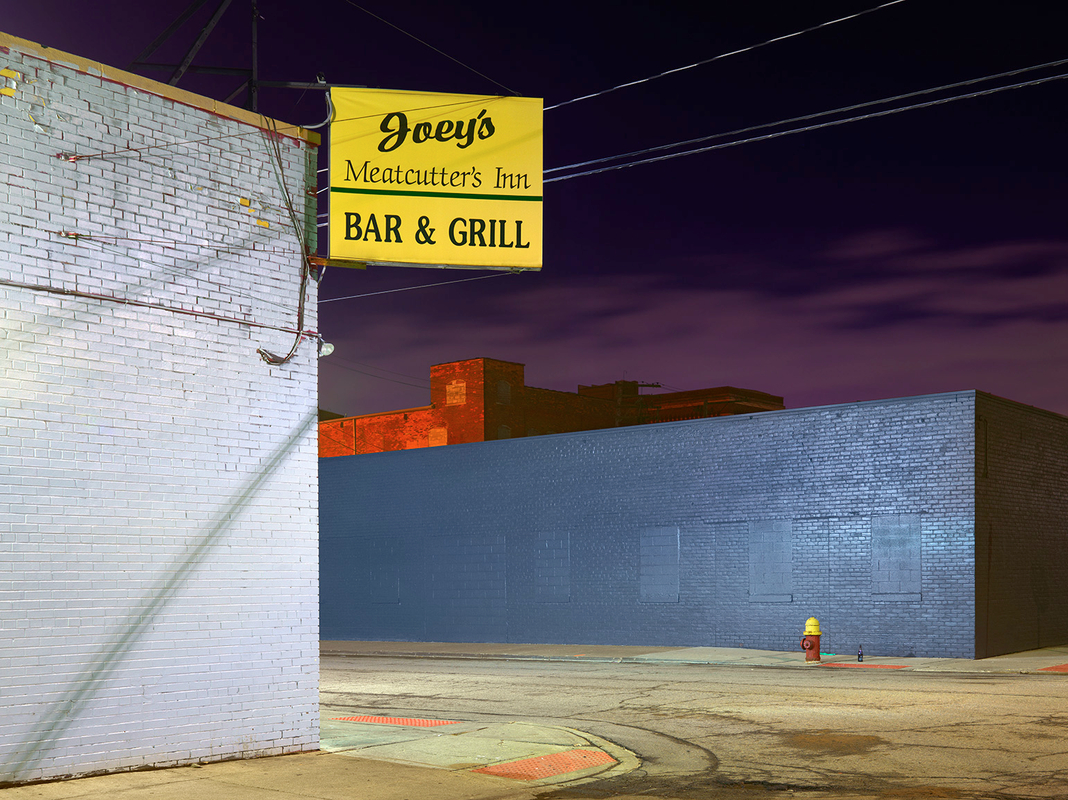
I’m partial to ‘Joey’s Meatcutter Inn, Bar & Grill 2017‘:

Joey's Meatcutter's Inn, Eastside, Detroit 2017

Immediately, I think of Edward Hopper: The lonely cityscape at night or the familiar glow of gas station lights cast into the American wilderness. The eye might want to linger among the colors, shapes and clouds even though the mind knows this is pretty much an empty street in a ‘post-industrial’ zone.

Perhaps it has do with another strand of expression: The break into free verse from past forms. The move from American Romanticism to Modernism which occurred this early past century. William Carlos Williams produced many good poems from a process of earnest, scrapbook-style intensity in trying to discover, redefine, and order a new poetic form within a modern ‘urban landscape.’

The individual artist is quite alone in the task he’s set before himself, and like much of modernism, it’s a rather big task.

Pastoral

When I was younger
it was plain to me
I must make something of myself.
Older now
I walk back streets
admiring the houses
of the very poor:
roof out of line with sides
the yards cluttered
with old chicken wire, ashes,
furniture gone wrong;
the fences and outhouses
built of barrel staves
and parts of boxes, all,
if I am fortunate,
smeared a bluish green
that properly weathered
pleases me best of all colors.

No one
will believe this
of vast import to the nation

William Carlos Williams

Do you believe any of that to be of vast import to the nation? Are you no one?

Repost: Within A Bank Of Modern Fog-Robert Hughes On Jeff Koons & Bullshit Is No Laughing Matter

‘The notion of carefully wrought bullshit involves, then, a certain inner strain. Thoughtful attention to detail requires discipline and objectivity. It entails accepting standards and limitations that forbid the indulgence of impulse or whim. It is this selflessness that, in connection with bullshit, strikes us as inapposite. But in fact it is not out of the question at all. The realms of advertising and of public relations, and the nowadays closely related realm of politics, are replete with instances of bullshit so unmitigated that they can serve among the most indisputable and classic paradigms of the concept. And in these realms there are exquisitely sophisticated craftsmen, who with the help of advanced and demanding techniques of market research, of public opinion polling, of psychological testing, and so forth, dedicate themselves tirelessly to getting every word and image they produce exactly right.’

From Harry Frankfurt’s On Bullshit.’

There is ocassionally such a commitment to bullshit I imagine the bullshitter blowing up a balloon; the bright shiny surface mesmerizing; the spirit of creative play engaged. It grows bigger and more beautiful as it expands with each breath.

There are many balloons like it, but this bullshit-balloon is mine. We’re going places.

Making up fans, a record label, a press outlet, awards and a fake web design company just to get your metal band (yourself, really) some Euro-gigs is next-level stuff:

‘I’ve spent the past 24 hours enraptured by the story of Threatin, the Los Angeles-based “band” (actually a vanity project for the solo artist “Jered Threatin”) who used wildly misleading YouTube live videos, paid-for Facebook likes and YouTube views, grossly exaggerated ticket counts and an imaginary booking agent to set himself up with a European tour which is now falling flat on its face with next to no one showing up to gigs.’

On that note, what I’m saying is 100% true: I don’t think it’s mere satire to point out that Dale Lonagan’s bestselling ‘Ismology In The 21st Century: Self-Wonder, Collective Consciousness & Global Harmony’ continues to inspire modern-day pilgrims to arrive at his thriving compound in the desert: Peace Pavilion West.

Imagine Frank Lloyd Wright wasn’t a profoundly talented architect, but rather a visionary wordsmith and ecological warrior, capable of genuine modern leadership. Imagine through a colossal writing output at Sandstone Mountain, one man realized Eastern visions and Western (S)cience and (A)rt could create a locally-sourced, globally aware community.

I’m certainly not making this character up. His books have changed the lives of millions.

In fact, here’s a quote of his:

Please check out Jeff Koons:

—————

There’s always been a bit of the showman about Jeff Koons; the kind of young man who could put on a bow tie and try to give many museum-goers their time/money/aspirations’ worth at the membership desk.

This blog forgives people trying to explain what their art ‘means,’ exactly, but confesses to pleasure in seeing Koons put on the spot under the suspicious eye of an ornery old Robert Hughes.

I don’t fault Koons for finding himself firmly within modernism, searching for universal forms and broader historical context within those confines, but I admit it’s nice to see him held to account for his bullshit, and perhaps the broader, deeper bullshit he shares with many modern and postmodern artists: Pursuing novelty and recognition and thus making art into a business and often commercializing it, aiming for celebrity while offering meta-critiques on celebrity, making the personal and private very public (masturbation into social commentary, sex into meta-critques of religious shame, ‘culture’ and pornography).

Two quotes by Hughes that stood out:

Religion is diminished into celebrity..a kind of reverse apotheosis.

‘This alienation of the work from the common viewer is actually a form of spiritual vandalism.’

It’s tough to say that art is really about religion (though much clearly is), but rather more about an experience Hughes wants as many people as possible to have, and that such experiences can elevate and expand.

Aside from the above, there’s something that strikes me as not just late 20th century-modern about Koons, but also very American.

As previously posted:

Is street-art, or the use of graffiti & mixed-materials performed illegally out in public (on public and privately owned property) partly due to the success of capital markets?

-Banksy’s website here.

-Newsweek’s piece: ‘See You Banksy, Hello Invader.

Response To A Reader On ‘Radical Chic’ And A Link to Banksy’s ‘Dismaland’

I’d argue that it’s possible, especially with the constant cries of modernism to ‘make it new,‘ I think this is one way we’ve arrived at pop art, and the desire to blend conceptual art and popular music together. This is in evidence from The Talking Heads to Lady Gaga to Jay Z promoting his new album alongside Marina Abramovic at MOMA.

Many modern artists, from Andy Warhol to Jeff Koons to Damien Hirst are people with some artistic talent and native gifts, but not as much in the way of classical and/or formal training. They may be trying to have a conversation with the old masters, but they are clearly also the products of, and speaking to, ‘modern’ audiences. Much of this has become a world of shallow depth, especially among the less talented. Drawing and drafting can be underdeveloped skills while ‘mixed-media’ presentations, celebrity, marketing, money and fame are all thrown into the same pot.

Also On This Site: Roger Scruton says keep politics out of the arts, and political judgment apart from aesthetic judgment…this includes race studies/feminist departments/gay studies etc.: Roger Scruton In The American Spectator Via A & L Daily: Farewell To Judgment

Goya’s Fight With Cudgels and Goya’s Colossus. A very good Goya page here.

Joan Miro: WomanGoethe’s Color Theory: Artists And ThinkersSome Quotes From Kant And A Visual Exercise

A Reaction To Jeff Koons ‘St John The Baptist’

Denis Dutton suggests art could head towards Darwin (and may offer new direction from the troubles of the modern art aimlessness and shallow depth) Review of Denis Dutton’s ‘The Art Instinct’

What Are You Doing With Your Visual Imagination? Words, Images, Things & Perhaps, Something Of The World

A-3 Coral & Iron-med..jpeg

This is not a photograph.

Well, it’s not a photograph quite abstract enough to get to mid-century American abstract expressionism, anyways.

Where did poems and paintings go, exactly, within the imaginations of many in this past generation now passing away?

Why I Am Not A Painter

I am not a painter, I am a poet.
Why? I think I would rather be
a painter, but I am not. Well,

for instance, Mike Goldberg
is starting a painting. I drop in.
“Sit down and have a drink” he
says. I drink; we drink. I look
up. “You have SARDINES in it.”
“Yes, it needed something there.”
“Oh.” I go and the days go by
and I drop in again. The painting
is going on, and I go, and the days
go by. I drop in. The painting is
finished. “Where’s SARDINES?”
All that’s left is just
letters, “It was too much,” Mike says.

But me? One day I am thinking of
a color: orange. I write a line
about orange. Pretty soon it is a
whole page of words, not lines.
Then another page. There should be
so much more, not of orange, of
words, of how terrible orange is
and life. Days go by. It is even in
prose, I am a real poet. My poem
is finished and I haven’t mentioned
orange yet. It’s twelve poems, I call
it ORANGES. And one day in a gallery
I see Mike’s painting, called SARDINES.

Frank O’Hara

Poems require your mouth and mind to come alive.  But aren’t there real things, to which these words refer within our visual memories, out in the world?

Are you lost within the peaks and valleys of the sounds, mesmerized by the singer and the song (poet and poem), as well as the underlying patterns, working upon your mind?

What are you doing with your visual imagination?

If you’re like me, maybe you just want a few minutes of pleasure; a return to when your mind (if you’re getting older) encoded sounds into a map within, during times of impressionable openness.

Strange how they stick around:

As posted: Let’s go further back, now, to a place and time which we’ve never experienced, but live partially within:

Maybe it’s Pilgrim’s pride, or perhaps the Puritan pursuit of image-less purity, or the Colonialists ecumenical style, or maybe even some Shaker weirdness that finds itself up for analysis.

Perhaps somewhere there’s a spare, Yankee work ethic resting on a simple, wooden shelf in the ‘American mind.’

Could such a thing be discovered within mid 20th-century modernism?

Robert Hughes takes a look at Donald Judd’s ‘Temple Of Aesthetic Fanaticism,’ and Richard Serra’s nod to Jackson Pollack and abstract expressionism in the rawness of material sculpture. You know, making stuff (a potentially sensitive subject with so many technological changes going on right now).

(link may not last):

As for Land Art, Michael Heizer’s life’s-work land-art project is apparently complete, if such a thing can be complete:

There’s a good piece in the New Yorker here.

There is an air of secrecy about the whole thing.

You can’t even visit?


Apparently, Heizer’s been working since 1972 on this sculpture in the Eastern Nevada desert, which was originally called ‘Complex One.’ It’s morphed into his life’s work, called City. It’s very large. It can’t be moved. You can’t reproduce it. It represents a break from traditional sculpture. It can’t be put in a museum and it’s not clear that it has a function.

In Brasil, they just started from the top-down and built a city that doesn’t work that well for people: Brasilia: A Planned City

——————

I have to confess that seeing that structure upon the wide open emptiness of Eastern Nevada is comforting for the familiarity it brings. It’s a little bit of order upon the unknown, and the design, or lack thereof (about which a man may wonder), within Nature herself. I think this is why a military installation out in the desert can captivate the imagination as it’s been known to in Hollywood and in the public mind (dreaming of aliens and conspiracies).

To expand on that theme, Wallace Stevens might shed some light. He was an American poet on the hinge between Romanticism and Modernism:

Anecdote of the Jar

I placed a jar in Tennessee,
And round it was, upon a hill.
It made the slovenly wilderness
Surround that hill.

The wilderness rose up to it,
And sprawled around, no longer wild.
The jar was round upon the ground
And tall and of a port in air.

It took dominion every where.
The jar was gray and bare.
It did not give of bird or bush,
Like nothing else in Tennessee.

Wallace Stevens

You’ve changed all of nature with just one jar.

What do you do with an uncivilized, wild land? Import European learning and literature “atop” it? Christian tradition and the Natural Law? Import the triumph of the Western mathematical sciences and technology? Import its movements of the arts and the individual artist?

You can’t help but do this.

Related On This Site: L.A.’s New Public Art Piece ‘The Levitated Mass,’ Or As The American Interest Puts It: ‘A Moving Rock’

Denis Dutton suggested art could head towards Darwin (and may offer new direction from the troubles of the modern art aimlessness and shallow depth…the money and the fame) Review of Denis Dutton’s ‘The Art Instinct’

Denver’s Devil Horse may be flirting with kitsch: From The Wall Street Journal: Denver’s Mustang Or ‘Devil Horse’…and I like his work:…Joan Miro: Woman

From Grist.Org Via The New Republic Via The A & L Daily: ‘Getting Past “Ruin Porn” In Detroit’…Marketplace aesthetics in service of “women”: Dove’s Campaign For Real Beauty: Pascal Dangin And AestheticsRoger Scruton In The City Journal: Cities For Living–Is Modernism Dead?Brasilia: A Planned City

Repost-Within A Bank Of Modern Fog-Another Link To Robert Hughes On Jeff Koons

—————

There’s always been a bit of the showman about Jeff Koons; the kind of young man who could put on a bow tie and try to give many museum-goers their time/money/aspirations’ worth at the membership desk.

This blog forgives people trying to explain what their art ‘means,’ exactly, but confesses to pleasure in seeing Koons put on the spot under the suspicious eye of an ornery old Robert Hughes.

I don’t fault Koons for finding himself firmly within modernism, searching for universal forms and broader historical context within those confines, but I admit it’s nice to see him held to account for his bullshit, and perhaps the broader, deeper bullshit he shares with many modern and postmodern artists: Pursuing novelty and recognition and thus making art into a business and often commercializing it, aiming for celebrity while offering meta-critiques on celebrity, making the personal and private very public (masturbation into social commentary, sex into meta-critques of religious shame, ‘culture’ and pornography).

Two quotes by Hughes that stood out:

Religion is diminished into celebrity..a kind of reverse apotheosis.

‘This alienation of the work from the common viewer is actually a form of spiritual vandalism.’

It’s tough to say that art is really about religion (though much clearly is), but rather more about an experience Hughes wants as many people as possible to have, and that such experiences can elevate and expand.

Aside from the above, there’s something that strikes me as not just late 20th century-modern about Koons, but also very American.

As previously posted:

Is street-art, or the use of graffiti & mixed-materials performed illegally out in public (on public and privately owned property) partly due to the success of capital markets?

-Banksy’s website here.

-Newsweek’s piece: ‘See You Banksy, Hello Invader.

Response To A Reader On ‘Radical Chic’ And A Link to Banksy’s ‘Dismaland’

I’d argue that it’s possible, especially with the constant cries of modernism to ‘make it new,‘ I think this is one way we’ve arrived at pop art, and the desire to blend conceptual art and popular music together. This is in evidence from The Talking Heads to Lady Gaga to Jay Z promoting his new album alongside Marina Abramovic at MOMA.

Many modern artists, from Andy Warhol to Jeff Koons to Damien Hirst are people with some artistic talent and native gifts, but not as much in the way of classical and/or formal training. They may be trying to have a conversation with the old masters, but they are clearly also the products of, and speaking to, ‘modern’ audiences. Much of this has become a world of shallow depth, especially among the less talented. Drawing and drafting can be underdeveloped skills while ‘mixed-media’ presentations, celebrity, marketing, money and fame are all thrown into the same pot.

Also On This Site: Roger Scruton says keep politics out of the arts, and political judgment apart from aesthetic judgment…this includes race studies/feminist departments/gay studies etc.: Roger Scruton In The American Spectator Via A & L Daily: Farewell To Judgment

Goya’s Fight With Cudgels and Goya’s Colossus. A very good Goya page here.

Joan Miro: WomanGoethe’s Color Theory: Artists And ThinkersSome Quotes From Kant And A Visual Exercise

A Reaction To Jeff Koons ‘St John The Baptist’

Denis Dutton suggests art could head towards Darwin (and may offer new direction from the troubles of the modern art aimlessness and shallow depth) Review of Denis Dutton’s ‘The Art Instinct’

Rattling Around-An Artsy Editorial: ‘Pop Culture & Iconic Art History Mashups From The Father Of Stencil Art’

Full piece here (Hat-tip to Anthony Williams)

Before Banksy, there was Blek Le Rat:

‘Following the cut-and-paste technique of Dada-ist collages and the sourcing of commercial imagery in Pop Art, appropriation of visual material or pop culture images has long been utilized by street and graffiti artists. Le Rat continues this style of sampling in his more recent body of works, employing pop culture references and Old Master artworks in a series of graphic spray paint works on canvas.’

An interview here:

——————

Hopefully, dear reader, you will indulge a few ideas that have sprung to mind, as clearly no one knows better what’s happening on the streets.

The first is the Youtube mashup, or in certain cases the sampling of music across different genres and styles, then cramming and crafting them back together into potentially new creations just by using the stuff of Youtube videos.

All this requires is access to a computer and the focus to really listen to music that draws one in. No particular musical training nor long years’ sacrifice is required.  In fact, Youtube has some real practitioners out there, taking apart and putting music videos back together, sifting through an enormous compilation of free and/or cheap recorded music.  The bar for being a D.J. just got lower.

The lower cost and easier availability of basic programs and equipment has spurred-on new genres of music, often driven by a few creative, talented and ambitious people and groups out to make something rather beautiful out of these component parts and their own experiences.

Hip-hop and 80’s synth-pop are just two examples.

————————-

The second idea that springs to mind is the shared history Youtube mashups, stencil artists like Le Rat, and graffiti artists might have with pop and modern art’s impulse to make meaning, often deeper meaning, out of what is at-hand in a large commercial society such as ours. All this takes might be a can of spray-paint, some basic technique, and a willingness to break the law where the law doesn’t often go.

On the higher-end, the art can be meant to spread and ‘democratize’ deeper artistic influences and ideas (a certain smugness there), while on the lower-end, a tag can be the nothing more a than a guy taking a piss on a wall with a spray-can.  The high-low dynamic can be intoxicating.

Yet, there are beautiful things to be found, however, especially when and where one looks for beauty.

There seems a basic desire in us to make something that will last and that will endure, to copy what works, and to aim for beauty and try and transcend and give meaning to our own experiences and circumstances.

The need to discover and share meaning through aesthetic influence and preference likely isn’t going anywhere either. From gangs to high-school cliques to art houses, from individual taggers to the loftiest aesthete and critic, there’s a whole lot of judgment and self-identification constantly going on in human affairs through through the process of judging what we like and don’t like, which group we may be a part of and which we may not at any point in time.

Back to the piece:

‘Hugely influential on today’s generation of graffiti artists, Le Rat’s counter-iconography continues to cut across time periods, media, and styles while still paying tribute to the iconic works and masters he uses in his work.’

Images surround us in the form of  thousands of prints, photos, comic book art, cartoons, advertisements etc that first drove a lot of modernism and its subsequent reactions in Pop Art.

Robert Hughes really didn’t like the lack of acquired skill and mastery of materials many moderns lack.

There have been a lot of virulent reactions to ‘modern’ life and technology ranging from utopian futurism to nihilism to consumerism and a kind of dejected anti-consumerism and spiritual malaise.

—————

Camille Paglia wants to tilt the culture more towards art education, but manages to resist the more virulent strains of secular ideology filling the modern hole, pushing back against the radicalism of feminist ideology when it encroaches upon aesthetics:

—————-

You don’t need Debussy when you’ve got Paul Mauriat.

What if eternity is listening to well-done orchestral elevator music?

=========

Some Links On 5Pointz, Graffiti, & The Arts–Property Rights & The Rule-Of-Law

Heather MacDonald At The City Journal: ‘Radical Graffiti Chic’

So, You’re Telling Me What’s Cool?-Theodore Dalrymple At The City Journal: ‘Banksy In Neverland’ What are these people doing with art?:  Often combining them with a Left-of-Center political philosophy as they are at NPR for popular consumption.

On this site, see: From ReasonTV Via Youtube: ‘Ken Burns on PBS Funding, Being a “Yellow-Dog Democrat,” & Missing Walter Cronkite’Repost-From NPR: Grants To The NEA To Stimulate The Economy?

From Grist.Org Via The New Republic Via The A & L Daily: ‘Getting Past “Ruin Porn” In Detroit’…Marketplace aesthetics in service of “women”: Dove’s Campaign For Real Beauty: Pascal Dangin And Aesthetics… Roger Scruton In The City Journal: Cities For Living–Is Modernism Dead?Brasilia: A Planned City
Sunday Quotation: Edmund Burke On The French Revolution

Via Architizer Blog: ‘Modernism Goes To The Movies’

Full post here.

Some pictures at the link.

There’s mention of the Mt. Rushmore house at the end of North By Northwest.  I suspect some among us have wanted to live in a modernist lair.

From an article in Der Spiegel on the Bauhaus, where modernism got its start:

‘The real feat achieved by Gropius and his cohorts was to have recognized and exposed the sociopolitical and moral power of architecture and design. They wanted to exert “effective influence” on “general conditions,” fashion a more just world and turn all of this into a “vital concern of the entire people.”‘

I’m always a little skeptical of such grand visions.  Utopianism runs deep.

Here’s Robert Hughes saving some choice criticism for the Empire State Plaza in Albany and the centralization of power through architecture as he saw it (a rich mix of the corporate and the bureaucratic from 50’s and 60’s America):

——————

Some of Le Corbusier’s work here, examples of Modern Architecture here.

See Also: They designed a city in the heart of Brazil that really doesn’t work for people: Brasilia: A Planned City

No thanks to living in planned communities upon someone else’s overall vision.: Roger Scruton In The City Journal: Cities For Living–Is Modernism Dead?Repost-Via Reason: ‘Salvador Allende’s Cybersocialist Command Center’…Cities should be magnets for creativity and culture? –From The Atlantic: Richard Florida On The Decline Of The Blue-Collar ManFrom Grist.Org Via The New Republic Via The A & L Daily: ‘Getting Past “Ruin Porn” In Detroit’… some people don’t want you to have the economic freedom to live in the suburbs: From Foreign Policy: ‘Urban Legends, Why Suburbs, Not Cities, Are The Answer’

A structure in the desert…not even a city Update On LACMA, Michael Heizer And The ‘Levitated Mass’-Modern Art And The Public;..where is modernism headed? Via Youtube: Justin, The Horse That Could Paint

Denis Dutton suggested art could head towards Darwin (and may offer new direction from the troubles of the modern art aimlessness and shallow depth…the money and the fame) Review of Denis Dutton’s ‘The Art Instinct’

Add to Technorati Favorites

Robert Hughes-R.I.P.

Australian art historian, thinker, and (sometimes savage) critic of modern art.  Video above is the first of his 8 part “Shock Of The New” series, which presents a modern art historian’s sweep of 20th century political and intellectual history and how images, ideas, art, and artists themselves are woven throughout.

Addition: Simon Schama has a piece on Hughes life and work.

Also On This Site:  Denis Dutton suggested art could head towards Darwin (and may offer new direction from the troubles of the modern art aimlessness and shallow depth…the money and the fame) Review of Denis Dutton’s ‘The Art Instinct’

Denver’s Devil Horse may be flirting with kitsch: From The Wall Street Journal: Denver’s Mustang Or ‘Devil Horse’…and I like his work:…Joan Miro: Woman

From Grist.Org Via The New Republic Via The A & L Daily: ‘Getting Past “Ruin Porn” In Detroit’…Marketplace aesthetics in service of “women”: Dove’s Campaign For Real Beauty: Pascal Dangin And Aesthetics… Roger Scruton In The City Journal: Cities For Living–Is Modernism Dead?Brasilia: A Planned City

What are these people doing with art?:  Often combining them with a Left-of-Center political philosophy as they are at NPR for popular consumption.  On this site, see: From ReasonTV Via Youtube: ‘Ken Burns on PBS Funding, Being a “Yellow-Dog Democrat,” & Missing Walter Cronkite’Repost-From NPR: Grants To The NEA To Stimulate The Economy?

Hughes wrote a review for Time entitled the “Princeling Of Kitsch.”

Add to Technorati Favorites