Like as the waves make towards the pebbled shore,
So do our minutes hasten to their end;
Each changing place with that which goes before,
In sequent toil all forwards do contend.
Nativity, once in the main of light,
Crawls to maturity, wherewith being crown’d,
Crooked elipses ‘gainst his glory fight,
And Time that gave doth now his gift confound.
Time doth transfix the flourish set on youth
And delves the parallels in beauty’s brow,
Feeds on the rarities of nature’s truth,
And nothing stands but for his scythe to mow:
And yet to times in hope my verse shall stand,
Praising thy worth, despite his cruel hand.
O hushed October morning mild, Thy leaves have ripened to the fall; Tomorrow’s wind, if it be wild, Should waste them all. The crows above the forest call; Tomorrow they may form and go. O hushed October morning mild, Begin the hours of this day slow. Make the day seem to us less brief. Hearts not averse to being beguiled, Beguile us in the way you know. Release one leaf at break of day; At noon release another leaf; One from our trees, one far away. Retard the sun with gentle mist; Enchant the land with amethyst. Slow, slow! For the grapes’ sake, if they were all, Whose leaves already are burnt with frost, Whose clustered fruit must else be lost— For the grapes’ sake along the wall.
A little authoritative and paternal, but a romantic poet. A modernist, brilliant with language but precise in meaning, abstract, somewhat philosophical. They say he had a deathbed conversion. Here’s another line of his:
“The poem must resist the intelligence / Almost successfully.“
And then just to frustrate matters more:
Beauty is no quality in things themselves, it exists merely in the mind which contemplates them; and each mind perceives a different beauty.
The cigarette smoke loops and slides above us, Dipping and swirling as the waiter passes. You strike a match and stare upon the flame. The tiny firelight leaps in your eyes a moment And dies away as silently as it came.
This melody, you say, has certain voices? They rise like nereids from a river, singing, Lift white faces, and dive to darkness again. Wherever you go you bear this river with you: A leaf falls, and it flows, and you have pain.
So says the tune to you? but what to me? What to the waiter, as he pours your coffee? The violinist who suavely draws his bow? That man, who folds his paper, overhears it. A thousand dreams revolve and fall and flow.
Someone there is who sees a virgin stepping Down marble stairs to a deep tomb of roses: At the last moment she lifts remembering eyes. Green leaves blow down; the place is checked with shadows; A long-drawn murmur of rain goes down the skies. And oaks are stripped and bare, and smoke with lightning; And clouds are blown and torn upon high forests; And the great sea shakes its walls. And then falls silence And through long silence falls This melody once more: Down endless stairs she goes, as once before.
So says the tune to him? but what to me? What are the worlds I see? What shapes fantastic, terrible dreams? I go my secret way, down secret alleys. My errand is not so simple as it seems.
Gloomy grammarians in golden gowns, Meekly you keep the mortal rendezvous, Eliciting the still sustaining pomps Of speech which are like music so profound They seem an exaltation without sound. Funest philosophers and ponderers, Their evocations are the speech of clouds. So speech of your processionals returns In the casual evocations of your tread Across the stale, mysterious seasons. These Are the music of meet resignation; these The responsive, still sustaining pomps for you To magnify, if in that drifting waste You are to be accompanied by more Than mute bare splendors of the sun and moon.
Late August, given heavy rain and sun For a full week, the blackberries would ripen. At first, just one, a glossy purple clot Among others, red, green, hard as a knot. You ate that first one and its flesh was sweet Like thickened wine: summer’s blood was in it Leaving stains upon the tongue and lust for Picking. Then red ones inked up and that hunger Sent us out with milk cans, pea tins, jam-pots Where briars scratched and wet grass bleached our boots. Round hayfields, cornfields and potato-drills We trekked and picked until the cans were full, Until the tinkling bottom had been covered With green ones, and on top big dark blobs burned Like a plate of eyes. Our hands were peppered With thorn pricks, our palms sticky as Bluebeard’s.
We hoarded the fresh berries in the byre. But when the bath was filled we found a fur, A rat-grey fungus, glutting on our cache. The juice was stinking too. Once off the bush The fruit fermented, the sweet flesh would turn sour. I always felt like crying. It wasn’t fair That all the lovely canfuls smelt of rot. Each year I hoped they’d keep, knew they would not.
There is a singer everyone has heard, Loud, a mid-summer and a mid-wood bird, Who makes the solid tree trunks sound again. He says that leaves are old and that for flowers Mid-summer is to spring as one to ten. He says the early petal-fall is past When pear and cherry bloom went down in showers On sunny days a moment overcast; And comes that other fall we name the fall. He says the highway dust is over all. The bird would sing and be as other birds, But that he knows in singing not to sing. The question that he frames in all but words is what to make of a diminished thing.
The Brown River, finger of a broken fist, Moved sluggish through the woods and dust. We made a bridge of the crashed oak, dancing over the limbs like monkeys or lovers, eschewing the deeps with our eyes; For on the other side they said lay paradise.
It was a modern replica, built by the offspring of some rich Dog-like dowager-some son-of-a-bitch Who like formal gardens of paths and shaven trees, Hedges in a maze and many elegant statues. I looked long at “The Girl With Silk,” a stone queen With legs apart but draped in the nick of time between.
The most expressive statuary was “The Last Centaur Expiring,” his face folded on his breast All the segment that was a man pleading love And fatal attraction for the brutal half. A visitor beside grew incensed At miscegenation, and spoke out against.
I walked away alone, over the fallen oak, Into the woods. From the woods outside of Eden came a snake. I found no principle of evil here except Two well-dressed women halted as they stepped, Binoculars fixed on birds escaping in the trees These eyes from outer space, evicted statues.
I do not know much about gods; but I think that the river Is a strong brown god—sullen, untamed and intractable, Patient to some degree, at first recognised as a frontier; Useful, untrustworthy, as a conveyor of commerce; Then only a problem confronting the builder of bridges. The problem once solved, the brown god is almost forgotten By the dwellers in cities—ever, however, implacable. Keeping his seasons and rages, destroyer, reminder Of what men choose to forget. Unhonoured, unpropitiated By worshippers of the machine, but waiting, watching and waiting. His rhythm was present in the nursery bedroom, In the rank ailanthus of the April dooryard, In the smell of grapes on the autumn table, And the evening circle in the winter gaslight.
The river is within us, the sea is all about us; The sea is the land’s edge also, the granite Into which it reaches, the beaches where it tosses Its hints of earlier and other creation: The starfish, the horseshoe crab, the whale’s backbone; The pools where it offers to our curiosity The more delicate algae and the sea anemone. It tosses up our losses, the torn seine, The shattered lobsterpot, the broken oar And the gear of foreign dead men. The sea has many voices, Many gods and many voices. The salt is on the briar rose, The fog is in the fir trees. The sea howl And the sea yelp, are different voices Often together heard: the whine in the rigging, The menace and caress of wave that breaks on water, The distant rote in the granite teeth, And the wailing warning from the approaching headland Are all sea voices, and the heaving groaner Rounded homewards, and the seagull: And under the oppression of the silent fog The tolling bell Measures time not our time, rung by the unhurried Ground swell, a time Older than the time of chronometers, older Than time counted by anxious worried women Lying awake, calculating the future, Trying to unweave, unwind, unravel And piece together the past and the future, Between midnight and dawn, when the past is all deception, The future futureless, before the morning watch When time stops and time is never ending; And the ground swell, that is and was from the beginning, Clangs The bell.
The illustration is nothing to you without the application. You lack half wit. You crush all the particles down into close conformity, and then walk back and forth on them.
Sparkling chips of rock are crushed down to the level of the parent block. Were not ‘impersonal judgment in aesthetic matters, a metaphysical impossibility,’ you
might fairly achieve It. As for butterflies, I can hardly conceive of one’s attending upon you, but to question the congruence of the complement is vain, if it exists.
–Marianne Moore (click through for a discussion of Moore’s work and style)
It’s not a landscape from too near. Like sorrows, they require some distance
Not to bulk up larger than they are.
The risk is, backing off too far.
But finger trees are hand from here.
The wounds of mines, the growth of pines
Both appear and disappear.
There’s but a shagginess remains,
An olive or a purple haze,
That nice, unshaven atmosphere
Of averages faces, average hills.
Whatever goats are dancing there, Being all invisible, Animate objects of a will Contemplative without desire, Suffer no vertigo at all But dance until our spirits tire, Or dine forever, or until The speculative garbage fail– Tin cans and comic books–which small Imaginary campers there Forgot against this very hour.
The underground roads Are, as the dead prefer them, Always tortuous. – – – When he looked the cave in the eye, Hercules Had a moment of doubt. – – – Leaning out over The dreadful precipice, One contemptuous tree.
Throw something at it and see if it sticks. I like Helen Vendler’s interpretation….
What do you do with an uncivilized, wild land? Import European learning and literature “atop” it?
The nature/culture divide? Nature is wonderful but it is to culture where we must return. If you are an artist, you turn towards direct experience in this land, but…you also turn to that which inspires you…European learning and thought….the products of other cultures.
Andrew Wyeth homepage here with some images included.
There are definitely interesting things going on with light in Wyeth’s work. It fills his paintings. I also find my eye and mind hovering between realist depiction and abstract arrangement of objects on the canvas.
Ferguson:
‘Beneath the frequent prettiness, most of the pictures are just this side of harrowing, not just lonesome and melancholy but portraits of life as it seeps inevitably away. The wind that lifts the lace curtain in Wind from the Sea makes the hair on your arms stand up. Jamie Wyeth, Andrew’s son and a celebrated artist himself, confesses to being puzzled by the benign view of Wyeth’s work. “My father’s work is terrifying,” he said. It’s not sentimental. It’s luminous! But in a creepy way.’
Wyeth reached a level of popular appreciation few artists ever receive in their lifetimes.
Like many Americans, I find myself drawn to what I would call a New England plainness and Yankee work ethic and aesthetic, which is evident is some of Wyeth’s landscapes, at least. Long winters and deep woods. Shorter distances and stonier soil in the meadows. Perhaps a Puritan, high-minded spiritual reserve.
Or perhaps the Shaker work song ‘Simple Gifts’ adapted by Aaron Copland might be a good example of what I’m trying to get at.
Here’s Yo-Yo Ma and Alison Kraus performing:
————————————–
So, is this representative of Wyeth? Perhaps. He did much of his work in Chadds Ford, Pennsylvania and Maine, but according to Wikipedia there may be other influences as well:
‘N.C. also fostered an inner self-confidence to follow one’s own talents without thought of how the work is received. N.C. wrote in a letter to Wyeth in 1944:[8]
“The great men [ Thoreau, Goethe, Emerson, Tolstoy] forever radiate a sharp sense of that profound requirement of an artist, to fully understand that consequences of what he creates are unimportant. Let the motive for action be in the action itself and not in the event. I know from my own experience that when I create with any degree of strength and beauty I have no thought of consequences. Anyone who creates for effect — to score a hit — does not know what he is missing!”‘
So, I’m speculating. Addition: There’s also a strong modernist-influenced creative imagination at work here too, and like Hopper, the American question of what to do with all that space and wilderness.
Yet, a man able to walk familiar land, seeing it anew with keen eyes, hoping his senses pick up more than he knows, having a medium with which to express his thoughts seems a man who’s had some success in life, regardless of popular appreciation.
Of course, a concupiscent eye must come into tension with other parts of a man’s character.
Or at least when there was a tittering about his ‘Helga‘ paintings a while back.
Ferguson:
‘Stopping to rest near a group of European spring beauties, he saw on a trail above him a young woman on a walk. Assuming she was alone, she moved off the trail, lifted her skirt, and defecated in the grass. Wyeth was charmed. “The white curve of her bottom was amazing,” he told Meryman. The little lumps she left tumbled downhill and stopped in the patch of spring beauties.’
These are great vocals and harmonies and very good songwriting. It’s country-folk with a bit of distance and strangeness; as though its been washed-through some pop and the indie L.A. scene, but also, apparently, through Sweden.
The Swedes seem to bring a forlorn, northern folk-depth to the table.
Hey, this reciprocity works for me:
A quintessential pop-song. There’s actually a lot of depth and arrangment here:
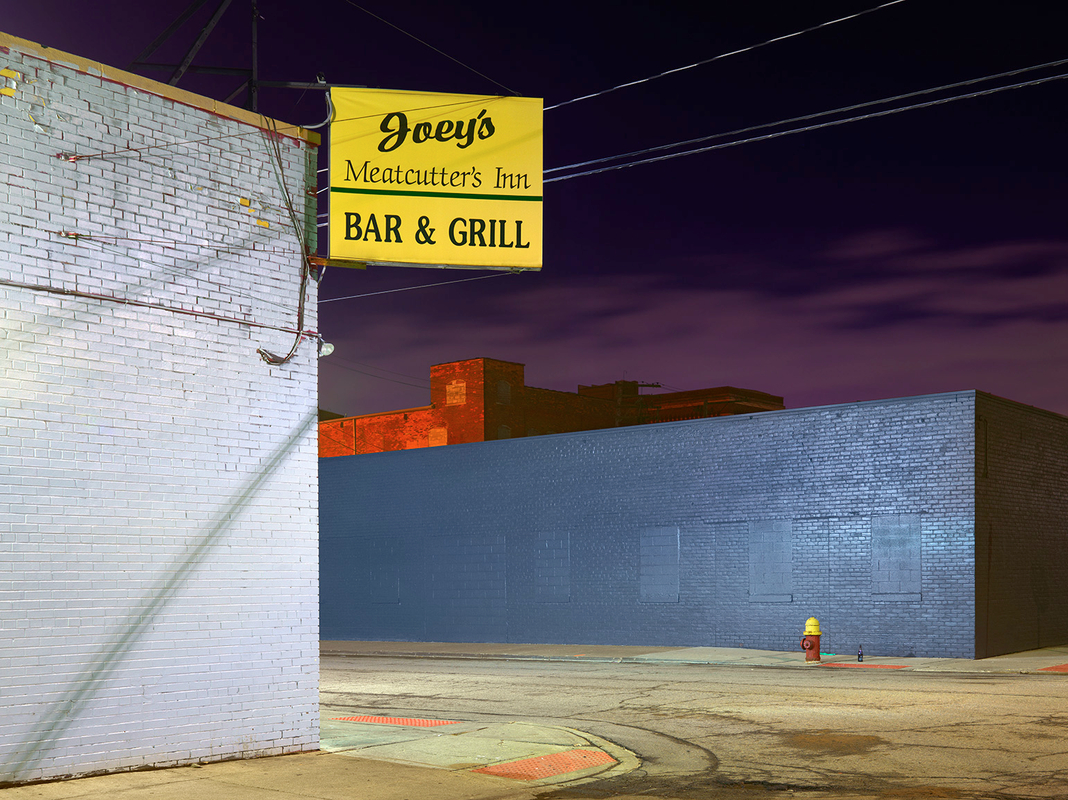
Immediately, I think of Edward Hopper: The lonely cityscape at night or the familiar glow of gas station lights cast into the American wilderness. The eye might want to linger among the colors, shapes and clouds even though the mind knows this is pretty much an empty street in a ‘post-industrial’ zone.
Perhaps it has do with another strand of expression: The break into free verse from past forms. The move from American Romanticism to Modernism which occurred this early past century. William Carlos Williams produced many good poems from a process of earnest, scrapbook-style intensity in trying to discover, redefine, and order a new poetic form within a modern ‘urban landscape.’
The individual artist is quite alone in the task he’s set before himself, and like much of modernism, it’s a rather big task.
Pastoral
When I was younger
it was plain to me
I must make something of myself.
Older now
I walk back streets
admiring the houses
of the very poor:
roof out of line with sides
the yards cluttered
with old chicken wire, ashes,
furniture gone wrong;
the fences and outhouses
built of barrel staves
and parts of boxes, all,
if I am fortunate,
smeared a bluish green
that properly weathered
pleases me best of all colors.
No one
will believe this
of vast import to the nation
Perhaps I’m not wrong in having called Halloween horror still and movie images to mind (it’s my mind, after all, so maybe I’m just thinking of Devil’s Night). I really enjoy the light on the dumpster and the side-front rectory wall. There seems to be a little more mood here, more drama, so maybe Edgar Allan Poe’s ‘psychological intensity,’ surrealism, and terror are more appropriate for comparison.
Poe was a bit mad, after all, despite his fascinatingly untamed and powerful imagination. He achieved a uniqueness and completeness of vision few artists do. Maybe there’s a bit of the sullen, self-aggrandizing earnestness in him of the teenager (J.D. Salinger); the desire to shock, delight and terrify.
The mind is as though a chamber, the horror rising to fever pitch, the lush rhyme matching an increasingly desperate search for truth and beauty in the world (Poe had very much his own Romantically inspired metaphysics).
Alone
From childhood’s hour I have not been As others were—I have not seen As others saw—I could not bring My passions from a common spring— From the same source I have not taken My sorrow—I could not awaken My heart to joy at the same tone— And all I lov’d—I lov’d alone— Then—in my childhood—in the dawn Of a most stormy life—was drawn From ev’ry depth of good and ill The mystery which binds me still— From the torrent, or the fountain— From the red cliff of the mountain— From the sun that ’round me roll’d In its autumn tint of gold— From the lightning in the sky As it pass’d me flying by— From the thunder, and the storm— And the cloud that took the form (When the rest of Heaven was blue) Of a demon in my view—
Are you looking at beautiful photos and feeling sorry for Detroit, and yourself? See Time Magazine’s photo essay by Yves Marchand and Romain Meffre (less porn-like, more thoughtful).
My brother comes home from work and climbs the stairs to our room. I can hear the bed groan and his shoes drop one by one. You can have it, he says.
The moonlight streams in the window and his unshaven face is whitened like the face of the moon. He will sleep long after noon and waken to find me gone.
Thirty years will pass before I remember that moment when suddenly I knew each man has one brother who dies when he sleeps and sleeps when he rises to face this life,
and that together they are only one man sharing a heart that always labours, hands yellowed and cracked, a mouth that gasps for breath and asks, Am I gonna make it?
All night at the ice plant he had fed the chute its silvery blocks, and then I stacked cases of orange soda for the children of Kentucky, one gray boxcar at a time
with always two more waiting. We were twenty for such a short time and always in the wrong clothes, crusted with dirt and sweat. I think now we were never twenty.
In 1948 the city of Detroit, founded by de la Mothe Cadillac for the distant purposes of Henry Ford, no one wakened or died, no one walked the streets or stoked a furnace,
for there was no such year, and now that year has fallen off all the old newspapers, calendars, doctors’ appointments, bonds wedding certificates, drivers licenses.
The city slept. The snow turned to ice. The ice to standing pools or rivers racing in the gutters. Then the bright grass rose between the thousands of cracked squares,
and that grass died. I give you back 1948. I give you all the years from then to the coming one. Give me back the moon with its frail light falling across a face.
Give me back my young brother, hard and furious, with wide shoulders and a curse for God and burning eyes that look upon all creation and say, You can have it.
How do I love thee? Let me count the ways. I love thee to the depth and breadth and height My soul can reach, when feeling out of sight For the ends of being and ideal grace. I love thee to the level of every day’s Most quiet need, by sun and candle-light. I love thee freely, as men strive for right. I love thee purely, as they turn from praise. I love thee with the passion put to use In my old griefs, and with my childhood’s faith. I love thee with a love I seemed to lose With my lost saints. I love thee with the breath, Smiles, tears, of all my life; and, if God choose, I shall but love thee better after death.
We are things of dry hours and the involuntary plan, Grayed in, and gray. “Dream” makes a giddy sound, not strong Like “rent,” “feeding a wife,” “satisfying a man.”
But could a dream send up through onion fumes Its white and violet, fight with fried potatoes And yesterday’s garbage ripening in the hall, Flutter, or sing an aria down these rooms
Even if we were willing to let it in, Had time to warm it, keep it very clean, Anticipate a message, let it begin?
We wonder. But not well! not for a minute! Since Number Five is out of the bathroom now, We think of lukewarm water, hope to get in it.
The blue booby lives
on the bare rocks
of Galapagos
and fears nothing.
It is a simple life:
they live on fish,
and there are few predators.
Also, the males do not
make fools of themselves
chasing after the young
ladies. Rather,
they gather the blue
objects of the world
and construct from them a nest—an occasional
Gaulois package,
a string of beads,
a piece of cloth from
a sailor’s suit. This
replaces the need for
dazzling plumage;
in fact, in the past
fifty million years
the male has grown
considerably duller,
nor can he sing well.
The female, though,
asks little of him—
the blue satisfies her
completely, has
a magical effect
on her. When she returns
from her day of
gossip and shopping,
she sees he has found her
a new shred of blue foil:
for this she rewards him
with her dark body,
the stars turn slowly
in the blue foil beside them
like the eyes of a mild savior.
When I was about nineteen, or twenty, there was a farmhouse nearby that had been sitting vacant for a few years, ready to be demolished. It had been lived-in and seemed decently kept for most of my life, and was still sitting there in my mind, where I had left it, but that was a different farmhouse, one I’d been in only briefly.
The farmhouse I entered, one spring day, with the thrill of trespass, boarded-up and shuttered, was in shockingly bad shape: I remember sunken floors in most of the rooms and wallpaper peeling off most of the walls. A great bloom of mold traced a crack in one bulging wall, in particular, where the spring melt was still re-freezing and tearing things apart at night. There were broken windows in every room, where I remember a few birds, beating their wings in and out.
There was a lot of silence. After just a few years, things had fallen apart in an unsettling, pretty unforgiving way.
Maybe that’s why I’m linking to these things.
As posted previously:
-Photographer Ben Marcin has a series called ‘Last House Standing.’ Solitary row-homes…the only ones left on the block.
-Check out Buzludzha, the abandoned communist monument in Bulgaria’s Balkan mountains, which still draws up to 50,000 Bulgarian Socialists for a yearly pilgrimage. Human Planet’s Timothy Allen visited the structure in the snow and took some haunting photos. You will think you’ve stepped into a Bond film and one of Blofeld’s modernist lairs, but with somewhat Eastern Orthodox tile frescos of Lenin and Marx gazing out at you, abandoned to time, the elements and to nature.
‘If you’re ever wondering what the War Room of “Dr. Strangelove” would look like if the movie had been directed by Prince, here you go.’
————————-
Pastoral
When I was younger
it was plain to me
I must make something of myself.
Older now
I walk back streets
admiring the houses
of the very poor:
roof out of line with sides
the yards cluttered
with old chicken wire, ashes,
furniture gone wrong;
the fences and outhouses
built of barrel staves
and parts of boxes, all,
if I am fortunate,
smeared a bluish green
that properly weathered
pleases me best of all colors.
No one
will believe this
of vast import to the nation
Gloomy grammarians in golden gowns, Meekly you keep the mortal rendezvous, Eliciting the still sustaining pomps Of speech which are like music so profound They seem an exaltation without sound. Funest philosophers and ponderers, Their evocations are the speech of clouds. So speech of your processionals returns In the casual evocations of your tread Across the stale, mysterious seasons. These Are the music of meet resignation; these The responsive, still sustaining pomps for you To magnify, if in that drifting waste You are to be accompanied by more Than mute bare splendors of the sun and moon.
I found a dimpled spider, fat and white,
On a white heal-all, holding up a moth
Like a white piece of rigid satin cloth–
Assorted characters of death and blight
Mixed ready to begin the morning right,
Like the ingredients of a witches’ broth–
A snow-drop spider, a flower like a froth,
And dead wings carried like a paper kite.
What had that flower to do with being white,
The wayside blue and innocent heal-all?
What brought the kindred spider to that height,
Then steered the white moth thither in the night?
What but design of darkness to appall?–
If design govern in a thing so small.
Sundays too my father got up early
and put his clothes on in the blueblack cold,
then with cracked hands that ached
from labor in the weekday weather made
banked fires blaze. No one ever thanked him.
I’d wake and hear the cold splintering, breaking.
When the rooms were warm, he’d call,
and slowly I would rise and dress,
fearing the chronic angers of that house,
speaking indifferently to him,
who had driven out the cold
and polished my good shoes as well.
What did I know, what did I know
of love’s austere and lonely offices?
I have come to a still, but not a deep center, A point outside the glittering current; My eyes stare at the bottom of a river, At the irregular stones, iridescent sandgrains, My mind moves in more than one place, In a country half-land, half-water. I am renewed by death, thought of my death, The dry scent of a dying garden in September, The wind fanning the ash of a low fire. What I love is near at hand, Always, in earth and air.
My Sorrow, when she’s here with me, Thinks these dark days of autumn rain Are beautiful as days can be; She loves the bare, the withered tree; She walks the sodden pasture lane.
Her pleasure will not let me stay. She talks and I am fain to list: She’s glad the birds are gone away, She’s glad her simple worsted gray Is silver now with clinging mist.
The desolate, deserted trees, The faded earth, the heavy sky, The beauties she so truly sees, She thinks I have no eye for these, And vexes me for reason why.
Not yesterday I learned to know The love of bare November days Before the coming of the snow, But it were vain to tell her so, And they are better for her praise.
Last night watching the Pleiades, Breath smoking in the moonlight, Bitter memory like vomit Choked my throat. I unrolled a sleeping bag On mats on the porch Under thick autumn stars. In dream you appeared (Three times in nine years) Wild, cold, and accusing. I woke shamed and angry: The pointless wars of the heart. Almost dawn. Venus and Jupiter. The first time I have Ever seen them close.
“No water so still as the dead fountains of Versailles.” No swan, with swart blind look askance and gondoliering legs, so fine as the chintz china one with fawn- brown eyes and toothed gold collar on to show whose bird it was.
Lodged in the Louis Fifteenth candelabrum-tree of cockscomb- tinted buttons, dahlias, sea urchins, and everlastings, it perches on the branching foam of polished sculptured flowers – at ease and tall. The king is dead.
I had always thought the deep bass note is the driving force behind the song. Much like the low rumbling and deep bass sounds indicate foreboding and fear in a cinema experience. Relentless with a hint of dread.
But then again, the chord progession is rather haunting and Annie Lennox’s vocals (top-notch) are stark and beautiful. Maybe it’s the syncopation?
From the description (arranged for order):
I’m going with the 8-bit or the dual piano (2 and/or 4).
‘Piano version, 8 bit version, ragtime version, dual piano version or the terror version…’
The original video is mildly surrealistic 80’s shock-pop; just cheesy enough to flirt with schlock, but the combination of lyrics, story, musicality and simplicity give this song serious staying-power:
Below is Albert Bierstadt’s ‘Puget Sound, on the Pacific Coast, 1870″ which is on display the Seattle Art Museum (SAM). Bierstadt painted the picture without having seen Puget Sound! More on the Hudson River School here, with its strong roots in romanticism.
The Smart Set had a recent article (with a reproduction of one of the paintings) of Xie Zhiliu, a Chinese painter taken with Yosemite:
“Then you get to the last room of the exhibit, where something special happens. In 1994, Xie traveled to Yosemite National Park with his painter wife Chen Peiqiu. There, he produced a series of paintings that are a testimonial to cognitive dissonance. He paints the mountains and trees of Yosemite, but they look vaguely Chinese.”
How do we come to know nature? What do we do with all this wilderness?
How might Nietzsche figure in the discussion (was he most after freeing art from a few thousand years of Christianity, monarchy and aristocracy…something deeper?), at least with regard to Camille Paglia. See the comments: Repost-Camille Paglia At Arion: Why Break, Blow, Burn Was Successful
The half-stripped trees struck by a wind together, bending all, the leaves flutter drily and refuse to let go or driven like hail stream bitterly out to one side and fall where the salvias, hard carmine,— like no leaf that ever was— edge the bare garden.
Too much shredding? Maybe, but that’s some tone, timing and technique!
You need a guy with near virtuosic talent on his instrument, some feel for composition, and long, long hours to play so faithfully live.
I like the change to the Am chorus at 2:50 or so.
Towards a theme. New-agey and way 80’s yes, but I really like the composition, and the raucous feel beginning at the :32 mark as the drums and bass kick-in:
Why, it’s a like a tapestry of vocal harmonies:
Everything old is new again. It gets positively medieval at 3:20 seconds?:
Who’s writing these things? Just enjoy. You culture has much to teach you if you bother to listen. Stuff gets passed down, you know.
O hushed October morning mild, Thy leaves have ripened to the fall; Tomorrow’s wind, if it be wild, Should waste them all. The crows above the forest call; Tomorrow they may form and go. O hushed October morning mild, Begin the hours of this day slow. Make the day seem to us less brief. Hearts not averse to being beguiled, Beguile us in the way you know. Release one leaf at break of day; At noon release another leaf; One from our trees, one far away. Retard the sun with gentle mist; Enchant the land with amethyst. Slow, slow! For the grapes’ sake, if they were all, Whose leaves already are burnt with frost, Whose clustered fruit must else be lost— For the grapes’ sake along the wall.
You may have already heard this mystery photographer’s story, if not, take a look.
Just a link for all the unknown photographers out there, documenting the grit and stuff of life.
Addition: I should clarify on behalf of a friend, that when the subject can be difficult to look at, the below quote about Walker Evans’ work might come in handy.
Art for art’s sake:
‘Many artists during the New Deal era wished to portray the poor to gain empathy and support for the experimental political program. Agee and Evans, however, saw this as a crude and manipulative practice, and defied it by “respecting the moral integrity of the poor while recognizing in these tenants something transcendentally human, making them more than just the tools of political propaganda,” said Jones. ‘
Well, good.
Continuing on that theme, Ken Burns discusses how he is primarily an artist, not an historian. Burns wants to be recognized as an artist striving for higher aesthetic and technical goals in his work (his influences range from Martin Scorsese to Henri Cartier-Bresson) in addition to the “social conscience.”
As for such an abstraction as a ‘social conscience’ he sees himself:
“…rooted in a humanist tradition of American History..that includes not just the old top down version, but the bottom up version that acknowledges women and labor and minorities….”
No wonder some folks at NPR love him. Here’s libertarian Nick Gillespie needling Burns about that issue.
———————————————-
Here’s a poem by beloved American modernist/physician whose work I had never associated with any sort of political philosophy, and which I still don’t while addressing his work:
Pastoral
When I was younger
it was plain to me
I must make something of myself.
Older now
I walk back streets
admiring the houses
of the very poor:
roof out of line with sides
the yards cluttered
with old chicken wire, ashes,
furniture gone wrong;
the fences and outhouses
built of barrel staves
and parts of boxes, all,
if I am fortunate,
smeared a bluish green
that properly weathered
pleases me best of all colors.
No one
will believe this
of vast import to the nation
As that same friend points out. Bill Moyers, “working-man” populist though he is, strives for journalistic excellence. But as for history, perhaps no one should aim for a Zinn-like state.
I do not know much about gods; but I think that the river Is a strong brown god—sullen, untamed and intractable, Patient to some degree, at first recognised as a frontier; Useful, untrustworthy, as a conveyor of commerce; Then only a problem confronting the builder of bridges. The problem once solved, the brown god is almost forgotten By the dwellers in cities—ever, however, implacable. Keeping his seasons and rages, destroyer, reminder Of what men choose to forget. Unhonoured, unpropitiated By worshippers of the machine, but waiting, watching and waiting. His rhythm was present in the nursery bedroom, In the rank ailanthus of the April dooryard, In the smell of grapes on the autumn table, And the evening circle in the winter gaslight.
I’ve wondered why Mike Oldfield (Tubular Bells, English guitarist and smart composer, New-Agey prog rock but deep…out there) seemed so popular in Spain.
I wouldn’t be surprised if there’s an appeal to a sense of the deeply tragic going on, well-designed but emotionally intense songs; compositions with some classical influence and historical context, but still functioning as popular/bar songs.
He manages to work with excellent singers too.
Going For Baroque (get it?):
I imagine a bunch of little kids slowly waking-up in a loft, daylight breaking through shutters, the cobwebs of sleep still filling the room.
When I was younger
it was plain to me
I must make something of myself.
Older now
I walk back streets
admiring the houses
of the very poor:
roof out of line with sides
the yards cluttered
with old chicken wire, ashes,
furniture gone wrong;
the fences and outhouses
built of barrel staves
and parts of boxes, all,
if I am fortunate,
smeared a bluish green
that properly weathered
pleases me best of all colors.
No one
will believe this
of vast import to the nation
She sang beyond the genius of the sea. The water never formed to mind or voice, Like a body wholly body, fluttering Its empty sleeves; and yet its mimic motion Made constant cry, caused constantly a cry, That was not ours although we understood, Inhuman, of the veritable ocean.
The sea was not a mask. No more was she. The song and water were not medleyed sound Even if what she sang was what she heard. Since what she sang was uttered word by word. It may be that in all her phrases stirred The grinding water and the gasping wind; But it was she and not the sea we heard.
For she was the maker of the song she sang. The ever-hooded, tragic-gestured sea Was merely a place by which she walked to sing. Whose spirit is this? we said, because we knew It was the spirit that we sought and knew That we should ask this often as she sang.
If it was only the dark voice of the sea That rose, or even colored by many waves; If it was only the outer voice of sky And cloud, of the sunken coral water-walled, However clear, it would have been deep air, The heaving speech of air, a summer sound Repeated in a summer without end And sound alone. But it was more than that, More even than her voice, and ours, among The meaningless plungings of water and the wind, Theatrical distances, bronze shadows heaped On high horizons, mountainous atmospheres Of sky and sea. It was her voice that made The sky acutest at its vanishing. She measured to the hour its solitude. She was the single artificer of the world In which she sang. And when she sang, the sea, Whatever self it had, became the self That was her song, for she was the maker. Then we, As we beheld her striding there alone, Knew that there never was a world for her Except the one she sang and, singing, made.
Ramon Fernandez, tell me, if you know, Why, when the singing ended and we turned Toward the town, tell why the glassy lights, The lights in the fishing boats at anchor there, As night descended, tilting in the air, Mastered the night and portioned out the sea, Fixing emblazoned zones and fiery poles, Arranging, deepening, enchanting night.
Oh! Blessed rage for order, pale Ramon, The maker’s rage to order words of the sea, Words of the fragrant portals, dimly-starred, And of ourselves and of our origins, In ghostlier demarcations, keener sounds.
Some ideas of what it could mean here, though I suspect saying it aloud, feeling its pomp and humility, staring out at the sea, into the dark ahead of you; is enough the kind of satisfaction to be found in such a poem.
There is a singer everyone has heard, Loud, a mid-summer and a mid-wood bird, Who makes the solid tree trunks sound again. He says that leaves are old and that for flowers Mid-summer is to spring as one to ten. He says the early petal-fall is past When pear and cherry bloom went down in showers On sunny days a moment overcast; And comes that other fall we name the fall. He says the highway dust is over all. The bird would sing and be as other birds, But that he knows in singing not to sing. The question that he frames in all but words is what to make of a diminished thing.
‘The most useful definition of modernist fiction I’ve encountered comes from Brian McHale’s Postmodernist Fiction. He says modernist fiction tends to “foreground epistemological questions” such as “How can I interpret the world I’m part of? What is there to be known? Who knows it? What are the limits of that knowledge?” In contrast, postmodernist fiction tends to “foreground ontological questions” such as “What is a world? What kinds of worlds are there and how are they constituted? What happens when…boundaries between worlds are violated?’
As to the epistemological questions surrounding Modernism, below are four poems. Hopefully, each is a representative example of a move away from the Romanticism that had been prevalent up until the late 1800’s.
In addition to the move away from traditional Romantic rhyme and meter towards modern blank verse, there’s also a certain conception of the Self rendered in them; a presentation of our natures that might be worth examining in some detail.
I believe we can see clearly a move away from tradition towards the Self, the Poet isolated, the poem itself as a means of communication, and an anxiety so common within the 20th century.
‘At the heart of Bloom’s project is the ancient quarrel between “poetry” and “philosophy.” In Bloom’s opinion, we ought not have to choose between Homer and Plato; we can have both, as long as we recognize that poetry is superior.’
Says the guy who writes about poetry…
What does one find within, as one looks without, waking from sleep and dream?
What kind of world is this, and can the poet actually help us know it?
You tossed a blanket from the bed
You lay upon your back, and waited;
You dozed, and watched the night revealing
The thousand sordid images
Of which your soul was constituted;
They flickered against the ceiling.
And when all the world came back
And the light crept up between the shutters
And you heard the sparrows in the gutters,
You had such a vision of the street
As the street hardly understands;
Sitting along the bed’s edge, where
You curled the papers from your hair,
Or clasped the yellow soles of feet
In the palms of both soiled hands.
—
The world will stain you, and it is a fallen, modern world, rendered profoundly and exquisitely.
As consciousness creeps in, building a bridge to the day, to the world, to the facts left as though they were the first facts, the light as though it were the first light, what one finds is distressing, both within and without.
That distress must be ‘made new,’ which is to say, the suffering (original?) in which we all sometimes find ourselves must match our experiences within the modern city and world, at least, the world created within Eliot’s lyrical verse.
Of the four poems, only the first and last have a 3rd-person subject.
—
Wallace Stevens‘ ‘I’ is in a more contemplative state, but it’s an ‘I’ exploring similar themes, and experiencing some distress in trying to know how the world actually is, and what might lie within.
The journey to The Self may not be a journey for the faint of heart.
The Poems Of Our Climate (stanzas II and III)
II Say even that this complete simplicity Stripped one of all one’s torments, concealed The evilly compounded, vital I And made it fresh in a world of white, A world of clear water, brilliant-edged, Still one would want more, one would need more, More than a world of white and snowy scents.
III There would still remain the never-resting mind, So that one would want to escape, come back To what had been so long composed. The imperfect is our paradise. Note that, in this bitterness, delight, Since the imperfect is so hot in us, Lies in flawed words and stubborn sounds.
—
Even if the verse can describe a perfected world, delivering us, perhaps, a little closer to perfection, our poet is still not free from the impulses and desires which simply never cease.
Interestingly, we end-up not with a discussion of the heart, the spirit, libido etc. as a source for those desires (for Plato, the irrational), but rather, for Stevens, just a mind.
We also find more Romantic elements of language and an almost baroque/rococo arrangement of words and ideas, dandyish even, yet combined with an intense effort to abstract, define, and clarify. From here, the poet may proceed on his task of flawed words and stubborn sounds.
***I find myself thinking of elements of modern architecture and abstract-expressionist painting. The meaning, or at least some delivery from our restless existences, can be found within the abstract itself. Or at least within a retreat to the abstract for its own sake, away from the world.
The modernist, glass-walled house on the hill will exist in its own space, offering and defying meaning. The structure’s own shapes will be stripped down to often mathematically precise forms interacting with Nature. These shall guide Man, or at least offer individual men a little refuge.
It is perhaps in Stevens’ poem we can see the questions of knowledge about the world suggesting questions about whether there is a world at all, or, at least, what kind of worlds each Self might be able to inhabit.
—
Here’s one of Robert Lowell’s poems, occurring a generation later, in the mid 20th-century, as part of the confessionals.
The Self is extremely isolated. In fact, Lowell went more than a little crazy. Unlike the known nervous breakdown of Eliot from which Eliot recovered, Lowell’s life was essentially one long breakdown from which he never recovered.
Here he is, looking back:
Epilogue
Those blessed structures plot and rhyme- why are they no help to me now i want to make something imagined not recalled? I hear the noise of my own voice: The painter’s vision is not a lens it trembles to caress the light. But sometimes everything i write With the threadbare art of my eye seems a snapshot lurid rapid garish grouped heightened from life yet paralyzed by fact. All’s misalliance. Yet why not say what happened? Pray for the grace of accuracy Vermeer gave to the sun’s illumination stealing like the tide across a map to his girl solid with yearning. We are poor passing facts. warned by that to give each figure in the photograph his living name.
—
The weight of having to make that meaning, for yourself, and by yourself, is a horrible weight indeed. One can glorify one’s Self and family, but that, alas, only goes so far. Rhyme and form still carry one’s living name, as far as they do.
Of course, there’s still wonderful rhythm and form here (this is excellent verse), but blanker now, with a relentless focus on the ‘I.’ The poet is perhaps talking a little more to himself, and the poem keeps self-consciously calling attention to itself.
—
In fact, it reminded me of the poem below, by Robert Creeley, which was published a few years afterwards.
From this page:
‘Creeley was a leader in the generational shift that veered away from history and tradition as primary poetic sources and gave new prominence to the ongoing experiences of an individual’s life. Because of this emphasis, the major events of his life loom large in his literary work.’
There’s Nothing but the Self and the Eye seeking and making meaning, by itself within a void of emotionally compact and precise language (of course there’s still form and other things besides).
Can the poet fit inside the little abstract chapel of words he’s building for himself (let alone the world, tradition etc.)?
For all the talk about ‘space,’ there seems very little.
The Window
Position is where you put it, where it is, did you, for example, that
large tank there, silvered, with the white church along- side, lift
all that, to what purpose? How heavy the slow
world is with everything put in place. Some
man walks by, a car beside him on the dropped
road, a leaf of yellow color is going to
fall. It all drops into place. My
face is heavy with the sight. I can feel my eye breaking.
—
The distress is still there…but I’d argue that we are now a good distance away from the grandness of Eliot’s vision, his religiosity and virtuosity with form and meter at the dawn of Modernism. Very few people can/could do what Eliot did (addition: even if he can help us gain knowledge of our Selves or the world).
That said, it’s unclear there’s enough tradition and confidence to even undertake such a project, now, even as such talents come along. The state of things is more scattered. We’re in a very different place of selves and artists isolated, of anxiety and post-anxiety.
Aside from the very accomplished poets above, in terms of both knowledge (epistemology) and being (ontology), we often have writers feeling pressure to weigh-in on such questions without even being about to write that well; artists who can’t draw or paint that well, and frankly, quite a bit of bullshit besides.
So, where are we headed? Who’s ‘we’ exactly?
Predictions are hard, especially about the future.
As previously posted:
Why not just put a few algorithms to work in writing those artist statements?
‘In “Sea Change,” Graham becomes Prospero, casting spells by spelling out her thoughts to merge with ours, and with the voices of the elements. The result is a mingling of perceptions rather than a broadcasting of opinions. Instead of analysis, the poems encourage emotional involvement with the drastic changes overwhelming us, overwhelm- ing the planet.’
and:
‘Strengths and weaknesses, flows and ebbs, yet every poem in “Sea Change” bears memorable lines, with almost haunting (if we truly have but 10 years to “fix” global warming) images of flora and fauna under siege. Jorie Graham has composed a swan song for Earth.’
Oh boy.
What are these poems being asked to do?
And moving away from poetry into the realm of ‘performance art,’
When I heard the learn’d astronomer;
When the proofs, the figures, were ranged in columns before me;
When I was shown the charts and the diagrams, to add, divide, and measure them;
When I, sitting, heard the astronomer, where he lectured with much applause in the lecture-room,
How soon, unaccountable, I became tired and sick;
Till rising and gliding out, I wander’d off by myself,
In the mystical moist night-air, and from time to time,
Look’d up in perfect silence at the stars.
I recall musical and deeply rhythmic English (Bowles was a composer who lived in Morocco for most of his life), along with a recurrent theme of Western innocence, ignorance and arrogance meeting ancient North African realities and brutalities.
‘Moments passed with no movement but then the snake suddenly made a move towards Allal. It then began to slither across Allal’s body and then rested next to his head. He was very calm at this moment and looked right into the snake’s eyes and felt almost one with the snake. Soon his eyes closed and he fell asleep in this position.’
What have you done with your I/Eye, dear Reader?
Something tells me the kind of fantastical savagery and imaginative schlock of Conan the Barbarian doesn’t quite capture the deeply moral, frighteningly real and lushly imagined Bowlesian world…
But maybe it does highlight some themes Bowles’ drew into relief:
By June our brook’s run out of song and speed. Sought for much after that, it will be found Either to have gone groping underground (And taken with it all the Hyla breed That shouted in the mist a month ago, Like ghost of sleigh bells in a ghost of snow)— Or flourished and come up in jewelweed, Weak foliage that is blown upon and bent, Even against the way its waters went. Its bed is left a faded paper sheet Of dead leaves stuck together by the heat— A brook to none but who remember long. This as it will be seen is other far Than with brooks taken otherwhere in song. We love the things we love for what they are.
I Clear water in a brilliant bowl, Pink and white carnations. The light In the room more like a snowy air, Reflecting snow. A newly-fallen snow At the end of winter when afternoons return. Pink and white carnations – one desires So much more than that. The day itself Is simplified: a bowl of white, Cold, a cold porcelain, low and round, With nothing more than the carnations there.
II Say even that this complete simplicity Stripped one of all one’s torments, concealed The evilly compounded, vital I And made it fresh in a world of white, A world of clear water, brilliant-edged, Still one would want more, one would need more, More than a world of white and snowy scents.
III There would still remain the never-resting mind, So that one would want to escape, come back To what had been so long composed. The imperfect is our paradise. Note that, in this bitterness, delight, Since the imperfect is so hot in us, Lies in flawed words and stubborn sounds.
The video’s about 6 minutes long. Included is a pretty brief definition of modernism, but which highlights some of what I think makes Goya so accessible:
“…modernism is an artistic movement which follows the thought of humans being able to change their environment with science, technology and knowledge. In short modernism results in the idea that we, as artists and as humans, should reject tradition…”
Now, there’s a lot to dispute in such a definition…you mean reject religious tradition…all tradition? Surely you want painters to learn how to paint, and understand the technique and mechanics of their craft. How much of modernism would be a product of/reaction to the Enlightenment?
How might Nietzsche figure in the discussion (was he most after freeing art from a few thousand years of Christianity, monarchy and aristocracy…something deeper?), at least with regard to Camille Paglia. See the comments: Repost-Camille Paglia At Arion: Why Break, Blow, Burn Was Successful
As to the title of Couperin’s piece, the mystery continues, from women’s eyelashes to a train and all that mass, slowly gaining momentum as each constituent car clacks along, picking up speed.
An ‘American Folk’ uptempo version by Christopher Parkening:
This poem is not addressed to you. You may come into it briefly, But no one will find you here, no one. You will have changed before the poem will.
Even while you sit there, unmovable, You have begun to vanish. And it does not matter. The poem will go on without you. It has the spurious glamour of certain voids.
It is not sad, really, only empty. Once perhaps it was sad, no one knows why. It prefers to remember nothing. Nostalgias were peeled from it long ago.
Your type of beauty has no place here. Night is the sky over this poem. It is too black for stars. And do not look for any illumination.
You neither can nor should understand what it means. Listen, it comes with out guitar, Neither in rags nor any purple fashion. And there is nothing in it to comfort you.
Close your eyes, yawn. It will be over soon. You will forget the poem, but not before It has forgotten you. And it does not matter. It has been most beautiful in its erasures.
O bleached mirrors! Oceans of the drowned! Nor is one silence equal to another. And it does not matter what you think. This poem is not addressed to you.
‘Jamison concludes that great poetry even justifies the humiliation he consciously inflicted on Hardwick by printing her anguished private letters in “The Dolphin.” As Elizabeth Bishop angrily told him, “Art just isn’t worth that much.”
Just to make matters more complicated:
“I do not believe that human lives may be made the means for satisfying an artist’s desire for self-expression. We must demand, rather, that every man should be given, if he wishes, the right to model his life himself, as far as this does not interfere too much with others. Much as I may sympathize with the aesthetic impulse, I suggest that the artist might seek expression in another material. Politics, I demand, must uphold equalitarian and individualistic principles; dreams of beauty have to submit to the necessity of helping men in distress, and men who suffer injustice; and to the necessity of constructing institutions to serve such purposes.”
I give you now Professor Twist,
A conscientious scientist,
Trustees exclaimed, “He never bungles!”
And sent him off to distant jungles.
Camped on a tropic riverside,
One day he missed his loving bride.
She had, the guide informed him later,
Been eaten by an alligator.
Professor Twist could not but smile.
“You mean,” he said, “a crocodile.”
By the road to the contagious hospital under the surge of the blue mottled clouds driven from the northeast—a cold wind. Beyond, the waste of broad, muddy fields brown with dried weeds, standing and fallen
patches of standing water the scattering of tall trees
All along the road the reddish purplish, forked, upstanding, twiggy stuff of bushes and small trees with dead, brown leaves under them leafless vines—
Lifeless in appearance, sluggish dazed spring approaches—
They enter the new world naked, cold, uncertain of all save that they enter. All about them the cold, familiar wind—
Now the grass, tomorrow the stiff curl of wildcarrot leaf
One by one objects are defined— It quickens: clarity, outline of leaf
But now the stark dignity of entrance—Still, the profound change has come upon them: rooted they grip down and begin to awaken
Perhaps Hawking is guilty of a little hubris in weighing in with such certitude on the God question?
Here’s a quote of his Hawking’s posted previously:
“His [Kant’s}argument for the thesis was that if the universe did not have a beginning, there would be an infinite period of time before any event, which he considered absurd. The argument for the antithesis was that if the universe had a beginning, there would be an infinite period of time before it, so why should the universe begin at any one particular time? In fact, his cases for both the thesis and the antithesis are really the same argument. They are both based on his unspoken assumption that time continues back forever, whether or not the universe had existed forever.”
Not so much that time continues back forever, but that it’s impossible to conceive of a point outside of time. Kant wished to argue that both time and space are not necessarily inherent characteristics of the universe (or any object at all…especially those objects with which we have no direct experience, like a black hole, though according to Kant we can have knowledge of objects) but rather time and space are part of our onboard apparatus, and preconditions for us have intelligible experience in the first place (unlike as is assumed in calculus, for example). He constructed a vast metaphysics to make his point in the hopes of putting metaphysics on the same ground as the sciences (the Enlightenment was going strong around him, and he latched onto Newton’s laws especially). It’s questionable as to whether or not he succeeded, but fascinating to think about nonetheless.
Talking with my beloved in New York
I stood at the outdoor public telephone
in Mexican sunlight, in my purple shirt.
Someone had called it a man/woman
shirt. The phrase irked me. But then
I remembered that Rainer Maria
Rilke, who until he was seven wore
dresses and had long yellow hair,
wrote that the girl he almost was
“made her bed in his ear” and “slept him the world.”
I thought, OK this shirt will clothe the other in me.
As we fell into long-distance love talk
a squeaky chittering started up all around,
and every few seconds came a sudden loud
buzzing. I half expected to find
the insulation on the telephone line
laid open under the pressure of our talk
leaking low-frequency noises.
But a few yards away a dozen hummingbirds,
gorgets going drab or blazing
according as the sun struck them,
stood on their tail rudders in a circle
around my head, transfixed
by the flower-likeness of the shirt.
And perhaps also by a flush rising into my face,
for a word — one with a thick sound,
as if a porous vowel had sat soaking up
saliva while waiting to get spoken,
possibly the name of some flower
that hummingbirds love, perhaps
“honeysuckle” or “hollyhock”
or “phlox” — just then shocked me
with its suddenness, and this time
apparently did burst the insulation,
letting the word sound in the open
where all could hear, for these tiny, irascible,
nectar-addicted puritans jumped back
all at once, as if the air gasped.