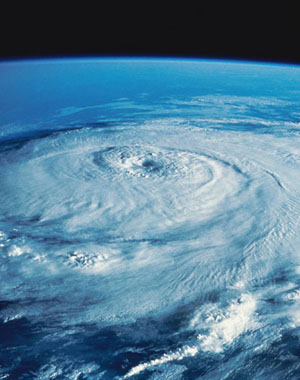
Via NPR: In Vivian, South Dakota-The Largest Hailstone Ever Recorded?

Full audio here.

The previous record was 7 in in diameter, and fell to the ground in Aurora, Nebraska in 2003.  This is not quite official yet, but is measuring 8 in in diameter and weighing in at 1 lb 15 oz, and was perhaps as large as 11 in before it melted to measured size.

Here’s a graphic on hail formation, and some more information here.  It takes a tremendous amount of lift to keep stones that big aloft.

Also On This Site:  Hurricanes By Popular DemandTornadoes! Some LinksThe Greensburg Tornado on Doppler Radar

A Short Post On Red Sprites And Blue Jets: Cosmic Origins Of Lightning?

Add to Technorati Favorites

From A Quantum Diaries Survivor-‘Muon Topography: Who Is Leading The Research?’

Full post here.

‘Sometimes my sympathy for science magazines (in print and online), which try to keep intelligent readers informed on the progress in basic science, gets dampened by observing how they end up providing a narrow-sighted look at things’

and

‘Muon radiography is indeed a promising technique for several applications, not only against smuggling of nuclear material or -God forbid- nuclear weapons. The Italian researchers are involved in a European Union funded project to detect screened radioactive sources illegally introduced into trucks bringing scrap iron to foundries’

Also On This Site: From 3 Quarks Daily: Richard Feynman Talks About A Pool And A Not-So-Pretty GirlFrom Scientific Blogging: ‘On Eyjafjallajökull’…what good can philosophy do for the sciences? From Scientific American: Was Einstein Wrong?

Add to Technorati Favorites

From YouTube Via Sound Politics: NASA-Mt St Helens: Thirty Years Later

(Original Sound Politics post here)

Mt St. Helens National Monument is still definitely worth a trip.  The crater is active, and the size and scope of the blast is awe inspiring.  57 people lost their lives and many others were affected for years to come.

Here’s what I think is some of the best footage of the towering ash cloud and force of the blast, and what might go through a man’s mind as something like that happens: Dave Crockett from Komo4 news was there.  The Elk herds in the North Fork Toutle River Valley are coming back strong and the recovery of life after the eruption is potentially the most carefully studied in human history.  The Johnston Ridge Observatory is among the best of our National Park System, and they have some volcano cams.

Brief timeline here, as the mountain gave many signs of impending activity.

Related On This Site:  Seattle Earthquake-January 30th 2009-4.5 On The Richter Scale

Add to Technorati Favorites

From The New Scientist: ‘Giant Crack Formed In Just Days’

Full article here.

Thought this might be of some interest:

“The crack is the surface component of a continental rift forming as the Arabian and African plates drift away from one another. It began to open up in September 2005, when a volcano at the northern end of the rift, called Dabbahu, erupted.”

And it happened in a few days, apparently.

“…Ebinger says it could continue to widen and lengthen. “As the plates keep spreading apart, it will end up looking like the Red Sea,”‘

Possibly in 4 million years.

Add to Technorati Favorites

A Few Responses To Kant’s Transcendental Idealism

There is a world out there, and your senses do give you an impression of it which yields genuine knowledge of empirical objects, according to Kant, but what empiricists fail to take into account is the apparatus that we depend upon to make sense of that world:

“Kant thought that Berkeley and Hume identified at least part of the mind’s a priori contribution to experience with the list of claims that they said were unsubstantiated on empirical grounds: “Every event must have a cause,” “There are mind-independent objects that persist over time,” and “Identical subjects persist over time.” The empiricist project must be incomplete since these claims are necessarily presupposed in our judgments, a point Berkeley and Hume failed to see. So, Kant argues that a philosophical investigation into the nature of the external world must be as much an inquiry into the features and activity of the mind that knows it” 

As mentioned, The American thinker W.V.O Quine has a dispute with the way in which Kant arrives at his answer to that problem. 

From a paper by Arthur Sullivan here:

“There do not exist two distinct types of reality in the world which require two distinct modes of expression. This leads Quine to conclude that the analytic-synthetic distinction is a purely logical convention that is ontologically unnecessary and empirically superfluous. In this respect, Quine agrees with the radical empiricism of Mill, with its claim that there is no a priori knowledge. The fact that something is the case, or even the fact that something seems to be necessarily the case, does not imply the reality of a priori truths. Quine goes so far a to refer to the notion of a priori knowledge as a “metaphysical article of faith.”

Of course, so also did Schopenhauer have a problem with Kant (wikipedia summary here).

This quote was found here:

“Empirical concepts are ultimately based on empirical perceptions. Kant, however, tried to claim that, analogously, pure concepts (Categories) also have a basis. This pure basis is supposed to be a kind of pure perception, which he called a schema. But such an empiricist analogy contradicts his previous rationalist assertion that pure concepts (Categories) simply exist in the human mind without having been derived from perceptions. Therefore they are not based on pure, schematic perceptions.”

Just some thoughts on a Sunday, as it was requested by a friend.  If you can refer me to a more comprehensive critique, I’d appreciate it.

Add to Technorati Favorites

From Climate Audit: Baby Whirls-Improved Detection Of Marginal Tropical Storms

Full post here.

“With the North Atlantic hurricane season officially starting in a couple weeks (June 1), but possibly getting a head start with a developing low-pressure system in the Bahamas, considerable attention will be paid by the media to each and every storm that gets a name.”

Like swine flu scaremongering, it’s perhaps for the best.

As for the global warming science, it’s complicated.  I’m a generalist and would like to work against the tide of those who insist action must not only be taken by individuals to reduce their contribution to the excess carbon in earth’s atmosphere, but by governments, mostly through regulation of economic activity.  Those are two different issues.

Related On This Site:  Hurricanes By Popular Demand

Andrew Revkin In The NY Times: Global Warming Moderation From Bloggingheads: On Freeman Dyson’s Global Warming Heresy…From The WSJ-A Heated Exchange: Al Gore Confronts His Critics…From The Literary Review–Weather Channel Green Ideology: Founder John Coleman Upset.

Add to Technorati Favorites

From The Wall Street Journal Via AL Daily: Buckminster Fuller’s World

Full article here.

Terry Teachout takes notice of the traveling exhibit:  Buckminster Fuller:  Starting With The Universe (at the Whitney in late June).  So was Fuller comparable to Frank Lloyd Wright?:

“…Fuller was a Wright-like figure, a high-octane utopian who believed in the life-enhancing potential of modern technology. The difference was that Fuller lacked Wright’s ruthless determination.”

Both have their followers and left some interesting work behind.  The discussion also reminds me of the explosion of science fiction this past century, and some of its darker mystic, utopian…and even religious (cultlike-this is alleged of course) tendencies that can make for good reading. 

This is one point Teachout wants to address when such ideas are pulled into the political realm:

“Was modernism totalitarian? That’s coming at it a bit high, but it’s true that more than a few top-tier modernists were also one-size-fits-all system-mongers who thought the world would be improved if it were rebuilt from top to bottom — so long as they got to draw up the plans.”

I first came across that argument here.  Do such visions have potentially harmful consequences in the political arena?

Perhaps, but in the meantime Fuller’s geodisic dome (platonic solids, ever-existing?) is still pretty interesting.

See Also On This Site:  Roger Scruton In The City Journal: Cities For Living–Is Modernism Dead?..Jonathan Meades On Le Corbusier At The New Statesman

Add to Technorati Favorites

Some Differences Between Newton And Goethe: Theories Of Light

“My Design in this Book is not to explain the Properties of Light by Hypotheses, but to propose and prove them by Reason and Experiments…”

Sir Isaac Newton, Opticks.

Here’s a brief visual (scroll to the bottom of the page) of 2 of his experiments.  

From A Wolfram biography of Newton:

“Newton invented a scientific method which was truly universal in its scope. Newton presented his methodology as a set of four rules for scientific reasoning. These rules were stated in the Principia and proposed that (1) we are to admit no more causes of natural things such as are both true and sufficient to explain their appearances, (2) the same natural effects must be assigned to the same causes, (3) qualities of bodies are to be esteemed as universal, and (4) propositions deduced from observation of phenomena should be viewed as accurate until other phenomena contradict them.”

An artist can transport you to a vast imaginative world of profound insight and profound truth.  Anyone who’s experienced great art can attest to that.  Yet, part of the rigor of science is in its painstaking correspondence to observable phenomenae, to measurement (and a capacity for nimble and accurate estimation), and to a set of laws often derived from mathematics which as far as we know, have not yet been proven wrong when applied to nature.

Many artists seem to take much freer license with their imaginations, and despite their own rigors which are rarely appreciated by the audience, seem to differ in many important ways from such a standard.

——————–Here’s a repost I put up about Goethe:

Johann Wolfgang Von Goethe is perhaps Germany’s greatest poet and writer, best known for Faust.  Not so well known is Goethe’s theory of color (which claimed insights that could refute Newton).  Like many artists, Goethe isolated the effect color has in terms of experience, making profound observations on refraction…for example…but for which he didn’t have a workable theoretical framework.  To this, a certain type of philosopher might say:  he ignored the fact that his thoughts and his senses combine to form experience.  

Goethe from Steiner, from wikipedia:

The colours therefore, to begin with, make their appearance purely and simply as phenomena at the border between light and dark…”

Colours arise at the borders, where light and dark flow together.

Click here for a visual representation.

Goethe seems to have thought of light and dark in terms of a metaphysical dualism, from whose interaction color is born. 

Newton held that white light passing through a prism is diffused into its various wavelengths.  He also may have steered the discussion into wave-particle duality.

See Also: Wikipedia’s article, Physics Today article on his experiments, Goethe’s color triangle.

It seems like this debate (art/science) is a product of the times.  I don’t think I’ve offered too much in the way of real insight.

See Also:  Review of Denis Dutton’s ‘The Art Instinct’


Add to Technorati Favorites

Repost: From MIT OpenCourseWare: Walter Lewin’s Lecture On Lightning

Full lecture here.

My brief summary:

So at room temperature, the electrical breakdown of dry air at 1 meter of distance is 3 million volts (at which point you have discharge sparks, visible light and heat, and moving air). 

Go and shuffle your feet on the carpet and touch the doorknob and if you see a spark of 3 mm it’s around 10,000 volts on average according to this calculation (a little prickle on the fingertip, maybe through your hand).

In the very large electrical field generated during a thunderstorm (400,000 storms every day on earth) you can get up to 300 million volts and more, blinding light and up to 50,000 degree F superheated air rushing outward in waves, or thunder.  The current should it ground itself through your body, can clearly kill you:

(Language)

Through induction the stepped leader has made contact with the earth, and the return strokes travelling back up to the cloud are visible and audible.

**Of course, if you go and look at the nearest light bulb, the current passing through the resistive filament also produces light and some heat. 

That’s my oversimplification.  Listen to the lecture, it’s worth it.  A whole semester’s worth of his lectures are available for free at that link.

Add to Technorati Favorites

From NOAA: Tornado Safety Guide

Full post here.

We’ll be hearing about tornadoes in the news in the next month or so, so I thought I’d post a link to a safety preparedness page (if you live in a tornado prone area).

Here’s a video from Tornado videos of a huge wedge tornado in Manitoba:

Notice how at 1:30 or so the pressure is so low around vehicle (getting sucked into the vortex) that the gentleman riding shotgun can’t open the door against it.  That’s pretty close.

See Also On This Site: The Greensburg Tornado on Doppler Radar… Tornadoes! Some Links…Tornadoes In Major Cities: Atlanta

Add to Technorati Favorites

From Scientific American: Was Einstein Wrong?

Full article here.

Can philosophy/metaphysics effectively help to deepen physics…or will it always be a way of attaching particulary deep thought (if done well) to even deeper thought?

———————————————————————————————

The authors, philosopher trained in physics David Albert and writer Rivka Galchen point out a problem they think ought to be focused on:

“-In the universe as we experience it, we can directly affect only objects we can touch; thus, the world seems local.

-Quantum mechanics, however, embraces action at a distance with a property called entanglement, in which two particles behave synchronously with no intermediary; it is nonlocal.

-This nonlocal effect is not merely counterintuitive: it presents a serious problem to Einstein’s special theory of relativity, thus shaking the foundations of physics.”

I’m pretty sure I’m not qualified to answer…

———————————————————————————————

See AlsoDavid Albert’s turn on bloggingheads with Sean Carroll.

Also, maybe it’s a trend (writers moving directly to science)?  Writer Louisa Gilder has a book out called “The Age Of Entanglement” on much the same subject, which she discusses here too on bloggingheads.

———————————————————————————————

Further:  The enlightenment happened, so if you’re going to make a successful metaphysical theory, it’s good to try and understand the mathematical sciences of the day and go from there (Newtonian mechanics for Kant), like Kant did: 

Michael Friedman’s Kant And The Exact Sciences tackles the subject ( I know him not and of course this too is more metaphysics and certainly not the mathematics of today…but if you’re going to be carrying Kant around …it’s good too understand how deep he went, what he seemed to understand and what he may have not understood at all about the Enlightenment explosion around him).

Add to Technorati Favorites

From The Washington Post: A Mission To Europa?

Full post here.

“But now scientists believe there may be environments well outside that zone that could potentially harbor life, an idea that Green called “tremendously exciting.” ‘

Has this belief been changed by the discovery of those deep sea tube worms that survive without sunlight?

“they discovered that the tubeworms had no mouth, digestive tract, or anus, they learned that bacteria live inside the tubeworms’ bodies”

Quite possibly.

More On Europa’s Galileo mission here.  A brief NASA overview of Europa here with a cool photo of the surface.

Slated for 2020…

See Also:  Phil Plait from Bad Astronomy and Carl Zimmer briefly discuss NASA here.

Add to Technorati Favorites

Seattle Earthquake-January 30th 2009-4.5 On The Richter Scale

Good info here at the USGS.

Apparently, it happen at 5:25 am PST, and I had no idea.  About 1 in 4 or 5 people I spoke with today either felt it, or were woken up enough to realize something had happened, but weren’t quite sure what.

Here’s a good map at the USGS site which measures how many people responded and intensity.

The vibrations and earth movement could be felt for only a few seconds, though it happened along the Nisqually fault, where the February 21, 2001 6.8 earthquake occured.

Map of that quake’s intensity here.

Add to Technorati Favorites

Some Quotes From Kant And A Visual Exercise

From Christopher Want’s Introducing Kant:

“In the case of the pyramids:

the eye needs some time to complete the apprehension from the base to the peak, but during that time some of the earlier parts are invariably extinguished in the Imagination before it has apprehended the later ones, and hence the comprehension is never complete..’  “

What about this video of a surfer on Maui’s north shore?

Perhaps you get a sense of awe and wonder at observing this wave, but this may have more to do with your imagination and your onboard apparatus for observing the wave than perhaps any necessary characteristic of the wave itself (for Kant, the imagination is a very specific category of perception, which can ((amended)) function without the rules of the understanding, especially in aesthetic representation but which ultimately is applied to the rules of the understanding to give us the best knowledge we have, which are in turn guided by the Ideas Of Reason…).

Here’s another quote:

“…a light broke upon all natural philosophers. They learned that reason only perceives that which it produces after its own design; that it must not be content to follow, as it were, in the leading-strings of nature, but must proceed in advance with principles of judgement according to unvarying laws, and compel nature to reply its questions.”

Immanuel KantPreface to the Critique of Pure Reason.

Newton’s 3rd Law might be a good example of those ‘unvarying’ laws.

Related On This Site:  When aesthetics goes too far?: Goethe’s Color Theory: Artists And Thinkers…some problems with Kant and potential idealism when applied to American politics:  From The Internet Encyclopedia Of Knowledge: Immanuel Kant And Utilitarianism

From Youtube: Lite-Brite Supernova

This won the youtube phylm prize (very prestigious).  Most astronomers believe that all elements other than hydrogen and helium come from supernovae.  So, in many senses, we are stardust.

Much of this understanding springs from the work of Subrahmanyan Chandrasekar in the 1930’s and the Chandrasekar limit (wikipedia). From wikipedia:

“A critical situation arises when iron accumulates in the core, since iron nuclei are incapable of generating further energy through fusion…”

“For more massive stars, electron degeneracy pressure will not keep the iron core from collapsing to very great density, leading to formation of a neutron star, black hole, or, speculatively, a quark star.”

Or the star can undergo a supernova explosion.

Add to Technorati Favorites

From Boston.com: Three Mystery Waves In Maine

Full Boston.com post here.

“In 15 minutes, the water rose 12 feet, then receded. And then it happened again. It occurred three times, she said, each time ripping apart docks and splitting wooden pilings.”

Spooky.  The article mentions 3 possible causes:

1.   Land movement-A landslide underwater by seismic disturbance or more likely by a land slump.  The slump could be caused by strong storm conditions that have stirred the water.  Perhaps even a methane decompression (land movement caused by gas) as the article mentions…however no seismic disturbances were measured.

2.  Wind movement-During large storms (and ocassionally not) a lot of wind blowing over a lot of water can generate high wave action.  The article mentions a squall line surge.    A brief explanation from The Deadliest Catch here about wind, current and how land underneath can effect wave action.

Brief you tube video explaining the difference between transverse and longitudinal waves here.  It gets more and more abstract.

3.  Tides-Due mostly to land form, tidal piles of water fill Maine’s harbors creating extreme difference between high and low tide.  This is not so far from the Bay Of Fundy, which has some of the highest tidal action on earth.  Stop-motion video of those tides here:

Add to Technorati Favorites

Sean Carroll And Jennifer Oullette At Bloggingheads: LHC And Higgs Boson

Full diavlog here.

What is the Higgs-Boson field/particle and how does it give other particles mass?  What are fields?

What is the universe?: Carroll states:  “A set of fields obeying the rules of quantum mechanics”

It makes me wonder…

Do we need philosophers, anyways?: 

The lesson to draw from his [Kant’s] careful discussion of this subject might well be not that there must be a form of reality lying beyond space and time but rather that nothing can be real that does not conform to spatial and temporal requirements. Space and time are bound up with particularity, and only what is particular can be real.”

Related On This SiteSean Carroll Is Live-Blogging The LHC Startup and Sean Carroll: What Will The LHC Find?

Add to Technorati Favorites

Tornadoes! Some Links

With so many deadly tornadoes in the news lately, I thought I’d post a few links:

Here’s a link to the How Stuff Works tornado page.

The Tornado Project Online. (Affiliated with How Stuff Works, lots of top-ten lists etc…)

-How to make a tornado box for a science fair.

-Is it a vortex of rising, warm and moist air or cool air dropping downward?   Good models here.  A horizontal column of rotating air that gets lifted with the rising air in the formation of a storm?

-The Red Cross Tornado Preparedness Page.

-You’ve got to check out Tornadovideos.net.

A swedish guy has a small tornado drop down in front of his car (1:15 or so, cool video)A dust-devil here.  If you have time and are a real weather geek, the formation of a supercell here.

See Also: The Greensburg Tornado on Doppler Radar


by Extreme WX Photographer

Add to Technorati Favorites

Tornadoes In Major Cities: Atlanta

This was yesterday, March 14th, 2008, in Atlanta where the Weather Channel is located.  Here’s a good report, with links to video.  I hope everyone is OK.

1.  Don’t forget about Brooklyn, August 9th, 2007, article here.  A reported F2.   

2.  Miami, May 12th 1997 (minor damage, F1).  It’s not often you see a tornado among office buildings. 

3.  And I guess if you live in Oklahoma City, you get used to it.

Here’s the (F)ujita Scale.  A really cool photo, the Atlanta tornado shrouded enough to inspire mystery.

Add to Technorati Favorites

Lunar Eclipse Video

This was taken from a time lapse video in Hawaii, on August 28th, 2007, not the recent one, I know, but the quality is high.

Apparently, the color of the eclipse is measured on the Danjon scale, and the February 20, 2008 eclipse was considered brick red, or L=3.  The light that does reach the moon is refracted through our atmosphere, the shorter wavelengths more likely to be deflected by small particles, the longer ones getting through, thus the moon appears red as the light bounces back to your eyes from its surface.

Or so I’ve found out. 

Addition:  February 20th eclipse here.

Add to Technorati Favorites

Lunar Eclipse And A Wednesday Poem: Matthew Arnold

Tonight, the lunar eclipse happened between 7:01 PST and 7:51 PST here in Seattle, and fortunately for us, it was a clear night.  In the penumbra of the earth’s shadow, there was just some darkening, but then the moon appeared inky black in direct shadow, and an overall reddish color for a few hours.

Here’s a NASA page, which includes some great photos.

For some reason I was reminded of a Matthew Arnold poem (which barely mentions the moon, and now that I look it, mentions a love, which is creepy in this context) as I stood in wonder and talked with a Muslim friend, who kept suggesting that such events were foreseen in the Koran.  Honestly, I was thinking of gravity, and the simplicity and depth of those laws.   It’s a strange life, sometimes.

Dover Beach

The sea is calm to-night.
The tide is full, the moon lies fair
Upon the straits; on the French coast the light
Gleams and is gone; the cliffs of England stand;
Glimmering and vast, out in the tranquil bay.
Come to the window, sweet is the night-air!
Only, from the long line of spray
Where the sea meets the moon-blanched land,
Listen! you hear the grating roar
Of pebbles which the waves draw back, and fling,
At their return, up the high strand,
Begin, and cease, and then again begin,
With tremulous cadence slow, and bring
The eternal note of sadness in.

Sophocles long ago
Heard it on the Agaean, and it brought
Into his mind the turbid ebb and flow
Of human misery; we
Find also in the sound a thought,
Hearing it by this distant northern sea.

The Sea of Faith
Was once, too, at the full, and round earth’s shore
Lay like the folds of a bright girdle furled.
But now I only hear
Its melancholy, long, withdrawing roar,
Retreating, to the breath
Of the night-wind, down the vast edges drear
And naked shingles of the world.

Ah, love, let us be true
To one another! for the world, which seems
To lie before us like a land of dreams,
So various, so beautiful, so new,
Hath really neither joy, nor love, nor light,
Nor certitude, nor peace, nor help for pain;
And we are here as on a darkling plain
Swept with confused alarms of struggle and flight,
Where ignorant armies clash by night
.

Matthew Arnold

Goethe’s Color Theory: Artists And Thinkers

Johann Wolfgang Von Goethe is perhaps Germany’s greatest poet and writer, best known for Faust.  Not so well known is Goethe’s theory of color (which claimed insights that could refute Newton).  Like many artists, Goethe isolated the effect color has in terms of experience, making profound observations on refraction…for example…but for which he didn’t have a workable theoretical framework.  To this, a certain type of philosopher might say:  he ignored the fact that his thoughts and his senses combine to form experience.

Goethe from Steiner, from wikipedia:

The colours therefore, to begin with, make their appearance purely and simply as phenomena at the border between light and dark…”

Colours arise at the borders, where light and dark flow together.”

Click here for a visual representation.

Goethe seems to have thought of light and dark in terms of a metaphysical dualism, from whose interaction color is born.

Newton held that white light passing through a prism is diffused into its various wavelengths.  He also may have steered the discussion into wave-particle duality.

See Also: Wikipedia’s article, Physics Today article on his experiments, Goethe’s color triangle.

Some Differences Between Newton And Goethe: Theories Of Light


Don’t Drink The Water: Pond Water Under A Microscope

Here are some quotes from Six Easy Pieces, by Richard Feynman:

If we look at it very closely, we see nothing but water-smooth continuous water.”

At 2000x:

“…the water drop will be roughly forty feet across, about as big as a large room, and if we looked rather closely, we would still see relatively smooth water-but here and there small football-shaped things swimming back and forth.  Very interesting.”

At 2000x times more:

Now the drop of water extends fifteen miles across, and if we look very closely we see a kind of teeming something which no longer has a smooth appearance-it looks something like a crowd at a football game seen from a very great distance.”

Biology gives way to physics. 

Add to Technorati Favorites

The Best Of All Possible Universe(s)?

Breitbart has an article that leads with:

The deeper astronomers gaze into the cosmos, the more they find it’s a bizarre and violent universe.”

Okay…

then:

The equivalent of post-menopausal stars giving unlikely birth

and 

“…galaxy-on-galaxy violence…”

Oh no….

and then a conclusion of:

Intellectually and spiritually, if I can use that word with a lower case ‘s,’ it’s awe-inspiring,” Wheeler said. “It’s a great universe.”

Would that be the best of all possible universe(s)? 

Here are the links the article suggests:  The American Astronomical Society and HubbleSite.

Add to Technorati Favorites 

The Greensburg Tornado on Doppler Radar

Stu Ostro, from the Weather Channel, posts a year-end review of his most interesting weather images. 

Click here for the Greensburg, Kansas, tornado.

“Dopper [sic] radar generally does not “see” the actual tornado, but in this case it did because the twister that annihilated Greensburg, Kansas was so large in size and its circulation contained so much debris…”

Here is a photo of Greenburg afterwards.  Here’s a page dedicated to Greensburg rebuilding itself.

The awe and mystery of the natural world sometimes pits curiosity against the knowledge that human life is lost.  Maybe it’s better not to be too curious?

Youtube video here.  Video here from the Local News Broadcast KSN during the tornado’s approach.

Addition 03/02/09:  The Wall Street Journal has a video piece highlighting Greensburg’s aim to rebuild itself green.

See AlsoTornadoes! Some Links

Add to Technorati Favorites

Hurricanes By Popular Demand

Here are some hurricane links I’ve found:

1. A Brief Overview-It’s for kids, but go ahead, swallow your pride.

2. The National Oceanographic and Atmospheric Administration

3. The Red Cross-How to Prepare

4. The Weather Channel-One of the best places to track hurricanes once they form.

Here’s one cool photo to check out.

Here’s a video of Hurricane Dean from space (it’s enormous) and here are some people feeling the force of hurricane winds.

Also, read about the deadly Key West hurricane here.

Addition:  Here’s a good link to the 10 most deadly hurricanes.  Click here for some NASA fun.

hurricane.jpg

Add to Technorati Favorites

Hurricanes By Popular Demand

Here are some hurricane links I’ve found:

1. The National Oceanographic and Atmospheric Administration

2. The Red Cross-How to Prepare

4. The Weather Channel-One of the best places to track hurricanes once they form.

Here’s a video of Hurricane Dean from space (it’s enormous) and here are some people feeling the force of hurricane winds.

Also, read about the deadly Key West hurricane here.

Addition:  Here’s a good link to the 10 most deadly hurricanes.  Click here for some NASA fun.

National Air and Space Museum!

I’ve been travelling this week and got to visit the Air and Space Museum on the Mall in Washington D.C.

They have a kids section where I spent a few hours playing with all the gadgets.

There are great explanations and demonstrations of the Bernoulli principle, and both Keplers’ and Newtons’ Laws. They also show some of the unique challenges with both atmospheric and space flight, as well as supersonic drag.

Highly recommended, and fun.

We also met a nice, older Danish guy. He had travelled the world as a mechanical engineer (diesel engines on large ships) but said he really enjoyed languages. He spoke English extremely well, Danish, French, German and goes regularly to Guatemala as a part of a Spanish immersion course. He was 70 years old and this was his first trip to America, and with no hint of rudeness suggested that this was because he’d gotten a great deal on tickets…..ah, well.

Washington is definitely worth the trip.

airspace1.jpg

Add to Technorati Favorites

A Trip Through The Universe

Here is a neat video (with some incorrect English).  If we travelled at the speed of light (so far theoretically impossible) what could we find, and how far could we go?

Some thoughts on Immanuel Kant’s thoughts, as the video gets a little mystic at the end:

1.  There may be a God, there may not be.  The arguments for God, however, are no longer valid.  God falls into the category of a transcendant object (that which transcends the senses and all known experience).  Kant offered good arguments for why these arguments for the existence of God are not good, nor deep, enough.

2.  As scientists know, they can tell you precise things about how energy behaves, how it can be measured, what will happen according to known laws, but they can’t tell you what energy is.  That is a different question. 

3.  Science itself (while yielding genuine knowledge) also makes errors that he attempted to clarify with his antinomies.  Kant sincerely wished to encompass all knowledge.  While he may not have achieved that lofty goal, he did think some of the deepest thoughts there have been, and may still be pointing us in the right direction.

Addition:  Kant sincerely wished to ecompass the limits of reason, and while there are obvious problems with the antinomies, his concept of freedom, and the ethics derived from such ideas, he is one of the most important philosophers…..likely ever.

I’m not sure anyone has drawn new limits yet, at least not of this kind.

Addition:  According to friesian.com, “Kant’s antinomies are intended to show that contradictory metaphysical absolutes can be argued and justified with equal force, meaning that neither can actually be proven. It can be argued however, that Einstein answered Kant by proposing a non-Euclidean (Riemannian) universe that is finite but unbounded (i.e. without an edge).”

Add to Technorati Favorites

Hurricane Dean

A Category 4 now south of Jamaica and heading toward the Yucatan.  Saffir-Simpson scale here. 

I spent a season in Florida with four hurricanes, and maybe what I most remember as I while driving northeast to Orlando to escape Charley, was how anxious I was.

I sat among tens of thousands of cars jammed on I4, nosing east.   I was flipping through even the am stations for updates.  Will it be really bad?  Will I find shelter?  This land is so flat, I remember thinking, just a large spit of sand. 

The weakened eye passed right near the Super 8 near Orlando where I luckily found a room.  I stood near the breezeway for a few minutes with some teenagers, watching plywood and bits of plastic, a construction cone, and driving walls of wind and rain pass through.

I watched and listened in awe as a steady roar filled the night, then gradually died down.  

Fortunately, I didn’t have a house or loved ones to lose. 

Add to Technorati Favorites